2.14 — FROM EMPIRE TO REVOLUTION: THE BIRTH OF MODERN STANS
By Altanbagana Baatar
DBA Candidate| Independent Historian
ImperialGG Historical Research Seriers
16 July 2026
By the beginning of the twentieth century, the political world of Central Asia had been fundamentally transformed by Russian expansion. Tashkent and Samarkand had been incorporated directly into Russian Turkestan, the Khanate of Kokand had disappeared, and the Emirate of Bukhara and the Khanate of Khiva survived only under Russian imperial supremacy. The independent political order that had developed in Central Asia over the centuries following the Mongol Empire had largely come to an end. Yet the old states, identities, dynastic traditions, and social structures had not disappeared. Beneath the political authority of the Russian Empire, Central Asia remained a complex historical world shaped by ancient Iranian civilizations, Turkic migrations, Islamic culture, the Mongol conquest, Chinggisid dynasties, Timurid rule, Uzbek confederations, and the khanates that had succeeded them.
The twentieth century would bring another transformation, perhaps even more fundamental than the Russian conquest itself. Within only a few decades, the Russian Empire would collapse, the Emirate of Bukhara and the Khanate of Khiva would disappear, Soviet power would reorganize the political geography of Central Asia, and the name “Uzbek” would become attached to a territorially defined modern republic. The road from the Jochid steppe to modern Uzbekistan was entering its final major stage.
Central Asia Under the Russian Empire
Russian rule did not affect every part of Central Asia in the same way. The territories incorporated into the Governor-Generalship of Turkestan were governed directly by imperial administrators, while Bukhara and Khiva remained formally separate states under Russian protection. Their rulers retained their thrones and controlled many aspects of internal government, but genuine sovereignty had been severely restricted. Russia dominated their foreign relations and increasingly influenced their economies.
Tashkent became the principal center of Russian imperial administration in Central Asia. A new colonial city developed alongside the older Muslim city, symbolizing the political and social divisions created by conquest. Russian officials, soldiers, merchants, settlers, engineers, and intellectuals entered the region in increasing numbers. Railways connected Central Asia more closely with the wider empire, while trade and agricultural production became increasingly oriented toward Russian economic interests. Cotton became particularly important. Central Asia was transformed into a major supplier for the Russian textile industry, especially as the imperial economy sought reliable sources of raw cotton. This expansion brought investment and commercial opportunities, but it also increased economic dependency and altered patterns of agricultural production. Land, irrigation, taxation, and access to markets became increasingly connected to the structures of the Russian imperial economy.
Yet Russian rule did not simply erase the existing society. Islamic institutions, local communities, traditional elites, merchants, scholars, and religious authorities continued to shape everyday life. Central Asia was being incorporated into an empire, but the peoples of the region continued to live within historical traditions far older than Russian colonial rule.
A Society Confronted by a Changing World
The late nineteenth and early twentieth centuries brought growing awareness among Central Asian intellectuals that their societies were facing a rapidly changing world. Russian imperial rule exposed the region more directly to European technologies, modern educational systems, printing, new political ideas, and global economic networks. At the same time, many intellectuals believed that Muslim society itself required reform if it was to survive and compete in the modern age.
From this environment emerged the reform movement commonly associated with the Jadids. Jadid intellectuals promoted new-method schools, broader education, literacy, printing, scientific knowledge, and social reform. They did not all share the same political program, and their ideas changed over time, but they represented a new generation attempting to reconsider the future of Central Asian society. The significance of the Jadids extends beyond education. Their writings contributed to emerging debates about language, history, identity, religion, political reform, and the relationship between the peoples of Central Asia and the modern world. The categories through which people understood themselves were beginning to change.
The modern national identities that would later become Uzbek, Kazakh, Kyrgyz, Tajik, Turkmen, and others were not simply waiting unchanged beneath the surface of history. They developed through long historical processes, and the intellectual transformations of the late imperial and early Soviet periods played an important role in defining them.
1916: The Crisis Before the Revolution
The tensions created by Russian colonial rule became dramatically visible during the Central Asian uprising of 1916. The immediate trigger was the imperial government’s decision to mobilize Central Asian men for labor service during the First World War, but the deeper causes included land seizures, colonial administration, economic pressure, and growing resentment against Russian rule. The uprising spread across large parts of Central Asia, although its character and intensity differed considerably between regions. Russian authorities responded with severe military repression. Particularly devastating consequences occurred among the Kyrgyz population, many of whom fled across the mountains toward China during the violence.
The events of 1916 demonstrated that the imperial order in Central Asia was far less stable than it appeared. Only one year later, the empire itself collapsed.
1917: The Empire Falls
The Russian Revolution of 1917 transformed the political landscape of Eurasia. The February Revolution brought down the Romanov monarchy, while the Bolshevik seizure of power later that year opened a period of civil war and political fragmentation across the former empire. For Central Asia, the collapse of imperial authority created both opportunity and uncertainty. Different political groups imagined different futures. Some sought greater autonomy within a transformed Russian state. Others promoted Islamic political unity, regional autonomy, national development, or revolutionary socialism.
One of the most important attempts to establish political autonomy emerged in Kokand in late 1917. The Kokand Autonomy, often called the Turkestan Autonomy, represented an effort by Muslim political leaders and reformers to create a self-governing political order in Turkestan. Its existence was brief. In early 1918, Bolshevik forces destroyed the autonomy. The violent suppression of Kokand deepened opposition to Soviet power and contributed to the broader armed resistance that would spread across Central Asia. The collapse of the Russian Empire had not automatically brought independence; a new struggle for control of the region had begun.
Revolution Reaches Bukhara and Khiva
The Emirate of Bukhara and the Khanate of Khiva initially survived the Russian Revolution because they had remained formally separate protectorates rather than directly administered provinces of the empire. Yet the disappearance of imperial Russia removed the political system that had protected their existence. Both states now faced revolutionary movements from within and Bolshevik pressure from outside.
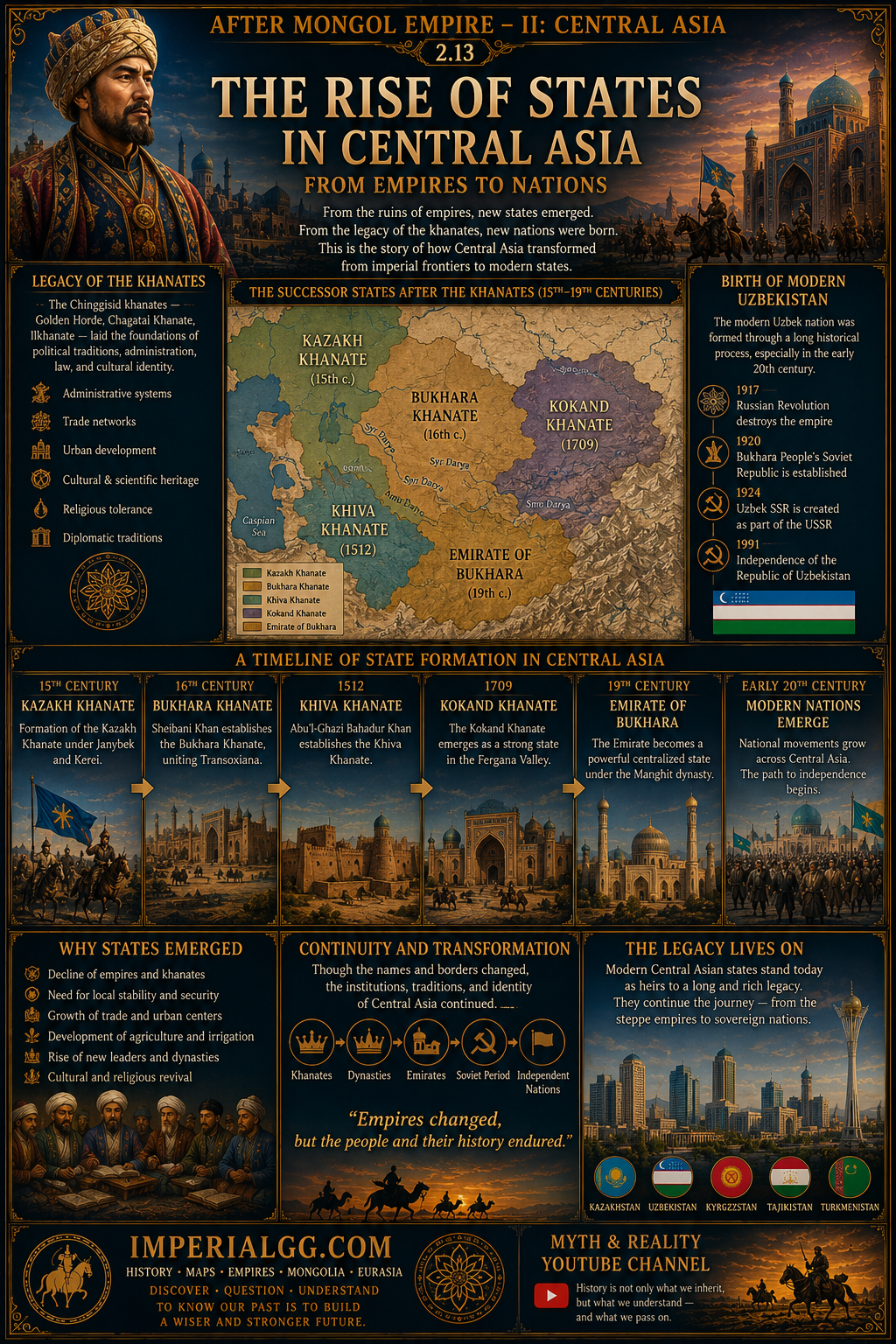
In Khiva, political conflict intensified between the khan, reformers, tribal forces, and revolutionary groups. In 1920, the old khanate was overthrown and replaced by the Khorezm People’s Soviet Republic. In the same year, the Emirate of Bukhara fell. Bolshevik forces under Mikhail Frunze attacked the emirate, while the Young Bukharan movement supported the overthrow of the existing regime. The Red Army captured Bukhara, Emir Alim Khan fled, and the centuries-old political state centered on Bukhara came to an end. The Bukhara People’s Soviet Republic was established in its place.
The events of 1920 marked one of the great historical endings in Central Asian history. Bukhara and Khiva had survived the Russian conquest of the nineteenth century by accepting protectorate status. They had survived as remnants of the old Central Asian political order while the surrounding territories were absorbed into Russian Turkestan. They did not survive the Russian Revolution.
The End of the Khanate World
The fall of Bukhara and Khiva represented more than the overthrow of two governments. It marked the final disappearance of the political order that had developed in Central Asia through centuries of post-Mongol history. The Shibanids had carried the Uzbek political name into Transoxiana. The Ashtarkhanids had continued the tradition of Jochid-Chinggisid rule in Bukhara. The Manghits had transformed the khanate into an emirate. In Khwarazm, Arabshahid and later Qungrat rulers had governed the lower Amu Darya. Kokand had emerged in the Ferghana Valley and disappeared under Russian conquest. Now the last surviving states of this historical world had fallen.
Yet their disappearance did not mean that the populations, cultures, or historical identities of Central Asia disappeared with them. Instead, the political framework through which those populations would be organized was about to be completely reconstructed. The Soviet state would draw new borders and create new national republics. Those borders would eventually become the international boundaries of modern Central Asia.
Resistance to Soviet Power
The establishment of Soviet rule was neither immediate nor uncontested. Across Central Asia, armed resistance developed against Bolshevik authority. Soviet sources commonly described this movement under the term Basmachi, although the resistance itself included diverse groups with different motivations, leaders, and political objectives. Some fought in defense of local autonomy. Others defended religious and traditional institutions. Some opposed Bolshevik economic policies and military intervention. Former officials, tribal leaders, religious figures, local commanders, and ordinary communities participated under different circumstances.
The resistance became especially strong in the Ferghana Valley and later spread into Bukhara and other regions. Emir Alim Khan, after fleeing Bukhara, continued to oppose Soviet power, while other commanders maintained armed resistance for years. From the Soviet perspective, these forces were counterrevolutionary rebels. From the perspective of many participants, they were resisting a new foreign-backed political system imposed through military force. The historical reality cannot be reduced to a single label. The conflict formed part of the wider Russian Civil War, but it was also rooted in the specific history of Central Asia and the struggle over who would control the region after the collapse of the old imperial order.
By the 1920s, Soviet military power gradually defeated most organized resistance, although armed opposition continued in some areas for years. The Bolsheviks had won the military struggle, but they now faced the much larger task of reorganizing Central Asia itself.
Before Modern Borders
Before 1924, Central Asia was not divided according to the borders of the modern republics. The political geography inherited from the Russian Empire and the revolutionary period was very different. Russian Turkestan included territories inhabited by populations who would later be classified as Uzbeks, Kazakhs, Kyrgyz, Tajiks, Turkmen, and others. The former Emirate of Bukhara contained both Persian-speaking and Turkic-speaking populations. Khorezm had its own complex mixture of settled and nomadic communities.
Cities such as Samarkand and Bukhara had deeply Persianate cultural traditions while also becoming central to the political and historical development of the Uzbek world. The Ferghana Valley contained populations whose languages, communities, trade networks, and historical relationships could not easily be divided by simple territorial lines. The Soviet leadership therefore faced an enormous question: how should Central Asia be reorganized? Their answer would fundamentally shape the future of the region.
1924: The Creation of the Uzbek Soviet Socialist Republic
In 1924, the Soviet government carried out the national-territorial delimitation of Central Asia. The existing political units were reorganized, and new republics were created around officially defined national categories. Among them was the Uzbek Soviet Socialist Republic. For the first time in history, a modern territorially defined political entity bearing the name “Uzbek” was established.
This statement requires careful interpretation. Uzbek identity had existed long before 1924, and the political name itself reached back centuries into the Jochid world. The Soviet state did not invent the word “Uzbek,” nor did it create the population from nothing. What changed in 1924 was the political form of that identity. The name that had once been associated with the political world of the Jochid steppe, then with the confederations of Abulkhair Khan, then with the followers of Muhammad Shaybani, and later with populations across the khanates of Central Asia was now attached to a territorially defined modern republic. This was a profound transformation: a political name born in the medieval steppe had become the name of a modern territorial state.
Samarkand, Bukhara, and the Question of Tajik Identity
The creation of the new republics did not resolve every question of identity and territory. One of the most complex issues concerned the Persian-speaking populations of Central Asia, particularly in historically important cities such as Samarkand and Bukhara. The new Uzbek SSR included both cities, despite their deep Persianate and Tajik cultural heritage. A Tajik Autonomous Soviet Socialist Republic was initially established within the Uzbek SSR. In 1929, it was separated and elevated to become the Tajik Soviet Socialist Republic.
The division illustrates the difficulty of drawing modern national borders across a region where populations, languages, cities, tribal networks, and cultural traditions had overlapped for centuries. Modern national histories sometimes present the borders of Central Asia as though they reflected ancient and clearly separated peoples. The historical reality was far more complicated. The Soviet borders did not create all identities from nothing, but they institutionalized particular identities territorially and politically in ways that had never previously existed. This distinction is essential for understanding the formation of modern Uzbekistan.
From Chinggisid Ulus to Soviet Republic
Looking backward from 1924 reveals an extraordinary historical journey. The name Uzbek had travelled through centuries of political transformation. Its deeper historical development was connected to the Jochid world and the political memory surrounding Özbeg Khan. It later became associated with the nomadic confederations ruled by Abulkhair Khan. Muhammad Shaybani carried the political power of those Uzbeks into Transoxiana. The Shibanids established themselves in Samarkand and Bukhara. Later dynasties governed the khanates that emerged from this political world. Russia conquered Central Asia in the nineteenth century. Revolution destroyed both the Russian Empire and the surviving khanates. Then, in 1924, the Uzbek name entered a completely new political form.
This was not a straight ethnic line from Özbeg Khan to the modern Republic of Uzbekistan. Populations had migrated, mixed, changed languages, adopted new identities, and lived under many different political systems. But neither was modern Uzbekistan created from an empty historical landscape in 1924. The Soviet republic emerged from a region carrying thousands of years of history and centuries of political transformations connected to the Mongol and post-Mongol worlds. Both truths must be held together.
A Mongolian View of the Long Transformation
From a Mongolian historical perspective, the journey from the Mongol Empire to modern Uzbekistan reveals the extraordinary ability of historical identities to transform while preserving traces of earlier political worlds. When Chinggis Khan’s armies entered Central Asia in the early thirteenth century, there was no Uzbek nation-state, no Kazakh nation-state, and no modern Russian Empire ruling the region. The political geography of Eurasia was entirely different. The Mongol Empire reorganized that geography on an enormous scale.
The Ulus of Jochi created a political world stretching across the western steppe. Over centuries, that world produced new dynasties, confederations, and identities. The Uzbek political name emerged within that history. The Shibanid descendants of Jochi carried it southward. In Transoxiana, the steppe political tradition met ancient urban civilizations and was itself transformed. Centuries later, Moscow expanded across much of the former Jochid world and eventually conquered Central Asia. Then the Russian Empire itself collapsed. Soviet power reorganized the region again and created the territorial republic from which modern Uzbekistan would eventually emerge.
This history does not mean that Uzbekistan is simply a continuation of the Mongol Empire. Such a claim would erase the ancient Iranian, Turkic, Islamic, Persianate, and local civilizations that shaped the region. But it also cannot be historically accurate to remove the Mongol and Jochid centuries from the formation of the political world from which Uzbekistan emerged. The connection is neither ownership nor a simple claim of direct descent. It is historical continuity through transformation.
The Birth of Modern Uzbekistan
The Uzbek SSR established in 1924 did not yet represent an independent nation-state. It was part of the Soviet Union and would remain so for nearly seven decades. Soviet rule would bring another enormous series of transformations: collectivization, industrialization, mass education, repression, linguistic reform, demographic change, urbanization, and the creation of modern state institutions. Those developments belong to another chapter.
For the purpose of this series, however, 1924 marks the point at which the long journey from medieval political identity to modern territorial statehood becomes clearly visible. The name Uzbek had crossed the Eurasian steppe, survived the fragmentation of the Jochid world, been carried into Transoxiana by a Chinggisid dynasty, become rooted in the ancient cities of Central Asia, and survived the fall of the Shibanids, the rise of new dynasties, the Russian conquest, and the destruction of the khanates. Now it stood on the map as the official name of a modern republic.
The political journey from the world of Chinggis Khan to modern Uzbekistan had reached a new destination, not because the people and states along that road remained unchanged, but precisely because they had continually transformed. That is the deeper history behind the name Uzbekistan.