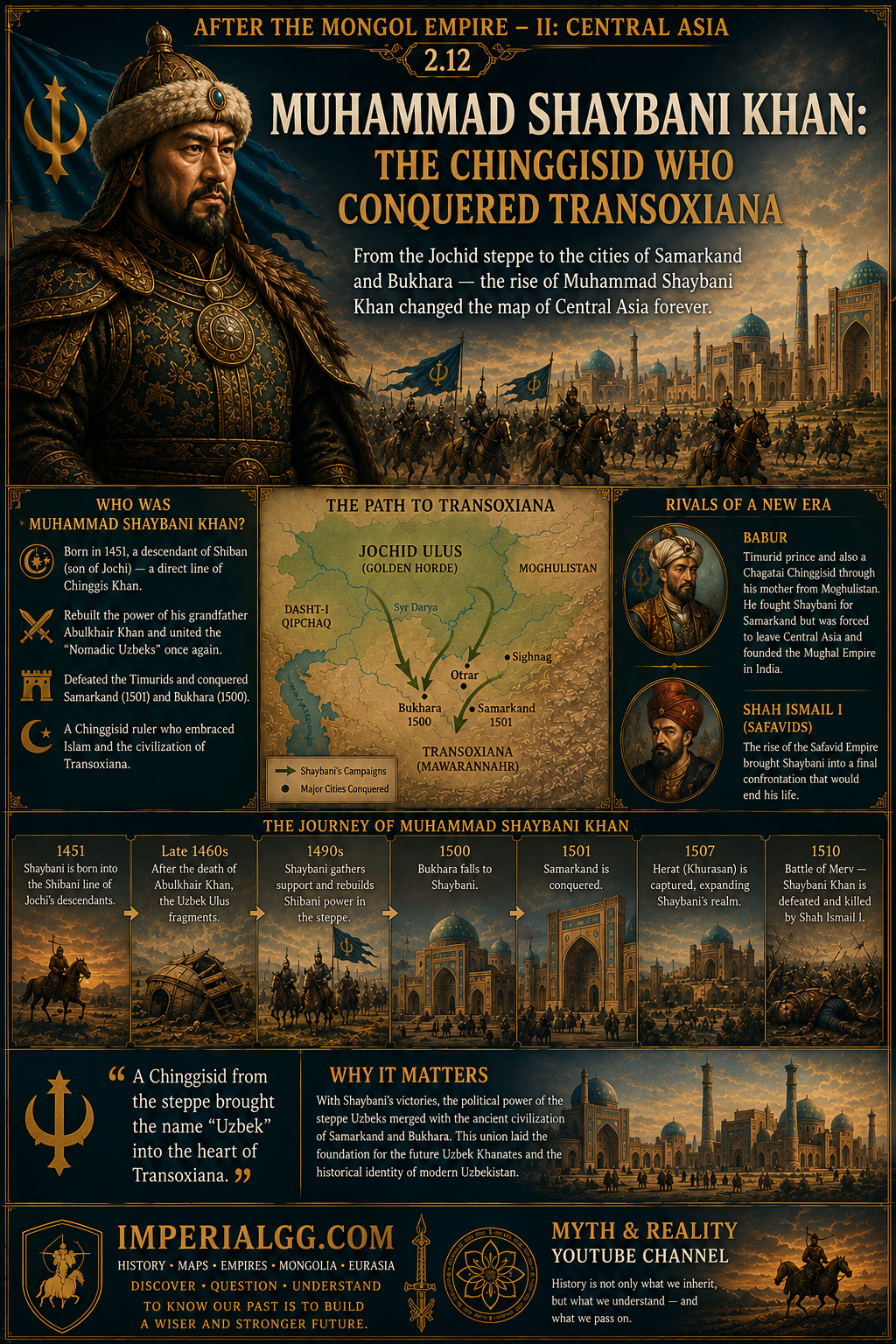
2.11 — MUHAMMAD SHAYBANI KHAN: THE CHINGGISID WHO CONQUERED TRANSOXIANA
By Altanbagana Baatar
DBA Candidate| Independent Historian
ImperialGG Historical Research Seriers
16 July 2026
At the end of the fifteenth century, Central Asia stood at another decisive turning point. The empire of Timur had fragmented among competing princes, the political world of the Jochid steppe had been transformed by the collapse of Abulkhair Khan’s confederation, and the descendants of Chinggis Khan continued to compete for power across the enormous territory between the Volga, the Syr Darya, Moghulistan, and Transoxiana. From this unstable world emerged Muhammad Shaybani Khan, the ruler who would carry the political power of the steppe Uzbeks into Samarkand and Bukhara and permanently change the history of Central Asia.
Shaybani’s rise was not the story of an entirely new people suddenly appearing from outside the region. He belonged to a political world whose foundations had been created by the Mongol Empire nearly three centuries earlier. Through Shiban, son of Jochi, Shaybani was a direct descendant of Chinggis Khan. His grandfather was Abulkhair Khan, the powerful ruler who had united much of the eastern Jochid steppe under the political confederation commonly described as the Uzbek Ulus. When Abulkhair died in 1468, however, the state he had created rapidly fragmented. Shaybani inherited neither a secure throne nor a unified kingdom. His achievement was to rebuild political power from the ruins of that collapse and eventually transform a displaced steppe dynasty into the ruling house of Transoxiana.
A Chinggisid Prince Without a Kingdom
Muhammad Shaybani was born in 1451. His father, Shah Budagh, died while Shaybani was still young, and the political world of his family became increasingly unstable after the death of Abulkhair Khan. The rise of Kerei and Janibek and the growing strength of the Kazakh Khanate drew many former followers of Abulkhair away from the Shibanid political sphere. Other tribal groups pursued their own interests, while rival Jochid princes competed for authority across the steppe.
For Shaybani, therefore, Chinggisid ancestry provided legitimacy but did not automatically provide power. Like many rulers of the post-Mongol world, he had to build his own political coalition. He moved between different centers of power, gathered followers, entered temporary alliances, fought rivals, and gradually restored the political position of his branch of the Jochid dynasty.
This period of Shaybani’s life is essential for understanding his later success. He was shaped by the political realities of the steppe, where authority depended upon mobility, military leadership, personal alliances, control of resources, and the ability to attract followers. When he later entered the urban world of Transoxiana, he brought with him not only a Chinggisid genealogy but also the political experience of a ruler who had survived decades of competition in the fragmented Jochid world.
The Steppe and the Cities of the Syr Darya
The cities along the Syr Darya formed the strategic bridge between the nomadic steppe and the settled civilization of Transoxiana. For Shaybani, control of this region was therefore crucial. Cities such as Sighnaq, Suzaq, Otrar, and Yasi were not merely isolated urban centers. They controlled trade routes, agricultural districts, wintering grounds, and the approaches leading south toward the great cities of Mawarannahr.
The struggle for these territories also brought Shaybani into direct conflict with the Kazakh khans. The division that had begun during the reign of Abulkhair continued into the next generation. The descendants and followers of Kerei and Janibek were consolidating a new political power in the steppe, while Shaybani attempted to rebuild the Shibanid political coalition.
The emerging Uzbek and Kazakh political worlds therefore developed through direct interaction and competition. They were not separated by an ancient ethnic frontier. Their rulers belonged to different branches of the same Jochid dynasty, and many of the populations involved came from overlapping tribal and political backgrounds. The distinction between them became sharper through political allegiance, migration, warfare, and the formation of separate khanates.
While this struggle continued in the north, however, a much greater opportunity was opening to the south.
The Fragmentation of the Timurid World
The empire created by Timur had once dominated much of Central Asia, Iran, and neighboring regions. After Timur’s death in 1405, his descendants continued to rule powerful states, but the unity of the empire gradually weakened. Timurid princes repeatedly fought one another for control of Samarkand, Bukhara, Herat, and other major centers.
By the late fifteenth century, Transoxiana had become politically vulnerable. The Timurid princes possessed prestigious dynastic claims and controlled wealthy cities, but their internal conflicts made sustained resistance increasingly difficult. For an ambitious ruler such as Shaybani, the fragmentation of the Timurid world created an extraordinary opportunity.
The situation also revealed a fundamental difference between Timurid and Shibanid legitimacy. Timur had created an enormous empire, but he was not himself a direct male-line descendant of Chinggis Khan. Throughout his career, he had therefore operated within a political system that still recognized the special prestige of Chinggisid descent. He married Saray Mulk Khanum, a Chinggisid princess, and used the title Gürgän, meaning royal son-in-law. Chinggisid figurehead khans also remained part of the formal political order during his reign.
Shaybani required no such arrangement. He was himself a descendant of Jochi and therefore belonged directly to the Golden Line of Chinggis Khan. When he entered the struggle for Transoxiana, he came not merely as the commander of a steppe army but as a Chinggisid khan claiming sovereignty in a region that had once belonged to the wider Mongol imperial world.
The Capture of Bukhara and Samarkand
Around the turn of the sixteenth century, Shaybani began the campaigns that would transform the political map of Central Asia. Bukhara fell under his control in 1500, followed by the struggle for Samarkand. The conquest of these cities represented far more than a military victory. For generations, Samarkand had been the political and symbolic center of Timurid power. Its loss demonstrated that the balance of power in Central Asia had fundamentally changed.
The Uzbek forces entering Transoxiana came from the political world of the Dasht-i Qipchaq, but they were now taking control of one of Eurasia’s oldest urban civilizations. Samarkand and Bukhara possessed sophisticated traditions of administration, Islamic scholarship, architecture, commerce, crafts, and agriculture. The new rulers could not govern these territories through steppe institutions alone. The Shibanid state therefore began a process of political adaptation in which Chinggisid dynastic authority and steppe military traditions became integrated with the established Persianate and Islamic institutions of Transoxiana.
This transformation was one of the defining moments in the formation of the later Uzbek political world. The Uzbek name, previously associated primarily with the Jochid steppe confederations, was now becoming attached to the ruling power of Samarkand and Bukhara.
But Shaybani’s conquest was not uncontested.
Shaybani and Babur: Two Heirs of the Mongol Imperial World
Among Shaybani’s most determined opponents was Zahir al-Din Muhammad Babur. Their struggle is often presented simply as a conflict between the Uzbeks and the Timurids. This description is not incorrect, but it hides the deeper historical structure behind the confrontation.
Shaybani was a direct descendant of Jochi and therefore of Chinggis Khan. Babur was a direct descendant of Timur through his father, but through his mother, Qutlugh Nigar Khanum, he also belonged to the Chagatai Chinggisid dynasty of Moghulistan.
The two men therefore represented different branches of the political world that had emerged from the Mongol imperial age. Shaybani carried the Jochid and Shibanid tradition from the northern steppe. Babur inherited the Timurid political tradition of Transoxiana and, through his maternal ancestry, the Chagatai legacy of Moghulistan.
Their struggle for Samarkand was therefore not a simple confrontation between a foreign invader and a local ruler. It was a contest among competing heirs of a political order whose roots stretched back to the empire of Chinggis Khan.
Babur briefly recovered Samarkand but could not hold it. Shaybani’s forces eventually established their dominance, forcing Babur to abandon his ambitions in Transoxiana. Babur later moved south through Afghanistan and eventually founded the Mughal Empire in India. Thus, the rise of Shaybani in Central Asia indirectly contributed to one of the greatest political transformations in South Asian history.
One Chinggisid-derived political struggle in Central Asia helped redirect a Timurid prince toward India, where another empire carrying the name “Mughal”—a form derived from “Mongol”—would emerge.
The End of Timurid Rule in Transoxiana
By the first years of the sixteenth century, Shaybani had effectively ended Timurid political dominance in most of Transoxiana. His forces expanded across the region, and the Shibanids became the new ruling dynasty of the lands that would later form the political heart of the Uzbek khanates.
This was not simply a dynastic replacement. It represented a major geographical shift in the political center of the Uzbek world. Under Abulkhair, the Uzbek Ulus had been centered primarily in the steppe. Under Shaybani, the political center moved toward the cities of Transoxiana.
The consequences were profound. The steppe elites who entered the region became rulers of settled populations with long-established traditions of government and culture. Over time, political integration, intermarriage, religious institutions, urban life, and linguistic change transformed both the ruling groups and the societies they governed.
The Uzbeks who entered Transoxiana did not remain unchanged steppe conquerors. Nor did the existing populations simply disappear. A long process of interaction followed, contributing to the development of the later Uzbek population and identity.
Shaybani Khan as a Ruler, Not Merely a Conqueror
Shaybani is often remembered primarily for his military campaigns, but his historical importance extends beyond conquest. He sought to establish a durable political order and presented himself as a legitimate Muslim ruler as well as a Chinggisid sovereign.
By Shaybani’s time, the political traditions inherited from the Mongol Empire had already undergone centuries of transformation. Islam had become central to the political identity of most Jochid and Central Asian ruling dynasties. Chinggisid legitimacy and Islamic kingship were no longer necessarily competing systems. They could exist together.
Shaybani represented precisely this synthesis. His authority rested upon his descent from Chinggis Khan, but he ruled within the Islamic civilization of Central Asia. He patronized religious institutions and participated in the literary culture of his age. He also wrote poetry under the pen name Shibani.
This combination is important because it challenges the old image of the Mongol political legacy as something separate from Islamic Central Asia. By the sixteenth century, descendants of the Mongol imperial dynasties were themselves deeply embedded within Islamic civilization.
The Mongol legacy had not disappeared. It had transformed.
From Samarkand Toward Khurasan
After consolidating much of Transoxiana, Shaybani continued expanding southward. The weakening of the Timurids opened the way toward Khurasan, including the great city of Herat. In 1507, Shaybani captured Herat, one of the most important cultural and political centers of the Timurid world.
At this point, his power extended across a vast region. The Shibanid state now controlled much of Transoxiana and Khurasan and had become one of the principal powers of Central Asia.
But Shaybani’s expansion brought him into confrontation with another rapidly rising empire: Safavid Iran.
Shah Ismail I had established the Safavid state at the beginning of the sixteenth century and was expanding his authority across Iran. The frontier between the Shibanid and Safavid spheres became both a geopolitical and religious boundary. The Shibanids were Sunni rulers, while the Safavid state promoted Twelver Shi’ism as a central foundation of its political identity.
The confrontation between Shaybani and Shah Ismail therefore emerged from a combination of territorial rivalry, imperial ambition, and the changing religious politics of the early modern Islamic world.
The Battle of Merv and the Death of Shaybani
In 1510, the confrontation reached its decisive moment near Merv. Shaybani’s forces faced the army of Shah Ismail I, and the Shibanid ruler suffered a catastrophic defeat. Shaybani was killed in the battle.
His death became famous partly because of the treatment reportedly given to his body afterward. Later accounts describe Shah Ismail using Shaybani’s skull as a drinking vessel, although such stories belong to a broader tradition of political symbolism and should be approached critically when reconstructing precise historical details.
What is certain is that Shaybani’s death ended his personal career at the height of a major regional struggle. Yet it did not destroy the political order he had created.
This is perhaps the clearest measure of his historical importance.
Abulkhair’s confederation had largely collapsed after his death. Shaybani’s conquest, by contrast, had established the Shibanid dynasty within the urban and agricultural heartland of Central Asia. His relatives and successors retained power in Transoxiana, and the Uzbek political presence in the region became permanent.
The ruler died, but the political transformation survived him.
The Uzbek Name Takes Root in Transoxiana
Before Shaybani, the political name “Uzbek” had been primarily connected with the steppe world of the Jochid Ulus. After the Shibanid conquest, the name became increasingly connected with the political order of Transoxiana.
This did not happen overnight. The population of the region remained extraordinarily diverse. Persian-speaking communities, established Turkic-speaking populations, urban inhabitants, agricultural communities, tribal groups, religious scholars, merchants, and newly arrived steppe populations all participated in the historical development of the region.
Over centuries, these populations interacted and identities changed. The political name carried by the conquering confederations gradually acquired broader territorial and social meanings. The later Uzbek identity was therefore not simply imported intact from the steppe. It developed through the meeting of the steppe and the city.
The history of modern Uzbekistan cannot be separated from either side of this encounter.
Without Samarkand, Bukhara, Khwarazm, and the ancient civilizations of Central Asia, there would be no Uzbekistan as we know it today. But without the Jochid steppe, Abulkhair Khan, the Shibanid dynasty, and Muhammad Shaybani Khan, the political history of the Uzbek name would also be impossible to explain.
A Mongolian View of Shaybani’s Rise
From a Mongolian historical perspective, Shaybani’s story demonstrates once again that the Mongol Empire did not simply disappear when its unified political structure fragmented. Its descendants continued to shape Eurasian history for centuries.
By the time Shaybani entered Samarkand, nearly three hundred years had passed since Chinggis Khan created the Mongol Empire. Languages had changed. Religions had changed. New political identities had emerged. The descendants of the imperial armies had mixed with numerous populations across Eurasia.
Yet the descendants of Chinggis Khan still occupied the thrones of the steppe. Chinggisid ancestry still provided the highest form of dynastic legitimacy across much of Central Eurasia. Jochid, Chagatai, and other post-Mongol political traditions continued to determine who could claim the title of khan.
Shaybani was therefore not simply a distant descendant carrying an irrelevant genealogy. His Chinggisid identity was part of the political reality of his own age. The same was true of the Kazakh khans who opposed his dynasty and the rulers of Moghulistan who competed across Central Asia.
The later national histories of Uzbekistan, Kazakhstan, Kyrgyzstan, Mongolia, and other modern states often separate these interconnected histories into different national narratives. Medieval Eurasia did not recognize those boundaries.
Shaybani’s world was still, in many fundamental ways, a post-Mongol world.
Why Muhammad Shaybani Khan Matters
Muhammad Shaybani Khan stands at the meeting point of several major historical transformations. He was a descendant of Chinggis Khan who emerged from the fragmented Jochid steppe. He rebuilt the political power lost after the collapse of Abulkhair Khan’s confederation. He defeated the divided Timurids and carried the Uzbek political name into the great cities of Transoxiana. His victories forced Babur away from Central Asia, indirectly contributing to the foundation of the Mughal Empire in India. His expansion into Khurasan brought the Shibanids into direct confrontation with Safavid Iran, placing the new Uzbek state within the wider geopolitical struggles of the early modern Islamic world.
Most importantly for the history of Uzbekistan, Shaybani connected two historical worlds that had previously followed different paths: the Uzbek political confederations of the Jochid steppe and the ancient urban civilization of Transoxiana.
After him, the history of the Uzbeks could no longer be told only as a history of the northern steppe. Samarkand and Bukhara had become part of their political world.
At the same time, the history of Transoxiana could no longer be told only through the succession of ancient Iranian, Turkic, Islamic, Mongol, and Timurid civilizations that had ruled before. A new Chinggisid dynasty had arrived from the steppe and established itself permanently within the region.
This was the historical achievement of Muhammad Shaybani Khan. He did not create the Uzbek people in a single moment, nor did he create the ancient civilization of Uzbekistan. What he did was bring the political power and name of the steppe Uzbeks into the heart of Transoxiana and establish the foundations of a new political era.
The empire of Chinggis Khan had disappeared as a unified state centuries earlier. Yet in the opening years of the sixteenth century, one of his descendants rode from the Jochid steppe into Samarkand and changed the history of Central Asia once again.