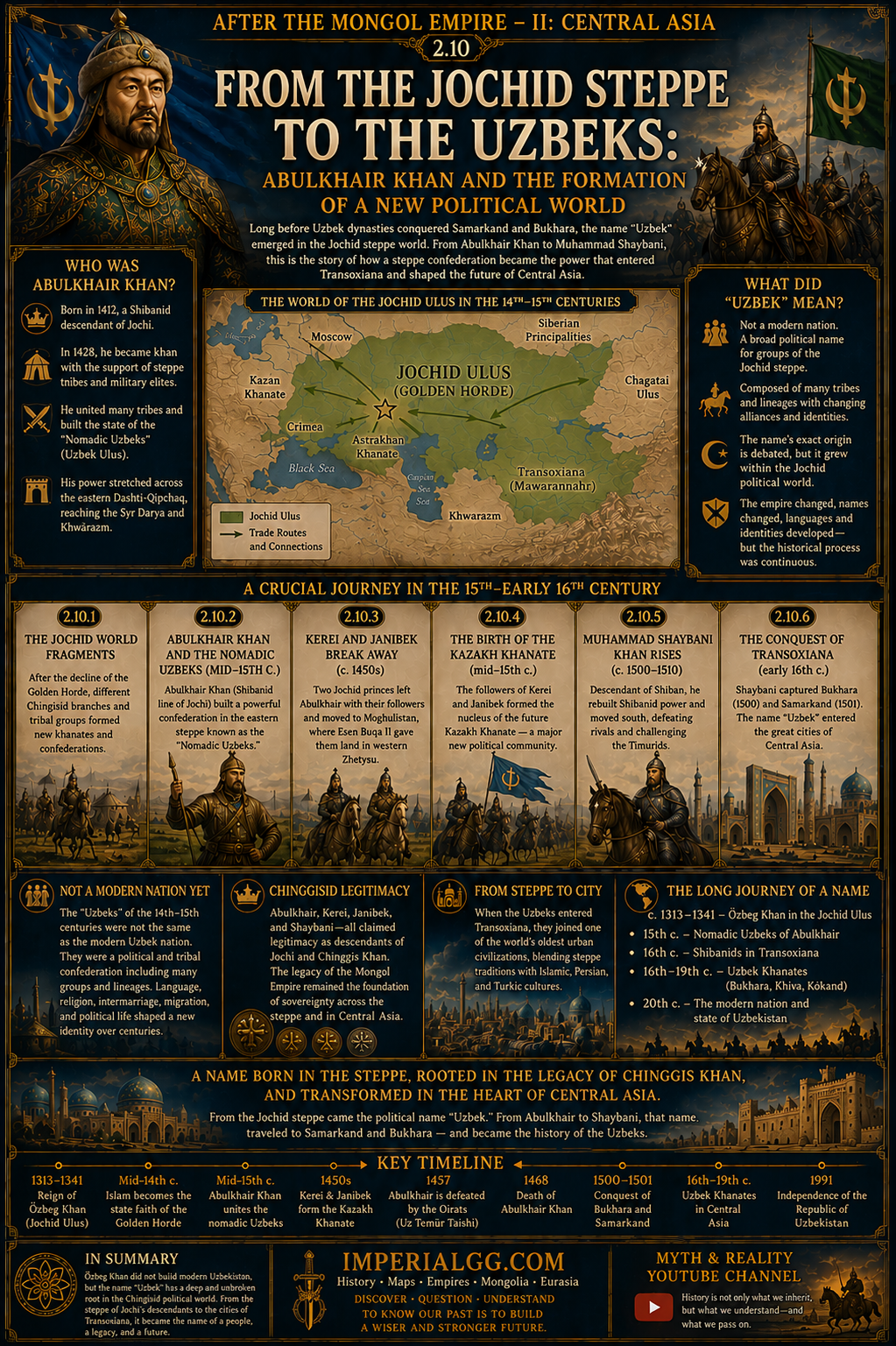
2.10 — FROM THE JOCHID STEPPE TO THE UZBEKS: ABULKHAIR KHAN AND THE FORMATION OF A NEW POLITICAL WORLD
The history of the Uzbeks cannot be understood only within the borders of modern Uzbekistan. Long before Uzbek dynasties conquered Samarkand and Bukhara, the political community from which they emerged had developed far to the north, across the vast steppe world of the Jochid Ulus. This is one of the most important connections in the history of Central Asia. The great cities of Transoxiana had ancient histories stretching back thousands of years, but the political name “Uzbek” entered the region through a different historical path. It came from the post-Mongol steppe world, through populations and dynasties whose political structures had developed within the territories ruled by the descendants of Jochi, the eldest son of Chinggis Khan.
By the fifteenth century, the unified power of the Golden Horde had weakened, but the Jochid world had not disappeared. Across the Dasht-i Qipchaq, Crimea, the Volga region, Khwarazm, western Siberia, and the steppe east of the Ural Mountains, competing descendants of Jochi continued to claim political authority. New khanates and confederations emerged from the fragmentation of the older imperial structure. Among these new political formations, one became particularly important for the future history of Uzbekistan: the state created by Abulkhair Khan.
The Jochid World After the Golden Horde
The Golden Horde is often described as though it simply collapsed and vanished. The historical reality was considerably more complex. Its central authority fragmented, but its dynasties, political institutions, military traditions, trade networks, and populations continued to shape Eurasia for centuries. The descendants of Jochi remained politically active across an enormous territory. Different branches of the dynasty competed for control of the steppe, while powerful tribal and military elites supported rival Chinggisid princes. The Crimean Khanate, the Kazan Khanate, the Astrakhan Khanate, the Great Horde, the Nogai Horde, the Siberian Khanate, and other political formations all emerged from this broader post-Jochid world.
Farther east, another branch of Jochi’s descendants was becoming increasingly powerful. This was the line descended from Shiban, one of Jochi’s sons. From this Chinggisid lineage would emerge Abulkhair Khan and, later, Muhammad Shaybani Khan. The history of the Uzbeks who eventually entered Transoxiana therefore begins not primarily in the cities of Samarkand and Bukhara, but in the political geography of the Jochid steppe.
Who Was Abulkhair Khan?
Abulkhair Khan was born in 1412 and belonged to the Shibanid branch of the descendants of Jochi. In 1428, while still a young man, he was elevated as khan by a coalition of steppe groups and military elites. His rise occurred during a period of intense political fragmentation. The eastern territories of the former Jochid Ulus contained numerous competing rulers, tribal confederations, and mobile political communities. Authority depended not only upon dynastic legitimacy but also upon the ability to maintain alliances, distribute resources, command military forces, and protect access to pastures and trade routes.
Abulkhair possessed the most important source of formal legitimacy in the post-Mongol steppe: he was a Chinggisid. But blood alone could not create a powerful state. He had to build a political coalition capable of defeating rivals and bringing different groups under his authority. Over several decades, Abulkhair succeeded in becoming one of the most powerful rulers of the eastern Dasht-i Qipchaq. The political confederation under his authority is often described in historical scholarship as the state of the “Nomadic Uzbeks,” or the Uzbek Ulus. This terminology, however, requires careful explanation.
What Did “Uzbek” Mean in the Fifteenth Century?
The word “Uzbek” in the fifteenth century did not have exactly the same meaning that the modern national name “Uzbek” has today. The populations gathered under Abulkhair were not a single modern nation with a standardized language, fixed borders, and a unified national identity. They were composed of numerous tribes and lineages whose histories stretched across the Mongol and pre-Mongol steppe worlds. Their political affiliations could change, tribal groups could move between competing rulers, and dynastic loyalty, military alliance, geography, and access to pasture could all influence political identity.
The term “Uzbek” increasingly functioned as a broad political designation associated with sections of the Jochid steppe population. Its precise origin and early development remain subjects of historical discussion, and it should not simply be assumed that every later use of the name derived directly and exclusively from Özbeg Khan of the Golden Horde. Nevertheless, the rise of the name occurred within the political world created by the Jochid Ulus. This distinction is essential. The Uzbeks did not suddenly appear as an entirely new people after the Mongol Empire. Their political formation occurred through the transformation of populations that had lived for generations within the Jochid imperial world. The empire changed, political names changed, and languages and identities developed, but the historical process was continuous.
Abulkhair’s Uzbek Ulus
Abulkhair Khan spent much of his reign attempting to consolidate the eastern Jochid steppe under his authority. His political sphere extended across a large and shifting territory, including regions associated with the Tobol, the Tura, the central steppe, the Syr Darya frontier, and eventually parts of Khwarazm. Like other steppe empires, Abulkhair’s state did not possess fixed borders in the modern sense. Political power depended upon control over people, routes, strategic cities, winter and summer pastures, and alliances with tribal elites.
The Syr Darya region was particularly important. Cities along the river stood at the meeting point between the nomadic steppe and the settled agricultural world of Central Asia. Control of these centers provided access to trade, taxation, supplies, and strategic routes toward Transoxiana. Abulkhair therefore did not rule an isolated northern steppe confederation. His state stood directly beside the great political struggles of Central Asia. To the south lay the Timurid world, to the east lay Moghulistan, and to the west were other Jochid and steppe powers. Between them stood a constantly changing political frontier in which alliances and rivalries could reshape the region within a generation.
The Timurid Connection
During the fifteenth century, the Timurid Empire itself was becoming increasingly divided among competing descendants of Timur. The magnificent imperial structure created by Timur had not disappeared, but succession struggles weakened political unity, and Abulkhair became involved in these conflicts. This is another example of why the history of Central Asia cannot be divided into completely separate “Mongol,” “Uzbek,” and “Timurid” histories. These political worlds were deeply interconnected. The Timurids themselves had emerged from the western Chagatai political environment, Abulkhair belonged to the Jochid line, and Moghulistan preserved the eastern Chagatai dynasty. All of them competed across territories once incorporated into the wider Mongol imperial system.
Abulkhair’s involvement in Timurid politics increased his influence toward the south, but his growing power also brought his confederation into contact with other forces moving across the Eurasian steppe. One of these encounters would have enormous consequences.
The Oirat Defeat and the Crisis of Abulkhair’s Authority
In 1457, Abulkhair Khan suffered a major defeat at the hands of the Oirats led by Uz Temür Taishi. The battle demonstrated that the political balance of Inner Eurasia remained much broader than the struggles of the Jochid and Timurid worlds alone. The Oirats had emerged as a major power from the Mongolian political world after the fragmentation of the Yuan and the struggles between eastern and western Mongol groups. Their military presence reached far into Central Asia, and their campaigns affected the politics of Moghulistan and the Jochid steppe.
Abulkhair’s defeat damaged his prestige among parts of his political coalition. In a steppe political system, military success was not merely a matter of battlefield reputation. A khan was expected to protect his followers, secure resources, maintain alliances, and demonstrate that his leadership remained effective. When these expectations failed, political loyalty could fracture. The consequences of this crisis became visible in the movement of two other Jochid princes: Kerei and Janibek.
Kerei and Janibek Break Away
Kerei and Janibek were descendants of Jochi through a different dynastic line from Abulkhair. They belonged to the same broad Chinggisid political universe but represented a competing source of authority. Together with groups of followers, they separated from Abulkhair’s political sphere and migrated toward Moghulistan. Esen Buqa II, the Chagatai khan of Moghulistan, accepted them and allowed them to settle in western Zhetysu, in territories associated with the Chu and Talas valleys.
This movement was not simply the migration of one ethnic nation away from another. It was a political division within the broader post-Jochid world. The followers of Kerei and Janibek gradually became associated with the political formation that developed into the Kazakh Khanate, while those who remained within the political sphere associated with Abulkhair and his successors continued along another historical path. From this division emerged one of the most important transformations in the history of the Central Asian steppe, and the later distinction between Kazakh and Uzbek political identities developed partly from this fifteenth-century separation.
The Birth of the Kazakh Political Community
The emergence of the Kazakh Khanate demonstrates how political identity could develop through dynastic conflict and migration. Kerei and Janibek did not leave the historical world created by the Mongol Empire. They were themselves descendants of Jochi, and their authority rested upon the same Chinggisid principle of legitimacy that supported Abulkhair. Their refuge was provided by another Chinggisid ruler, Esen Buqa II of Moghulistan.
Thus, at this crucial historical moment, three different political branches of the Mongol imperial legacy intersected. Abulkhair represented the Shibanid branch of the Jochids, Kerei and Janibek represented another Jochid line, and Esen Buqa represented the Chagatai dynasty. The political division that contributed to the emergence of the Kazakh Khanate therefore occurred entirely within a world still structured by the descendants of Chinggis Khan.
For a Mongolian observer, this is an important point. Modern national borders can make these histories appear disconnected, but in the fifteenth century they were parts of one enormous and interconnected post-Mongol political landscape.
The Death of Abulkhair and the Fragmentation of His Confederation
Abulkhair Khan died in 1468 while preparing a campaign against Kerei and Janibek and their followers. His death created a major political crisis. The confederation he had built depended heavily upon his personal authority. Without him, rival groups competed for power, many followers shifted their allegiance, and the growing Kazakh political formation attracted additional populations from the steppe.
Abulkhair’s state fragmented, yet this was not the end of the Shibanid story. The political project that Abulkhair had created would eventually be revived by one of his most important descendants, his grandson Muhammad Shaybani Khan. With Muhammad Shaybani, the history of the steppe Uzbeks would move decisively southward.
Muhammad Shaybani and the Return of the Shibanids
Muhammad Shaybani was born into a political world transformed by the collapse of his grandfather’s confederation. He did not inherit a stable kingdom. Instead, he had to rebuild political power through warfare, alliances, mobility, and the continued prestige of his Chinggisid ancestry. Over time, Shaybani gathered supporters and reestablished Shibanid power, while his rise coincided with the continuing fragmentation of the Timurid world.
By the end of the fifteenth century, the descendants of Timur were divided by dynastic rivalry. Samarkand, Bukhara, and other major cities repeatedly changed hands, creating an opportunity for the Shibanids. Around the turn of the sixteenth century, Muhammad Shaybani moved into Transoxiana. Bukhara and Samarkand fell under his control, although the struggle for the region continued. Among his most famous opponents was Babur, the Timurid prince who would eventually leave Central Asia and establish the Mughal Empire in India.
The confrontation between Shaybani and Babur was therefore another struggle between heirs of the post-Mongol political world. Shaybani was a direct descendant of Jochi and Chinggis Khan, while Babur descended from Timur through his father and from the Chagatai khans of Moghulistan through his mother. The political map was changing, but the genealogical and institutional legacy of the Mongol Empire remained everywhere.
When the Uzbeks Entered Transoxiana
The Shibanid conquest of Transoxiana represents a major turning point in the history of Uzbekistan. Political groups associated with the Uzbek confederations of the Dasht-i Qipchaq moved into a region with an ancient and highly developed urban civilization. They did not enter an empty land. Samarkand and Bukhara had existed for centuries before the Mongol conquests. Persian-speaking and Turkic-speaking populations lived across the region, while Islamic scholarship, trade, agriculture, architecture, and urban culture had deep roots.
The arriving Uzbek political groups therefore entered a complex society and gradually became part of it. Over generations, the political name “Uzbek” expanded and changed. It became associated not only with the steppe confederations that had entered Transoxiana but increasingly with the broader population and political identity of the region. This was a long historical process, not a single event.
The modern Uzbek people emerged from multiple historical layers: ancient Central Asian populations, Iranian-speaking communities, Turkic migrations, Islamic civilization, the Mongol imperial transformation, the Jochid steppe, the Shibanid conquests, and centuries of later cultural and political development. No single origin can explain the whole, but the Jochid and Mongol component cannot be removed from the story without fundamentally distorting it.
From the Mongol Empire to the Uzbek Khanates
After Muhammad Shaybani established Shibanid power in Transoxiana, the political center of the Uzbek world increasingly shifted southward from the steppe into the great cities of Central Asia. The political elite that had emerged from the Jochid steppe now ruled one of the oldest urban civilizations in Eurasia. Steppe military traditions interacted with Persian bureaucratic culture, Islamic scholarship, Turkic literary traditions, and the commercial networks of Samarkand and Bukhara.
The result was not simply the replacement of one population by another. It was the creation of a new political synthesis. The Shibanids ruled as Chinggisids, and their legitimacy came from their descent from Jochi and ultimately from Chinggis Khan. Yet the civilization they governed was deeply Islamic and Central Asian. Persian remained enormously important in administration and literature, while Turkic languages continued to develop and expand. This combination would shape the later history of the Khanate of Bukhara and other Uzbek political formations. The Mongol imperial legacy had therefore entered another stage of transformation.
Özbeg Khan and the Name “Uzbek”
The relationship between the ethnonym “Uzbek” and Özbeg Khan of the Golden Horde deserves special caution. Özbeg Khan, who ruled the Jochid Ulus from 1313 to 1341, was one of the most powerful rulers in the history of the Golden Horde. Under his reign, Islam became firmly established at the center of Jochid political authority, and the state reached a period of considerable power. Because of the similarity between the ruler’s name and the later ethnonym, a long tradition has connected the name “Uzbek” directly with Özbeg Khan.
The connection is historically plausible and important, but the development of ethnonyms is rarely simple. Medieval sources used political and collective names in changing ways, and scholars have debated precisely how and when “Uzbek” became established as a designation for populations of the Jochid steppe. What can be stated more securely is that the Uzbek political identity that emerged in the late medieval period developed within the world of the Jochid Ulus. Whether the name itself should be traced directly to Özbeg Khan in a simple one-to-one line is a separate question. The historical connection between the Uzbeks and the Jochid political world, however, is beyond serious doubt.
The Uzbek and Kazakh Paths
The history of Abulkhair Khan also helps explain why Uzbek and Kazakh histories are so closely connected. Both political communities emerged from overlapping populations of the eastern Jochid steppe. Both were led by Chinggisid dynasties, and their separation developed through political competition rather than through an ancient and permanent ethnic boundary.
After the death of Abulkhair, the followers of Kerei and Janibek strengthened the Kazakh Khanate. The Shibanid line eventually rebuilt its power and moved toward Transoxiana under Muhammad Shaybani. One branch increasingly became associated with the steppe world of the Kazakh khanates, while the other established itself in the cities and agricultural territories of Transoxiana and became central to the political history of the Uzbeks. Their later histories diverged, but their medieval roots remained deeply intertwined.
Why This History Matters
If we begin the history of Uzbekistan only with the territory of modern Uzbekistan, we miss one of the most important parts of the story. The political ancestors of the Uzbek khanates came from the Jochid steppe. Their rulers were descendants of Chinggis Khan. Their political institutions developed within the world created by the Mongol Empire. Their rise was connected with the fragmentation of the Golden Horde, the struggles of the Shibanid dynasty, the crisis of Abulkhair’s confederation, the emergence of the Kazakh Khanate, and the eventual conquest of Timurid Transoxiana.
This does not mean that the entire history of the Uzbek people can be reduced to Mongol ancestry. It cannot. The population of modern Uzbekistan emerged through the interaction of many peoples and civilizations over thousands of years. But the political formation of the late medieval Uzbeks belongs directly to the history of the Mongol imperial world.
From the Mongolian Plateau, the empire of Chinggis Khan expanded across Eurasia. The descendants of Jochi ruled the western steppe, and although their political world fragmented, it survived. From one branch came Abulkhair Khan. From the crisis of his state emerged both the growing Kazakh political community and the Shibanid line that would eventually conquer Transoxiana. Muhammad Shaybani then carried the political name and power of the steppe Uzbeks into Samarkand and Bukhara.
What had begun as part of the Jochid world became part of the history of Uzbekistan. The Mongol Empire was no longer politically united, but its historical descendants were still creating new states, new identities, and a new map of Central Asia.