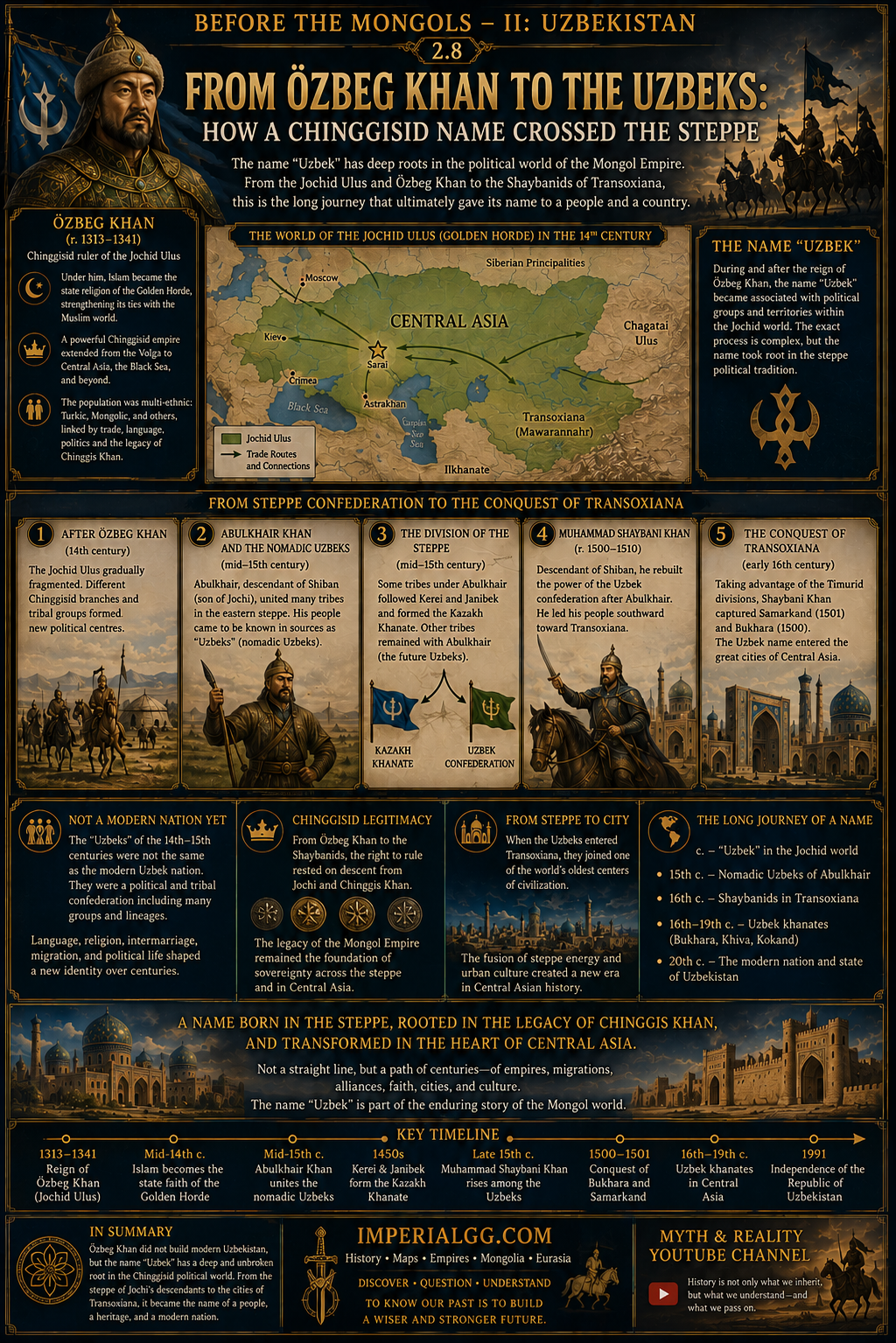
2.8 — From Özbeg Khan to the Uzbeks: How a Chinggisid Name Crossed the Steppe
By Altanbagana Baatar
DBA Candidate| Independent Historian
ImperialGG Historical Research Seriers
16 July 2026
The name “Uzbekistan” carries within it a history that reaches far beyond the borders of the modern state. To understand where the name “Uzbek” came from, we must travel north from Samarkand and Bukhara, beyond Transoxiana, into the vast steppe world of the Jochid Ulus.
This is one of the most important connections between the history of the Mongol Empire and the later history of Central Asia.
Özbeg Khan, who ruled the Jochid Ulus from 1313 to 1341, was a descendant of Jochi, the eldest son of Chinggis Khan. During his long reign, the Jochid state became one of the most powerful political and commercial centers of Eurasia. Its territories extended across the western Eurasian steppe, connecting the Black Sea, the Volga region, the northern routes toward Rus’, Central Asia, and the wider Islamic world.
Özbeg Khan did not establish the modern state of Uzbekistan, and the people who today identify as Uzbeks did not suddenly emerge as a fully formed modern nation during his reign. The historical development was far more complex. Nevertheless, the similarity between the ruler’s name and the later ethnonym “Uzbek” is not accidental. Medieval sources increasingly associated forms of the name Uzbek with political communities belonging to the Jochid steppe world, although historians continue to discuss the precise process by which the ruler’s name, political affiliation, and broader group identity became connected.
The political importance of Özbeg Khan’s reign provides essential context for this development. Under him, Islam became firmly established at the highest level of the Jochid state, although Muslim communities had already existed throughout its territories long before his reign. The ruling dynasty remained Chinggisid, while the population of the ulus included many different Turkic and Mongolic peoples, as well as communities connected with the cities of the Volga region, Crimea, Khwarazm, and other parts of Eurasia.
Over generations, the Mongol ruling houses and military populations of the western ulus became increasingly integrated with the much larger Turkic-speaking populations of the steppe. Language, religion, marriage, migration, and political association gradually transformed the social landscape. Yet this process did not erase the political legacy of the Mongol Empire. Chinggisid descent remained the principal foundation of legitimate khanly authority across much of the steppe for centuries.
The term “Uzbek” therefore emerged within a political world that was still fundamentally shaped by the descendants of Chinggis Khan.
After the fragmentation of centralized authority in the Jochid Ulus during the later fourteenth and fifteenth centuries, several competing political centers emerged across the western and central steppe. The territories once governed within a broader Jochid imperial framework became divided among different Chinggisid dynasties and confederations. Yet these successor states continued to share political traditions inherited from the Mongol imperial period.
One of the most important developments took place in the eastern territories of the Jochid world.
During the fifteenth century, Abulkhair Khan, a descendant of Shiban, another son of Jochi, established a powerful steppe confederation that brought together numerous tribes across the region often described in historical sources as the eastern Dasht-i Qipchaq. The population under his authority became widely associated with the political designation “Uzbeks” or “nomadic Uzbeks.”
This was still not identical to the modern Uzbek nation.
The confederation included diverse tribal and political groups whose identities were shaped by lineage, clan, political allegiance, territory, and religion. Some groups that initially belonged to this political world later followed different historical paths. Most importantly, the followers of Kerei and Janibek separated from Abulkhair’s political sphere and became associated with the formation of the Kazakh Khanate.
This division demonstrates why modern national borders cannot simply be projected backward onto the medieval steppe. The histories of the Uzbeks, Kazakhs, and other Central Asian peoples were deeply interconnected. They emerged from overlapping political, cultural, and genealogical worlds rather than from isolated national territories.
The decisive movement toward Transoxiana came at the end of the fifteenth and beginning of the sixteenth centuries.
Muhammad Shaybani Khan, a Chinggisid descendant of Shiban and therefore a member of the wider Jochid royal house, rebuilt the political power of the Uzbek confederation after the death of Abulkhair Khan. Taking advantage of the political fragmentation of the Timurid world, Shaybani Khan led his forces southward into the great cities of Central Asia.
Around the turn of the sixteenth century, Samarkand and Bukhara became central prizes in the struggle between the Shaybanids and the remaining Timurid princes. By the first decade of the sixteenth century, Shaybani Khan had established control over much of Transoxiana.
This represented one of the great historical movements of Central Asian history.
The name “Uzbek,” which had become associated with political communities of the Jochid steppe, now moved southward with the Shaybanid conquest into the urban and agricultural world of Transoxiana. The conquerors did not arrive in an empty land. They entered one of the oldest centers of civilization in Eurasia, inhabited by populations whose histories extended through the Sogdian, Iranian, Turkic, Islamic, Khwarezmian, Chagatai, Mongol, and Timurid periods.
The later Uzbek identity developed through the interaction of these historical layers.
The incoming Uzbek tribal groups became part of the existing social and cultural world of Central Asia. Over time, political identities, Turkic languages, Islamic traditions, urban civilization, tribal affiliations, and the heritage of earlier populations combined in complex ways. The result cannot be reduced to the simple migration of one people replacing another.
The political dynasty that brought the Uzbek name into Transoxiana was itself Chinggisid.
This fact is particularly significant when viewed from the perspective of Mongolian history. The Shaybanids did not claim legitimacy by rejecting the Mongol imperial past. Their right to rule as khans rested precisely upon their descent from Jochi and Chinggis Khan. In this sense, the arrival of the Uzbek political name in Transoxiana represented another stage in the long transformation of the political world created by the Mongol Empire.
There is also an important historical symmetry in this development.
The Timurids had ruled Central Asia while recognizing the special dynastic prestige of the Chinggisid house, because Timur himself was not a Chinggisid. The Shaybanids who displaced them were direct descendants of Chinggis Khan through Jochi and Shiban. Thus, at the beginning of the sixteenth century, political authority in Transoxiana returned directly to a Chinggisid dynasty.
The history did not end there. The Uzbek khanates that developed in Central Asia underwent their own political transformations, while the meaning of the name “Uzbek” continued to evolve. Bukhara, Khiva, and later Kokand became major centers of political and cultural life. The populations of the region continued to develop through centuries of interaction, long before the establishment of the modern Republic of Uzbekistan.
The modern country therefore should not be described simply as the state founded by Özbeg Khan or as a direct continuation of his fourteenth-century realm. Such a claim would collapse several centuries of complicated history into a single line.
But the opposite extreme is equally misleading.
The name “Uzbek” does have deep roots in the political world created by the Mongol Empire. Its historical journey passes through the Jochid Ulus, the reign and memory of Özbeg Khan, the nomadic Uzbek confederations of the eastern steppe, the Chinggisid descendants of Shiban, and the conquest of Transoxiana by Muhammad Shaybani Khan.
From the Mongolian steppe, the empire of Chinggis Khan had expanded across Eurasia. Generations later, the descendants of that imperial world had become deeply integrated into the societies they ruled. Some adopted Turkic languages. Many embraced Islam. New political identities emerged. New peoples and states took shape.
But the historical connection did not disappear simply because the names changed.
The road from Özbeg Khan to modern Uzbekistan was neither straight nor simple. It crossed centuries, dynasties, migrations, wars, and cultural transformations. Yet at crucial stages of that journey stood the descendants of Jochi and the political traditions of the Mongol imperial world.
The name of modern Uzbekistan therefore preserves, within a much larger and more complex Central Asian history, an enduring historical connection to the Chinggisid age.