2.7 — Timur the Güregen: Samarkand and the Rebirth of Imperial Power
By Altanbagana Baatar
DBA Candidate| Independent Historian
ImperialGG Historical Research Seriers
16 July 2026
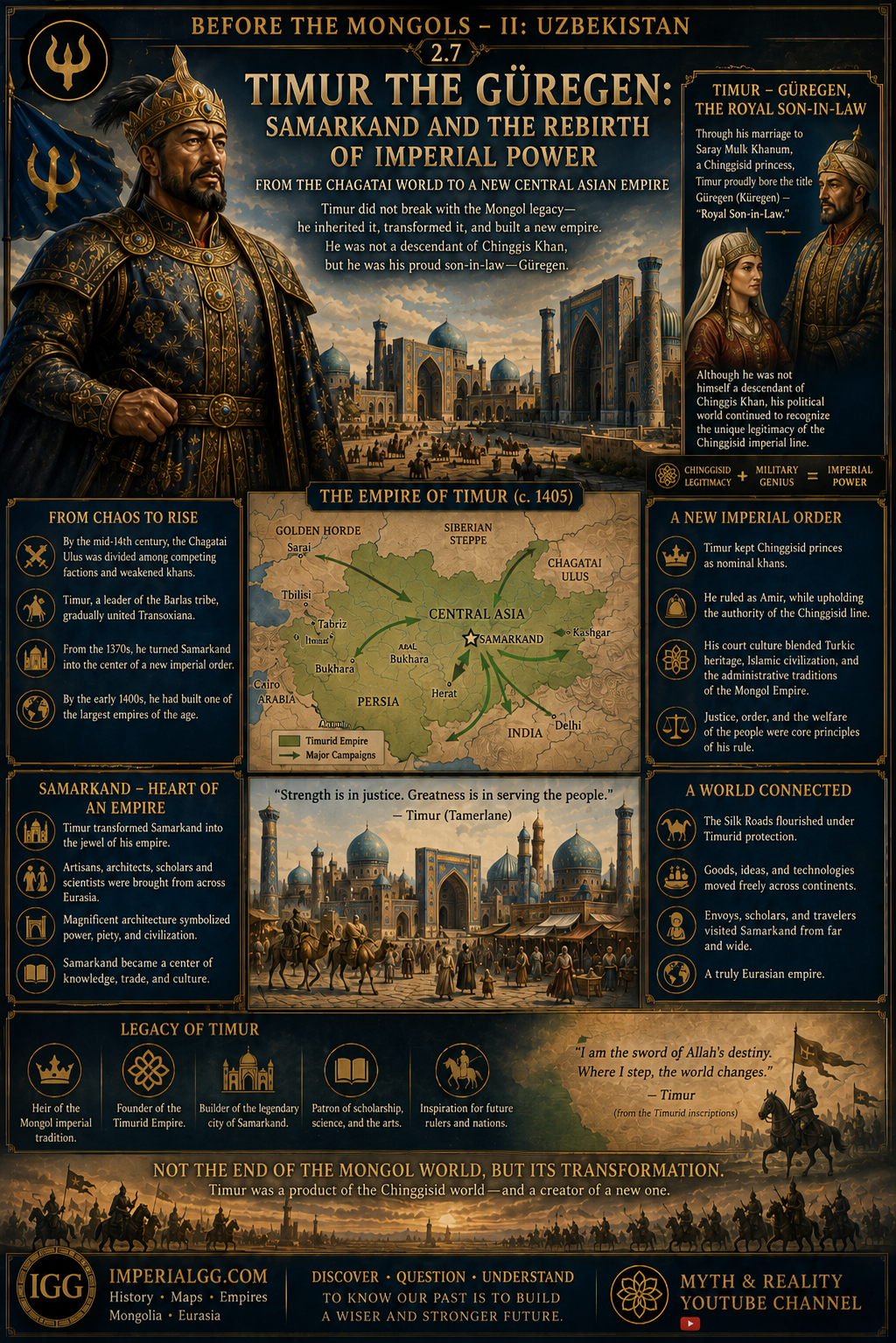
By the middle of the fourteenth century, the political order of the Chagatai Ulus had become increasingly fragmented. The western territories of the ulus, particularly Transoxiana, were divided among powerful military leaders and competing political factions. The authority of individual Chagatai khans had weakened, but the political legitimacy of the house of Chinggis Khan had not disappeared. It remained one of the most powerful principles of sovereignty in Central Asia.
It was from this world that Timur emerged.
Timur is often presented as the founder of an entirely new empire that arose after the Mongol age. Such a description is incomplete. He did create a new imperial power centered on Samarkand, but the political world in which he operated was deeply rooted in the institutions, traditions, military structures, and concepts of legitimacy inherited from the Mongol Empire and the Chagatai Ulus.
Timur was born in 1336 near Kesh, south of Samarkand, into the Barlas political and military elite. The Barlas had originated within the wider Mongol imperial world and had become deeply integrated into the Turkic-speaking and Islamic environment of Central Asia over the generations. By Timur’s lifetime, this transformation had produced a political culture in which Mongol imperial traditions, Turkic language, Islamic civilization, and the urban culture of Transoxiana existed together.
Timur himself was not a direct descendant of Chinggis Khan. Under the political traditions that had developed across much of the Mongol world, this distinction mattered greatly. The title of khan remained closely associated with the Chinggisid royal line. Timur therefore did not attempt simply to erase this tradition and declare himself a Chinggisid ruler. Instead, he built his authority within the political framework that continued to recognize the special legitimacy of the descendants of Chinggis Khan.
This is one of the most important aspects of Timur’s political identity.
Through his marriage to Saray Mulk Khanum, a princess of the Chinggisid line, Timur acquired the prestigious title Güregen, or Küregen, meaning the son-in-law of the royal house. In the political culture inherited from the Mongol Empire, this was far more than a description of marriage. It connected Timur directly to the house whose imperial legitimacy continued to command extraordinary authority across Central Eurasia.
Timur used this connection openly as part of his political position. The title Güregen became closely associated with his public identity and appeared within the political representation of his rule. He did not need to pretend that he was a descendant of Chinggis Khan. His position was different: he was the powerful amir and royal son-in-law who ruled within a political universe in which the Chinggisid house still represented the highest dynastic legitimacy.
For this reason, Timur’s empire should not be understood simply as a rejection of the Mongol imperial past. In important respects, it represented a transformation and continuation of that political world.
Timur maintained Chinggisid princes as nominal khans while effective authority remained in his own hands. This arrangement was not an empty historical curiosity. It demonstrated that even a conqueror as powerful as Timur continued to operate within a political system in which Chinggisid legitimacy mattered. His own military success could give him enormous practical power, but the imperial traditions created after the conquests of Chinggis Khan still shaped the language through which sovereignty was understood.
At the same time, Timur was not merely preserving the past. He was building something new from the political materials he had inherited.
Beginning in the 1370s, he gradually established control over Transoxiana and transformed Samarkand into the center of his expanding power. From there, his armies campaigned across Iran, Afghanistan, the Caucasus, the steppe territories of the Golden Horde, India, Anatolia, and the Middle East. By the beginning of the fifteenth century, Timur had created one of the largest and most powerful empires of his age.
Samarkand stood at the heart of this imperial project.
The city was not chosen accidentally. Its geographical position connected the major routes of Central Asia, while its historical importance reached back centuries before the Mongol conquest. Under Timur, however, Samarkand was transformed into an imperial capital designed to represent the scale of his ambitions. Craftsmen, architects, scholars, and specialists from different parts of the conquered world were brought to the city, contributing to a remarkable period of architectural and cultural development.
This transformation also reflected the changing character of the political world that had emerged from the Chagatai Ulus. The ruling elite was now overwhelmingly connected with Islam and the Turkic and Persianate cultural environment of Central Asia. Yet the political memory of the Mongol Empire remained deeply embedded within the structures of authority.
Timur therefore stood at the intersection of several historical traditions. He was a Muslim ruler whose court operated within the sophisticated Persianate cultural world. He emerged from a Turkic-speaking Central Asian environment. His military and political background was rooted in the post-Mongol society of the Chagatai Ulus. At the same time, his claim to supreme authority was carefully connected to the continuing prestige of the house of Chinggis Khan.
These identities were not necessarily contradictions. They were the historical reality of Central Asia after more than a century of interaction between the Mongol steppe world and the older civilizations of Transoxiana.
From a Mongolian historical perspective, this continuity deserves greater attention. The descendants and political heirs of the Mongol imperial world did not simply vanish when the unified empire fragmented. They became part of the societies they ruled, while the institutions and concepts of legitimacy created during the Mongol imperial period continued to evolve in new cultural environments.
Timur’s relationship with the Chinggisid tradition demonstrates this particularly clearly. He conquered enormous territories and defeated powerful rulers, yet he did not abolish the symbolic authority of the Chinggisid house. Instead, he placed himself beside it as Güregen—the royal son-in-law—and made that relationship part of his own imperial legitimacy.
This does not mean that Timur was merely continuing the Mongol Empire unchanged. His state had its own institutions, ambitions, cultural character, and historical circumstances. Nor did loyalty to Chinggisid political tradition prevent him from fighting other states and rulers that had themselves emerged from the Mongol imperial world. His devastating campaigns against Tokhtamysh and the Golden Horde demonstrate that shared political heritage did not eliminate imperial rivalry.
Nevertheless, the deeper continuity remains impossible to ignore.
The empire Timur built was born in the former territories of the Chagatai Ulus. Its military aristocracy emerged from the political world created after the Mongol conquest. Its understanding of dynastic legitimacy remained connected to Chinggis Khan. Its ruler proudly carried the title Güregen. Even as Samarkand became the capital of a new imperial civilization, the political shadow of the Mongol Empire remained present.
Under Timur and his descendants, Samarkand became one of the great centers of Eurasian civilization. The Timurid period produced extraordinary developments in architecture, art, literature, historical writing, mathematics, and astronomy. Under Ulugh Beg, Samarkand would become home to one of the most important astronomical centers of the fifteenth century.
Yet this cultural flowering did not emerge from an empty historical landscape. It grew from centuries of interaction across the Mongol imperial world and from the political transformation of Central Asia that had begun with the conquest of the Khwarezmian Empire.
For the history of Uzbekistan, Timur therefore represents both a beginning and a continuation. He founded a new dynasty and created a new imperial center in Samarkand, but he did so within a world profoundly shaped by the Mongol Empire and the Chagatai Ulus.
The man who ruled one of the greatest empires of the late medieval world did not call himself Chinggis Khan’s descendant.
He called himself Güregen—the royal son-in-law.
And in the political world of fourteenth-century Central Asia, that title carried the memory and legitimacy of an empire that had never entirely disappeared.