The Four E’s of Chinggis Khan
By Altanbagana Baatar
DBA Candidate| Independent Historian
ImperialGG Historical Research Seriers
15 July 2026
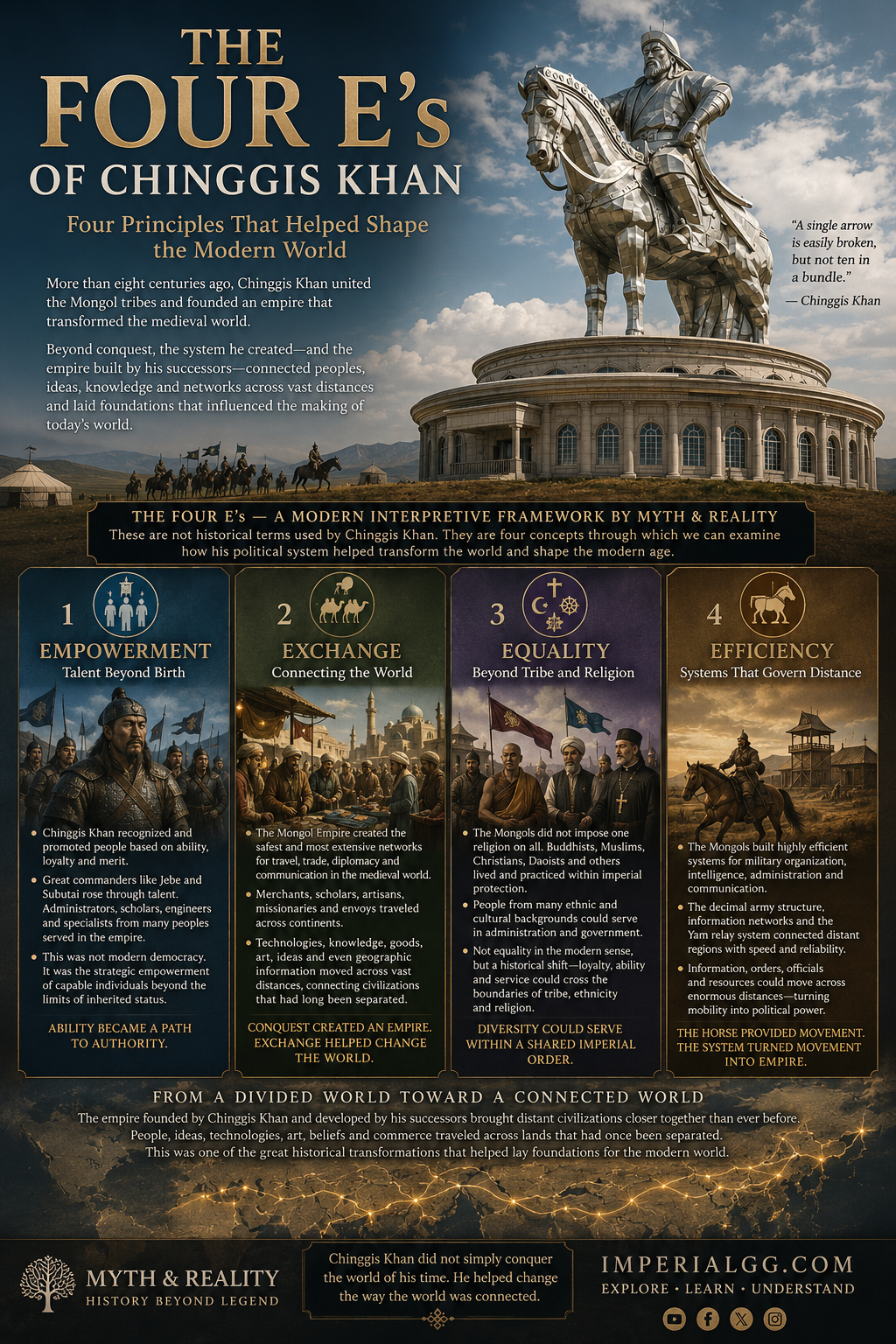
Empowerment. Exchange. Equality. Efficiency.
The Four E’s of Chinggis Khan—Endurance, Excellence, Efficiency, and Expansion—offer a framework for understanding the principles that shaped Mongol leadership and imperial governance.
More than eight centuries ago, Chinggis Khan emerged from the fragmented political world of the Mongolian steppe and founded an empire that would fundamentally alter the course of world history.
His name is most often associated with conquest. Yet conquest alone cannot explain the historical significance of Chinggis Khan or the extraordinary transformation that followed the rise of the Mongol Empire.
The world created by Chinggis Khan and developed by his successors brought distant civilizations into closer contact, accelerated the movement of people and knowledge, reorganized systems of communication, encouraged long-distance commerce, and governed an unprecedented diversity of cultures and religions under interconnected imperial structures.
Many of these developments had earlier precedents, and none can be attributed to a single individual alone. Yet the scale on which they operated under the Mongol Empire was historically exceptional.
To understand this wider legacy, Myth & Reality presents a modern interpretive framework: The Four E’s of Chinggis Khan.
Empowerment. Exchange. Equality. Efficiency.
These are not historical terms used by Chinggis Khan himself. They are four concepts through which we can examine how the political system he founded helped transform the medieval world and contributed to the emergence of a more interconnected modern age.
1. Empowerment — Talent Beyond Birth
Chinggis Khan was born into a world in which lineage, tribal allegiance, and inherited status strongly influenced political power. Yet one of the defining characteristics of the state he created was his ability to recognize and employ talent beyond the narrow boundaries of traditional aristocratic privilege.
The old hierarchy did not disappear. The family of Chinggis Khan remained at the summit of imperial authority, and aristocratic descent continued to matter greatly. Nevertheless, the new Mongol order created remarkable opportunities for individuals who demonstrated loyalty, courage, intelligence, and ability.
Some of the greatest commanders of the Mongol age rose because of what they could accomplish.
Jebe became one of Chinggis Khan’s most celebrated generals. Subutai rose to become one of the greatest military commanders of the medieval world. Across the expanding empire, administrators, engineers, physicians, scholars, craftsmen, translators, and specialists from many different peoples were incorporated into the imperial system.
This was not modern democracy.
It was something historically transformative in its own context: a political culture in which demonstrated ability could sometimes overcome the limitations of inherited position.
Chinggis Khan understood a fundamental principle of state-building.
A great state cannot depend solely upon those who are born into privilege. It must find, empower, and organize capable people.
This principle became one of the foundations of Mongol imperial success.
2. Exchange — Connecting the World
Long-distance trade existed thousands of years before Chinggis Khan. The Silk Roads had connected civilizations across Asia for centuries.
The Mongols did not invent global exchange.
What they did was create conditions in which exchange could operate across an extraordinary geographical scale under interconnected political authority.
As the Mongol Empire expanded, regions that had previously been separated by political frontiers became connected through imperial networks stretching from East Asia across Central Asia and the Middle East toward Europe.
Merchants travelled.
Diplomats crossed continents.
Scholars and religious figures moved between courts.
Artisans and engineers carried specialized knowledge from one civilization to another.
Technologies, geographical information, medical knowledge, astronomy, mathematics, artistic traditions, military techniques, and administrative practices travelled alongside commercial goods.
The consequences reached far beyond the empire itself.
Europe learned more about Asia.
Asian rulers gained greater knowledge of distant western lands.
Islamic, Chinese, Central Asian, European, and other intellectual traditions encountered one another with greater frequency.
The Mongol Empire did not create the first connected world.
But it dramatically intensified connections across much of the known world.
In this sense, one of Chinggis Khan’s greatest historical legacies was not simply the territory his armies conquered.
It was the opening of pathways through which civilizations encountered one another.
Conquest created an empire. Exchange helped change the world.
3. Equality — Beyond Tribe and Religion
The word Equality must be understood carefully.
The Mongol Empire was not an egalitarian society according to modern standards. It contained social hierarchies, inherited privilege, slavery, and profound inequalities between different groups and individuals.
Yet within the political realities of the thirteenth century, the Mongol imperial system introduced practices that challenged some traditional boundaries.
One of the clearest examples was religious policy.
The Mongol rulers governed populations belonging to many different faiths. Buddhists, Christians, Muslims, Daoists, and practitioners of traditional steppe beliefs all lived within territories controlled by the Mongol imperial houses.
Rather than attempting to impose one universal religion across the entire empire, Mongol rulers generally permitted multiple religious traditions to operate under their authority.
This was partly philosophical, partly political, and profoundly practical.
An empire containing many civilizations could not easily survive if every conquered people were required to abandon its identity.
The same principle could be seen in imperial administration.
The Mongols employed people from many ethnic, linguistic, and cultural backgrounds. A person’s origin did not necessarily prevent that individual from serving the empire at a high level.
Therefore, Equality, as one of our Four E’s, does not mean modern equality before the law in its complete contemporary sense.
It represents a broader historical shift:
the recognition that loyalty, ability, knowledge, and service could cross the boundaries of tribe, ethnicity, and religion.
For a world still deeply divided by inherited identities, this principle had significant consequences.
- 4. Efficiency — Building Systems That Could Govern Distance
Perhaps the most important lesson of Chinggis Khan’s success was his understanding that power depended upon organization.
Military courage alone could win a battle.
It could not govern a continent.
The Mongol state developed highly effective systems for organizing armies, gathering intelligence, transmitting orders, moving officials, and connecting distant regions.
The decimal military organization provided a clear command structure.
Information about enemies was gathered before campaigns.
Specialists were incorporated into military and administrative operations.
Later, under the expanding empire established by Chinggis Khan and developed by his successors, the relay-post network known as the Yam became one of the most remarkable communication systems of the medieval world.
Official messengers could travel through networks of stations, changing horses and receiving provisions along their routes.
Information moved faster.
Orders travelled farther.
Governments could communicate across distances that had previously made centralized administration extraordinarily difficult.
This was not simply a postal system.
It represented a new understanding of political power.
The strength of an empire depended not only on how much land it controlled, but on how effectively information could move across that land.
In this respect, the Mongol system anticipated one of the defining principles of the modern world: connectivity.
The faster people, information, knowledge, and resources can move, the more deeply societies become connected.
From a Divided World Toward a Connected World
The greatest historical significance of Chinggis Khan may therefore lie beyond the battlefield.
Before his rise, the civilizations of the Old World were already connected through ancient networks of trade and migration. But these connections were often interrupted by political fragmentation, warfare, and geographical barriers.
The Mongol expansion transformed the scale of interaction.
Within several generations, much of the vast territory between East Asia and Eastern Europe came under the rule of Chinggis Khan’s descendants.
For the first time, people could travel through interconnected Mongol-ruled territories across distances of continental scale.
This movement carried far more than merchandise.
It carried ideas.
It carried inventions.
It carried scientific knowledge.
It carried religious beliefs.
It carried artistic traditions.
It carried information about distant societies.
And, tragically, interconnected networks could also carry disease.
The Mongol age demonstrated one of the central realities of the modern world: when distant societies become connected, changes in one region can have consequences thousands of miles away.
This is one reason Chinggis Khan belongs not merely to Mongolian history, nor even solely to the history of medieval conquest.
His legacy belongs to the history of how the world became increasingly interconnected.
The Four E’s and the Making of the Modern World
The Four E’s help us understand this transformation.
Empowerment meant finding talent beyond the narrow limits of inherited privilege.
Exchange allowed goods, people, knowledge, and technologies to travel across unprecedented distances.
Equality, within the limitations of its historical context, allowed different peoples and religious traditions to participate within a broader imperial system.
Efficiency created the organization and communication networks necessary to govern enormous distances.
None of these principles was invented entirely by Chinggis Khan.
Earlier civilizations had practiced forms of merit-based advancement, international trade, religious accommodation, and sophisticated administration.
The historical achievement of the Mongol Empire lay in bringing such practices together and operating them across an extraordinary geographical scale.
The result was a profound acceleration of global interaction.
The world after the Mongol Empire was not the same world that had existed before it.
Beyond the Image of the Conqueror
Chinggis Khan remains one of the most controversial figures in world history.
The Mongol conquests caused immense destruction and loss of life. That history cannot and should not be erased.
But historical understanding also requires us to examine what followed conquest.
The empire founded by Chinggis Khan became a mechanism through which civilizations that had developed at opposite ends of the known world encountered one another more directly than ever before.
The Mongols connected roads.
They moved specialists.
They protected and encouraged merchants.
They transmitted information.
They governed religious diversity.
They built systems capable of operating across extraordinary distances.
The result was not the modern world as we know it today.
But it was one of the great historical transformations that helped create the conditions from which a more interconnected world would eventually emerge.
This is the deeper meaning behind The Four E’s of Chinggis Khan.
Empowerment.
Exchange.
Equality.
Efficiency.
Four principles.
One extraordinary transformation.
And a legacy that reached far beyond the borders of the Mongol Empire.
Chinggis Khan did not simply conquer the world of his time.
He helped change the way the world was connected.
The Four E’s of Chinggis Khan is a modern interpretive framework developed by Myth & Reality for historical discussion and education.
MYTH & REALITY
History Beyond Legend
IMPERIALGG.COM
Explore • Learn • Understand