BEFORE THE MONGOLS I – MOSCOW SERIES 1.2
1300–1400: Moscow Under the Golden Horde
By Altanbagana Baatar
DBA Candidate| Independent Historian
ImperialGG Historical Research Seriers
15 July 2026
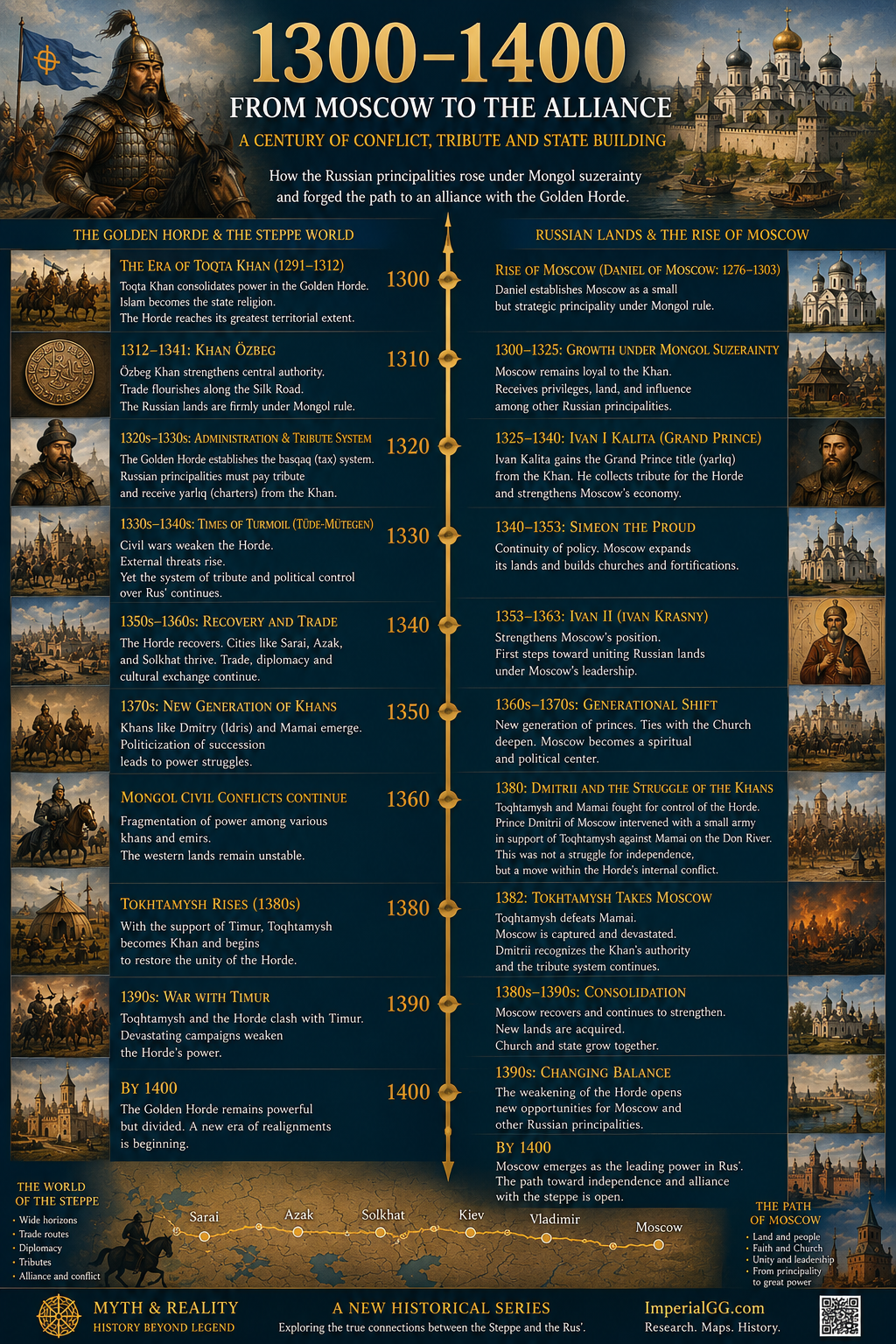
From a Minor Principality to the Emerging Center of Rus’
At the beginning of the fourteenth century, Moscow was neither the natural nor the inevitable center of the Russian lands. It was one principality among many, overshadowed by older and more powerful centers such as Vladimir, Tver, Novgorod, and Ryazan.
Yet between 1300 and 1400, Moscow underwent a remarkable political transformation.
This rise did not take place outside the political order of the Mongol Empire and its western successor, the Golden Horde. On the contrary, Moscow developed for generations within the political system of the Jochid Ulus.
Its princes received recognition from the khans, competed with rival Rus’ principalities for political authority, participated in the tribute system, and used their relationship with the Horde to strengthen their own position.
The history of Moscow’s rise, therefore, cannot adequately be described as a simple, continuous struggle of “Russia against the Mongols.”
The historical reality was considerably more complex.
1300–1325: Moscow Rises Within the Mongol Political Order
The foundations of Moscow’s ascent were laid under Prince Daniel of Moscow, the youngest son of Alexander Nevsky. By the time of Daniel’s death in 1303, Moscow had already begun expanding its territory and strengthening its strategic position.
His successors continued this policy.
At the same time, the Golden Horde remained the supreme political power over the Rus’ principalities. Russian princes competed among themselves for recognition from the khan, particularly for the prestigious title of Grand Prince of Vladimir.
The rivalry between Moscow and Tver became especially important.
The khans were not merely distant rulers observing events from the steppe. The Horde played an active role in the political balance among the Rus’ principalities, confirming rulers, issuing charters, regulating tribute, and intervening when conflicts threatened the established order.
Moscow gradually became exceptionally skilled at operating within this system.
That ability became one of the foundations of its future power.
1325–1340: Ivan Kalita and the Consolidation of Moscow
The reign of Ivan I of Moscow, known as Ivan Kalita, marked a decisive stage in Moscow’s development.
A major turning point came with the Tver uprising of 1327.
After violence erupted against the Mongol presence in Tver, Ivan Kalita cooperated with the forces acting under Khan Özbeg’s authority in suppressing the rebellion.
The consequences were profound.
Tver was weakened, while Moscow gained greater political confidence from the khan.
Ivan subsequently secured the title of Grand Prince of Vladimir and became deeply involved in the collection and transmission of tribute.
This relationship brought Moscow significant advantages.
By serving as an effective intermediary within the political and fiscal system of the Golden Horde, Moscow accumulated wealth, territory, and influence. Its growing association with the Orthodox metropolitan also strengthened its position as a religious center.
One of the great paradoxes of later Russian history therefore becomes visible:
Moscow did not initially rise by destroying the political system of the Golden Horde. It rose, in significant measure, by learning how to operate successfully within it.
1340–1359: The Golden Age of the Horde and Moscow’s Consolidation
During the reigns of Simeon the Proud and Ivan II, Moscow continued to strengthen its position.
Meanwhile, the Golden Horde remained one of the major political and commercial powers of Eurasia.
Under Khan Özbeg and his successor Jani Beg, extensive networks connected the Volga region, the Black Sea, Central Asia, the Caucasus, and the Rus’ principalities.
Relations between the Horde and Rus’ were therefore never exclusively military.
They included taxation, diplomacy, dynastic politics, trade, religious privileges, military service, and administrative interaction.
The Orthodox Church itself enjoyed substantial privileges confirmed by the khans.
By the middle of the fourteenth century, Moscow had grown considerably stronger.
But it had not become independent.
It remained an important component of the larger political world centered upon the Golden Horde.
1359–1380: The Great Troubles and the Struggle for the Jochid Throne
The death of Berdi Beg in 1359 opened a period of severe political instability within the Golden Horde.
Multiple Chinggisid claimants competed for supreme authority.
In the western territories, Mamai emerged as one of the most powerful political and military figures. Yet Mamai was not himself a descendant of Chinggis Khan and therefore could not legitimately claim the title of khan in his own name.
He exercised power through Chinggisid puppet khans.
At the same time, another force was rising in the east.
Tokhtamysh, a descendant of Jochi and therefore a legitimate Chinggisid claimant, emerged with the support of Timur. His objective was not to destroy the Golden Horde but to reunify the fragmented Jochid Ulus under his own authority.
The confrontation between Tokhtamysh and Mamai therefore formed part of a larger Mongol civil struggle over the legitimate succession and political reunification of the Horde.
It is within this context that the events traditionally associated with the Battle of Kulikovo must be reconsidered.
1380: Dmitry, Mamai, and the Struggle for the Golden Horde
The events of 1380 are commonly presented in later national narratives as a decisive confrontation between “Russia” and the “Mongols.”
Such a simplified interpretation obscures the wider political context.
The Golden Horde was already divided by an internal struggle for supreme authority. Mamai controlled much of its western political sphere, while Tokhtamysh was advancing from the east as a legitimate Chinggisid contender seeking to reunify the Jochid Ulus.
Dmitry of Moscow entered this larger conflict with forces drawn from Moscow and allied Rus’ principalities.
In the interpretation advanced by this series, Dmitry’s military action against Mamai should be examined in relation to the wider Tokhtamysh–Mamai struggle rather than treated automatically as a war for complete independence from Mongol rule.
The Russian forces represented only one component within a much larger geopolitical conflict unfolding across the Golden Horde.
Mamai’s forces were weakened after the confrontation on the Don. Soon afterward, Tokhtamysh confronted Mamai directly and destroyed his remaining political power.
Tokhtamysh then reunited the principal territories of the Golden Horde under his authority.
This sequence raises an important historical question:
Was Dmitry fighting the Mongol political order itself—or had Moscow become involved in an internal struggle over who would control that order?
The events that followed strongly challenge the traditional interpretation of 1380 as the end of Mongol authority.
Only two years later, Tokhtamysh appeared before Moscow as the recognized Khan of the Golden Horde.
1382: Tokhtamysh Takes Moscow
In 1382, Khan Tokhtamysh marched against Moscow.
The city was captured and devastated.
Dmitry subsequently recognized the authority of Tokhtamysh, and the tributary relationship continued.
This is one of the most important facts for understanding the political meaning of 1380.
If Dmitry’s objective had been the complete destruction of Mongol authority, the rapid restoration of relations with the newly reunified Golden Horde requires further explanation.
From another perspective, however, the sequence is more coherent.
Mamai was removed.
Tokhtamysh became the recognized khan.
The political unity of the Golden Horde was restored.
Moscow remained within its sphere of authority.
Thus, 1380 should not automatically be interpreted through the later national framework of a decisive Russian war of liberation from the Mongols.
It belonged first to the complex political world of the late-fourteenth-century Golden Horde.
1380s–1390s: Tokhtamysh, Timur, and a Changing Eurasian Balance
After consolidating his position, Tokhtamysh restored much of the unity and authority of the Golden Horde.
However, his relationship with Timur eventually collapsed.
The resulting wars transformed the political balance of Eurasia.
Timur’s campaigns against Tokhtamysh in the 1390s devastated important centers and weakened the economic and political foundations of the Horde.
This conflict—not the events of 1380 alone—was one of the major turning points in the weakening of centralized Jochid power.
Moscow benefited from the changing geopolitical environment.
Yet even by 1400, the relationship between Moscow and the steppe had by no means ended.
The political transformation was only beginning.
The Larger Historical Reality
The fourteenth century cannot be adequately understood through a simple narrative of permanent conflict between two peoples.
Moscow rose within the political world of the Golden Horde.
Its princes received recognition from the khans.
They competed for Mongol political support against rival Rus’ princes.
They collected and transmitted tribute.
They cooperated with the Horde when their interests aligned.
They resisted particular rulers and political factions when circumstances changed.
The Golden Horde itself was never a single, static political entity. It experienced strong centralized rule, dynastic crises, civil conflicts, regional power struggles, and repeated attempts at reunification.
The events of 1380 must therefore be placed inside this broader history.
The central question is not simply:
“When did Moscow defeat the Mongols?”
The more historically revealing question is:
“How did Moscow rise within the political system of the Golden Horde, participate in its internal struggles, inherit elements of its political world, and eventually transform itself into a new Eurasian imperial power?”
That is the larger story this series will follow.
From Moscow under the Golden Horde, through the rise of the Muscovite state and the Russian Empire, and eventually to the formation of the Soviet Union, the history of Russia cannot be separated from the political world of the Eurasian steppe.
MYTH & REALITY — History Beyond Legend
From Moscow to the Soviet Union: A Century-by-Century Historical Series
ImperialGG.com — Research. Maps. History.