The Xiongnu Empire (匈奴): A Mongolic-Speaking Empirial Confederation of the Ancient Mongolian Plateau
By Altanbagana Baatar
DBA Candidate| Independent Historian
ImperialGG Historical Research Seriers
09 July 2026
Introduction
The Xiongnu Empire (匈奴) occupies a prominent place in the history of Inner Asia and the eastern Eurasian steppe.
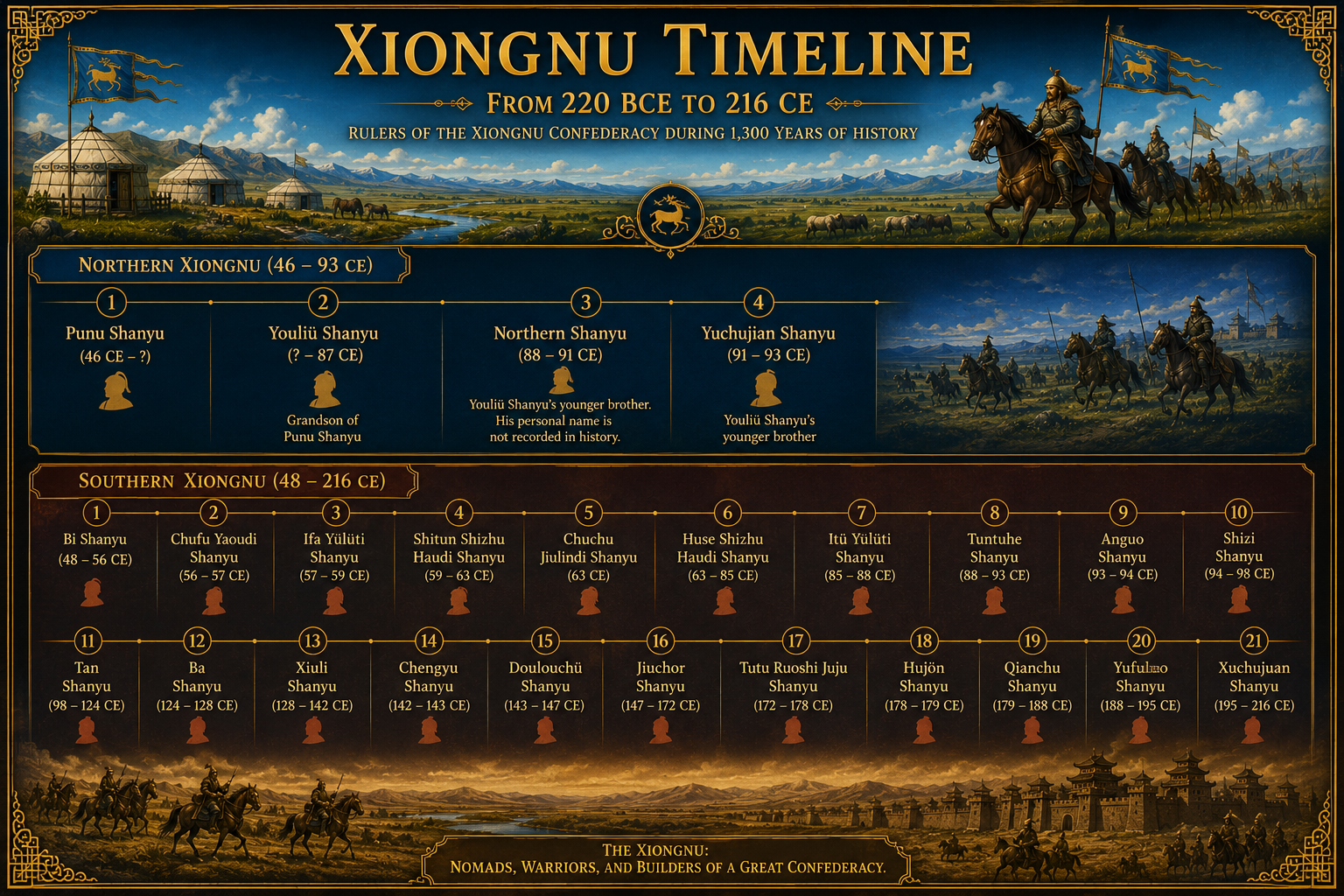
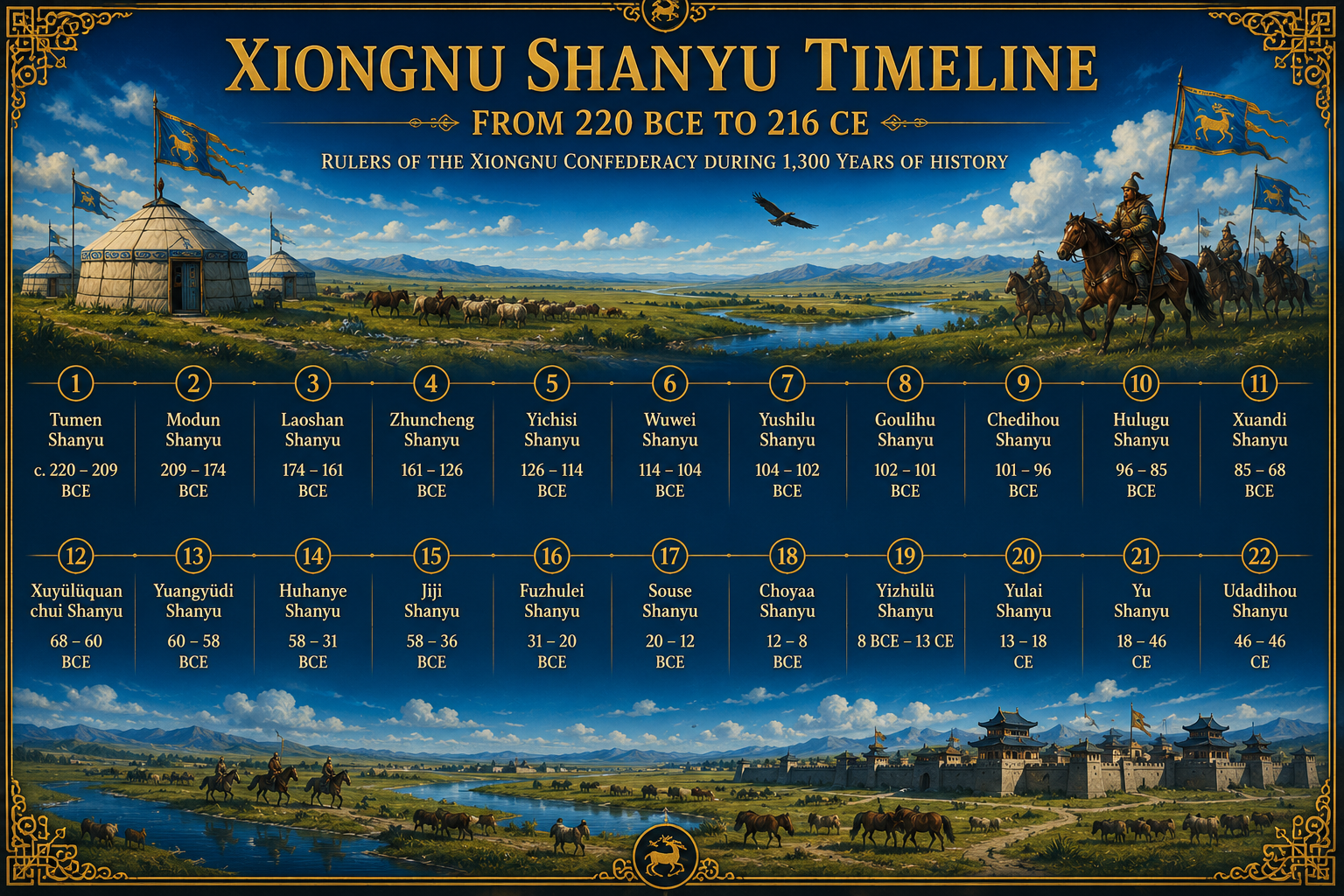
Among the many peoples who inhabited the eastern Eurasian steppe, none occupies a more prominent place in the history of Inner Asia than the Xiongnu Empire (匈奴). Emerging at the end of the third century BCE under the leadership of Modu Chanyu (Maodun), the Xiongnu created the first great nomadic empire of the Mongolian Plateau and fundamentally transformed the political history of Eurasia. Their empire extended across vast territories from Manchuria to the Altai Mountains and from the Gobi Desert to the regions bordering the agricultural states of northern China, establishing a new model of steppe imperial organization that would profoundly influence later Inner Asian polities.¹
The historical significance of the Xiongnu extends far beyond their military conflicts with the Han dynasty. The rise of the Xiongnu marked the first successful political unification of numerous pastoral communities inhabiting the Mongolian Plateau and gave rise to an imperial tradition that would shape the subsequent history of Inner Asia for centuries. Later nomadic empires, including the Xianbei, Rouran, Türk, Uighur, Khitan, and Mongol empires, inherited and adapted many of the political and military traditions that first appeared under the Xiongnu.²
The ethnic and linguistic identity of the Xiongnu has long been one of the most debated questions in Eurasian historiography. Since the nineteenth century, scholars have proposed a wide variety of interpretations, identifying the Xiongnu as Turkic, Mongolic, Yeniseian, or as a multiethnic imperial confederation. The scarcity of indigenous written sources and the complexity of steppe ethnogenesis have contributed to the persistence of these debates.³
In Mongolian historiography, however, the Xiongnu occupy a particularly important position. Many Mongolian historians regard the Xiongnu Empire founded in 209 BCE as the earliest great imperial tradition of the Mongolian Plateau and an important ancestral state in the long historical development of the Mongolian people. In contemporary Mongolia, the year 209 BCE serves as a significant chronological marker, and the commemoration of the 2235th anniversary of the Xiongnu Empire reflects the central place that the Xiongnu occupy in modern Mongolian historical consciousness.⁴
Recent decades have witnessed substantial advances in archaeology, historical linguistics, and archaeogenetics. New excavations of Xiongnu cemeteries and settlements throughout Mongolia, together with paleogenetic studies conducted by Mongolian and international research teams, have significantly expanded our understanding of the population history of the Mongolian Plateau. These new findings increasingly suggest long-term patterns of demographic and cultural continuity extending across the eastern Eurasian steppe and have prompted renewed discussion concerning the place of the Xiongnu in the ethnogenesis of later Mongolic-speaking peoples.⁵
This study re-examines the history of the Xiongnu Empire from the perspectives of historical sources, archaeology, linguistics, and recent genetic research. It argues that the cumulative evidence increasingly supports the interpretation of the Xiongnu as a Mongolic-speaking imperial tradition that emerged on the Mongolian Plateau and constituted an important ancestral component in the long historical development of the Mongolian people.⁶
Footnotes
¹ Records of the Grand Historian, chap. 110; Nicola Di Cosmo, Ancient China and Its Enemies: The Rise of Nomadic Power in East Asian History (Cambridge: Cambridge University Press, 2002), 161–188.
² Thomas J. Barfield, The Perilous Frontier: Nomadic Empires and China (Oxford: Blackwell, 1989), 32–55.
³ Christopher I. Beckwith, Empires of the Silk Road (Princeton: Princeton University Press, 2009), 51–69; Hyun Jin Kim, The Huns, Rome and the Birth of Europe (Cambridge: Cambridge University Press, 2013), 12–30.
⁴ J. Boldbaatar, Монголын Түүх (Улаанбаатар, 2011), xx–xx; Sh. Natsagdorj, Чингис хааны намтар (Улаанбаатар, 1991), xx–xx.
⁵ Bryan K. Miller et al., archaeological studies on Xiongnu cemeteries in Mongolia; recent archaeogenetic studies conducted by Mongolian and international research teams on the population history of the eastern Eurasian steppe.
⁶ Gunjiin Sukhbaatar, Монголчуудын эртний өвөг (Улаанбаатар, 1980), xx–xx; Shagdaryn Bira, Mongolian Historiography in the 13th–17th Centuries (New Delhi, 1978), xx–xx.
I. Historical Sources on the Xiongnu
The Xiongnu are among the earliest peoples of Inner Asia for whom relatively extensive historical documentation survives. Unlike many earlier populations of the eastern Eurasian steppe, whose histories can only be reconstructed through fragmentary references and archaeological evidence, the Xiongnu occupy a prominent place in numerous Chinese dynastic histories. These sources constitute the principal written foundation for reconstructing the political, military, and social history of the Xiongnu Empire and have consequently shaped nearly all subsequent scholarship concerning their origins and development.¹
The earliest and most important account of the Xiongnu is found in the Shiji (史記, Records of the Grand Historian) compiled by Sima Qian during the first century BCE. Chapter 110, commonly known as the “Account of the Xiongnu” (Xiongnu liezhuan 匈奴列傳), provides the first systematic narrative concerning the origins of the Xiongnu, the rise of Modu Chanyu, and the political and military relations between the Xiongnu Empire and the Han dynasty. Although written from the perspective of the Han court, the Shiji remains the single most important textual source for the early history of the Xiongnu.²
The Hanshu (漢書, Book of Han) compiled by Ban Gu and his sister Ban Zhao further expanded and systematized the information contained in the Shiji. The Hanshu provides valuable details regarding the administrative structure of the Xiongnu Empire, diplomatic relations with Han China, internal political divisions, and the eventual separation of the Xiongnu into northern and southern branches.³
Additional information is preserved in later dynastic histories, including the Book of the Later Han, the Book of Wei, and other medieval compilations. Although these works were composed centuries after the rise of the Xiongnu, they preserve earlier traditions and provide important evidence concerning the historical memory of the Xiongnu among later peoples of Inner Asia.⁴
Despite their immense value, Chinese historical sources must be approached critically. They were written by sedentary officials of imperial Chinese states and naturally reflect the political, cultural, and ideological perspectives of those societies. The Xiongnu are frequently portrayed through the traditional Chinese distinction between the civilized (hua) and the non-Chinese (yi, di, rong, and hu), and descriptions of steppe societies are sometimes shaped by literary conventions and political concerns rather than direct ethnographic observation.⁵
Nevertheless, these limitations do not diminish the importance of the Chinese historical record. On the contrary, the remarkable quantity of information preserved concerning the Xiongnu distinguishes them from many other ancient peoples of Inner Asia. Chinese sources provide detailed accounts of Xiongnu political institutions, military organization, succession practices, diplomatic activities, and social customs, allowing historians to reconstruct the history of the first great empire of the Mongolian Plateau with a degree of precision impossible for earlier steppe societies.⁶
In addition to Chinese written sources, archaeological discoveries made throughout Mongolia during the last century have significantly expanded our understanding of the Xiongnu. Excavations of elite tombs, ordinary cemeteries, settlements, and ritual sites have provided an independent body of evidence that can be compared with the written record. In many cases, archaeological findings have confirmed, refined, or corrected traditional interpretations derived solely from Chinese texts.⁷
Recent advances in archaeogenetics have further transformed the study of the Xiongnu. Ancient DNA studies conducted by Mongolian and international research teams have revealed a complex but historically continuous population history on the Mongolian Plateau and have provided entirely new evidence concerning the demographic composition of the Xiongnu Empire. These developments have encouraged scholars to reconsider older theories concerning the ethnic and linguistic identity of the Xiongnu and have opened new avenues of interdisciplinary research.⁸
Accordingly, the history of the Xiongnu must be reconstructed through the careful integration of written sources, archaeology, linguistics, and genetic evidence. No single category of evidence is sufficient on its own. Only through an interdisciplinary approach can the origins, development, and historical significance of the Xiongnu Empire be properly understood.⁹
Footnotes
¹ Nicola Di Cosmo, Ancient China and Its Enemies: The Rise of Nomadic Power in East Asian History (Cambridge: Cambridge University Press, 2002), 161–188.
² Records of the Grand Historian, chap. 110.
³ Book of Han, chap. 94.
⁴ Book of the Later Han, chap. 89; Book of Wei.
⁵ Nicola Di Cosmo, Ancient China and Its Enemies, 1–20; Thomas J. Barfield, The Perilous Frontier: Nomadic Empires and China (Oxford: Blackwell, 1989), 3–15.
⁶ Christopher I. Beckwith, Empires of the Silk Road (Princeton: Princeton University Press, 2009), 51–69.
⁷ Bryan K. Miller, archaeological studies of Xiongnu cemeteries and settlements in Mongolia; William W. Fitzhugh and Morris Rossabi, eds., Genghis Khan and the Mongol Empire (Washington, D.C.: Smithsonian Institution, 2009), 40–55.
⁸ Recent archaeogenetic studies of Xiongnu-period populations conducted by Mongolian and international research teams.
⁹ Nicola Di Cosmo, Ancient China and Its Enemies, 175–188.
II. Origins of the Xiongnu and the Rise of Modu Chanyu
The origins of the Xiongnu constitute one of the most debated questions in the historiography of Inner Asia. Despite more than two centuries of scholarship, no universal consensus has been reached regarding their ethnic and linguistic identity or the precise circumstances surrounding their emergence on the Mongolian Plateau. Nevertheless, both historical and archaeological evidence indicate that the rise of the Xiongnu was not a sudden event but rather the culmination of long processes of political consolidation and cultural development among the pastoral societies of eastern Inner Asia.¹
Chinese historical sources consistently portray the Xiongnu as an already established power inhabiting the regions north of the Chinese states by the late Warring States period. The Shiji records that the Xiongnu occupied the vast territories extending across the Mongolian Plateau and that their political influence had already become a significant concern for the northern Chinese kingdoms before the unification of China under the Qin dynasty.² This evidence suggests that the roots of the Xiongnu polity extended considerably further into the past than the foundation of the empire under Modu Chanyu in 209 BCE.
The historical emergence of the Xiongnu should therefore be understood within the broader context of the long-term cultural developments of the Mongolian Plateau. Archaeological evidence demonstrates substantial continuity between the Bronze Age and Early Iron Age cultures of Mongolia and the societies that later formed the Xiongnu Empire. The expansion of horse pastoralism, the increasing complexity of social organization, and the development of regional networks of exchange and political interaction created the conditions necessary for the emergence of large-scale political confederations.³
Many scholars have suggested that the Xiongnu inherited political traditions and populations from earlier societies of the eastern Eurasian steppe. In Mongolian historiography, particular attention has been given to the possibility of historical continuity between earlier peoples such as the Beidi and Donghu and the populations that later participated in the formation of the Xiongnu Empire. Although the precise nature of these relationships remains debated, the available evidence increasingly points toward long-term processes of ethnogenesis and political transformation rather than repeated episodes of complete population replacement.⁴
The decisive stage in the formation of the Xiongnu Empire occurred under the leadership of Modu Chanyu (Maodun), who ascended to power in 209 BCE. According to the Shiji, Modu was the son of Touman Chanyu, the ruler of the Xiongnu. The historical narrative concerning his rise to power has become one of the most famous episodes in the history of Inner Asia. After being sent as a hostage to the Yuezhi and subsequently abandoned by his father, Modu escaped, returned to the Xiongnu, and gradually built a loyal military following.⁵
The Shiji describes how Modu created an elite corps of mounted archers whose absolute loyalty was tested through a series of increasingly severe commands. Only after consolidating his personal authority did he eliminate his political rivals, including Touman Chanyu himself, and assume supreme power over the Xiongnu confederation. Although some details of this account may contain literary embellishment, the narrative nevertheless illustrates the extraordinary process of political centralization that accompanied the rise of the Xiongnu Empire.⁶
Under Modu’s leadership, the Xiongnu underwent a remarkable transformation. Numerous tribes and pastoral communities of the Mongolian Plateau were brought under a unified political authority, creating the first great empire in the history of Inner Asia. Within a relatively short period, the Xiongnu defeated the Donghu in the east, subdued the Yuezhi in the west, and established themselves as the dominant power of the Eurasian steppe.⁷
The rise of Modu Chanyu represents far more than the success of an individual ruler. It marks a fundamental turning point in the history of the Mongolian Plateau and the emergence of a new imperial tradition characterized by centralized leadership, large-scale military organization, and the political integration of diverse steppe populations. The institutions created during this period would profoundly influence the subsequent development of Inner Asian empires for many centuries.⁸
For this reason, the year 209 BCE occupies a special place in modern Mongolian historiography and historical consciousness. It marks the foundation of the first historically attested great empire of the Mongolian Plateau and serves as one of the most important chronological reference points in discussions of the origins and development of Mongolian statehood.⁹
Footnotes
¹ Nicola Di Cosmo, Ancient China and Its Enemies: The Rise of Nomadic Power in East Asian History (Cambridge: Cambridge University Press, 2002), 161–188.
² Records of the Grand Historian, chap. 110.
³ Bryan K. Miller, archaeological studies on the emergence of the Xiongnu state; William W. Fitzhugh and Morris Rossabi, eds., Genghis Khan and the Mongol Empire (Washington, D.C.: Smithsonian Institution, 2009), 40–55.
⁴ Gunjiin Sukhbaatar, Монголчуудын эртний өвөг (Ulaanbaatar, 1980), xx–xx; P. Delgerjargal, studies on ethnocultural continuity in Inner Asia.
⁵ Records of the Grand Historian, chap. 110.
⁶ Nicola Di Cosmo, Ancient China and Its Enemies, 174–181.
⁷ Thomas J. Barfield, The Perilous Frontier: Nomadic Empires and China (Oxford: Blackwell, 1989), 36–44.
⁸ Christopher I. Beckwith, Empires of the Silk Road (Princeton: Princeton University Press, 2009), 51–69.
⁹ J. Boldbaatar, Монголын Түүх (Ulaanbaatar, 2011), xx–xx; Sh. Natsagdorj, Чингис хааны намтар (Ulaanbaatar, 1991), xx–xx.
III. The Xiongnu Imperial System:
Society, Economy, and Political Institutions
The Xiongnu Empire was not a loose tribal confederation held together solely by military force. Rather, it constituted a highly organized imperial polity that developed sophisticated political institutions, a hierarchical administrative structure, and a remarkably effective military system. The creation of these institutions enabled the Xiongnu to govern vast territories and diverse populations across the eastern Eurasian steppe and established an imperial model that profoundly influenced later Inner Asian states.¹
The Political Structure of the Empire
Chinese historical sources describe the Xiongnu Empire as a highly centralized polity headed by the Chanyu (單于), who exercised supreme political, military, and religious authority. The office of the Chanyu occupied the apex of the imperial hierarchy and appears to have combined the functions of ruler, commander-in-chief, and sacred leader.²
Below the Chanyu stood a hierarchy of kings and nobles. The most important among these were the Left and Right Wise Kings (Zuoxian Wang and Youxian Wang), who governed the eastern and western wings of the empire respectively. This dual administrative structure became one of the defining characteristics of steppe imperial organization and would later reappear among numerous Inner Asian empires, including the Türk and Mongol empires.³
The Shiji and Hanshu further indicate that the Xiongnu possessed an elaborate administrative hierarchy composed of kings, generals, commanders, and officials responsible for the governance of different tribal and territorial units. Such institutions demonstrate a level of political complexity considerably greater than the image of an unstructured nomadic confederation that often appeared in earlier scholarship.⁴
Decimal Organization and Military Administration
One of the most remarkable features of the Xiongnu state was its ability to mobilize large military forces across enormous distances. Chinese sources suggest the existence of a highly developed military-administrative system capable of organizing and commanding hundreds of thousands of mounted warriors.⁵
Several scholars have observed striking similarities between later Inner Asian military systems and those attributed to the Xiongnu. In particular, the decimal organization that became famous under the Mongol Empire may possess antecedents in earlier steppe traditions. Although direct institutional continuity cannot always be demonstrated, the evidence suggests the existence of long-standing military principles that persisted on the Mongolian Plateau over many centuries.⁶
The importance of numerical terminology in steppe political culture has also attracted scholarly attention. The name of Modu Chanyu’s father, Touman (頭曼), has been compared by some Mongolian scholars to the Mongolian word tümen (“ten thousand”), which later designated an important military-administrative unit of the Mongol Empire. Although the etymology of the name remains debated, such parallels have been regarded as suggestive of deeper historical continuities in the political traditions of Inner Asia.⁷
Society and Social Hierarchy
Xiongnu society was highly stratified. Archaeological excavations of elite tombs in Mongolia have revealed considerable differences in wealth, status, and access to prestige goods. Richly furnished burials containing imported luxury items, gold ornaments, weapons, and sacrificial horses stand in sharp contrast to ordinary graves, indicating the existence of a powerful aristocratic elite.⁸
Chinese sources similarly describe a hierarchical society organized around noble lineages and hereditary offices. The ruling elite appears to have exercised authority through networks of kinship, patronage, and military obligation, enabling the empire to maintain political cohesion despite its enormous territorial extent.⁹
Economy and Pastoral Production
The economic foundations of the Xiongnu Empire rested primarily upon mobile pastoralism. The grasslands of the Mongolian Plateau provided ideal conditions for the breeding of horses, sheep, cattle, and camels. Seasonal migration between summer and winter pastures allowed the Xiongnu to exploit diverse ecological zones while maintaining a high degree of mobility.¹⁰
Horse breeding occupied a particularly central place in the Xiongnu economy and military system. Chinese historical sources repeatedly emphasize the extraordinary mobility of Xiongnu cavalry and the central importance of horses in their way of life. Archaeological discoveries further demonstrate the profound significance of horse culture in Xiongnu society, including horse sacrifices, equestrian equipment, and specialized riding technologies.¹¹
Nevertheless, the Xiongnu economy was not based solely upon pastoralism. Archaeological evidence increasingly suggests the existence of agriculture, metallurgy, craft production, and extensive trade networks. Xiongnu settlements have yielded evidence of iron production, ceramics, and imported goods originating from China and Central Asia. Such findings indicate a considerably more diversified economy than earlier stereotypes of purely nomadic societies would suggest.¹²
Imperial Integration and Multiethnic Rule
The Xiongnu Empire incorporated numerous peoples and tribes inhabiting the eastern Eurasian steppe. As the empire expanded under Modu Chanyu and his successors, diverse populations were integrated into a common political framework through systems of alliance, tribute, military service, and dynastic diplomacy.¹³
The incorporation of multiple peoples into a single imperial system constituted one of the principal strengths of the Xiongnu state. Like later Inner Asian empires, the Xiongnu demonstrated a remarkable capacity to govern ethnically and culturally diverse populations while preserving political cohesion and imperial authority. Their empire should therefore be understood not as an ethnically homogeneous tribal confederation but as a complex imperial system centered on the Mongolian Plateau.¹⁴
The First Great Empire of the Mongolian Plateau
The political institutions created by the Xiongnu represented a major innovation in the history of Inner Asia. The office of the Chanyu, the dual administrative system, the mobilization of large cavalry forces, and the integration of diverse populations into a single political order all demonstrate the existence of a highly sophisticated imperial state. These institutions profoundly influenced the development of subsequent steppe empires and established political traditions that would endure on the Mongolian Plateau for many centuries.¹⁵
For this reason, the Xiongnu Empire should be regarded not merely as the first nomadic confederation known from historical sources but as the earliest great imperial tradition of the Mongolian Plateau and one of the foundational states in the history of Inner Asia.¹⁶
Footnotes
¹ Thomas J. Barfield, The Perilous Frontier: Nomadic Empires and China (Oxford: Blackwell, 1989), 32–55.
² Records of the Grand Historian, chap. 110.
³ Nicola Di Cosmo, Ancient China and Its Enemies (Cambridge: Cambridge University Press, 2002), 175–188.
⁴ Book of Han, chap. 94.
⁵ Christopher I. Beckwith, Empires of the Silk Road (Princeton: Princeton University Press, 2009), 51–69.
⁶ Thomas J. Barfield, The Perilous Frontier, 36–48.
⁷ Sh. Natsagdorj, studies on early Mongolian state traditions; J. Boldbaatar, Монголын Түүх (Ulaanbaatar, 2011), xx–xx.
⁸ Bryan K. Miller, archaeological studies of Xiongnu elite burials in Mongolia.
⁹ Nicola Di Cosmo, Ancient China and Its Enemies, 181–188.
¹⁰ David Sneath, The Headless State (New York: Columbia University Press, 2007), 16–31.
¹¹ William W. Fitzhugh and Morris Rossabi, eds., Genghis Khan and the Mongol Empire (Washington, D.C.: Smithsonian Institution, 2009), 40–55.
¹² Bryan K. Miller, studies on Xiongnu settlements and craft production.
¹³ Thomas J. Barfield, The Perilous Frontier, 42–55.
¹⁴ Christopher I. Beckwith, Empires of the Silk Road, 61–69.
¹⁵ Nicola Di Cosmo, Ancient China and Its Enemies, 175–188.
¹⁶ J. Boldbaatar, Монголын Түүх (Ulaanbaatar, 2011), xx–xx.
IV. Archaeology, Linguistics, and Genetics:
Reconsidering the Mongolic Identity of the Xiongnu
During the last several decades, the study of the Xiongnu has been profoundly transformed by new discoveries in archaeology, historical linguistics, and archaeogenetics. Earlier discussions concerning the ethnic and linguistic identity of the Xiongnu relied almost exclusively upon Chinese historical texts and consequently produced widely divergent interpretations.^1 Recent interdisciplinary research, however, has provided entirely new categories of evidence that permit a more comprehensive understanding of the peoples who inhabited the Mongolian Plateau during the Xiongnu period.^2
Archaeological Continuity on the Mongolian Plateau
Archaeological investigations conducted throughout Mongolia have demonstrated that the emergence of the Xiongnu Empire was preceded by a long period of cultural development extending from the Bronze Age into the Early Iron Age.^3 The Deer Stone-Khirigsuur cultural complex and subsequent Early Iron Age archaeological traditions exhibit important continuities in pastoral lifeways, horse culture, and mortuary practices that persisted into the Xiongnu period.^4
Excavations at major Xiongnu sites, including Noin-Ula, Gol Mod, Duurlig Nars, and Tamiryn Ulaan Khoshuu, have revealed a sophisticated and highly stratified society possessing extensive political and economic networks.^5 Imported Chinese silks, Central Asian goods, horse equipment, and elaborate elite burials demonstrate the existence of an imperial society deeply integrated into the wider world of Inner Asia.^6
At the same time, the archaeological record suggests substantial continuity between earlier populations of the Mongolian Plateau and the communities that later formed the Xiongnu Empire. Rather than representing a sudden migration from outside the region, the Xiongnu increasingly appear to have emerged through processes of local political consolidation and cultural transformation among populations already inhabiting the eastern Eurasian steppe.^7
Linguistic Evidence
The language of the Xiongnu remains one of the most debated subjects in Inner Asian studies. Because no indigenous Xiongnu texts survive, scholars have been forced to rely upon personal names, titles, place names, and a limited number of recorded words preserved in Chinese historical sources.^8 Consequently, numerous hypotheses have been proposed, including Turkic, Mongolic, Yeniseian, and multiethnic interpretations.^9
Mongolian scholars have frequently emphasized the possibility that at least the ruling core of the Xiongnu spoke a language belonging to the early Mongolic world.^10 Certain titles, personal names, and institutional terminology have been interpreted as preserving archaic linguistic forms that later appear among Mongolic-speaking peoples.^11 Although individual etymologies remain open to debate, the cumulative linguistic evidence has increasingly been regarded by many Mongolian historians as compatible with a Mongolic interpretation of the Xiongnu.^12
Particular attention has been devoted to the name of Touman Chanyu (頭曼), which some scholars have compared with the Mongolian word tümen (“ten thousand”), a term later used to designate a major military-administrative unit in the Mongol Empire.^13 While this identification cannot be regarded as definitively proven, it illustrates the broader search for linguistic continuities linking the Xiongnu and later Mongolic traditions.
Archaeogenetics and Population Continuity
Perhaps the most important developments in recent decades have come from archaeogenetic research. Ancient DNA studies conducted by Mongolian and international research teams have fundamentally transformed our understanding of the population history of the Mongolian Plateau.^14
These studies demonstrate that the Xiongnu Empire was genetically diverse and incorporated populations from multiple regions of Inner Asia. At the same time, they also reveal significant elements of long-term demographic continuity on the Mongolian Plateau extending from the Bronze Age through the Xiongnu period and into later historical populations.^15
The genetic evidence therefore does not support simplistic models of complete population replacement. Instead, it suggests a complex process of interaction, admixture, and continuity among the peoples of the eastern Eurasian steppe.^16 Such findings are broadly compatible with the arguments advanced by many Mongolian historians regarding the long historical development of the populations inhabiting the Mongolian Plateau.^17
Taken together, the archaeological, linguistic, and genetic evidence has encouraged a substantial reassessment of older interpretations concerning the Xiongnu. Although many questions remain unresolved and scholarly debate continues, the cumulative evidence increasingly suggests that the Xiongnu should be understood primarily within the historical context of the Mongolian Plateau and that they likely constituted an important ancestral component in the ethnogenesis of later Mongolic-speaking populations.^18
Footnotes
- Nicola Di Cosmo, Ancient China and Its Enemies: The Rise of Nomadic Power in East Asian History (Cambridge: Cambridge University Press, 2002), 161–188.
- Bryan K. Miller, Xiongnu Archaeology and the Early Nomadic Empire of Inner Asia (Bonn: Vor- und Frühgeschichtliche Archäologie, 2014), 1–18.
- William W. Fitzhugh and Morris Rossabi, eds., Genghis Khan and the Mongol Empire (Washington, D.C.: Smithsonian Institution, 2009), 24–39.
- D. Erdenebaatar, studies on the Deer Stone-Khirigsuur complex and Early Iron Age Mongolia.
- Bryan K. Miller, “Elite Tombs and the Formation of the Xiongnu Empire,” various publications.
- Ursula Brosseder and Bryan K. Miller, eds., Xiongnu Archaeology: Multidisciplinary Perspectives of the First Steppe Empire in Inner Asia (Bonn: Vor- und Frühgeschichtliche Archäologie, 2011), 15–40.
- Nicola Di Cosmo, Ancient China and Its Enemies, 166–175.
- Sima Qian, Shiji (史記), chap. 110, “Xiongnu liezhuan” (匈奴列傳).
- Christopher I. Beckwith, Empires of the Silk Road (Princeton: Princeton University Press, 2009), 51–69.
- Gunjiin Sukhbaatar, Монголчуудын эртний өвөг (Улаанбаатар, 1980), xx–xx.
- Sh. Natsagdorj, studies on early Mongolian state traditions.
- Gunjiin Sukhbaatar, Монголчуудын эртний өвөг, xx–xx.
- J. Boldbaatar, Монголын Түүх (Улаанбаатар, 2011), xx–xx.
- Choongwon Jeong et al., “A Dynamic 6,000-Year Genetic History of Eurasia’s Eastern Steppe,” Cell 183, no. 4 (2020): 890–904.
- Choongwon Jeong et al., “A Dynamic 6,000-Year Genetic History of Eurasia’s Eastern Steppe,” 897–901.
- Ke Wang et al., “Genomic Insights into the Formation of Human Populations in East Asia,” Nature 591 (2021): 413–419.
- Gunjiin Sukhbaatar, Монголчуудын эртний өвөг, xx–xx.
- Choongwon Jeong et al., “A Dynamic 6,000-Year Genetic History of Eurasia’s Eastern Steppe,” 900–904.
V. Historical Memory and the Legacy of the Chanyu Tradition
The memory of the Xiongnu Empire did not disappear with the collapse of its political institutions. Throughout the history of Inner Asia, the legacy of the Xiongnu and the institution of the Chanyu continued to occupy an important place in historical traditions and political memory.^1 Medieval sources and later historical writings suggest that the memory of the first great empire of the Mongolian Plateau survived long after the disappearance of the Xiongnu as a political entity.
Particular interest has been devoted to the name of Touman Chanyu (頭曼單于), the father of Modu Chanyu and the last ruler before the establishment of the Xiongnu Empire. Several Mongolian scholars have noted the phonetic similarity between the name Touman and the Mongolian word tümen (“ten thousand”), a term that later became one of the fundamental military-administrative units of the Mongol Empire.^2
During the reign of Chinggis Khan, the tümen constituted the principal organizational unit of the Mongol military and administrative system. Each tümen nominally comprised ten thousand households or warriors and served as one of the foundations of imperial governance.^3 Although direct institutional continuity between the Xiongnu and the Mongol Empire cannot be conclusively demonstrated, the recurrence of similar terminology and administrative concepts has encouraged scholars to reconsider the possibility of long-term political traditions on the Mongolian Plateau.^4
Medieval sources further suggest that the memory of the Xiongnu was not entirely absent from the historical consciousness of the Mongols. Several Mongolian historians have drawn attention to traditions indicating that Chinggis Khan himself perceived the Mongol state as standing within a much older imperial tradition extending back to the age of the Chanyus.^5
Particularly noteworthy in this regard is the account of the meeting between Chinggis Khan and the Daoist master Qiu Chuji (Changchun). In later historical traditions, Chinggis Khan is described as referring to the antiquity of his state and associating it with earlier imperial traditions of the steppe. Mongolian historians have interpreted these passages as evidence that the memory of the Xiongnu and the institution of the Chanyu retained symbolic importance within the political culture of the Mongol Empire.^6
The significance of such traditions lies not in proving an unbroken institutional continuity between the Xiongnu and the Mongols. Rather, they demonstrate the persistence of historical memory and the enduring prestige of ancient steppe imperial traditions. Throughout world history, later states frequently sought legitimacy by connecting themselves with earlier empires and ancestral political traditions. The Mongols were not exceptional in this regard.^7
The continued remembrance of the Xiongnu during the medieval period therefore provides an additional perspective from which to understand the long historical development of the peoples of the Mongolian Plateau. Whether expressed through political memory, historical traditions, or the preservation of ancient terminology, these traditions suggest that the first great empire of Inner Asia continued to occupy an important place in the historical consciousness of later steppe societies.^8
Consequently, the legacy of the Xiongnu should be understood not only in terms of political institutions and imperial organization but also as a powerful element of historical memory that contributed to the formation of later conceptions of statehood and imperial legitimacy on the Mongolian Plateau.^9
Footnotes
- Thomas J. Barfield, The Perilous Frontier: Nomadic Empires and China (Oxford: Blackwell, 1989), 55–65.
- J. Boldbaatar, Монголын Түүх (Улаанбаатар, 2011), xx–xx; Sh. Natsagdorj, studies on early Mongolian state traditions, xx–xx.
- The Secret History of the Mongols, §§202–204.
- Christopher P. Atwood, Encyclopedia of Mongolia and the Mongol Empire (New York: Facts on File, 2004), 588–589.
- Sh. Natsagdorj, Чингис хааны намтар (Улаанбаатар, 1991), xx–xx.
- Travels of an Alchemist; Sh. Natsagdorj, Чингис хааны намтар, xx–xx.
- Anthony D. Smith, The Ethnic Origins of Nations (Oxford: Blackwell, 1986), 177–191.
- Shagdaryn Bira, Mongolian Historiography in the 13th–17th Centuries (New Delhi: International Academy of Indian Culture, 1978), xx–xx.
- Christopher I. Beckwith, Empires of the Silk Road (Princeton: Princeton University Press, 2009), 61–69.
VI. The Xiongnu in Mongolian Historiography:
The First Great Empire of the Mongolian Plateau
Few historical subjects occupy a more important position in modern Mongolian historiography than the Xiongnu Empire. Since the early twentieth century, Mongolian historians, archaeologists, and linguists have devoted considerable attention to the origins, ethnic identity, and historical significance of the Xiongnu. Their studies have increasingly emphasized the central place of the Xiongnu in the long historical development of the peoples of the Mongolian Plateau.^1
One of the most influential figures in this regard was the historian Gunjiin Sukhbaatar, whose studies on the ancient peoples of Inner Asia argued for long-term historical continuity among the populations of the Mongolian Plateau. Although his principal works focused upon the Xianbei and the Rouran, his broader methodological approach encouraged scholars to reconsider the place of the Xiongnu within the ethnogenesis of later Mongolic-speaking peoples.^2
Mongolian historiography has generally rejected the notion that the Xiongnu were entirely unrelated to the later historical populations of Mongolia. Instead, many scholars have emphasized the importance of viewing the Xiongnu within the broader framework of historical continuity, cultural transformation, and political development on the Mongolian Plateau.^3
Particular significance has been attached to the year 209 BCE, when Modu Chanyu established the Xiongnu Empire after consolidating his authority over the steppe. In modern Mongolia, this event is widely regarded as marking the emergence of the first historically attested great empire of the Mongolian Plateau and one of the earliest milestones in the history of Mongolian statehood.^4
The commemoration of the 2235th anniversary of the Xiongnu Empire in contemporary Mongolia reflects the enduring importance of the Xiongnu in modern historical consciousness. Public commemorations, academic conferences, archaeological exhibitions, and educational programs have all contributed to the growing recognition of the Xiongnu as a foundational component of Mongolia’s ancient history and state tradition.^5
Mongolian archaeologists have also played a decisive role in transforming the study of the Xiongnu. Excavations conducted at Noin-Ula, Gol Mod, Duurlig Nars, and numerous other sites have produced an unprecedented quantity of archaeological material, revealing the complexity of Xiongnu society and the sophistication of its political institutions.^6 These discoveries have significantly challenged older portrayals of the Xiongnu as a loosely organized nomadic confederation.
Similarly, recent advances in archaeogenetics have further strengthened scholarly interest in the relationship between the Xiongnu and later populations of the Mongolian Plateau. Studies conducted by Mongolian and international research teams increasingly point toward long-term demographic continuity and have encouraged renewed examination of earlier theories concerning the origins of the Mongolian people.^7
Modern Mongolian historiography does not claim that every population incorporated into the Xiongnu Empire was ethnically homogeneous, nor does it seek to establish a simplistic and unbroken line of descent between the Xiongnu and the modern Mongols. Rather, it argues that the Xiongnu Empire constituted a crucial stage in the historical development of the peoples of the Mongolian Plateau and that the political, cultural, and demographic legacy of the Xiongnu continued to shape the subsequent history of Inner Asia.^8
From this perspective, the Xiongnu should be understood not merely as one among many ancient nomadic confederations but as the first great imperial tradition of the Mongolian Plateau and one of the principal foundations upon which later Inner Asian states and political cultures were built.^9
Footnotes
- J. Boldbaatar, Монголын Түүх (Улаанбаатар, 2011), xx–xx.
- Gunjiin Sukhbaatar, Монголчуудын эртний өвөг (Улаанбаатар, 1980), xx–xx.
- Shagdaryn Bira, Mongolian Historiography in the 13th–17th Centuries (New Delhi: International Academy of Indian Culture, 1978), xx–xx.
- Sh. Natsagdorj, studies on early Mongolian state traditions, xx–xx.
- Proceedings of conferences and commemorative publications dedicated to the anniversary of the Xiongnu Empire in Mongolia.
- Bryan K. Miller, archaeological studies on Xiongnu cemeteries and settlements; Ursula Brosseder and Bryan K. Miller, eds., Xiongnu Archaeology: Multidisciplinary Perspectives of the First Steppe Empire in Inner Asia (Bonn, 2011).
- Choongwon Jeong et al., “A Dynamic 6,000-Year Genetic History of Eurasia’s Eastern Steppe,” Cell 183, no. 4 (2020): 890–904.
- Gunjiin Sukhbaatar, Монголчуудын эртний өвөг, xx–xx.
- J. Boldbaatar, Монголын Түүх, xx–xx.
VII. Legacy and Historical Significance of the Xiongnu
The historical significance of the Xiongnu extends far beyond the chronological limits of their empire. Although the political power of the Xiongnu gradually declined and eventually disappeared, the institutions, traditions, and historical processes initiated under their rule profoundly shaped the subsequent history of Inner Asia. In many respects, the Xiongnu established the political and ideological foundations upon which later steppe empires were built.^1
The most immediate consequence of the rise of the Xiongnu was the transformation of the political landscape of the eastern Eurasian steppe. By unifying numerous tribes and pastoral communities under a single authority, the Xiongnu created the first large-scale imperial system in the history of Inner Asia. Their success demonstrated that the peoples of the Mongolian Plateau possessed the political, military, and economic capacity to establish and maintain an empire extending across enormous territories.^2
Many of the institutions associated with later steppe empires first appeared under the Xiongnu. The supreme authority of the Chanyu, the division of the empire into eastern and western wings, the mobilization of large cavalry armies, and the integration of diverse peoples into a common political order all became recurring characteristics of subsequent Inner Asian states.^3 The Xianbei, Rouran, Türk, Uighur, Khitan, and Mongol empires all developed within a political environment profoundly influenced by the precedents established by the Xiongnu.
The Xiongnu also played a decisive role in shaping relations between the steppe and the sedentary civilizations of East Asia. Their emergence forced the Han dynasty to develop new diplomatic, military, and economic strategies, including the construction and expansion of frontier defenses, the establishment of tribute systems, and the development of long-distance diplomatic networks extending across Eurasia.^4 In this sense, the Xiongnu became one of the principal architects of the geopolitical order of ancient Inner Asia.
The historical importance of the Xiongnu is equally evident in the long-term processes of ethnogenesis that characterized the Mongolian Plateau. The collapse of the empire did not result in the disappearance of its population. Rather, the peoples formerly incorporated into the Xiongnu world continued to participate in the political and cultural transformations that produced the later societies of Inner Asia.^5 The subsequent emergence of the Xianbei and other steppe polities cannot be fully understood without reference to the historical legacy of the Xiongnu.
Recent archaeological and genetic research has further strengthened interest in the role of the Xiongnu in the long-term history of the peoples of the Mongolian Plateau. Evidence of demographic continuity, cultural interaction, and persistent patterns of political organization increasingly suggests that the Xiongnu occupied a foundational position in the historical development of Inner Asia.^6 These findings have encouraged scholars to reconsider earlier interpretations that viewed the Xiongnu as an isolated and historically disconnected phenomenon.
In modern Mongolia, the Xiongnu occupy a particularly important place in national historical consciousness. The year 209 BCE, traditionally associated with the accession of Modu Chanyu and the formation of the Xiongnu Empire, is widely regarded as one of the earliest milestones in the history of Mongolian statehood.^7 The commemoration of the 2235th anniversary of the Xiongnu Empire reflects the enduring significance of the Xiongnu as a symbol of ancient statehood, imperial tradition, and historical continuity on the Mongolian Plateau.
The legacy of the Xiongnu therefore transcends the boundaries of a single empire. Their historical significance lies not merely in their military achievements or political expansion but in their role as the creators of the first great imperial tradition of the eastern Eurasian steppe. Through their institutions, their political innovations, and their enduring historical memory, the Xiongnu became one of the principal foundations upon which the subsequent history of Inner Asia was built.^8
For this reason, the Xiongnu should be regarded as one of the most consequential peoples in the history of Eurasia and as a central subject in any study of the origins and historical development of the peoples of the Mongolian Plateau.^9
Footnotes
- Thomas J. Barfield, The Perilous Frontier: Nomadic Empires and China (Oxford: Blackwell, 1989), 55–65.
- Nicola Di Cosmo, Ancient China and Its Enemies: The Rise of Nomadic Power in East Asian History (Cambridge: Cambridge University Press, 2002), 175–188.
- Christopher I. Beckwith, Empires of the Silk Road (Princeton: Princeton University Press, 2009), 61–69.
- Nicola Di Cosmo, Ancient China and Its Enemies, 189–220.
- Gunjiin Sukhbaatar, Монголчуудын эртний өвөг (Улаанбаатар, 1980), xx–xx.
- Choongwon Jeong et al., “A Dynamic 6,000-Year Genetic History of Eurasia’s Eastern Steppe,” Cell 183, no. 4 (2020): 890–904.
- J. Boldbaatar, Монголын Түүх (Улаанбаатар, 2011), xx–xx; Sh. Natsagdorj, studies on early Mongolian state traditions.
- Shagdaryn Bira, Mongolian Historiography in the 13th–17th Centuries (New Delhi: International Academy of Indian Culture, 1978), xx–xx.
- Christopher I. Beckwith, Empires of the Silk Road, 61–69.
VIII. Conclusion
The Xiongnu Empire occupies a unique and foundational place in the history of Inner Asia. Emerging on the Mongolian Plateau at the end of the third century BCE, the Xiongnu created the first historically attested great empire of the eastern Eurasian steppe and fundamentally transformed the political history of Eurasia. Their rise marked the beginning of a new imperial tradition characterized by centralized authority, sophisticated military organization, and the political integration of diverse pastoral societies under a single state structure.^1
The evidence examined in this study demonstrates that the Xiongnu cannot be understood solely through the lens of Chinese historical narratives or as an isolated nomadic confederation that briefly appeared and disappeared from history. Rather, archaeological discoveries, linguistic evidence, and recent archaeogenetic research increasingly reveal the Xiongnu as a complex and dynamic society deeply rooted in the long historical development of the Mongolian Plateau.^2
The political institutions established by the Xiongnu exercised a profound influence upon subsequent states of Inner Asia. The traditions of supreme rulership, dual administration, imperial military organization, and the incorporation of multiple peoples into a single political order became enduring features of later steppe empires, including the Xianbei, Rouran, Türk, Uighur, Khitan, and Mongol empires.^3 In this sense, the Xiongnu established many of the political and ideological precedents that shaped the history of the eastern Eurasian steppe for more than a millennium.
Equally significant is the role of the Xiongnu in the long processes of ethnogenesis on the Mongolian Plateau. Although the precise linguistic and ethnic composition of the empire remains a subject of scholarly discussion, the cumulative evidence increasingly suggests that the Xiongnu formed an important ancestral component in the historical development of the later peoples of Inner Asia and occupied a central place in the formation of the historical traditions of Mongolia.^4
Modern Mongolian historiography has therefore attached particular importance to the foundation of the Xiongnu Empire under Modu Chanyu in 209 BCE. In contemporary Mongolia, this event is widely regarded as one of the earliest milestones in the history of Mongolian statehood and as the beginning of the first great imperial tradition of the Mongolian Plateau. The commemoration of the 2235th anniversary of the Xiongnu Empire reflects the enduring significance of the Xiongnu in Mongolia’s historical consciousness and collective memory.^5
The study of the Xiongnu thus extends beyond the reconstruction of an ancient empire. It concerns broader questions regarding historical continuity, the origins of state traditions on the Mongolian Plateau, and the place of Inner Asia in the wider history of Eurasia. The Xiongnu were not merely participants in the history of ancient Eurasia; they were among its principal architects.
For these reasons, the Xiongnu Empire should be regarded as one of the most consequential political formations in the history of the Eurasian steppe and as an indispensable subject in any attempt to understand the origins and long-term historical development of the peoples of the Mongolian Plateau. The histories of the Xianbei, Rouran, Shiwei, and the historical Mongols cannot be fully understood without first recognizing the formative role played by the Xiongnu, the first great empire of Inner Asia.^6
Footnotes
- Nicola Di Cosmo, Ancient China and Its Enemies: The Rise of Nomadic Power in East Asian History (Cambridge: Cambridge University Press, 2002), 175–188.
- Ursula Brosseder and Bryan K. Miller, eds., Xiongnu Archaeology: Multidisciplinary Perspectives of the First Steppe Empire in Inner Asia (Bonn: Vor- und Frühgeschichtliche Archäologie, 2011), 15–40.
- Thomas J. Barfield, The Perilous Frontier: Nomadic Empires and China (Oxford: Blackwell, 1989), 55–65.
- Choongwon Jeong et al., “A Dynamic 6,000-Year Genetic History of Eurasia’s Eastern Steppe,” Cell 183, no. 4 (2020): 890–904.
- J. Boldbaatar, Монголын Түүх (Улаанбаатар, 2011), xx–xx; Sh. Natsagdorj, studies on early Mongolian state traditions.
- Christopher I. Beckwith, Empires of the Silk Road (Princeton: Princeton University Press, 2009), 61–69.
Author’s Thesis
This study argues that the Xiongnu Empire (匈奴), founded by Modu Chanyu in 209 BCE, represents the first historically attested great empire of the Mongolian Plateau and occupies a central place in the long-term historical development of the Mongolian people.^1 Far from being an isolated or historically disconnected nomadic confederation, the Xiongnu constituted a highly organized imperial polity whose political institutions, military traditions, and cultural legacy profoundly influenced the subsequent history of Inner Asia.
The author further contends that the cumulative evidence derived from historical sources, archaeology, historical linguistics, and recent archaeogenetic research increasingly supports the interpretation of the Xiongnu as a Mongolic-speaking imperial tradition and as an important ancestral component in the ethnogenesis of later Mongolic-speaking peoples.^2 Although the precise ethnic composition of the Xiongnu Empire remains a matter of scholarly discussion, the evidence no longer supports simplistic models that entirely separate the Xiongnu from the later historical populations of the Mongolian Plateau.
This study does not seek to demonstrate that all peoples historically associated with the European Huns were Mongols, nor does it claim that every tribe and population incorporated into the Xiongnu Empire belonged to a single homogeneous ethnic community. Like all great empires of antiquity, the Xiongnu polity was multiethnic and politically complex. The principal question addressed here is whether the imperial tradition that emerged on the Mongolian Plateau under the Xiongnu constituted an important stage in the historical development of the Mongolian people. The author argues that the available evidence increasingly supports such an interpretation.^3
Particular significance is attached to the year 209 BCE, which marks the accession of Modu Chanyu and the establishment of the Xiongnu Empire. In modern Mongolian historiography, this event is widely regarded as one of the earliest milestones in the history of Mongolian statehood and as the beginning of the first great imperial tradition of the Mongolian Plateau.^4 The commemoration of the 2235th anniversary of the Xiongnu Empire in contemporary Mongolia reflects the enduring significance of the Xiongnu in the historical consciousness and collective memory of the Mongolian people.
The enduring place of the Xiongnu in Mongolian historical memory is further illustrated by both medieval and modern testimony. The Mongolian statesman Agdanbuugiin Amar referred to the Mongolian state as extending back to the age of the Xiongnu, emphasizing the antiquity and continuity of Mongolian statehood.^5 Likewise, traditions preserved in the Secret History of the Mongols indicate that the memory of the Chanyus and the ancient imperial traditions of the steppe had not entirely disappeared even during the age of Chinggis Khan.^6
More than a thousand years separated the fall of the Xiongnu Empire from the rise of the Mongol Empire. In historical terms, however, such a period is not extraordinary. Many civilizations preserve political traditions, collective memories, and claims of historical continuity across much longer spans of time.^7 The persistence of traditions linking the Mongols with the age of the Chanyus is therefore of considerable historiographical significance and suggests that the first great empire of the Mongolian Plateau continued to occupy an important place in the historical consciousness of later Mongolian societies.
Accordingly, this study maintains that the Xiongnu Empire should be understood as the earliest great imperial tradition of the Mongolian Plateau and as one of the principal historical foundations upon which later Inner Asian states and the long historical development of the Mongolian people were built. The histories of the Xianbei, Rouran, Shiwei, and the historical Mongols cannot be fully understood without first recognizing the formative role played by the Xiongnu in shaping the political, cultural, and demographic landscape of Inner Asia.^8
Footnotes
- J. Boldbaatar, Монголын Түүх (Улаанбаатар, 2011), xx–xx.
- Gunjiin Sukhbaatar, Монголчуудын эртний өвөг (Улаанбаатар, 1980), xx–xx; Choongwon Jeong et al., “A Dynamic 6,000-Year Genetic History of Eurasia’s Eastern Steppe,” Cell 183, no. 4 (2020): 890–904.
- Christopher I. Beckwith, Empires of the Silk Road (Princeton: Princeton University Press, 2009), 51–69.
- Sh. Natsagdorj, studies on early Mongolian state traditions, xx–xx.
- Agdanbuugiin Amar, speeches and writings concerning the antiquity of Mongolian statehood, xx–xx.
- The Secret History of the Mongols, §XXX; Igor de Rachewiltz, trans., The Secret History of the Mongols: A Mongolian Epic Chronicle of the Thirteenth Century (Leiden: Brill, 2004), §XXX.
- Anthony D. Smith, The Ethnic Origins of Nations (Oxford: Blackwell, 1986), 177–191; Jan Assmann, Cultural Memory and Early Civilization (Cambridge: Cambridge University Press, 2011), 36–52.
- Gunjiin Sukhbaatar, Монгол Нирун Улс (Улаанбаатар, 1992), xx–xx; J. Boldbaatar, Монголын Түүх, xx–xx.