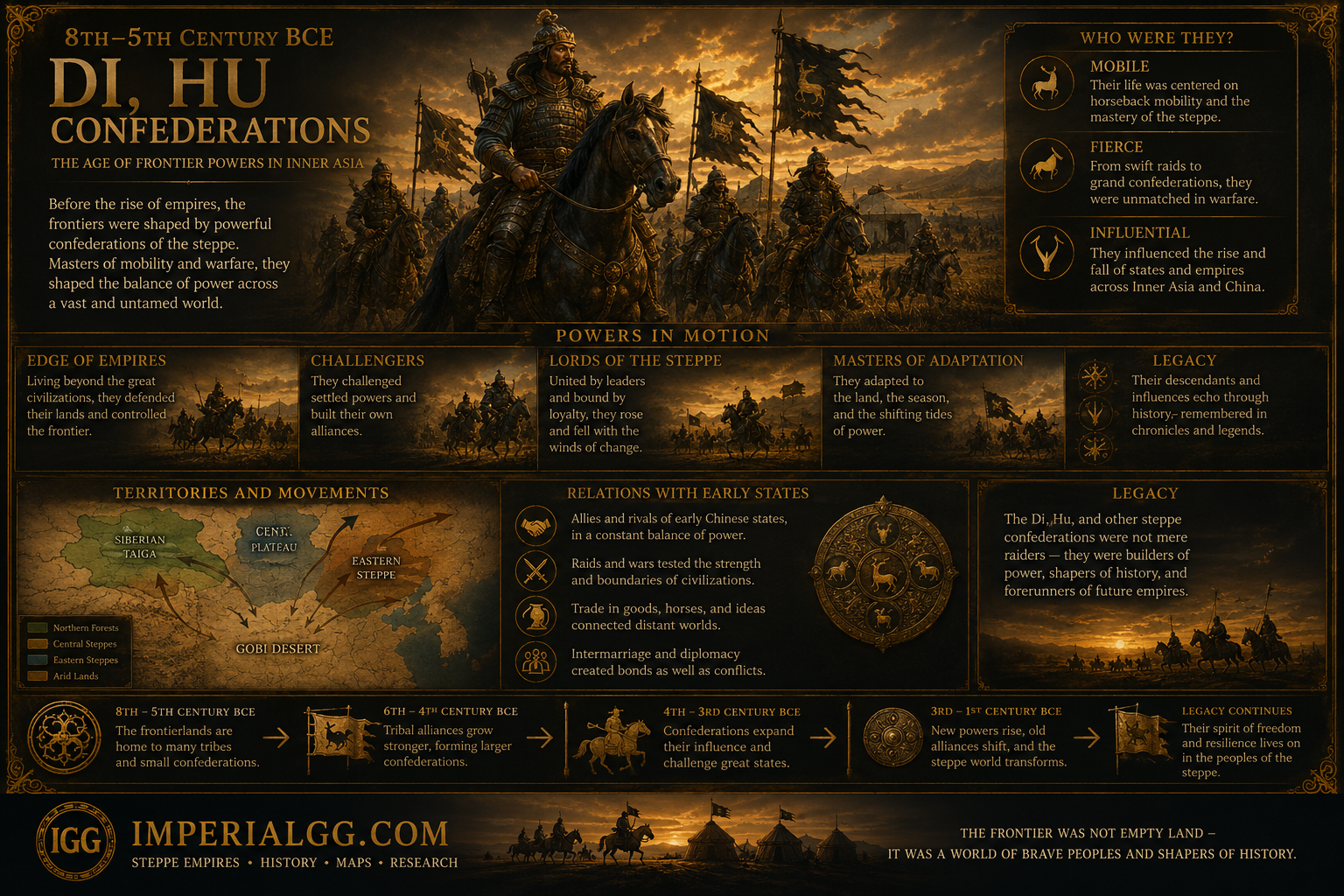
The Di: Peoples of the Northern Frontier and the Transformation of Early China
By Altanbagana Baatar
DBA Candidate| Independent Historian
ImperialGG Historical Research Seriers
05 July 2026
Reconsidering the Frontier World Between the Northern States and the Eastern Eurasian Steppe
Introduction
The Di were among the most significant frontier peoples recorded in the historical traditions of ancient China. Among the many frontier peoples recorded in the historical traditions of ancient China, few played a more significant role in the transformation of the northern frontier than the Di (狄). Frequently mentioned in the sources of the Spring and Autumn and Warring States periods, the Di were not a single tribe or unified ethnic community but a broad designation encompassing numerous populations inhabiting the lands north of the Central Plains.
Unlike many other frontier peoples, the Di maintained long and complex relationships with the states of northern China through warfare, diplomacy, migration, trade, and cultural exchange. They repeatedly influenced the balance of power among the regional states and became active participants in the political struggles that shaped early East Asian history. Their history therefore cannot be understood merely as that of peoples living beyond the frontier; rather, it forms an integral part of the historical development of northern China itself.
The territories associated with the Di extended across regions corresponding broadly to present-day Inner Mongolia, northern Hebei, Shanxi, and parts of southern Manchuria. These lands constituted a dynamic frontier zone where agrarian societies and mobile populations interacted continuously. Their geographical position exposed them to the emerging horse cultures of the northern steppe and made them important participants in the broader historical processes that shaped the eastern Eurasian frontier.
Chinese historical sources distinguish several Di groups, most notably the Red Di (Chidi, 赤狄) and the White Di (Baidi, 白狄), each occupying different territories and maintaining their own political organizations. The existence of these separate groups demonstrates that the term Di functioned primarily as a broad frontier designation rather than the name of a single people.
Traditional historiography often portrayed the Di as outsiders or “barbarians” beyond civilization. Modern scholarship, however, increasingly recognizes that the Di represented a diverse frontier world characterized by mobility, cultural interaction, and political adaptability. Their societies occupied an important transitional zone between the agrarian states of northern China and the societies of the eastern Eurasian steppe, serving both as rivals and as intermediaries between these two worlds.
The study of the Di is therefore essential for understanding the historical geography of the northern frontier, the emergence of horse-oriented cultures in eastern Eurasia, and the long processes of interaction that preceded the rise of the great nomadic confederations of Inner Asia.
Footnotes
- Nicola Di Cosmo, Ancient China and Its Enemies: The Rise of Nomadic Power in East Asian History (Cambridge: Cambridge University Press, 2002). (page verification required).
- Nicola Di Cosmo, Ancient China and Its Enemies: The Rise of Nomadic Power in East Asian History (Cambridge: Cambridge University Press, 2002). (page verification required).
- Gideon Shelach-Lavi, The Archaeology of Early China: From Prehistory to the Han Dynasty (Cambridge: Cambridge University Press, 2015); and Jessica Rawson, “The Northern Frontier of Late Bronze Age China,” in The Cambridge History of Ancient China: From the Origins of Civilization to 221 B.C., ed. Michael Loewe and Edward L. Shaughnessy (Cambridge: Cambridge University Press, 1999). (page verification required).
- Zuo Zhuan. (page verification required).
- Edwin G. Pulleyblank, “The Chinese and Their Neighbors in Prehistoric and Early Historic Times,” in The Origins of Chinese Civilization, ed. David N. Keightley (Berkeley: University of California Press, 1983). (page verification required).
Historical Sources and Terminology
The term Di (狄) occupies a prominent place in the historical literature of ancient China, yet its precise meaning remains elusive. Like many frontier ethnonyms recorded in early Chinese sources, Di did not designate a single tribe, kingdom, or ethnic community. Rather, it functioned as a broad designation applied to numerous populations inhabiting the northern frontier beyond the political core of the Central Plains.
The earliest references to the Di appear in texts of the Western Zhou period, but they become especially prominent during the Spring and Autumn era, when the northern frontier emerged as one of the principal arenas of political and military interaction. Sources such as the Book of Documents, the Book of Songs, the Zuo Zhuan, and later the Records of the Grand Historian preserve valuable information concerning the activities of various Di groups and their relationships with the states of northern China.
Chinese historical sources distinguish several major Di communities. The most important among them were the Red Di (Chidi, 赤狄) and the White Di (Baidi, 白狄), each occupying different territories and maintaining their own political organizations. The Zuo Zhuan also mentions the Tall Di (Changdi, 長狄), further illustrating the diversity of the populations encompassed by the term Di. The existence of these separate groups demonstrates that Di functioned primarily as a general frontier designation rather than the name of a unified people.
The territories associated with the Di extended across much of present-day Inner Mongolia, northern Hebei, Shanxi, and parts of southern Manchuria. These regions formed a broad northern frontier characterized by ecological diversity, seasonal mobility, and continual interaction between agricultural and pastoral communities. Unlike the western frontier inhabited by many Rong groups, the lands associated with the Di were more directly connected to the open grasslands of the eastern Eurasian steppe.
This geographical position may have had important historical consequences. The northern frontier exposed many Di communities to increasingly mobile forms of life and to the growing importance of horses in warfare and communication. Although the Di should not be regarded as fully developed nomadic cavalry societies comparable to the later Xiongnu, they may represent an important stage in the historical development of the northern frontier and the gradual emergence of horse-oriented cultures in eastern Eurasia.
The terminology itself also deserves careful consideration. As with Rong, the term Di was an exonym employed by Chinese authors and frequently reflected cultural and political perceptions rather than precise ethnic realities. Communities identified as Di in one source sometimes disappeared from the historical record, reappeared under different names, or were gradually incorporated into expanding states. Consequently, the study of the Di requires caution, for the term may have encompassed populations of diverse linguistic and cultural backgrounds.
Modern scholarship increasingly emphasizes this complexity. Rather than viewing the Di as a single ethnic nation, historians now regard them as a diverse frontier world inhabiting the northern borderlands between the states of early China and the eastern Eurasian steppe. Their significance lies not in ethnic uniformity but in their role as active participants in the political, military, and cultural transformations that shaped the northern frontier for centuries.
Footnotes
- Nicola Di Cosmo, Ancient China and Its Enemies: The Rise of Nomadic Power in East Asian History (Cambridge: Cambridge University Press, 2002). (page verification required).
- Book of Documents; Book of Songs; Zuo Zhuan; and Records of the Grand Historian.
- Zuo Zhuan. (page verification required).
- Gideon Shelach-Lavi, The Archaeology of Early China: From Prehistory to the Han Dynasty (Cambridge: Cambridge University Press, 2015); and Jessica Rawson, “The Northern Frontier of Late Bronze Age China,” in The Cambridge History of Ancient China: From the Origins of Civilization to 221 B.C., ed. Michael Loewe and Edward L. Shaughnessy (Cambridge: Cambridge University Press, 1999). (page verification required).
- Nicola Di Cosmo, Ancient China and Its Enemies; and Thomas J. Barfield, The Perilous Frontier: Nomadic Empires and China (Cambridge, MA: Blackwell, 1989). (page verification required).
- Edwin G. Pulleyblank, “The Chinese and Their Neighbors in Prehistoric and Early Historic Times,” in The Origins of Chinese Civilization, ed. David N. Keightley (Berkeley: University of California Press, 1983). (page verification required).
Political and Military History
The Di were among the most active and influential peoples of the northern frontier during the Spring and Autumn period. Unlike many frontier populations that remained largely beyond the political affairs of the Central Plains, various Di communities became deeply involved in the struggles among the states of northern China through warfare, alliances, migration, and diplomacy. Their history illustrates the increasingly interconnected nature of the frontier world and the growing importance of the northern borderlands in early East Asian politics.
The weakening of Zhou royal authority after the collapse of the Western Zhou created opportunities for frontier peoples to expand their influence. Numerous Di groups occupied territories north of the major states and frequently intervened in regional affairs. Chinese historical sources describe repeated conflicts between the Di and the states of Jin, Wey, and other northern polities, as well as periods of alliance and coexistence. The frontier was therefore not a rigid boundary separating two worlds but rather a dynamic zone of interaction where political relationships constantly evolved.
Among the various Di communities, the Red Di (Chidi, 赤狄) emerged as particularly influential during the seventh and sixth centuries BCE. Several Red Di polities developed stable political organizations and controlled strategically important territories along the northern frontier. Their military activities frequently affected the balance of power among the states of northern China and demonstrate that at least some Di communities possessed considerable political and military capabilities.
The White Di (Baidi, 白狄) likewise occupied an important place in the history of the northern frontier. Historical sources indicate that they maintained extensive contacts with neighboring states and participated in the shifting alliances and conflicts that characterized the Spring and Autumn period. The existence of separate Red and White Di communities further demonstrates the political and cultural diversity encompassed by the term Di.
The geographical position of the Di distinguished them from many western frontier populations. Occupying regions adjacent to the open grasslands of the eastern Eurasian steppe, many Di communities appear to have practiced increasingly mobile forms of life and to have placed growing importance on horses and mounted warfare. Although the available evidence does not support the conclusion that the Di were fully developed nomadic cavalry societies comparable to the later Xiongnu, their northern environment exposed them to historical processes that would eventually transform the military and political landscape of Inner Asia.
Relations between the Di and the northern states were not limited to conflict. Trade, migration, intermarriage, and cultural exchange also formed important aspects of frontier interaction. Over time, many Di groups were incorporated into expanding states, while others fragmented, migrated, or disappeared from the historical record. Yet these processes of absorption and transformation were characteristic of the frontier world itself, where political identities frequently changed and new confederations continually emerged.
The political and military history of the Di therefore reveals a northern frontier characterized by remarkable dynamism and adaptability. Far from existing on the margins of history, the Di were active participants in the transformations that reshaped northern China and the eastern Eurasian steppe during the first millennium BCE.
Footnotes
- Nicola Di Cosmo, Ancient China and Its Enemies: The Rise of Nomadic Power in East Asian History (Cambridge: Cambridge University Press, 2002). (page verification required).
- Zuo Zhuan; and Records of the Grand Historian. (page verification required).
- Zuo Zhuan. (page verification required).
- Records of the Grand Historian. (page verification required).
- Thomas J. Barfield, The Perilous Frontier: Nomadic Empires and China (Cambridge, MA: Blackwell, 1989); and Nicola Di Cosmo, Ancient China and Its Enemies. (page verification required).
- Edwin G. Pulleyblank, “The Chinese and Their Neighbors in Prehistoric and Early Historic Times,” in The Origins of Chinese Civilization, ed. David N. Keightley (Berkeley: University of California Press, 1983). (page verification required).
Society, Identity, and Scholarly Debates
Among the frontier peoples of early China, the Di present one of the most intriguing problems of historical interpretation. The term Di (狄) did not denote a single tribe, language, or ethnic community. Rather, it encompassed numerous populations inhabiting the northern frontier, many of whom likely possessed distinct political traditions, economic systems, and cultural identities. Consequently, modern attempts to identify the Di with particular later peoples have produced a wide range of competing interpretations.
Traditional Chinese historiography frequently portrayed the Di as outsiders living beyond the civilized world of the Central Plains. Modern scholarship, however, increasingly rejects such portrayals and instead views the Di as diverse frontier societies occupying a broad transitional zone between northern China and the eastern Eurasian steppe.Their history demonstrates the permeability of the frontier and the constant movement of peoples, ideas, and technologies across northern Eurasia.
The question of Di ethnicity and language remains unresolved. Some scholars have proposed that certain Di groups may have spoken languages related to early Tibeto-Burman communities, while others have suggested possible connections with Proto-Mongolic, Para-Mongolic, Turkic, or even Indo-European-speaking populations. The available evidence, however, remains insufficient to support any single explanation. The northern frontier was inhabited by numerous communities whose linguistic and ethnic identities likely varied considerably from one region to another.
Archaeological evidence further supports this interpretation. Excavations in Inner Mongolia, northern Hebei, Shanxi, and southern Manchuria reveal a mosaic of Bronze and Early Iron Age cultures characterized by mixed economies, regional diversity, and increasing mobility.Material culture indicates both local development and long-distance connections linking the northern frontier with the wider world of the eastern Eurasian steppe.
The geographical position of the Di has attracted particular scholarly attention. Unlike many western frontier populations, the Di occupied territories directly adjacent to the open grasslands of Inner Asia. This environment appears to have encouraged increasing mobility and growing familiarity with horses and mounted warfare. Although the Di should not be regarded as fully developed nomadic cavalry societies, they may represent an important historical stage in the emergence of the horse-oriented cultures that would later dominate the northern frontier.
The political organization of the Di was likewise complex. The Red Di (Chidi) and the White Di (Baidi) maintained separate political identities, yet they belonged to the same broader northern frontier world and occasionally appear to have pursued parallel or cooperative policies in their relations with the states of northern China. Periods of military pressure may at times have encouraged the formation of temporary alliances among different Di communities, even though the historical sources provide no evidence for a permanent and unified Di confederation.
Modern scholarship therefore increasingly treats the Di not as a single ethnic nation but as a diverse and dynamic frontier world occupying a pivotal position between northern China and the eastern Eurasian steppe. Their significance lies precisely in this position. They served as intermediaries, rivals, and participants in the long historical processes that transformed the northern frontier and prepared the ground for the emergence of later political formations in Inner Asia.
Footnotes
- Nicola Di Cosmo, Ancient China and Its Enemies: The Rise of Nomadic Power in East Asian History (Cambridge: Cambridge University Press, 2002). (page verification required).
- Edwin G. Pulleyblank, “The Chinese and Their Neighbors in Prehistoric and Early Historic Times,” in The Origins of Chinese Civilization, ed. David N. Keightley (Berkeley: University of California Press, 1983). (page verification required).
- Christopher I. Beckwith, Empires of the Silk Road: A History of Central Eurasia from the Bronze Age to the Present (Princeton: Princeton University Press, 2009); and Edwin G. Pulleyblank, various studies on early frontier peoples. (page verification required).
- Gideon Shelach-Lavi, The Archaeology of Early China: From Prehistory to the Han Dynasty (Cambridge: Cambridge University Press, 2015); and Jessica Rawson, “The Northern Frontier of Late Bronze Age China,” in The Cambridge History of Ancient China: From the Origins of Civilization to 221 B.C., ed. Michael Loewe and Edward L. Shaughnessy (Cambridge: Cambridge University Press, 1999). (page verification required).
- Thomas J. Barfield, The Perilous Frontier: Nomadic Empires and China (Cambridge, MA: Blackwell, 1989); and Nicola Di Cosmo, Ancient China and Its Enemies. (page verification required).
- Zuo Zhuan; and Records of the Grand Historian. (page verification required).
Legacy and Historical Significance
Although the name Di gradually disappeared from the historical record, the historical significance of the Di peoples extended far beyond the fate of any particular tribe or political community. For several centuries, the Di remained among the most important inhabitants of the northern frontier and played a decisive role in shaping the political, military, and cultural development of northern China.
The history of the Di demonstrates that the northern frontier was not a peripheral zone inhabited by isolated tribes but a dynamic and politically significant region whose peoples repeatedly influenced the balance of power among the states of early China. Through warfare, diplomacy, migration, and alliance, various Di communities became deeply integrated into the history of the northern states and contributed to the transformation of the frontier itself.
Equally important was the geographical position of the Di. Occupying territories corresponding broadly to present-day Inner Mongolia, northern Hebei, Shanxi, and parts of southern Manchuria, the Di inhabited regions directly adjacent to the open grasslands of the eastern Eurasian steppe. This environment encouraged increasing mobility and exposed many Di communities to the growing importance of horses and mounted warfare. Although the available evidence does not permit the conclusion that the Di were fully developed nomadic cavalry societies, they occupied a historical environment that anticipated many of the characteristics later associated with the great peoples of the northern steppe.
The significance of the Di therefore lies not only in their interactions with the states of northern China but also in their place within the long-term development of the frontier world itself. The northern regions inhabited by the Di would later become the homelands of numerous powerful peoples and confederations, including the Beidi, Donghu, and other steppe communities that emerged in subsequent centuries. While direct lines of descent cannot presently be demonstrated, the geographical and cultural continuities of the northern frontier strongly suggest that the history of the Di formed part of the broader historical processes that shaped the eastern Eurasian steppe.
The disappearance of the name Di should therefore not be mistaken for the disappearance of the peoples themselves. Throughout the history of Inner Asia, ethnonyms frequently changed while populations were absorbed into new confederations, reorganized under different political structures, or reappeared under new names. The northern frontier repeatedly generated new political formations, and the Di occupied an important place in this long historical continuum.
The legacy of the Di ultimately lies in their role as intermediaries between the agrarian states of northern China and the societies of the eastern Eurasian steppe. They stood at the crossroads of two worlds and participated in the historical processes that transformed both. Their history reveals that the emergence of the great nomadic powers of Inner Asia was preceded by many centuries of political and cultural development among earlier frontier populations whose contributions have often been underestimated in traditional historical narratives.
Conclusion
The Di remain among the most important yet least understood peoples of early East Asian history. Far from constituting a single ethnic nation, they represented a diverse frontier world inhabiting the northern borderlands between the states of early China and the eastern Eurasian steppe.
Their repeated interactions with the northern states, their occupation of regions closely connected to the open steppe, and their increasing familiarity with mobile forms of life and horse-oriented warfare demonstrate that they were active participants in the transformation of the northern frontier. Although many questions concerning their languages, ethnic affiliations, and historical descendants remain unresolved, their significance is undeniable.
The study of the Di therefore provides valuable insight into the deep history of the northern frontier and the long historical processes that eventually gave rise to the great political formations of Inner Asia. They should be understood not merely as peoples beyond the borders of ancient China, but as essential participants in the making of early East Asian civilization and in the development of the eastern Eurasian steppe.
Recent Mongolian scholarship has increasingly cautioned against interpreting every ethnonym in early Chinese sources as evidence of complete population replacement. Archaeological studies on the Bronze and Early Iron Age cultures of the Mongolian Plateau, together with the works of Mongolian historians such as Gunjiin Sukhbaatar and P. Delgerjargal, suggest that the peoples known as the Di should be examined within the broader context of the long-term cultural and demographic development of Inner Asia rather than as an isolated and unrelated population.
Footnotes
- Nicola Di Cosmo, Ancient China and Its Enemies: The Rise of Nomadic Power in East Asian History (Cambridge: Cambridge University Press, 2002). (page verification required).
- Zuo Zhuan; and Records of the Grand Historian. (page verification required).
- Gideon Shelach-Lavi, The Archaeology of Early China: From Prehistory to the Han Dynasty (Cambridge: Cambridge University Press, 2015). (page verification required).
- Thomas J. Barfield, The Perilous Frontier: Nomadic Empires and China (Cambridge, MA: Blackwell, 1989); and Nicola Di Cosmo, Ancient China and Its Enemies. (page verification required).
- Edwin G. Pulleyblank, “The Chinese and Their Neighbors in Prehistoric and Early Historic Times,” in The Origins of Chinese Civilization, ed. David N. Keightley (Berkeley: University of California Press, 1983). (page verification required).
Author’s Thesis
This essay argues that the Di were not merely peripheral tribes beyond the northern borders of early China but one of the most significant frontier populations in the long historical development of the eastern Eurasian steppe. Their occupation of the northern frontier, extending across regions corresponding broadly to present-day Inner Mongolia, northern Hebei, Shanxi, and parts of southern Manchuria, placed them within an environment increasingly shaped by mobility, pastoral adaptation, and the growing importance of horses in transportation and warfare.
Furthermore, this study contends that the Di may represent an important transitional stage in the emergence of the horse-oriented cultures that later came to dominate the northern frontier and Inner Asia. Although the available evidence does not permit the conclusion that the Di were fully developed nomadic cavalry societies, their geographical position and cultural environment suggest a closer relationship to the evolving steppe world than that of many other frontier populations of the same period.
This essay also draws attention to ongoing scholarly discussions concerning the ethnolinguistic identity of the Di. Several scholars have proposed that at least some Di communities may have been associated with early Para-Mongolic or Proto-Mongolic linguistic populations, although no scholarly consensus has yet emerged. Such hypotheses deserve further investigation through archaeology, historical geography, and comparative linguistics, particularly in light of the geographical overlap between the lands of the Di and the regions that later gave rise to powerful northern confederations.
Finally, this study argues that the history of the Di should be understood within a broader framework of long-term frontier continuity. The northern territories inhabited by the Di subsequently became the homeland of numerous influential peoples and political formations, including the Beidi, Donghu, and later steppe confederations. While direct ethnic descent cannot presently be demonstrated, the historical and geographical continuities of the northern frontier strongly suggest that the Di occupied a pivotal position in the deep history of the eastern Eurasian steppe and deserve greater recognition in the study of early Inner Asia.
Although the precise relationship between the Di and later eastern steppe peoples remains uncertain, the possibility of historical continuity cannot be dismissed. The emergence of the Donghu in subsequent Chinese records therefore raises important questions regarding the evolution of populations inhabiting the Mongolian Plateau.