The Chagatai Khanate: Where a New Eurasia Was Born
By Altanbagana Baatar
DBA Candidate| Independent Historian
ImperialGG Historical Research Seriers
30 June 2026
The Formation of the Chagadai Ulus
Abstract
The Chagatai Ulus is often overshadowed by the histories of the Yuan Dynasty, the Ilkhanate, and the Golden Horde. Yet it occupied the geographical heart of Eurasia and played a decisive role in shaping the historical development of Central Asia. This article argues that the significance of the Chagatai Khanate extends far beyond its existence as one of the successor states of the Mongol Empire. Through the interaction of Mongol and Turkic traditions, the expansion of transcontinental trade networks, the emergence of the Chagatai literary language, and the formation of new political and cultural identities, the khanate became the foundation of a new Eurasian world. Although the original state fragmented during the fourteenth century, the Chagataid political and cultural order endured through Moghulistan, the Yarkent Khanate, and subsequent Central Asian traditions. The article therefore proposes that the Chagatai Khanate should be understood not merely as a vanished medieval polity, but as one of the principal historical forces that shaped the making of modern Central Asia and the broader history of Eurasia.
Introduction
Among the successor states of the Mongol Empire, the Chagatai Khanate has often occupied a relatively marginal place in both academic scholarship and popular historical narratives. The Yuan Dynasty is remembered for its conquest of China, the Ilkhanate for its role in the Islamic world, and the Golden Horde for its influence on Eastern Europe and Russia. By contrast, the Chagatai Khanate is frequently portrayed merely as a transitional polity situated between these more prominent states. Such an interpretation, however, obscures its profound historical significance.
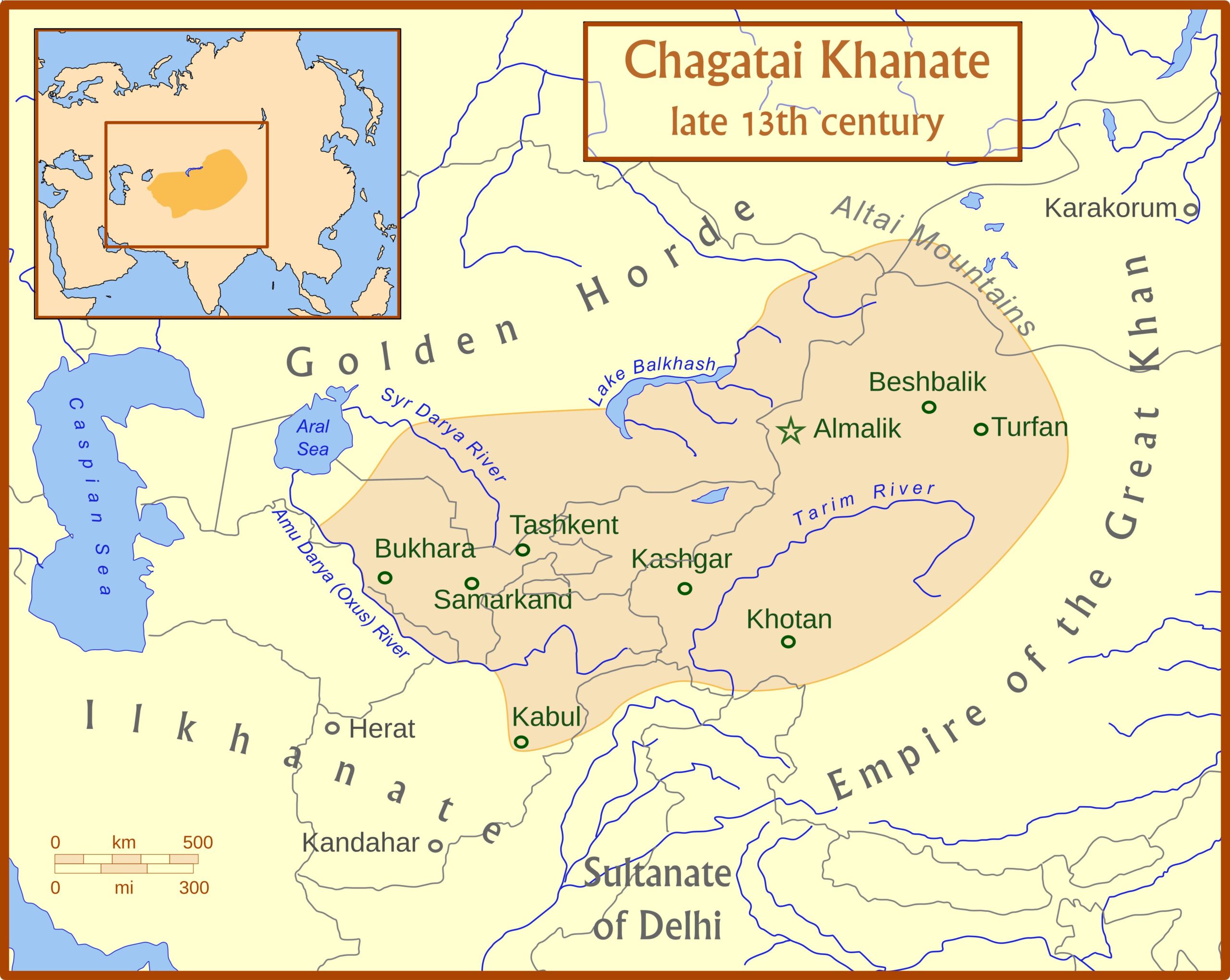
Established in 1227 following the death of Genghis Khan, the Chagatai Ulus inherited the geographical heart of Central Asia. Stretching from the Ili Valley and Semirechye to Transoxiana and the western fringes of the Tarim Basin, it occupied one of the most strategically important regions of Eurasia and controlled significant segments of the transcontinental trade routes commonly known as the Silk Roads.The khanate became a meeting place of Mongol, Turkic, Persian, and Islamic traditions and served as a major conduit for the movement of peoples, goods, and ideas across the continent.
The importance of the Chagatai Khanate lies not merely in its political history but in the new historical world that emerged within its territories. During the thirteenth and fourteenth centuries, Central Asia underwent profound transformations. New political institutions appeared, Turkic and Mongol elites became increasingly integrated, and a distinctive cultural sphere gradually developed. The emergence of the Chagatai literary language and the persistence of Chagataid political legitimacy long after the fragmentation of the original state demonstrate that the khanate produced an enduring historical legacy that extended far beyond its own existence.
Despite its importance, the Chagatai Khanate has received considerably less scholarly attention than other major Mongol successor states. Historiography has traditionally concentrated on the Mongol conquest of China, the Islamization of the Ilkhanate, or the rise of Muscovy under the Golden Horde, often treating Central Asia as a peripheral region rather than as one of the principal centers of Eurasian transformation.Such an approach underestimates the pivotal role of the Chagatai realm in shaping the political, cultural, and linguistic landscape of Inner Asia.
This article argues that the Chagatai Khanate should be understood as one of the principal foundations of a new Eurasia. Although the original state ceased to exist as a unified political entity during the fourteenth century, the world it created survived through Moghulistan, the Yarkent Khanate, and the broader political and cultural traditions of Central Asia. In this sense, the Chagatai state ended, but the Chagatai world endured.
The present study employs a historical and comparative approach and draws upon both primary and secondary sources. Among the principal sources are The Secret History of the Mongols, Rashid al-Din’s Jami’ al-Tawarikh, the Yuan Shi, and Mirza Muhammad Haidar Dughlat’s Tarikh-i Rashidi, together with the modern scholarship of David Morgan, Peter Jackson, Michal Biran, and Beatrice Forbes Manz. By examining the political development of the khanate, the formation of its cultural and linguistic traditions, and the continuity of its legacy in later centuries, this study seeks to reassess the historical place of the Chagatai Khanate within Eurasian history and to demonstrate that the making of modern Central Asia cannot be fully understood without understanding the Chagatai world.
Author’s Thesis
This article proposes that the history of the Chagatai Khanate should not be confined to the chronology of a medieval state that fragmented during the fourteenth century. Rather, the Chagatai world continued to survive through a succession of political, cultural, and linguistic traditions that endured for centuries in Central Asia.
The states of Moghulistan and the Yarkent Khanate, both ruled by descendants of Chagatai Khan, preserved important elements of Chagataid legitimacy and political culture. Furthermore, the enduring influence of Chagataid institutions, literary traditions, and historical memory profoundly shaped the historical environment from which later Central Asian polities emerged.
This study therefore argues that the Chagatai world constituted one of the principal foundations of a new Eurasia and that its historical legacy extended far beyond the disappearance of the original khanate. In this broader historical sense, the Chagatai world may be understood as a long historical continuum whose influence reached into the early modern and, in some respects, even the modern history of Central Asia.
III. The Inheritance of Central Asia (1227–1260)
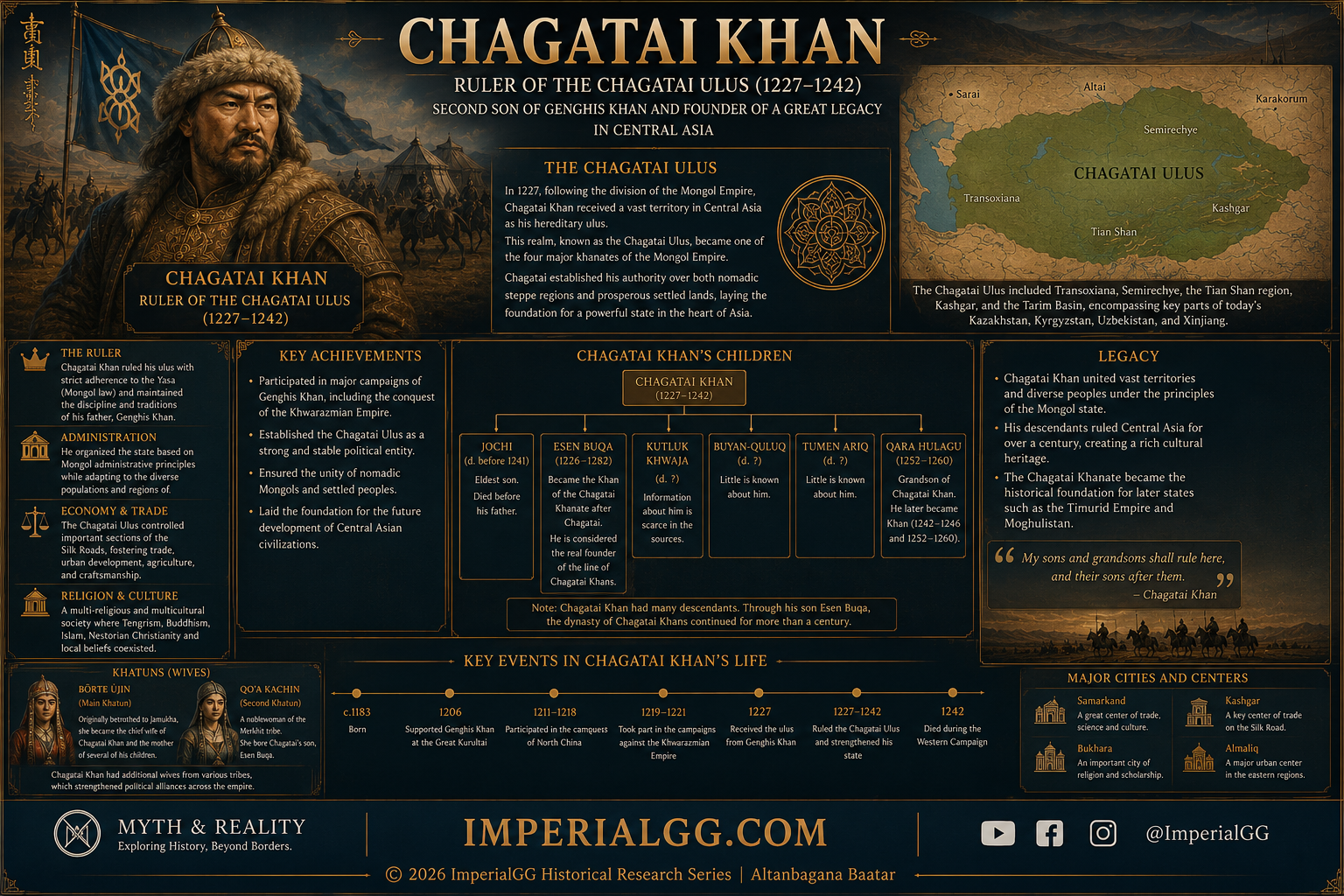
The death of Genghis Khan in 1227 marked a critical moment in the history of Eurasia. In accordance with the principles of Chinggisid patrimonial division, the vast Mongol Empire was apportioned among his sons, while supreme authority remained vested in the office of the Great Khan. Chagatai, the second son of Genghis Khan, inherited the central regions of Inner Asia, a territory extending from the Ili Valley and Semirechye to Transoxiana and the western fringes of the Tarim Basin.
The territories assigned to Chagatai were neither peripheral nor insignificant. They occupied the geographical heart of Eurasia and encompassed some of the most important commercial and strategic corridors of the medieval world. Major urban centers such as Almaliq, Kashgar, Balasaghun, and the cities of Transoxiana connected China, the Islamic world, and the Eurasian steppes through the network of routes collectively known as the Silk Roads.
The population of the ulus was equally diverse. Turkic-speaking nomads, settled Iranian populations, merchants from across Asia, and remnants of earlier political traditions coexisted within the Chagatai realm. The Mongol conquest did not erase these local traditions; rather, it created a new political framework in which different peoples, religions, and economic systems interacted with unprecedented intensity.
Although the early Chagatai Ulus remained an integral component of the wider Mongol Empire and acknowledged the authority of the Great Khan, it gradually developed its own political institutions and regional identity. The strategic position of the ulus at the center of Eurasia enabled it to become a meeting place of civilizations and laid the foundations for the emergence of a distinct Chagataid world in the centuries that followed.⁴
The Chagatai Ulus occupied one of the most strategically significant regions of medieval Eurasia. Its territories included Semirechye, the Ili Valley, the Chu River basin, Transoxiana, and parts of the Tarim Basin, placing the khanate at the crossroads of the major commercial and cultural routes linking East Asia, the Islamic world, and the Eurasian steppes.⁵
The region contained numerous urban centers that had flourished long before the Mongol conquest. Cities such as Almaliq, Balasaghun, Kashgar, Otrar, Bukhara, and Samarkand served as important administrative, commercial, and cultural centers. The Mongol conquest initially caused disruption and destruction in some regions, yet the subsequent establishment of political stability under the Pax Mongolica facilitated the revival of long-distance trade and communication.⁶
The geographical position of the Chagatai realm allowed merchants, scholars, diplomats, and religious figures to move across Eurasia with unprecedented frequency. The khanate therefore became not merely a territorial possession of the Chinggisids but a central arena of cultural exchange and economic integration. The historical importance of the Chagatai Ulus lay partly in its ability to connect different civilizations and to transform Central Asia into one of the principal crossroads of the medieval world.⁷
Although the Chagatai Ulus remained formally subordinate to the Great Khan, it gradually developed its own administrative and political structures. The Chinggisid principle of patrimonial rule was preserved, and authority rested upon the legitimacy of the descendants of Genghis Khan. Local administrators, military commanders, and urban elites continued to play important roles in governing the diverse populations of the khanate.⁸
The early rulers of the Chagatai realm sought to maintain order across a vast and heterogeneous territory inhabited by nomadic pastoralists and sedentary urban populations. The coexistence of different legal traditions, economic systems, and religious communities required considerable administrative flexibility. In many respects, the Chagatai Ulus represented an experiment in imperial governance, combining Mongol political traditions with pre-existing Central Asian institutions.⁹
By the middle of the thirteenth century, the foundations of a distinct Chagataid political order had begun to emerge. Although the khanate remained part of the larger Mongol imperial system, its strategic position and internal development increasingly gave it a separate historical trajectory, one that would profoundly influence the later history of Central Asia.
The inheritance of Central Asia by Chagatai in 1227 was therefore far more than a dynastic division of territory. It established a political and geographical framework that would transform the heart of Eurasia for centuries. From this inheritance emerged the Chagatai world—a new Eurasian space in which peoples, cultures, and traditions interacted to shape the future history of Central Asia.
IV. The Formation of the Chagatai World (1260s–1340s)
The decades following the death of Möngke Khan in 1259 fundamentally transformed the political landscape of the Mongol Empire. The civil war between Qubilai and Ariq Böke weakened the authority of the Great Khan and accelerated the political autonomy of the imperial uluses. In Central Asia, the Chagatai realm increasingly pursued its own interests and gradually evolved from a regional division of the Mongol Empire into a distinct political entity.
A decisive turning point came with the rise of Alghu Khan (r. 1260–1266). Originally appointed by Ariq Böke, Alghu eventually rejected the latter’s authority and established an independent course for the Chagatai realm. The political struggles of the 1260s demonstrated that the Chagatai Ulus was no longer merely an administrative inheritance of Chagatai, son of Genghis Khan, but an increasingly autonomous state with its own political ambitions and regional interests.
The consolidation of the khanate continued under Duwa Khan (r. 1282–1307), one of the most influential rulers in Chagataid history. Duwa succeeded in stabilizing the realm after decades of internal conflict and transformed the Chagatai Khanate into one of the principal powers of Inner Asia. His reign witnessed the strengthening of political institutions, the revival of trade, and the expansion of diplomatic relations with neighboring states. Although the khanate maintained complex relations with the Yuan Dynasty and the Ögedeid princes, it increasingly acted as an independent actor in Eurasian politics.
The strategic location of the Chagatai realm contributed significantly to its historical importance. Situated at the center of Eurasia, the khanate controlled vital segments of the Silk Roads linking China, India, the Islamic world, and the western steppes. Merchants, scholars, artisans, and religious figures crossed its territories in growing numbers. The period commonly known as the Pax Mongolica facilitated unprecedented levels of mobility and communication across the continent. As Thomas Allsen has argued, the Mongol Empire created a new environment of transcontinental interaction that encouraged the exchange of goods, technologies, and ideas.⁴ The Chagatai realm stood at the very heart of this Eurasian system.
Equally important was the interaction between Mongol and Turkic populations within the khanate. The Mongol ruling elite gradually became integrated into the predominantly Turkic environment of Central Asia. Political alliances, military cooperation, intermarriage, and economic interaction produced a gradual process of cultural synthesis. The result was neither the disappearance of Mongol traditions nor the simple continuation of earlier Turkic practices, but the emergence of a new political and cultural order that combined elements of both worlds.⁵
This process laid the foundations for what may be described as the Chagataid world. By the early fourteenth century, the Chagatai Khanate had developed its own political traditions, social structures, and cultural characteristics. The increasing use of Turkic languages, the growth of regional identities, and the integration of diverse populations created a distinct Central Asian sphere that differed from both the Yuan East and the Ilkhanid West.
The historical significance of this transformation extends far beyond the boundaries of the medieval khanate itself. Many of the political, cultural, and linguistic developments that shaped later Central Asian history originated during this period. The Chagatai world became the environment from which Moghulistan, the Chagatai literary tradition, and later Central Asian political formations would emerge. In this sense, the late thirteenth and early fourteenth centuries witnessed the birth of a new Eurasia in the heart of Central Asia.
IV. The Formation of the Chagatai World (1260s–1340s)
The decades following the death of Möngke Khan in 1259 fundamentally transformed the political landscape of the Mongol Empire. The civil war between Qubilai and Ariq Böke weakened the authority of the Great Khan and accelerated the political autonomy of the imperial uluses. In Central Asia, the Chagatai realm increasingly pursued its own interests and gradually evolved from a regional division of the Mongol Empire into a distinct political entity.
A decisive turning point came with the rise of Alghu Khan (r. 1260–1266). Originally appointed by Ariq Böke, Alghu eventually rejected the latter’s authority and established an independent course for the Chagatai realm. The political struggles of the 1260s demonstrated that the Chagatai Ulus was no longer merely an administrative inheritance of Chagatai, son of Genghis Khan, but an increasingly autonomous state with its own political ambitions and regional interests.
The consolidation of the khanate continued under Duwa Khan (r. 1282–1307), one of the most influential rulers in Chagataid history. Duwa succeeded in stabilizing the realm after decades of internal conflict and transformed the Chagatai Khanate into one of the principal powers of Inner Asia. His reign witnessed the strengthening of political institutions, the revival of trade, and the expansion of diplomatic relations with neighboring states. Although the khanate maintained complex relations with the Yuan Dynasty and the Ögedeid princes, it increasingly acted as an independent actor in Eurasian politics.
The strategic location of the Chagatai realm contributed significantly to its historical importance. Situated at the center of Eurasia, the khanate controlled vital segments of the Silk Roads linking China, India, the Islamic world, and the western steppes. Merchants, scholars, artisans, and religious figures crossed its territories in growing numbers. The period commonly known as the Pax Mongolica facilitated unprecedented levels of mobility and communication across the continent. As Thomas Allsen has argued, the Mongol Empire created a new environment of transcontinental interaction that encouraged the exchange of goods, technologies, and ideas. The Chagatai realm stood at the very heart of this Eurasian system.
Equally important was the interaction between Mongol and Turkic populations within the khanate. The Mongol ruling elite gradually became integrated into the predominantly Turkic environment of Central Asia. Political alliances, military cooperation, intermarriage, and economic interaction produced a gradual process of cultural synthesis. The result was neither the disappearance of Mongol traditions nor the simple continuation of earlier Turkic practices, but the emergence of a new political and cultural order that combined elements of both worlds.
This process laid the foundations for what may be described as the Chagataid world. By the early fourteenth century, the Chagatai Khanate had developed its own political traditions, social structures, and cultural characteristics. The increasing use of Turkic languages, the growth of regional identities, and the integration of diverse populations created a distinct Central Asian sphere that differed from both the Yuan East and the Ilkhanid West.
The historical significance of this transformation extends far beyond the boundaries of the medieval khanate itself. Many of the political, cultural, and linguistic developments that shaped later Central Asian history originated during this period. The Chagatai world became the environment from which Moghulistan, the Chagatai literary tradition, and later Central Asian political formations would emerge. In this sense, the late thirteenth and early fourteenth centuries witnessed the birth of a new Eurasia in the heart of Central Asia.
V. The Chagatai Language and the Making of a New Eurasian Culture
Among the most enduring legacies of the Chagatai world was the emergence of the Chagatai literary language. Although its classical form flourished during the Timurid period, its origins lay in the political and cultural environment created by the Chagatai Khanate. The formation of a new Central Asian order after the Mongol conquest brought Turkic-speaking populations and Mongol ruling elites into sustained interaction, creating conditions that encouraged the development of a common literary and cultural sphere.
The Chagatai language belonged fundamentally to the Karluk branch of the Turkic language family and should not be regarded as a Mongolian language. Nevertheless, its historical development cannot be understood apart from the Mongol world in which it emerged. The political institutions established by the Chinggisids, the prestige of Mongol ruling traditions, and the integration of Mongol and Turkic elites profoundly shaped the linguistic environment of Central Asia. As a result, Chagatai absorbed numerous Mongolian lexical, administrative, and military terms that reflected the political realities of the age.
The term “Chagatai” itself originally referred to the territories and peoples associated with the descendants of Chagatai Khan. Over time, it came to designate a literary language that served as a medium of written communication among educated elites throughout much of Central Asia. The emergence of a common literary language represented an important stage in the cultural integration of the region. Merchants, administrators, scholars, and poets increasingly operated within a shared intellectual environment that transcended tribal and regional boundaries.
The significance of the Chagatai language extended beyond literature. It became one of the principal vehicles through which historical memory, political ideas, and cultural traditions were transmitted across Inner Asia. The language helped create a broader Central Asian cultural sphere in which Turkic, Mongol, Persian, and Islamic traditions interacted and coexisted. In this sense, the Chagatai literary tradition constituted one of the most important cultural foundations of the Chagatai world.
The literary achievements of later centuries, particularly those associated with Ali-Shir Nava’i and Babur, demonstrated the remarkable vitality of this tradition. By the fifteenth and sixteenth centuries, Chagatai had become one of the principal literary languages of the Islamic world and an important medium of poetry, history, and political thought.
The historical importance of Chagatai lies not only in its literary accomplishments but also in its enduring legacy. Both modern Uzbek and modern Uyghur literary traditions inherited important elements from the Chagatai linguistic heritage, although neither can be regarded as a simple or exclusive continuation of medieval Chagatai.
The emergence of the Chagatai language therefore illustrates one of the most enduring consequences of the Chagatai Khanate. States may disappear, but cultural traditions often survive for centuries. The Chagatai state eventually fragmented, yet the literary and intellectual world that developed within it continued to shape Central Asia long after the original khanate had ceased to exist.
VI. Islamization and Cultural Transformation
The Islamization of the Chagatai world constituted one of the most significant transformations in the history of medieval Central Asia. During the thirteenth century, the Chagatai Khanate remained religiously diverse, encompassing Buddhists, Christians, Muslims, and adherents of traditional Mongol beliefs. The Mongol conquest did not initially seek to impose a single religious system, and religious pluralism remained a defining feature of the early khanate.
A major turning point occurred during the reign of Tarmashirin Khan (r. c. 1326–1334), who embraced Islam and actively promoted the faith within the Chagatai realm. His conversion reflected broader social and political developments that had gradually brought the Mongol ruling elite into closer contact with the predominantly Muslim populations of Transoxiana and other urban centers. Islam increasingly became a source of political legitimacy and an important component of statecraft.
The spread of Islam did not, however, signify the disappearance of earlier Mongol traditions. Chinggisid legitimacy remained fundamental to political authority, and many institutions inherited from the Mongol imperial order continued to function. The transformation of the Chagatai world was therefore characterized by adaptation and synthesis rather than by abrupt cultural replacement.
The Islamization of the khanate also accelerated processes of cultural integration throughout Central Asia. Islamic scholarship, religious networks, and urban institutions became increasingly influential, contributing to the formation of a broader cultural sphere that connected Central Asia with the wider Islamic world.At the same time, the political traditions of the Chinggisids and the social realities of the steppe continued to shape the region’s historical development.
The significance of this transformation extended far beyond the fourteenth century. The synthesis of Mongol, Turkic, and Islamic traditions became one of the defining characteristics of later Central Asian civilization and profoundly influenced the political and cultural worlds of Moghulistan, the Timurid Empire, and subsequent states of Inner Asia. The Islamization of the Chagatai realm therefore represented not the end of the Chagataid world but one of the principal forces that reshaped and sustained it.
VII. The Fragmentation of the Chagatai State
The fourteenth century witnessed profound political changes within the Chagatai realm. Following the reign of Tarmashirin Khan, internal conflicts, regional rivalries, and disputes over political authority weakened the unity of the khanate. The growing differences between the predominantly nomadic eastern regions and the more urbanized and Islamicized west gradually undermined the cohesion of the Chagataid state.
By the middle of the fourteenth century, the Chagatai Khanate had effectively divided into two distinct political spheres. In the west, Transoxiana became increasingly dominated by powerful military and tribal leaders, while in the east the territories of Semirechye and the Tarim Basin gave rise to the polity later known as Moghulistan. This division did not immediately destroy the Chagataid political order, but it fundamentally transformed its institutional and geographical character.
The establishment of Moghulistan in 1348 represented one of the most important developments in the history of the Chagatai world. The new state was ruled by descendants of Chagatai Khan and preserved important elements of Chagataid political legitimacy. Although it developed its own regional characteristics, Moghulistan remained deeply rooted in the political and cultural traditions of the eastern Chagatai realm.
In Transoxiana, a different historical process unfolded. During the second half of the fourteenth century, Timur emerged as the dominant political figure in the region. Although he was not a descendant of Genghis Khan, he carefully preserved the principle of Chinggisid legitimacy by ruling through puppet Chagataid khans. This arrangement demonstrates the enduring prestige of the Chagataid political tradition even after the fragmentation of the original state.
The dissolution of political unity did not signify the end of the Chagatai world. Political institutions, dynastic legitimacy, cultural traditions, and regional identities continued to develop within both Moghulistan and Timurid Transoxiana. The fragmentation of the state therefore marked not a historical rupture but a transformation in the form of Chagataid political and cultural life.
The fourteenth century thus represents a crucial turning point in the history of Central Asia. The Chagatai Khanate ceased to exist as a unified polity, yet the world it had created endured and evolved into new political formations that would shape the history of Inner Asia for centuries.
VIII. The Survival of the Chagatai World
The political fragmentation of the Chagatai Khanate did not bring an end to the historical world that had emerged in Central Asia during the thirteenth and fourteenth centuries. Although the unified state disappeared, its institutions, dynastic traditions, and cultural foundations survived in new political formations. The Chagataid legacy continued to shape the history of Inner Asia long after the original khanate had ceased to exist.
The most direct successor to the eastern Chagatai realm was Moghulistan, established in 1348 under the authority of Tughlugh Timur Khan. Ruled by descendants of Chagatai Khan, the new state preserved the principle of Chinggisid legitimacy and inherited many political traditions of the earlier khanate. Despite changes in territorial boundaries and political circumstances, the rulers of Moghulistan continued to regard themselves as heirs to the Chagataid order.
The persistence of Chagataid traditions became even more evident in the cultural sphere. The integration of Mongol and Turkic populations continued, while the spread of Islam further reshaped the political and social landscape of Central Asia. Nevertheless, the memory of Chagatai and the prestige of his lineage remained important sources of legitimacy. Even powerful rulers such as Timur found it necessary to govern in the name of Chinggisid princes, demonstrating the enduring authority of the Chagataid political tradition.
The continuity of the Chagatai world extended beyond Moghulistan itself. The Yarkent Khanate, founded in the early sixteenth century, also remained under the rule of Chagataid descendants and preserved important elements of the political and cultural heritage of the earlier khanate. Chagatai literary traditions flourished, regional identities matured, and the historical memory of the Chagataids remained deeply embedded in the political culture of Central Asia.
The survival of the Chagatai world can also be observed in the persistence of broader social and cultural patterns. The interaction of Turkic, Mongol, and Islamic traditions created a distinctive Central Asian civilization whose influence endured into the modern era. Many political practices, literary traditions, and concepts of legitimacy that developed within the Chagatai realm continued to shape the historical development of Inner Asia for centuries.
The history of the Chagatai Khanate therefore cannot be reduced to the chronology of a medieval state. The political entity founded in the aftermath of Genghis Khan’s death eventually fragmented and disappeared, yet the world it created proved remarkably durable. In this sense, the Chagatai state ended, but the Chagatai world endured.
IX. Legacy: The Birth of a New Eurasia
The historical significance of the Chagatai Khanate extends far beyond the lifespan of the medieval state itself. Although the political unity of the khanate disappeared during the fourteenth century, the world that emerged within its territories profoundly influenced the subsequent history of Central Asia. The interaction of Mongol, Turkic, and Islamic traditions produced new political, cultural, and linguistic forms whose influence endured for centuries.
One of the most enduring legacies of the Chagatai world was the formation of a distinct Central Asian political tradition. The principle of Chinggisid legitimacy remained fundamental to political authority in Inner Asia long after the fragmentation of the original khanate. Both the rulers of Moghulistan and later Chagataid dynasties continued to derive their authority from their descent from Chagatai Khan and, ultimately, from Genghis Khan himself.
The Chagatai world also played a decisive role in the cultural history of Eurasia. The emergence of the Chagatai literary language created a common intellectual sphere that connected diverse peoples across Central Asia. Literary traditions associated with Chagatai continued to flourish under the Timurids and later states, leaving a lasting influence upon the development of both Uzbek and Uyghur literary cultures.
Equally important was the creation of a new social and cultural environment in which Mongol and Turkic traditions became increasingly integrated. The synthesis of steppe political culture, Islamic scholarship, and urban civilization produced a distinctive Central Asian world that differed from both the Mongol East and the Islamic West. This new Eurasian space became one of the principal centers of cultural exchange and historical development in Inner Asia.
Many of the historical processes that shaped modern Central Asia have their roots in the Chagatai period. Regional identities, political traditions, literary cultures, and concepts of legitimacy that emerged during the thirteenth and fourteenth centuries continued to influence subsequent states and societies. This study further proposes that the historical environment created by the Chagataids profoundly influenced later political formations, including Moghulistan, the Yarkent Khanate, the Timurid world, and other post-Chagataid polities of Central Asia.
The history of the Chagatai Khanate therefore compels us to reconsider the place of Central Asia in world history. Rather than a peripheral region situated between great civilizations, the Chagatai world was itself a center of historical transformation. It was here, in the heart of Eurasia, that new political traditions, cultural identities, and intellectual communities emerged and shaped the historical development of Inner Asia for centuries to come. In this broader sense, the Chagatai world constituted one of the principal foundations of a new Eurasia.
X. Conclusion
The history of the Chagatai Khanate cannot be confined to the rise and fall of a medieval state. Such an interpretation overlooks one of the most important historical transformations in the heart of Eurasia. The Chagatai realm was not merely one of the successor states of the Mongol Empire; it became a political, cultural, and intellectual world whose influence endured for centuries.
From the thirteenth century onward, the territories of the Chagatai Khanate witnessed the interaction of Mongol and Turkic traditions, the expansion of transcontinental trade networks, and the emergence of new political and cultural identities. The formation of the Chagatai literary tradition, the persistence of Chinggisid legitimacy, and the development of a distinctive Central Asian civilization were all products of this historical environment. The Chagatai world became one of the principal arenas in which the peoples and cultures of Inner Asia interacted, adapted, and created new forms of political and cultural life.
Although the original khanate fragmented during the fourteenth century, the Chagatai world did not disappear. Its political traditions survived in Moghulistan and the Yarkent Khanate, while its cultural and intellectual legacies continued to shape later Central Asian societies. Even the Timurid world emerged within a political environment that continued to recognize the enduring prestige of Chinggisid legitimacy and the authority of Chagataid traditions.
The influence of the Chagatai world extended far beyond the medieval period. The political cultures, literary traditions, and historical memories that emerged under the Chagataids profoundly shaped the historical environments from which many later Central Asian societies and states developed. The making of modern Central Asia cannot be fully understood without recognizing the centuries-long influence of the Chagataid world and its enduring institutions of legitimacy, culture, and identity.
This study therefore proposes that the history of the Chagatai Khanate should be understood as a long historical continuum rather than as the history of a state that simply vanished in the fourteenth century. The Chagatai realm created a civilizational space that linked the Mongol Empire to the later history of Inner Asia and became one of the principal foundations upon which a new Eurasia was built. It was within this world that new identities, literary traditions, and political cultures emerged and continued to shape Central Asia long after the disappearance of the original khanate.
The Chagatai state ended, but the Chagatai world endured—and through that enduring legacy, a new Eurasia was born.