Uzbeks
By Altanbagana Baatar
DBA Candidate| Independent Historian
ImperialGG Historical Research Seriers
26 June 2026
From the Steppe to a Modern Nation
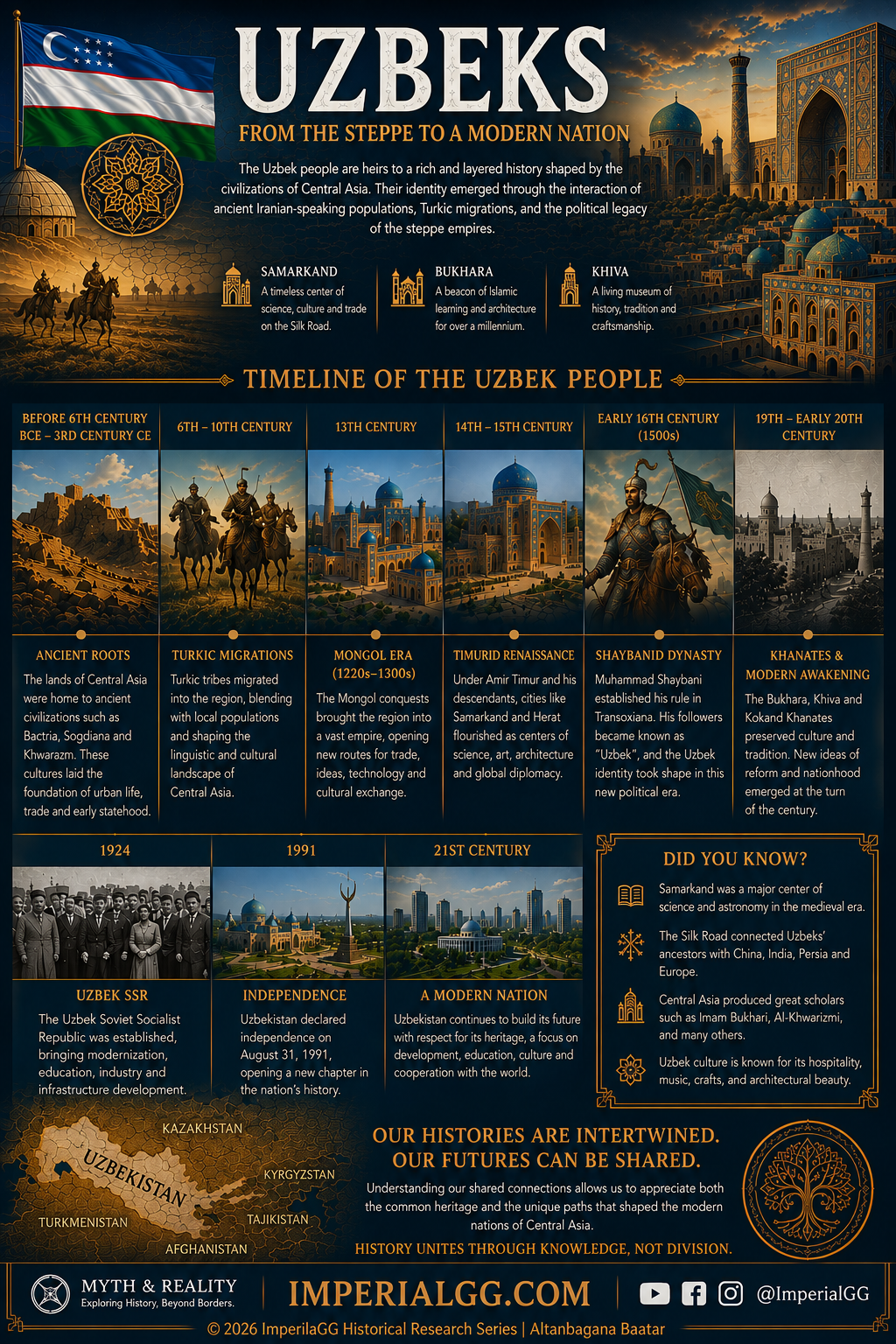
The Uzbek people are heirs to a rich and layered history shaped by the civilizations of Central Asia.
Their identity emerged through the interaction of ancient Iranian-speaking populations, Turkic migrations, and the political legacy of the steppe empires. The name “Uzbek” became widely associated with the followers of Muhammad Shaybani, whose conquests in the early sixteenth century transformed the political landscape of Transoxiana.
Cities such as Samarkand, Bukhara, and Khiva became enduring centers of scholarship, architecture, trade, and Islamic learning, preserving traditions that continue to influence the region today.
For centuries, the peoples of the Eurasian steppe shared migrations, commerce, diplomacy, and conflict. Their histories are deeply intertwined, yet each developed its own distinct language, culture, and national identity.
Understanding these shared connections allows us to appreciate both the common heritage and the unique paths that shaped the modern nations of Central Asia.
History unites through knowledge, not division.
Myth & Reality
ImperialGG.com