
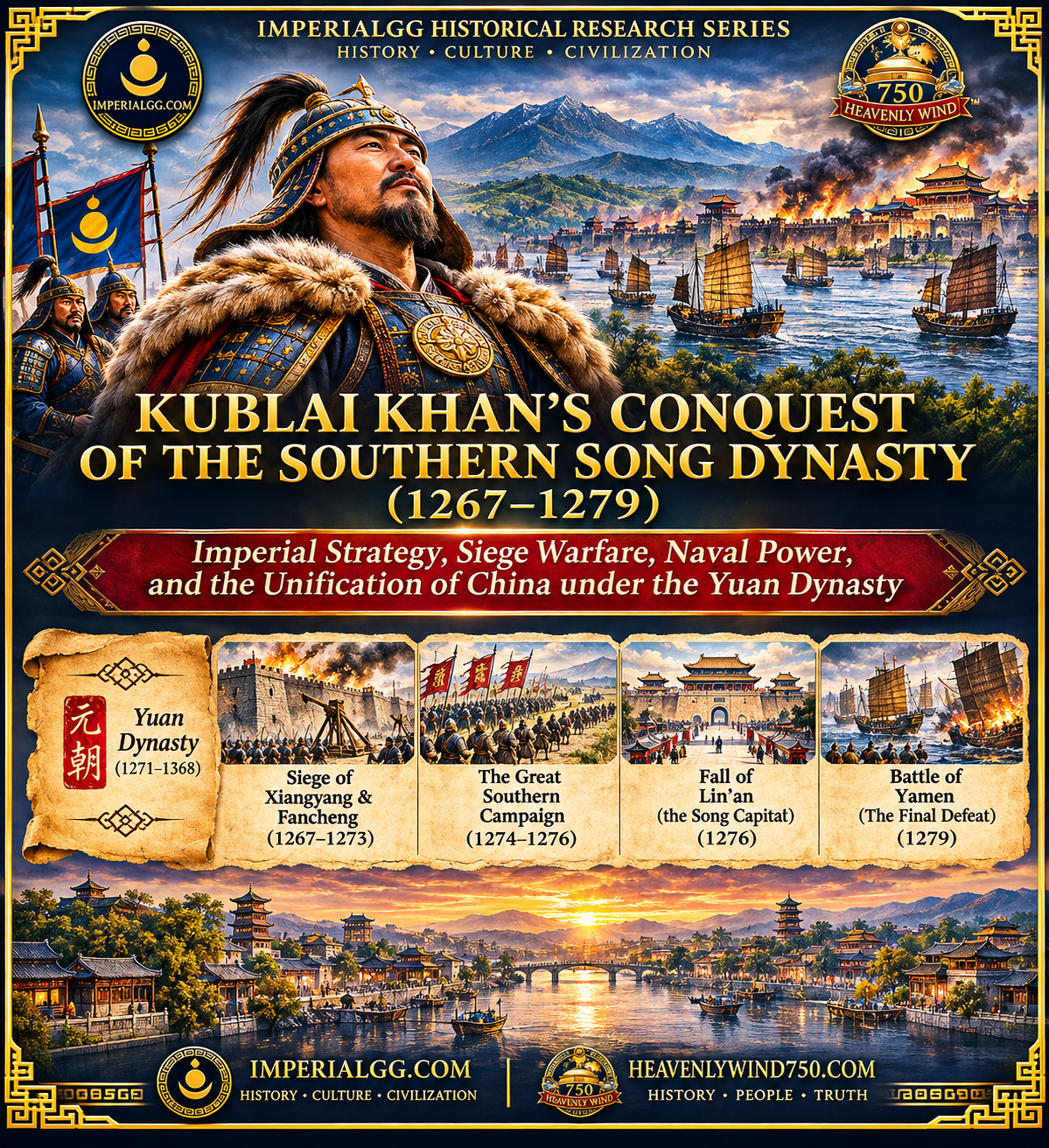
KUBLAI KHAN’S CONQUEST OF THE SOUTHERN SONG DYNASTY (1267–1279)
By Altanbagana Baatar
DBA Candidate| Independent Historian
ImperialGG Historical Research Seriers
28 June 2026
Imperial Strategy, Siege Warfare, Naval Power, and the Unification of China under the Yuan Dynasty
IMPERIALGG HISTORICAL RESEARCH SERIES
ABSTRACT
The conquest of the Southern Song dynasty by Kublai Khan between 1267 and 1279 was one of the most consequential military and political achievements of the Mongol Empire. It brought the wealthiest and most populous part of China under Mongol imperial authority and transformed the political geography of East Asia. Unlike the earlier Mongol campaigns across the open grasslands and continental territories of Eurasia, the war against the Southern Song required a prolonged combination of land warfare, riverine operations, naval construction, siege engineering, diplomatic negotiation, and the integration of Chinese military and administrative personnel into the Mongol imperial system.
This article examines the conquest as a process rather than a single military event. It traces the strategic importance of Xiangyang and Fancheng, the development of the Mongol naval forces, the employment of engineers and military specialists from different parts of the empire, the advance under Bayan, the surrender of the Southern Song capital Lin’an in 1276, and the continued resistance of the Southern Song loyalists until the naval battle of Yamen in 1279.
Drawing upon the Chinese dynastic histories Song Shi and Yuan Shi, Persian historical writing, Marco Polo’s account, and modern scholarship, the article distinguishes between the fall of the Song capital and the final destruction of the Southern Song court. It argues that Kublai’s victory was not simply the result of Mongol cavalry superiority. It depended upon the transformation of Mongol military organization into a coordinated imperial war machine capable of operating across different geographical and technological environments.
Keywords: Kublai Khan; Southern Song; Yuan dynasty; Mongol Empire; Xiangyang; Fancheng; Bayan; naval warfare; siege technology; Yamen; 13th-century China.
1. HISTORICAL BACKGROUND: THE MONGOL EMPIRE AND THE SOUTHERN SONG
The conflict between the Mongol Empire and the Song dynasty had begun long before Kublai Khan’s final campaign. The Southern Song was the continuation of the Song imperial state after the Jurchen Jin conquest of northern China in 1127. Its political center shifted southward to Lin’an, modern Hangzhou, while its government retained control over a densely populated and economically productive territory characterized by extensive agricultural production, commercial networks, advanced manufacturing, river transport, and a substantial naval establishment.
The Mongol conquest of northern China under Chinggis Khan and his successors fundamentally altered the strategic balance between the northern steppe and the southern Chinese states. Following the destruction of the Jin dynasty in 1234, the Mongols gained control of northern China and established a much longer frontier with the Southern Song. Yet the conquest of the south proved considerably more difficult. The Song possessed fortified cities, extensive river systems, strong defensive positions, and a navy capable of moving supplies and troops through the Yangtze basin.
The campaigns conducted under Ögedei and Möngke demonstrated both the possibilities and limitations of Mongol military expansion into southern China. Möngke’s campaign of 1258–1259 penetrated deeply into Song territory, but his death during the siege of Hezhou, near the strategically important Diaoyu fortress, disrupted the operation. Kublai, then engaged in the campaign in the middle Yangtze region, had to confront the political consequences of Möngke’s death and the struggle over imperial succession.
By 1260, Kublai had assumed the title of Great Khan, although his authority was contested by other branches of the Chinggisid family. His subsequent establishment of a new imperial center in northern China and his adoption of Chinese imperial institutions did not mean that the Mongol Empire had ceased to be a Eurasian political formation. Rather, Kublai sought to consolidate his authority over the Chinese territories while maintaining the wider claims and traditions of Chinggisid sovereignty.
The conquest of the Southern Song therefore served several purposes simultaneously: it eliminated the last major independent Chinese dynasty, expanded the economic resources available to Kublai’s government, strengthened his political legitimacy, and connected the Mongol-controlled territories of northern China with the maritime and commercial networks of the south. Christopher P. Atwood emphasizes that the conquest of the Song was the largest single territorial acquisition in the history of the Mongol Empire in terms of population and wealth.
api.pageplace.de+1
2. KUBLAI KHAN’S STRATEGIC DECISION: WHY XIANGYANG MATTERED
One of the most important decisions in the final conquest was the selection of Xiangyang as the principal strategic objective.
Xiangyang, situated on the Han River in present-day Hubei, occupied a critical position in the defensive geography of the Southern Song. Its location protected the approaches to the middle Yangtze basin, while its neighboring fortified city of Fancheng guarded the opposite bank. Together, these two cities formed a defensive complex that obstructed a direct Mongol advance toward the lower Yangtze and the political and economic heartland of the Southern Song.
The importance of Xiangyang was not simply that it was a strong fortress. It was a strategic gateway. Control of the Han River would allow Mongol forces to move troops, supplies, and naval units toward the Yangtze, thereby threatening the communication network upon which the Southern Song defense depended.
A major change in Mongol strategy followed the submission of Liu Zheng, a former Song commander who understood the defensive system and geographical vulnerabilities of the Southern Song. In 1266, Liu Zheng presented a proposal to attack Xiangyang. Kublai subsequently assigned Aju, son of Uriyangqadai, to conduct the operation. The campaign began in 1267–1268 and developed into a prolonged struggle.
The Mongols initially faced serious difficulties. Their traditional military strengths—rapid cavalry movements, encirclement, and operations across open terrain—could not by themselves overcome the fortified river cities of southern China. The Song navy continued to supply the defenders, while the river system complicated the establishment of an effective blockade.
By 1270, Aju and Liu Zheng had recognized that the conquest of Xiangyang required a substantial naval force. Kublai approved the development of such a force, marking a significant evolution in Mongol military practice. The campaign was no longer simply an extension of the northern land war; it had become an integrated operation involving river control, shipbuilding, engineering, and the coordination of multiple military traditions.
The subsequent attack on Fancheng, proposed by Ariq-Qaya, an Uyghur official, became decisive. Its capture weakened the defensive relationship between the two fortified cities and opened the way for the fall of Xiangyang.
api.pageplace.de+2
3. THE SIEGE OF XIANGYANG AND FANCHENG (1267–1273): TECHNOLOGY AND IMPERIAL COOPERATION
The siege of Xiangyang and Fancheng illustrates the multinational and technologically adaptive character of Kublai Khan’s military organization. The Mongol forces were not composed exclusively of Mongol cavalry. They incorporated Chinese troops, former Jin military personnel, engineers, administrators, and specialists recruited or transferred from other regions under Mongol authority. This military diversity became especially important when the Mongols encountered the fortified cities and river defenses of the Southern Song.
A particularly significant development was the employment of advanced siege artillery. The Yuan historical tradition records the role of Muslim military specialists, and Christopher Atwood identifies Ismaʿil, a mangonel operator from Iraq, in connection with the successful assault on Fancheng. His participation demonstrates how military expertise could move across the Mongol imperial world, linking the Chinese theater of war with the technological traditions of western Asia.
The siege culminated in the fall of Fancheng in 1273. The destruction of its defenses and the subsequent surrender of Xiangyang’s commanding general on 14 March 1273 gave the Mongol Empire control of this crucial strategic position.
The role of engineers from western Asia is particularly important because it challenges the simplistic image of the Mongol conquest as an exclusively cavalry-based military phenomenon. The Mongols were able to draw upon the technical capabilities of the territories and populations already incorporated into their empire. The resulting military system combined Mongol command structures, Chinese manpower and naval experience, and specialists whose knowledge originated in the Islamic world.
E. V. Kaziev’s 2024 study further identifies five Alanian commanders in the Southern Song campaign of 1267–1273, based on the Yuan Shi and other historical materials. This provides additional evidence that Alanian military personnel participated in significant operations, including the campaign around Xiangyang. The study is especially valuable because it examines the participation of a specific non-Mongol military group through the comparison of Chinese and Persian historical traditions.
Золотоордынское обозрение+2
The fall of Xiangyang was therefore not merely the victory of one army over one fortress. It represented the successful application of an imperial military system that could combine different peoples, technologies, and operational methods under a single strategic command.
4. THE PROCLAMATION OF THE YUAN DYNASTY (1271): IMPERIAL LEGITIMACY AND THE CONQUEST OF THE SOUTH
In 1271, while the war against the Southern Song was still continuing, Kublai proclaimed the dynastic name Da Yuan (大元), the Great Yuan. This was a major political development, but it must be understood in its proper context.
Kublai had already assumed the title of Great Khan in 1260. The proclamation of the Yuan dynasty in 1271 was not the beginning of his rule, nor did it immediately signify the conquest of all China. Instead, it formalized a new dynastic identity for his government in China, drawing upon the language and political conventions of Chinese imperial statecraft while retaining the authority and military foundations of the Mongol Empire.
Frederick W. Mote emphasizes that Kublai’s adoption of the dynastic name and Chinese imperial forms was part of a broader process of adapting Mongol government to the institutions and traditions of Chinese statecraft. This did not simply replace Mongol political identity with Chinese identity. It created a new imperial structure in which Chinggisid sovereignty and Chinese dynastic legitimacy operated together.
This distinction is essential. The Yuan dynasty was established in 1271, but the Southern Song remained an independent political and military opponent until its final defeat in 1279. The proclamation of the dynasty and the completion of the conquest were separate historical events.
cambridge.org+1
5. THE GREAT SOUTHERN CAMPAIGN (1274–1276): THE ADVANCE OF BAYAN
After the fall of Xiangyang, Kublai faced a strategic decision: whether to continue the war immediately or consolidate the newly acquired position. The debate within the Yuan leadership demonstrates that the conquest was not an automatic or uncontested decision.
Aju supported a major advance, arguing that the Southern Song had lost its strategic initiative. However, the proposal encountered opposition, including that of the Confucian scholar Xu Heng. The surviving historical record does not preserve all the arguments in this debate, and therefore the precise reasoning of every participant cannot be reconstructed. Nevertheless, the delay reveals that Kublai’s government considered the political, military, and logistical implications of a full-scale invasion.
In the winter of 1273–1274, Kublai approved the mobilization of a much larger force. The principal command was entrusted to Bayan, a senior Mongol commander, while Aju commanded a major portion of the expeditionary army. Other commanders, including Ariq-Qaya, operated in supporting theaters.
The campaign began in October 1274, when the main army advanced from the Xiangyang region. Its progress was considerably faster than the prolonged siege that had preceded it. Ezhou and Hanyang surrendered as the Mongol forces approached, allowing the invaders to exploit the strategic opening created by the fall of Xiangyang.
The composition of the invasion army is particularly revealing. Persian historical accounts cited by Atwood suggest that approximately 30 percent of the force was Mongol and more than 70 percent Han Chinese. These figures should be treated as estimates transmitted through historical sources rather than as a precise modern military census. Nevertheless, they indicate the extent to which the Yuan military machine depended upon the participation of Chinese troops and commanders.
This was an imperial army, not simply a Mongol tribal force. Its ability to conquer the Southern Song depended upon the incorporation of soldiers and military institutions from the very political and cultural environment it was attempting to subdue.
api.pageplace.de+1
6. THE NAVAL WAR: DINGZHOU ISLAND AND JIAOSHAN (1275)
The campaign against the Southern Song was determined not only by land operations but also by control of the river system.
The Song dynasty possessed a long-established naval tradition. Its warships, river transport, and logistical infrastructure were essential to the defense of the Yangtze basin. For the Mongols, overcoming this system required the development of a navy capable of transporting large numbers of troops, maintaining supply lines, blockading fortified cities, and defeating Song fleets in open water.
The naval battle near Dingzhou Island on 18 March 1275 marked a significant Yuan victory. The combined Mongol army and navy defeated the Southern Song forces commanded by Jia Sidao. This defeat weakened the Song military leadership and further undermined the government’s capacity to coordinate resistance.
Another important engagement occurred at Jiaoshan, between Yangzhou and Zhenjiang, on 26 July 1275. Aju’s forces successfully attacked Song warships that had been anchored too closely together and set a large portion of the fleet ablaze. The episode demonstrates that the Mongols had developed considerable operational experience in river warfare.
These engagements should not be understood as isolated victories. They were part of a broader strategy designed to break the Southern Song’s capacity to move troops and supplies along the Yangtze. Once the Mongol forces gained the initiative on the river, the geographical advantages that had protected the Southern Song for decades became increasingly difficult to maintain.
Lo Jung-pang’s China as a Sea Power, 1127–1368 provides an important framework for understanding this transformation. His study treats the Southern Song and Yuan periods as a major phase in the development of Chinese maritime and naval history, rather than viewing the conquest exclusively through the perspective of land warfare.
api.pageplace.de+1
7. THE FALL OF LIN’AN (1276): THE END OF THE SOUTHERN SONG CAPITAL
By the beginning of 1276, the Mongol forces had advanced toward the political center of the Southern Song. The capital, Lin’an, modern Hangzhou, was now threatened by the collapse of the empire’s outer defenses and the rapid disintegration of its military coordination.
The Song court faced a difficult choice. Continued resistance risked the destruction of the capital and the deaths of members of the imperial family, officials, and civilian population. The court, under the leadership of Empress Dowager Xie, ultimately chose surrender.
On 19 February 1276, the reigning Song emperor and his officials surrendered at Lin’an. The event represented the collapse of the central government of the Southern Song and a decisive victory for Kublai Khan.
However, it is important not to describe this event as the immediate end of all Song resistance. The surrender of the capital did not eliminate every loyalist army, naval commander, or surviving member of the imperial family.
Empress Dowager Xie also arranged for two young princes to escape southward. In June 1276, Song loyalists established a surviving court at Fuzhou and enthroned one of the princes as a new emperor. The Southern Song therefore continued to exist as a political and military resistance movement after the loss of Lin’an.
The distinction between the fall of the capital and the final end of the dynasty is essential for an accurate chronology of the conquest.
api.pageplace.de+1
8. WEN TIANXIANG AND THE CONTINUATION OF SONG RESISTANCE
Among the most significant figures associated with the final phase of the Southern Song resistance was Wen Tianxiang (文天祥, 1236–1283), a statesman, military organizer, and scholar who became a symbol of loyalty to the fallen dynasty.
Wen Tianxiang’s resistance demonstrates that the conquest of the Southern Song was not merely a sequence of military operations. It also involved competing ideas of political legitimacy, loyalty, and the moral obligations of officials toward their sovereign.
Following the fall of Lin’an, Wen attempted to organize resistance in the southern provinces. His efforts took place in a difficult political environment. Some Song commanders surrendered and entered Yuan service, while others continued to resist despite the increasingly unfavorable military situation.
The surviving Song court depended heavily upon naval forces and the support of loyalist officials and regional commanders. The resistance operated across Fujian and Guangdong, where the Yuan forces sought to eliminate the remaining centers of opposition.
Wen Tianxiang was eventually captured by Yuan forces. He refused to abandon his allegiance to the Song dynasty and was executed in 1283.
His historical significance lies not in changing the final military outcome, but in the enduring memory of resistance. His writings, especially the tradition associated with Zhengqi Ge (正氣歌, “Song of Righteousness”), became important expressions of moral integrity and political loyalty in later Chinese historical memory.
It is important, however, to distinguish the historical Wen Tianxiang from later literary and national interpretations of his life. His political decisions should be studied within the ethical and institutional world of the late Southern Song, rather than reduced to a modern political symbol.
The continued resistance of Wen Tianxiang and other loyalists demonstrates that the conquest of the Southern Song involved not only the defeat of an army but also the dissolution of an established political order.
api.pageplace.de+1
9. THE BATTLE OF YAMEN (1279): THE FINAL DEFEAT OF THE SOUTHERN SONG
The final military confrontation took place at Yamen, also known as Yaishan, in Guangdong on 19 March 1279. By this stage, the surviving Southern Song court had retreated toward the coast. Its remaining military strength depended heavily upon naval forces. The Yuan army and navy pursued the loyalist fleet and eventually trapped it in the coastal waters of Yamen.
The battle was decisive. The remaining Song fleet, reportedly numbering approximately one thousand vessels in the account discussed by Christopher Atwood, was surrounded by Yuan land and naval forces. The Song resistance was unable to break the encirclement.
The defeat at Yamen destroyed the remaining organized naval power of the Southern Song court. The young emperor Zhao Bing died during the catastrophe, traditionally associated with the final collapse of the Song loyalist resistance. With the death of the emperor and the destruction of the remaining fleet, the Southern Song ceased to exist as an independent political authority.
The date of 19 March 1279 is therefore conventionally treated as the end of the Southern Song dynasty.
The distinction between 1276 and 1279 is fundamental:
1276: Lin’an, the Southern Song capital, surrendered. The central imperial government collapsed.
1276–1279: A surviving Song court and loyalist forces continued resistance in the south.
1279: The Yuan victory at Yamen ended the remaining organized Southern Song political and military resistance.
The conquest was thus completed over several years, not in a single decisive battle.
api.pageplace.de+1
10. THE CONSEQUENCES OF THE CONQUEST: THE UNIFICATION OF CHINA UNDER YUAN RULE
The conquest of the Southern Song transformed the Mongol Empire in several fundamental ways.
First, it brought the southern Chinese economic heartland under the authority of the Yuan dynasty. The acquisition of densely populated agricultural regions, commercial centers, manufacturing industries, and maritime ports greatly expanded the resources available to Kublai’s government.
Second, it connected the continental and maritime trade networks of the Mongol Empire. The integration of northern and southern China created new opportunities for the movement of goods, people, and information across Eurasia. The conquest therefore had consequences beyond China itself.
Third, it transformed the Yuan military and administrative structure. Former Song soldiers were reorganized into Yuan service, including formations known as the xinfu jun (新附軍), or “newly submitted armies.” This process incorporated former enemies into the military establishment of the conquering state.
Fourth, the conquest involved monetary and administrative changes. The Yuan government withdrew Song currency and replaced it with Yuan paper money. The expansion of currency issuance during the conquest illustrates the immense financial demands of the military campaigns and the subsequent integration of the southern territories.
Atwood notes that the monetary requirements of the conquest were substantial, with Yuan paper currency issuance increasing dramatically during the years immediately following the fall of Lin’an. This provides an important indication of the economic scale of the operation.
Finally, the conquest strengthened Kublai’s position as ruler of China, although it did not resolve all political tensions within the wider Mongol Empire. The Chinggisid uluses continued to possess their own political interests, and the unity of the Mongol imperial family remained complicated by dynastic competition and regional autonomy.
The conquest of the Southern Song therefore strengthened the Yuan dynasty while simultaneously changing the balance of power within the broader Mongol imperial world.
api.pageplace.de+2
11. HISTORICAL SOURCE CRITICISM: HOW SHOULD THE CONQUEST BE RECONSTRUCTED?
The conquest of the Southern Song is documented through several historical traditions. A serious reconstruction must compare these sources rather than rely on a single narrative.
The Chinese dynastic histories
The Song Shi (宋史, History of the Song) and Yuan Shi (元史, History of the Yuan) are indispensable sources for reconstructing the political and military events of the conquest.
The Song Shi preserves the institutional and political perspective of the defeated dynasty. Its accounts are particularly important for the final Southern Song emperors, court officials, military commanders, and loyalist resistance.
The Yuan Shi, in contrast, preserves the imperial perspective of the conquering government. Its biographies and imperial annals provide information about commanders, military operations, administrative decisions, and the incorporation of former Song personnel into Yuan service.
Neither source should be treated as a neutral eyewitness account. Both were compiled within later dynastic historiographical traditions, and their descriptions reflect political and moral judgments about the legitimacy of rulers and the actions of historical figures.
Persian historical writing
The historical works of Rashid al-Din provide a wider Eurasian perspective on the Mongol imperial world. His Jamiʿ al-Tawarikh is especially valuable for understanding the political and military structures of the Mongol Empire beyond China.
Persian accounts can help clarify the participation of Mongol and non-Mongol military personnel and the wider imperial context of Kublai’s campaigns. However, they must be compared with Chinese records when reconstructing the precise chronology of operations in the Southern Song theater.
Marco Polo
Marco Polo’s account provides a European perspective on the Yuan imperial world. His narrative is valuable for understanding how the Mongol court, administration, military organization, and economic resources were perceived by a foreign visitor.
However, Marco Polo should not be treated as a direct eyewitness to the principal events of the 1267–1279 conquest. His narrative was recorded in a later context and must be distinguished from contemporary Chinese documentary and dynastic materials.
Modern scholarship
Modern scholarship provides the comparative framework necessary to interpret these records. Christopher P. Atwood’s chapter in The Cambridge History of the Mongol Empire is particularly important for the chronology and strategic development of the conquest. Frederick W. Mote’s work on Chinese society under Mongol rule provides the wider political and institutional context. Lo Jung-pang’s study offers a valuable perspective on naval warfare and the maritime transformation of the Song–Yuan period.
E. V. Kaziev’s 2024 article adds a specific contribution by examining the role of Alanian commanders in the Southern Song campaign through the comparison of Chinese and Persian sources.
api.pageplace.de+3
12. AUTHOR’S THESIS: THE CONQUEST AS A TRANSFORMATION OF THE MONGOL IMPERIAL SYSTEM
The conquest of the Southern Song should be understood as one of the clearest demonstrations of the Mongol Empire’s capacity for military and institutional adaptation. The traditional image of Mongol conquest often emphasizes cavalry, mounted archery, mobility, and the ability to coordinate large forces across open terrain. These capabilities were fundamental to the expansion of the empire. Yet the war against the Southern Song revealed that the Mongol military system could not achieve every strategic objective through cavalry warfare alone.
Kublai Khan’s victory required a different combination of capabilities. The Mongols had to construct and operate naval forces, maintain riverine supply lines, capture heavily fortified cities, employ advanced siege engines, and coordinate armies composed of multiple ethnic and military groups. Chinese commanders and soldiers, Uyghur administrators, Alanian officers, and specialists from the Islamic world all contributed to the wider imperial military structure.
The siege of Xiangyang and Fancheng was the turning point because it demonstrated how the Mongol leadership could identify a strategic geographical obstacle and overcome it through technological and organizational adaptation. The subsequent campaign under Bayan demonstrated that this victory could be transformed into a coordinated invasion of the Southern Song heartland.
Equally important was the political dimension of the conquest. Kublai did not merely seek the destruction of the Song ruling family. His government sought to inherit the administrative, economic, and institutional resources of the conquered state. The incorporation of former Song commanders, officials, and soldiers into Yuan service was therefore not an incidental consequence of victory; it was part of the process by which military conquest became imperial government.
The proclamation of the Yuan dynasty in 1271, the surrender of Lin’an in 1276, and the final defeat at Yamen in 1279 represent three different stages in this transformation: the establishment of a new dynastic identity, the collapse of the Southern Song central government, and the destruction of its remaining organized resistance.
The central argument of this article is that Kublai Khan’s conquest of the Southern Song was not simply the final chapter of Mongol territorial expansion. It was the transformation of the Mongol imperial system from a predominantly continental military power into a political and administrative empire governing both the steppe and the densely populated maritime and agricultural societies of southern China.
The victory demonstrated that Mongol imperial power rested not only upon the military traditions of the steppe but also upon the ability to mobilize, combine, and govern the diverse peoples and technologies of the territories incorporated into the empire.
CONCLUSION
Between 1267 and 1279, Kublai Khan’s forces overcame one of the most sophisticated defensive systems in medieval East Asia. The conquest required nearly twelve years of intensive preparation and military operations, from the strategic investment of Xiangyang to the final destruction of the Southern Song fleet at Yamen.
The fall of Xiangyang in 1273 opened the way for the invasion of the southern heartland. The victories at Dingzhou Island and Jiaoshan demonstrated the growing effectiveness of Yuan naval operations. The surrender of Lin’an in February 1276 brought the central Southern Song government to an end, but the surviving imperial court continued to resist until the decisive battle of Yamen in March 1279.
The consequences extended far beyond the battlefield. The conquest unified the principal territories of China under Yuan rule, expanded the resources of the Mongol Empire, integrated former Song military and administrative personnel, and connected continental Eurasian networks with the maritime economy of southern China.
Kublai Khan’s achievement must therefore be assessed not only through the territory he conquered but also through the new imperial system he established. The conquest of the Southern Song marked a decisive moment in the history of the Mongol Empire and in the wider history of Eurasian political integration.
PRIMARY SOURCES AND SELECTED BIBLIOGRAPHY
I. PRIMARY HISTORICAL SOURCES
1. Song Shi (宋史). History of the Song. Compiled under the supervision of Toqto’a and others during the Yuan dynasty. Beijing: Zhonghua Shuju editions. Particularly relevant are the imperial annals and biographies concerning the final Southern Song emperors, Empress Dowager Xie, Wen Tianxiang, and the military resistance of the 13th century.
2. Yuan Shi (元史). History of the Yuan. Compiled in 1370 under the early Ming dynasty. Beijing: Zhonghua Shuju editions. Particularly relevant are the annals of Shizu (Kublai Khan) and the biographies of commanders and officials involved in the Southern Song campaigns.
3. Rashid al-Din. Jamiʿ al-Tawarikh (Compendium of Chronicles). Persian historical account of the Mongol Empire. English translation: W. M. Thackston, Jamiʿu’t-Tawarikh: Compendium of Chronicles. Cambridge, MA: Harvard University, 1998–1999.
4. Marco Polo. The Description of the World (The Travels). Edited and translated editions. A valuable retrospective account of the Yuan imperial world, to be used with chronological and source-critical caution.
5. Wen Tianxiang (文天祥). Wen Shan Ji (文山集). Collected writings of Wen Tianxiang, including material relevant to his political thought, resistance, and historical memory.
II. MODERN SCHOLARSHIP
6. Atwood, Christopher P. “The Empire of the Great Khan.” In The Cambridge History of the Mongol Empire, edited by Michal Biran and Hodong Kim. Cambridge: Cambridge University Press, 2023. See particularly the section “Conquest of the Song Dynasty,” pp. 116–118.
7. Mote, Frederick W. “Chinese Society under Mongol Rule, 1215–1368.” In The Cambridge History of China. Cambridge: Cambridge University Press. Cambridge University Press publication record.
8. Lo, Jung-pang. China as a Sea Power, 1127–1368: A Preliminary Survey of the Maritime Expansion and Naval Exploits of the Chinese People during the Southern Song and Yuan Periods. Edited by Bruce A. Elleman. Singapore: NUS Press, 2012. JSTOR publication record.
9. Kaziev, E. V. “Alans in the Southern Song Campaign of Kaan and Emperor Khublai 1267–1273.” Golden Horde Review 12, no. 2 (2024): 320–332. DOI: 10.22378/2313-6197.2024-12-2.320-332. Read the academic article.
10. Davis, Richard L. “The Reign of Tu-tsung (1264–1274) and His Successors to 1279.” In The Cambridge History of China. Relevant to the political and military circumstances of the final Southern Song period.
IMPERIALGG HISTORICAL RESEARCH SERIES
History • Culture • Civilization