
THE JIN CONQUEST, THE DEATH OF TOLUI
By Altanbagana Baatar
DBA Candidate| Independent Historian
ImperialGG Historical Research Seriers
21 November 2026
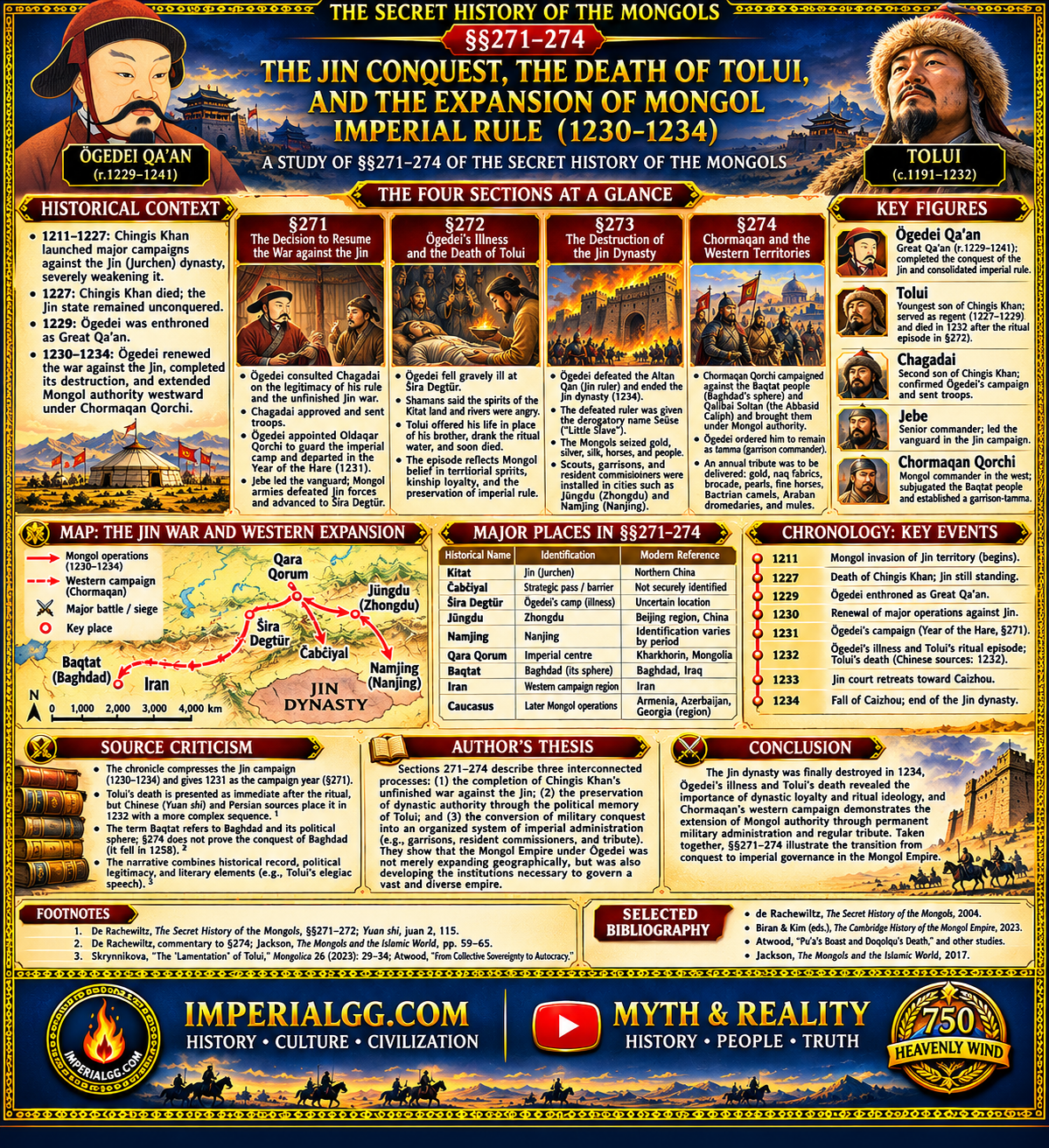
THE EXPANSION OF MONGOL IMPERIAL RULE (1230–1234)
An Academic Study of §§271–274 of The Secret History of the Mongols
ABSTRACT
Sections 271–274 of The Secret History of the Mongols present a decisive phase in the consolidation of the Mongol Empire under Ögedei Qa’an. They describe Ögedei’s decision to resume the unfinished war against the Jin dynasty, his consultation with Chagadai, the campaign in northern China, the illness of the Great Qa’an and the death of his younger brother Tolui, the destruction of the Jin state, and the extension of Mongol authority westward through Chormaqan Qorchi. These passages are especially important because they combine military history, political legitimacy, shamanic ritual, dynastic memory, and the practical mechanisms of imperial administration.
The narrative, however, cannot be read as a strictly chronological military report. Its account of the Jin conquest compresses events extending from 1230 to 1234, while its presentation of Tolui’s death differs in important respects from the Chinese and Persian records. Likewise, the reference to the Baqtat people in §274 must be interpreted carefully: the name refers to Baghdad and its political sphere, but the passage does not establish that Chormaqan conquered the city of Baghdad. This study examines the text alongside Chinese dynastic records, Persian historical writing, and modern scholarship, distinguishing the chronicle’s narrative claims from independently established historical events.
Keywords: Ögedei Qa’an, Tolui, Chagadai, Jin dynasty, Jurchen, Chormaqan, Baghdad, Mongol Empire, shamanism, imperial administration.
1. HISTORICAL CONTEXT: THE UNFINISHED WAR AGAINST THE JIN DYNASTY
The fall of Western Xia in 1227 did not bring an end to the Mongol campaigns in northern China. The Jin dynasty, established by the Jurchen in the early twelfth century, remained a major political and military power in northern China. Its territory included important agricultural regions, fortified cities, administrative centres, and a substantial population whose economic resources were strategically important to the Mongol Empire.
The relationship between the Mongols and the Jin had a much longer history than the events described in §§271–273. The Mongol invasion of Jin territory began in 1211, during the reign of Chingis Khan. The first campaigns were directed not simply at the occupation of northern China but also at weakening Jin influence over the peoples and territories bordering the Mongolian steppe. The Mongols gradually captured frontier regions, strategic passes, and major urban centres, while the Jin court struggled with internal political divisions and military setbacks.
The death of Chingis Khan in 1227 interrupted the final phase of this conflict. Although the Jin state had already suffered extensive territorial losses, it had not been destroyed. Ögedei therefore inherited an unfinished war from his father. This unfinished campaign became one of the central military undertakings of his reign.
Modern scholarship distinguishes the earlier campaigns of 1211–1227 from the final Mongol offensive of 1230–1234. The latter involved Ögedei personally, his brother Tolui, and the senior Mongol commanders who continued the campaign after the Great Qa’an withdrew from active operations. The final fall of the Jin dynasty occurred in 1234, not in 1231, the year given in the chronological framework of §271.
academic.oup.com+2
2. §271 — ÖGEDEI, CHAGADAI, AND THE DECISION TO RESUME THE WAR
Section 271 begins with a political question rather than a description of military operations. Ögedei sends a message to his elder brother Chagadai, asking for advice about the legitimacy of his position as Great Qa’an and the unfinished conflict with the Jin.
The passage records Ögedei’s concern that people might ask by what merit he had occupied the throne prepared by his father, Chingis Khan. He then proposes to complete the war against the Jin, explaining that his father had left the matter unresolved.
This statement has two important dimensions.
First, Ögedei presents military action as a continuation of his father’s political programme. His campaign is not described as an independent undertaking but as the completion of an imperial responsibility inherited from Chingis Khan. The unfinished war thus becomes a test of dynastic continuity.
Second, Ögedei seeks the approval of Chagadai. This consultation is significant because Chagadai was not merely an elder brother. He was one of the most influential surviving sons of Chingis Khan and a central figure in the political arrangement established after the Great Qa’an’s death.
Chagadai agrees with the proposal. His response is practical: Ögedei should appoint a capable person to supervise the main base camp and then proceed with the campaign. Chagadai also promises to dispatch troops from his own territory.
The exchange suggests that imperial military decisions were made within a system of dynastic consultation. Ögedei held the supreme title, but the participation and cooperation of the other Chinggisid princes remained important to the exercise of imperial authority.
2.1. OLDĀQAR QORCHI AND THE IMPERIAL BASE CAMP
Before leaving for the campaign, Ögedei appoints Oldaqar Qorchi to take charge of the Great Palaces. The passage associates this appointment with the management of the imperial encampment while the Qa’an was away.
The term translated as “Great Palaces” should not automatically be understood as a reference to a permanent stone palace. The Mongol imperial court was substantially organized around mobile royal camps and ordo establishments. These included tents, household personnel, guards, officials, supplies, livestock, and the administrative structures required to maintain the ruler’s household. The appointment therefore reflects the importance of preserving the imperial centre while the ruler conducted military operations elsewhere.
2.2. THE YEAR OF THE HARE AND THE 1231 CAMPAIGN
The Secret History dates Ögedei’s departure against the Kitat to the Year of the Hare, identified in the traditional chronology as 1231. He appoints Jebe as vanguard commander and advances against Jin forces.
The text describes the destruction of enemy troops in vivid language, comparing the slain soldiers to heaps of rotten logs. It then records the crossing of Čabčiyal and the dispatch of Mongol forces against towns and cities in different directions. Ögedei establishes his camp at Šira Degtür.
The identity of Čabčiyal requires particular care. The name appears in earlier sections of the chronicle in connection with the Mongol campaigns in northern China. It is associated with a strategic passage or mountain barrier, but the exact identification of every occurrence should not be assumed to be identical without examining the context.
Šira Degtür is likewise a historical place-name whose precise modern identification requires caution. The fact that the chronicle associates it with Ögedei’s illness does not by itself establish a modern geographical location.
Most importantly, the date 1231 should be treated as the date assigned by the narrative to this stage of the campaign, not as the complete chronology of the Jin conquest. The broader historical record places the final Mongol war against Jin across several years, ending with the dynasty’s destruction in 1234.
cdn.angkordatabase.asia+1
3. §272 — ÖGEDEI’S ILLNESS AND THE DEATH OF TOLUI
Section 272 is one of the most dramatic and historically controversial passages in the final part of the Secret History. It describes Ögedei’s sudden illness, the intervention of shamans and diviners, and the decision of Tolui to take the place of his elder brother in a ritual intended to save the Great Qa’an’s life. The episode is not simply a report of illness. It is a carefully constructed narrative about political responsibility, kinship, sacrifice, and the preservation of imperial authority.
3.1. THE SPIRITS OF THE LAND AND RIVERS
According to the chronicle, Ögedei becomes seriously ill at Šira Degtür. His condition deteriorates to the point that he loses his speech and experiences severe distress. Shamans and diviners are summoned to determine the cause. They declare that the powerful lords and rulers of the land and rivers of the Kitat are angry because the Mongol army has devastated their territory, plundered their people, and destroyed their cities.
This explanation reflects a religious understanding in which the natural landscape was not spiritually empty. Mountains, rivers, territories, and other features of the environment could be associated with powerful spiritual beings. Military devastation could therefore be interpreted not only as a human conflict but also as an offence against the spiritual powers associated with the conquered land.
The shamans initially offer compensation in the form of people, gold, silver, livestock, and food. Yet, according to the text, these offerings do not satisfy the spirits. Their anger intensifies. The diviners then ask whether a member of the Qa’an’s own family could serve as a substitute for his life. At this point Ögedei regains consciousness and asks what has happened. The shamans explain their interpretation and leave the decision to him.
3.2. TOLUI’S DECLARATION
Tolui is standing beside his elder brother. He responds by recalling the decision of their father, Chingis Khan, who had chosen Ögedei to occupy the Great Throne and govern the people. Tolui describes his own responsibility as the younger brother who was expected to remain beside the Qa’an, remind him of forgotten matters, and awaken him when he slept.
The passage then turns into a poetic declaration. Tolui asks who will remind Ögedei of his duties if the Great Qa’an dies. He warns that the Mongol people would be left like orphans and that the Kitat would rejoice. He then offers himself as a substitute.
His speech includes the following lines in de Rachewiltz’s English translation:
I have cleft the back of the trout,
I have rent the back of the sturgeon;
I have conquered those in the fore,
I have pierced those afar.
And fair of face,
And tall of stature
am I.
The passage combines two different kinds of justification. Tolui refers to the enemies he has killed, but he also emphasizes his physical appearance and stature. In the ritual logic of the narrative, these qualities help present him as an appropriate person to offer in place of the Qa’an.
The shamans perform their incantations, and Tolui drinks the ritual water. After sitting for a short time, he says that he has become drunk. He asks Ögedei to care for his younger brothers and his widowed sister-in-law Berüde until they can look after themselves. He then collapses, and the chronicle declares that this is how he died.
cdn.angkordatabase.asia+1
3.3. THE HISTORICAL PROBLEM: DID TOLUI DIE IN THE RITUAL?
The account in §272 must be distinguished from the historical question of how and when Tolui actually died. The Secret History connects his death directly to the ritual water consumed during Ögedei’s illness. However, Chinese and Persian sources preserve a more complicated chronology.
The Yuan shi records Ögedei’s illness in 1232 and associates Tolui’s ritual intervention with the fifth and sixth lunar months. It also records Tolui’s death later in the same year. The chronological information therefore does not support the simple impression that Tolui died immediately after drinking the ritual water.
De Rachewiltz discusses the differences among the sources. The Secret History gives a chronology associated with 1231, while the Yuan shi places the relevant illness and death in 1232. Rashīd al-Dīn gives a different chronological indication, which de Rachewiltz considers likely to refer to 1232 rather than 1233.
altaica.ru+1
Christopher P. Atwood has further questioned the historical reliability of the ritual-sacrifice explanation. His analysis emphasizes that Tolui appears to have survived the ritual episode and continued travelling before his death. Atwood also discusses the possibility that alcohol consumption, rather than the ritual drink, contributed to Tolui’s death, drawing attention to the account of Juwaynī and the differences between the Mongolian, Chinese, and Persian traditions.
academia.edu+1
Tatiana D. Skrynnikova’s 2023 study offers another important interpretation. Rather than treating the passage merely as a literal record of a ritual execution, she analyzes it as a poetic lament or elegy in which Tolui speaks about his own death. She argues that the structure and symbolic language of the passage support reading it as a distinct literary composition within the chronicle.
orientalstudies.ru+1
These interpretations do not establish a single universally accepted explanation for Tolui’s death. They do, however, demonstrate that §272 should be read simultaneously as a historical narrative, a political text, and a literary composition.
3.4. TOLUI’S POLITICAL SIGNIFICANCE
Tolui’s death had consequences far beyond the personal relationship between two brothers. He was the youngest son of Chingis Khan and had served as regent during the period between his father’s death and Ögedei’s enthronement.
His household, military following, and descendants remained central to the subsequent history of the Mongol Empire. His wife Sorqaqtani Beki later became one of the most influential women in the Chinggisid world, while their sons included Möngke and Qubilai, both of whom would eventually occupy the Great Throne.
The narrative of Tolui’s sacrifice therefore had an important dynastic dimension. It presented him as a loyal younger brother who placed the continuity of the empire above his own life. This interpretation became particularly meaningful in later political contexts, when the descendants of Tolui emerged as major contenders for imperial authority.
4. §273 — THE DESTRUCTION OF THE JIN DYNASTY
Section 273 records Ögedei’s destruction of the Altan Qan, the seizure of Jin wealth, and the establishment of Mongol military and administrative personnel in the conquered cities. The passage is brief, but it contains several important elements of imperial conquest.
4.1. THE ALTAN QAN
The term Altan Qan means “Golden Khan” and is the designation used in the Secret History for the ruler of the Jin state. The Jin dynasty was ruled by the Jurchen, whose political centre had shifted over time from the north-eastern regions of Manchuria into northern China. By the final stage of the war, the Jin court had lost much of its earlier territory and was under severe military pressure.
The last Jin emperor was Wanyan Shouxu, known by the temple name Aizong. The chronicle’s account of the destruction of the Altan Qan must be understood in the context of the final collapse of the Jin state, rather than as a precise description of the emperor’s personal fate. The historical Jin dynasty ended in 1234. Aizong did not simply fall into Mongol captivity: he died by suicide as the Mongol and allied forces brought the final Jin stronghold at Caizhou under attack. The dynasty’s political existence ended with the fall of the city in February 1234.
academic.oup.com+1
4.2. THE NAME SEÜSE
The Secret History states that Ögedei gave the Altan Qan the name Seüse after defeating him.
De Rachewiltz translates the expression as “Little Slave.” The naming should be read as a political act of humiliation, not as an ordinary personal name. It symbolically reverses the former status of a sovereign ruler and places him in a position of subordination.
The passage does not provide enough evidence to establish that this was the emperor’s formal historical name. It is best understood as the chronicle’s representation of the victor’s power to redefine the defeated ruler.
4.3. THE CONFISCATION OF WEALTH
The chronicle lists the wealth seized from the Jin ruler and his state:
Gold and silver.
Gold-embroidered and patterned silk fabrics.
Other valuable possessions.
Piebald horses.
Young enslaved persons.
This list is important because it shows that the Mongol campaign was not limited to defeating the Jin army. It also involved the transfer of material resources into the imperial system. The wealth of conquered rulers could be redistributed among the ruling household, commanders, officials, and other members of the imperial elite. Such redistribution helped maintain political loyalty and military support. The mention of silk and luxury goods also demonstrates the importance of the urban and commercial economy of northern China to the Mongol ruling system.
4.4. SCOUTS, GARRISONS, AND RESIDENT COMMISSIONERS
Section 273 then records the establishment of scouts, garrison troops, and resident commissioners in cities including Nanjing and Jüngdu.
These institutions served different functions:
Scouts provided information about local conditions, political developments, and possible resistance.
Garrison troops maintained military control and protected strategic locations.
Resident commissioners represented Mongol authority within conquered urban centres and helped supervise local administration.
The passage therefore reflects a transition from military victory to the institutional management of conquered territory. The Mongols did not rely solely on the physical presence of an army. They developed a system in which military personnel and administrative representatives operated within cities and regions that had previously belonged to other political authorities.
4.5. JÜNGDU AND NAMJING
The two urban names in §273 are particularly significant. Jüngdu is the Mongolian form associated with Zhongdu, the former Jin capital in the area of present-day Beijing. It had been captured by the Mongols during the earlier stages of the war against Jin.
Namjing is the name used in the chronicle for Nanjing, associated in this context with the southern refuge of the Jin court. It should not be confused with every later historical use of the name Nanjing, since the same name was applied to different cities in different periods. The appearance of these urban centres in §273 indicates that Mongol control was being extended through a network of cities rather than through a single battlefield victory.
Finally, Ögedei returns to Qara Qorum. The passage thus connects the conclusion of the Jin campaign with the Mongol imperial centre in Mongolia.
cdn.angkordatabase.asia+1
5. §274 — CHORMAQAN QORCHI AND THE EXTENSION OF MONGOL AUTHORITY WESTWARD
Section 274 shifts the narrative from northern China to the western territories. It introduces Chormaqan Qorchi, who had been assigned to campaign against the Baqtat people and Qalibai Soltan. The passage records that Chormaqan brought the Baqtat people under Mongol authority. Ögedei then ordered him to remain in the conquered region as a tamma commander and required the delivery of valuable goods to the imperial court every year.
This section is especially important because it provides evidence of the relationship between military conquest and the establishment of a regular system of tribute.
5.1. CHORMAQAN QORCHI
Chormaqan was one of the important Mongol commanders responsible for the expansion of imperial power in western Asia during the reign of Ögedei. His appointment was part of a broader military strategy. The Mongol Empire could not maintain control over distant territories merely by sending armies through them. It required commanders who could remain in the region, supervise military forces, receive the submission of local rulers, and ensure that the conquered territories continued to provide resources.
The Secret History uses the name Chormaqan Qorchi. The title Qorchi is associated with the Mongol military and courtly tradition of quiver-bearers. In the context of §274, however, the important point is his function as a commander appointed to remain in the conquered western territory.
Modern historical studies place Chormaqan’s major western campaign in the early 1230s. He led Mongol forces into Iran, while other commanders operated in regions corresponding to modern Afghanistan. His campaigns contributed to the establishment of Mongol supremacy over much of Iran and the subsequent expansion into the Caucasus.
academic.oup.com+1
5.2. BAQTAT: BAGHDAD AND THE ABBASID CALIPHATE
The name Baqtat is generally identified with Baghdad. The Secret History refers to the Baqtat people and Qalibai Soltan, whom the commentary identifies as the Abbasid Caliph of Baghdad. The historical identification is important, but it must not be misunderstood.
The reference to Baqtat does not prove that Chormaqan conquered Baghdad itself during this campaign. Rather, the passage reflects the Mongol court’s interest in the political sphere of the Abbasid Caliphate and the western territories associated with it.
The Abbasid Caliphate was centred in Baghdad and represented one of the most important political and religious institutions of the Islamic world. The caliph possessed a religious and symbolic authority that extended beyond the immediate territories under his direct political control.
The title Qalibai Soltan is a Mongolian rendering associated with the caliph of Baghdad. The word Soltan in this context should not be taken as proof that the ruler was a sultan in the strict institutional sense. The caliphate and the sultanate represented different forms of political authority in the medieval Islamic world.
The distinction between the intended target and the actual military result is essential. Chormaqan’s campaigns established Mongol authority over extensive territories in Iran and neighbouring regions, but Baghdad remained under Abbasid rule until Hülegü’s campaign in 1258, more than two decades later.
academia.edu+2
5.3. THE MEANING OF TAMMA
Ögedei’s order that Chormaqan remain in the region as tamma is one of the most important administrative details in §274. The term is associated with a military garrison or military-administrative establishment. In the Mongol imperial system, such a force could serve as a permanent instrument of supervision in a conquered region. The appointment was therefore more than a temporary battlefield command. It signified the transformation of military occupation into an enduring structure of imperial authority.
The arrangement involved several responsibilities:
Maintaining a military presence in the conquered territory.
Supervising local political authorities and communities.
Protecting the routes and centres under Mongol control.
Organizing the collection and delivery of tribute.
Maintaining the connection between the western command and the Great Qa’an’s court.
The exact institutional meaning of tamma varied according to historical context. It should not be equated automatically with a modern provincial government or a single standardized administrative office. Nevertheless, the passage clearly demonstrates the use of a permanent military presence to secure Mongol control.
5.4. THE ANNUAL TRIBUTE: GOODS, ANIMALS, AND IMPERIAL RESOURCES
Ögedei’s decree lists the goods that were to be delivered annually from the western territory.
The list includes:
Yellow gold.
Naq fabrics.
Brocades and damasks with gold thread.
Small and large pearls.
Fine horses.
Bactrian camels.
Arabian dromedaries.
Pack mules.
Riding mules.
This inventory is particularly revealing because it includes not only precious metals and luxury textiles but also animals essential to transportation, military mobility, and the operation of the imperial court. The distinction between Bactrian camels and Arabian dromedaries is significant. The former were adapted to the continental environments of Central Asia, while the latter were associated with the warmer and more arid regions of western Asia. Their inclusion in the tribute list reflects the geographical breadth of the Mongol imperial network.
The tribute system therefore transferred the resources of distant regions into the imperial centre. It also connected different ecological and economic zones through the movement of animals, textiles, precious metals, and other valuable commodities. The passage does not specify the exact quantities of each commodity. It would therefore be incorrect to assign numerical quotas or calculate the annual economic value of the tribute from this section alone.
5.5. THE DIFFERENCE BETWEEN CONQUEST AND ADMINISTRATIVE SUBMISSION
Section 274 should be read alongside §273.
Section 273 describes the establishment of garrisons and resident commissioners in conquered cities of northern China. Section 274 describes Chormaqan’s continuing presence in the western territories and the regular delivery of tribute.
Together, the two passages show that Mongol imperial expansion involved more than defeating rival armies. It required the establishment of mechanisms through which conquered populations, local resources, and regional political authorities could be integrated into a larger imperial structure.
This was not necessarily a uniform system across all regions. The political and economic arrangements depended on local conditions, the strength of resistance, the resources available, and the authority of the Mongol commander assigned to the territory. Nevertheless, the principle is clear: military conquest was followed by a demand for continuing political and economic obligations.
cdn.angkordatabase.asia+2
6. CHRONOLOGY: THE JIN CAMPAIGN AND THE DEATH OF TOLUI
One of the most important source-critical problems in §§271–273 is the difference between the chronology presented in the Secret History and the chronology reconstructed from Chinese and other historical records.
The following table separates the main events and indicates where the evidence requires qualification.
Date | Event | Historical assessment |
|---|---|---|
1211 | Beginning of the Mongol invasion of Jin territory | Campaign under Chingis Khan |
1227 | Death of Chingis Khan | The Jin state remained unconquered |
1229 | Ögedei formally enthroned | Beginning of his reign as Great Qa’an |
1230 | Renewal of major Mongol operations against Jin | Ögedei and Tolui participated |
1231 | Year of the Hare in §271 | The chronicle places Ögedei’s campaign in this year |
1232 | Ögedei’s illness and Tolui’s ritual episode | Chinese records provide more detailed lunar dating |
1232 | Death of Tolui | The Yuan shi places his death in the ninth lunar month |
1233 | Jin court retreats toward Caizhou | Final stage of the Jin collapse |
February 1234 | Fall of Caizhou and end of the Jin dynasty | Final destruction of the Jin state |
The table makes clear that §271 should not be interpreted as a complete record of the entire Jin war. It introduces a major phase of the campaign, while the historical destruction of the dynasty occurred in 1234.
The date of Tolui’s death is another point requiring caution. The Secret History presents the ritual episode as immediately connected with his death, but the Yuan shi and Persian accounts preserve a more complicated sequence. The historical evidence supports 1232 as the year of Tolui’s death, but the precise circumstances remain disputed.
altaica.ru+2
7. HISTORICAL GEOGRAPHY OF §§271–274
The geographical references in these sections connect the Mongol heartland, northern China, and the western territories of the empire.
Historical name | Identification | Modern geographical reference |
|---|---|---|
Kitat | Jin/Jurchen state | Northern China |
Čabčiyal | Strategic pass or barrier; exact identification requires caution | Northern China / Inner Asian frontier zone |
Šira Degtür | Place of Ögedei’s illness; precise identification uncertain | Not securely established |
Jüngdu | Zhongdu | Beijing region, China |
Namjing | Nanjing in the chronicle’s historical context | Identification requires period-specific care |
Qara Qorum | Mongol imperial centre | Kharkhorin region, Övörkhangai, Mongolia |
Baqtat | Baghdad and its political sphere | Baghdad, Iraq |
Iran | Western campaign region under Chormaqan | Modern Iran |
Caucasus | Later theatre of Mongol expansion | Armenia, Azerbaijan, Georgia and surrounding regions |
Geographical note: The table distinguishes secure identifications from uncertain ones. A historical name should not be assigned a precise modern coordinate when the surviving evidence does not support that precision.
8. SOURCE CRITICISM: THE CHRONICLE AND ITS HISTORICAL LIMITATIONS
The four sections contain valuable information, but they must be evaluated in relation to the literary and political character of the Secret History.
8.1. THE CHRONICLE’S CHRONOLOGICAL COMPRESSION
The Jin campaign is presented in a short sequence that does not fully reflect the duration and complexity of the historical war. The campaign began before Ögedei’s reign, resumed in 1230, continued through 1232 and ended with the fall of Caizhou in 1234. The narrative’s organization should therefore be distinguished from a modern chronological reconstruction.
8.2. THE POLITICAL FUNCTION OF TOLUI’S SACRIFICE
The episode of Tolui’s sacrifice is not simply a neutral account of a ritual. It presents Tolui as a loyal brother whose death preserves the authority of the Great Qa’an. This representation had political significance for later generations, particularly because the descendants of Tolui became central figures in the struggle for the imperial throne.
Atwood’s analysis raises the possibility that the passage reflects later dynastic interests. Skrynnikova’s literary interpretation, meanwhile, emphasizes its structure as a lament. These approaches are not identical, but both show why the passage cannot be reduced to a simple medical or military report.
academia.edu+1
8.3. THE DIFFERENCE BETWEEN THE INTENDED TARGET AND THE CONQUEST OF BAGHDAD
The reference to Baqtat in §274 has sometimes been read too broadly. The text associates Chormaqan with the submission of the Baqtat people and the Qalibai Soltan, but it does not establish that Baghdad itself was captured.
The later Mongol conquest of Baghdad occurred under Hülegü in 1258. The distinction between the earlier western campaigns and the later siege of Baghdad is essential for an accurate reconstruction of Mongol expansion in the Middle East.
academic.oup.com+1
8.4. THE ADMINISTRATIVE VALUE OF THE TEXT
Despite its chronological compression, §§273–274 preserve important information about Mongol imperial governance. The references to scouts, garrison troops, resident commissioners, tamma, and annual tribute demonstrate that the chronicle was concerned not only with the victories of the ruling house but also with the mechanisms through which imperial authority was maintained.
The administrative details should be compared with Chinese and Persian accounts rather than treated as a complete description of a single uniform system.
9. AUTHOR’S THESIS
Sections 271–274 reveal that the consolidation of the Mongol Empire under Ögedei was not simply a continuation of Chingis Khan’s military expansion. It involved the transformation of inherited conquest into a more organized system of imperial government.
The campaign against the Jin demonstrates the political importance of completing the military objectives left unfinished by Chingis Khan. Ögedei’s consultation with Chagadai shows that the Great Qa’an’s authority operated within a dynastic framework in which the cooperation of senior Chinggisid princes remained essential.
The account of Tolui’s death reveals another dimension of imperial politics. Through the language of ritual sacrifice, the chronicle presents Tolui as the brother who protects the Great Qa’an and preserves the unity of the Mongol people. Whether or not the ritual episode accurately records the physical circumstances of Tolui’s death, its literary and political meaning is unmistakable.
The destruction of the Jin dynasty and the appointment of Chormaqan in the western territories demonstrate the practical mechanisms of Mongol imperial expansion. Military victory was followed by the establishment of garrisons, resident representatives, and systems of tribute. These arrangements connected distant regions to the central authority of the Great Qa’an.
The central thesis of this study is that §§271–274 describe three interconnected processes: the completion of Chingis Khan’s unfinished war against the Jin, the preservation of dynastic authority through the political memory of Tolui, and the conversion of military conquest into an organized system of imperial administration. The Mongol Empire under Ögedei was therefore not merely expanding geographically; it was developing the institutions and obligations necessary to govern an increasingly interconnected Eurasian territory.
10. CONCLUSION
Sections 271–274 occupy an important position in the historical narrative of the Mongol Empire. They describe the transition from the unfinished military programme of Chingis Khan to the imperial policies of Ögedei.
The war against the Jin was one of the defining campaigns of Ögedei’s reign. Although the Secret History presents the campaign in a compressed sequence, comparison with Chinese and other historical sources establishes that the final destruction of the Jin dynasty occurred in 1234.
The story of Tolui’s death remains one of the most difficult passages in the chronicle. It combines religious beliefs concerning the spirits of the land and rivers, the ritual substitution of a human life, dynastic loyalty, and a poetic lament. The differences between the Secret History, the Yuan shi, and Persian historical accounts prevent us from treating every detail as an independently verified historical fact.
The final section, concerning Chormaqan and the Baqtat people, reveals the westward reach of Mongol imperial policy. It also demonstrates the importance of permanent military commands and regular tribute in maintaining control over distant territories. The passage should not be interpreted as evidence that Baghdad was conquered at this time; that event belongs to the campaign of Hülegü in 1258.
Taken together, these sections show that the Mongol Empire under Ögedei was developing from a conquest-based political order into a more complex imperial system. The Great Qa’an’s authority depended not only on military victory but also on dynastic cooperation, regional commanders, administrative institutions, and the systematic transfer of resources from conquered territories.
FOOTNOTES
1. Igor de Rachewiltz, The Secret History of the Mongols: A Mongolian Epic Chronicle of the Thirteenth Century, translated with historical and philological commentary, 2 vols. (Leiden: Brill, 2004), §§271–274. The shorter version edited by John C. Street (2015) is also consulted for the English translation.
2. Ruth W. Dunnell, “The Rise of Chinggis Khan and the United Empire, 1206–1260,” in Michal Biran and Hodong Kim, eds., The Cambridge History of the Mongol Empire, vol. I (Cambridge: Cambridge University Press, 2023). See also the chapter’s discussion of the Jin campaigns and the final destruction of the dynasty.
3. De Rachewiltz, Secret History of the Mongols, commentary on §271. The chronicle’s Year of the Hare is 1231, but the broader Jin campaign continued across several years.
4. De Rachewiltz, commentary on §272, especially pp. 999–1001. He compares the date in the Secret History with the Chinese and Persian accounts of Tolui’s death.
5. Yuan shi (元史), juan 2 and juan 115, especially the biographical material on Tolui. The lunar dates discussed by de Rachewiltz place Ögedei’s illness and Tolui’s death in 1232.
6. Christopher P. Atwood, “Pu’a’s Boast and Doqolqu’s Death: Historiography of a Hidden Scandal in the Mongol Conquest of the Jin.” Atwood examines the chronological and political problems surrounding the campaign and the account of Tolui’s death.
7. Christopher P. Atwood, “From Collective Sovereignty to Autocracy: The Evolution of the Mongol Empire, 1227–1251.” The study discusses the political implications of the succession, the Tolui narrative, and the development of imperial authority.
8. Tatiana D. Skrynnikova, “The ‘Lamentation’ of Tolui in The Secret History of the Mongols,” Mongolica 26, no. 1 (2023), pp. 29–34. The article interprets the passage as a poetic lament and examines the ritual and literary structure of Tolui’s speech.
9. De Rachewiltz, commentary on §273. The translation of Seüse as “Little Slave” is an interpretation of the derogatory name in the chronicle, not evidence that it was the Jin emperor’s formal personal name.
10. For the final fall of the Jin dynasty in 1234, see Dunnell, “The Rise of Chinggis Khan and the United Empire,” and The Cambridge History of the Mongol Empire, vol. I. The last Jin emperor, Aizong (Wanyan Shouxu), died by suicide during the fall of Caizhou.
11. De Rachewiltz, commentary on §§260–261 and §274. The identification of Baqtat with Baghdad and Qalibai Soltan with the Abbasid Caliph is discussed in the commentary to the earlier western expedition.
12. For Chormaqan’s western campaigns, see the chapter “Mongol Wars in Asia,” The Oxford Handbook of Mongol History (Oxford University Press, 2025), particularly its discussion of the campaigns in Iran and the Caucasus.
13. Peter Jackson, The Mongols and the Islamic World: From Conquest to Conversion (New Haven: Yale University Press, 2017), especially the discussion of the Mongol advance into western Asia and the later threat to Baghdad.
14. The historical distinction between the early campaigns of Chormaqan and the later conquest of Baghdad under Hülegü is essential. Baghdad was captured in 1258, not during the events described in §274.
BIBLIOGRAPHY
PRIMARY SOURCES
The Secret History of the Mongols. Middle Mongolian text. Chinese-character transcription preserved in the Yuan chao bi shi (元朝秘史).
de Rachewiltz, Igor, trans. The Secret History of the Mongols: A Mongolian Epic Chronicle of the Thirteenth Century. 2 vols. Leiden: Brill, 2004.
de Rachewiltz, Igor. The Secret History of the Mongols. Shorter version edited by John C. Street. Western Washington University, 2015.
Yuan shi (元史). Official history of the Yuan dynasty, especially juan 2 and juan 115.
Rashīd al-Dīn. Jāmiʿ al-Tawārīkh. Persian historical chronicle. English translation and studies consulted through the works of Boyle and later scholarship.
Juwaynī, ʿAṭā-Malik. The History of the World-Conqueror. Translated by J. A. Boyle. Manchester: Manchester University Press, 1958.
SECONDARY SOURCES
Atwood, Christopher P. “From Collective Sovereignty to Autocracy: The Evolution of the Mongol Empire, 1227–1251.”
Atwood, Christopher P. “Pu’a’s Boast and Doqolqu’s Death: Historiography of a Hidden Scandal in the Mongol Conquest of the Jin.”
Biran, Michal, and Hodong Kim, eds. The Cambridge History of the Mongol Empire. Vol. I: History; Vol. II: Sources. Cambridge: Cambridge University Press, 2023.
Jackson, Peter. The Mongols and the Islamic World: From Conquest to Conversion. New Haven: Yale University Press, 2017.
Skrynnikova, Tatiana D. “The ‘Lamentation’ of Tolui in The Secret History of the Mongols.” Mongolica 26, no. 1 (2023): 29–34.
de Rachewiltz, Igor. The Secret History of the Mongols, vol. 3 (Supplement). Leiden: Brill, 2013.
DIGITAL TEXTUAL RESOURCES
Historical Corpus of the Mongolian Language, Secret History of the Mongols, §§271–274. Open the Mongolian historical corpus.
Monumenta Altaica, editions, transcriptions, translations, and bibliography of The Secret History of the Mongols. Open the textual resources.
IMPERIALGG.COM — HISTORY • CULTURE • CIVILIZATION
MYTH & REALITY — HISTORY • PEOPLE • TRUTH
This article distinguishes the chronicle’s account from later historical reconstruction. Dates, geographical identifications, and interpretations that remain disputed have been explicitly qualified rather than presented as established facts