
THE MONGOL EXPANSION ACROSS THE KIPCHAK STEPPE AND THE ESTABLISHMENT OF IMPERIAL ADMINISTRATION
By Altanbagana Baatar
DBA Candidate| Independent Historian
ImperialGG Historical Research Seriers
18 November 2026
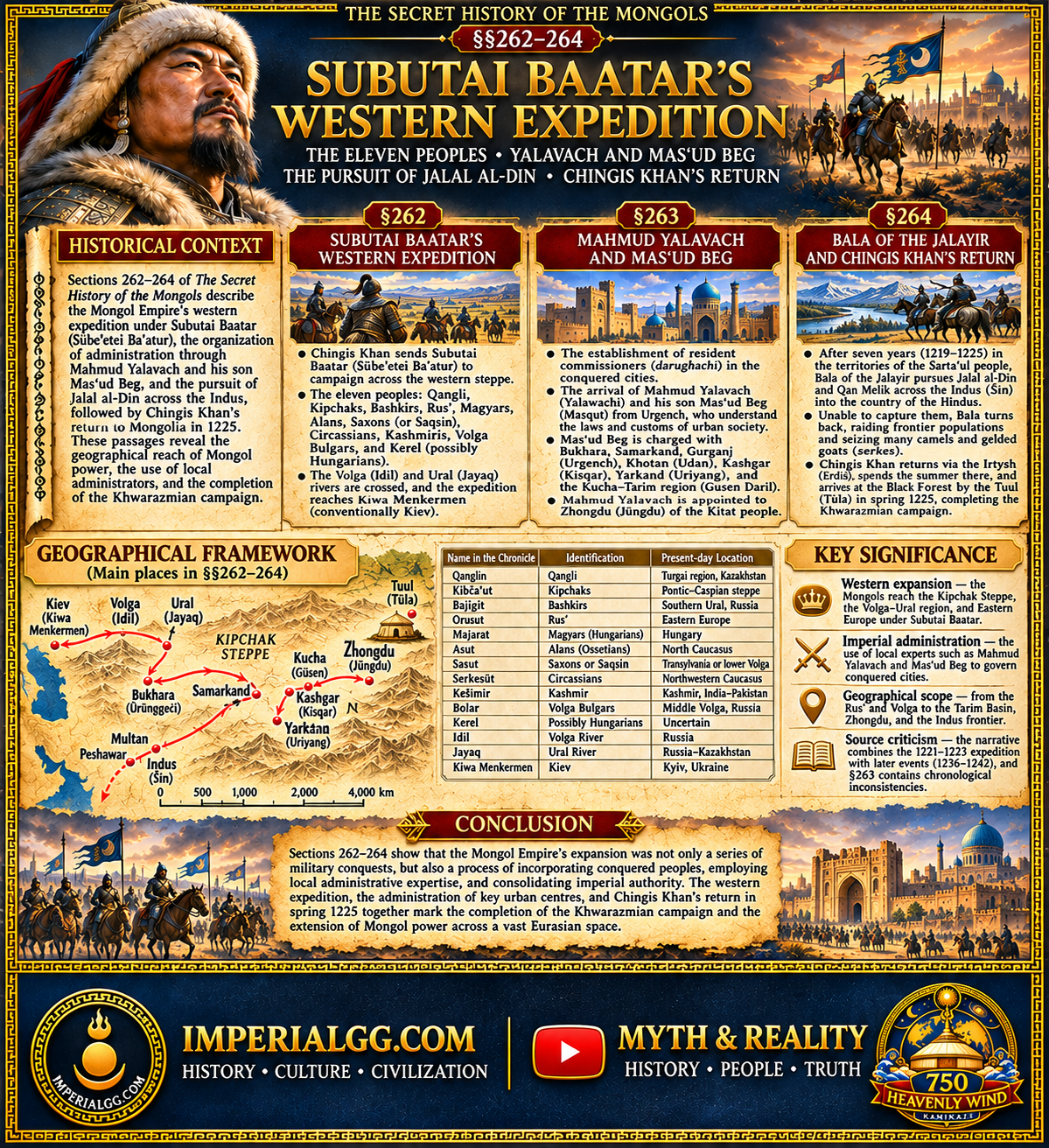
SUBUTAI BAATAR, THE KIPCHAK STEPPE, YALAVACH AND MAS‘UD BEG, AND CHINGIS KHAN’S RETURN TO MONGOLIA
An Academic Study of §§262–264 of The Secret History of the Mongols
ABSTRACT
Sections 262–264 of The Secret History of the Mongols preserve an important account of the Mongol Empire’s expansion across the western steppe, the administration of conquered urban territories, and the return of Chingis Khan to Mongolia after the Khwarazmian campaign. These passages connect three historical processes: the military expedition of Subutai Baatar and Jebe across the regions surrounding the Caspian Sea and the Kipchak Steppe; the appointment of Khwarazmian administrators Mahmud Yalavach and his son Mas‘ud Beg; and the pursuit of Jalal al-Din across the Indus, followed by Chingis Khan’s return to his principal encampment in Mongolia in 1225.
Section 262 lists eleven peoples and geographical communities, including the Qangli, Kipchaks, Bashkirs, Rus’, Magyars, Alans, Saxons or Saqsin, Circassians, Kashmiris, Volga Bulgars, and a group called Kerel. It also identifies the Volga and Ural rivers and the city of Kiwa Menkermen, conventionally identified with Kiev. Modern scholarship, however, demonstrates that the passage conflates the expedition of Jebe and Subutai Baatar in 1221–1223 with events associated with the Great Western Campaign of 1236–1242. The identification of Menkermen with Kiev remains the dominant interpretation, although István Zimonyi has examined a possible connection with the Volga Bulgar capital.
Section 263 shifts from military conquest to administration. It describes the appointment of resident commissioners and the use of local officials familiar with the laws and customs of urban society. The careers of Mahmud Yalavach and Mas‘ud Beg, however, reveal a chronological problem: their documented appointments to major administrative positions belong primarily to the reigns of Ögedei and his successors, rather than to the final years of Chingis Khan.
Section 264 returns to the events of 1221–1225. It describes Bala of the Jalayir pursuing Jalal al-Din across the Indus, the Mongol withdrawal from Central Asia, and Chingis Khan’s return to the Black Forest by the Tuul River. The passage’s reference to the autumn of 1225 is critically corrected by Igor de Rachewiltz to spring 1225, in agreement with the other historical sources.
This study argues that these sections should be understood not as a simple chronological itinerary, but as a composite historical narrative preserving information about military campaigns, imperial administration, and the geographical reach of Mongol power across Eurasia.
1. INTRODUCTION: THE WESTERN CAMPAIGNS AND THE EXPANSION OF MONGOL IMPERIAL POWER
The conquest of the Khwarazmian Empire, initiated in 1219, transformed the political and geographical position of the Mongol Empire. The capture of Otrar, Bukhara, Samarkand, Urgench, and other major urban centres brought extensive territories of Central Asia under Mongol authority. The subsequent campaigns across Khurasan, northern Iran, Azerbaijan, Georgia, the Caucasus, and the territories bordering the Indus extended Mongol military operations far beyond the original theatre of war.
The destruction of the Khwarazmian political structure did not, however, bring the western expansion of the Mongol Empire to an end. The northern steppe, the territories of the Qangli and Kipchaks, the Volga and Ural river basins, the Caucasus, and the principalities of Rus’ remained strategically important.
The three sections examined in this article represent different dimensions of this expansion.
First, §262 describes the expedition of Subutai Baatar—whose name appears in the Mongolian source in the scholarly transliteration Sübe’etei Ba’atur—and the peoples and territories associated with his western operations. The section is particularly important because it preserves a geographical list extending from the eastern steppe toward the Volga, the Ural, and Eastern Europe.
Second, §263 records the appointment of resident commissioners and the employment of two Khwarazmian administrators, Mahmud Yalavach and his son Mas‘ud Beg. The passage demonstrates the importance of local administrative expertise in the government of conquered cities.
Third, §264 describes the pursuit of Jalal al-Din by Bala of the Jalayir, the return of Mongol forces from the Indian frontier, and Chingis Khan’s journey back to Mongolia.
These passages also present substantial chronological and textual difficulties. De Rachewiltz identifies the combination of the 1221–1223 expedition and the later western campaign in §262, the anachronistic appointment of Yalavach and Mas‘ud Beg in §263, and the incorrect seasonal reading in §264. These issues must be addressed rather than silently reconciled.
The purpose of this article is therefore twofold: to reconstruct the historical information contained in §§262–264 and to distinguish the chronicle’s narrative from what can be established through comparison with independent historical sources.
THE SECRET HISTORY+2
2. SECTION 262: SUBUTAI BAATAR AND THE EXPEDITION ACROSS THE WESTERN STEPPE
2.1 THE DISPATCH OF SUBUTAI BAATAR
Section 262 begins with the dispatch of Subutai Baatar toward the western territories.
The English translation of the passage reads: “Further, he sent Sübe’etei Ba’atur northwards to campaign as far as the countries and peoples of these eleven tribes…”
— The Secret History of the Mongols, §262, trans. Igor de Rachewiltz.
pdfs.semanticscholar.org
The name Sübe’etei Ba’atur is the scholarly transliteration of the name and title preserved in the Mongolian text. In this article, the internationally familiar form Subutai Baatar is used consistently.
The passage is brief, but its geographical scope is considerable. It identifies eleven peoples and then names two major rivers that Subutai Baatar was ordered to cross: the Idil and the Jayaq. The expedition was to extend as far as the city of Kiwa Menkermen.
One textual issue must be corrected at the outset. De Rachewiltz argues that the word translated as “northwards” is erroneous and should be read as “eastwards.” This correction matters because the geographical direction of the expedition is central to understanding its relationship with the wider Mongol campaign around the Caspian Sea and the western steppe.
THE SECRET HISTORY
The passage should not be treated as a precise day-by-day military itinerary. It is a compressed geographical notice that appears to preserve information from more than one campaign.
2.2 THE ELEVEN PEOPLES NAMED IN THE CHRONICLE
The eleven groups listed in §262 are:
Qanglin
Kibča’ut
Bajigit
Orusut
Majarat
Asut
Sasut
Serkesüt
Kešimir
Bolar
Kerel
De Rachewiltz examines these names through comparison with other Mongolian, Persian, Turkic, and European historical traditions. The identifications are not equally certain, and some require qualification.
THE SECRET HISTORY+1
Qanglin — the Qangli
The Qangli were a Turkic population associated with the steppe territories north of the Aral Sea and in the Turgai region. Their geographical position connected the eastern Kipchak world with the wider steppe extending toward the Volga and Ural.
De Rachewiltz identifies Qanglin with the Qangli of Turgai. The group formed part of the complex political environment of the western steppe, where tribal confederations and mobile pastoral populations exercised influence over extensive territories.
Kibča’ut — the Kipchaks
Kibča’ut is the plural form associated with Kibčaq and refers to the Kipchaks, one of the most influential Turkic confederations of medieval Eurasia.
The Kipchaks were known by different names in different historical traditions. Western sources frequently referred to them as Cumans, while Slavic sources used the name Polovtsy. These designations should not automatically be treated as exact equivalents of a single centralized political organization; they refer to overlapping populations and political groupings within the wider steppe world.
The Kipchak Steppe extended across much of the Pontic-Caspian grasslands, connecting the regions north of the Black Sea with the Volga basin and territories farther east.
The Mongol effort to bring the Kipchaks under control was strategically significant. The steppe was not an empty buffer between settled states. It was a major political and economic zone, with its own networks of trade, military alliances, pastoral production, and seasonal migration.
Bajigit — the Bashkirs
Bajigit is identified with the Bashkirs, whose historical territories were associated with the southern Ural and Volga regions.
Their inclusion in the list reflects the importance of the Ural region in the geographical expansion of Mongol military operations.
Orusut — the Rus’
Orusut refers to the Rus’ populations of Eastern Europe. In the early thirteenth century, the Rus’ political landscape was divided among several principalities. Kiev remained a major ecclesiastical and historical centre, but it was not the capital of a single unified Rus’ state.
Majarat — the Magyars
Majarat refers to the Magyars, or Hungarians. The name is connected with the Hungarian self-designation Magyar.
The presence of the Magyars in the list is especially important for the chronology of §262. De Rachewiltz notes that some of these names could only have become known to the Mongols through the later western campaign of 1237 and its associated operations.
THE SECRET HISTORY
Asut — the Alans
Asut refers to the Alans, also associated with the Ossetians of the Caucasus. The Alans occupied a strategically important region between the northern steppe and the Caucasus mountain system.
Their territories connected the steppe world with the routes leading into Transcaucasia. Their military and political position made them important in the Mongol campaigns west of the Caspian Sea.
Sasut — Saxons or Saqsin
De Rachewiltz discusses two possible identifications: the Saxons of Transylvania or the Saqsin population of the lower Volga. He considers the Saxon identification more likely, while acknowledging the uncertainty.
The name should therefore not be presented as an unquestionable identification.
Serkesüt — the Circassians
Serkesüt refers to the Circassians, whose historical territories were located in the northwestern Caucasus.
Their inclusion reflects the importance of the Caucasus as a geographical and military corridor between the northern steppe, the Black Sea region, and Transcaucasia.
Kešimir — Kashmir
Kešimir is identified with Kashmir. However, de Rachewiltz considers the name misplaced in this list because it relates to a separate Mongol expedition into northern India and Kashmir under Oqotur, also rendered Hoqatur.
This is an important textual problem: the list does not necessarily preserve a single geographically coherent sequence of peoples encountered during one expedition.
THE SECRET HISTORY
Bolar — the Volga Bulgars
Bolar refers to the Volga Bulgars, whose political centre was located along the middle Volga and Kama river systems.
The Volga Bulgar state was an important commercial and urban power. Its trading connections linked the northern forest zone, the steppe, and the wider Islamic world.
Kerel — possibly another designation for the Hungarians
De Rachewiltz considers Kerel possibly another name for the Hungarians, connecting it with the Hungarian word király, meaning “king.”
However, he also notes that this identification is uncertain. Kerel may refer to another population whose identity cannot presently be established with confidence.
The fact that the Hungarians may appear twice in the list—once as Majarat and once as Kerel—must be acknowledged rather than concealed.
THE SECRET HISTORY
Figure 1. The Kipchak Steppe and material culture associated with medieval steppe populations. The geographical and political extent of the Kipchak world is central to understanding the western campaigns.
2.3 THE IDIL AND JAYAQ RIVERS: THE VOLGA AND THE URAL
After naming the eleven peoples, §262 identifies two major rivers: “…the rivers Idil and Jayaq rich in waters…”
The geographical identifications are:
Idil: the Volga River.
Jayaq: the Ural River.
De Rachewiltz confirms these identifications and notes that the Volga appears under related forms in other sections of the chronicle, including Adil and Ejil.
THE SECRET HISTORY
The Volga was one of the most important river systems in medieval Eurasia. It connected the northern forest regions with the Caspian Sea and the commercial centres of the Volga Bulgars.
The Ural River flowed from the southern Ural region toward the Caspian Sea. Its geographical position made it a major reference point for movement between the eastern and western steppe.
Figure 2. The Volga and Ural river systems. These rivers formed major geographical corridors in the western Eurasian steppe.
The crossing of these rivers demonstrates the geographical reach of Mongol military operations. However, it should not be interpreted as proof that the entire list of peoples was encountered in the exact order presented by the chronicle.
The river names are important not only as geographical markers but also as evidence of the Mongol leadership’s strategic interest in controlling the routes connecting Central Asia with the Volga basin and Eastern Europe.
2.4 KIWA, KERMEN: THE CITY OF KIEV
The final destination named in §262 is Kiwa, Kermen.
The conventional identification is Kiev, the major political and ecclesiastical centre of Kievan Rus’.
De Rachewiltz identifies Kiwa Menkermen with Kiev. He explains that Menkermen represents a Turkic name for the city, with the second element Menkermen associated with the meaning “Great City” or “Great Fortress.” The same city appears in §270 as Menkermen Keyibe and in §274 in a related form.
THE SECRET HISTORY
Figure 3. Kiev, the conventional identification of Kiwa Menkermen. The city was an important political and ecclesiastical centre of Kievan Rus’.
However, István Zimonyi’s 2021 study, “The Great Town – Man Kermen in The Secret History of the Mongols,” re-examines the identification.
Zimonyi accepts the established connection between Man-Kermen and Kiev, based on Rashid al-Din’s reference to the “great city of the Rus” called Man-Kermen. He nevertheless proposes that the expression could also be associated with the capital of the Volga Bulgars.
The Volga Bulgar capital is known in Russian sources as Velikij Gorod and in the account of the Hungarian friar Julian as Magna Civitas—both expressions meaning “Great City.” The archaeological remains of the city have been identified near Bilyarsk in modern Tatarstan.
pdfs.semanticscholar.org
This alternative does not overturn the conventional identification with Kiev. Rather, it introduces a further question about the use of the expression “Great City” in the historical geography of the western steppe.
For the present article, Kiev remains the principal identification, while the Volga Bulgar interpretation is acknowledged as an alternative scholarly proposal.
2.5 THE HISTORICAL CONTEXT: THE EXPEDITION OF JEBE AND SUBUTAI BAATAR, 1221–1223
De Rachewiltz identifies §262 as a brief notice concerning the major expedition of Jebe and Subutai Baatar around the Caspian Sea, across northern Iran, Azerbaijan, Georgia, the Caucasus, and southern Russia.
This expedition followed their unsuccessful pursuit of Sultan Muhammad II in Mazandaran during the winter of 1220–1221. The two commanders subsequently conducted military operations across the Caucasus and the western steppe before returning to Central Asia and rejoining the main Mongol army north of the Syr Darya in 1223.
THE SECRET HISTORY
The expedition was therefore not simply a journey toward Europe. It was part of a wider military operation following the collapse of Khwarazmian resistance.
The Mongol forces encountered several political and military communities, including the Georgians, the Alans, the Circassians, and the Kipchaks. The campaign also brought them into conflict with Rus’ forces.
The Battle of the Kalka River in 1223 became the most famous engagement of this expedition. The Mongol army defeated the combined forces of several Rus’ princes and their Kipchak allies.
Stephen Pow’s study of Jebe’s final campaign emphasizes that the expedition should not be interpreted merely as reconnaissance. He examines the possibility that Jebe was captured and killed during the 1223 campaign, while also discussing the implications of the expedition for Mongol strategy toward the Kipchaks and the western steppe.
Cambridge Core
Alexander Maiorov likewise argues that the expedition of Jebe and Subutai Baatar in 1221–1223 was part of Chingis Khan’s wider strategy to establish control over the Kipchaks and their steppe territories in Asia and Europe.
academic.oup.com
2.6 THE CHRONOLOGICAL CONFLATION WITH THE GREAT WESTERN CAMPAIGN, 1236–1242
One of the most important findings in de Rachewiltz’s commentary is that §262 confuses the expedition of 1221–1223 with the later Great Western Campaign of 1236–1242. The later campaign was organized under Ögedei. Batu led the western princes, while Subutai Baatar served as the senior military commander.
The Mongol forces advanced into the territories of the Volga Bulgars, Kipchaks, Rus’, and other peoples of Eastern Europe. Kiev was captured and destroyed on 6 December 1240.
De Rachewiltz observes that the list of peoples and the geographical names in §262 are repeated in §§270 and 274, which refer to the later western campaign. He further notes that the inclusion of the Hungarians in the list suggests knowledge acquired during the campaign of 1237.
THE SECRET HISTORY+1
Atwood’s study of the composition and dating of The Secret History of the Mongols also identifies the repeated references to Subutai Baatar’s western expeditions as evidence of chronological and editorial complexity.
The most important distinction is therefore:
Historical event | Approximate dates | Main commanders and context |
|---|---|---|
First western expedition | 1221–1223 | Jebe and Subutai Baatar; operations around the Caspian, Caucasus, and southern Rus’ |
Great Western Campaign | 1236–1242 | Batu and other Chinggisid princes, supported by Subutai Baatar; conquest of the Volga Bulgar and Rus’ territories and invasion of Eastern Europe |
The two campaigns were connected by the Mongol strategic objective of bringing the western steppe under imperial authority, but they were not the same expedition.
The narrative of §262 appears to combine memories of the earlier expedition with information associated with the later campaign. This is a significant example of why The Secret History must be studied through comparison with other historical sources rather than treated as an uninterrupted chronological record.
scholarworks.iu.edu+2
3. SECTION 263: MAHMUD YALAVACH AND MAS‘UD BEG — THE ADMINISTRATION OF CONQUERED CITIES
3.1 FROM MILITARY CONQUEST TO ADMINISTRATIVE CONTROL
Section 263 marks a major transition in the narrative. Having described the conquest of the Khwarazmian territories and the western campaigns, the chronicle turns to the organization of government in the conquered cities. The passage records that Chingis Khan ordered the establishment of resident commissioners in the various cities.
The Mongolian administrative terms used in this context are daruqači and daruqa. De Rachewiltz translates them as resident commissioners, local administrators, controllers, or governors.
The exact etymology and institutional interpretation of these terms have been debated. De Rachewiltz explains that both derive from the verb daru-—“to press down,” “to hold under,” or “to control.” In practical terms, these officials exercised authority over subject populations, including responsibilities connected with taxation and the recruitment of people for service and corvée labour.
THE SECRET HISTORY
The appointment of resident commissioners illustrates a central problem of imperial expansion: conquering a city was not the same as governing it.
The Mongols needed officials capable of supervising local populations, maintaining administrative order, collecting resources, and implementing the decisions of the imperial government.
The establishment of these offices therefore represents an important dimension of the transformation from military conquest to territorial administration.
3.2 THE ARRIVAL OF TWO KHWAREZMIAN OFFICIALS FROM URGENCH
The chronicle then introduces two men who came from Urgench:
Yalawachi
Masqut
They are described as father and son and members of the Qurumši clan among the Sarta’ul people.
The historical identities of these men are:
Yalawachi: Mahmud Yalavach, also written Maḥmūd Yalavač.
Masqut: Mas‘ud Beg, also written Mas‘ūd Beg.
De Rachewiltz identifies Mahmud Yalavach as a famous administrator who had originally been a merchant. His name is connected with the Turkic term yalavač, meaning “envoy” or “messenger.”
Mas‘ud Beg was his son and later became one of the most influential administrators in Central Asia.
THE SECRET HISTORY
The chronicle’s description of the two men as members of the Qurumši clan is also significant. De Rachewiltz associates this designation with Khwarazmian origin. Persian sources refer to Mahmud Yalavach as Mahmud Khwarazmi, confirming his connection with the former Khwarazmian society. Their arrival from Urgench is therefore not incidental. They were members of the conquered population who possessed administrative knowledge that could be used by the new imperial government.
3.3 KNOWLEDGE OF THE LAWS AND CUSTOMS OF CITIES
The chronicle emphasizes that Yalawachi and Masqut understood the laws and customs of urban society.
The Mongolian expression is yosu dörü, referring to the established customs, rules, and legal practices of the cities.
This detail provides an important insight into the practical character of Mongol administration.
The conquered cities of Central Asia were not newly created settlements. They possessed long-standing traditions of commercial regulation, taxation, religious institutions, property relations, and local government.
The Mongol rulers therefore had a practical reason to employ officials familiar with these systems. The ability to understand existing administrative practices could help the imperial government supervise the population without having to replace every local institution immediately.
The passage does not provide a complete legal code or specify every administrative regulation explained by Yalawachi and Masqut. It establishes, more narrowly, that their knowledge of urban laws and customs was the basis of their usefulness to Chingis Khan.
This is an important distinction: the chronicle records their expertise, but it does not prove that the Mongols adopted all the existing Khwarazmian laws unchanged.
3.4 THE CITIES UNDER MAS‘UD BEG’S ADMINISTRATION
Section 263 names several cities and geographical areas placed under the authority of Masqut together with resident commissioners.
The names in the chronicle are:
Buqar
Semisgen
Ürünggeči
Udan
Kisqar
Uriyang
Güsen Daril
De Rachewiltz identifies the first three as Bukhara, Samarkand, and Gurganj (Urgench). The remaining names refer to major urban centres of the Tarim Basin in present-day Xinjiang.
THE SECRET HISTORY+1
Figure 4. Bukhara, Samarkand, and Gurganj (Old Urgench). These were major urban centres of the former Khwarazmian political and commercial sphere.
Buqar — Bukhara
Bukhara was one of the most important cities of Transoxiana. It was a major centre of Islamic scholarship, trade, craftsmanship, and regional administration.
Its commercial networks connected Central Asia with Iran, the Middle East, and the wider Silk Road system.
Semisgen — Samarkand
Samarkand was another major centre of Transoxiana. Its strategic location and economic importance made it one of the principal urban prizes of the Mongol conquest.
Ürünggeči — Gurganj / Urgench
Urgench was the major urban centre of Khwarazm. Its location in the lower Amu Darya region connected the agricultural and commercial settlements of the oasis with the wider Central Asian steppe.
The next four names extend the geographical scope of the administrative arrangement eastward.
Udan — Khotan
Udan is identified with Khotan, also known as Hetian, in southwestern Xinjiang.
Khotan was a major oasis city on the southern branch of the Silk Road. It was known for its trade, agriculture, and cultural connections with Central Asia and China.
Kisqar — Kashgar
The reading Kisqar is considered erroneous by de Rachewiltz, who proposes Kišqar or Kišyar, connected with the Turkic form Qašyar. The city is identified with Kashgar in western Xinjiang.
Kashgar occupied a strategic position at the junction of routes connecting the Tarim Basin with Central Asia and the mountain corridors leading toward the Pamirs.
Uriyang — Yarkand
Uriyang is also regarded as a corrupted reading. De Rachewiltz reconstructs the name as Yarkand or Yarkend.
Yarkand was an important oasis city in southwestern Xinjiang, located along the southern Tarim route.
Güsen Daril — Kucha and the Tarim River
De Rachewiltz interprets Güsen as Kucha and Daril as the Tarim River.
The combined expression appears to designate the wider geographical region of Kucha and the Tarim Basin rather than a single urban settlement.
Kucha was an important city in the northern Tarim Basin, with a long history of trade and Buddhist cultural development.
THE SECRET HISTORY
Figure 5. The eastern urban centres named in §263: Khotan, Kashgar, Yarkand, and Kucha. These settlements belonged to the former Qara Khitai sphere and became subject to Mongol power after the defeat of the Naiman prince Güčülük in 1218.
De Rachewiltz notes that Khotan, Kashgar, Yarkand, and Kucha had formerly belonged to the Qara Khitai realm, which had been taken over by the Naiman prince Güčülük. The region came under Mongol authority after Güčülük’s defeat in 1218.
THE SECRET HISTORY
This geographical list is important because it shows that the administrative network described in §263 extended beyond the former Khwarazmian territories. It included urban centres farther east, connecting Central Asia with the Tarim Basin.
3.5 YALAVACH AND ZHONGDU: THE ADMINISTRATION OF NORTHERN CHINA
The chronicle then records the appointment of Yalawachi to the city of Jüngdu of the Kitat people.
Jüngdu refers to Zhongdu, the former capital of the Jurchen Jin dynasty, located in the area of modern Beijing.
Figure 6. Zhongdu, the former capital of the Jurchen Jin dynasty, located in the area of modern Beijing.
The passage describes a division of administrative responsibilities:
Mas‘ud Beg was associated with the Central Asian cities.
Mahmud Yalavach was assigned to Zhongdu and the Kitat people.
This is an important geographical connection between the administration of Central Asia and the former territories of the Jin dynasty.
However, the passage creates a substantial chronological problem.
3.6 THE CHRONOLOGICAL PROBLEM: THE CAREERS OF MAHMUD YALAVACH AND MAS‘UD BEG
The appointment of Mahmud Yalavach and Mas‘ud Beg in §263 cannot be accepted as a straightforward account of appointments made by Chingis Khan around 1223–1225. The independent historical evidence places their major administrative appointments later.
De Rachewiltz states that Mahmud Yalavach was first appointed to a leading administrative position in North China in 1241, not during the final years of Chingis Khan. He also notes that there is no evidence that Mas‘ud Beg was associated with his father in the administration of China. Mas‘ud Beg began his career as his father’s assistant in Central Asia sometime after 1229. In 1239, he assumed the governorship of Turkestan. After a period of exile in the West during Töregene’s regency, he returned to power and was confirmed in office by Möngke in 1251.
THE SECRET HISTORY
Christopher P. Atwood examines this discrepancy in “The Date of the ‘Secret History of the Mongols’ Reconsidered.”
Atwood points out that §263 presents Mahmud Yalavach and Mas‘ud Beg as Chingis Khan’s own appointees to the administration of North China and Central Asia around 1223. Yet other sources place Yalavach’s appointment to Central Asia at the beginning of Ögedei’s reign in 1229 and his transfer to North China in 1241.
Atwood argues that the version of §263 describing these appointments must have been added or revised at a later date. His analysis places the relevant textual material after 1241 and discusses evidence suggesting that the passage’s present form reflects developments extending into the later thirteenth century.
scholarworks.iu.edu+1
The historical distinction must therefore be stated clearly:
The careers of Mahmud Yalavach and Mas‘ud Beg are historically documented.
Their expertise and importance to Mongol administration are well established.
The attribution of their later appointments directly to Chingis Khan in §263 is chronologically problematic.
The passage may preserve later administrative arrangements retrospectively incorporated into the narrative of Chingis Khan’s reign.
This problem is not unique to §263. It forms part of a broader scholarly discussion about the composition, dating, and editorial history of The Secret History of the Mongols.
3.7 THE DARUGACHI SYSTEM AND THE GOVERNANCE OF CONQUERED SOCIETIES
The administrative offices mentioned in §263 deserve attention beyond the biographies of Yalavach and Mas‘ud Beg. The darughachi system provided a mechanism through which Mongol authority could be maintained in conquered cities and districts.
The officials’ responsibilities included supervision of subject populations, taxation, and recruitment for service. The precise functions varied across regions and periods, and the institution should not be assumed to have operated identically in Central Asia, northern China, and the western territories.
THE SECRET HISTORY
The use of local administrators also reveals a practical dimension of Mongol imperial government.
The Mongols had conquered societies with established systems of urban administration. Their ability to retain, employ, and supervise individuals who understood these systems helped them govern territories far beyond the immediate reach of the central army.
Section 263 therefore preserves an important historical idea: the expansion of Mongol power depended not only on military force but also on the incorporation of administrative knowledge from conquered societies.
4. SECTION 264: BALA OF THE JALAYIR, THE PURSUIT OF JALAL AL-DIN, AND CHINGIS KHAN’S RETURN TO MONGOLIA
4.1 SEVEN YEARS IN THE TERRITORIES OF THE SARTA’UL
Section 264 begins with the statement that Chingis Khan spent seven years in the country of the Sarta’ul people. The passage refers to the period of the Khwarazmian campaign, beginning in 1219 and extending through 1225.
De Rachewiltz explains that the seven years are counted inclusively as 1219–1225. The statement does not mean that Chingis Khan remained continuously in one city or camp throughout the entire period. Mongol forces operated across an extensive territory, while the Great Khan moved between different military headquarters and regions.
THE SECRET HISTORY
The narrative then returns to an earlier episode: the pursuit of Jalal al-Din by Bala of the Jalayir after the Battle of the Indus in 1221.
This change in narrative time is important. Although §264 appears after the administrative passage in §263, its account of Bala’s pursuit refers to events several years earlier.
4.2 BALA OF THE JALAYIR
The chronicle identifies Bala as a member of the Jalayir, one of the important Mongol tribal groups that supplied commanders and officials to the imperial government. The Jalayir had been part of the political and military environment in which Temüjin established his authority. Members of the group later occupied important positions in the military organization and administration of the Mongol Empire.
In §264, Bala’s significance comes from his mission to pursue the defeated Khwarazmian ruler and his companion beyond the Indus. The passage does not provide a detailed biography of Bala. It should therefore not be expanded into a complete military career without additional evidence.
4.3 THE CROSSING OF THE ŠIN RIVER: THE INDUS
Section 264 states that Bala crossed the Šin River while pursuing Jalal al-Din and Qan Melik toward the country of the Hindus. De Rachewiltz identifies the Šin River with the Indus, also known historically as the Sind.
THE SECRET HISTORY
The crossing took place in the aftermath of the Battle of the Indus in November 1221.
Following his defeat by Chingis Khan, Jalal al-Din escaped across the river and entered the Indian territories. His escape prevented the immediate extinction of the Khwarazmian royal line, although the empire’s principal political and military structure had already collapsed.
The chronicle records: “Bala, having crossed the Šin River, was pursuing Jalaldin Soltan and Qan Melik as far as the country of the Hindus.”
— The Secret History of the Mongols, §264.
THE SECRET HISTORY
Figure 7. The Indus River and the geographical setting of Jalal al-Din’s escape after the battle of 1221.
4.4 JALAL AL-DIN MANGBURNI AND QAN MELIK
Two individuals are named in the pursuit:
Jalal al-Din Mangburni
Jalal al-Din was the son and successor of Sultan Muhammad II of Khwarazm. Following the destruction of the Khwarazmian military position, he continued resisting Mongol expansion.
His escape across the Indus in 1221 marked an important turning point in his political career. Although he lost the central territories of his father’s empire, he continued to operate in India and later returned to western Asia.
His subsequent military activities involved campaigns against Mongol forces and other regional powers.
Qan Melik
De Rachewiltz identifies Qan Melik with Amīn al-Mulk, a figure associated with Jalal al-Din.
However, the inclusion of Qan Melik in this passage is considered erroneous by de Rachewiltz. The chronicle’s account appears to have combined names and events that do not fit the independently reconstructed historical sequence.
THE SECRET HISTORY
This is an important source-critical qualification: the two names should be retained when discussing what the chronicle says, but the identification and chronology should be checked against other historical accounts.
4.5 THE MONGOL PURSUIT INTO NORTHERN INDIA
The chronicle describes Bala as pursuing the fugitives as far as the middle of the country of the Hindus.
This expression should not be interpreted as a precise geographical measurement or proof that Mongol forces reached the central regions of India.
De Rachewiltz explains that the Mongols did not advance much farther than Multan and Peshawar before turning back. He therefore considers the phrase “the middle of the country of the Hindus” figurative.
THE SECRET HISTORY
Figure 8. Multan and Peshawar. These cities illustrate the approximate northern Indian frontier reached during the Mongol pursuit.
The geographical significance of this operation should not be underestimated. The Mongol forces had crossed the Indus and continued their pursuit beyond the territories of the former Khwarazmian state.
However, the operation was not an invasion of the Indian subcontinent on the scale of the later Mongol campaigns in Central and South Asia. It was a pursuit of a fleeing political and military opponent.
4.6 THE FAILURE TO CAPTURE JALAL AL-DIN AND THE RETURN OF BALA
The chronicle states that Bala could not find Jalal al-Din and Qan Melik. After pursuing them into the territories of the Hindus, Bala turned back. During his return, he raided frontier populations and captured numerous camels and gelded billy-goats.
This detail reveals the logistical dimension of Mongol military operations. Camels were particularly valuable for transporting supplies across dry and semi-arid regions. The acquisition of livestock could support the movement of armies and the transportation of goods.
De Rachewiltz also draws attention to the word serkes in this passage. Here it refers to gelded male goats, whereas the related-looking name Serkesüt in §262 refers to the Circassians. The two usages must be distinguished by context.
THE SECRET HISTORY
4.7 THE RETURN THROUGH THE IRTYSH RIVER REGION
After Bala’s return, Chingis Khan began his journey toward Mongolia.
The chronicle states: “Then Chinggis Qa’an returned home. On the way he spent the summer on the river Erdiš.”
— The Secret History of the Mongols, §264.
THE SECRET HISTORY
The Erdiš is identified with the Irtysh River, a major river system extending through present-day China, Kazakhstan, and Russia.
Figure 9. The Irtysh River, where Chingis Khan spent the summer during his return journey.
De Rachewiltz notes that Chingis Khan was again on the Irtysh in the summer of 1224, almost certainly in the same general area where he had encamped during the summer of 1219.
The return journey therefore brought him back through a region connected with the beginning of the western campaign.
THE SECRET HISTORY
4.8 THE RETURN TO THE BLACK FOREST BY THE TÜLA IN 1225
The final part of §264 records Chingis Khan’s arrival at his principal encampment in Mongolia.
The chronicle gives the following date “In the autumn of the Year of the Hen (1225) – the seventh year of the campaign – he settled at his Palaces in the Black Forest by the Tüla.”
— The Secret History of the Mongols, §264, trans. Igor de Rachewiltz.
THE SECRET HISTORY
There is an important textual problem concerning the season.
The surviving text uses the word namur, meaning “autumn.” However, de Rachewiltz argues that this is a scribal error for qabur, meaning “spring.”
The reason is that the other historical sources agree that Chingis Khan returned to his Mongolian headquarters in the spring of 1225. The two words could easily have been confused during manuscript transmission in Uighur-Mongolian script.
The historically accepted reading is therefore spring 1225, rather than autumn 1225.
THE SECRET HISTORY
The Tüla is the modern Tuul River, which flows through central Mongolia and the region surrounding present-day Ulaanbaatar.
The Black Forest is identified by de Rachewiltz with the principal imperial encampment in the Sa’ari valley and the Sa’ari Steppe, in the upper Kerulen basin between the Kerulen and Tuul rivers.
The word ordos refers to the imperial residences and encampments of the ruler. It should not be translated as a permanent stone palace in the modern architectural sense.
THE SECRET HISTORY
Figure 10. The Tuul and upper Kerulen geographical environment. The Black Forest encampment was part of the imperial landscape of the Mongolian heartland.
The return in 1225 marked the completion of the major Khwarazmian campaign. It did not mark the end of Mongol expansion. Chingis Khan would subsequently prepare for his final campaign against the Tangut state of Western Xia.
5. THE GEOGRAPHICAL FRAMEWORK OF §§262–264
The three sections contain geographical references extending from the Kipchak Steppe and Eastern Europe to the Indus and back to the Mongolian heartland. The following table distinguishes the names in the chronicle from their historical and modern identifications.
Name in the chronicle | Historical identification | Modern geographical location |
|---|---|---|
Qanglin | Qangli | Turgai and northern Central Asian steppe |
Kibča’ut | Kipchaks | Kipchak Steppe |
Bajigit | Bashkirs | Southern Ural region |
Orusut | Rus’ | Eastern Europe |
Majarat | Magyars | Hungary |
Asut | Alans / Ossetians | North Caucasus |
Sasut | Saxons or Saqsin | Transylvania or lower Volga; disputed |
Serkesüt | Circassians | Northwestern Caucasus |
Kešimir | Kashmir | Northern Indian subcontinent |
Bolar | Volga Bulgars | Middle Volga region |
Kerel | Possibly another name for Hungarians | Uncertain |
Idil | Volga River | Russia |
Jayaq | Ural River | Russia and Kazakhstan |
Kiwa Menkermen | Conventionally Kiev | Ukraine |
Buqar | Bukhara | Uzbekistan |
Semisgen | Samarkand | Uzbekistan |
Ürünggeči | Gurganj / Urgench | Historical Khwarazm |
Udan | Khotan | Xinjiang, China |
Kisqar / Kišqar | Kashgar | Xinjiang, China |
Uriyang | Yarkand | Xinjiang, China |
Güsen Daril | Kucha–Tarim region | Xinjiang, China |
Jüngdu | Zhongdu | Beijing, China |
Šin | Indus River | Pakistan |
Erdiš | Irtysh River | China, Kazakhstan, Russia |
Tüla | Tuul River | Mongolia |
The map provides a geographical overview of the places named in the three sections. It is not a verified itinerary connecting every location in the order shown. In particular, §262 contains chronological material associated with more than one western campaign.
6. HISTORICAL INTERPRETATION: MILITARY EXPANSION, ADMINISTRATIVE INTEGRATION, AND IMPERIAL AUTHORITY
6.1 THE KIPCHAK STEPPE AS A STRATEGIC IMPERIAL FRONTIER
The first major theme of §§262–264 is the extension of Mongol military power into the western steppe. The Qangli and Kipchaks occupied territories that connected Central Asia with the Volga, the Caucasus, the Black Sea, and Eastern Europe.
These communities were not merely populations living on the margins of established states. They were part of a major political and economic environment whose control had implications for trade, military mobility, and the security of the western territories of the Mongol Empire.
The campaigns of Jebe and Subutai Baatar in 1221–1223 provided the Mongols with direct military experience in the region. The later Great Western Campaign under Batu and Subutai Baatar in 1236–1242 transformed that experience into a much larger campaign of conquest.
6.2 LOCAL ADMINISTRATIVE KNOWLEDGE AS AN IMPERIAL RESOURCE
The second major theme is the use of local administrative expertise. The appointment of Yalavach and Mas‘ud Beg illustrates the importance of employing officials who understood the laws, customs, and economic structures of conquered cities.
The darughachi system provided a means of supervising local populations and implementing imperial authority. Its functions included taxation, recruitment, and the administration of subject communities.
The Mongol Empire therefore did not rely exclusively on military commanders to govern conquered territories. It incorporated administrators from the societies it had defeated.
The chronological problems in §263 demonstrate that the Secret History may preserve later administrative arrangements in a narrative framework associated with Chingis Khan. This does not invalidate the historical importance of the two administrators, but it requires their careers to be reconstructed through independent evidence.
6.3 THE COMPLETION OF THE KHWAREZMIAN CAMPAIGN
The third major theme is the return of Chingis Khan after the western campaign. The pursuit of Jalal al-Din across the Indus demonstrates the geographical reach of Mongol operations. The return through the Irtysh and the arrival at the Black Forest by the Tuul mark the restoration of the Great Khan’s presence at his principal Mongolian encampment. The return in spring 1225 did not signify the end of imperial expansion. It marked the conclusion of one major campaign and the beginning of a new phase of military and political consolidation.
7. AUTHOR’S THESIS
Sections 262–264 demonstrate that the expansion of the Mongol Empire was not simply a sequence of military victories. It was a process involving the conquest of steppe territories, the incorporation of urban administrative expertise, and the restoration of central political authority after prolonged campaigns.
The expedition of Subutai Baatar and Jebe reveals the importance of the western steppe in Mongol strategic planning. The list of the Qangli, Kipchaks, Bashkirs, Rus’, Magyars, Alans, Circassians, and Volga Bulgars demonstrates the geographical breadth of the Mongol military horizon. The Volga and Ural rivers were not merely geographical references; they were major corridors through which military forces, trade, and political influence moved across Eurasia.
The chronological problems in §262, however, require the distinction between the first western expedition of 1221–1223 and the Great Western Campaign of 1236–1242. The Secret History appears to preserve material from both campaigns in a combined narrative. The identification of Kiwa Menkermen with Kiev remains the principal interpretation, while the Volga Bulgar alternative deserves further scholarly consideration.
Section 263 reveals the administrative dimension of imperial expansion. Mahmud Yalavach and Mas‘ud Beg were important administrators whose knowledge of urban laws and customs made them valuable to Mongol government. Their careers illustrate the incorporation of local expertise into imperial administration. Yet the chronicle’s attribution of their later appointments to Chingis Khan is chronologically inconsistent with independent historical evidence.
Section 264 completes the account of the western campaign through Bala’s pursuit of Jalal al-Din across the Indus and Chingis Khan’s return to Mongolia in spring 1225. The return to the Black Forest by the Tuul marked the restoration of the imperial headquarters after years of military operations across Central Asia and western Asia.
The central argument is that Mongol imperial power depended on the integration of military mobility, territorial control, and administrative organization. The ability to conquer distant populations was only one part of imperial expansion; the ability to govern them and maintain a unified political structure was equally essential.
8. CONCLUSION
Sections 262–264 form an important concluding sequence in the account of Chingis Khan’s western campaigns.
Section 262 records Subutai Baatar’s expedition across the western steppe and identifies eleven peoples, two major rivers, and the city of Kiwa Menkermen. Its geographical information is exceptionally valuable, but its chronology is complicated by the combination of the 1221–1223 expedition and material associated with the later Great Western Campaign.
Section 263 describes the establishment of resident commissioners and the employment of Mahmud Yalavach and Mas‘ud Beg in the administration of conquered cities. The passage demonstrates the importance of local administrative knowledge, while its chronological inconsistencies reveal the later editorial development of the chronicle.
Section 264 returns to the events of 1221–1225, describing Bala’s pursuit of Jalal al-Din across the Indus and Chingis Khan’s return to the Mongolian heartland in spring 1225.
Together, the three sections reveal the geographical reach and institutional development of the Mongol Empire. They show that the western campaigns were not merely military operations against distant enemies. They were part of a larger process through which the Mongols extended their authority across the steppe, incorporated conquered urban societies into an imperial system, and maintained the central political organization of the empire.
NOTES AND REFERENCES
PRIMARY SOURCE
1. Igor de Rachewiltz, The Secret History of the Mongols: A Mongolian Epic Chronicle of the Thirteenth Century, vols. 1–2 (Leiden and Boston: Brill, 2004), translation and commentary on §§262–264. Consult the complete scholarly edition and commentary.
2. Igor de Rachewiltz, commentary on §262, pp. 959–961; §263, pp. 961–962; and §264, pp. 964–965. Section 262 commentary; Section 263 commentary; Section 264 commentary.
SECONDARY SCHOLARSHIP: SUBUTAI BAATAR AND THE WESTERN CAMPAIGNS
3. Christopher P. Atwood, “The Date of the ‘Secret History of the Mongols’ Reconsidered,” Journal of Song-Yuan Studies 37 (2007): 1–48. Read the full article.
4. István Zimonyi, “The Great Town – Man Kermen in The Secret History of the Mongols,” Acta Orientalia Academiae Scientiarum Hungaricae 74, no. 1 (2021): 145–157. DOI: 10.1556/062.2021.00006. Read the article.
5. Stephen Pow, “The Last Campaign and Death of Jebe Noyan,” Journal of the Royal Asiatic Society 27, no. 1 (2017): 31–51. DOI: 10.1017/S135618631600033X. Read the study.
6. Alexander V. Maiorov, “The Mongol Invasion of Eastern Europe in 1223, 1237–1240,” Oxford Research Encyclopedia of Asian History (2020). Read the research overview.
SECONDARY SCHOLARSHIP: ADMINISTRATION
7. Thomas T. Allsen, Culture and Conquest in Mongol Eurasia (Cambridge: Cambridge University Press, 2001), especially the discussion of Mahmud Yalavach and Mas‘ud Beg. See also the bibliography cited by de Rachewiltz in his commentary on §263.
8. Christopher P. Atwood, “The Date of the ‘Secret History of the Mongols’ Reconsidered,” especially the discussion of the appointments of Mahmud Yalavach and Mas‘ud Beg. Read the relevant discussion.
SOURCE-CRITICAL QUALIFICATIONS
The English article consistently uses Subutai Baatar. The original Mongolian scholarly transliteration is Sübe’etei Ba’atur.
The term “northwards” in §262 is corrected to “eastwards” following de Rachewiltz’s commentary.
The identity of Sasut remains uncertain between the Saxons of Transylvania and the Saqsin of the lower Volga.
The identification of Kerel with the Hungarians is possible but not certain.
Kešimir (Kashmir) appears misplaced in the list and is associated by de Rachewiltz with a separate expedition under Oqotur.
Kiwa Menkermen is conventionally identified with Kiev. Zimonyi’s alternative discussion of the Volga Bulgar capital is acknowledged.
Section 262 appears to combine material from the 1221–1223 expedition and the Great Western Campaign of 1236–1242.
The appointments of Mahmud Yalavach and Mas‘ud Beg in §263 are chronologically problematic and should not be treated as independently verified appointments by Chingis Khan.
The reference to seven years in §264 corresponds to the inclusive period 1219–1225.
The season “autumn” in the surviving text is corrected to “spring” 1225 following de Rachewiltz’s textual analysis.
The phrase “middle of the country of the Hindus” is interpreted figuratively; the Mongol pursuit reached approximately Multan and Peshawar.
The identification of Qan Melik with Amīn al-Mulk and his inclusion in the pursuit narrative are treated cautiously, following de Rachewiltz.
IMPERIALGG.COM — HISTORY • CULTURE • CIVILIZATION
MYTH & REALITY — HISTORY • PEOPLE • TRUTH