
THE MONGOL SUCCESSION QUESTION
By Altanbagana Baatar
DBA Candidate| Independent Historian
ImperialGG Historical Research Seriers
14 November 2026
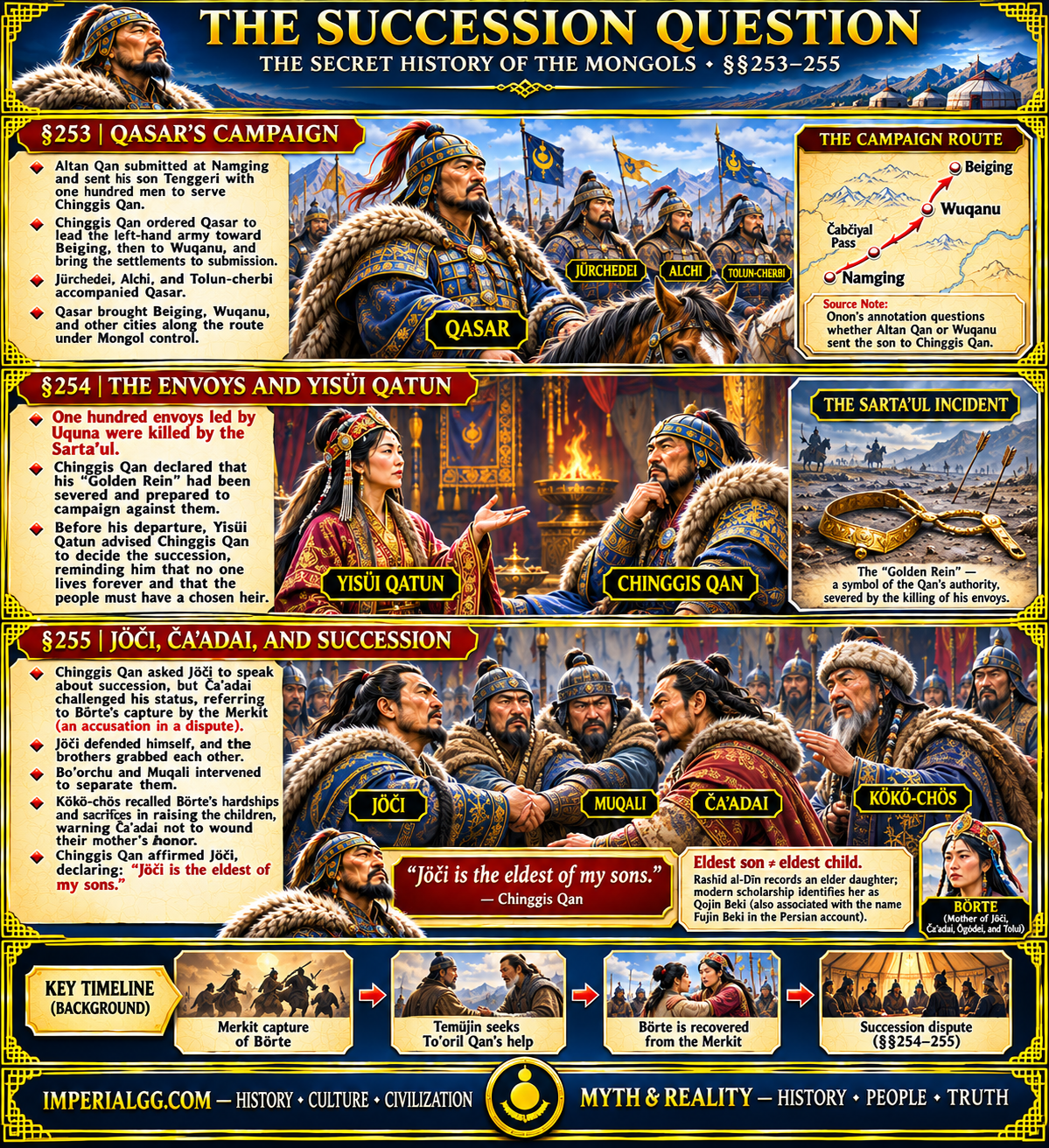
THE SARTA’UL ENVOYS, YISÜI QATUN’S INTERVENTION, AND THE STATUS OF JÖČI — THE SECRET HISTORY OF THE MONGOLS, §§253–255
ABSTRACT
Sections 253–255 of The Secret History of the Mongols connect the conclusion of the campaign against the Jin dynasty with a major political question within Chinggis Qan’s family: the designation of an heir. Section 253 describes the submission of Altan Qan at Namging, the dispatch of Qasar and three commanders toward Beiging, and the submission of settlements along their route. Section 254 records the killing of one hundred Mongol envoys led by Uquna by the Sarta’ul people. As Chinggis Qan prepares to undertake a campaign of retribution, Yisüi Qatun raises the question of succession, reminding him that no ruler is immortal and asking which of his sons he intends to designate as his successor. Section 255 then records the confrontation between Jöči and Ča’adai, the intervention of Kökö-chös, and Chinggis Qan’s explicit declaration that Jöči is the eldest of his sons. The article examines the distinction between eldest son and eldest child, including the evidence concerning Jöči’s elder sister, Qojin Beki, in Rashīd al-Dīn’s Compendium of Chronicles. It argues that these sections are not merely a family dispute: they reveal the relationship between military authority, dynastic legitimacy, maternal intervention, and the political organization of succession in the Mongol Empire.
Keywords: Chinggis Qan; Jöči; Ča’adai; Yisüi Qatun; Börte; Qojin Beki; Qasar; Uquna; Sarta’ul; succession; Secret History of the Mongols.
INTRODUCTION
The final sections of Chapter Eleven of The Secret History of the Mongols move from the military and political consequences of the campaign against the Jin dynasty to the internal question of succession within Chinggis Qan’s ruling family. The narrative begins with the submission of Altan Qan at Namging and the subsequent movement of Qasar’s forces toward Beiging. It then records the killing of one hundred Mongol envoys led by Uquna by the Sarta’ul people. This attack becomes the immediate reason for Chinggis Qan’s decision to campaign against the Sarta’ul. Before his departure, however, Yisüi Qatun raises a question that the ruler has not yet publicly resolved: who will inherit authority over the people after his death?
Ш . ЖИГЖИД
The succession question leads directly to the confrontation between Jöči and Ča’adai. Ča’adai challenges Jöči’s legitimacy by referring to the circumstances of Börte’s capture by the Merkit. Jöči responds by defending his standing as a son of Chinggis Qan. Chinggis then intervenes and declares, “Is not Jöči the eldest of my sons?” The statement is particularly important because it identifies Jöči as the eldest among the sons, not necessarily the eldest among all of Chinggis Qan’s children.
Ш . ЖИГЖИД+1
This distinction matters for reconstructing the family’s birth order. Rashīd al-Dīn, writing in the early fourteenth century, identifies a daughter named Fujin Beki as older than Jöči. Other scholarship identifies the eldest daughter as Qojin Beki. The names and their relationship require careful treatment, but the broader point is clear: Jöči’s status as the eldest son should not be confused with a claim that he was Chinggis Qan’s firstborn child.
Pax Mongolica+1
1. THE SUBMISSION OF ALTAN QAN AND QASAR’S CAMPAIGN TOWARD BEIGING — §253
Section 253 begins with the submission of Altan Qan after his arrival at Namging. The Jin ruler humbled himself before Chinggis Qan and sent his own son, Tenggeri, accompanied by one hundred men, to serve as sentries for Chinggis Qan. The chronicle presents this as a sign that Altan Qan had been brought under Mongol authority. Having received his submission, Chinggis Qan announced that the Mongol forces would withdraw.
Ш . ЖИГЖИД
Figure 1. The Jin dynasty’s political geography and the region around Namging. Namging is identified in Urgunge Onon’s notes as Nanjing, present-day Kaifeng in Henan Province. The illustration provides historical context and is not a contemporary depiction of Altan Qan’s submission.
Ш . ЖИГЖИД
As the Mongol army withdrew through Čabčiyal Pass, Chinggis Qan assigned Qasar to lead the left-hand army around the coast. He instructed Qasar to proceed to the city of Beiging, establish a camp there, and compel the city to submit. Qasar was then ordered to continue through the territory of Wuqanu, identified in Onon’s notes as Puxian Wannu, and to respond according to whether Wuqanu resisted or submitted. If Wuqanu chose resistance, Qasar was to attack him; if he submitted, Qasar was to pass through the border cities and continue along the banks of the Ula and Na’u rivers. He was then to cross the Tawur River upstream and rejoin Chinggis Qan at the main camp.
Ш . ЖИГЖИД
Chinggis Qan appointed three commanders to accompany Qasar: Jürchedei, Alchi, and Tolun-cherbi. The chronicle states that Qasar brought Beiging, Wuqanu, and the other cities along the route into submission. He subsequently travelled upstream along the Tawur River and returned to the main camp, where he dismounted.
Ш . ЖИГЖИД
Figure 2. A modern reconstruction of a Mongol military column operating across northern China. The scene illustrates the type of mobile operation described in §253, in which Qasar’s force moved through a series of settlements and river corridors.
An important source-critical detail appears in Onon’s annotation to this passage. Although the main text associates the dispatch of a son to Chinggis Qan with Altan Qan, the note states that the son was actually sent by Wuqanu, not by Altan Qan. The article therefore preserves what the narrative says while recording the translator’s correction. This discrepancy should not be silently harmonized: the identity of the ruler who sent the son requires comparison with the Jin and Yuan historical records.
Ш . ЖИГЖИД
The military significance of §253 lies in the use of a separate force under Qasar to secure the route and bring additional cities under submission while the main Mongol army withdrew. The operation was not simply a retreat. It combined the withdrawal of the central force with a parallel campaign by the left-hand army, supported by Jürchedei, Alchi, and Tolun-cherbi. The result, according to the chronicle, was the submission of Beiging, Wuqanu, and other settlements along the route.
2. THE KILLING OF UQUNA AND ONE HUNDRED MONGOL ENVOYS — §254
Section 254 opens with a new crisis. One hundred envoys sent by Chinggis Qan, under the leadership of Uquna, were obstructed and killed by the Sarta’ul people. The chronicle does not present this as a minor diplomatic incident. It portrays the killing as an attack upon the authority represented by the Mongol ruler’s envoys.
Ш . ЖИГЖИД
Chinggis Qan responded with a declaration that his “Golden Rein” had been severed by the Sarta’ul. He then announced his intention to ride against them, seeking vengeance for the deaths of Uquna and the one hundred envoys. The metaphor of the Golden Rein is politically significant: it represents the authority and command of the Qan, which the killing of his representatives had directly challenged.
Ш . ЖИГЖИД
Figure 3. A modern historical reconstruction of diplomatic envoys travelling on horseback. It is illustrative rather than an original image of Uquna’s mission.
As Chinggis Qan prepared to depart, Yisüi Qatun addressed him. Her intervention changed the direction of the conversation from military retaliation to the future of the Mongol state. She reminded him that he was preparing to cross high mountains, ford broad rivers, undertake distant campaigns, and bring many peoples under control. Yet, she argued, no human being was born to live forever. If his body were to fall like an old, withered tree or the stone foundation of a pillar, to whom would he leave the people under his authority?
Ш . ЖИГЖИД
Yisüi then asked which of his “four steeds”—a poetic expression for his sons—he intended to designate. She emphasized that his sons, younger brothers, common people, and even she herself understood the importance of the matter. She had therefore spoken openly and left the final decision to the Qan.
Ш . ЖИГЖИД
Figure 4. An artistic reconstruction of a Mongol royal woman of the early thirteenth century. The image is intended to evoke the political role of Yisüi Qatun in the narrative, not to claim a historically verified portrait of her.
Chinggis Qan responded by acknowledging the importance of Yisüi’s words. He declared that although she was a woman, her counsel could not be corrected. He then criticized the fact that neither his sons nor his younger brothers—including Bo’orchu and Muqali—had raised the issue. He admitted that he himself had forgotten it, having failed to follow the example of his ancestors.
Ш . ЖИГЖИД
He then turned directly to Jöči, his eldest son, and asked him to speak. Before Jöči could answer, however, Ča’adai interrupted. He interpreted the invitation as a possible indication that Chinggis Qan intended to nominate Jöči as his successor. Ča’adai then challenged Jöči’s legitimacy, asking how the Mongols could be ruled by someone he called a “bastard of the Merkits.”
Ш . ЖИГЖИД
This accusation refers to the earlier capture of Börte by the Merkit. It is essential to distinguish the allegation made by Ča’adai from an established historical fact. The Secret History records the accusation as part of a heated political confrontation; it does not provide independent proof that Jöči was fathered by a Merkit man.
3. BÖRTE’S CAPTURE, THE QUESTION OF JÖČI’S PATERNITY, AND THE IMPORTANCE OF HIS ELDER SISTER
The controversy over Jöči’s birth cannot be understood without returning to the earlier events described in the Secret History. In §§101–111, the Merkit attack on Temüjin’s camp is presented as retaliation for an earlier abduction: Yisügei Ba’atur had taken Hö’elün, the mother of Temüjin, from Yeke Čiledü, the younger brother of Toqto’a-beki. The Merkit leaders Toqto’a-beki, Dayir-usun, and Qa’atai-darmala subsequently attacked Temüjin’s camp and captured Börte. She was entrusted to Čilger Böko, the younger brother of Yeke Čiledü.
Monumenta Altaica+1
Temüjin sought help from To’oril Qan, ruler of the Kereyit, whom he regarded as a father figure because of the earlier alliance between their families. In §104, Temüjin reminded To’oril that the Merkit had taken his wife and, in the wording of some translations, his unborn child. He asked To’oril to help recover them. To’oril agreed to fulfil the promise he had made when Temüjin presented him with a sable coat, and he arranged support involving Jamuqa and the Kereyit forces.
Ш . ЖИГЖИД+1
The Mongol and Kereyit forces attacked the Merkit. During the pursuit, Temüjin found Börte among the fleeing people and recognized her. The chronicle describes their reunion in §110. It subsequently records that Čilger Böko fled. The episode is central to the later dispute because it establishes the circumstances under which Börte was captured and recovered.
Monumenta Altaica
Figure 5. The landscapes associated with the early history of Temüjin and the Merkit conflict. Burqan Qaldun, the Tu’ula River region, and the steppe environment form part of the geographical setting of the narrative. These images are geographical illustrations, not verified views of the exact locations of the abduction or rescue.
The later accusation by Ča’adai must be read against this background. He uses the Merkit capture of Börte to question Jöči’s paternity at the very moment when Chinggis Qan is asking Jöči to speak about succession. The timing is significant: the allegation is not an isolated insult but a direct challenge to Jöči’s right to be considered in the succession discussion.
There is, however, another essential distinction concerning Jöči’s place in the family. Chinggis Qan calls him the eldest of his sons, but this does not mean that he was the eldest of all his children. The Secret History itself, in §255, records the phrase “the eldest of my sons.” It does not call him the firstborn child of Börte and Chinggis Qan.
Ш . ЖИГЖИД
Rashīd al-Dīn’s Jāmiʿ al-Tawārīkh provides a further piece of evidence. In his account of Jöči’s lineage, Rashīd states that Jöči was the eldest of Chinggis Qan’s children except for an older sister, whom he calls Fujin Beki. Modern scholarship discussing the family identifies the eldest daughter as Qojin Beki. Anne F. Broadbridge’s study of the Chinggisid marriage network notes that Rashīd al-Dīn identifies Qojin as the oldest child overall, while the birth order of the sons and daughters can be reconstructed from his genealogical accounts.
Pax Mongolica+1
Figure 6. An artistic reconstruction of a Mongol royal princess. The image is illustrative; no verified contemporary portrait of Qojin Beki or Fujin Beki is established by the sources cited here.
The distinction between the two names requires caution. The Secret History sections under examination do not name this elder sister. Rashīd al-Dīn’s account gives the name Fujin Beki, while scholarship identifies the eldest daughter as Qojin Beki. It is therefore more rigorous to state that the evidence points to an elder daughter—identified in modern scholarship as Qojin Beki—rather than to claim that §§253–255 themselves name her. The key genealogical point remains: Jöči was the eldest son, but an elder sister preceded him in the overall birth order.
Pax Mongolica+1
This distinction also clarifies the political language of succession. In a ruling family that included daughters as well as sons, the designation “eldest son” described a particular position among male descendants. It did not erase the existence or seniority of daughters. The chronicle’s wording should therefore be preserved exactly in historical interpretation.
4. THE CONFRONTATION BETWEEN JÖČI AND ČA’ADAI — §254
After Ča’adai questioned Jöči’s legitimacy, Jöči rose and seized Ča’adai by the collar. He protested that their father had never told him that he was different from his brothers and demanded to know why Ča’adai was discriminating against him. He challenged Ča’adai’s claim to superiority, arguing that the only respect in which Ča’adai might be superior was stupidity.
Ш . ЖИГЖИД
Jöči then proposed a direct test of their abilities. If Ča’adai could defeat him in long-distance archery, Jöči said he would cut off his own thumb and throw it away. If Ča’adai defeated him in wrestling, Jöči declared that he would not rise from the ground where he fell. He then demanded that their father decide who should succeed him.
Ш . ЖИГЖИД
Figure 7. Mongol mounted archery as a representation of the martial culture invoked in Jöči’s challenge. The chronicle specifically refers to long-distance shooting and wrestling as tests of physical and military ability.
The brothers continued to hold each other by the collar. Bo’orchu pulled at Jöči’s arm, while Muqali pulled at Ča’adai’s arm. Chinggis Qan sat silently and listened. This detail is important: two of the ruler’s most trusted commanders intervened physically to prevent the dispute from escalating, while the ruler himself initially allowed the brothers to speak.
Ш . ЖИГЖИД
At this point, Kökö-chös intervened. He addressed Ča’adai and reminded him that Chinggis Qan had placed great expectations upon him. He then recalled the difficult years before the brothers were born, when their mother had joined the Merkit and people were forced into conflict by circumstances beyond their control. He warned that Ča’adai’s words would wound their mother’s heart and turn her affection against him.
Ш . ЖИГЖИД
Kökö-chös then reminded the brothers that they had emerged from the same mother and that Börte had suffered alongside Chinggis Qan during the years of struggle. His speech describes her endurance: she worked, cared for the children, shared her food with them, and sacrificed her own comfort to raise them. The speech culminates in a tribute to Börte’s character, describing her heart as bright as the sun and wide as a lake.
Ш . ЖИГЖИД
This speech is one of the most important passages concerning Börte’s political and maternal role. She is not present in the confrontation, yet her position as the mother of the rival brothers becomes central to the argument. Kökö-chös does not attempt to resolve the dispute through a legal statement about Jöči’s birth. Instead, he reminds Ča’adai that the brothers share a mother who endured the hardships of the family’s rise. The appeal to maternal sacrifice becomes an argument against fraternal hostility.
5. CHINGGIS QAN’S DECLARATION: “IS NOT JÖČI THE ELDEST OF MY SONS?” — §255
After hearing Kökö-chös’s speech, Chinggis Qan intervened directly. He asked how anyone could speak in such a way about Jöči and declared: “Is not Jöči the eldest of my sons? From now on, never speak [of him] again in such a way.” The command was explicit. Chinggis Qan rejected Ča’adai’s attempt to delegitimize Jöči through the Merkit accusation and prohibited further use of that language.
Ш . ЖИГЖИД
This declaration is central to the interpretation of Jöči’s status. It is not merely an expression of paternal affection. In the context of a succession discussion, it affirms that Jöči belongs among Chinggis Qan’s sons and that his seniority among them must be recognized. The ruler does not say that Jöči is the eldest child; he says that Jöči is the eldest of his sons. That wording must be retained in any historical account.
Figure 8. An artistic depiction of Chinggis Qan and his sons. It is a modern reconstruction of the dynastic setting, not a contemporary portrait of the individuals or the actual succession meeting.
After Chinggis Qan’s declaration, Ča’adai smiled and responded that he did not consider Jöči’s strength to be a special ability. He then used a proverb to suggest that a person cannot gain practical value from something that exists only in words. He proposed that he and Jöči, as the two eldest sons, should serve their father together and agree to appoint Ögödei as successor.
Ш . ЖИГЖИД
Jöči accepted Ča’adai’s proposal and stated that Ča’adai had spoken for him. He agreed that they should serve their father together and that Ögödei should be selected. Chinggis Qan then rejected the need for the two brothers to act as a partnership in the succession arrangement. He explained that the earth was broad and that there were many rivers and waters; he would distribute lands among his sons so that each would govern a separate territory. He instructed Jöči and Ča’adai to keep their agreement and not allow others to ridicule them.
Ш . ЖИГЖИД
The chronicle then records Chinggis Qan’s reference to Altan and Quchar, who had previously made promises of loyalty but failed to keep them. He used their example to warn his sons against repeating the same political failure. He next asked Ögödei to speak. Ögödei replied that he would remain steadfast, while acknowledging that he could not guarantee the conduct of his descendants.
Ш . ЖИГЖИД
Finally, Chinggis Qan asked Tolui to speak. Tolui pledged to remain beside the elder brother chosen by their father, to remind him of what he forgot, awaken him when he slept, and serve him faithfully in distant campaigns and nearby battles. Chinggis Qan approved his words and issued further instructions concerning the descendants of Qasar, Alchidai, Otchigin, and Belgütei. The succession discussion thus extended beyond the immediate question of which son would inherit the throne. It also addressed the political responsibilities of the wider ruling family and the role of the collateral branches in maintaining the state.
Ш . ЖИГЖИД
6. HISTORICAL INTERPRETATION: SENIORITY, LEGITIMACY, AND THE POLITICAL ROLE OF WOMEN
The three sections reveal several dimensions of Mongol political life that should be considered together.
First, §253 shows that military operations continued even after the submission of Altan Qan. Qasar’s force, accompanied by Jürchedei, Alchi, and Tolun-cherbi, moved through Beiging and the territory of Wuqanu, bringing cities along the route under submission. This demonstrates that the withdrawal of the main Mongol army did not mean the abandonment of military objectives. It was accompanied by further operations to secure territory and enforce submission.
Second, §254 demonstrates the relationship between diplomatic authority and military retaliation. The killing of Uquna and one hundred envoys was represented as an attack on the Golden Rein of Chinggis Qan’s authority. Yet before departing on the campaign, the ruler was reminded that the future of the empire required a decision about succession. The narrative thereby connects external warfare with internal political continuity.
Third, Yisüi Qatun’s intervention demonstrates the political importance of women in the ruling household. She raised a question that the male commanders and the ruler’s sons had not raised. Her words forced Chinggis Qan to confront the consequences of mortality and the need to establish a clear succession arrangement. Kökö-chös’s later speech, in turn, invokes Börte’s sacrifices as a mother and as a participant in the family’s rise. The two women occupy different positions in the narrative: Yisüi raises the political question, while Börte’s maternal authority becomes central to the resolution of the dispute between Jöči and Ča’adai.
Fourth, the confrontation reveals that Jöči’s position was challenged not simply because of personal rivalry but because his birth had become a politically sensitive subject. Ča’adai used the Merkit capture of Börte to question Jöči’s legitimacy. Chinggis Qan rejected this challenge and publicly identified Jöči as his eldest son. The declaration did not erase the historical circumstances of Börte’s capture, but it established the ruler’s position regarding Jöči’s status within the family.
Finally, the distinction between eldest son and eldest child is essential. Jöči was the eldest of Chinggis Qan’s sons, but Rashīd al-Dīn’s genealogical account identifies an older daughter, called Fujin Beki, while modern scholarship identifies Qojin Beki as the eldest daughter and oldest child. The Secret History passage should therefore be translated and interpreted precisely: Jöči was the eldest son, not necessarily the firstborn child.
Pax Mongolica+2
CONCLUSION
Sections 253–255 present a transition from military operations to the question of dynastic continuity. The submission of Altan Qan at Namging was followed by Qasar’s campaign toward Beiging and the submission of Wuqanu and other settlements. The killing of Uquna and one hundred Mongol envoys by the Sarta’ul people then prompted Chinggis Qan to prepare a campaign of retribution. Before his departure, Yisüi Qatun raised the question of succession, compelling the ruler to consider who would inherit authority over the Mongol people.
The resulting discussion exposed the tension between Jöči and Ča’adai. Ča’adai challenged Jöči’s legitimacy by invoking Börte’s capture by the Merkit, but Jöči defended his position, and Chinggis Qan explicitly affirmed him as the eldest of his sons. Kökö-chös’s intervention is equally important: by recalling Börte’s sacrifices and the hardships she endured while raising her children, he redirected the argument from an accusation about birth to the shared history and obligations of the brothers.
The evidence concerning Qojin Beki adds an important genealogical clarification. Jöči was the eldest son, but not necessarily the eldest child. Rashīd al-Dīn’s account and modern scholarship indicate that Börte’s daughter, identified as Qojin Beki and also associated with the name Fujin Beki in the Persian account, was older than Jöči. This distinction prevents the common mistake of treating “eldest son” and “firstborn child” as equivalent descriptions.
The central historical significance of §§253–255 lies in their portrayal of succession as a matter of imperial security rather than merely private family preference. Military authority, dynastic legitimacy, maternal influence, and the political responsibilities of the ruling family all converge in this discussion. The chronicle shows that Chinggis Qan’s concern was not only who would inherit his position, but also how his sons and their descendants would preserve the unity of the state after his death.
PRIMARY SOURCES AND SCHOLARLY REFERENCES
1. Urgunge Onon, translator and annotator. The Secret History of the Mongols: The Life and Times of Chinggis Khan. London and New York: RoutledgeCurzon, 2001. Sections 253–255, especially pp. 240–248.
2. Igor de Rachewiltz. The Secret History of the Mongols: A Mongolian Epic Chronicle of the Thirteenth Century. Leiden and Boston: Brill, 2004. The principal scholarly English translation and commentary for comparison of the Mongolian text and its interpretation.
– Igor de Rachewiltz — The Secret History of the Mongols, Volume I.
3. Rashīd al-Dīn Faḍl Allāh. Jāmiʿ al-Tawārīkh (Compendium of Chronicles), section on the history and descendants of Jöči Khan. Translated by J. A. Boyle in The Successors of Genghis Khan. London: Royal Asiatic Society, 1971.
– Rashīd al-Dīn — History of Jöči Khan and his descendants (Boyle translation).
4. Anne F. Broadbridge. “Marriage, Family and Politics: The Ilkhanid-Oirat Connection.” Journal of the Royal Asiatic Society 26, nos. 1–2 (2016): 121–135.
– Cambridge University Press — Marriage, Family and Politics.
5. Christopher P. Atwood. “Six Pre-Chinggisid Genealogies in the Mongol Empire.” 2012. Relevant to the study of Jöči’s status, genealogical traditions, and the interpretation of succession within the Chinggisid dynasty.
– Christopher P. Atwood — Six Pre-Chinggisid Genealogies in the Mongol Empire.
SOURCE-CRITICAL NOTES
1. The year of the events: Section 253 follows the events of the Jin campaign and the submission at Namging. Section 254 is a later event. Onon’s annotation places the killing of Uquna and the hundred envoys in late 1216 or early 1217, not in the 1214 campaign.
Ш . ЖИГЖИД
2. The identity of the envoys: The one hundred envoys in §254 were led by Uquna and were killed by the Sarta’ul. They must not be confused with the envoys obstructed by Altan Qan in §251.
3. Börte’s capture: The Merkit capture of Börte is narrated in §§101–111. The accusation against Jöči in §254 is Ča’adai’s statement during a political dispute; it is not independent proof of Jöči’s biological paternity.
4. Jöči’s birth: The Secret History records Chinggis Qan’s declaration that Jöči was the eldest of his sons. It does not say that he was the eldest of all his children.
5. Qojin Beki / Fujin Beki: Rashīd al-Dīn’s account identifies an elder daughter as Fujin Beki; modern scholarship discusses Qojin Beki as the eldest daughter. The names should be presented with their source traditions identified, rather than treated as automatically identical without qualification.
6. Wuqanu and the son sent to Chinggis Qan: Onon’s note to §253 questions the attribution in the main narrative and states that Wuqanu, not Altan Qan, sent his son. This discrepancy should remain visible in any source-based historical account.
IMPERIALGG.COM — HISTORY • CULTURE • CIVILIZATION
MYTH & REALITY — HISTORY • PEOPLE • TRUTH