
THE 1211–1215 MONGOL CAMPAIGNS AGAINST THE JIN DYNASTY
By Altanbagana Baatar
DBA Candidate| Independent Historian
ImperialGG Historical Research Seriers
12 November 2026
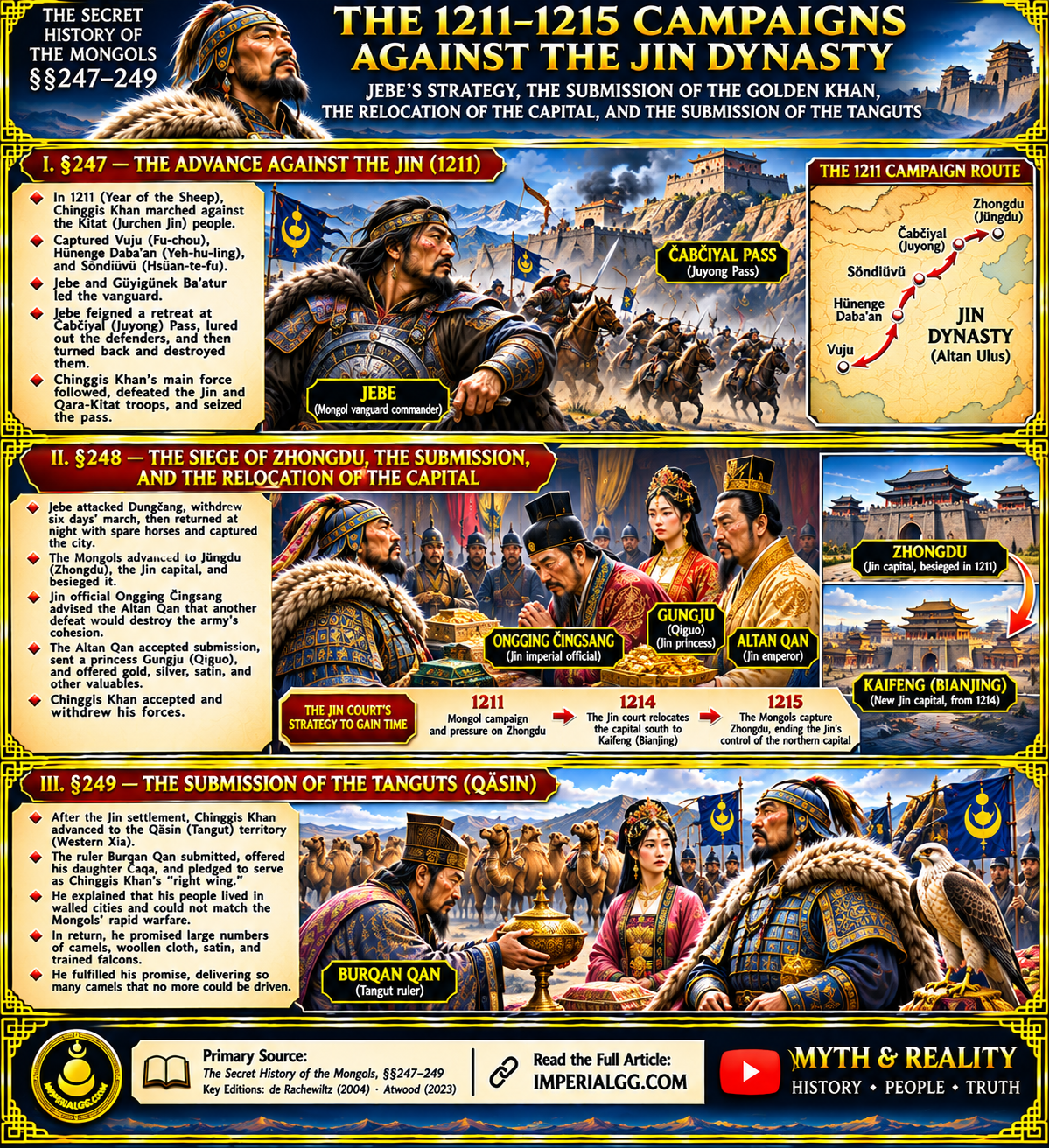
JEBE’S MILITARY STRATEGY, THE SUBMISSION OF THE GOLDEN KHAN, AND THE FALL OF ZHONGDU
A Historical and Source-Critical Study of The Secret History of the Mongols, §§247–249, with the subsequent historical developments of 1214–1215
IMPERIALGG.COM | ACADEMIC HISTORICAL RESEARCH
ABSTRACT
Sections 247–249 of The Secret History of the Mongols preserve an account of Chinggis Khan’s campaigns against the Jurchen Jin dynasty and the Tangut state of Western Xia. The narrative begins with the Mongol advance against the Kitat people in 1211, recording Jebe’s tactical deception at Čabčiyal Pass, the defeat of the Jin defensive forces, and the capture of Dungčang through a separate operation involving a six-day withdrawal followed by a surprise night attack.
The Mongol advance subsequently brought the Jin capital, Zhongdu, under severe military pressure. The Jin court’s senior official, Ongging Čingsang, advised the Altan Qan that continued resistance could destroy the cohesion of the Jin army. The ruler therefore accepted a negotiated settlement involving a princess, gold, silver, satin, and other valuable goods. Chinggis Khan accepted the submission and withdrew his forces from the cities they were attacking.
However, the settlement did not end the conflict. The Jin court subsequently moved its political center southward from Zhongdu to Kaifeng, a decision that reflected its continuing effort to preserve the dynasty and escape the immediate Mongol threat. The renewed Mongol offensive culminated in the capture of Zhongdu in 1215.
The final section of the narrative, §249, describes Chinggis Khan’s advance into the territory of the Qäsin, or Tangut, people. Their ruler, Burqan Qan, submitted, offered his daughter Čaqa, and pledged service as the Mongol ruler’s right wing. He also promised camels, woollen fabrics, satin, and trained falcons. The account emphasizes that the number of camels delivered was so great that no more could be driven.
This article argues that the campaigns reveal the interaction of military deception, strategic pressure, diplomatic submission, dynastic marriage, and material tribute in the expansion of Mongol imperial power.
I. THE HISTORICAL BACKGROUND: THE JURCHEN JIN DYNASTY
The state referred to in The Secret History as the Kitat was the Jurchen Jin dynasty (金朝, 1115–1234), which ruled much of northern China. Its capital, Zhongdu (中都), was located in the area of present-day Beijing.
The Jin dynasty was not the Tangut state. These were two separate political powers, with different rulers, territories, and political histories. The distinction is essential to understanding the order of events in §§247–249.
Map of the Jurchen Jin dynasty and its northern Chinese territories. Historical territorial maps should be checked against the period represented. Source: The Cambridge History of China.
The Mongol campaign against the Jin began in 1211, during the Year of the Sheep. The conflict developed over several years. The initial campaign weakened the northern defensive system, while subsequent operations in 1213–1214 brought the Mongol army to the vicinity of Zhongdu.
The Jin court eventually negotiated peace in 1214. The capital was subsequently abandoned and the court relocated to Kaifeng. Zhongdu fell to the Mongols in 1215. These developments are supported by modern historical scholarship and should be distinguished from the compressed narrative sequence of the Secret History.
PagePlace+2
II. §247 — CHINGGIS KHAN’S CAMPAIGN AGAINST THE JIN DYNASTY
THE MONGOL ADVANCE AND THE NORTHERN FRONTIER
The Secret History states that in the Year of the Sheep, 1211, Chinggis Khan marched against the Kitat people. The first places mentioned are Vuju, Hünenge Daba’an, and Söndiüvu.
De Rachewiltz identifies these geographical names with locations in the northern defensive zone of the Jin dynasty:
Vuju — identified with Fu-chou (撫州).
Hünenge Daba’an — identified with Yeh-hu-ling (野狐嶺), or Wild Fox Pass.
Söndiüvu — identified with Hsüan-te-fu (宣德府).
Čabčiyal — identified with Juyong Pass (居庸關).
Jüngdu — Zhongdu (中都), the Jin capital.
The ruler dispatched Jebe and Güyigünek Ba’atur as vanguard commanders. Their advance was intended to break through the defensive positions and open the way for the main Mongol force.
JEBE’S DECEPTION AT ČABČIYAL PASS
When Jebe reached Čabčiyal, he found that the pass was defended. Rather than immediately attempt a frontal assault, he proposed to draw the defenders out of their fortified position.
He turned back, encouraging the Jin soldiers to believe that the Mongol vanguard was retreating. The defenders pursued him, leaving their prepared defensive position and spreading through the surrounding valleys and mountains.
When Jebe reached the area of Söndiüvu, he suddenly turned and attacked the pursuing forces. The defenders were caught in an exposed position and defeated.
Juyong Pass (Čabčiyal), identified by historical scholarship as a strategic northern approach to Zhongdu. The visible structures today largely reflect later construction and restoration, not the exact fortifications of 1211. Source: Beijing Municipal Government — Juyongguan Great Wall.
This operation demonstrates the use of tactical deception. Jebe did not simply withdraw; he deliberately manipulated the enemy’s expectations, induced the defenders to abandon their advantageous position, and attacked when their forces were exposed.
The sequence was:
Reconnaissance of the defended pass.
Feigned retreat.
Enemy pursuit.
Withdrawal of the defenders from their prepared position.
Sudden counterattack.
Defeat of the pursuing forces.
CHINGGIS KHAN’S MAIN ARMY AND THE CAPTURE OF THE PASS
While Jebe was engaging the defenders, Chinggis Khan advanced with the main Mongol army. The narrative records the defeat of the Jin forces, including the elite troops associated with the Qara-Kitat and the Jürčet.
Jebe then captured the gate of Čabčiyal and secured the passage through the mountain barrier. Chinggis Khan established his camp at Šira Degtür.
The defeat at the pass weakened the northern defensive system of the Jin dynasty and opened the way for Mongol operations deeper into its territory.
III. JEBE’S SIX-DAY WITHDRAWAL AND THE CAPTURE OF DUNGČANG
After the Mongol advance toward Zhongdu, Chinggis Khan dispatched Jebe to attack Dungčang. Jebe reached the city but was initially unable to capture it. Instead of continuing an unsuccessful assault, he withdrew to a position six days’ march away.
The Jin defenders believed that the Mongol force had abandoned the operation. Jebe then reversed direction and returned during the night. His soldiers led spare horses by hand, allowing the force to move quickly while preserving the mobility of the mounted troops.
The Mongols arrived unexpectedly and captured the city. This operation must be distinguished from the earlier maneuver at Čabčiyal. At the pass, Jebe drew the enemy into pursuit. At Dungčang, he used a six-day withdrawal to create the impression that the threat had passed, then returned at night to launch a surprise attack.
The account preserves two distinct examples of Jebe’s operational deception within the same campaign.
Primary source: The Secret History of the Mongols, §247; Monumenta Altaica — original text and translations; de Rachewiltz translation.
IV. §248 — THE SIEGE OF ZHONGDU AND THE SUBMISSION OF THE ALTAN QAN
THE JIN CAPITAL UNDER MONGOL PRESSURE
Following Jebe’s capture of Dungčang, the Mongol forces operated around Jüngdu (Zhongdu, 中都), the capital of the Jin dynasty.
The city was a major political and administrative center, protected by extensive fortifications. The Mongol army’s arrival placed the Jin court under severe pressure.
Reconstructed layout of Jin Zhongdu, the medieval capital in the area of present-day Beijing. This is a historical city-plan illustration, not a photograph of the 1211 siege. Image source: Jin Zhongdu city layout map.

The Secret History describes the Mongol encirclement and pressure on the Jin capital. However, the city was not captured during this initial settlement. The Jin ruler negotiated and submitted in order to avoid the further destruction of his forces.
ONG GING ČINGSANG’S ADVICE
The Jin court’s senior official, Ongging Čingsang, advised the Altan Qan that another major military engagement could bring disaster. He argued that the Jin forces had already lost many of their strongest and most capable soldiers. If another army were defeated, the remaining troops might disperse to their own cities. Attempts to force them back into military service could turn them against the court.
His proposal was to accept submission, send a princess to Chinggis Khan, and provide gold, silver, satin, and other valuable goods. The argument reveals that the Jin court was not simply considering whether it could win another battle. It was calculating whether its military and political structure could survive another defeat.
THE ALTAN QAN’S SUBMISSION AND THE PRINCESS GUNGJU
The Altan Qan accepted Ongging Čingsang’s proposal. He sent a princess, identified in the Mongolian narrative as Gungju, together with substantial quantities of gold, silver, satin, and other goods for the Mongol army.
A philological distinction is important: Gungju corresponds to the Chinese title gongzhu (公主), meaning “princess.” It should not automatically be treated as the woman’s personal name. Christopher Atwood’s translation identifies her personal name as Qiguo, based on the Chinese historical tradition and relevant scholarship.
Ongging Čingsang personally conveyed the settlement to Chinggis Khan. The Mongol ruler accepted the arrangement and ordered his troops to withdraw from the cities they were attacking. The Jin court had therefore obtained a temporary respite. It had not been destroyed, and its ruling structure remained in place.
THE SUBMISSION AS A STRATEGY TO GAIN TIME
The Jin submission should be understood in the context of the court’s continuing effort to preserve its state. Ongging Čingsang’s speech reflects a calculation that the Jin army could not withstand another major defeat. The offer of a princess and valuable goods was intended to secure the Mongol withdrawal and prevent the immediate collapse of the capital’s defenses.
The subsequent actions of the Jin court demonstrate that the settlement did not resolve the underlying conflict. The dynasty continued to pursue its own political and military interests.
V. THE RELOCATION OF THE JIN CAPITAL: FROM ZHONGDU TO KAIFENG
THE DECISION OF EMPEROR XUANZONG
In 1213, the Jin throne passed to Emperor Xuanzong (宣宗, r. 1213–1223). In 1214, the court relocated its political center from Zhongdu to Kaifeng (開封), also known as Bianliang or Bianjing, in the southern part of the Jin realm.

Historical plan of Kaifeng, the Jin court’s southern political center after the relocation from Zhongdu. The illustration is based on a Northern Song city plan and should be used as a geographical reference, not as an exact reconstruction of the Jin-period city. Image source: Wikimedia Commons — Kaifeng historical city plan.

The relocation was a major political decision. The Jin court was moving away from the region most exposed to Mongol military pressure and toward a more defensible and economically productive area south of the Yellow River.
The move demonstrated that the Jin ruler regarded the 1214 agreement as a temporary measure rather than a permanent solution to the conflict.
It is important, however, not to claim that the Secret History explicitly records a secret deception planned by the Jin ruler. The text records the negotiated submission and withdrawal; the subsequent relocation is established through the broader historical record. The interpretation that the Jin court used the truce to gain time is supported by the sequence of its actions.
THE RENEWED MONGOL OFFENSIVE AND THE FALL OF ZHONGDU IN 1215
The relocation of the Jin court was followed by renewed Mongol military pressure. The Mongols interpreted the movement of the Jin capital as a serious breach of the settlement and resumed their operations.
In 1215, Zhongdu fell to the Mongol forces. The capture was a separate historical event from the negotiated submission of 1214.
Historical remains and reconstructions associated with Jin Zhongdu. The medieval city was captured by Mongol forces in 1215. Source: Beijing historical account of Zhongdu and its military history.
Ruth W. Dunnell’s chapter in The Cambridge History of the Mongol Empire explains that the Mongols withdrew from Zhongdu in 1214 after the negotiated settlement, while the Jin court’s move to Kaifeng prompted the renewed siege and the capture of the city in May 1215.
PagePlace+2
The sequence is therefore:
1211: Mongol campaign against the Jin frontier.
1213–1214: renewed Mongol operations and pressure on Zhongdu.
1214: the Jin court negotiates peace and offers tribute.
1214: Emperor Xuanzong relocates the court to Kaifeng.
1215: Mongol forces capture Zhongdu.
This chronology is essential for understanding the difference between a negotiated submission and the later military occupation of the capital.
VI. §249 — THE SUBMISSION OF THE TANGUT QÄSIN AND BURQAN QAN
CHINGGIS KHAN’S ADVANCE INTO THE TANGUT TERRITORY
After the account of the Jin settlement, §249 describes Chinggis Khan’s visit to the Qäsin people, identified by de Rachewiltz with the Tanguts of the Western Xia state.
This is a separate political development from the submission of the Jin Altan Qan.
Map of the Western Xia or Tangut kingdom, showing its territorial extent and principal centers, including Xingqing. This map represents the kingdom around 1150, not its exact borders during the 1211 campaign. Image source: Western Xia historical map.

When Chinggis Khan arrived in the Qäsin territory, Burqan Qan submitted and offered to serve the Mongol ruler as his “right hand” or right wing.
The expression indicates a political and military relationship of service. Burqan Qan was not simply offering a gift; he was proposing that the Tangut ruler and his people become part of the Mongol ruler’s wider military and political order.
BURQAN QAN’S DAUGHTER ČAQA
Burqan Qan presented his daughter Čaqa to Chinggis Khan.
This should be distinguished from the princess Gungju in §248. Gungju is a title meaning princess, whereas Čaqa is the personal name recorded for the Tangut ruler’s daughter.
The two diplomatic arrangements involved different rulers and different states:
Jin dynasty, §248 | Tangut Qäsin, §249 |
|---|---|
Altan Qan | Burqan Qan |
Ongging Čingsang as intermediary | Burqan Qan’s own submission |
Princess Gungju (title; personal name identified as Qiguo in scholarship) | Daughter Čaqa |
Gold, silver, satin, fabrics | Camels, woollen fabrics, satin, trained falcons |
Negotiated submission and Mongol withdrawal | Pledge of service as the right wing |
BURQAN QAN’S EXPLANATION OF TANGUT MILITARY CAPACITY
The Tangut ruler explained that his people lived in established settlements and fortified cities. Their military organization and way of life differed from those of the Mongols. He acknowledged that the Tanguts could not keep pace with the Mongol army during rapid campaigns or participate in swift mounted warfare in the same manner. This statement is important because it shows that Burqan Qan was not promising to provide an identical military force. Instead, he offered resources that his own settled society could produce and deliver.
He explained that the Tanguts could serve Chinggis Khan by providing:
Large numbers of camels raised in the tall broom-grass country.
Woollen cloth.
Satin.
Trained falcons, with the best birds selected and presented to the Mongol ruler.
The offer reveals a form of military and economic cooperation based on the different strengths of the two societies.
THE CAMEL TRIBUTE: AN ENORMOUS LEVY
Burqan Qan promised to levy camels from the Tangut population and deliver them to Chinggis Khan.
The narrative states that he fulfilled his promise by collecting so many camels that it was impossible to drive any more of them. He then brought the animals and presented them to the Mongol ruler.
Illustrative image of a camel caravan. This is not a depiction of the actual Tangut tribute recorded in §249. The primary text describes the enormous camel levy but gives no exact numerical total. Image source: Monumenta Altaica — primary text and translations.
The source does not provide an exact number of camels. Its emphasis is on the extraordinary scale of the tribute: the quantity was so large that the Mongols could not drive any more animals.
The camels had practical value for transportation and the movement of goods across arid regions. Woollen fabrics and satin were valuable materials, while trained falcons belonged to the elite hunting and prestige culture of the ruling household.
TRAINED FALCONS AND THE SYMBOLIC VALUE OF THE TRIBUTE
The Tangut ruler also promised to train falcons, gather them together, and send the best birds to Chinggis Khan. This detail should not be overlooked. The tribute was not limited to livestock and textiles. It also included animals associated with elite hunting practices and the prestige of the ruling class.
The combination of camels, fabrics, and trained falcons illustrates the range of resources that a settled state could provide to the Mongol imperial household. The Tangut submission therefore demonstrates how the Mongols could incorporate different economic and military capacities into a broader imperial relationship.
Primary source: The Secret History of the Mongols, §249. Original text and multiple translations; de Rachewiltz translation and commentary. The English passage is also available in Christopher Atwood translation, §249.
VII. COMPARATIVE ANALYSIS: THE JIN AND TANGUT SUBMISSIONS
The two submissions recorded in §§248–249 demonstrate different methods of entering into a political relationship with Chinggis Khan. The Jin court faced a military crisis around Zhongdu and negotiated a temporary settlement to preserve its political structure. The Tangut ruler, by contrast, offered service and material resources in exchange for recognition and incorporation into the Mongol order.
Historical dimension | Jin dynasty | Tangut Qäsin |
|---|---|---|
Ruler | Altan Qan | Burqan Qan |
Main political pressure | Mongol military operations around Zhongdu | Chinggis Khan’s arrival in Tangut territory |
Diplomatic representative | Ongging Čingsang | Burqan Qan |
Dynastic connection | Princess Gungju / Qiguo | Čaqa |
Material contribution | Gold, silver, satin, other goods | Camels, woollen cloth, satin, falcons |
Political outcome | Temporary negotiated submission | Pledge of service and tribute |
The difference between these arrangements reveals that Mongol imperial expansion was not based on a single fixed model. Military pressure could lead to negotiated withdrawal and temporary submission, while other rulers offered service, dynastic ties, and resources suited to their own economies.
VIII. AUTHOR’S THESIS — FROM MILITARY VICTORY TO POLITICAL AND MATERIAL INCORPORATION
The central thesis of this article is that the campaigns recorded in §§247–249 reveal the transformation of Mongol military victories into a wider system of imperial relationships.
Jebe’s operations at Čabčiyal and Dungčang demonstrate tactical deception, mobility, and the manipulation of enemy expectations. The defeat of the Jin defensive forces placed the court under pressure and contributed to the negotiations led by Ongging Čingsang.
The Altan Qan’s submission, the presentation of a princess, and the transfer of valuable goods temporarily halted the Mongol advance. Yet the Jin court continued to pursue its own interests. The relocation of its capital to Kaifeng and the subsequent loss of Zhongdu in 1215 demonstrate that the 1214 settlement had not resolved the underlying conflict.
The Tangut submission in §249 reveals a different mechanism of incorporation. Burqan Qan offered service as the Mongol ruler’s right wing and provided his daughter, camels, woollen fabrics, satin, and trained falcons. These contributions complemented the military and economic resources of the Mongol imperial household.
The author therefore argues that the events demonstrate three mutually reinforcing processes:
Military penetration: the Mongol army defeated frontier defenses and opened strategic routes into the territory of the Jin dynasty.
Diplomatic submission: rulers negotiated with Chinggis Khan through envoys, princesses, gifts, and pledges of service.
Material incorporation: the wealth, livestock, textiles, and specialized resources of neighboring states were transferred into the expanding imperial system.
The campaigns did not immediately destroy either the Jin or Tangut state. The Jin dynasty continued to exist after the fall of Zhongdu, and the Tangut state survived until the campaigns of 1226–1227. Nevertheless, these events reveal the increasing ability of Chinggis Khan to transform military superiority into political relationships and material resources.
CONCLUSION
Sections 247–249 preserve an important account of the expansion of Mongol power against the Jin dynasty and the Tangut state.
The operations of Jebe at Čabčiyal and Dungčang reveal the tactical flexibility of the Mongol army. The pressure placed on Zhongdu led the Jin court to negotiate a temporary settlement in 1214, offering a princess and extensive material wealth. The subsequent relocation of the Jin capital to Kaifeng demonstrated that the court continued to seek a means of preserving its state, while the renewed Mongol offensive resulted in the capture of Zhongdu in 1215.
The Tangut submission recorded in §249 reveals another dimension of imperial expansion. Burqan Qan offered his daughter Čaqa, pledged service as the Mongol ruler’s right wing, and delivered an enormous levy of camels together with woollen fabrics, satin, and trained falcons.
The historical significance of these events lies in the combination of military strategy, diplomatic negotiation, dynastic relationships, and economic incorporation. Chinggis Khan’s imperial authority expanded not only through battlefield victories, but also through the ability to convert those victories into submission, tribute, and enduring political relationships.
FOOTNOTES AND REFERENCES
The Secret History of the Mongols, §247. Igor de Rachewiltz, The Secret History of the Mongols: A Mongolian Epic Chronicle of the Thirteenth Century, vol. I (Leiden: Brill, 2004), Chapter Eleven. Translation.
De Rachewiltz, commentary on §247. Place-name identifications include Vuju/Fu-chou, Hünenge Daba’an/Yeh-hu-ling, Söndiüvu/Hsüan-te-fu, Čabčiyal/Juyong Pass, and Jüngdu/Zhongdu. Historical commentary.
The Secret History of the Mongols, §247. Jebe’s feigned retreat and counterattack at Čabčiyal.
Ibid. Jebe’s six-day withdrawal and surprise night attack on Dungčang.
The Secret History of the Mongols, §248. Ongging Čingsang’s advice and the Jin settlement.
Ruth W. Dunnell, “The Mongol Empire,” in The Cambridge History of the Mongol Empire. The chapter describes the 1214 settlement, the relocation of the Jin court, and the 1215 fall of Zhongdu. Read the chapter PDF.
The Secret History of the Mongols, §248. The presentation of the princess Gungju and the gifts of gold, silver, satin, and other goods. Atwood’s translation and notes identify the personal name Qiguo. Atwood translation.
The Secret History of the Mongols, §249. Burqan Qan’s submission, the presentation of Čaqa, and the pledge to serve as the right wing.
Ibid. The levy of camels, woollen cloth, satin, and trained falcons.
Christopher P. Atwood, trans., The Secret History of the Mongols (London: Penguin Classics, 2023), Chapter Eleven. Translation and notes.
Monumenta Altaica, The Secret History of the Mongols, original Chinese-character text and multiple transliterations and translations. Digital primary-source repository.
BIBLIOGRAPHY
Atwood, Christopher P., trans. The Secret History of the Mongols. London: Penguin Classics, 2023. Digitized text.
de Rachewiltz, Igor. The Secret History of the Mongols: A Mongolian Epic Chronicle of the Thirteenth Century. 2 vols. Leiden–Boston: Brill, 2004. Translation and commentary.
Dunnell, Ruth W. “The Mongol Empire.” In The Cambridge History of the Mongol Empire. Academic chapter.
Monumenta Altaica. The Secret History of the Mongols: original text, transliterations, and translations. Digital research repository.
IMPERIALGG.COM — HISTORY • CULTURE • CIVILIZATIONMYTH & REALITY — HISTORY • PEOPLE • TRUTH