
HÖ’ELÜN’S UNRECOGNIZED CONTRIBUTION, THE SURVIVAL OF DÄRITAI, AND THE CONSOLIDATION OF THE CHINGGISID DYNASTY
By Altanbagana Baatar
DBA Candidate| Independent Historian
ImperialGG Historical Research Seriers
09 November 2026
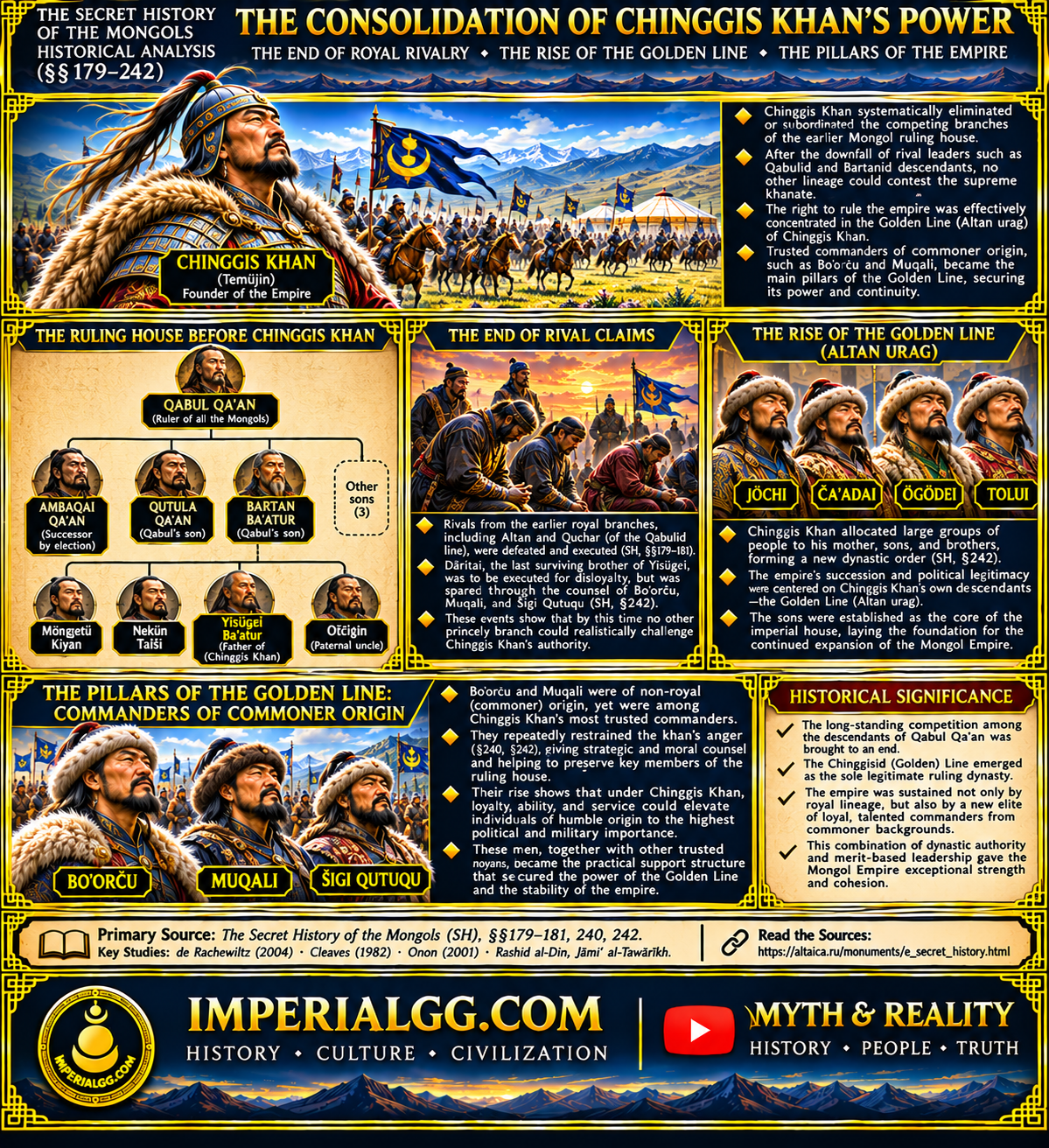
A Historical and Genealogical Reassessment of The Secret History of the Mongols, §§242–243, with Comparative Evidence from Mongol Genealogical and Persian Sources
IMPERIALGG.COM | ACADEMIC HISTORICAL RESEARCH
ABSTRACT
The account of the distribution of subject populations in §242 of The Secret History of the Mongols is more than a record of the allocation of people among members of Chinggis Khan’s family. It preserves evidence of a decisive transformation in Mongol political authority: the concentration of imperial succession and political legitimacy within the ruling line of Chinggis Khan, alongside the diminishing position of the older branches of the Borjigin dynasty.
This article re-examines three interconnected issues. First, it considers the joint allocation of ten thousand people to Hö’elün and her youngest son, Temüge Otčigin, and the significance of Hö’elün’s dissatisfaction in light of her earlier contribution to the survival and political consolidation of the family. Second, it examines the threatened execution of Däritai Otčigin, identified in the source as the only surviving paternal uncle of Chinggis Khan, and the intervention of Bo’orču, Muqali, and Šigi Qutuqu. Third, it places these events within the longer history of the Qabulid and Bartanid branches of the Mongol ruling house, examining how Chinggis Khan’s political authority became increasingly associated with his own descendants.
The article argues that §242 reveals a critical distinction between the historical contribution of the older generation and the distribution of political power under the new imperial order. It also proposes that the survival of Däritai, despite his previous disloyalty, demonstrates the political importance of preserving the ancestral household and its remaining genealogical continuity. These developments are considered alongside the wider incorporation of Oirat, Uyghur, and other frontier communities into the expanding empire.
Primary source: Igor de Rachewiltz, The Secret History of the Mongols (2004), §§242–243 and commentary, pp. 862–869.
I. THE DISTRIBUTION OF SUBJECT POPULATIONS: MORE THAN A DIVISION OF PEOPLE
Section 242 records Chinggis Khan’s decree to distribute subject populations among his mother, sons, and younger brothers. Before making the allocations, he explicitly identifies three considerations: his mother had worked hardest to gather the people; Jöchi was his eldest son; and Temüge Otčigin was the youngest among his younger brothers.
The original narrative is especially important because it connects the distribution to the history of the ruling family. The Mongolian expression translated by de Rachewiltz as “gathering the people” refers not merely to assembling a population but to the recovery and consolidation of clansmen and followers who had become disaffected after the death of Yisügei Ba’atur. De Rachewiltz further suggests that Chinggis Khan may also have been acknowledging the advice and support he received from his mother during the difficult years in which he sought to establish authority over the Mongolian tribes.[1]
The allocations recorded in the passage are as follows:
Recipient | Relationship | Allocation in §242 |
|---|---|---|
Hö’elün and Temüge Otčigin, jointly | Mother and youngest brother | 10,000 |
Jöchi | Eldest son | 9,000 |
Ča’adai | Second son | 8,000 |
Ögödei | Third son | 5,000 |
Tolui | Youngest son | 5,000 |
Jöči Qasar | Brother | 4,000 |
Alčidai | Nephew, son of Qači’un | 2,000 |
Belgütei | Half-brother | 1,500 |
Source: The Secret History of the Mongols, §242; de Rachewiltz (2004), pp. 862–865. These are the figures reported in the Mongol narrative, not independently verified census totals.
A crucial clarification concerns the first allocation. The text does not give Hö’elün ten thousand people and Otčigin another ten thousand. It gives ten thousand jointly to Hö’elün and Otčigin. De Rachewiltz explains that Otčigin’s share was combined with that of his mother because, as the youngest son, he traditionally remained at home and inherited responsibility for the ancestral hearth. In the comparative account of Rashid al-Din, the figures are different: five thousand are assigned to Hö’elün and three thousand to Otčigin, making eight thousand in total.[2]
This difference between the sources must not be concealed. It is precisely the kind of discrepancy that makes comparative source criticism necessary.
The allocation was therefore not simply a matter of dividing ten thousand people equally between mother and son. It reflected a political and household arrangement in which the mother’s contribution and the youngest son’s responsibility for the ancestral home were combined within a single allocation.
Primary text and comparison: de Rachewiltz, commentary on §242, pp. 863–865; Monumenta Altaica — original text and parallel versions.
II. HÖ’ELÜN’S DISSATISFACTION: THE WOMAN WHO HELPED PRESERVE THE IMPERIAL HOUSEHOLD
The narrative states that Hö’elün was dissatisfied with the allocation, considering the number too small, but did not openly complain. De Rachewiltz emphasizes that the Mongolian expression used here conveys more than a neutral assessment that the number was insufficient. It carries the sense of dissatisfaction, resentment, and even blame.[3]
This brief statement becomes much more meaningful when read against the earlier chapters of The Secret History.
Following Yisügei Ba’atur’s death, the Tayichi’ut kinsmen and their followers abandoned Hö’elün and her children, taking many of the family’s people with them. Hö’elün was left to raise her children under extremely difficult circumstances. The narrative describes her efforts to sustain the household, gather people, and preserve the family’s existence during a period when its political position had nearly collapsed.
In §74, the source recalls that Hö’elün took up the standard and attempted to bring back people who had left with the Tayichi’ut. Although many of those recovered did not remain, the episode illustrates her active role in maintaining the family’s following. Her contribution was therefore not limited to motherhood in a private or domestic sense. She participated directly in the survival of the political household from which Chinggis Khan’s later power emerged.[4]
The significance of §242 is that Chinggis Khan himself acknowledges this contribution. He does not overlook her historical role. On the contrary, he explicitly declares that she had worked harder than anyone in gathering the people.
Yet the practical distribution does not appear to satisfy her.
This creates an important contrast: the sovereign publicly recognizes his mother’s foundational contribution, while the allocation of political resources leaves her dissatisfied.
The source does not tell us precisely what Hö’elün expected to receive, nor does it record her explaining the reasons for her dissatisfaction. It would therefore be excessive to claim that she demanded a separate ten-thousand-person allocation. However, the combination of her acknowledged service, the joint allocation with Otčigin, and her recorded resentment allows us to consider whether the decision adequately recognized her contribution as the person who had preserved the family and its political base during its most vulnerable period.
OTČIGIN AND THE ANCESTRAL HEARTH
The position of Temüge Otčigin adds another dimension to this issue. As the youngest son of Yisügei Ba’atur and Hö’elün, he was traditionally associated with remaining at the family’s home and preserving the ancestral hearth.
De Rachewiltz explicitly connects this custom to the combined allocation in §242. Otčigin was the son who remained at home, and his share was associated with the household inheritance. This makes it possible to interpret the joint ten-thousand allocation not as a simple reward to Hö’elün but as an arrangement connecting maternal contribution with the responsibility of the youngest son.[5]
The distinction is important. Hö’elün had helped preserve the household during its collapse; Otčigin was now entrusted with its continued maintenance. Their allocation therefore joined the memory of the family’s survival to the practical administration of its ancestral base.
Nevertheless, the source records Hö’elün’s dissatisfaction. The narrative thus preserves a tension between recognition, inheritance, and the distribution of authority within the imperial family.
Sources: The Secret History of the Mongols, §§72–74, 242; de Rachewiltz (2004), commentary, pp. 863–865. Open the complete translation and commentary.
III. DÄRITAI OTČIGIN: THE LAST SURVIVING BROTHER OF YISÜGEI BA’ATUR
The second major issue in §242 concerns Däritai Otčigin, Chinggis Khan’s paternal uncle. The passage records that Chinggis Khan learned that Däritai had joined the Kereyit and declared that he would remove him from his sight. In context, this expression is understood as a threat to kill him.
The intervention that followed is one of the most revealing political episodes in the chapter.
Bo’orču, Muqali, and Šigi Qutuqu addressed Chinggis Khan and argued that killing Däritai would be equivalent to extinguishing his own hearth-fire and destroying his own tent. They reminded him that, as a remembrance of his deceased father, only his paternal uncle remained. They urged him to spare Däritai, explaining that his earlier disloyalty had resulted from acting without considering the consequences.[6]
The source records that the three advisers continued reasoning with Chinggis Khan until he became deeply moved. Remembering his father, he accepted their advice and spared Däritai.
WHY WAS DÄRITAI SO IMPORTANT?
The genealogical background makes this intervention especially significant.
According to The Secret History, Qabul Qa’an had seven sons. Among them was Bartan Ba’atur, whose four sons were:
Mönggetü Kiyan
Nekün Taiši
Yisügei Ba’atur
Däritai Otčigin
Yisügei was the father of Chinggis Khan, while Däritai was Yisügei’s youngest brother. The designation Otčigin is associated with his position as the youngest son of Bartan Ba’atur.[7]
The source explicitly describes Däritai as the only surviving paternal uncle of Chinggis Khan. De Rachewiltz’s commentary confirms that the argument of the three advisers was based on this precise genealogical fact: to kill Däritai would mean severing the last remaining link with the deceased Yisügei.
This is more than a sentimental appeal to family affection. It is an argument about the continuity of the ancestral household.
Däritai represented the surviving generation of Yisügei’s brothers. His existence maintained a living connection between Chinggis Khan and his father’s generation. His death would have removed that final paternal connection, making the ruler’s own household more completely detached from the older generation of the family.
The metaphor of the hearth is therefore particularly important. In the political and social world represented by the source, the hearth was not merely a domestic object. It symbolized the continuity of the family, its ancestors, its descendants, and its household identity. The advisers were effectively telling Chinggis Khan that executing Däritai would amount to destroying a part of his own ancestral foundation.[8]
THE POLITICAL CONSEQUENCES OF THE KEREYIT DEFECTION
Däritai’s earlier political conduct must also be considered. The Secret History had previously mentioned his disobedience concerning the distribution of booty after the defeat of the Tatars. De Rachewiltz further notes that Rashid al-Din records Däritai’s departure from the Mongol camp, his association with the Tayichi’ut, and his subsequent movement among the Kereyit, Naiman, and Dörben.[9]
Thus, Chinggis Khan’s anger did not arise from a single isolated disagreement. Däritai’s political history included repeated changes of allegiance and conduct that could be interpreted as disloyalty to the emerging imperial authority.
Nevertheless, the intervention of Bo’orču, Muqali, and Šigi Qutuqu demonstrates that political disloyalty was not the only consideration in determining the fate of a member of the ruling family. The survival of the last paternal uncle carried a significance that extended beyond the immediate question of obedience.
The advisers did not deny the earlier breach of loyalty. Instead, they argued that the punishment should not destroy the remaining connection to the deceased father.
This distinction is central to understanding the episode.
IV. FROM QABUL QA’AN TO CHINGGIS KHAN: THE TRANSFORMATION OF THE MONGOL RULING HOUSE
The political meaning of §242 becomes clearer when placed within the genealogy and succession history of the Mongol ruling family.
The Secret History traces Chinggis Khan’s paternal ancestry through the following sequence:
TUMBINAI SEČEN
Earlier ancestor
QABUL QA’AN
Ruler of all the Mongols
BARTAN BA’ATUR
Son of Qabul Qa’an
YISÜGEI BA’ATUR
Father of Chinggis Khan
CHINGGIS KHAN
DÄRITAI OTČIGIN
Youngest brother of Yisügei
Paternal uncle
The genealogy in §§48–50 identifies Qabul Qa’an as the son of Tumbinai Sečen and Bartan Ba’atur as one of Qabul’s seven sons. It then identifies Yisügei and Däritai among the four sons of Bartan.[10]
This genealogy is important because it reveals that Chinggis Khan’s rise did not occur in a politically empty environment. His family belonged to a lineage with a history of leadership claims, rival branches, and succession disputes.
THE LEGACY OF QABUL QA’AN AND THE SUCCESSION STRUGGLES
Section 52 states that Qabul Qa’an ruled over all the Mongols. After him, however, the succession did not pass automatically to one of his seven sons. The narrative identifies Ambaqai Qa’an, the son of Senggüm Bilge, as the successor chosen by Qabul Qa’an.
This is an important indication that early Mongol leadership involved political selection and competing lines of descent rather than an uncomplicated rule of direct father-to-son succession.
The later succession history also involved Qutula Qa’an, a son of Qabul, and the line of Bartan Ba’atur through Yisügei. The Secret History and Rashid al-Din do not agree on every detail of this succession. De Rachewiltz explicitly notes the differences between their accounts.[11]
These disagreements should not be ignored. They demonstrate that the genealogy and succession history of the early Mongol ruling house were preserved through more than one historical tradition.
Nevertheless, the central point remains: Chinggis Khan inherited a political world in which leadership had previously been exercised and contested by several branches of the wider ruling lineage.
THE DECLINE OF COMPETING CLAIMS AND THE RISE OF THE CHINGGISID LINE
By the time of the imperial distribution recorded in §242, Chinggis Khan had established a political order in which his own sons and close family members occupied clearly defined positions.
The allocation of subject populations to Jöchi, Ča’adai, Ögödei, Tolui, Qasar, Alčidai, Belgütei, Hö’elün, and Otčigin was not simply a family arrangement. It represented the distribution of people and political responsibilities among individuals whose positions were recognized by the sovereign.
The broader historical context includes the elimination or subordination of earlier political rivals. In §179, the Secret History records the political fate of Altan and Quchar, who had previously participated in the recognition of Temüjin’s leadership but later became associated with the Naiman side. Rashid al-Din provides additional details about their execution.[12]
These events, considered alongside the treatment of Däritai, suggest that the political position of the older ruling branches had been fundamentally transformed.
However, it is important not to claim that every member of the older Borjigin generation was eliminated or that all competing paternal branches were physically destroyed. The evidence demonstrates the suppression of particular rival claims and the concentration of political authority around Chinggis Khan and his descendants, not the complete disappearance of every collateral branch.
The central historical argument is therefore that the Chinggisid dynasty emerged as the dominant succession line through a combination of military victory, political elimination of rivals, dynastic allocation, and the incorporation of previously competing elites.
This is the wider significance of §242: the distribution of people among the ruling family reflects a political order in which the authority to allocate subjects had become concentrated in Chinggis Khan’s hands.
V. THE INCORPORATION OF FRONTIER PEOPLES: DIPLOMACY, SUBMISSION, AND IMPERIAL POWER
The consolidation of Chinggis Khan’s authority within the ruling family occurred alongside the expansion of Mongol power beyond the central steppe. The preceding sections of The Secret History provide important evidence of this process.
In §238, the Uyghur Idu’ut established a relationship with Chinggis Khan through diplomatic envoys, submission, and dynastic marriage. His request to be accepted as a fifth son of Chinggis Khan, followed by the marriage alliance involving Alaltun, illustrates how political relationships could be established through recognition and kinship rather than military defeat alone.
In §§239–241, the Oirats and other Forest Peoples appear in a different political context. Quduqa Beki of the Oirat submitted before the other Forest Peoples and assisted Jöchi in extending Mongol authority into the northern regions. The subsequent Tumat rebellion, however, demonstrated that submission did not necessarily eliminate local resistance.
These episodes reveal that the Mongol Empire employed different methods according to the political circumstances of each community. Some rulers approached Chinggis Khan through diplomacy and offered allegiance; others submitted after military pressure; and some communities rebelled after previously accepting Mongol authority.
The significance of these developments is that Chinggis Khan’s imperial power was not based solely on the defeat of rival armies. It increasingly depended on the ability to establish relationships with regional rulers, reorganize local leadership, distribute populations, and mobilize military forces across a large geographical area.
DIPLOMATIC INTEGRATION AND THE EXPANSION OF THE IMPERIAL ORDER
Modern scholarship has emphasized the relationship between military and diplomatic methods in the formation of the Mongol Empire. Francesca Fiaschetti explains that Chinggis Khan alternated between military and diplomatic initiatives to integrate subjects and neighboring peoples, developing networks of dependency that structured trade, marriage, political allegiance, and warfare.[13]
This interpretation is particularly useful when comparing the Uyghur and Oirat episodes with the distribution recorded in §242.
The Uyghur Idu’ut’s diplomatic submission created a new relationship with the imperial ruler. Quduqa Beki’s early submission and subsequent assistance helped extend imperial authority among the Forest Peoples. The Tumat settlement demonstrated how resistance could be punished and local relationships reorganized. Finally, the allocation of subject populations among Chinggis Khan’s family members provided a means of organizing the people already brought under Mongol authority.
The resulting political order was therefore more complex than a simple division between conquerors and conquered. It combined military command, regional intermediaries, diplomatic recognition, dynastic marriage, and the allocation of people to members of the ruling family.
The incorporation of frontier communities also increased the empire’s capacity to mobilize resources and military manpower. Nevertheless, it would be an overstatement to assume that every newly submitted population immediately became fully integrated into a centralized administrative structure. The degree of control varied according to the region, the local leadership, and the circumstances of submission.
The broader argument is that Chinggis Khan’s diplomatic and military achievements expanded the political and human resources available to the imperial center, while the allocation of those resources strengthened the position of the ruling dynasty.
Sources: Francesca Fiaschetti, “Diplomacy in the Age of Mongol Globalization: An Introduction” (2019); Lhamsuren Munkh-Erdene, “The Rise of the Chinggisid Dynasty” (2018).
Brill+1
VI. AUTHOR’S THESIS — THE CONCENTRATION OF SOVEREIGNTY AND THE ESTABLISHMENT OF THE CHINGGISID SUCCESSION ORDER
The central thesis of this article is that §242 records a decisive stage in the transformation of Mongol political authority from a leadership structure involving several competing branches of the ruling lineage into an imperial order increasingly centered on Chinggis Khan and his descendants.
Hö’elün’s dissatisfaction is significant because it reveals the difference between historical contribution and the distribution of political resources. She had preserved the family after Yisügei’s death, recovered followers, raised the children, and contributed to the foundation of Chinggis Khan’s political power. The sovereign himself acknowledged that she had worked harder than anyone in gathering the people. Yet her share was combined with that of Otčigin, whose traditional responsibility was to remain at home and preserve the ancestral hearth. The recorded dissatisfaction suggests that recognition of her contribution did not necessarily translate into an allocation she considered adequate.
The case of Däritai reveals another aspect of the transformation. He was not merely a disloyal political associate; he was the last surviving brother of Yisügei Ba’atur. His threatened execution therefore raised a question extending beyond personal punishment. It concerned whether Chinggis Khan would preserve or destroy the final living connection with his father’s generation.
The intervention of Bo’orču, Muqali, and Šigi Qutuqu demonstrates the importance of political counsel in this situation. Their argument was grounded in the ancestral household, the continuity of the family, and the consequences of eliminating the last paternal uncle. Chinggis Khan’s acceptance of their advice shows that his authority, although exceptionally powerful, could still be influenced by the political and moral obligations associated with his lineage.
When these events are considered against the earlier succession history of Qabul Qa’an, Ambaqai Qa’an, Qutula Qa’an, Bartan Ba’atur, and Yisügei Ba’atur, a broader historical pattern becomes visible. The older Mongol ruling tradition had involved competing branches and changing political leadership. By the time of §242, however, the authority to allocate subject populations and define the political positions of the ruling family was concentrated in Chinggis Khan’s hands.
This did not mean that every collateral branch had disappeared. Däritai’s survival itself demonstrates otherwise. Rather, it meant that the authority to determine the future political order increasingly rested with Chinggis Khan and the dynasty descending from him.
The expansion of Mongol power beyond the central steppe reinforced this transformation. The submission of the Uyghur Idu’ut, the early cooperation of the Oirats, the incorporation of the Forest Peoples, and the suppression of the Tumat rebellion expanded the political reach and resources of the imperial center. These developments provided the conditions within which the distribution of subject populations among members of the ruling family could take place on an unprecedented scale.
The author therefore proposes that §§238–242 should be read as evidence of two mutually reinforcing processes:
External imperial expansion: the incorporation of neighboring and frontier communities through diplomacy, military campaigns, submission, and regional alliances.
Internal dynastic consolidation: the concentration of authority, population, and succession rights within the Chinggisid ruling line, while preserving selected relationships with the older generation of the Borjigin family.
Together, these processes helped establish the political foundations of the Mongol imperial dynasty.
This thesis is an interpretation of the combined evidence. The claim that Chinggis Khan had made the old ruling branches incapable of challenging him should be understood as a hypothesis about the concentration of political power, not as a literal statement that every rival lineage had been destroyed.
CONCLUSION
The distribution of subject populations in §242 cannot be understood merely as an administrative decision. It must be considered alongside the history of Hö’elün’s contribution to the family, the traditional position of Temüge Otčigin, the genealogy of the ruling house, and the political fate of Däritai Otčigin.
Hö’elün’s dissatisfaction reveals the tension between the recognition of foundational service and the allocation of political resources. The combined ten-thousand-person share given to her and Otčigin reflects the relationship between her contribution and the youngest son’s responsibility for the ancestral household. The comparison with Rashid al-Din further demonstrates that the precise numerical distribution was remembered differently in separate historical traditions.
Däritai’s threatened execution and subsequent survival reveal the significance of preserving the final paternal connection to Yisügei Ba’atur. The intervention of Bo’orču, Muqali, and Šigi Qutuqu demonstrates how political counsel could restrain sovereign anger and protect the continuity of the ancestral household.
Placed within the broader history of the Mongol ruling family, these events illuminate the concentration of political authority around Chinggis Khan and his descendants. The older succession traditions associated with Qabul Qa’an, Ambaqai Qa’an, Qutula Qa’an, and Bartan Ba’atur had involved multiple branches and competing claims. By the early imperial period, however, the distribution of subject populations and the organization of political authority increasingly reflected the dominance of the Chinggisid line.
At the same time, the submission of the Uyghurs, Oirats, and other frontier peoples expanded the resources and political reach of the Mongol Empire. Diplomacy, military strength, regional cooperation, and dynastic organization worked together to establish a new imperial order.
The historical significance of §§238–242 therefore lies in the connection between the expansion of the empire and the consolidation of its ruling dynasty. The growth of Mongol power beyond the steppe and the concentration of authority within the Chinggisid family were not separate developments. They were mutually reinforcing elements in the formation of the Mongol imperial state.
FOOTNOTES AND REFERENCES
[1] The Secret History of the Mongols, §242. Igor de Rachewiltz, The Secret History of the Mongols: A Mongolian Epic Chronicle of the Thirteenth Century, vol. II, Commentary (Leiden: Brill, 2004), pp. 863–864. Full translation and commentary.
[2] De Rachewiltz, commentary on §242, p. 864. He compares the Secret History figure of 10,000 jointly assigned to Hö’elün and Otčigin with Rashid al-Din’s separate figures of 5,000 and 3,000. See Rashid al-Din, Jāmiʿ al-Tawārīkh, ed. B. Karimi, vol. I, part II, p. 274 and related pages. The two traditions differ, and the figures should not be combined as if they were identical. De Rachewiltz’s source comparison.
[3] De Rachewiltz, commentary on §242, p. 864. His philological discussion of čimat- explains the expression as conveying dissatisfaction, resentment, or blame, rather than simply an objective opinion that the number was too small.
[4] The Secret History of the Mongols, §§70, 72–74. De Rachewiltz, vol. I, Chapter One, pp. 18–20, and vol. II, commentary on the early life of Hö’elün. Primary text and commentary.
[5] De Rachewiltz, vol. II, commentary on §242, p. 864. The explanation of Otčigin’s share is linked to his position as the youngest son who remained at home and inherited responsibility for the ancestral hearth.
[6] The Secret History of the Mongols, §242; de Rachewiltz, vol. I, Chapter Ten, pp. 167–168. Text of the Däritai episode.
[7] The Secret History of the Mongols, §§48–50. De Rachewiltz, vol. I, Chapter One, pp. 9–10. The four sons of Bartan Ba’atur are named as Mönggetü Kiyan, Nekün Taiši, Yisügei Ba’atur, and Däritai Otčigin. Genealogical passage.
[8] De Rachewiltz, vol. II, commentary on §242, pp. 865–867. His explanation identifies Däritai as the only surviving brother of Yisügei and interprets the advisers’ argument as a plea to preserve the final living reminder of the deceased father.
[9] De Rachewiltz, commentary on §242, p. 865; Rashid al-Din, Jāmiʿ al-Tawārīkh, vol. I, part II, p. 48, as cited by de Rachewiltz. The Persian account records Däritai’s subsequent movements among the Tayichi’ut, Kereyit, Naiman, and Dörben.
[10] The Secret History of the Mongols, §§48–53. De Rachewiltz, vol. I, pp. 9–12. Genealogy and early succession narrative.
[11] De Rachewiltz, commentary on §§48–53, pp. 313–315, and the discussion of differences between the Secret History and the Yuan Shi and Rashid al-Din’s accounts. See also Six Pre-Chinggisid Genealogies in the Mongol Empire.
[12] The Secret History of the Mongols, §§177–181; Lhamsuren Munkh-Erdene, “The Rise of the Chinggisid Dynasty: Pre-modern Eurasian Political Order and Culture at a Glance,” International Journal of Asian Studies 15, no. 1 (2018), pp. 39–84. Read the scholarly article.
[13] Francesca Fiaschetti, “Diplomacy in the Age of Mongol Globalization: An Introduction,” Eurasian Studies 17 (2019), pp. 175–181. Open academic article (PDF).
BIBLIOGRAPHY
Cleaves, Francis Woodman, trans. The Secret History of the Mongols. Cambridge, MA: Harvard University Press, 1982. Digitized translation.
de Rachewiltz, Igor. The Secret History of the Mongols: A Mongolian Epic Chronicle of the Thirteenth Century. 2 vols. Leiden–Boston: Brill, 2004. Translation and commentary.
Fiaschetti, Francesca. “Diplomacy in the Age of Mongol Globalization: An Introduction.” Eurasian Studies 17 (2019): 175–181. Journal article.
Munkh-Erdene, Lhamsuren. “The Rise of the Chinggisid Dynasty: Pre-modern Eurasian Political Order and Culture at a Glance.” International Journal of Asian Studies 15, no. 1 (2018): 39–84. Journal article.
Rashid al-Din. Jāmiʿ al-Tawārīkh. Relevant passages on the descendants of Qabul Qa’an, the allocation of people, and Däritai’s political history, as cited in de Rachewiltz (2004).
PRIMARY TEXT AND DIGITAL RESEARCH REPOSITORY: Monumenta Altaica — The Secret History of the Mongols.
IMPERIALGG.COM — HISTORY • CULTURE • CIVILIZATIONMYTH & REALITY — HISTORY • PEOPLE • TRUTH
Editorial qualification: The primary text directly supports the joint 10,000 allocation, Hö’elün’s dissatisfaction, the description of Däritai as the only surviving paternal uncle, and the intervention of the three advisers. The broader thesis concerning the concentration of power in the Chinggisid line is an interpretation supported by the genealogy and comparative scholarship; it should not be presented as a direct statement of §242.