
THE KESHIGTEN OF GENGHIS KHAN: STATECRAFT, LOYALTY AND MILITARY ORDER
By Altanbagana Baatar
DBA Candidate| Independent Historian
ImperialGG Historical Research Seriers
07 November 2026
I. INTRODUCTION
The establishment of the Mongol Empire under Chinggis Khan was not simply a process of military conquest. It involved the development of an organized political system capable of maintaining authority over people, territories, military forces, and administrative responsibilities.
Sections 234–236 of The Secret History of the Mongols offer a particularly valuable perspective on this process. Although each section records a different event, their sequence reveals three interconnected dimensions of imperial governance:
The participation of the imperial guard in administrative and judicial responsibilities.
The incorporation of regional political authorities through submission and dynastic relations.
The elimination of remaining military threats through organized campaigns.
These accounts should not be treated as isolated historical episodes. Read together, they illustrate how political authority, institutional organization, diplomacy, and military security operated within the emerging Mongol imperial system.
The central argument of this article is that the strength of Chinggis Khan’s state rested not merely on the ability to defeat opponents, but on its capacity to transform military success into a durable political order.
II. PRIMARY SOURCE: THE SECRET HISTORY OF THE MONGOLS
The primary textual foundation of this study is paragraphs 234–236 of The Secret History of the Mongols.
The original Mongolian text survives through the Chinese phonetic transcription and translation tradition of the Yuan period. The text is therefore approached through comparison of the surviving transcriptions, Mongolian editions, and later historical transmission.
Primary-source access:
Monumenta Altaica – Mongolian transcription by S. A. Kozin — includes the text of §§234–236 and links to other scholarly transcriptions.
Монголын нууц товчоо – бүрэн эх — Mongolian text, including §§234–236.
Monumenta Altaica – manuscript and translation collection — access to the Chinese-character edition, transliterations, and English translation by Francis Woodman Cleaves.
An important manuscript-related qualification is necessary: the surviving Secret History transmission is not the same thing as an extant original thirteenth-century autograph. The textual history must therefore be considered when interpreting individual expressions.
III. THE IMPERIAL GUARD AND THE ORGANIZATION OF STATE RESPONSIBILITIES (§234)
Figure 1. The 1651 Lu. Altan Tobchi manuscript, an important witness to the Mongolian textual tradition of the Secret History. Image and manuscript information: UNESCO Memory of the World – Lu. Altan Tobchi. © National Library of Mongolia.
3.1. The Hэвтүүл and their participation in judicial affairs
Paragraph 234 begins with a significant decree: “Шигихутугийн зарга шийтгэхэд хэвтүүлээс сонсолцож оролцтугай.”
The meaning is that members of the Hэвтүүл were to participate in consultation when Shigi Qutuqu administered judicial decisions.
This instruction deserves particular attention. Shigi Qutuqu was an important figure in the judicial and administrative organization of Chinggis Khan’s state. The participation of the Hэвтүүл in his judicial proceedings suggests that the responsibilities of the imperial guard were not restricted to the physical protection of the ruler.
The passage indicates an institutional relationship between the ruler’s personal security organization and the administration of justice. However, it would be incorrect to conclude from this single passage that the Hэвтүүл possessed independent judicial authority. The source describes their participation and consultation, not a separate judicial jurisdiction.
The distinction is important: the decree demonstrates that the imperial guard could participate in the functioning of government while remaining within the authority of the central ruler.
3.2. Military equipment, logistics, and administrative coordination
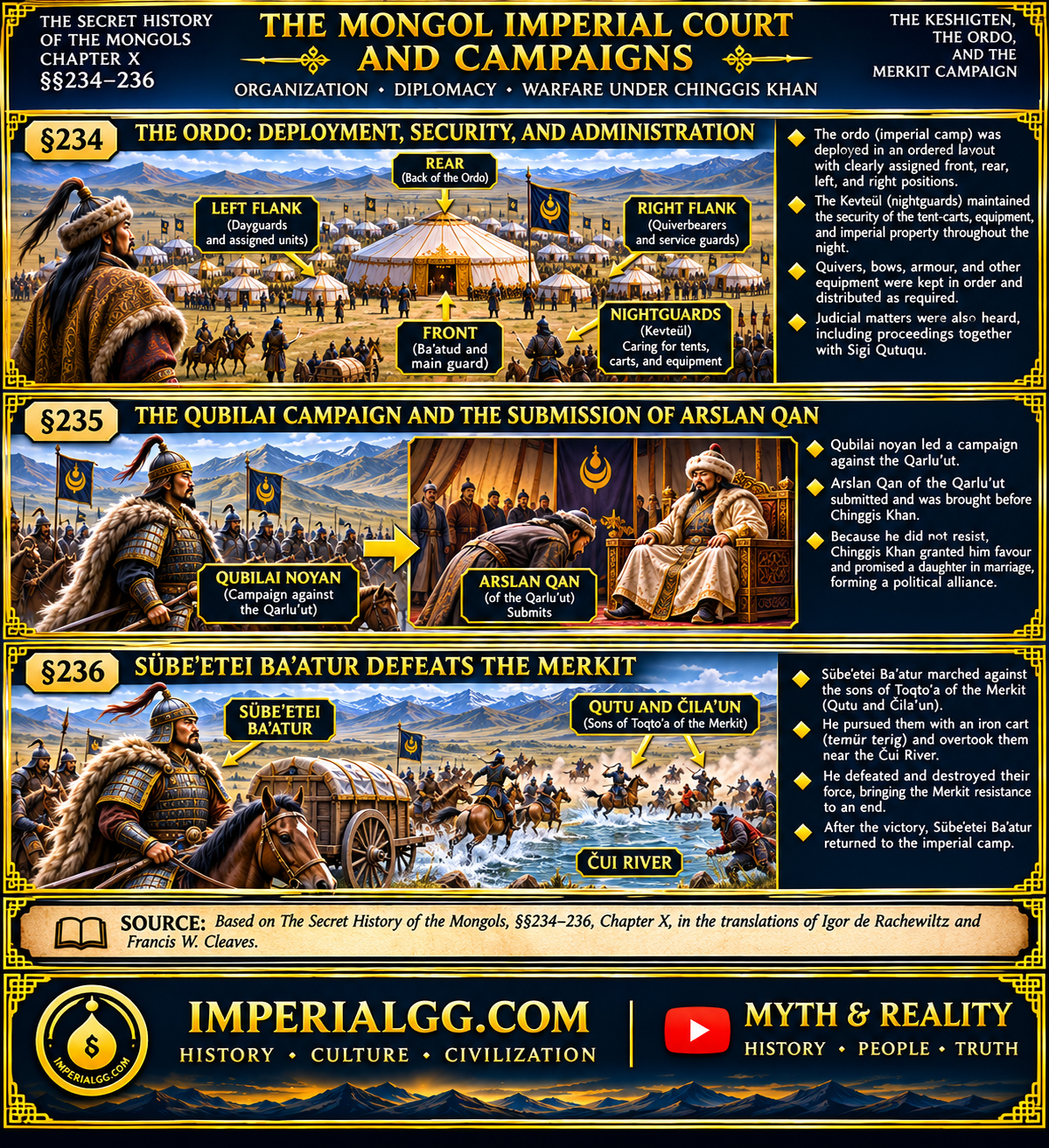
The same paragraph continues by assigning the Hэвтүүл responsibilities for:
Safeguarding bows, quivers, armor, and arrows.
Distributing and managing military equipment.
Bringing horses and transporting baggage.
Coordinating with the Cherbi officials in the distribution of goods and supplies.
Protecting the imperial encampment and organizing the movement of the court.
The text also specifies the positions of different groups around the imperial camp.
This is especially important because it demonstrates that the imperial court was not an informal collection of attendants. It operated through differentiated responsibilities, assigned positions, and a recognizable chain of command.
The Hэвтүүл, Torghuud, Khorchin, and Cherbi personnel performed different functions within this arrangement.
The appointment of Dodai Cherbi to supervise the personnel responsible for livestock and other court services further illustrates the importance of administrative coordination.
Historical interpretation
The organization described in §234 reveals a practical understanding of state power. The protection of the ruler, preservation of military equipment, transportation of supplies, movement of the imperial court, and participation in judicial consultation were connected responsibilities.
The imperial guard therefore represented more than a military formation. It was also an essential component of the institutional infrastructure that sustained the imperial government.
An important distinction must nevertheless be maintained: the Hэвтүүл should not automatically be equated with the entire Keshig. They were a specific guard component within the broader imperial household and guard organization. Their responsibilities should be understood within that larger institutional framework.
3.3. The relationship between loyalty and institutional responsibility
Paragraph 233, immediately preceding the passage under examination, explains why the Hэвтүүл were not to be sent independently into battle when Chinggis Khan himself was absent.
The stated reason was that they were responsible for protecting the ruler and the imperial camp.
This context helps explain §234.
The same organization that protected the ruler also participated in judicial consultation, equipment management, logistics, and the protection of the imperial household.
This combination of responsibilities demonstrates that loyalty was institutionalized through specific duties rather than expressed only as personal allegiance.
The historical significance lies in the integration of personal service with the functioning of the state.
IV. THE SUBMISSION OF QARLUQ ARSLAN KHAN: POLITICAL INTEGRATION THROUGH DIPLOMACY (§235)
Figure 2. Historical-geographical context of the Qarluq territories in Central Asia. This is a contextual geographical illustration, not a map establishing the precise location or boundaries of Arslan Khan’s authority in §235. For further research: Monumenta Altaica – historical source collection.
4.1. The account of Arslan Khan’s submission
Paragraph 235 records: “Харлагийн Арслан хан, Хубилайд элсэн ирсэнд Хубилай ноён, Арслан ханыг авчирч, Чингис хаанд уулзуулав.”
The passage describes how Arslan Khan of the Qarluq people submitted through Qubilai Noyan, who brought him before Chinggis Khan. The text then states that Chinggis Khan praised Arslan for submitting without fighting and declared that he would give him his daughter in marriage.
This short account contains an important political message. Arslan Khan’s submission was recognized as a political act. Rather than describing only military defeat, the chronicle emphasizes the value placed on submission without armed resistance.
4.2. Submission and the creation of political relationships
The marriage arrangement is particularly significant. The marriage of a Chinggisid princess to a regional ruler could establish a relationship that went beyond the immediate act of submission. It created a dynastic connection between the ruling house and a previously independent political authority.
In this context, marriage functioned as an instrument of political integration. However, it is necessary to distinguish between what the source explicitly records and what can be inferred from it. The chronicle directly records Arslan Khan’s submission, Chinggis Khan’s approval, and the marriage arrangement. The interpretation that this relationship helped consolidate imperial authority is a historical inference based on the political function of dynastic marriages.
The account should therefore not be used to claim that the Qarluqs immediately lost all local political structures or became administratively uniform with other Mongol territories.
Instead, it illustrates a method through which the Mongol leadership could incorporate regional authorities into a wider imperial political framework.
4.3. Political loyalty and the language of trust
The passage also preserves a moral and political message associated with the marriage. The poem emphasizes the value of a trustworthy companion, the importance of wisdom, and the danger of uncontrolled anger.These ideas are significant because the narrative does not present political integration as a purely administrative transaction.
It connects political loyalty with personal conduct, trust, and mutual obligation. The language of the passage suggests that the legitimacy of a political relationship depended not only on submission but also on the expectation of continued loyalty.
Historical interpretation
The episode of Arslan Khan demonstrates an important feature of Mongol imperial expansion: the ability to incorporate regional rulers through a combination of military pressure, diplomatic negotiation, recognition, and dynastic relationships.
The Mongol state was not built exclusively through the destruction of existing political authorities. It also expanded by establishing new relationships with them.
V. SÜBE’ETEI BA’ATUR AND THE ELIMINATION OF THE MERKIT REMNANTS (§236)
Figure 3. Modern artistic reconstruction of a Mongol military commander and cavalry. Illustrative representation only; it is not a historical portrait of Sübe’etei Ba’atur. No contemporary authenticated portrait of the commander is established by this image.
5.1. The campaign against the remaining Merkit forces
Paragraph 236 states: “Сүбээдэi баатар, төмөр тэрэгтэй цэргээ авч яваад мэргидийн Тогтоагийн Худу, Чулуун зэрэг хөвүүдийг нэхэн довтолж, Чүй мөрний тэнд гүйцэж сөнөөгөөд ирэв.”
The account identifies Sübe’etei Ba’atur as the commander of a force described as having temür tergetü — literally associated with iron carts or iron-wheeled transport.
He pursued the sons of Toghtoa of the Merkit, including Qudu and Chilaun, caught them near the Chui River, and defeated them. This passage is brief, but its historical implications are considerable. The account demonstrates that the defeat of a major political opponent did not necessarily mean the immediate disappearance of all resistance associated with that group. The remaining members of the defeated leadership could continue to represent a military and political challenge.
5.2. The significance of the iron-cart force
The expression temür tergetü deserves careful attention. It is tempting to interpret this expression as evidence of a specific military technology or a standardized mobile siege formation. However, the surviving passage does not provide sufficient technical detail to establish the exact construction, tactical configuration, or operational purpose of these carts.
The responsible interpretation is to recognize the expression as an indication of a distinctive equipment or logistical arrangement associated with Sübe’etei’s force, while leaving its precise military function open to further investigation. This distinction matters because historical research must avoid turning a brief textual reference into an unsupported reconstruction of military technology.
5.3. The strategic importance of pursuing defeated opponents
The pursuit of the Merkit remnants demonstrates that imperial security required more than victory in a major battle. A defeated political group could retain the capacity to reorganize, seek new allies, or challenge the authority of the emerging state.The campaign therefore reflects a broader strategic objective: preventing the reconstitution of hostile military power.
Sübe’etei’s operation illustrates the importance of continued military pressure after an initial victory. It also demonstrates the role of trusted commanders in carrying out the strategic objectives of the central leadership.
The chronicle’s account is concise, and it does not provide enough information to reconstruct the campaign’s full route, force size, duration, or tactical sequence. Those details should not be invented.
5.4. The Chui River as a historical-geographical reference
The reference to the Chui River is significant because it locates the final encounter within the wider Central Asian geographical setting. The river provides a geographical anchor for the narrative, although the passage itself does not identify the exact battlefield.
Figure 4. The Chui River valley, in the modern geographical region of Kyrgyzstan and Kazakhstan. Contemporary landscape for geographical orientation; it does not identify the exact location of the battle described in §236.
The geographical reference is also useful for understanding the wider reach of Mongol military operations beyond the central Mongolian steppe.
The episode demonstrates that the consolidation of imperial authority involved campaigns across extensive distances and different geographical environments.
VI. THREE DIMENSIONS OF IMPERIAL STATE-BUILDING: A COMPARATIVE ANALYSIS
The three paragraphs should be examined together because they describe different but complementary dimensions of the same political system.
Historical episode | Institutional function | Political significance |
|---|---|---|
Hэвтүүл and Shigi Qutuqu (§234) | Administration, consultation, logistics and security | Institutional organization |
Arslan Khan (§235) | Submission and dynastic relations | Political integration |
Sübe’etei Ba’atur (§236) | Military pursuit and suppression of resistance | Imperial security |
6.1. From military organization to administrative order
The first episode shows that the imperial guard participated in the practical functioning of government.
The organization of personnel, equipment, supplies, and the imperial household indicates that the Mongol state required administrative coordination alongside military strength.
6.2. From submission to political integration
The second episode demonstrates that imperial expansion could incorporate regional authorities through diplomatic and dynastic relationships. Arslan Khan’s submission was recognized and rewarded, creating a political connection between his leadership and the Chinggisid ruling house.
6.3. From military victory to long-term security
The third episode demonstrates that the imperial leadership continued to pursue opponents after major political and military victories. Sübe’etei’s campaign against the Merkit remnants represents the security dimension of imperial consolidation.
These three dimensions were mutually reinforcing. Administrative organization supported political authority; political integration expanded the state’s relationships; and military security protected the resulting order.
VII. AN INTERNATIONAL SCHOLARLY PERSPECTIVE
From the perspective of international Mongol studies, these passages offer an opportunity to move beyond the conventional interpretation of the Mongol Empire as a military conquest system.
The institutional evidence in §234 is especially important because it reveals the relationship between the imperial household, military organization, and judicial administration.
The diplomatic and dynastic account in §235 demonstrates that the empire’s political expansion also involved the incorporation of existing regional authorities.
Finally, §236 illustrates the continuing importance of military operations in preventing defeated opponents from re-establishing their political and military influence.
The methodological importance of these passages lies in reading the narrative as evidence of institutional development while distinguishing the chronicle’s direct statements from modern historical interpretation.
The work of Igor de Rachewiltz is particularly valuable for understanding the language and historical context of the Secret History. His two-volume translation and commentary provide an important scholarly reference for further examination of the text.
VIII. CONCLUSION
Sections 234–236 of The Secret History of the Mongols reveal three essential dimensions of Chinggis Khan’s state-building process: administrative organization, political integration, and military security. The participation of the Hэвтүүл in judicial consultation and the management of the imperial household illustrates the development of institutional responsibilities beyond personal protection.
The submission of Arslan Khan demonstrates the use of diplomacy and dynastic relationships to incorporate regional political authorities into the expanding empire.
The campaign of Sübe’etei Ba’atur against the Merkit remnants illustrates the continuing importance of military operations in maintaining imperial security.
Taken together, these events suggest that the Mongol Empire’s strength cannot be explained by military superiority alone.
Its political durability depended on the integration of organized administration, consultation, loyalty, diplomatic relationships, military discipline, and security.
The central historical argument of this study is that Chinggis Khan’s state-building achievement lay in transforming military authority into an organized political system.
AUTHOR’S THESIS
The Mongol Empire under Chinggis Khan should be understood not merely as a military expansionist power, but as a developing imperial state whose strength rested on the coordinated relationship between administrative institutions, political integration, military organization, and security.
The three episodes in §§234–236 illustrate how these functions operated together: the imperial guard helped maintain institutional order, the submission of regional rulers expanded the political structure of the empire, and the military campaigns of commanders such as Sübe’etei Ba’atur protected that structure against continuing resistance.
This interpretation places the institutional and political dimensions of Mongol state formation alongside its military achievements.
IX. REFERENCES AND FURTHER RESEARCH
Primary sources
The Secret History of the Mongols, §§234–236. Mongolian transcription by S. A. Kozin, available through Monumenta Altaica.
Ц. Дамдинсүрэн, Монголын нууц товчоо. Улаанбаатар, 1957. Bibliographic record listed in Monumenta Altaica.
Монголын нууц товчоо – бүрэн эх. Mongolian text, sections 234–236.
Scholarly works
de Rachewiltz, Igor. The Secret History of the Mongols: A Mongolian Epic Chronicle of the Thirteenth Century. 2 vols. Leiden: Brill, 2004.
Cleaves, Francis Woodman, trans. The Secret History of the Mongols. Cambridge: Harvard-Yenching Institute, 1982.
Atwood, Christopher P. Review of Igor de Rachewiltz’s The Secret History of the Mongols. Journal of Islamic Studies 17, no. 2 (2006): 234–236. Oxford Academic – publication record.
Manuscript and visual documentation
UNESCO. Lu. Altan Tobchi: Golden History Written in 1651. National Library of Mongolia, Memory of the World Register. UNESCO manuscript record.
ImperialGG.com | History, Statecraft & Civilization
Editorial note before publication: This is a substantive first draft, not yet a fully verified critical edition. In particular, the exact meaning of temür tergetü, the historical geography of the Chui River encounter, and the precise institutional relationship between the Hэвтүүл and the wider Keshig require further specialist source comparison. The visual illustrations above are contextual illustrations, not authenticated thirteenth-century images.
The next important step is to establish a line-by-line comparison of §§234–236 against the Chinese-character source, the original-language transcriptions, and de Rachewiltz’s English translation before assigning definitive scholarly interpretations.