
FROM PERSONAL SERVICE TO IMPERIAL INSTITUTION
By Altanbagana Baatar
DBA Candidate| Independent Historian
ImperialGG Historical Research Seriers
02 November 2026
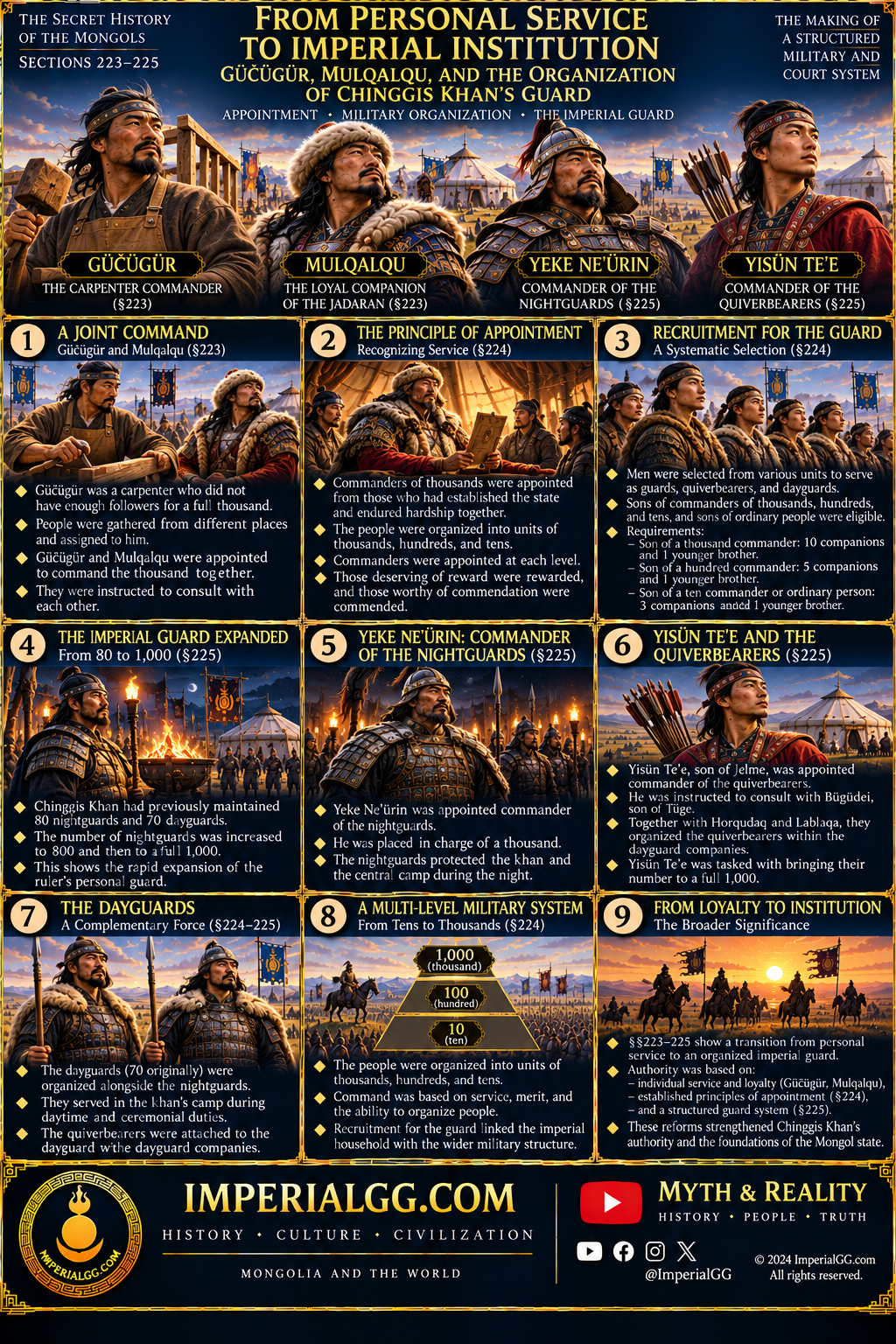
GÜČÜGÜR, MULQALQU, AND THE ORGANIZATION OF CHINGGIS KHAN’S GUARD
ABSTRACT
Sections 223–225 of The Secret History of the Mongols illuminate an important stage in the institutional development of Chinggis Khan’s emerging state. They record the appointment of Güčügür and Mulqalqu as joint commanders of a thousand, the general principles governing the appointment of military commanders, and the systematic expansion of the ruler’s personal guard. These passages reveal how personal loyalty, individual service, administrative recruitment, and military organization were combined to establish a more structured system of imperial authority.
The creation of the guard was not merely an increase in the number of armed men surrounding the ruler. It involved recruitment from different social and military ranks, the allocation of personnel and horses, the establishment of command responsibilities, and the introduction of disciplinary regulations. The passages therefore provide valuable evidence for understanding the relationship between military organization and the consolidation of political authority under Chinggis Khan.
Keywords: Chinggis Khan; Güčügür; Mulqalqu; Mongol military organization; imperial guard; nightguards; quiverbearers; The Secret History of the Mongols.
1. INTRODUCTION
The establishment of the Mongol Empire required more than the unification of previously competing tribes and the appointment of military commanders. It also required the development of institutions capable of maintaining the ruler’s authority, protecting the central political establishment, and coordinating personnel drawn from different social and military groups.
Sections 223–225 of The Secret History of the Mongols document this process through three connected developments. Section 223 describes the joint appointment of Güčügür and Mulqalqu. Section 224 outlines the broader principles by which commanders were selected and military units organized. Section 225 records the expansion and appointment of commanders within the ruler’s personal guard.
Read together, these passages demonstrate a transition from a political order sustained primarily through personal relationships and military achievement toward a more differentiated administrative and military structure.
2. GÜČÜGÜR AND MULQALQU: JOINT COMMAND AND COMPLEMENTARY SERVICE
Section 223 records Chinggis Khan’s decision concerning Güčügür, identified in the translation as a carpenter who lacked sufficient followers to establish a thousand-unit of his own.
Rather than excluding him from military command because he did not possess an adequate body of followers, Chinggis Khan ordered that people be gathered from different places and assigned to him. He then appointed Güčügür and Mulqalqu jointly to command the thousand, instructing them to consult with one another.
The passage identifies two distinct considerations in this appointment.
First, Güčügür’s occupational identity is explicitly mentioned. The chronicle does not present him simply as an established tribal leader with a ready-made following. His position illustrates that an individual’s previous occupation did not necessarily prevent him from receiving military responsibility.
Second, Mulqalqu is recognized for his close companionship with Chinggis Khan among the Jadaran. His appointment alongside Güčügür therefore introduces a complementary basis of authority: one commander required an organized body of followers, while the other was recognized for an established personal relationship with the ruler.
The instruction that the two commanders consult with one another is especially significant. It indicates that the appointment was not simply a division of personnel between two individuals. Their shared command was accompanied by an expectation of cooperation.
The chronicle does not explain the precise internal distribution of their responsibilities. It would therefore be inappropriate to assign them separate administrative functions without additional evidence. What the text clearly establishes is their joint command and the requirement for consultation.
3. SECTION 224: THE PRINCIPLES OF MILITARY APPOINTMENT AND ORGANIZATION
Section 224 moves from individual appointments to the broader organization of the state.
The chronicle states that Chinggis Khan appointed commanders of thousands from among those who had helped establish the state and endured hardship alongside him. It then describes the formation of units of thousands, hundreds, and tens, together with the appointment of commanders at each level.
The passage identifies two connected principles.
The first was recognition of service. Those who had participated in the establishment of the state and shared its hardships were considered for command positions. Military authority was therefore associated with demonstrated contribution to the ruler’s political and military success.
The second was organizational hierarchy. Units were arranged at different numerical levels, and commanders were appointed according to those structures. The text presents the military hierarchy not as an accidental collection of personal followings, but as an organized framework under the authority of Chinggis Khan.
The passage also distinguishes between rewarding individuals and formally recognizing their service. Those considered deserving of reward were rewarded, while those worthy of commendation were commended. This distinction suggests that the ruler’s recognition operated through more than one form of acknowledgement.
The significance of §224 lies in its presentation of a governing principle: military command was connected both to personal merit and to the requirements of an increasingly organized state.
4. THE RECRUITMENT OF THE IMPERIAL GUARD: A STRUCTURED SYSTEM OF SERVICE
The second part of §224 describes the recruitment of personnel for service close to the ruler. Chinggis Khan recalls that he previously maintained eighty nightguards and seventy dayguards. Following the expansion of his authority, he orders that men be selected from the various military units to serve as guards, quiverbearers, and dayguards.
The recruitment system was designed to draw personnel from across the military organization rather than relying exclusively on one group or household. The text specifies that sons of commanders of thousands, hundreds, and tens, as well as sons of ordinary people, could enter the ruler’s service. Their recruitment was subject to standards of physical ability, appearance, and suitability for service.
This is important because the guard was not presented as a purely hereditary institution restricted to the families of senior commanders. The sons of ordinary people were also eligible, although the number of companions they were required to bring differed according to their fathers’ military rank.
The recruitment regulations established the following requirements:
Sons of commanders of thousands were to bring ten companions and one younger brother.
Sons of commanders of hundreds were to bring five companions and one younger brother.
Sons of commanders of tens and sons of ordinary people were to bring three companions and one younger brother.
The personnel and mounts required for this service were to be supplied through the military units from which the recruits originated. The text also specifies that these obligations were to be assessed independently of the recruits’ personal inheritance or privately acquired property.
This arrangement connected the ruler’s personal guard directly to the wider military structure. Recruitment was not simply an individual decision by a young man seeking service at court; it was supported by obligations distributed across the existing military units.
The order also included disciplinary provisions. Those who evaded their assigned service could be replaced and punished. At the same time, the chronicle states that people who came forward voluntarily to learn service within the ruler’s tent should not be obstructed. The resulting system combined selection, material provision, military obligation, and discipline.
5. SECTION 225: THE EXPANSION OF THE NIGHTGUARDS AND QUIVERBEARERS
Section 225 records the practical implementation of the recruitment order. The number of nightguards, previously eighty, was increased to eight hundred. Chinggis Khan then ordered that their number be raised to a full thousand. Yeke Ne’ürin was appointed commander of the nightguards and placed in charge of a thousand.
The passage also describes the organization of the quiverbearers. Yisün Te’e, the son of Jelme, was appointed their commander and instructed to consult with Bügüdei, the son of Tüge.
Four commanders were then named in connection with the organization of the quiverbearers within the companies of dayguards: Yisün Te’e, Bügüdei, Horqudaq, and Lablaqa. They were to coordinate the quiverbearers with the dayguard companies, while Yisün Te’e was assigned responsibility for bringing the overall number of quiverbearers to a full thousand.
These arrangements demonstrate that the guard was not a single undifferentiated body of armed attendants. Its personnel were organized according to distinct functions and command responsibilities. The nightguards, quiverbearers, and dayguards formed related but differentiated components of the ruler’s personal service establishment.
The appointment of commanders for these groups also reveals the importance of clearly assigned leadership. The text names individuals and specifies their responsibilities rather than leaving the organization of the guard to informal arrangements.
6. HISTORICAL SIGNIFICANCE: THE INSTITUTIONALIZATION OF PERSONAL SERVICE
The three sections provide evidence for a broader transformation in the organization of Mongol political power. In the earlier stages of Chinggis Khan’s rise, personal loyalty, military ability, and the capacity to gather followers were central to the formation of political relationships. The preceding sections of the chronicle repeatedly record individuals receiving command because of their service, loyalty, or ability to assemble people.
Sections 223–225 show how these principles were incorporated into a more systematic structure.
Güčügür and Mulqalqu illustrate the accommodation of different forms of service within a shared command. Section 224 establishes the connection between prior contribution, military rank, and the organization of units. Section 225 demonstrates how recruitment for the ruler’s immediate service was regulated through numerical requirements, designated commanders, and disciplinary rules.
The guard consequently occupied a position within the larger military system while performing duties specifically connected to the ruler.
It is important, however, not to equate the guard described in these sections with a modern standing army or a fully developed bureaucratic institution. The chronicle presents a system rooted in the political and social structures of the Mongol world. Its organization combined personal relationships, household service, military obligations, and hierarchical command.
Nevertheless, the detailed regulations indicate a significant degree of institutional development.
7. SOURCE-CRITICAL CONSIDERATIONS
The interpretation of these sections requires attention to the distinction between what the chronicle explicitly states and what may be inferred from its organization. The identification of Güčügür as a carpenter is explicit in §223. The passage does not, however, provide a detailed account of his earlier career or explain the exact circumstances through which he acquired this occupation.
Likewise, the text identifies Mulqalqu as a close companion of Chinggis Khan among the Jadaran, but does not provide enough information in this passage to reconstruct the full history of their relationship.
The numerical structure of the guard is more explicit. The chronicle gives the earlier numbers of nightguards and dayguards, describes the increase in the nightguard establishment, and identifies commanders and recruitment requirements. These details provide direct evidence for the administrative organization represented in the narrative.
The translation also preserves distinctions between nightguards, dayguards, and quiverbearers. These terms should not be treated as interchangeable, since the chronicle assigns them different organizational positions and responsibilities. This analysis follows Igor de Rachewiltz’s 2015 shorter translation, edited by John C. Street. The section numbering follows the standard 282-section arrangement of the Secret History.
8. CONCLUSION
Sections 223–225 reveal an important dimension of Chinggis Khan’s state-building process: the transformation of personal service into an organized system of military and court service.
The joint appointment of Güčügür and Mulqalqu demonstrates that command could accommodate different forms of contribution and that cooperation was an explicit expectation. Section 224 articulates the broader principles of military appointment, hierarchy, reward, and recruitment. Section 225 shows these principles operating through the expansion and organization of the ruler’s personal guard.
The historical importance of these passages therefore extends beyond the number of guards or the names of their commanders. They preserve evidence of how military personnel were recruited, equipped, organized, supervised, and integrated into the ruler’s immediate political environment.
The emerging Mongol state was sustained not only by battlefield victories and the loyalty of prominent commanders, but also by the creation of structured institutions capable of maintaining authority and coordinating service across the expanding political order.
AUTHOR’S THESIS
Sections 223–225 demonstrate that the consolidation of Chinggis Khan’s authority involved the institutionalization of personal service. By integrating commanders with different backgrounds, organizing military units through a hierarchical structure, and regulating recruitment into the imperial guard, the Mongol leadership developed a system in which loyalty and individual merit were increasingly translated into defined responsibilities within the state.
PRIMARY SOURCE
The Secret History of the Mongols, §§223–225.
REFERENCES
de Rachewiltz, Igor, trans. 2004–2013. The Secret History of the Mongols: A Mongolian Epic Chronicle of the Thirteenth Century. 3 vols. Leiden: Brill.
de Rachewiltz, Igor, trans. 2015. The Secret History of the Mongols: A Mongolian Epic Chronicle of the Thirteenth Century. Shorter version edited by John C. Street. Western Washington University.
Cleaves, Francis Woodman, trans. 1982. The Secret History of the Mongols: For the First Time Done into English out of the Original Tongue and Provided with an Exegetical Commentary. Cambridge, MA: Harvard University Press.
Onon, Urgunge, trans. 2001. The Secret History of the Mongols: The Life and Times of Chinggis Khan. Richmond: Curzon.