
PROPHECY, COURAGE, AND COMMAND
By Altanbagana Baatar
DBA Candidate| Independent Historian
ImperialGG Historical Research Seriers
28 October 2026
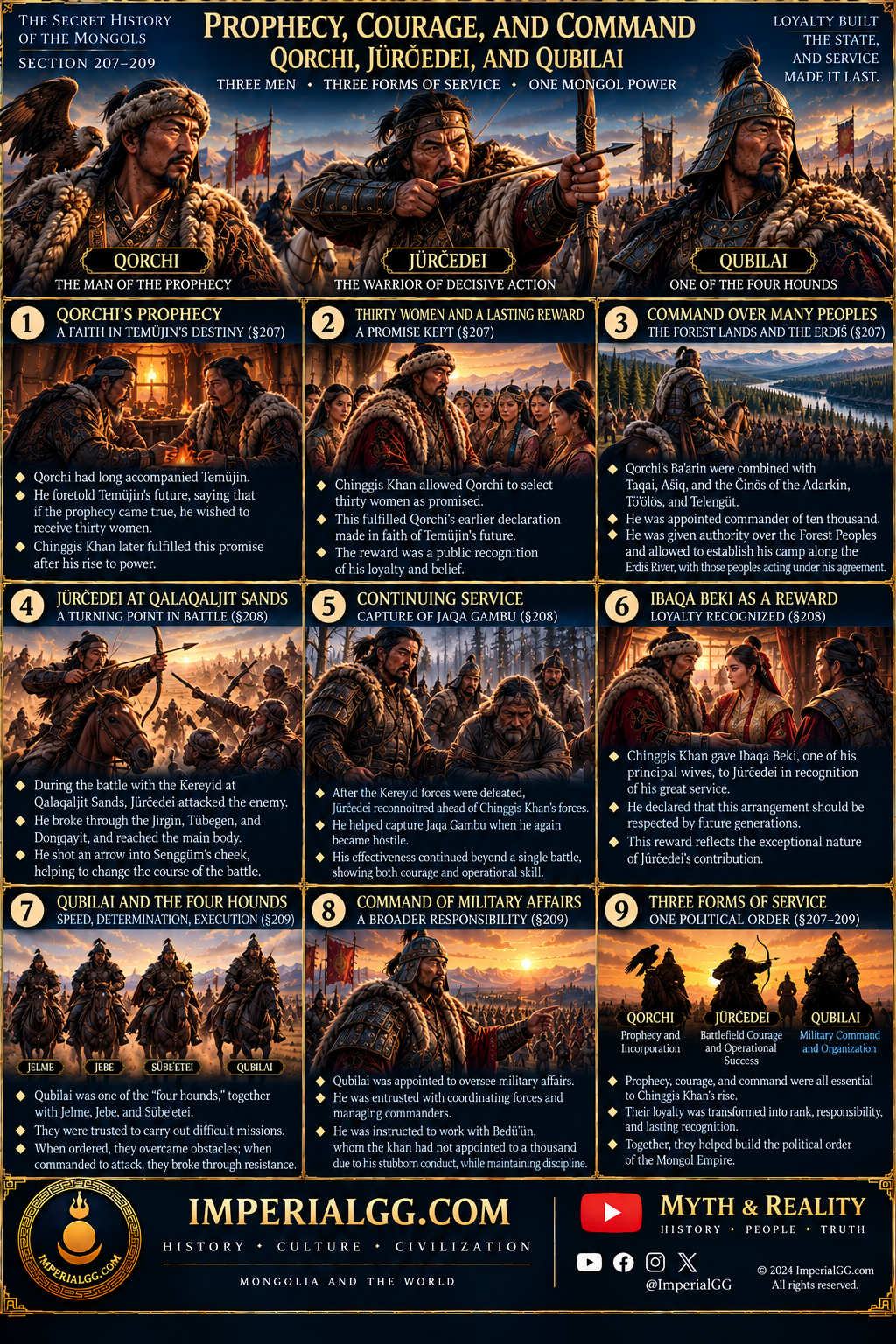
QORCHI, JÜRČEDEI, AND QUBILAI IN THE CONSOLIDATION OF CHINGGIS KHAN’S POWER
Abstract
Sections 207–209 of The Secret History of the Mongols continue the chronicle’s account of how Chinggis Khan rewarded the individuals whose service contributed to his rise and the organization of his new political order. These passages present three distinct forms of contribution. Qorchi is recognized for his long-standing companionship and a prophecy concerning Temüjin’s future, receiving a military command over a composite population that included several forest peoples. Jürčedei is honored for decisive battlefield action against the Kereyid forces, particularly his attack on Senggüm, and for subsequent operations that helped eliminate renewed opposition. Qubilai is praised as one of Chinggis Khan’s “four hounds,” commanders entrusted with carrying out difficult military missions, and is assigned broader responsibility for military affairs. This article argues that the three accounts distinguish between prophetic recognition, battlefield achievement, and operational command while showing how Chinggis Khan translated remembered service into rank, authority, and continuing political obligations.
Keywords: The Secret History of the Mongols; Chinggis Khan; Qorchi; Jürčedei; Qubilai; military leadership; prophecy; loyalty; Mongol Empire.
1. Introduction
Sections 207–209 of The Secret History of the Mongols form part of a broader sequence in which Chinggis Khan publicly recognizes the services of individuals who helped establish his authority. Following the accounts of Mönglik, Bo’orču, and Muqali in §§204–206, the narrative turns to Qorchi, Jürčedei, and Qubilai. Their stories are different, but each illustrates the relationship between past service and future responsibility.
Qorchi’s recognition is associated with a prophecy that he had made concerning Temüjin’s destiny. Jürčedei’s honor rests on his conduct in battle and his later role in defeating renewed opposition. Qubilai’s appointment emphasizes military effectiveness, reliability in carrying out orders, and the coordination of forces under a broader command structure.
The central argument of this article is that these sections portray political authority as something built through the recognition and organization of diverse contributions. Chinggis Khan does not reward every follower in the same way. Instead, he connects each person’s past service to a specific form of rank, responsibility, or privilege within the emerging Mongol polity.
2. Qorchi: Prophecy, Recognition, and the Governance of Forest Peoples
In §207, Chinggis Khan addresses Qorchi, recalling both his long companionship and his earlier prophecy concerning Temüjin’s future. The khan describes their shared hardships through the imagery of enduring wet weather and cold together. This language places Qorchi among those whose relationship with Temüjin preceded the establishment of supreme political authority.
The distinctive element in Qorchi’s story is the prophecy. According to the chronicle, Qorchi had declared that if the prediction concerning Temüjin’s future came true through the will of Heaven, he wished to receive thirty women. Now that Temüjin’s rise had fulfilled the prophecy, Chinggis grants him the opportunity to select thirty women from among the people who had submitted to his authority.
The passage should be understood within the political and literary framework of the chronicle. Prophecy connects the ruler’s rise to the favor of Heaven, while the fulfillment of the prediction becomes a basis for recognizing Qorchi’s earlier confidence and continued service. The reward is therefore not simply a private gift: it is presented as the fulfillment of a promise associated with the ruler’s destiny.
The passage also records a substantial military appointment. Qorchi is to combine his existing Ba’arin contingent with forces associated with Taqai and Ašiq, as well as the Činòs of the Adarkin, the Tö’ölös, and the Telengüt, to form a command of ten thousand. He is assigned responsibility for these forces and authorized to establish his camp along the Erdiš River toward the Forest Peoples. The chronicle further gives him authority over those peoples, requiring them to act with his agreement (§207).
This appointment is significant because Qorchi’s role extends beyond personal favor. He receives responsibility for a composite military and political population, linking his individual status to the governance of groups that had not originally belonged to a single unified command. His appointment illustrates how the emerging regime used established relationships and trusted leaders to organize a wider political landscape.
At the same time, the passage should not be read as evidence that all forest communities were culturally or politically identical. The chronicle groups several named populations under a particular command arrangement. It records a political act of incorporation, not a comprehensive ethnographic description of the peoples concerned.
Qorchi’s story thus joins prophetic recognition with practical responsibility. His reward is rooted in an earlier prediction, but his place in the new order is secured through command over people and territory.
3. Jürčedei: Battlefield Courage and the Turning Point at Kharakhalzan Eleet
Section 208 presents Jürčedei’s service in more explicitly military terms. Chinggis Khan identifies his most important achievement as his conduct during the conflict with the Kereyid at Kharakhalzan Eleet . The passage recalls that Quyildar had made a vow, but Jürčedei carried out the dangerous task associated with it.
Jürčedei attacked and overcame several enemy contingents, including the Jirgin, Tübegen, and Dongqayit, as well as the forces under Qori Šilemün and his bodyguards. He then reached the main body of the opposing army and shot an arrow into Senggüm’s cheek. Chinggis Khan interprets the resulting change in the military situation as a moment when Eternal Heaven opened the way to his success (§208).
The chronicle’s account gives Jürčedei’s action particular importance because it occurred during a battle whose outcome was uncertain. His attack was not simply another act of bravery in a long campaign. In the khan’s retrospective judgment, wounding Senggüm helped change the course of the confrontation and contributed to the eventual defeat of the Kereyid.
The narrative then records Jürčedei’s later service. After the Kereyid forces had been defeated and scattered, Jürčedei reconnoitred ahead of Chinggis Khan’s forces and subsequently helped capture Jaqa Gambu when he again became hostile. The chronicle treats this as a second major service, emphasizing Jürčedei’s continuing effectiveness after the initial victory.
These episodes demonstrate two related dimensions of military leadership. The first is decisive action during battle, when the result remains uncertain. The second is sustained operational effectiveness: reconnaissance, stratagem, and the suppression of renewed resistance after a major enemy has already been defeated.
Chinggis Khan’s recognition of Jürčedei culminates in a highly significant reward. He gives Jürčedei Ibaqa Beki, one of his principal wives, and explicitly explains that this decision is made in recognition of Jürčedei’s service. He also commands that future descendants should respect the arrangement and preserve Ibaqa’s recognized position (§208).
This passage must be approached carefully. The transfer of a royal wife was part of a political and household order fundamentally different from modern assumptions about marriage and personal autonomy. Within the chronicle, however, the khan explicitly frames the decision as a reward for military service and insists that the obligation should continue into the future.
Jürčedei’s account therefore shows how military achievement could be translated into exceptional personal and political recognition. His reward was not limited to material goods or a military title. It involved a change in the relationships of the ruling household, accompanied by a decree intended to preserve the consequences of that reward.
4. Qubilai: The “Four Hounds” and the Organization of Military Power
Section 209 turns to Qubilai, whom Chinggis Khan places among his celebrated “four hounds,” together with Jelme, Jebe, and Sübe’etei. The metaphor emphasizes speed, determination, and the ability to execute commands against difficult opponents.
The khan praises these commanders through a series of forceful images. When ordered to reach a destination, they overcome obstacles; when instructed to attack, they break through resistance. Their effectiveness is expressed through imagery of crushing stone, cleaving deep waters, and overcoming seemingly impossible barriers (§209).
The language is poetic rather than a literal description of military engineering. Its purpose is to communicate the commanders’ relentless execution of orders and their ability to overcome obstacles in the field.
Chinggis Khan then contrasts the “four hounds” with his “four steeds”—Bo’orču, Muqali, Boroqul, and Čila’un Ba’atur—who provided the support and stability he needed near the center of the army. He also recalls Jürčedei and Quyildar with their Uru’ut and Mangqut forces standing before him on the day of battle.
The contrast between hounds, steeds, and the troops stationed before the khan is a compressed statement about the organization of military power. Some commanders were sent ahead to strike at distant or difficult targets; others formed the stable core around the ruler; still others provided immediate battlefield protection. The chronicle presents these functions as complementary rather than interchangeable.
Qubilai’s recognition culminates in his appointment to oversee military affairs. This is a broader responsibility than simply leading one contingent into battle. It reflects the trust placed in his ability to manage military operations and coordinate the actions of other commanders.
The passage also addresses Bedü’ün, whom Chinggis Khan had previously refused to appoint to a thousand because of his stubborn conduct. Qubilai is entrusted with managing this situation and is instructed to work with Bedü’ün, while the khan reserves the right to review the latter’s behavior later (§209).
This detail reveals that command involved more than rewarding personal courage. It also required the management of difficult relationships, the coordination of subordinates, and the maintenance of discipline. Qubilai’s appointment reflects the confidence that he could exercise authority in a politically sensitive situation.
His role therefore represents the institutional dimension of military loyalty: the ability to carry out the ruler’s intentions while organizing people whose temperaments and interests might differ.
5. Three Forms of Service and the Structure of Authority
Read together, §§207–209 distinguish three forms of contribution.
Qorchi represents the relationship between prophecy, personal recognition, and the governance of newly incorporated peoples. His reward acknowledges an earlier prediction, but his appointment places him in charge of a large and diverse military population.
Jürčedei represents decisive battlefield courage followed by continued operational service. His attack on Senggüm is remembered as a turning point, while his later operations demonstrate that his value extended beyond a single battle.
Qubilai represents military effectiveness at the level of coordination and command. The metaphor of the “four hounds” celebrates his ability to execute difficult missions, while his appointment reflects confidence in his capacity to manage broader military affairs.
The differences among these men illuminate the political logic of the chronicle. Chinggis Khan’s new order was not sustained by a single model of loyalty. It required prophecy and counsel, courage under fire, operational competence, and the ability to command diverse groups. Their individual achievements were incorporated into a hierarchy of responsibilities that helped consolidate the ruler’s authority.
The rewards also show that the chronicle connects personal service with the future of the political order. Appointments establish command relationships; privileges recognize exceptional contributions; and provisions concerning descendants preserve certain obligations beyond the lifetime of the individuals involved.
6. Conclusion
Sections 207–209 of The Secret History of the Mongols demonstrate how the chronicle presents the consolidation of Chinggis Khan’s power through distinct but complementary forms of service. Qorchi’s prophecy is recognized through reward and a major command. Jürčedei’s battlefield courage and later operations earn exceptional favor and lasting recognition. Qubilai’s effectiveness as one of the “four hounds” leads to responsibility for broader military affairs.
These passages reveal a political order in which remembered service becomes the basis for authority. Yet the rewards are not identical because the services themselves differ. The chronicle distinguishes between the recognition of prophecy, the courage that changes the course of battle, and the organizational capacity required to direct military operations.
The three men’s stories therefore contribute to a broader understanding of Mongol state formation. Conquest depended not only on the ruler’s ambitions but also on the abilities of individuals who could interpret political circumstances, act decisively, command diverse forces, and carry out difficult assignments. By preserving their stories and recording their rewards, The Secret History of the Mongols presents military loyalty as one of the foundations upon which Chinggis Khan’s political order was built.
References
Atwood, Christopher P., trans. 2023. The Secret History of the Mongols. Penguin Classics.
de Rachewiltz, Igor, trans. 2004–2013. The Secret History of the Mongols: A Mongolian Epic Chronicle of the Thirteenth Century. 3 vols. Leiden: Brill.
Onon, Urgunge, trans. 2001. The Secret History of the Mongols: The Life and Times of Chinggis Khan. Richmond: Curzon.
Primary source: The Secret History of the Mongols, §§207–209.
Source-critical note: This article follows the narrative of §§207–209 in de Rachewiltz’s translation. The poetic descriptions of military prowess are interpreted as literary expressions of battlefield effectiveness rather than literal accounts. The political status of the Forest Peoples, the scope of Qorchi’s command, and the terms of Jürčedei’s reward should be checked against the full annotated edition when preparing a publication-ready version.