
AFTER NAQU GUN: THE MERKITS, NAYA’A NOYAN, QULAN QATUN, AND THE CONSOLIDATION OF CHINGGIS KHAN’S POWER
By Altanbagana Baatar
DBA Candidate| Independent Historian
ImperialGG Historical Research Seriers
22 October 2026
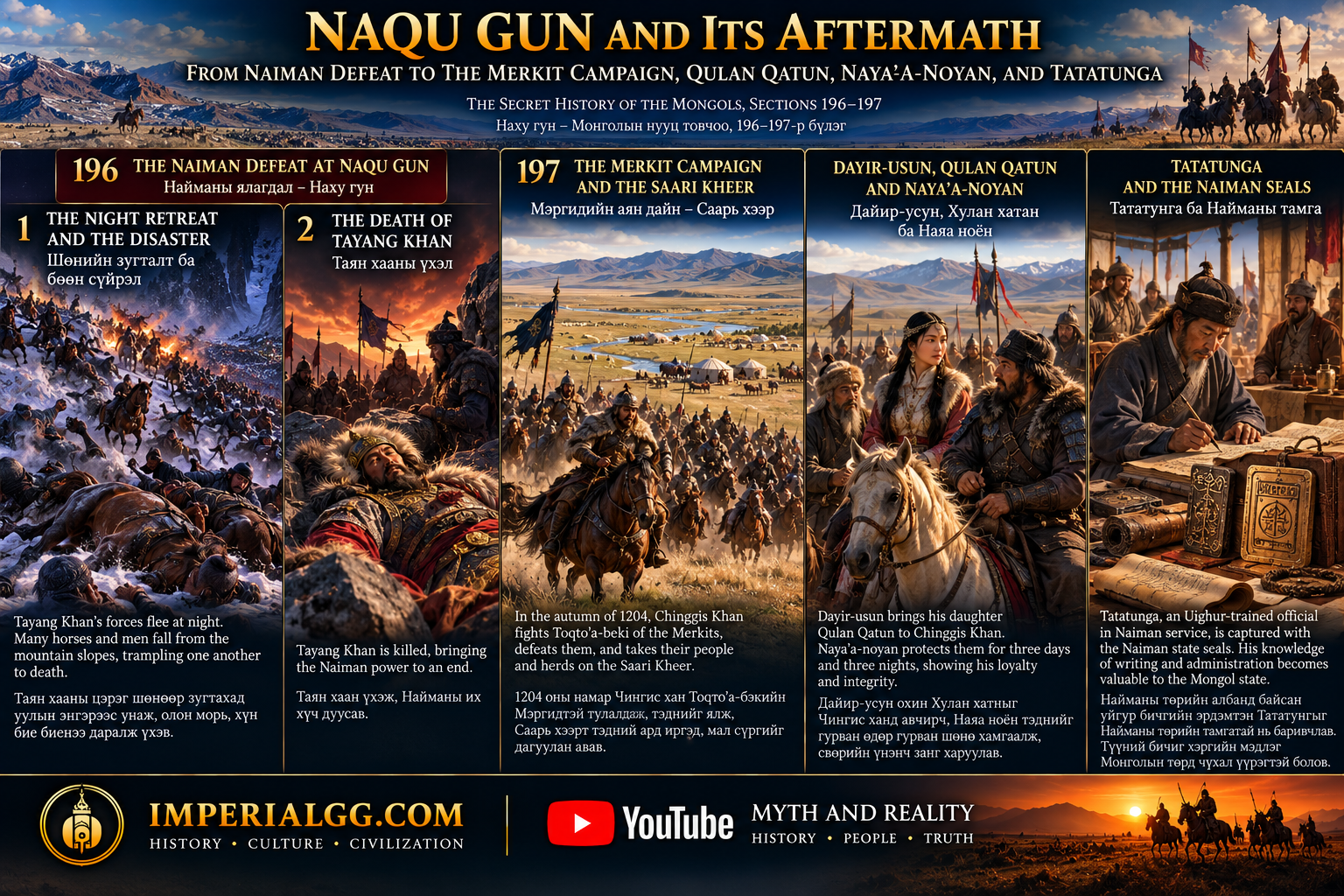
A Historical Analysis of The Secret History of the Mongols, §§196–197
Abstract
The defeat of the Naiman forces at Naqu Gun in 1204 marked a decisive stage in Chinggis Khan’s consolidation of power across the Mongolian steppe. Yet the events following the battle reveal that military victory was only one dimension of political unification. Section 197 of The Secret History of the Mongols describes Chinggis Khan’s autumn campaign against Toqto’a-beki of the Merkits, the subjugation of Merkit communities on the Sa’ari Steppe, the arrival of Qulan Qatun, and the conduct of Naya’a-noyan, whose loyalty is demonstrated through his protection of Qulan and her father, Dayir-usun. These episodes illuminate the relationship between conquest, the treatment of defeated populations, the incorporation of elite families, and the moral expectations placed upon commanders serving the emerging Mongol polity. The subsequent incorporation of Tatatunga, a Uyghur-trained official formerly in Naiman service, provides a further perspective on how military conquest could be followed by the appropriation and adaptation of administrative knowledge. Read together, these developments suggest that the consolidation of Chinggis Khan’s authority depended not only on defeating rival armies but also on controlling populations, regulating access to the ruler, and incorporating useful personnel and institutions.
Keywords: Chinggis Khan; The Secret History of the Mongols; Merkit; Naya’a-noyan; Qulan Qatun; Tatatunga; Sa’ari Steppe; political consolidation.
1. Introduction: From Military Victory to Political Consolidation
The account of the Naiman defeat at Naqu Gun in §196 is followed by a broader process of political consolidation. The destruction of Tayang Qan’s military position weakened one of the principal powers competing with Chinggis Khan, but it did not immediately eliminate every rival group or resolve the political relationships among the peoples of the steppe.
Section 197 records a further campaign in the autumn of the same Year of the Rat, conventionally identified as 1204. Chinggis Khan fought Toqto’a-beki of the Merkits at the Qaradal source, forced him to retreat, and subdued his people and community on the Sa’ari Steppe. Toqto’a escaped with his sons Qudu and Chila’un and a small number of followers. The narrative then turns to Dayir-usun of the Qo’as Merkits, his daughter Qulan Qatun, and Naya’a-noyan, whose intervention becomes the central episode in the section.
The importance of this passage lies in its juxtaposition of military coercion and personal conduct. The Merkit community was subjected to conquest, while the episode involving Qulan and Naya’a demonstrates the expectations of loyalty, restraint, and accountability that operated within Chinggis Khan’s emerging political order.
This article argues that §§196–197 should be read not simply as a record of successive victories, but as an account of the transition from battlefield dominance to the political management of people, families, and elite relationships.
2. The Merkit Campaign and the Subjugation of the Sa’ari Steppe
The opening of §197 places the Merkit campaign in the autumn of 1204. Chinggis Khan confronted Toqto’a-beki at the Qaradal source. Following the engagement, Toqto’a was forced to retreat, while his people, relatives, and community on the Sa’ari Steppe were subjected to Mongol power.
The distinction between Toqto’a’s personal escape and the fate of his community is significant. A defeated leader could survive and flee, while the people and resources associated with his political authority remained vulnerable to the victorious army. The narrative thus distinguishes between the survival of a ruler and the loss of the social and material base that had sustained his power.
The Sa’ari Steppe is especially important because it appears as a landscape in which communities, livestock, and political authority were connected. In a pastoral society, control over people was closely related to access to herds, pasture, water, and seasonal movement. The subjugation of a community could therefore have consequences extending beyond the battlefield: it could alter the distribution of resources, obligations, and political allegiance across the steppe.
The text does not provide a modern geographical boundary for the Sa’ari Steppe, nor does the place-name alone establish its exact correspondence with a present-day location. Its historical geography must be examined through the text, historical toponymy, and independent geographical evidence. Nevertheless, the narrative makes clear that the Sa’ari Steppe was not merely a backdrop to the campaign. It was part of the territory in which the defeated Merkit community was brought under Mongol authority.
3. Qulan Qatun and the Politics of Incorporation
During the subjugation of the Merkits, Dayir-usun of the Qo’as Merkits decided to present his daughter, Qulan Qatun, to Chinggis Khan. The journey took place amid the disorder that followed military defeat. Soldiers were moving through the region, and the danger of violence against travellers was sufficiently serious that Dayir-usun and his daughter encountered Naya’a-noyan of the Ba’arids.
Naya’a proposed that they travel together rather than proceed alone. He explained that, in the unsettled circumstances, other soldiers might harm Dayir-usun or cause trouble for his daughter. He then kept the father and daughter under his protection for three days and three nights before taking them to Chinggis Khan.
The episode reveals the vulnerability of individuals and families during the aftermath of conquest. The collapse of a defeated group’s political authority could create opportunities for unauthorized seizure, violence, or exploitation. Naya’a’s intervention is presented as an effort to prevent such harm and to ensure that the intended meeting with the ruler took place under controlled circumstances.
Qulan Qatun is not merely a passive figure in this account. When Chinggis Khan questioned Naya’a about the delay, she spoke in his defence and explained why the journey had been made together. Her testimony established that Naya’a had protected her and her father rather than acting from improper motives.
Her intervention matters because the narrative gives her a voice in the adjudication of the incident. She explains the circumstances, identifies the protection Naya’a provided, and asks the ruler to judge the matter on the basis of what actually occurred. The episode therefore concerns not only the incorporation of a woman into the ruler’s household but also the credibility of testimony and the regulation of conduct during a period of military disorder.
4. Naya’a-noyan: Loyalty, Self-Restraint, and Trust
The central ethical issue in the episode is Naya’a-noyan’s explanation of his conduct. Under questioning, he declares that he will not turn away from Chinggis Khan in favour of another. He explains that when he encounters women from other peoples or valuable horses, he regards them as belonging to the Qahan rather than as objects for his own private appropriation.
This declaration presents loyalty as more than battlefield obedience. It includes restraint in the use of opportunities created by conquest. A commander who could seize valuable property or exercise power over vulnerable people was expected, according to the narrative’s moral framework, to recognize the ruler’s authority and refrain from treating such opportunities as personal entitlement.
Naya’a’s actions also suggest that loyalty was demonstrated through judgment rather than through the unrestrained exercise of force. He did not simply allow Dayir-usun and Qulan to travel through a dangerous military environment without protection. Nor does the narrative portray him as exploiting their vulnerability. Instead, he assumes responsibility for their safe passage and accepts the risk of being questioned by Chinggis Khan.
The ruler’s initial anger is equally important. Chinggis Khan does not automatically accept Naya’a’s explanation. He questions him closely, seeking to establish the facts. Qulan’s testimony supports Naya’a’s account, and the narrative reports that Chinggis Khan subsequently confirmed the truth of her statement and approved of Naya’a’s conduct.
The episode concludes with the ruler recognizing Naya’a as a man whose words can be trusted and indicating that he will assign him important responsibilities. This conclusion transforms a potentially damaging incident into a demonstration of the political value of integrity.
Naya’a’s significance therefore lies not simply in his loyalty as an individual, but in the principle illustrated by the episode: the consolidation of a new political order required commanders who would not convert the disorder of conquest into unrestricted private gain.
5. Qulan Qatun’s Testimony and the Authority of the Ruler
Qulan Qatun’s testimony contributes to the political meaning of the episode. Her explanation allows Chinggis Khan to distinguish between an apparent irregularity—the three-day delay—and the actual circumstances of the journey.
The narrative portrays the ruler as both a source of authority and an examiner of conduct. Naya’a’s status does not exempt him from questioning, while Qulan’s statement becomes essential to determining what occurred. Chinggis Khan’s subsequent approval of Naya’a rests on the reported confirmation of his account.
This is not evidence of a modern legal procedure in the institutional sense. Rather, it is a narrative representation of the ruler’s responsibility to investigate the conduct of his subordinates and to distinguish trustworthy service from possible abuse. The story establishes that access to the ruler, the protection of vulnerable persons, and the proper use of authority were matters with political consequences.
Qulan’s position is also significant in the context of conquest and incorporation. Her arrival at Chinggis Khan’s court was initiated by her father, but she participates directly in explaining the events and defending the conduct of the man who protected them. The narrative thus presents her as an active witness whose words influence the ruler’s judgment.
6. Tatatunga and the Incorporation of Administrative Knowledge
The story of Tatatunga, the Uyghur-trained official who served the Naiman leadership, provides a related but distinct perspective on the consequences of the Naiman defeat. Accounts of his capture describe him as carrying the official seals of the Naiman ruler. When questioned about their purpose, he explained their administrative function, including their use in authorizing official documents and the collection of revenue.
Tatatunga’s importance lies in the knowledge he embodied. Military victory brought the Mongols into possession of more than territory and people: it also exposed them to the administrative practices, writing traditions, and documentary techniques used by their defeated rivals. Tatatunga’s expertise in Uyghur writing and his service in the Naiman administration made him a valuable official in the new political order. <Cite refs={[“turn304016search0″,”turn304016search2”]}/>
The episode should not be conflated with the events narrated in §197. The story of Tatatunga belongs to the broader account of the consequences of Naiman defeat and the development of Mongol administration. It complements the story of Naya’a and Qulan by demonstrating another mechanism through which conquest could produce political consolidation: the incorporation of skilled personnel and the adaptation of existing administrative knowledge.
The comparison is instructive. Naya’a represents the personal qualities of loyalty and restraint that Chinggis Khan expected from his commanders. Tatatunga represents the practical value of preserving and employing expertise that existed within a defeated political community. Together, these cases suggest that the emerging Mongol polity relied on both trusted service and the selective incorporation of institutional knowledge.
7. Conquest, Population, and the Reorganization of Power
The account of the Merkit campaign demonstrates that military victory had consequences extending beyond the elimination of a rival leader. Toqto’a’s escape did not prevent the subjugation of the Merkit community on the Sa’ari Steppe. The narrative’s reference to the people, kin, and community of the defeated leader emphasizes the collective dimension of conquest.
Such language should be interpreted carefully. The chronicle’s account does not provide a detailed demographic record, nor does it quantify the number of people captured, displaced, or incorporated. It does, however, depict the campaign as an event through which a defeated community was brought under the authority of Chinggis Khan.
The subsequent arrival of Qulan Qatun and the intervention of Naya’a illustrate the interpersonal dimension of this process. Conquered communities were not represented solely as anonymous populations. The narrative also records encounters involving family relationships, individual testimony, protection, and the expectations placed on those who served the ruler.
These episodes reveal the multiple scales at which political consolidation operated: the defeat of a rival army, the subjugation of its community, the regulation of soldiers’ behaviour, the incorporation of elite families, and the recruitment of personnel whose skills could serve the new regime.
8. Conclusion
Sections 196–197 of The Secret History of the Mongols record more than the transition from the defeat of the Naimans to a new campaign against the Merkits. They present a broader picture of the consolidation of Chinggis Khan’s authority through military action, control over populations, the management of vulnerable individuals, and the recognition of trustworthy service.
The defeat of Toqto’a-beki at Qaradal and the subjugation of the Merkit community on the Sa’ari Steppe demonstrate the coercive dimension of political expansion. The episode involving Dayir-usun, Qulan Qatun, and Naya’a-noyan reveals a complementary dimension: the expectation that commanders should exercise restraint, protect those under their responsibility, and remain accountable to the ruler.
Tatatunga’s incorporation into the Mongol administration offers a further perspective on the consequences of conquest. The defeat of the Naimans enabled the Mongols to acquire not only political control but also access to administrative knowledge and writing traditions that could be employed within the expanding state.
The central argument of this article is that the consolidation of Chinggis Khan’s power depended on the interaction of coercion, loyalty, personal accountability, and the incorporation of human and administrative resources. The narrative of Naya’a and Qulan shows how the chronicle articulated ideals of trustworthy service, while the accounts of the Merkit campaign and Tatatunga illustrate the broader political consequences of military victory.
These episodes should be read critically as representations preserved in a dynastic historical narrative. They illuminate the political ideals and mechanisms through which the Mongol ruling order understood and presented its own expansion, while leaving many questions about the practical treatment and long-term integration of conquered communities open to further historical investigation.
References
Atwood, Christopher P., trans. 2023. The Secret History of the Mongols. Penguin Classics.
Onon, Urgunge, trans. 2001. The Secret History of the Mongols: The Life and Times of Chinggis Khan. London and New York: Curzon Press/Routledge.
de Rachewiltz, Igor, trans. 2004. The Secret History of the Mongols: A Mongolian Epic Chronicle of the Thirteenth Century. Leiden: Brill.
Medievalists.net. 2022. “Writing and the Mongol Empire.” Discussion of the role of Tatatunga and Uyghur writing in the Mongol administration.