
BAVUUDAI TSEND (1875–1932)
By Altanbagana Baatar
DBA Candidate| Independent Historian
ImperialGG Historical Research Seriers
18 October 2026
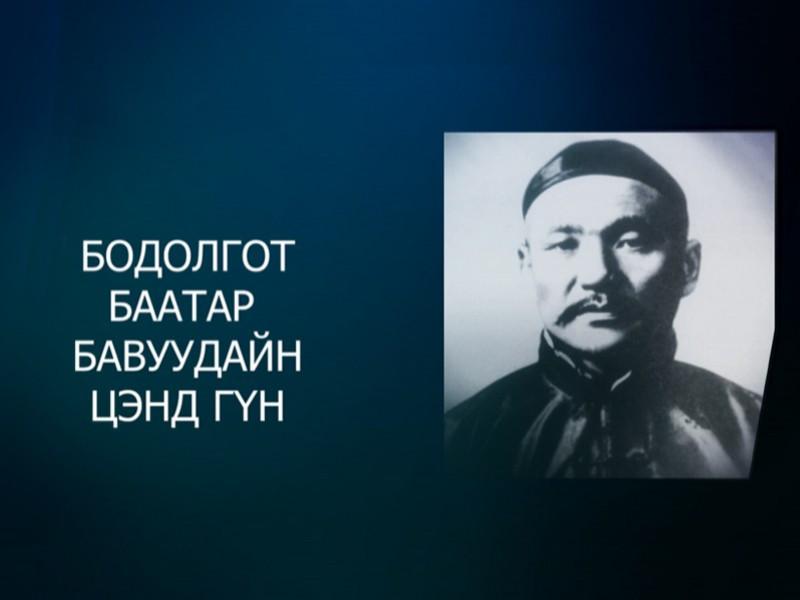
THE FIRST MODERN MONGOLIAN TRANSLATION OF THE SECRET HISTORY OF THE MONGOLS AND ITS PLACE IN MONGOLIAN SCHOLARSHIP
Abstract
Bavuudai Tsend (1875–1932), known by his historical title Bodlogot Baatar Gün, was a Mongolian statesman, diplomat, and scholar whose contribution to the history of Mongolian textual scholarship deserves greater international recognition. In 1916–1917, Tsend undertook the pioneering task of translating The Secret History of the Mongols from its Chinese-script textual tradition into written Mongolian. His manuscript represents an important stage in the modern history of the text, preceding the influential translation by Tsendiin Damdinsüren, published in 1947. Although Tsend’s work did not initially achieve wide circulation, subsequent research, publication, and digitization have made it increasingly accessible to scholars and readers.
This article examines Tsend’s life, diplomatic career, translation project, and continuing significance for Mongolian historical and linguistic research. It also explores the role of the Bodlogot Baatar Tsend Gün Foundation, a Mongolian nongovernmental organization established to preserve and promote his legacy. Through the publication of annotated editions of Tsend’s translation, the digitization of his manuscript, scholarly collaboration, and cultural outreach, the foundation has helped bring this previously underrepresented contribution into contemporary research and public awareness. The article argues that Tsend’s legacy should be understood both as an individual scholarly achievement and as an ongoing process of cultural preservation. A systematic comparison of his translation with later versions of The Secret History of the Mongols offers an important opportunity to investigate the relationship between textual fidelity, literary interpretation, and historical understanding.
Keywords: Bavuudai Tsend; The Secret History of the Mongols; Mongolian history; diplomatic history; translation studies; textual scholarship; cultural heritage; Bodlogot Baatar Tsend Gün Foundation.
1. Introduction
The Secret History of the Mongols is one of the most important surviving sources for the history, political culture, social relationships, and intellectual world of the early Mongol Empire. Its importance extends beyond historical narrative. The work preserves evidence of medieval Mongolian vocabulary, grammatical structures, political terminology, oral-literary conventions, and cultural practices. Its transmission through Chinese-script phonetic transcription and an accompanying Chinese rendering, however, has created complex challenges for scholars attempting to reconstruct and interpret its Mongolian text.
Bavuudai Tsend (1875–1932), commonly known as Tsend Gün and bearing the title Bodlogot Baatar, made a pioneering contribution to this process in the early twentieth century. In 1916–1917, he translated the work into written Mongolian from the transmitted Chinese-script textual tradition. His undertaking preceded the modern Mongolian translation by Tsendiin Damdinsüren, published in 1947 and subsequently read by generations of Mongolian readers.
Tsend’s translation did not initially achieve the same public visibility as Damdinsüren’s version. Its manuscript history and limited circulation meant that its significance was not widely recognized outside specialist research. Later scholarly editions, however, have brought the text into renewed attention, enabling researchers to examine Tsend’s wording, translation practices, and contribution to the history of Mongolian philology.
The preservation of Tsend’s legacy has also become the subject of organized cultural and scholarly activity. The Bodlogot Baatar Tsend Gün Foundation, officially registered in Mongolia as the Bodlogot Baatar Tsend Gün nongovernmental organization, has undertaken initiatives to study, publish, preserve, and disseminate his historical and intellectual contributions. Its activities demonstrate how the legacy of an individual scholar and statesman can be sustained through collaboration among descendants, researchers, cultural institutions, and the wider public.
This article considers Tsend’s biography, his translation of The Secret History of the Mongols, and the modern institutional efforts to preserve his work. It also identifies the importance of comparing his translation with later versions without assuming in advance that literary adaptation necessarily constitutes textual inaccuracy.
2. Bavuudai Tsend: Statesman, Diplomat, and Scholar
Bavuudai Tsend was born in 1875 in Hulunbuir, in the region historically associated with the Mongols of Inner Mongolia. He grew up during a period of substantial political and cultural transformation in the Mongolian world. His education included Mongolian writing and the study of languages important to the administration and intellectual life of the region, including Chinese and Manchu.
Tsend’s linguistic education and experience in public service formed an important background to his later scholarly work. His knowledge of written languages was particularly relevant to the task of interpreting a historical text transmitted through Chinese characters. The reconstruction of Mongolian expressions from such a source required more than the conversion of characters into another script: it demanded linguistic judgment, historical awareness, and an understanding of the relationship between phonetic transcription and meaning.
In 1912, Tsend entered the service of the government of the Bogd Khanate of Mongolia. He was granted the title Bodlogot Baatar by the Bogd Khan and served in the government’s foreign-affairs administration. Biographical accounts identify him as a senior official and deputy minister in the Ministry of Foreign Affairs. His diplomatic responsibilities placed him within the political institutions of a newly established Mongolian state at a time when questions of sovereignty, international relations, and national cultural identity were especially significant.
Tsend’s career therefore belongs to two interconnected histories. The first is the political history of Mongolia during the transition from Qing imperial rule to the Bogd Khanate. The second is the history of Mongolian scholarship, in which the recovery and interpretation of historical texts formed an important component of intellectual life. His translation of The Secret History of the Mongols brought these two dimensions together: a senior government official undertook the reconstruction of a foundational Mongolian historical work at a moment when the preservation and interpretation of Mongolian heritage had renewed importance.
His contribution should not be reduced to his official title or diplomatic career. Tsend’s lasting scholarly significance rests particularly on his translation project and on the manuscript that preserves his work.
3. The Translation of The Secret History of the Mongols, 1916–1917
Tsend’s translation project is generally dated to 1916–1917. Accounts of its history associate the undertaking with the Buryat scholar Jamsrangiin Tseveen, who commissioned the work. Tsend completed the translation in 1917, producing a written Mongolian version of a text transmitted through Chinese-script phonetic transcription and Chinese interpretation.
The textual circumstances made the project particularly demanding. The Mongolian language represented in the Chinese-script transcription could not always be recovered mechanically from the characters. Chinese phonetic conventions did not reproduce every distinction in Mongolian pronunciation, while the accompanying Chinese rendering reflected an interpretive tradition of its own. The translator consequently needed to identify likely Mongolian word forms, distinguish grammatical relationships, interpret names and titles, and reconstruct the meaning of expressions within their narrative context.
Tsend’s translation is an important early example of the modern effort to restore The Secret History of the Mongols to written Mongolian. Its value lies not simply in having preceded later versions, but in providing evidence of how a Mongolian scholar approached the textual and linguistic problems presented by the transmitted source.
The title associated with Tsend’s manuscript, Yuan-ü Ulus-un Niγuča Teüke, is commonly rendered as “The Secret History of the Yuan Dynasty.” This title reflects the terminology of the textual tradition through which the work was transmitted. It should be distinguished from modern scholarly understandings of the work’s historical identity and original context.
Tsend’s manuscript did not become a widely circulated publication immediately after its completion. Its limited accessibility delayed public recognition of the translation, while Damdinsüren’s later version became the principal Mongolian literary text for a much broader readership. Nevertheless, the survival of Tsend’s manuscript made it possible for later scholars to examine and republish his work.
For contemporary scholarship, the manuscript is valuable as a historical translation document. It provides evidence of early twentieth-century Mongolian linguistic interpretation and offers a basis for examining how a major medieval text was reconstructed from its transmitted form.
4. Tsend and Damdinsüren: Translation, Literary Style, and Textual Fidelity
The modern reception of The Secret History of the Mongols has been shaped substantially by Tsendiin Damdinsüren’s translation, published in 1947. His version introduced the work to a wide Mongolian readership and became influential in education, literary culture, and historical understanding.
Damdinsüren approached the translation with an explicit concern for literary quality and readability. He sought to communicate the aesthetic force of the work to modern Mongolian readers, including the effects of its poetic passages and oral-literary style. His version should therefore be understood within the objectives of modern literary translation rather than treated merely as a transcription of an earlier manuscript.
Tsend’s translation and Damdinsüren’s version emerged in different historical circumstances and served different purposes. Tsend’s work represents an early attempt to restore the Mongolian text from its Chinese-script transmission. Damdinsüren’s version was prepared later, with the objective of producing a compelling literary text for modern readers. These distinctions make the two translations valuable for comparative study.
The comparison should not begin with the assumption that one is entirely faithful and the other fundamentally inaccurate. A literal rendering may preserve the sequence of words or the structure of a sentence while leaving its historical meaning unclear. A literary translation may clarify a passage and communicate its emotional or rhetorical force while changing repetition, syntax, imagery, or ambiguity.
A rigorous comparison should therefore examine specific passages and ask several questions:
How does Tsend reconstruct the Mongolian words represented in the Chinese-script transcription?
How does Damdinsüren render the same expressions, and what changes occur in syntax, imagery, repetition, or narrative emphasis?
Do the differences arise from the transmitted source, from linguistic interpretation, or from the translators’ literary objectives?
Do these differences affect the historical interpretation of political messages, diplomatic exchanges, kinship relationships, military events, or personal names?
Such questions provide a more reliable basis for evaluating the two translations than a general judgment about their relative literary or philological merits. They also demonstrate why Tsend’s manuscript should be treated as an important research resource rather than simply as an earlier version superseded by a later one.
5. The Bodlogot Baatar Tsend Gün Foundation: Preserving a Scholarly Legacy
The modern preservation and promotion of Tsend’s legacy has been advanced through the work of the Bodlogot Baatar Tsend Gün Foundation, officially registered as a Mongolian nongovernmental organization under the name Bodlogot Baatar Tsend Gün. The foundation’s stated mission is to study and publicize the historical achievements and intellectual contributions of Tsend Gün and to disseminate the cultural heritage associated with him to Mongolian and international audiences.
The foundation is especially significant because it connects historical research with practical activities in publishing, digitization, cultural education, and public commemoration. Its work demonstrates that preserving a historical figure’s legacy requires more than biographical recognition: manuscripts must be made accessible, scholarly editions must be prepared, and the resulting knowledge must reach readers beyond specialist academic circles.
5.1. Publication and digitization of Tsend’s translation
One of the foundation’s major contributions has been its involvement in bringing Tsend’s translation of The Secret History of the Mongols into wider circulation.
In 2022, a three-volume annotated edition titled Mongolyn Nuuts Tovchoon: Tsend Güngiin Orchuulsan, Tailbart Ekh was published under the general editorship of S. Chuluun and the editorship of D. Bolormaa. The volumes present Tsend’s translation with scholarly commentary and material in Mongolian Cyrillic and traditional Mongolian script.
In 2023, a further publication, Mongolyn Nuuts Tovchoony Il Tüükh—the “Open History” of The Secret History of the Mongols translated by Tsend Gün—was released. The publication project involved the digitization of Tsend’s manuscript, the preparation of a scholarly transcription, and a Cyrillic rendering accompanied by explanatory notes. The Institute of Language and Literature of the Mongolian Academy of Sciences has documented the publication and its editorial work.
The digitization project is particularly important for future research. It provides a basis for comparing the manuscript’s wording with later translations and scholarly reconstructions. It also reduces the practical barriers faced by researchers who might otherwise have limited access to the historical manuscript.
According to a 2023 interview published by iKon.mn, B. Mönkhsük, Tsend’s grandson and head of the foundation, described the Il Tüükh project as involving more than 59,000 words of transcription and the digital presentation of the manuscript in traditional Mongolian script, alongside a Cyrillic version intended to improve accessibility for contemporary readers.
These publications have helped transform Tsend’s translation from a relatively inaccessible manuscript into a resource that can be examined by historians, linguists, literary scholars, and interested readers.
5.2. Scholarship and the dissemination of historical knowledge
The foundation’s activities also include supporting scholarship and promoting research on Tsend’s historical contribution. Its work is associated with the publication of studies that situate him within the political and intellectual history of Mongolia.
A notable example is the Mongolian-English book by Dr. and Professor G. Myagmarsambuu, titled Mongol Töriin Mergen Said, Bodlogot Baatar Gün Bavuudaiyn Tsend: 1875–1932—rendered in its English subtitle as The Wise Minister of the Mongol State: 1875–1932. Published in 2025 for the 150th anniversary of Tsend’s birth, the book provides a bilingual resource for introducing his life and contributions to Mongolian and international audiences.
The publication is significant because it brings together the study of Tsend’s political career and his intellectual legacy. His translation of The Secret History of the Mongols cannot be fully understood without considering the linguistic education, administrative experience, and historical circumstances that shaped his work. A bilingual study also creates opportunities for his biography to reach researchers who do not read Mongolian.
The foundation’s role in supporting such publications illustrates the importance of institutional initiatives in the preservation of cultural heritage. Historical scholarship depends not only on the work of individual researchers but also on organizations that support publication, documentation, and public access.
5.3. The Tsend Gün Memorial Award
The foundation has also been associated with the establishment of the Bodlogot Baatar Tsend Gün Memorial Award in 2017. The award is intended to recognize scholarly contributions related to The Secret History of the Mongols, Mongolian history, tradition, and cultural heritage.
The establishment of a memorial award places Tsend’s name within contemporary scholarly life. It provides a means of linking his historical achievement with continuing research and encourages public recognition of the intellectual work required to preserve and interpret Mongolian historical sources.
The award’s significance lies not merely in commemorating Tsend as an individual. It also emphasizes the continuing relevance of historical research, textual scholarship, and cultural preservation as collective undertakings.
5.4. Cultural outreach and international cooperation
The foundation’s activities extend beyond publication and academic research. It has participated in cultural outreach, including the donation of books to institutions serving Mongolian communities abroad. One reported example is the donation of publications to the Mongolian Heritage Center in Chicago, Illinois, United States.
Such initiatives extend the reach of Mongolian historical scholarship beyond Mongolia itself. They provide opportunities for diaspora communities, students, and general readers to engage with historical literature and learn about the people who contributed to its preservation.
International cultural outreach is especially relevant to Tsend’s legacy because the history of The Secret History of the Mongols is itself transnational. Its preservation involved multiple linguistic traditions, manuscript collections, and generations of researchers. Making Tsend’s work available to international audiences helps situate Mongolian scholarship within broader conversations about manuscript transmission, historical memory, and the preservation of cultural heritage.
5.5. Commemoration of the 150th anniversary of Tsend’s birth
In 2025, the 150th anniversary of Tsend’s birth provided an occasion for renewed public recognition of his achievements. In collaboration with the Chinggis Khaan National Museum, the foundation participated in commemorative activities, including the installation of a bust of Tsend in the museum’s research library.
The occasion also saw the publication and presentation of Myagmarsambuu’s Mongolian-English study of Tsend’s life and career. These activities linked biographical scholarship, public commemoration, and the institutional preservation of historical memory.
The museum setting is particularly appropriate because Tsend’s contribution belongs to both political history and the history of knowledge. His work as a government official and diplomat forms part of Mongolia’s modern political history, while his translation of The Secret History of the Mongols represents a major undertaking in the recovery of Mongolian textual heritage.
The 2025 commemorations therefore illustrate how the foundation’s work has developed beyond the publication of individual books. Through collaboration with cultural institutions, it has helped establish a more visible public presence for Tsend and his achievements.
6. The Foundation and the Future of Mongolian Textual Scholarship
The work of the Bodlogot Baatar Tsend Gün Foundation has implications beyond the preservation of one historical figure’s reputation. Its publication and digitization initiatives contribute to the wider infrastructure of Mongolian historical scholarship.
First, the availability of Tsend’s translation enables researchers to compare different stages in the interpretation of The Secret History of the Mongols. This is particularly valuable for studying the relationship between the medieval text, its Chinese-script transmission, and modern Mongolian translations.
Second, the annotated editions create opportunities for linguistic research. Differences in the rendering of personal names, titles, kinship terminology, diplomatic language, and military expressions can be examined systematically. Such comparisons may clarify how translators understood particular passages and where the transmitted source remains open to alternative interpretations.
Third, the foundation’s bilingual and public-facing publications help connect academic research with broader audiences. Historical scholarship is more sustainable when the results of research are accessible to readers, educational institutions, cultural organizations, and international communities.
Finally, the foundation provides an example of how descendants, scholars, and public institutions can work together to preserve a historical legacy. The involvement of Tsend’s family in the publication and dissemination of his work has helped sustain attention to a manuscript that might otherwise remain relatively obscure outside specialist circles.
The long-term value of these efforts will depend on continued scholarly scrutiny, careful documentation, transparent editorial practices, and sustained access to the underlying manuscript. Digitization and publication are essential first steps, but their greatest value emerges when they support verifiable research and encourage new interpretations grounded in the source.
7. Conclusion
Bavuudai Tsend (1875–1932), known by his title Bodlogot Baatar Gün, occupies an important place in the modern history of Mongolian scholarship. His translation of The Secret History of the Mongols, completed in 1916–1917, represents a pioneering attempt to restore a foundational Mongolian historical text from its Chinese-script transmission. His diplomatic career and scholarly work place him within the political and intellectual transformation of Mongolia in the early twentieth century.
Tsend’s translation did not initially become the principal version read by the modern Mongolian public. That role was assumed by Tsendiin Damdinsüren’s influential translation, published in 1947. Nevertheless, Tsend’s manuscript remains significant as an early reconstruction of the text and as a source for investigating the history of Mongolian translation, language, and textual interpretation.
The work of the Bodlogot Baatar Tsend Gün Foundation has played a major role in bringing this legacy into renewed public and scholarly attention. Its involvement in the publication of annotated editions, the digitization of the manuscript, support for bilingual scholarship, cultural outreach, and commemorative activities has helped make Tsend’s contribution more accessible to Mongolian and international audiences.
The foundation’s initiatives also demonstrate that cultural preservation is an ongoing process. A manuscript becomes a living scholarly resource when it is documented, published, compared with other versions, and made available for critical investigation. The next stage in the study of Tsend’s legacy should therefore involve systematic comparison of his translation with Damdinsüren’s version and other scholarly editions, supported by direct examination of the relevant texts.
Such research would allow scholars to move beyond general judgments about literalness and literary style toward specific, verifiable conclusions about wording, meaning, and historical interpretation. Through the combination of textual scholarship and institutional preservation, Bavuudai Tsend’s work can continue to contribute to a deeper understanding of The Secret History of the Mongols and the history of Mongolian intellectual life.
References
Chinggis Khaan National Museum. “The Bust of Bodlogot Baatar B. Tsend Gün Installed in the Museum’s Research Library.” 27 September 2025.
Chinggis Khaan National Museum. “Celebration of the Publication of The Open History of the Secret History of the Mongols Translated by Tsend Gün.” 10 August 2023.
Chuluun, S., general editor, and D. Bolormaa, editor. Mongolyn Nuuts Tovchoon: Tsend Güngiin Orchuulsan, Tailbart Ekh [The Secret History of the Mongols Translated by Tsend Gün: An Annotated Edition]. Ulaanbaatar: Bodlogot Baatar Gün, 2022. Three volumes.
Chuluun, S., general editor, and G. Bilgüüdüi, editor. Mongolyn Nuuts Tovchoony Il Tüükh [The Open History of the Secret History of the Mongols Translated by Tsend Gün]. Ulaanbaatar: Bodlogot Baatar Gün, 2023.
Damdinsüren, Tsendiin. Mongolyn Nuuts Tovchoon [The Secret History of the Mongols]. Ulaanbaatar, 1947.
Mongolian Academy of Sciences, Institute of Language and Literature. “The Publication of The Open History of the Secret History of the Mongols Translated by Tsend Gün.” 2023.
Mongolian National University Library. Bibliographic record for G. Myagmarsambuu, Mongol Töriin Mergen Said, Bodlogot Baatar Gün Bavuudaiyn Tsend: 1875–1932 [The Wise Minister of the Mongol State: 1875–1932]. Ulaanbaatar: Soyombo Printing, 2025.
Mongolian National University Library. Bibliographic records for the 2022 annotated edition of The Secret History of the Mongols Translated by Tsend Gün.
iKon.mn. “B. Mönkhsük: ‘The Open History of the Secret History of the Mongols’ Is a National-Level Transcription Containing More Than 59,000 Words.” 9 August 2023.
Bodlogot Baatar Tsend Gün Foundation. Institutional information and reports on publications, cultural outreach, and commemorative activities