
THE FALL OF ONG KHAN: REWARD, LEGACY, AND THE PRICE OF BETRAYAL
By Altanbagana Baatar
DBA Candidate| Independent Historian
ImperialGG Historical Research Seriers
16 October 2026
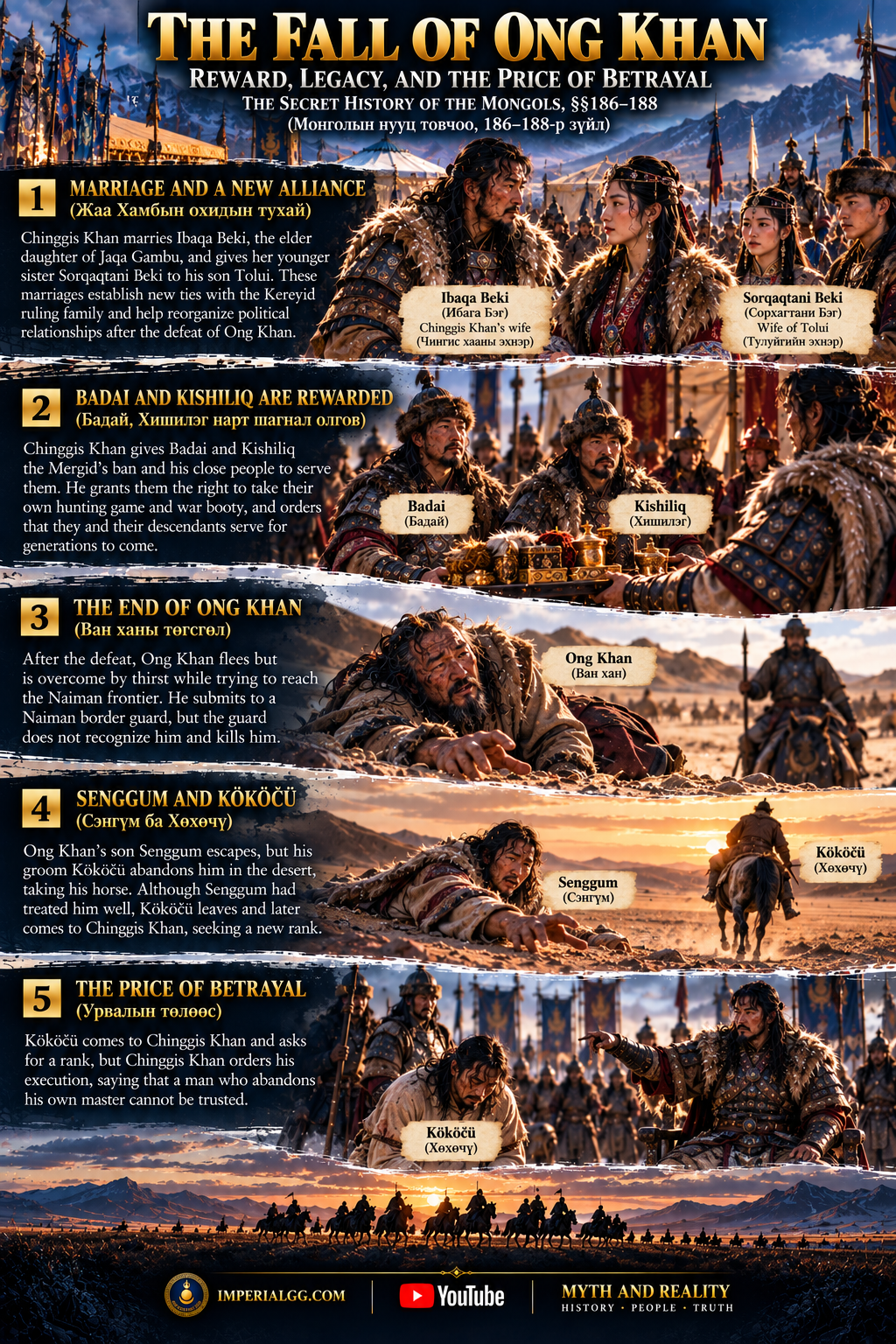
The Secret History of the Mongols | Sections 186–188
INTRODUCTION
The defeat of Ong Khan (Ван хан) marked more than the collapse of Kereyid power. In Sections 186–188 of The Secret History of the Mongols, the narrative turns to the political order that followed the victory: the incorporation of former adversaries, the rewarding of loyal service, the fate of the defeated rulers, and the punishment of a man who abandoned his master but later sought favor from the victorious Chinggis Khan.
These episodes reveal several interconnected aspects of Chinggis Khan’s leadership. His marriage to Ibaqa Beki (Ибага Бэг), daughter of Jaqa Gambu (Жаа Хамбу), and the marriage of her younger sister Sorqaqtani Beki (Сорхагтани Бэг) to his son Tolui (Тулуй) establish new ties with a branch of the defeated Kereyid ruling family. His grants to Badai and Kishiliq (Бадай, Хишилэг) recognize service through privileges intended to endure across generations. Meanwhile, the ends of Ong Khan and Senggum, followed by the execution of Kököčü for abandoning his master, demonstrate the consequences of political defeat and the importance attached to loyalty.
Together, these events show that victory involved not only defeating an enemy, but also reorganizing relationships, distributing privileges, preserving obligations, and defining the conduct expected of those who entered the new political order.
I. MARRIAGE AND THE REORGANIZATION OF KEREYID RELATIONSHIPS
Following the defeat of Ong Khan’s forces, Chinggis Khan’s attention turns to the people and households connected with the defeated Kereyid leadership. The chronicle records his marriage to Ibaqa Beki, the elder daughter of Jaqa Gambu, and the marriage of her younger sister, Sorqaqtani Beki, to Chinggis Khan’s son Tolui.
These marriages are significant within the political world of the Mongols. Marriage among ruling families could establish relationships that continued beyond the immediate conflict, linking households through kinship and creating new obligations within the emerging order.
Chinggis Khan’s marriage to Ibaqa Beki establishes a direct connection between himself and Jaqa Gambu’s family. By giving Sorqaqtani Beki to Tolui, he also creates a relationship between that family and the next generation of his own ruling house.
The two marriages therefore have a significance extending beyond the personal lives of the individuals involved. They connect the defeated Kereyid elite to Chinggis Khan’s household and succession line.
The chronicle’s account also shows that the aftermath of conquest was not uniform. The defeat of Ong Khan did not mean that every member of his wider family would be treated identically. Kinship, political relationships, and the circumstances of particular households continued to shape their place within the new order.
This should not be mistaken for evidence that the marriages alone explain every subsequent political decision. Rather, the text records them as part of the wider reorganization that followed the collapse of Ong Khan’s power.
II. BADAI AND KISHILIQ: REWARDING SERVICE ACROSS GENERATIONS
The narrative next emphasizes the service of Badai and Kishiliq, whose actions had helped Chinggis Khan at a critical moment in his struggle with Ong Khan.
Chinggis Khan rewards them by assigning people associated with the defeated Mergid leadership and other closely connected groups to their service. He also grants them the right to retain the spoils they acquire through hunting and warfare. These privileges are not restricted to the two men personally: the chronicle establishes that their descendants are to continue receiving recognition and serving in accordance with the grant.
The significance of this arrangement lies in its combination of reward, privilege, and hereditary obligation. Badai and Kishiliq are not simply given gifts for a past act. Their service is acknowledged through a formal arrangement that establishes a continuing place for them and their descendants within the political order.
The rights to hunting and military booty are particularly important. Such privileges provide material benefits and recognize the recipients’ standing. By allowing them to retain these spoils, Chinggis Khan makes their reward tangible and connects it directly to the activities through which they continue to serve.
At the same time, the grant of people to their service reflects the hierarchical social structure of the period. The chronicle presents these arrangements as part of the distribution of status and obligations following victory, rather than as a modern system of individual employment or voluntary association.
Chinggis Khan also commands that the service of Badai and Kishiliq must not be forgotten by future generations. This demand gives the episode its enduring significance. The ruler’s gratitude is transformed into an obligation that later rulers are expected to respect.
Their story therefore illustrates a principle that runs through the chronicle: the establishment of political authority requires remembering those whose actions contributed to its success. A ruler’s power may rest on victory, but the stability of the resulting order also depends on the recognition of service.
III. ONG KHAN AND SENGGUM: THE END OF A DEFEATED HOUSE
The chronicle then recounts the fate of Ong Khan and his son Senggum after their defeat. Once their forces collapse, the two men flee, but their escape does not restore their former authority.
Ong Khan eventually reaches the territory of the Naimans. Thirsty and unable to rely on the political network that once sustained him, he encounters a Naiman border guard who does not recognize him. Although Ong Khan identifies himself, the guard does not believe him and kills him.
The contrast between Ong Khan’s former position and his final circumstances is stark. He had once been a powerful ruler whose relationships with Temüjin had helped shape the political landscape of the steppe. Now, separated from his followers and unable to establish his identity to a stranger, he dies without recovering his authority.
His death illustrates the vulnerability of political power when the military and social structures supporting it have disintegrated. A ruler’s title and past reputation cannot guarantee safety once the people and institutions that recognize his authority have disappeared.
Senggum’s fate is different. He survives the immediate defeat but becomes a fugitive, separated from the power and security that had once accompanied his position as Ong Khan’s son. His later encounter with his groom, Kököčü, introduces the final moral contrast in these sections.
The chronicle does not treat the escape of Ong Khan and Senggum as a single, unified ending. Their circumstances diverge, showing that the collapse of a ruling house can produce different outcomes even for its closest members.
IV. KÖKÖČÜ: ABANDONING A MASTER AND SEEKING A NEW PATRON
While fleeing, Senggum and his groom Kököčü search for water in the desert. When Senggum dismounts, he entrusts his horse to Kököčü. The groom takes the opportunity to leave his master behind and departs with the horse. Kököčü’s conduct is challenged by his woman, who reminds him that Senggum had treated him well, providing him with fine clothing and food and showing him personal favor. She asks how he can abandon the very person who had supported him.
Kököčü refuses to return. He leaves Senggum’s golden goblet behind but continues his journey, eventually arriving at Chinggis Khan’s camp and asking to enter his service. This is the decisive moment in the episode. Kököčü has left Senggum when his master is vulnerable and has now approached the victorious ruler in search of a new place within the emerging political order. From a purely practical perspective, he has chosen survival and the possibility of future favor. But Chinggis Khan interprets his conduct differently.
Chinggis Khan orders Kököčü’s execution on the grounds that a man who has abandoned his own master cannot be trusted. The judgment is directed not merely at the fact that Kököčü once served Senggum, but at the way he behaved when that service became difficult and dangerous.
This episode creates a pointed contrast with the conduct of men whose loyalty had been tested during the conflict. In the chronicle’s moral framework, joining the victorious side is not enough to establish trustworthiness. A person’s previous conduct remains relevant, especially when it reveals whether he can be relied upon under pressure.
Kököčü appears before Chinggis Khan hoping to begin a new relationship of service, but his abandonment of Senggum undermines that request. The victorious ruler does not treat betrayal as proof of useful adaptability. Instead, he regards it as evidence that the same behavior could be directed against a future master.
The episode thus presents loyalty as a quality that cannot be judged solely by the side a person ultimately joins. What matters is also how that person treats the one to whom he has already given service.
V. THE POLITICAL MEANING OF REWARD AND PUNISHMENT
Considered together, the events of Sections 186–188 reveal how the chronicle represents the consolidation of Chinggis Khan’s authority after victory. The marriages involving Ibaqa Beki and Sorqaqtani Beki establish new relationships with Jaqa Gambu’s family. The grants to Badai and Kishiliq reward decisive service and establish privileges that are intended to continue through their descendants. The deaths and exile of Ong Khan and Senggum demonstrate the consequences of losing the political and military structures that had supported their authority. Finally, Kököčü’s execution establishes a boundary around the conduct expected of those seeking to enter Chinggis Khan’s service.
These outcomes are different because the people involved occupy different positions and have acted in different ways. The chronicle does not depict the victorious ruler as distributing rewards indiscriminately or accepting every person who offers service after a defeat. Instead, it emphasizes relationships, prior conduct, and remembered obligations.
The distinction between Badai and Kishiliq on the one hand and Kököčü on the other is especially revealing. Badai and Kishiliq are rewarded because their earlier service contributed to Chinggis Khan’s success. Kököčü is executed because he abandons his master when that master is in danger. One episode establishes an obligation to remember service; the other rejects the idea that betrayal should automatically lead to a new opportunity for favor.
This does not mean that the chronicle offers a complete or neutral account of every political calculation involved. It is a narrative shaped by its representation of Chinggis Khan’s rise. Nevertheless, the juxtaposition of reward, marriage, defeat, and punishment reveals the values through which the text explains the formation of his authority.
CONCLUSION
Sections 186–188 of The Secret History of the Mongols portray the aftermath of Ong Khan’s defeat as a process of political reorganization. Through his marriages to Ibaqa Beki and the marriage of Sorqaqtani Beki to Tolui, Chinggis Khan establishes ties with Jaqa Gambu’s family. Through his grants to Badai and Kishiliq, he rewards service with material privileges and enduring recognition for their descendants. The separate fates of Ong Khan and Senggum show the vulnerability of defeated rulers, while Kököčü’s execution demonstrates the consequences of abandoning a master and then seeking favor from the victor.
The section’s central concern is not victory alone, but the order that follows it: who is incorporated, whose service is remembered, which privileges are preserved, and what conduct disqualifies a person from trust.
AUTHOR’S THESIS
Sections 186–188 show Chinggis Khan consolidating power through a combination of kinship, hereditary privilege, remembered service, and punishment. The marriages connect Jaqa Gambu’s family to the ruling household; the grants to Badai and Kishiliq transform past service into enduring rights and obligations; and the fate of Kököčü shows that seeking a new patron does not erase the meaning of abandoning one’s former master. The chronicle presents political authority as an order built not only through conquest, but also through the selective recognition of service and the enforcement of expectations about loyalty.
Primary source: The Secret History of the Mongols, §§186–188. Personal names and transliterations may vary by edition; the interpretation above follows the narrative’s sequence and distinguishes the chronicle’s events from their political significance.
IMPERIALGG.COM
MYTH AND REALITY — HISTORY • PEOPLE • TRUTH