
LOYALTY, HONOR, AND THE MEMORY OF THE DEAD
By Altanbagana Baatar
DBA Candidate| Independent Historian
ImperialGG Historical Research Seriers
15 October 2026
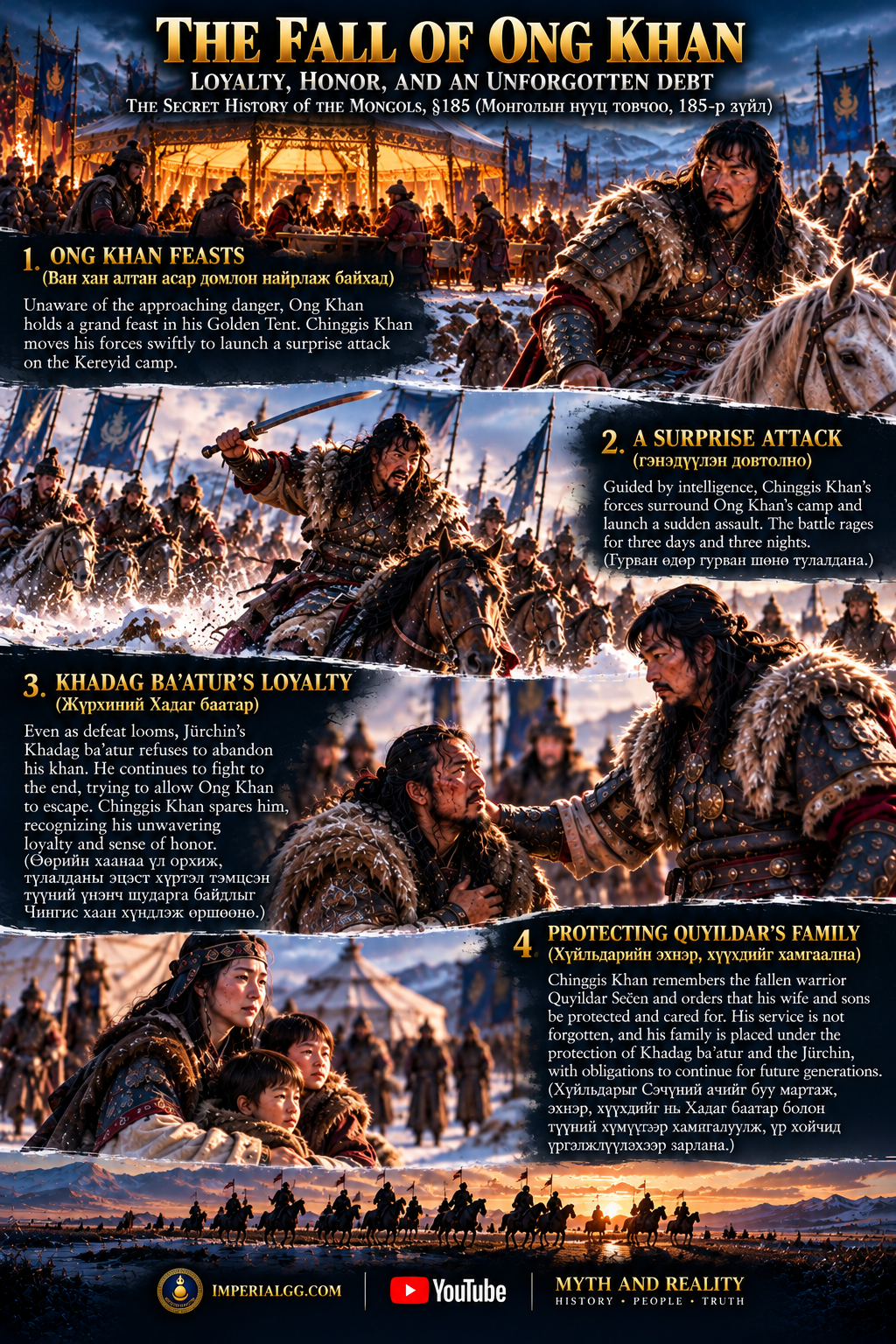
Chinggis Khan’s Attack on Ong Khan and His Protection of Quyildar’s Family
The Secret History of the Mongols — Section 185
INTRODUCTION
Section 185 of The Secret History of the Mongols begins with a decisive military move against Ong Khan. After discovering that Ong Khan is feasting in his Golden Tent, unaware of the danger approaching him, Qali’udar and Čaqurqan urge Chinggis Khan to advance rapidly, change mounts along the way, travel through the nights, and surround the Kereyid camp by surprise. Chinggis Khan approves their proposal, sends Jürčedei and Arqai ahead as scouts, and advances until his forces surround Ong Khan’s people near the opening of Jer Gully in the Jeje’er Heights. The fighting continues for three days and three nights. <Cite refs={[“turn592396search0″,”turn592396search23”]}/>
Yet the significance of this section extends beyond military tactics. Amid the attack, the chronicle presents two contrasting examples of loyalty and leadership: a warrior who refuses to abandon his own ruler even when defeat appears imminent, and Chinggis Khan’s decision to protect the wife and sons of Quyildar Sečen, remembering the service and sacrifice of a man who had already died.
Together, these episodes reveal a political ethic in which loyalty is tested under pressure, while past service creates obligations that survive the death of the person who rendered it.
I. THE SURPRISE ATTACK ON ONG KHAN
The information brought by Qali’udar and Čaqurqan creates an immediate opportunity. Ong Khan has established his Golden Tent and is feasting, apparently unaware of the approaching danger. Rather than delay, the commanders recommend a forced march, changing horses and riding through the night to achieve surprise.
Chinggis Khan accepts their advice. The movement of his forces is coordinated with reconnaissance, and his army reaches the Kereyid camp before Ong Khan can adequately prepare for the attack.
The episode illustrates a fundamental principle of steppe warfare: speed, mobility, intelligence, and the timing of an attack could be as consequential as the number of warriors involved. The objective was not simply to engage the enemy but to strike while the opposing leadership remained unprepared.
The chronicle describes the fighting as prolonged and difficult. For three days and three nights, the battle continues as Chinggis Khan’s forces surround Ong Khan’s people. The outcome is not presented as a bloodless triumph. It emerges from sustained combat in which individual decisions about loyalty, survival, and allegiance become critically important.
II. THE WARRIOR WHO WOULD NOT ABANDON HIS KHAN
Within the account of the battle, the chronicle records the conduct of Qadag Ba’atur, associated with the Jürgin contingent. His situation raises a question central to the political world depicted in the Secret History: what should a warrior do when his ruler is losing and his own survival may depend on abandoning him?
Qadag Ba’atur’s conduct is framed around his refusal to forsake his own qan. He continues fighting even as the situation deteriorates, seeking to allow his ruler an opportunity to escape with his life. His explanation is not that victory is assured, nor that his ruler has made no mistakes. Rather, he presents his action as the fulfillment of an obligation that he cannot simply discard when danger arrives.
This is a powerful distinction. Loyalty is easy to profess while a ruler is strong and victory appears likely. Its meaning becomes clearer when continued service carries a real risk of death.
Qadag Ba’atur’s conduct can therefore be read as an expression of fidelity and personal honor. His commitment is demonstrated through action, not merely through words. He does not treat allegiance as a convenience that can be abandoned the moment political circumstances change.
The passage should not, however, be reduced to a simple declaration that loyalty to a ruler is always right. The chronicle records a warrior’s decision within a specific conflict. Its significance lies in showing how seriously personal allegiance was understood, even when it placed the warrior in immediate danger.
III. CHINGGIS KHAN’S RESPONSE: RECOGNIZING LOYALTY
When Qadag Ba’atur’s conduct is reported to Chinggis Khan, the response is striking. Rather than treating the warrior’s resistance solely as hostility, Chinggis recognizes the principle behind his action: Qadag could not bring himself to abandon his own khan and sought to preserve his ruler’s life.
Chinggis Khan consequently spares him and accepts him as someone worthy of companionship. This decision introduces a second dimension to the section. Chinggis Khan is engaged in a campaign against Ong Khan, yet the chronicle depicts him as capable of recognizing a quality of character even in a man who had fought on the opposing side.
The episode suggests that political allegiance and personal merit are not necessarily identical. A warrior may serve another ruler and still demonstrate qualities that Chinggis considers worthy of respect. The recognition does not erase the conflict, but it allows the possibility that a man’s conduct under pressure may matter beyond the side on which he initially fought. This is not simply an act of leniency. It presents leadership as the capacity to distinguish between an enemy’s allegiance and the qualities revealed by his behavior.
IV. THE MEMORY OF QUYILDAR SEČEN
The section then turns to the family of Quyildar Sečen, whose earlier service to Chinggis Khan had come at a terrible cost. Quyildar had been mortally wounded in an earlier battle, and his sacrifice remained part of the political memory of the community.
Chinggis Khan now issues an order concerning Quyildar’s wife and sons. Qadag Ba’atur and the hundred Jürgin are assigned to serve and protect Quyildar’s family. The order extends beyond immediate assistance: the obligations are to continue through subsequent generations, with provisions concerning the service of descendants and the upbringing and protection of the family. The chronicle also associates the arrangement with the reward granted in memory of Quyildar’s service. <Cite refs={[“turn592396search23″,”turn592396search0”]}/>
The importance of this decision lies in its duration. Chinggis Khan does not treat Quyildar’s death as the end of his obligations toward him. Instead, he converts remembrance into an enduring responsibility toward the family left behind.
The dead warrior can no longer receive protection, reward, or recognition personally. His wife and children, however, remain. By protecting them, Chinggis Khan acknowledges that Quyildar’s service created a debt that his death did not cancel.
This is a form of political memory expressed through action. Gratitude is not confined to praise or ceremonial words; it becomes an arrangement intended to provide continuing support and security.
V. LOYALTY AND GRATITUDE AS PRINCIPLES OF LEADERSHIP
The juxtaposition of Qadag Ba’atur and Quyildar’s family is especially significant. Qadag Ba’atur demonstrates loyalty by refusing to abandon his own ruler when defeat threatens. Chinggis Khan responds by recognizing his conduct, sparing him, and accepting him as a worthy companion. Quyildar, by contrast, has already died after serving Chinggis Khan. His loyalty can no longer be rewarded through a direct relationship, so Chinggis directs his gratitude toward the people who survive him.
The two episodes illuminate different dimensions of the same political ethic.
The first concerns how a leader should recognize a warrior whose conduct reveals fidelity, even when that warrior has served an adversary. The second concerns how a leader should remember the service of a dead companion and protect those who depended on him.
In the first case, the warrior’s honor survives the defeat of his side. In the second, the dead warrior’s service survives his death.
Neither episode requires us to assume that the Mongol political world was free from coercion, rivalry, or violence. The battle itself demonstrates the opposite. Instead, the chronicle presents loyalty, personal merit, and obligations to the families of the dead as values that could operate within a harsh environment of political and military competition.
Chinggis Khan’s authority is thus represented not only through his ability to mobilize troops and defeat rivals but also through decisions about how to treat people whose conduct carries moral significance.
CONCLUSION
Section 185 begins with a surprise attack on Ong Khan while he is feasting, but its significance extends beyond the battlefield. The account of Qaday Ba’atur shows a warrior who refuses to abandon his ruler even when defeat is near. Chinggis Khan recognizes the fidelity behind that decision and spares him. The order concerning Quyildar Sečen’s wife and sons reveals another aspect of leadership: gratitude toward a fallen companion becomes a continuing obligation to protect his family.
These episodes present loyalty not as an abstract virtue but as a commitment tested by danger, and gratitude not as a passing emotion but as a duty that can outlast the person who earned it.
AUTHOR’S THESIS
Section 185 of The Secret History of the Mongols brings together military strategy and a political ethic of loyalty and remembrance. Chinggis Khan’s surprise attack demonstrates the importance of speed and coordination, while his response to Qaday Ba’atur recognizes fidelity even when it is directed toward an opposing ruler. His protection of Quyildar Sečen’s wife and sons further shows that the service of a fallen warrior remains binding upon the living. The section presents leadership not only as the capacity to defeat an adversary, but also as the capacity to recognize honor, repay service, and preserve obligations beyond death.
Primary source: The Secret History of the Mongols, §185. Names and interpretations should be checked against the chosen Mongolian edition, since English translations vary in their spellings and renderings of titles and personal names.
IMPERIALGG.COM
MYTH AND REALITY — HISTORY • PEOPLE • TRUTH