
FROM DEFEAT TO REORGANIZATION
By Altanbagana Baatar
DBA Candidate| Independent Historian
ImperialGG Historical Research Seriers
11 October 2026
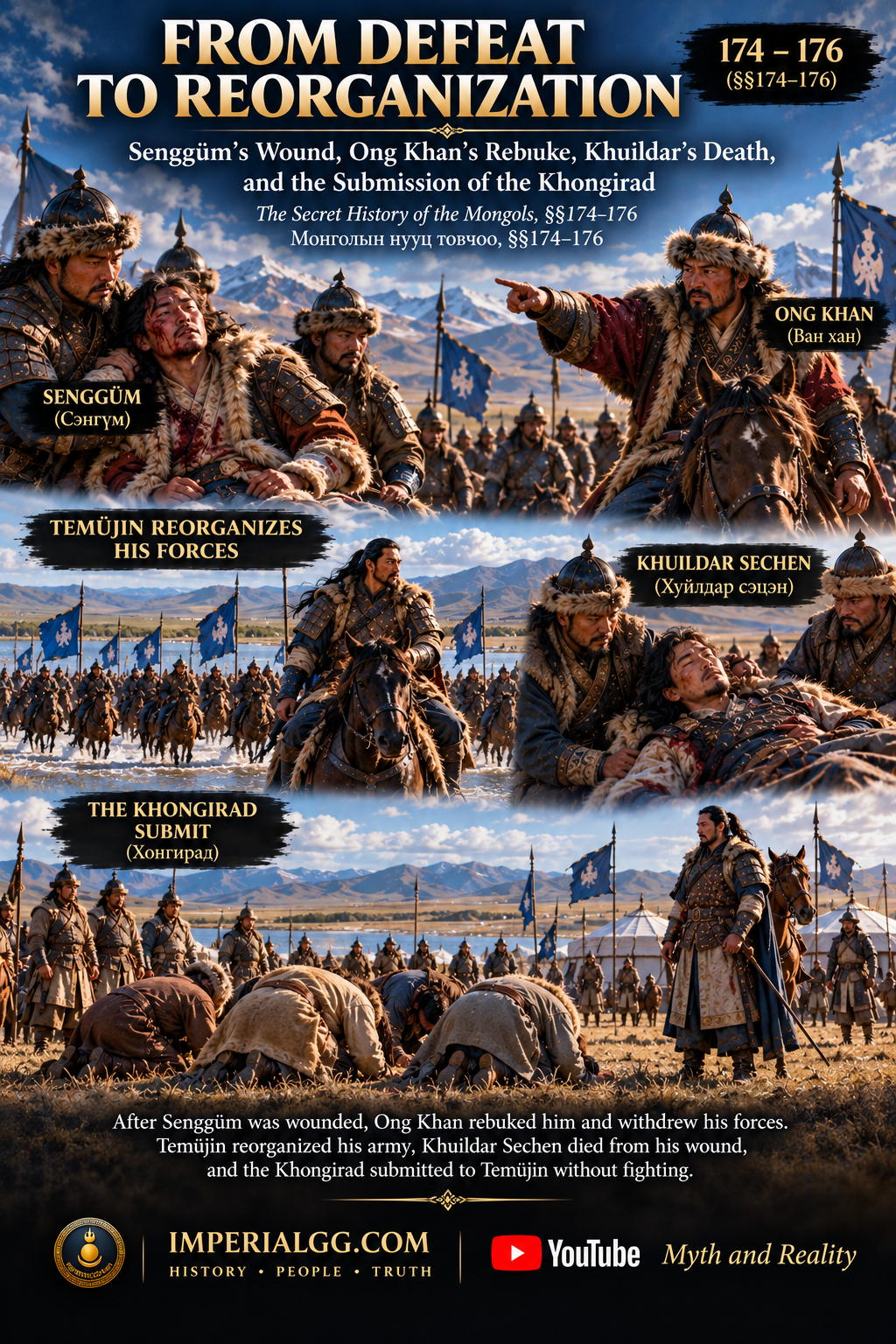
Ong Khan’s Rebuke, Khuildar’s Death, and the Submission of the Khongirad
The Secret History of the Mongols (Монголын нууц товчоо), §§174–176
1. ONG KHAN REBUKES SENGGÜM (СЭНГҮМ)
After Senggüm (Сэнгүм) is struck in the cheek by an arrow and falls from his horse during the battle at Khar Khaljan Elete (Хархалзан элээт), the Kereit (Хэрэйд) forces gather around him. In §174, Qada’an-Daldurqan (Хадаан-Далдурхан) brings Temüjin news of Ong Khan’s reaction.
Ong Khan rebukes his son for provoking a conflict and endangering himself while attempting to harm another person. When Senggüm’s injury becomes the reason to renew the attack, Aciq-Shirun (Ачиг-Ширүн) urges caution. He warns that the Mongols who have joined Jamuqa, Altan, and Quchar remain a potential force, and that Temüjin’s followers should not be underestimated.
Ong Khan ultimately decides to withdraw from the battlefield and attend to Senggüm. The episode reveals the tension between a father’s concern for his wounded son and the military consequences of continuing the campaign.
2. TEMÜJIN REORGANIZES HIS FORCES
In §175, Temüjin moves from Dalan Nemürges (Далан нэмүргэ) toward the Qalqha River (Халх гол). When his forces are counted, the chronicle records 2,600 men. Temüjin takes 1,300 and moves along the western side of the river, while the other 1,300 travel along the eastern side with the Uruud (Урууд) and Manghud (Мангуд).
The division is an important detail in the narrative because it shows Temüjin reorganizing his forces after the confrontation with Ong Khan. The chronicle records the numbers and directions of movement, providing specific information about the composition and deployment of his army.
The same section recounts the fate of Khuildar Sechen (Хуйлдар сэцэн), who has not yet recovered from his battlefield wound. Despite Temüjin’s advice, Khuildar attacks game while the group is hunting for food. His wound worsens, and he dies. The chronicle records that he is buried at a place called Or Nugu in the Qalqha River region.
Khuildar’s death is a reminder that the consequences of battle continue after the armies have separated. A wound received in combat can remain fatal even when the immediate fighting has ended.
3. THE KHONGIRAD (ХОНГИРАД) SUBMIT
Section 176 introduces a new development. Temüjin learns that a group of Khongirad (Хонгирад) is living near the point where the Qalqha River flows into Buir Lake (Буйр нуур).
He recalls their traditional reputation: they were known for valuing the beauty of their sons-in-law and daughters. Temüjin believes that reminding them of this reputation may persuade them to submit peacefully. He orders Jorchidai (Жорчидай) to lead the Uruud against them if they resist.
The Khongirad submit without fighting. The chronicle explicitly states that Temüjin does not harm them after their submission.
This episode contrasts with the preceding military conflict. Whereas the dispute with Ong Khan has led to battle, the Khongirad episode ends through submission without bloodshed. Temüjin’s approach combines an appeal to the group’s established identity with a clear warning that resistance may lead to force.
AUTHOR’S THESIS
Sections 174–176 trace three connected developments: the consequences of Senggüm’s injury and Ong Khan’s decision to withdraw; Temüjin’s reorganization of his forces and the death of the wounded Khuildar; and the peaceful submission of the Khongirad.
Together, these episodes show that the aftermath of battle involves more than victory or defeat. Leaders must respond to injuries, manage their forces, and decide when to pursue military action and when to accept submission without further violence. The chronicle presents these decisions through specific speeches, movements, and outcomes rather than through a single general statement about power.
The Secret History of the Mongols — §§174–176
ImperialGG — HISTORY • PEOPLE • TRUTH
#MongolHistory #SecretHistoryOfTheMongols #OngKhan #Senggum #Khuildar #Khongirad #ImperialGG