
FROM RETREAT TO BATTLE
By Altanbagana Baatar
DBA Candidate| Independent Historian
ImperialGG Historical Research Seriers
09 October 2026
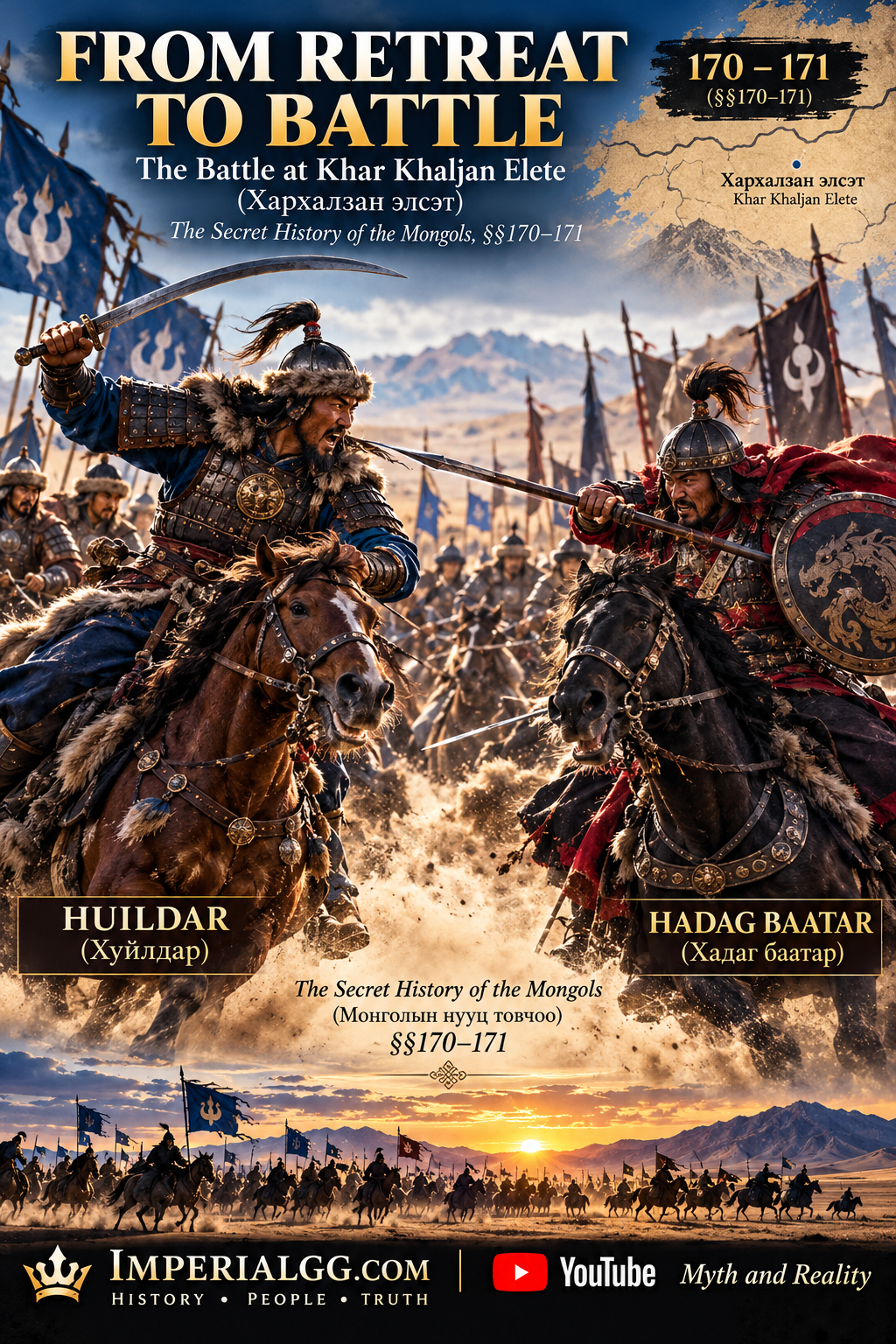
The Battle at Khar Khaljan Elete (Хархалзан элээт): Intelligence, Command, and the First Clash
The Secret History of the Mongols (Монголын нууц товчоо), §§170–171
ABSTRACT
Sections 170–171 of The Secret History of the Mongols (Монголын нууц товчоо) trace the transition from Temüjin’s withdrawal from an impending ambush to armed confrontation with the forces of Ong Khan (Ван хан). The narrative emphasizes the practical importance of intelligence, reconnaissance, military leadership, and the experience of individual commanders. It also records Jamuqa’s assessment of Temüjin’s followers and describes the engagement involving the Uriangqad, Uruud, Manghud, and Jürkin contingents. Read together, these sections show how information obtained before battle shaped the decisions that followed, while the outcome of the initial encounters depended on the actions of particular commanders and their forces.
Keywords: The Secret History of the Mongols (Монголын нууц товчоо); Khar Khaljan Elete (Хархалзан элээт); Temüjin (Тэмүжин); Ong Khan (Ван хан); Jamuqa (Жамуха); Uruud (Урууд); Manghud (Мангуд); military intelligence; political alliances.
1. FROM WARNING TO WITHDRAWAL
Section 170 continues the events surrounding the exposure of Senggüm’s (Сэнгүм) conspiracy. After receiving information from Badai (Бадай) and Kishiliq (Хишилиг), Temüjin believes their warning and communicates it to the people he trusts. He abandons unnecessary baggage and withdraws during the night, leaving Jelme Qo’a (Жэлмэ Хоа) of the Uriangqad (Урианхад) to serve as rearguard while scouts are sent ahead. These details portray retreat not as an unorganized flight but as a deliberate response to a threat supported by information from within the opposing political circle.
The episode also continues the pattern established in §§168–169: the conspiracy is weakened by the circulation of information, while Temüjin’s survival depends on his willingness to assess that information and act before the enemy can complete its preparations. The earlier warning from Mönglik (Мөнглик), followed by the disclosures of Badai and Kishiliq, has now produced a concrete military consequence. Temüjin’s force changes its position, reduces its burden, maintains a rearguard, and uses scouts to observe the surrounding terrain.
2. THE APPROACH OF ONG KHAN’S FORCES
At Khar Khaljan Elete (Хархалзан элээт), Temüjin’s men halt to rest and eat. The narrative then introduces another observation that changes the situation: Alchidai (Алчидай) sends the herdsmen Chigidei (Чигидэй) and Yadir (Ядир) to move his horses to new pasture, and they observe dust rising in the distance. Their report alerts Temüjin to the movement of a large force.
The episode is significant because the warning does not come from a formal diplomatic channel or a high-ranking commander, but from people engaged in ordinary herding duties. Their observation becomes useful military intelligence because it is communicated to those able to interpret and act on it. The chronicle thereby presents reconnaissance as a practical activity distributed across the camp rather than as the exclusive responsibility of a specialized military office.
The appearance of dust does not, by itself, establish every detail of the approaching force. Its significance emerges from the context: Temüjin has already withdrawn because he was warned of a planned capture, and the movement now observed suggests that the danger has developed into an approaching military confrontation. The narrative connects information, interpretation, and action without requiring the reader to assume that every observer knew the full political background.
3. JAMUQA’S ASSESSMENT OF TEMÜJIN’S FOLLOWERS
Section 171 introduces Jamuqa’s (Жамуха) assessment of the forces accompanying Temüjin. In the Mongolian text shown in the edition used for this study, Jamuqa identifies the Uruud (Урууд) and Manghud (Мангуд) among Temüjin’s followers and warns Ong Khan that they are experienced in warfare. His description draws attention not simply to the number of men available to Temüjin, but to the military qualities of the groups supporting him.
This passage should be read with care because Jamuqa is not a detached narrator describing two armies from a neutral position. He is a political participant whose knowledge of Temüjin’s followers informs his advice to Ong Khan. His words are therefore evidence of how the opposing side understood Temüjin’s military strength, while also functioning as a form of political and military counsel. The distinction between the information supplied by a character and the interpretation placed upon that information remains essential to a source-based reading of the chronicle.
The account’s emphasis on experienced warriors also helps explain why the ensuing battle is narrated through the actions of particular leaders and contingents. The Uruud and Manghud are not merely names in a list of allies; they are represented as forces whose prior experience and command structure matter in the confrontation. Their role demonstrates how political allegiance became militarily consequential once the dispute between Temüjin and the Kereit ruling house escalated into open conflict.
4. THE FIRST CLASH AND THE ROLE OF COMMANDERS
The battle narrative describes the Uruud and Manghud forces under Jorchidai (Жорчидай) and Khuildar Sechen (Хуйлдар сэцэн) engaging the opposing troops. The Jürkin (Жүрхин) contingent, led by its own commanders, enters the confrontation, and the chronicle then records the intervention of Achig-Shirun (Ачиг-Ширүн) of the Tümen-Tübegän (Түмэн-Түвэгэн). These successive encounters give the account a specific military structure: rather than presenting the engagement as an undifferentiated clash of masses, the text identifies groups and leaders as the fighting develops.
The importance of these details lies in the relationship between leadership and collective action. The forces are identified through their affiliations and commanders, while the narrative records the consequences of their encounters in sequence. This approach allows the reader to follow the battle through identifiable units and decisions, although it does not provide enough information to reconstruct every tactical movement or determine the exact size and arrangement of the opposing armies.
The episode should not be reduced to a simple claim that one side possessed superior warriors or that the battle was decided by a single individual. The text instead presents a sequence of engagements in which experienced commanders lead their respective groups into combat. Any broader interpretation of battlefield tactics must remain proportionate to the detail actually preserved in the source.
5. HISTORICAL INTERPRETATION: INFORMATION, LOYALTY, AND MILITARY ORGANIZATION
Sections 170–171 bring together several themes that have developed throughout the preceding narrative. The conspiracy against Temüjin fails to remain secret; information reaches him through individuals who are not all members of the political elite; reconnaissance identifies the movement of an approaching force; and the resulting confrontation is narrated through the roles of named commanders and their followers. The movement from warning to withdrawal and then to battle reveals how political decisions become operational realities in a society where military capacity depends on personal allegiance, established relationships, and the ability to mobilize experienced fighters.
The text also invites a distinction between political legitimacy and military effectiveness. Ong Khan (Ван хан) retains the authority associated with the Kereit ruling house, while Temüjin’s position rests increasingly on the groups and commanders who follow him. Jamuqa’s description of Temüjin’s supporters suggests that the danger to Ong Khan cannot be assessed solely by reference to formal rank or inherited status. The military experience and cohesion of a leader’s followers are equally relevant to the outcome of a confrontation.
Nevertheless, the chronicle should not be treated as a complete battlefield report. It offers a narrative of events shaped by selection, characterization, and the perspective of its participants. Its accounts of speeches and military actions provide valuable evidence for reconstructing how the conflict was remembered and represented, but details that the text does not establish should not be supplied through speculation.
6. AUTHOR’S THESIS
Sections 170–171 mark the transition from the exposure of Senggüm’s conspiracy to open military confrontation at Khar Khaljan Elete (Хархалзан элээт). Temüjin’s survival depends first on the movement of information and his willingness to respond to it; the subsequent encounter reveals the importance of experienced commanders and the political loyalties that organize armed forces. The chronicle’s emphasis on observers, scouts, named contingents, and individual leaders shows that military power emerges not from authority alone but from the interaction of intelligence, judgment, command, and collective action.
The central historical question is therefore not simply which side possessed the greater number of warriors, but how each leadership converted information and allegiance into effective action. In these sections, the chronicle presents the battlefield as the point at which earlier political choices are tested through the conduct of commanders and the forces that follow them.
SOURCE NOTE
The principal text for this commentary is the Mongolian edition of Монголын нууц товчоо supplied by the author, pp. 104–105, §§170–171. English-language comparison should include Igor de Rachewiltz’s translation and historical-philological commentary, which provides a major scholarly reference for interpreting the chronicle’s wording and historical context. <Cite refs={[“turn397822search0″,”turn397822search11”]}/>
For place-names and personal names, this article retains the Mongolian forms in parentheses to make comparison with the Mongolian text possible. The form Хархалзан элээт follows the edition supplied for this series; alternative English renderings should be treated as translation choices rather than silently substituted for the source form.
ImperialGG — HISTORY • PEOPLE • TRUTH