
THE BREAKING OF AN ALLIANCE
By Altanbagana Baatar
DBA Candidate| Independent Historian
ImperialGG Historical Research Seriers
04 October 2026
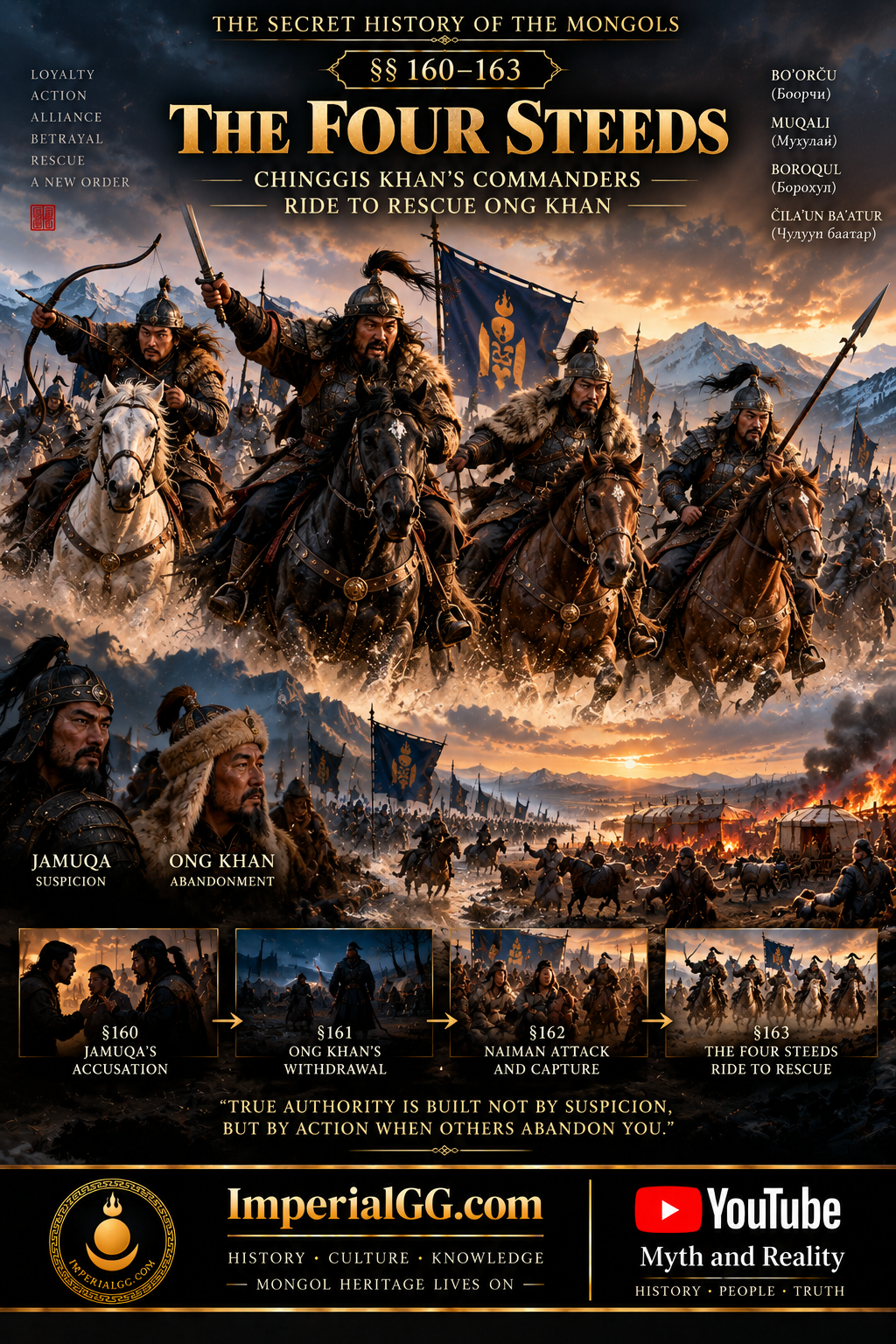
Jamuqa, Ong Khan, and the Four Steeds of Chinggis Khan in The Secret History of the Mongols (§§160–163)
Abstract
Sections 160–163 of The Secret History of the Mongols record a decisive stage in the deterioration of the political relationship between Chinggis Khan and Ong Khan. The episode begins with Jamuqa’s accusation that Temüjin had maintained secret relations with the Naiman and had deliberately remained behind rather than accompanying Ong Khan. Although Kirin Ba’atur immediately condemns Jamuqa’s statement as slander, Ong Khan nevertheless abandons the battlefield during the night, leaving Chinggis Khan exposed. The subsequent Naiman attack on Ong Khan produces a reversal of political fortune: the ruler who had abandoned Chinggis Khan becomes dependent upon him for military assistance. Chinggis Khan responds by dispatching four distinguished commanders—Bo’orču (Боорчи), Muqali (Мухулай), Boroqul (Борохул), and Čila’un Ba’atur (Чулуун баатар)—who rescue Senggum and recover Ong Khan’s captured households, possessions, and dependants. These sections therefore illuminate more than the collapse of an alliance. They reveal the importance of military reliability, political trust, intelligence, and reciprocal obligation in the formation of Chinggis Khan’s emerging political order. The episode also introduces the group later characterized as Chinggis Khan’s “four steeds,” whose military service becomes an important component of the new imperial elite. studylib.net
Keywords: Chinggis Khan; Ong Khan; Jamuqa; Bo’orču; Muqali; Boroqul; Čila’un Ba’atur; Kereyit; Naiman; Secret History of the Mongols
1. Introduction
Sections 160–163 of The Secret History of the Mongols occupy a critical position in the narrative of the relationship between Chinggis Khan and Ong Khan. The preceding sections describe the military cooperation between the two rulers against the Naiman ruler Buyruq Khan and then the confrontation with the Naiman commander Kökse’u-Sabraq. In §160, however, the narrative introduces a new element: political suspicion generated through speech. Jamuqa tells Ong Khan that Temüjin has long maintained relations with the Naiman and suggests that his absence from the army is evidence of defection. Kirin Ba’atur immediately challenges this interpretation, asking why Jamuqa is slandering his upright brother. Nevertheless, the suspicion has already entered the political relationship. Ong Khan withdraws during the night, leaving Chinggis Khan without the ally upon whom he had relied. studylib.net
The importance of the episode lies in the contrast between speech and action. Jamuqa’s accusation is based on inference and suspicion, whereas the subsequent actions of Chinggis Khan and his commanders are demonstrated through military conduct. Ong Khan abandons his ally, but Chinggis Khan later responds to Ong Khan’s request for assistance. The four commanders whom he sends do not merely participate in a military operation; they recover the political position of a ruler who had previously abandoned them. This reversal provides one of the clearest examples in the Secret History of the distinction between political rhetoric and operational loyalty.
2. Jamuqa’s Accusation
In §160, Jamuqa tells Ong Khan that Temüjin had already been communicating with the Naiman and that, because Temüjin had not accompanied them, he must have remained behind intentionally in order to go over to the Naiman. His accusation is presented through an extended bird metaphor, contrasting his own supposed loyalty to Ong Khan with Temüjin’s alleged intention to depart. Kirin Ba’atur’s immediate response is significant because the narrative does not present Jamuqa’s accusation as established fact. He explicitly characterizes it as slander against an upright brother. studylib.net
This exchange is important for understanding the narrative construction of Jamuqa. The Secret History does not simply state that Jamuqa was responsible for the later rupture. Rather, it presents a political environment in which information, interpretation, and personal allegiance become difficult to separate. Jamuqa possesses knowledge of Temüjin’s political relations, but he interprets that knowledge in the most damaging possible manner. The narrative therefore establishes suspicion before establishing betrayal.
3. Ong Khan’s Withdrawal
Section 161 records the immediate consequence. Chinggis Khan remains in position during the night, expecting battle the following morning, but discovers that Ong Khan has disappeared. His response—expressing that he has been deceived and abandoned in the encampment—marks a decisive deterioration in their relationship. Chinggis Khan then withdraws across the Ider-Altai region and eventually establishes camp on the Sa’ari steppe. studylib.net
The significance of this event is greater than the loss of a single military engagement. The alliance between Chinggis Khan and Ong Khan had been constructed through kinship symbolism, political reciprocity, and repeated military cooperation. The night withdrawal demonstrates that these bonds could not withstand political suspicion. At the same time, the Secret History records that Chinggis Khan and Qasar understood what had happened but did not immediately publicize the details. This restraint is important: the narrative does not portray Chinggis Khan as reacting impulsively. He withdraws, assesses the situation, and preserves his political position.
4. The Reversal of Fortune
Section 162 reverses the political situation. Kökse’u-Sabraq, the Naiman commander, pursues Ong Khan and seizes Senggum’s household, women, children, possessions, and dependants. The two sons of Toqto’a Beki of the Merkit, Godu and Čila’un, also use the opportunity to separate from Ong Khan and return toward their father with their people. studylib.net
The man who had abandoned Chinggis Khan is now himself in need of rescue. This reversal is structurally important in the Secret History. The narrative moves from suspicion → abandonment → defeat → appeal for assistance. The political consequences of the earlier decision therefore become visible without requiring an explicit moral judgment from the narrator.
5. The Four Steeds
In §163, Ong Khan sends an envoy to Chinggis Khan asking for assistance. He specifically requests four distinguished commanders. Chinggis Khan responds by mobilizing troops and sending Bo’orču (Боорчи), Muqali (Мухулай), Boroqul (Борохул), and Čila’un Ba’atur (Чулуун баатар). The Mongolian text identifies them as the дөрвөн хүлэг баатар, the “four steeds/champions.” They arrive before Senggum can be captured and rescue him together with the households, dependants, women, children, and possessions that had been taken by the Naiman. studylib.net
This designation is historically significant because these four men later occupy a prominent place within the political and military structure of the Mongol Empire. Atwood’s discussion of the new aristocracy likewise places Bo’orču, Muqali, Boroqul, and Čila’un among the four “steeds” associated with Chinggis Khan’s ruling elite. studylib.net
The terminology should also be distinguished from another famous group in the Secret History: the Four Hounds, namely Jebe, Qubilai, Jelme, and Sübe’etei. The Four Steeds and Four Hounds represent different groupings within the political and military order and should not be merged merely because both employ animal imagery.
6. Military Service and Political Legitimacy
The episode reveals an important principle in the formation of Chinggis Khan’s political authority: military service could create obligations that survived political betrayal. Chinggis Khan had been abandoned by Ong Khan, yet when Ong Khan requested assistance, he did not refuse. Instead, he entrusted the mission to commanders whose military competence and reliability were already established.
The distinction between Ong Khan’s conduct and that of the four commanders is therefore central. Ong Khan’s decision is driven by suspicion and political calculation; the four commanders act through direct military execution. Their authority is demonstrated not by titles alone but by their capacity to recover people, property, and political assets under hostile conditions.
This is also why the episode should not be reduced to a simple story of loyalty. The Secret History presents a developing political system in which rulers depend upon commanders who can translate political decisions into effective military action. Bo’orču, Muqali, Boroqul, and Čila’un become important not merely because they are personally loyal to Chinggis Khan, but because their service produces concrete political results.
7. Conclusion
Sections 160–163 mark a decisive turning point in the political relationship between Chinggis Khan and Ong Khan. Jamuqa’s accusation introduces suspicion; Ong Khan’s withdrawal converts suspicion into political rupture; the Naiman attack exposes the consequences of that rupture; and Chinggis Khan’s dispatch of the Four Steeds demonstrates the operational strength of his emerging military leadership.
The episode is particularly important because the Secret History juxtaposes two forms of political behavior. Jamuqa interprets, accuses, and persuades; Ong Khan withdraws; Chinggis Khan and his commanders act. The narrative ultimately gives greater historical weight to demonstrated action than to political assertion.
The rescue of Senggum and the recovery of Ong Khan’s people therefore constitute more than an isolated military episode. They reveal the emergence of a command structure in which commanders such as Bo’orču, Muqali, Boroqul, and Čila’un become instruments through which Chinggis Khan’s authority could be exercised beyond the immediate reach of his personal presence. The later organization of the Mongol Empire would depend heavily upon precisely this relationship between central authority and trusted military command. The Secret History begins to make that structure visible here, in the crisis recorded in §§160–163. studylib.net
Primary Source
The Secret History of the Mongols, §§160–163, especially the Mongolian text transmitted in the Damdinsüren tradition and the modern translation of Christopher P. Atwood.
Suggested scholarly sources
- Ц. Дамдинсүрэн, Монголын нууц товчоо.
- Christopher P. Atwood, The Secret History of the Mongols (Penguin Classics, 2023). Penguin Random House
- Igor de Rachewiltz, The Secret History of the Mongols: A Mongolian Epic Chronicle of the Thirteenth Century.
- Francis W. Cleaves, The Secret History of the Mongols.
- Ш. Гаадамба, Монголын нууц товчооны судлалын зарим асуудал.