
JELME (ЗЭЛМЭ): SERVICE, WARFARE, AND POLITICAL LOYALTY IN THE SECRET HISTORY OF THE MONGOLS
By Altanbagana Baatar
DBA Candidate| Independent Historian
ImperialGG Historical Research Seriers
03 October 2026
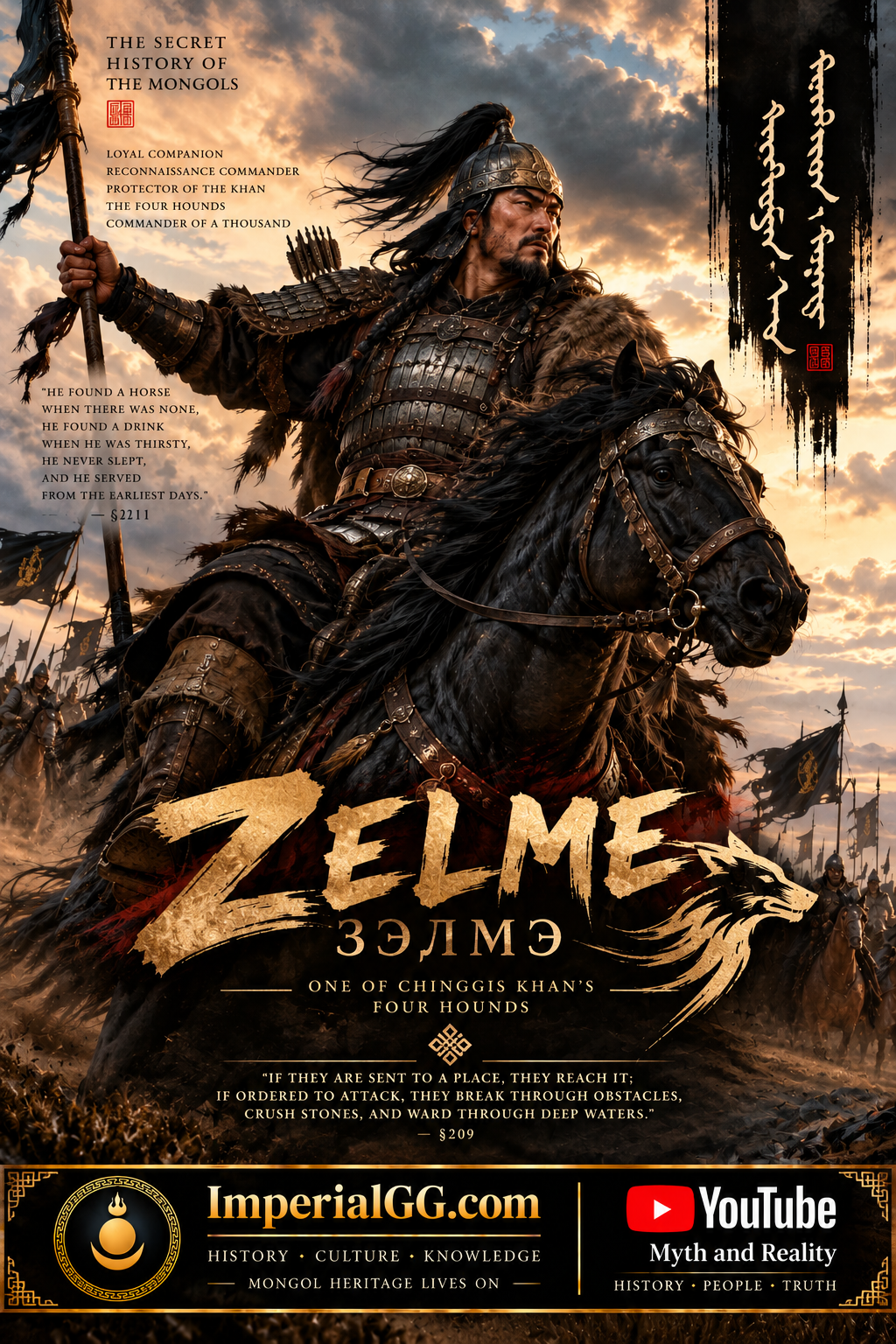
A textual and historiographical study of one of Chinggis Khan’s principal commanders
Abstract
Jelme (Зэлмэ) occupies a distinctive position in The Secret History of the Mongols (Mongγol-un niγuča tobčiyan), not merely as one of Chinggis Khan’s principal commanders, but as a figure whose identity is constructed through a sustained sequence of personal service, military competence, tactical initiative, and political recognition. His first appearance in §97 connects him to Temüjin’s earliest life through his father Jarchi’udai (Жарчиудай), while subsequent passages portray him as a member of Temüjin’s immediate circle, a reconnaissance commander, a participant in the formation of Temüjin’s early political following, the protector of the wounded Chinggis Khan, an independently acting battlefield commander, one of the “Four Hounds,” a commander of a thousand, and finally the recipient of an exceptional privilege concerning nine offenses. His family also remained connected to the imperial military establishment through his son Esuntui (Есөнтэй), who appears in §225 in command of the quiver-bearers. This article reconstructs Jelme’s career from the relevant passages of the Secret History, while comparing the Mongolian scholarly tradition represented by Tsendiin Damdinsüren (Ц. Дамдинсүрэн) and Sh. Gaadamba (Ш. Гаадамба) with the English scholarship of Christopher P. Atwood, Francis Woodman Cleaves, and Igor de Rachewiltz. Particular attention is given to §§145–146 and §§149–155, where the Secret History most clearly develops Jelme’s military character. The article argues that Jelme is presented not simply as a heroic or loyal warrior, but as a model of reliable operational service under conditions requiring independent judgment. His career also demonstrates how personal loyalty in the early Mongol polity could be transformed into military authority, institutional rank, and exceptional political privilege.
Keywords: Jelme; Зэлмэ; Jarchi’udai; Жарчиудай; Temüjin; Тэмүжин; Chinggis Khan; Чингис хаан; Secret History of the Mongols; Four Hounds; Mongol military history; Damdinsüren; Gaadamba; Atwood.
1. Introduction
The career of Jelme cannot be reconstructed as a conventional medieval biography. The Secret History of the Mongols does not give his birth year, describe his childhood in detail, or provide a continuous chronological narrative of his life. Instead, Jelme emerges through a series of strategically placed episodes. He is first introduced as the son of Jarchi’udai, presented to Temüjin in connection with an event reaching back to Temüjin’s birth; he subsequently appears in the early crises of Temüjin’s career, in reconnaissance against the Merkits, in the political consolidation of Temüjin’s followers, in the battle in which Chinggis Khan is wounded, in later military operations, in the classification of the “Four Hounds,” and finally in the formal distribution of offices and privileges after the establishment of the empire.
The result is not simply a collection of heroic anecdotes. The repeated appearance of Jelme creates a cumulative characterization. Each episode contributes a different element: proximity to Temüjin, loyalty, mobility, reconnaissance, physical endurance, tactical improvisation, offensive action, and institutional authority. Read together, these passages provide a particularly useful case study for examining how the Secret History represents the relationship between personal service and political power.
The textual tradition must, however, be handled with care. The modern Mongolian version of Tsendiin Damdinsüren (Ц. Дамдинсүрэн), edited by Sh. Gaadamba (Ш. Гаадамба), remains an essential point of reference for Mongolian readers and scholars. The 1990 fourth edition is catalogued as a translation from Old Mongolian into modern Mongolian by Damdinsüren, with Gaadamba as editor. CiNii Gaadamba’s own scholarly work must be treated separately from his editorial role. His Монголын нууц товчооны судлалын зарим асуудал and his 1990 reconstruction of the text in traditional Mongolian script represent important contributions to Mongolian philology and textual interpretation. Судалгаа
For English-language scholarship, Christopher P. Atwood’s 2023 translation is particularly valuable because it combines a new translation with an extensive discussion of the text’s preservation, composition, genre, terminology, and historical context. The edition explicitly discusses the role of biographical material concerning important commanders, which is especially relevant to the repeated passages concerning Jelme. studylib.net Cleaves and Igor de Rachewiltz provide additional points of comparison, particularly for philological questions and the interpretation of names, titles, poetic expressions, and institutional terminology.
The present article therefore distinguishes three levels of evidence: the wording and narrative structure of the Secret History itself; interpretations found in Mongolian and international scholarship; and conclusions that can reasonably be drawn from the pattern created by the source material. This distinction is necessary because later historical traditions concerning Chinggis Khan’s commanders should not automatically be projected backward into the thirteenth-century text.
2. Jarchi’udai and the Beginning of Jelme’s Service
Jelme first appears in §97, when Jarchi’udai of the Uriyangqad (Урианхай) comes from Burqan-qaldun (Бурхан халдун) with his son. Jarchi’udai recalls that when Temüjin was born at Deli’ün-boldaq (Дэлүүн болдог) on the Onon, he had given him sable swaddling clothes and had also given him his son Jelme. Because Jelme was still too young, Jarchi’udai had taken him back; he now returns him and instructs him to serve Temüjin by saddling his horse and opening the felt door of his dwelling.
The importance of this passage lies in the unusual depth of the relationship that it establishes. Jelme does not first enter Temüjin’s history as an unknown warrior who subsequently earns his position through battlefield achievement. His relationship with Temüjin is presented as originating in the earliest period of Temüjin’s life. The material gift of sable swaddling clothes and the human “gift” of Jelme are placed within the same narrative context.
This becomes particularly important when §211 is read together with §97. When Chinggis Khan later evaluates Jelme’s service, he deliberately returns to the circumstances surrounding Jarchi’udai and Jelme’s original presentation. The two passages therefore form a narrative frame around Jelme’s career: §97 establishes the relationship; §211 retrospectively evaluates what that relationship became.
The text does not, however, provide Jelme’s exact age in §97. It establishes only that he was too young to remain with Temüjin. A precise birth date or age therefore cannot legitimately be presented as information derived from the Secret History.
3. Jelme among the Early Companions of Temüjin
Jelme’s transition from a presented retainer to an active member of Temüjin’s immediate circle is visible in §99. When the Tayichi’ut (Тайчууд) appear, Temüjin and his family flee. The passage names Jelme together with Temüjin, Hö’elün (Өэлүн), Qasar (Хасар), Qachi’un (Хачиун), Temüge (Тэмүгэ), Belgütei (Бэлгүтэй), and Bo’orču (Боорчу) among those who mount horses.
This detail is significant precisely because the passage is not heroic. Jelme is simply there, within the immediate group surrounding Temüjin. The narrative therefore assumes that his position is already established.
His role becomes more explicit in §103. Temüjin is uncertain whether the Three Merkits have actually returned home or whether they are waiting somewhere in ambush. He therefore sends Belgütei, Bo’orču, and Jelme to investigate. They pursue the Merkits for three days until the enemy disappears.
Here Jelme appears in a clearly operational role. He is entrusted with reconnaissance and pursuit, not simply with participation in battle. This early evidence is important when considering the later “Four Hounds” characterization. The qualities represented by that metaphor—mobility, pursuit, reaching an objective, and acting at a distance from the khan—are already visible in Jelme’s early career.
4. Jelme and the Uriyangqad: Ca’urqan and Sübe’etei
The political significance of Jelme within his own lineage becomes visible in §120. His younger brothers Ca’urqan (Цаурхан) and Sübe’etei (Сүбээдэй) leave the Uriyangqad and join Jelme.
This passage deserves more attention than it usually receives. Sübe’etei would later become one of the most prominent commanders of the Mongol Empire and would himself be included among the Four Hounds with Jelme, Jebe (Зэв), and Qubilai (Хубилай). The source does not suggest that Sübe’etei’s later career was merely inherited from his elder brother, but it does show that Jelme already occupied a position of sufficient authority that his younger brothers could attach themselves to his political following.
Thus, the Jelme–Sübe’etei relationship belongs not only to family history but also to the formation of the Mongol military elite.
5. Jelme and Bo’orču: The Earliest Companions
After Temüjin becomes Chinggis Khan, §125 provides one of the most important statements concerning Jelme’s political status. Chinggis Khan addresses Bo’orču and Jelme together, recalling the period when he had no companion except his shadow and no whip except a tail. He describes these two men as having become his shadow and tail, easing his soul and heart, and then places them before the others and entrusts them with leadership.
The imagery is relational, but its political significance is concrete. Bo’orču and Jelme possess authority because their service predates the imperial order itself. Their political legitimacy is therefore based not merely on formal military rank but on demonstrated loyalty during the formative period of Temüjin’s career.
This is an important principle in the political world represented by the Secret History: personal service could become institutional authority. Jelme’s later position cannot be understood solely by counting battles or military victories. His political status also derives from his position among Temüjin’s earliest and most trusted companions.
6. The Wounded Khan: Jelme’s Greatest Act of Personal Service
The most extensive narrative concerning Jelme occurs in §§145–146, during the battle against the Tayichi’ut.
Chinggis Khan is struck in the neck and suffers a serious wound. Jelme remains beside him through the night. He does not entrust the task of guarding the wounded khan to another person; instead, he repeatedly removes the congealed blood from the wound, swallowing or spitting it out when necessary. Atwood’s translation emphasizes that Jelme remains on guard until midnight and continues to deal with the blood while the khan is incapacitated. studylib.net
When Chinggis Khan regains consciousness, he says that he is thirsty. Jelme then removes his clothing and enters the enemy position almost naked. He searches for esük (эсэг), the fermented mare’s milk associated with Mongolian pastoral life, but cannot find it because the fleeing people have released their mares without milking them. He therefore takes a large container of fermented curds and returns without being detected. He then obtains water, mixes it with the fermented curds, and gives the drink to Chinggis Khan. The Mongolian version likewise emphasizes that Jelme went to and returned from the enemy position without being noticed. FlipHTML5
The significance of this episode lies not simply in physical courage. Jelme’s actions display independent judgment under extreme circumstances.
When Chinggis Khan questions why he entered the enemy position naked, Jelme explains his contingency plan. If he had been captured, he would claim that he had intended to defect, that his own people had discovered his intention, stripped him, and that he had escaped to the enemy. He expected that this explanation would persuade the enemy to give him clothing and a horse, after which he could return.
The passage therefore presents Jelme as a man who does not simply act courageously but thinks through the consequences of his action before taking the risk. His loyalty is expressed through improvisation, deception, physical endurance, and personal responsibility.
The Mongolian text makes this episode especially striking because Jelme himself explains that he acted immediately because he was distressed by Chinggis Khan’s condition and wished to relieve his suffering. www.assa.mn
Chinggis Khan subsequently connects this service with an earlier rescue. The episode therefore establishes a recurring pattern: Jelme is repeatedly placed in circumstances where the khan’s survival depends upon an individual acting without delay.
7. §§149–155: Jelme’s Military Mind
The sequence beginning in §149 is essential for understanding Jelme as a commander.
Chinggis Khan recounts a dream involving three black standards and a force of enemies and asks several commanders what they would do if confronted with such a force. Jelme’s answer is distinguished by its aggressive character. He describes an immediate attack, the seizure of the enemy’s standards, and the destruction of their capacity to resist.
It is important not to reduce this passage to the statement that Jelme was simply “the bravest” of the commanders. The six responses are deliberately differentiated. Each commander demonstrates a particular way of understanding the military problem. Jelme’s answer is distinctive because it emphasizes immediate offensive action.
The narrative then moves from hypothetical response to actual military action. The enemy force is encountered, and the three black standards become concrete battlefield objectives. Jelme participates in the assault and captures the standards.
This creates one of the most interesting structural patterns in Jelme’s biography:
Jelme’s proposed action → the actual encounter → execution of the proposed action → Chinggis Khan’s evaluation.
The importance of this sequence is greater than the individual act of capturing the standards. The Secret History establishes a correspondence between what Jelme says he would do and what he subsequently does.
This is a characteristic literary method of the Secret History: a commander’s identity is constructed through repeated correspondence between speech, action, and recognition.
8. Chinggis Khan’s Praise of Jelme
Following the military episodes, Chinggis Khan praises his commanders individually. Jelme’s praise is particularly revealing because it is not limited to courage.
The text associates him with hunting and tracking ability, the capacity to frighten the hearts of arrogant enemies, finding a horse when he has none, finding drink when he is thirsty, remaining alert with little sleep, wisdom, and long-standing service to the polity. The final formulation identifies him as the “good Jelme of the Uriyangqad.” studylib.net
This list deserves close attention.
Chinggis Khan does not praise Jelme primarily as a man who kills the largest number of enemies. Instead, the praise identifies a cluster of practical competencies:
- tracking and observation;
- psychological effect upon the enemy;
- resourcefulness when deprived of a horse;
- resourcefulness when deprived of drink;
- alertness and endurance;
- wisdom;
- long-standing political service.
The praise therefore confirms what the earlier narrative episodes had already demonstrated. Jelme’s defining characteristic is not raw violence. It is reliability in situations where ordinary resources are unavailable.
The wording of the Mongolian text is particularly important here because it gives the praise a rhythmic, cumulative form. The sequence of qualities builds toward the final recognition of Jelme’s long service “for the polity.” studylib.net
9. Jelme and the “Four Hounds”
Jelme’s most famous military designation occurs in §195. Jamuqa (Жамуха), speaking to Tayang Khan (Таян хан), describes the commanders pursuing the Naiman forces as Chinggis Khan’s “four hounds”: Jebe, Qubilai, Jelme, and Sübe’etei. The imagery is deliberately violent and kinetic: iron foreheads, steel hearts, sharp tongues and snouts, swords as whips, riding the wind, and living on dew. www.assa.mn
The source of the description matters. These are Jamuqa’s words, spoken from the perspective of an opponent. The metaphor therefore represents how Chinggis Khan’s mobile commanders appeared to their enemies.
The same classification is subsequently confirmed by Chinggis Khan himself in §209. He tells Qubilai that Qubilai, Jelme, Jebe, and Sübe’etei are his four trusted hounds. If they are sent to a place, they reach it; if ordered to attack, they break through obstacles and destroy resistance. Chinggis Khan then contrasts them with Bo’orču, Muqali (Мухулай), Boroqul (Борохул), and Chila’un (Чулуун), his “four steeds,” whom he keeps near himself. Монголын нууц товчоо
This distinction is important because it reveals a functional conception of the Mongol military elite.
The Four Hounds are characterized by mobility and offensive projection.
The Four Steeds are characterized by proximity to the khan and service beside him.
Jelme’s earlier career makes the classification understandable. His Merkit reconnaissance, his penetration of the enemy camp, his battlefield initiative, and his repeated ability to act independently all correspond to the operational function represented by the “hound” metaphor.
10. Jelme as a Commander of a Thousand
The political transformation of Jelme’s position becomes explicit in §202. Following the establishment of Chinggis Khan’s imperial order in 1206, the khan appoints a large number of commanders as lords of thousands (myangan-u noyan). Jelme appears ninth in the list. The Mongolian text explicitly includes “Зэлмэ” among those appointed. Урлаг.мн
This appointment is important because it marks a transition from personal service to institutional authority.
The young Jelme presented by Jarchi’udai in §97 is now an established military commander within an organized imperial system. The progression can therefore be summarized as:
personal presentation → personal service → military responsibility → command → institutional rank.
The appointment should not, however, be confused with the later “Four Hounds” classification. The two represent different aspects of Jelme’s position. The first is an institutional military rank; the second is a functional and metaphorical classification of elite commanders.
11. §211: The Final Appraisal of Jelme
The culmination of Jelme’s career occurs in §211.
Chinggis Khan returns to the beginning of their relationship. He recalls Jarchi’udai and Jelme, the sable swaddling clothes associated with Temüjin’s birth, and Jelme’s subsequent service. The narrative thus deliberately returns to the event recorded in §97.
The significance of this return is considerable. The Secret History does not allow Jelme’s later political status to erase the origins of his relationship with Temüjin. Instead, the imperial ruler himself remembers the beginning.
Chinggis Khan then states that Jelme has performed many services and grants him the extraordinary privilege that up to nine offenses may be committed without punishment.
This privilege is one of the clearest expressions of the political value attached to long-term personal service in the Secret History. It is not a reward for a single military victory. It is the cumulative recognition of a career.
The relationship between §§97 and 211 is therefore central to understanding the narrative architecture of Jelme’s biography:
§97: Jarchi’udai gives Jelme to Temüjin.
§211: Chinggis Khan formally recognizes Jelme’s lifetime of service.
The sable swaddling clothes provide the symbolic connection between these two moments.
12. The “Nine Offenses” and the “Nine Urleg” Tradition
The number nine creates a potential historiographical problem.
The privilege in §211 concerns nine offenses. This should not automatically be equated with the later concept of the Nine Urleg (Есөн өрлөг).
Likewise, the Four Hounds are an explicit grouping in §§195 and 209:
Qubilai – Jelme – Jebe – Sübe’etei.
The “nine offenses” are a legal-political privilege.
The “Nine Urleg” is a broader historiographical tradition.
These categories should not be merged simply because the number nine appears in more than one context.
At the same time, later scholarship has recognized broader classifications of Chinggis Khan’s principal commanders. Rachewiltz’s index, for example, places Jelme in connection with both the Four Hounds and the category he indexes as the “Nine Paladins.” This is useful evidence for the history of interpretation, but it does not justify treating all three categories as identical. The article should therefore distinguish the textual category, the legal privilege, and the later historiographical classification.
Gaadamba’s discussion of the “Four Hounds” is particularly relevant here because he treats the expression as a textual and cultural problem rather than merely as a list of four famous names. Later Mongolian scholarship has likewise examined the symbolic meaning of the dog metaphor and its continuity within Mongolian literary tradition. BlogMN
13. Jelme and the Protection of the Ruling House
Jelme’s service extends beyond Chinggis Khan personally.
In §214, Jelme appears with Jedei (Жэдэй) in the episode involving the Tatar Qarγilširai. When the alarm is raised, they intervene and kill the enemy, thereby participating in the protection of the young Tolui (Тулуй).
The importance of this episode lies in its chronological position. Jelme is no longer merely the companion who protected Temüjin during the latter’s own rise. His service has become part of the protection of the ruling household and the next generation.
This is a significant development because the political continuity of the Mongol Empire depended not only upon the survival of Chinggis Khan but also upon the protection and succession of his sons.
Jelme therefore appears in the Secret History as a servant of the ruling house, not only as a personal retainer of its founder.
14. Esuntui (Есөнтэй): The Continuation of Jelme’s Household
The final appearance relevant to Jelme’s family occurs in §225.
The passage concerns the organization of the quiver-bearers, the qorči (хорч), who belonged to the khan’s close military establishment. The Mongolian text identifies Esuntui (Есөнтэй) as the son of Jelme and places him at the head of the quiver-bearers. The organization is subsequently expanded, and Esuntui remains in command.
This is an important correction to a common modern misreading of the name. The Mongolian form in the Damdinsüren text is clearly Есөнтэй, and the article should therefore use Esuntui (Есөнтэй) consistently rather than “Yisün Te’e.”
The historical importance of §225 is greater than genealogy alone. Jelme’s son is incorporated into the institutional military organization surrounding the khan. The text therefore provides evidence that Jelme’s household remained politically significant after the establishment of the imperial order.
At the same time, the source does not require us to conclude that Esuntui simply inherited his father’s position. What it establishes is that the son of Jelme received an important command within the khan’s personal military establishment. That is sufficient to demonstrate continuity without assuming a hereditary office that the source itself does not explicitly describe.
15. Jelme’s Military Character: A Synthesis
When the episodes are read chronologically, the Secret History constructs a remarkably consistent military personality.
In §103 Jelme is sent to find and verify the enemy.
In §§145–146 he is required to protect and sustain the wounded khan.
In the same episode he must improvise in enemy territory.
In §§149–155 he expresses a preference for immediate offensive action, and subsequent events confirm that disposition.
In §195 the enemy recognizes him as one of the commanders capable of relentless movement against them.
In §202 he becomes a formal commander of a thousand.
In §209 Chinggis Khan identifies him as one of the Four Hounds.
In §211 the khan retrospectively recognizes his accumulated service through exceptional legal privilege.
In §214 he participates in the protection of the next generation of the ruling family.
In §225 his son Esuntui enters the institutional military structure surrounding the khan.
The pattern suggests that the most precise characterization of Jelme is not simply “loyal warrior” or “brave general.”
A more historically defensible formulation is:
Jelme represents the ideal of a commander whose loyalty is repeatedly demonstrated through effective action under conditions requiring independent judgment.
This interpretation explains why the various episodes belong together. Reconnaissance, rescue, improvisation, offensive action, mobility, and institutional command are not unrelated characteristics. They are different expressions of the same underlying quality: operational reliability.
16. Loyalty as Action
The distinction between emotional loyalty and operational loyalty is especially important.
The Secret History certainly uses intimate language when Chinggis Khan recalls his earliest companions. Yet Jelme’s loyalty is almost always demonstrated through an action.
He does not merely promise to remain loyal. He follows the enemy.
He does not merely claim courage. He enters the enemy position.
He does not merely say that he will protect the khan. He remains beside the wounded ruler throughout the night.
He does not merely state that he can fight. In the military sequence that follows his answer in §149, he acts according to the offensive principle he has articulated.
The political value of Jelme therefore lies in the conversion of loyalty into reliable performance.
This may help explain why Chinggis Khan’s final evaluation is so extensive. The khan does not simply say that Jelme was loyal. He lists concrete capacities—tracking, finding a horse, finding drink, frightening enemies, maintaining alertness, possessing wisdom, and serving the polity from an early period. studylib.net
The list transforms personal praise into an implicit theory of military excellence.
17. Jelme and the Early Mongol Military System
Jelme’s biography also illuminates the larger military structure represented in the Secret History.
The Mongol military elite was not composed of commanders with identical functions. The text differentiates among them.
Jelme, Jebe, Qubilai, and Sübe’etei are the Four Hounds, associated with mobility and offensive action.
Bo’orču, Muqali, Boroqul, and Chila’un are the Four Steeds, associated with the khan’s immediate battlefield presence.
Jürčedei (Жүрчидэй) and Quyildar (Хуйлдар) are associated with the Uru’ut and Mangqut contingents that stand before the khan.
The significance of §209 is therefore organizational as well as literary. Chinggis Khan describes an arrangement in which different commanders perform different functions, allowing him to send mobile commanders toward objectives while retaining other trusted commanders beside himself. Монголын нууц товчоо
Jelme’s career fits this system exceptionally well because the narrative had already established his ability to function away from the khan while remaining completely committed to the khan’s interests.
18. Conclusion
Jelme’s career in The Secret History of the Mongols is best understood as a history of accumulated service.
He enters the narrative in §97 not as an independent warrior seeking advancement, but as the son of Jarchi’udai, presented to Temüjin in a relationship symbolically connected with Temüjin’s birth. In §99 he is already among Temüjin’s immediate companions. In §103 he participates in reconnaissance against the Merkits. In §120 his younger brothers Ca’urqan and Sübe’etei join him. In §125 Chinggis Khan places him beside Bo’orču as one of the men whose service had begun before Temüjin possessed imperial power.
The central episode of §§145–146 reveals the practical meaning of this loyalty. Jelme guards the wounded khan, removes the congealed blood from his wound, enters the enemy position to obtain drink, improvises when his first attempt fails, and develops a contingency plan in case he is captured. His conduct demonstrates courage, but equally important are his judgment, resourcefulness, endurance, and willingness to assume personal responsibility. studylib.net
The sequence of §§149–155 then moves from personal service to military character. Jelme’s answer to Chinggis Khan’s question concerning the three black standards is distinguished by its offensive orientation. His subsequent action corresponds to the disposition he had articulated. The narrative then culminates in Chinggis Khan’s praise, which identifies not one heroic quality but a cluster of practical military capacities: tracking, alertness, resourcefulness, wisdom, psychological effect upon the enemy, and long-standing service to the polity. studylib.net
By §195 Jelme has become one of the Four Hounds in the enemy’s description of Chinggis Khan’s army. By §202 he has become a commander of a thousand. By §209 Chinggis Khan himself confirms the Four Hounds as a functional group of elite mobile commanders. Монголын нууц товчоо
The culmination comes in §211, where Chinggis Khan returns to the beginning of the relationship. The ruler remembers the circumstances surrounding Jarchi’udai and Jelme and grants Jelme the exceptional privilege concerning nine offenses. The narrative thereby closes a long chronological circle: the child presented to Temüjin becomes the commander whose lifetime of service is recognized by the founder of the empire.
The subsequent appearance of Esuntui (Есөнтэй) in §225 extends this history into the next generation. The son of Jelme is placed in command of the quiver-bearers, demonstrating that Jelme’s household remained connected to the institutional military establishment of the khan. The passage does not prove hereditary succession to Jelme’s office, but it does establish the continued political importance of his family.
Jelme should therefore not be reduced to the familiar formula of “the loyal general of Chinggis Khan.” The evidence of the Secret History permits a more precise historical interpretation. Jelme is presented as a commander whose loyalty repeatedly becomes effective action: he investigates, pursues, protects, improvises, attacks, commands, and remains dependable when ordinary resources fail.
His importance consequently lies in the intersection of personal loyalty, military competence, tactical initiative, mobility, and political continuity.
The narrative movement from §97 to §211 is particularly revealing. It begins with a father presenting his young son to Temüjin and ends with the ruler of the Mongol Empire recognizing that man’s accumulated services. Between those two points, the Secret History transforms Jelme from a personal retainer into one of the central commanders of the emerging imperial order.
The sable swaddling clothes of §97 therefore do not merely mark the beginning of Jelme’s story. They establish the first visible point of a political relationship that the Secret History follows across decades of warfare and state formation. The final reward in §211 is consequently not an isolated honor but the formal culmination of a lifetime of service.
Primary Sources and Scholarship
Дамдинсүрэн, Ц. Монголын нууц товчоо. Дөрөв дэх хэвлэл. Улаанбаатар: Улсын Хэвлэлийн Газар, 1990. Translated from Old Mongolian into modern Mongolian by Tsendiin Damdinsüren; edited by Sh. Gaadamba. The bibliographic record confirms the 1990 fourth edition and the respective roles of Damdinsüren and Gaadamba. CiNii
Гаадамба, Ш. Монголын нууц товчооны судлалын зарим асуудал. Улаанбаатар, 1990. This work represents Gaadamba’s independent contribution to the study of the Secret History, distinct from his editorial role in Damdinsüren’s edition. Судалгаа
Гаадамба, Ш. Монголын нууц товчоо. Худам монгол бичгээр сийрүүлсэн хэвлэл. Улаанбаатар, 1990. The catalogue records Gaadamba as the person responsible for the traditional-script reconstruction. GeNII
Atwood, Christopher P., trans. The Secret History of the Mongols: A Mongolian Epic Chronicle of the Thirteenth Century. Penguin Classics, 2023. Atwood’s edition includes an extensive introduction addressing preservation, composition, genre, terminology, and the historical character of the text. studylib.net
Cleaves, Francis Woodman, trans. The Secret History of the Mongols. Particularly useful for comparison of poetic formulations and the wording of §211.
de Rachewiltz, Igor, trans. and comm. The Secret History of the Mongols. Leiden: Brill, 2004. Particularly valuable for philological commentary, terminology, indexing, and comparison of the different textual categories surrounding Jelme.
Citation convention for the ImperialGG version
For the final website version, I recommend we do not put a web URL after every sentence. Instead, the article should use scholarly footnotes/endnotes in this form:
¹ The Secret History of the Mongols, §97; C. P. Atwood, trans., The Secret History of the Mongols (Penguin Classics, 2023), corresponding section; Ц. Дамдинсүрэн, Монголын нууц товчоо, 4th ed. (Ulaanbaatar, 1990), corresponding section.
And for a specific interpretive point:
² Ш. Гаадамба, Монголын нууц товчооны судлалын зарим асуудал (Улаанбаатар, 1990), relevant discussion; compare Atwood, Secret History of the Mongols, corresponding note.