
§§157–159: THE WESTERN CAMPAIGN OF 1202 AND THE STRATEGIC MOVEMENT OF CHINGGIS KHAN AND ONG KHAN
By Altanbagana Baatar
DBA Candidate| Independent Historian
ImperialGG Historical Research Seriers
02 October 2026
Introduction
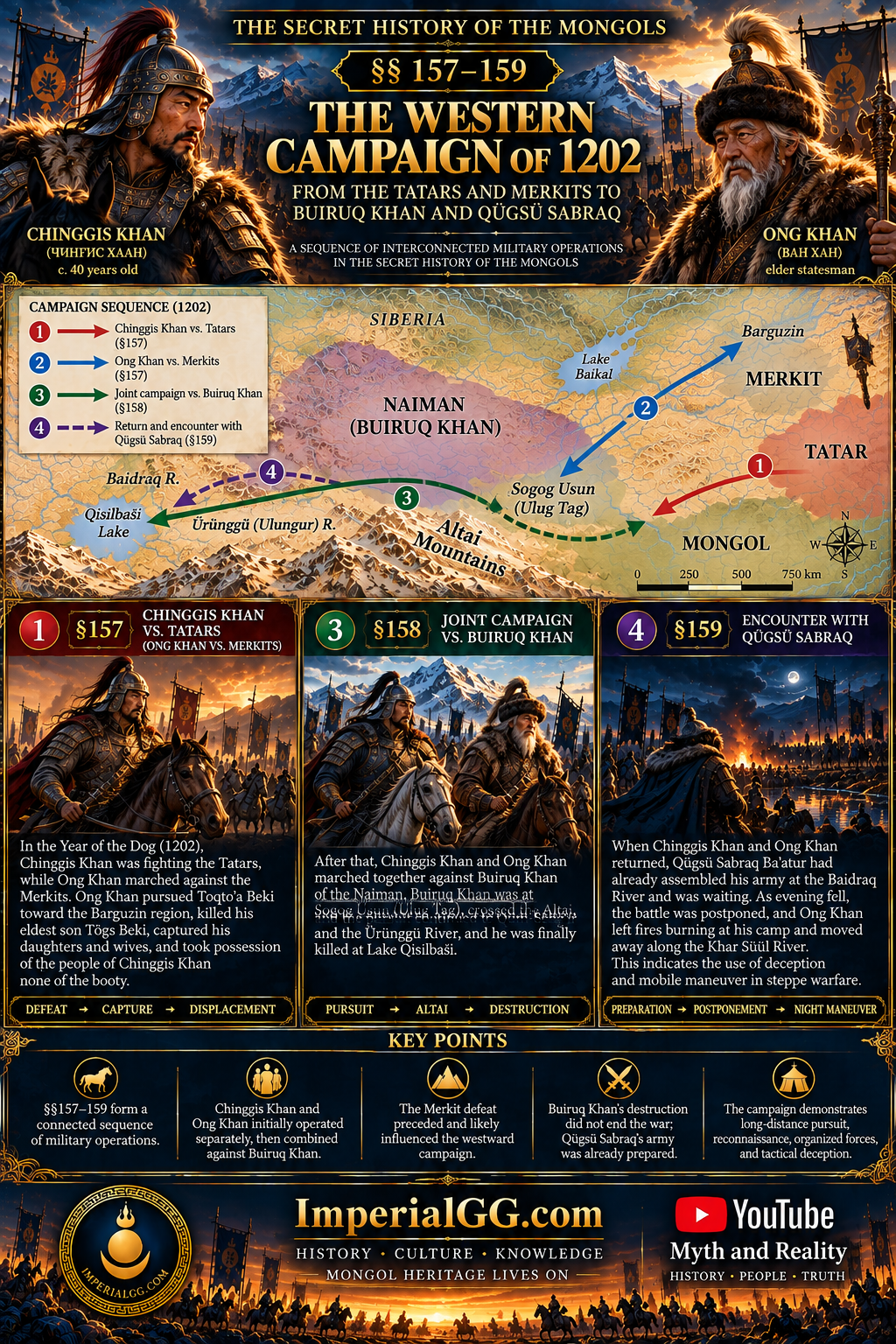
Sections 157–159 of the Secret History of the Mongols should not be read simply as three unrelated military episodes. Taken together, they describe a sequence of operations in which the military defeat of one political force altered the strategic environment and was followed by confrontation with another. Section 157 records that, in the Year of the Dog, 1202, while Chinggis Khan was campaigning against the Tatars, Ong Khan moved against the Merkit and pursued Toqto’a Beki toward the Barguzin region. Ong Khan killed Toqto’a’s eldest son, Tögs Beki, captured his daughters and wives, and took possession of the people belonging to his sons Qutu and Čulu’un.[1] Section 158 then states, “After that,” Chinggis Khan and Ong Khan marched together against Buiruq Khan of the Naiman Qüčügüd, pursuing him from Sogoɣ Usun across the Altai and along the Ürünggü River until he was killed at Lake Qisïlbaši.[2] Section 159 demonstrates that the campaign did not end with Buiruq Khan’s defeat: when Chinggis Khan and Ong Khan returned, the Naiman commander Qügsü Sabraq Ba’atur was already positioned at the confluence of the Baidraq River with an army prepared to meet them.[3]
The sequence is significant because it reveals a military environment in which operations were not confined to a single battlefield or a single enemy. Chinggis Khan and Ong Khan initially operated in different directions, against the Tatars and Merkits respectively; subsequently, their forces were combined against a Naiman ruler; and after Buiruq Khan’s destruction, another Naiman force was already prepared for confrontation. The Secret History therefore permits the events of 1202 to be examined as a connected military process extending westward across a broad political and geographical space.
The sources do not explicitly state that Chinggis Khan and Ong Khan formulated one comprehensive plan covering all of these operations. Such a conclusion would go beyond the evidence. Nevertheless, the sequence of movements, the geographical continuity of the campaign, the transition from the Merkit operation to the Naiman campaign, and the immediate Naiman military response provide substantial grounds for examining these events as a coordinated strategic process rather than as isolated encounters.
1. Section 157: Simultaneous Operations against the Tatars and Merkits
Section 157 begins by establishing the chronology: “In the Year of the Dog (1202),” while Chinggis Khan was fighting the Tatars, Ong Khan marched against the Merkits.[4] This temporal formulation is important because it shows that the military activities of the two leaders did not initially constitute one unified army operating in a single direction. Chinggis Khan was engaged against the Tatars while Ong Khan conducted a separate operation against the Merkits.
Ong Khan pursued Toqto’a Beki toward the Barguzin region, killed his eldest son Tögs Beki, captured Qutuɣtai and Čaɣun, and took possession of the people belonging to Qutu and Čulu’un.[5] The operation therefore extended beyond the defeat of a military contingent. It affected the ruling household, its dependents, and the population under the authority of Toqto’a’s sons. The operation may consequently be understood as a political as well as military attack directed against the structure of Merkit power.
The final statement of §157 is also significant: Ong Khan gave Chinggis Khan none of the booty obtained from the campaign.[6] The remark is brief, but its inclusion indicates that the distribution of captured people and property was politically meaningful within the relationship between the two rulers. Their cooperation against common enemies did not eliminate questions concerning authority, entitlement, and the distribution of the benefits of war.
The geographical direction of Ong Khan’s campaign is equally important. The pursuit of Toqto’a Beki toward Barguzin pushed the Merkit leadership far from its previous position. Immediately thereafter, §158 moves to a joint campaign by Chinggis Khan and Ong Khan against Buiruq Khan of the Naiman. The Secret History thus places the Merkit operation directly before a major westward movement against another political power.
2. The Merkit Defeat and the Western Strategic Space
The earlier history of the Merkits provides an obvious context for their hostility toward Chinggis Khan, particularly their seizure of Börte. Nevertheless, §157 itself does not identify the seizure of Börte as the immediate cause of Ong Khan’s campaign. It is therefore preferable to distinguish between the broader political history of the Merkit–Chinggis Khan conflict and the specific cause of Ong Khan’s operation in 1202.
What is clear from the source is that the Merkit leadership was subjected to a major military defeat and driven toward the west. The next operation described by the Secret History also moves westward, ultimately reaching the Altai and the region of the Ürünggü River. The geographical succession raises an important historical question: was the destruction of Merkit power merely an isolated military objective, or did it contribute to the conditions under which the subsequent Naiman campaign became possible?
The source does not provide a direct answer. It does, however, establish a sequence in which the Merkit leadership was driven toward the western political frontier and the next major military operation was directed against the Naiman ruler Buiruq Khan.
It is therefore possible to formulate a hypothesis that the remnants of the defeated Merkits may have entered the political sphere of the Naimans and sought protection or support there. Such a development would have been entirely plausible within the political environment of the steppe, where defeated groups could seek protection from another power in order to preserve their political existence. Yet the Secret History does not explicitly state that the Merkits approached Buiruq Khan or that Buiruq Khan provided them with assistance. This possibility must therefore remain a hypothesis rather than a historical fact.
3. Section 158: Buiruq Khan and the Pursuit across the Altai
Section 158 begins with the transitional phrase “After that,” and records that Chinggis Khan and Ong Khan marched together against Buiruq Khan of the Naiman Qüčügüd.[7] Buiruq Khan was encountered at Sogoɣ Usun in the vicinity of Ulug Tag. When the two allied forces approached, Buiruq Khan was unable to maintain the engagement and moved across the Altai.[8]
The character of the military operation changes significantly at this point. The Merkit campaign had involved the destruction of a political household and the seizure of its dependent population. The campaign against Buiruq Khan instead became an extended pursuit. Buiruq Khan withdrew across the Altai, while Chinggis Khan and Ong Khan continued the pursuit across the same mountain system and toward the Ürünggü River.
Atwood’s translation preserves the geographical sequence particularly clearly: the forces encounter Buiruq Khan at Sogoɣ River near Ulug Tag; Buiruq Khan crosses the Altai; and the pursuit continues toward Qum-Seng’ir and the Ulungur River.[9] The geographical references indicate that the operation covered a considerable distance and was not confined to a single battlefield.
The account also contains evidence of organized reconnaissance and forward security. Buiruq Khan’s commander Edi-Tobluɣ was performing guard duty when he was pursued by Chinggis Khan’s troops. Attempting to escape toward the mountains, his saddle girth broke and he was captured.[10] This seemingly minor episode is significant because it reveals the existence of a structured system of forward observation and military security during the campaign.
The pursuit eventually reached its conclusion at Lake Qisïlbaši, where Buiruq Khan was overtaken and killed.[11] The sequence therefore consisted of several distinct military stages: locating the enemy, forcing him to withdraw, maintaining pursuit across difficult terrain, capturing elements of his command structure, and finally preventing his escape.
4. Section 159: The War Did Not End with Buiruq Khan
Section 159 is particularly important for understanding the scale of the conflict. The destruction of Buiruq Khan did not terminate the Naiman military resistance. When Chinggis Khan and Ong Khan returned, they encountered Qügsü Sabraq Ba’atur, who had already organized his army at the confluence of the Baidraq River and was waiting to engage them.[12]
This detail changes the interpretation of §158. The campaign against Buiruq Khan was not simply a single expedition directed against one isolated ruler. After Buiruq Khan had been killed, another Naiman commander had already assembled a substantial force and positioned it in anticipation of the returning army.
The sequence suggests a continuing military confrontation involving more than one Naiman political and military center. The elimination of Buiruq Khan did not remove the broader military capacity of the Naiman polity. Instead, a second commander was prepared to continue the confrontation.
The two sides organized their forces for battle, but because evening had arrived, they postponed the engagement until the following day.[13] This detail provides evidence of deliberate military organization and timing. The armies were not merely reacting spontaneously to one another; they were capable of forming battle lines, assessing circumstances, and postponing engagement when conditions were unfavorable.
The subsequent movement of Ong Khan is particularly noteworthy. During the night, he left fires burning at his camp and moved away along the Khar Süül River.[14] The episode is significant because it demonstrates the use of deception and concealment within mobile warfare. The fires maintained the appearance that the army remained in its previous position while the actual force moved during the night.
The Secret History does not explicitly state Ong Khan’s intention. It is therefore preferable not to describe the maneuver as a deliberate tactical deception with absolute certainty. Nevertheless, the practical effect was to conceal the army’s movement and create uncertainty concerning its actual location. The episode provides a valuable example of the tactical flexibility associated with steppe warfare.
5. From a Single Encounter to a Multi-Stage War
Read together, §§157–159 reveal a pattern substantially more complex than a sequence of isolated battles.
First, Chinggis Khan and Ong Khan were operating simultaneously but in different directions: Chinggis Khan against the Tatars and Ong Khan against the Merkits. Second, following the Merkit operation, the two rulers combined their forces and moved against Buiruq Khan. Third, Buiruq Khan’s withdrawal transformed the engagement into a long-distance pursuit across the Altai and toward the Ürünggü region. Fourth, after Buiruq Khan was killed, another Naiman commander was already prepared for battle.
The military process can therefore be reconstructed as:
Tatar campaign by Chinggis Khan
→ Merkit campaign by Ong Khan
→ western movement and joint operation
→ campaign against Buiruq Khan
→ pursuit across the Altai
→ destruction of Buiruq Khan
→ encounter with Qügsü Sabraq’s Naiman army
→ night maneuver by Ong Khan
This sequence should not be transformed into a claim that all three campaigns were predetermined components of one master plan. The evidence does not establish that. Rather, it demonstrates that the outcome of one operation continually altered the strategic environment in which the next operation took place.
The distinction is important. The military history represented in the Secret History is not a simple series of independent battles. It is a dynamic process in which political groups were displaced, military forces pursued one another across large distances, new opponents entered the conflict, and the destruction of one commander did not necessarily eliminate the military capacity of his political community.
6. The Question of a Merkit–Naiman Connection
The possibility of a Merkit–Naiman connection deserves consideration precisely because the Secret History does not explicitly explain the transition between the two conflicts.
Ong Khan’s campaign severely weakened the Merkit leadership and drove Toqto’a Beki toward the Barguzin region. Shortly thereafter, Chinggis Khan and Ong Khan moved westward against Buiruq Khan. If surviving Merkit groups entered Naiman territory and sought protection or assistance, their presence could have contributed to the widening of the conflict. A defeated political group attempting to find protection among another powerful polity would have been a rational response to military pressure.
Yet the available passage does not establish that this actually occurred. The hypothesis therefore requires corroboration from other sources before it can be treated as an historical conclusion.
The more secure observation is that the geographical and chronological sequence places the defeated Merkit leadership and the subsequent Naiman confrontation within the same broad western strategic environment. This is sufficient to justify further investigation without converting a plausible reconstruction into an unsupported fact.
7. Geography and the Logic of Mobile Warfare
The geographical references in §§157–159 are central to understanding the military process. Section 157 places the Merkit pursuit toward Barguzin. Section 158 then gives a sequence involving Ulug Tag, Sogoɣ Usun, the Altai, Qum-Seng’ir, the Ürünggü or Ulungur region, and Lake Qisïlbaši.[15] These references indicate a campaign extending across a broad western landscape rather than a localized confrontation.
The precise identification of every medieval place-name with a modern administrative territory requires caution. In particular, identifying Ulug Tag directly with the modern province of Bayan-Ölgii would require additional topographical and comparative evidence. The text itself, however, clearly states that Buiruq Khan crossed the Altai and that Chinggis Khan and Ong Khan followed him across the same mountain system.[16]
The military significance of this geography should not be underestimated. The army was required to maintain pursuit across mountain terrain, preserve communication and reconnaissance, and prevent the enemy commander from escaping. The presence of forward guards, the capture of Edi-Tobluɣ, and the eventual interception of Buiruq Khan demonstrate that mobility was accompanied by organization.
The evidence therefore challenges any simplistic distinction between “nomadic mobility” and military organization. In these sections, mobility itself was an organized military capability. The effectiveness of the campaign depended upon reconnaissance, pursuit, timing, geographical knowledge, and the ability to maintain pressure over considerable distances.
Conclusion
Sections 157–159 of the Secret History of the Mongols provide a coherent account of a rapidly expanding military conflict in 1202. While Chinggis Khan was fighting the Tatars, Ong Khan attacked the Merkits and drove Toqto’a Beki toward the Barguzin region. The subsequent section records the joint movement of Chinggis Khan and Ong Khan against the Naiman Buiruq Khan, whose withdrawal across the Altai developed into an extended pursuit ending at Lake Qisïlbaši. Section 159 demonstrates that Buiruq Khan’s destruction did not end the conflict: Qügsü Sabraq Ba’atur was already positioned at the Baidraq River with a Naiman army prepared to engage the returning forces.[17]
The evidence therefore supports interpreting §§157–159 as a sequence of interconnected military operations rather than as isolated encounters. The initial operations against the Tatars and Merkits were conducted separately, but the subsequent campaign against Buiruq Khan was undertaken jointly by Chinggis Khan and Ong Khan. The Naiman response then produced another confrontation, demonstrating that the destruction of one political leader did not necessarily terminate the military capacity of the wider polity.
The broader significance lies in the strategic geography of the campaign. Military pressure moved westward; defeated groups were displaced; political boundaries were consequently altered; and new military confrontations emerged from those movements. The Secret History does not provide sufficient evidence to claim that Chinggis Khan and Ong Khan had formulated a single comprehensive plan to destroy the Tatars, Merkits, and Naimans in sequence. It does, however, provide sufficient evidence to identify a pattern of strategic interaction in which one military operation created the conditions for the next.
The possibility that defeated Merkit groups sought protection within the Naiman sphere remains a hypothesis rather than an established fact. Its value lies in identifying a question that can be tested against other historical traditions. What the Secret History establishes directly is that the defeat of the Merkits was followed by a major westward campaign against Buiruq Khan, that Buiruq Khan’s defeat was followed by another Naiman military confrontation, and that the conflict involved reconnaissance, long-distance pursuit, organized battle formation, and deceptive night movement.
Consequently, §§157–159 should be read not merely as a record of battles, but as evidence for the operational character of early Mongol warfare: mobile, geographically expansive, organizationally sophisticated, and capable of transforming the defeat of one political force into the conditions for confrontation with another.
Footnotes
[1] The Secret History of the Mongols (MNT), §157; C. Damdinsüren, The Secret History of the Mongols, §157.
[2] MNT, §158; C. Damdinsüren, The Secret History of the Mongols, §158.
[3] MNT, §159; C. Damdinsüren, The Secret History of the Mongols, §159.
[4] Damdinsüren, §157.
[5] MNT, §157; Damdinsüren, §157.
[6] Damdinsüren, §157.
[7] MNT, §158; Christopher P. Atwood, The Secret History of the Mongols: A Mongolian Epic Chronicle of the Thirteenth Century, §158.
[8] MNT, §158; Damdinsüren, §158.
[9] Atwood, §158.
[10] MNT, §158; Damdinsüren, §158.
[11] MNT, §158; Atwood, §158.
[12] MNT, §159; Damdinsüren, §159.
[13] Damdinsüren, §159.
[14] MNT, §159; Atwood, §159.
[15] Atwood, §§157–159.
[16] Damdinsüren, §158; Atwood, §158.
[17] MNT, §§157–159; Damdinsüren, §§157–159.