
FROM MILITARY VICTORY TO ADMINISTRATIVE ORDER
By Altanbagana Baatar
DBA Candidate| Independent Historian
ImperialGG Historical Research Seriers
01 October 2026
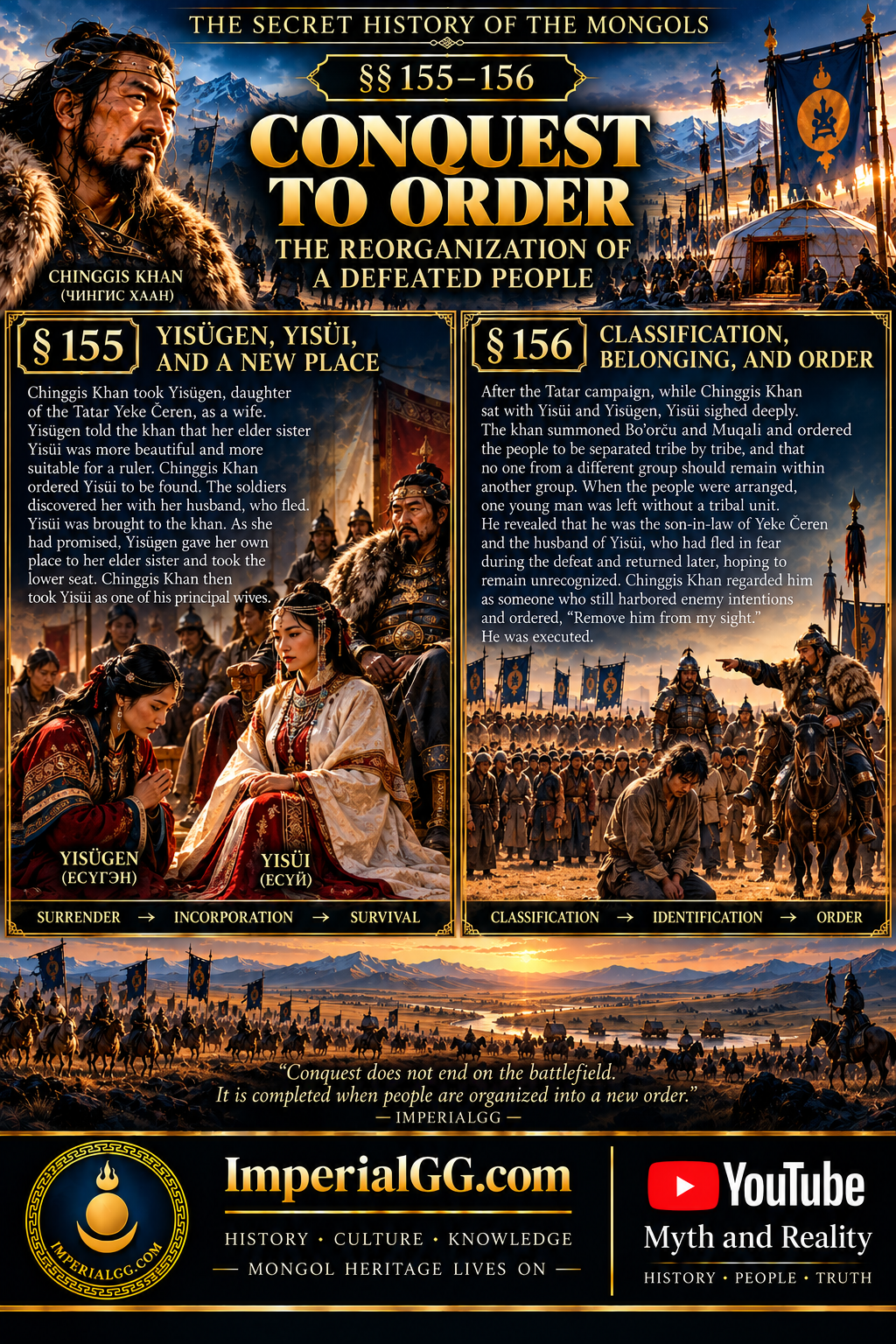
Reading Sections 155–156 of The Secret History of the Mongols
AUTHOR’S THESIS
Sections 155–156 of The Secret History of the Mongols should be read not merely as a story about Chinggis Khan’s marriage to the Tatar sisters Yisügen and Yisüi, but as a continuation of the political reorganization that followed the conquest of the Tatar people in §§153–154. The sequence is striking: the khan conquers a people → the population is separated and classified → individuals are placed within their tribal units → a person without a recognizable tribal affiliation is identified → the new political order is enforced.
This sequence reveals an important feature of steppe state formation: military conquest did not end with victory on the battlefield. It had to be followed by the reorganization of people, identities, and political belonging. In §§155–156, the The Secret History of the Mongols presents tribal affiliation not simply as a social identity but as an essential mechanism through which a newly conquered population could be incorporated into the emerging Mongol political order. The fate of the unidentified son-in-law of Yeke Čeren demonstrates the danger of existing outside that structure, while Yisügen’s decision to yield her position to her elder sister Yisüi also opens a more intimate dimension of the same political transformation.
I. THE CONTINUATION OF THE TATAR CONQUEST
Sections 155–156 immediately follow the violent conclusion of the Tatar campaign described in §§153–154. This placement is important. The narrative does not simply move from war to marriage as though the two subjects were unrelated. Rather, the personal story of the Tatar sisters is embedded within the aftermath of the destruction and redistribution of the Tatar political community.
In §155, Chinggis Khan takes Yisügen Qatun, daughter of the Tatar Yeke Čeren, as a wife. Yisügen then tells the khan that her elder sister Yisüi is superior to her in beauty and suitable for a ruler. Chinggis Khan orders that Yisüi be sought, and the soldiers eventually find her together with the son-in-law to whom she had been given. Her husband flees, while Yisüi is brought back. When Yisügen sees her elder sister, she keeps the promise she had made: she gives Yisüi her own place and takes the lower position herself. Chinggis Khan subsequently takes Yisüi as one of his principal wives. Peachv
The episode is therefore simultaneously personal, dynastic, and political. The two sisters have emerged from a defeated Tatar elite family, and one of them becomes incorporated into the household of the conquering ruler. Their incorporation is part of the larger process by which the remnants of the defeated political community are absorbed into the new order.
II. YISÜGEN AND YISÜI: FAMILY, SURVIVAL, AND POLITICAL INCORPORATION
Yisügen’s decision to yield her position to Yisüi deserves particular attention. The text explicitly gives her reason: she says that her elder sister is better than she is and is fit for a qan. It does not, however, explicitly state that Yisügen was deliberately trying to save her sister from death. Nevertheless, the surrounding circumstances make another interpretation possible.
Yisüi was the daughter of the defeated Tatar Yeke Čeren and had been married into the Tatar community. When Chinggis Khan’s forces found her, her husband fled and Yisüi was brought into the conqueror’s camp. In such a situation, Yisügen’s offer to surrender her own position may have provided her sister with a route into the protection of the khan’s household. This should be treated as an interpretive possibility rather than an established motive, because the Secret History itself does not explicitly say that Yisügen acted in order to save Yisüi.
Yet the narrative gives the episode a remarkable outcome: one member of a defeated family survives and rises within the household of the conqueror, while the political community from which she came is being dismantled. The personal relationship of the sisters thus unfolds against the transformation of their entire political world.
III. “TRIBE BY TRIBE”: THE ORGANIZATION OF THE CONQUERED
The deeper political meaning becomes visible in §156.
After the Tatar campaign has been completed, Chinggis Khan is drinking with Yisüi and Yisügen when Yisüi sighs deeply. Chinggis Khan notices this and summons Bo’orču, Muqali, and other commanders. He then orders the assembled people to be arranged unit by unit / tribe by tribe, separating those who belong to a different tribal group from the group with which they are standing. studylib.net
This is one of the most revealing administrative moments in this portion of the Secret History. The conqueror is not merely counting people. He is classifying them according to political and social belonging. That distinction matters.
A modern reader may imagine a defeated population as a mass of anonymous individuals. The narrative presents something very different. People remain embedded in recognizable collective units, and those units provide the basic framework through which individuals can be identified and reorganized.
Thus, the conquest of the Tatars does not simply produce prisoners or survivors. It produces a population that must be sorted into a new political structure.
This is why the sequence from §§153–156 is particularly important:
Military conquest → destruction of enemy political power → redistribution of population → tribal classification → incorporation into the new order.
The sequence suggests that the Mongol political system operated through the reorganization of existing social units rather than through the simple erasure of them.
IV. THE MAN WHO HAD NO TRIBE
The most revealing detail comes immediately after the people are separated.
When the population is arranged according to its respective tribal units, one handsome young man remains standing apart from all the groups. He has no place within the newly organized structure. studylib.net
This apparently minor detail carries considerable historical significance.The man identifies himself as the son-in-law of Yeke Čeren and the husband of Yisüi. He explains that he fled because he was afraid when the enemy was plundering the Tatars, and that he returned only after believing that peace had been restored. He apparently expected to disappear among the larger population and avoid recognition.
But the new administrative procedure exposes him immediately. He is not hidden. He is the one person who does not belong anywhere. This is precisely why the episode is so valuable for understanding the organization of nomadic society. The Secret History does not present tribal affiliation as a decorative label. It functions as a practical system of identification. When everyone is placed within a recognizable unit, the person without such a unit becomes conspicuous. The narrative therefore gives us an extraordinary inversion:
the entire population is difficult to distinguish individually, but the person without a recognized collective affiliation becomes immediately visible.
V. FEAR AS THE CAUSE OF HIS DEATH
The young man’s own explanation is significant: he fled because he was afraid.
From his perspective, this may have been a rational act of survival. The Tatars were being defeated, his political community was collapsing, and he escaped from the danger. When he later believed that the fighting had ended, he returned, apparently thinking that he could remain unnoticed among the population.
But Chinggis Khan interprets the same behavior differently. According to the narrative, the khan regards him as someone who still thinks like an enemy and has lived outside the established order. The young man is consequently executed. Atwood’s translation similarly emphasizes the contrast between the man’s claim that he fled in fear and Chinggis Khan’s judgment that he continued to behave like an enemy. studylib.net
This produces one of the most important contrasts in the passage:
fear caused him to flee when submission might have offered another possibility; concealment then placed him outside the newly established order; and his lack of recognized affiliation ultimately exposed him.
We should be cautious about saying that he certainly would have survived had he immediately surrendered. The source does not establish that counterfactual. What the text does establish is that his flight and subsequent concealment were interpreted as evidence of continuing hostility, and that interpretation determined his fate.
VI. TRIBAL BELONGING AS A POLITICAL TECHNOLOGY
The episode allows us to see tribal organization from another angle. The Mongol imperial system is often described in terms of military units—tümen, mingγan, and similar structures—but §§155–156 remind us that political organization also depended upon the recognition of collective belonging.
A person was not simply an isolated individual. He belonged to a particular social and political community. This helps explain why the order to stand “tribe by tribe” is so significant. It is an act of administrative knowledge. The state must know who belongs to whom before it can effectively reorganize the conquered population. In this sense, classification itself becomes a form of political power.
The conquest of the Tatars therefore has three interconnected stages:
- Destruction of independent political resistance;
- Reorganization of the surviving population;
- Identification and incorporation of individuals according to collective affiliation.
The man who remains outside the groups demonstrates what happens when this system encounters someone whose political identity has become uncertain.
VII. FROM THE BATTLEFIELD TO THE STATE
This is where §§155–156 connect directly with §§153–154.
In §153, Chinggis Khan establishes military discipline: warriors are forbidden to stop for booty while an enemy remains to be defeated, and they must return to the point from which they launched their attack if forced to retreat. Those who violate the ordinance are punished.
In §154, after the Tatar defeat, the conquered population is subjected to further political reorganization.
Then §§155–156 continue the process at the level of individuals and families. The narrative therefore moves from military discipline to population management.
The same political logic operates throughout: Order must exist on the battlefield, and order must continue after the battlefield.
Victory without organization would leave the conquered population capable of regrouping. Military victory therefore becomes meaningful only when followed by a mechanism for distributing, identifying, and incorporating people. This is the larger significance of the sequence.
VIII. THE NOMADIC POLITICAL ORDER
The episode also challenges the simplistic idea that nomadic societies were politically unstructured or loosely organized.
The opposite is visible here. People can be rapidly assembled, separated, identified, redistributed, and incorporated. Commanders know how to organize them. Tribal affiliation remains legible even after the destruction of a political community. A person who falls outside those categories can be identified precisely because the categories themselves are functioning.
The story therefore provides an important window into the organizational capacity of steppe society. Nomadic political organization did not necessarily depend upon permanent cities or fixed territorial administration in the sedentary sense. It could operate through people, kinship, tribal affiliation, military units, and personal allegiance. In §§155–156, the body of the conquered population itself becomes the object of political organization.
IX. FROM TATAR POLITICAL COMMUNITY TO MONGOL IMPERIAL ORDER
The Tatar people had entered these sections as an enemy political community. By §156, that community has ceased to function as an independent political structure. Its former members are no longer simply “Tatars” acting under their own collective authority. They are being placed into new units and subjected to the authority of Chinggis Khan.
The two sisters represent one dimension of this transformation: members of a defeated elite family are incorporated into the khan’s household. The unidentified son-in-law represents another: a person who has failed to establish a secure place within the new order is treated as a potential enemy.
Thus the passage presents two different forms of incorporation:
incorporation through relationship and household, represented by Yisügen and Yisüi; and incorporation through collective affiliation, represented by the organization of the population tribe by tribe. The person who belongs to neither becomes politically vulnerable.
X. THE DEEPER MEANING OF §§155–156
The most important point, therefore, is not simply that Chinggis Khan married two Tatar women or that one Tatar man was executed. The deeper story is about the transformation of a conquered population.
The narrative shows a movement: Conquest → Classification → Affiliation → Identification → Incorporation
That movement is fundamental to understanding how military expansion could become political order. Sections 155–156 therefore belong naturally with §§153–154. The earlier sections show how Chinggis Khan imposed discipline upon his own warriors and destroyed the political resistance of the Tatars. The following sections show what happened after victory: people were reorganized, their affiliations were identified, members of the defeated elite entered the conqueror’s household, and those who remained outside the new order could be treated as threats.
The significance of the passage lies precisely in this transition.
The Mongol conquest was not completed when the enemy army was defeated. It was completed when the conquered people had been reorganized into the new political system.
CONCLUSION
Sections 155–156 reveal a crucial dimension of early Mongol state formation: conquest generated an administrative problem, and the solution was the organization of people according to recognizable forms of collective belonging.
Yisügen’s elevation of Yisüi shows how members of a defeated ruling family could enter the household of the conqueror, while the division of the population “tribe by tribe” demonstrates that collective affiliation remained the fundamental mechanism for identifying and organizing people. The solitary young man who remains outside every group is therefore more than a tragic individual. His isolation exposes the underlying structure of the society around him.
His fate also reveals the political importance of fear. He fled when the Tatars were being defeated, returned only after believing the danger had passed, and attempted to disappear within the larger population. Yet the very system that organized the population made him visible. He had no recognized place within the newly established order, and his earlier flight was interpreted as evidence that he remained potentially hostile.
Taken together with §§153–154, these sections present a remarkably coherent progression:
MILITARY VICTORY → POPULATION REORGANIZATION → TRIBAL CLASSIFICATION → INDIVIDUAL IDENTIFICATION → POLITICAL INCORPORATION
This is why §§155–156 are important beyond the personal story of Yisüi and Yisügen. They offer a glimpse of the transformation by which a military conquest was converted into an organized political order.
Rachewiltz’s translation and the Atwood version both preserve the crucial “tribe by tribe” organization and the separation of the man who belonged to a different group, confirming that this administrative dimension is central to the passage rather than an artifact of one modern Mongolian translation. Peachv
ImperialGG AUTHOR’S THESIS: In §§155–156, the Secret History presents conquest as a process that extends beyond the battlefield: once the Tatars were defeated, the population had to be classified, redistributed, and incorporated according to recognizable tribal affiliations. The man who remained outside every group reveals, by his very isolation, how essential collective belonging was to the political organization of steppe society. Thus, the passage marks the transition from military victory to administrative order—the transformation of conquered people into subjects of a new political system.