
§146 — SORQAN ŠIRA AND QADA’AN: TRUST, MEMORY, AND THE TIMING OF LOYALTY
By Altanbagana Baatar
DBA Candidate| Independent Historian
ImperialGG Historical Research Seriers
26 September 2026
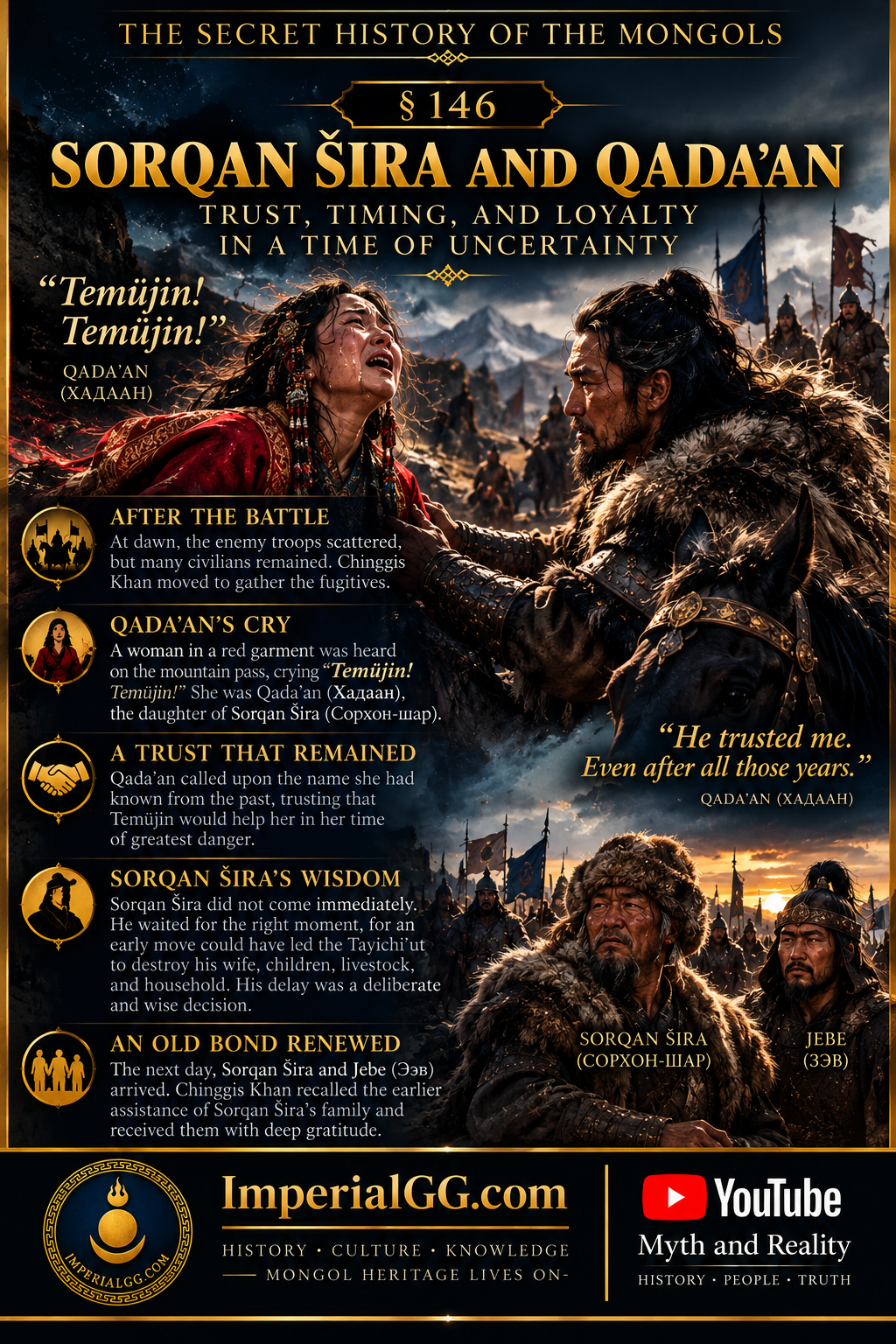
THE SECRET HISTORY OF THE MONGOLS
INTRODUCTION
Section 146 of The Secret History of the Mongols follows immediately after the night in which Jelme (Зэлмэ) preserves the life of the wounded Chinggis Khan (Чингис хаан). With daylight, the political and human consequences of the preceding battle begin to unfold. The enemy troops who had remained near Chinggis Khan during the night have dispersed, while groups of civilians and camp followers who could not escape rapidly remain behind. Chinggis Khan begins to gather the fugitives, and during this movement he hears a woman in a red garment crying loudly from a mountain pass and repeatedly calling the name Temüjin (Тэмүжин). The woman identifies herself as Qada’an (Хадаан), the daughter of Sorqan Šira (Сорхон-шар), and explains that soldiers have seized her husband and are killing him; she has therefore called upon Temüjin to save him. Chinggis Khan immediately rides toward her, dismounts, and embraces her, although her husband has already been killed by the soldiers. He then invites Qada’an to sit beside him. The following day Sorqan Šira and Jebe (Зэв) arrive, bringing the episode back to the earlier history of Temüjin’s relationship with Sorqan Šira’s family. Scribd
The significance of §146 lies not only in the reunion itself but in the way the Secret History constructs trust across time. Sorqan Šira does not immediately abandon his existing position and rush to Temüjin after the political balance begins to shift. Instead, he waits until he can move without placing his wife, children, herds, and household at immediate risk. His explanation the following morning is explicit: he trusted that Temüjin would remain reliable, but if he had come too quickly, his Tayichi’ut superiors might have destroyed the family and property he left behind. His delay is therefore not presented as hesitation or disloyalty. It is represented as a deliberate calculation in which confidence in Temüjin is combined with responsibility toward his own household. www.assa.mn
THE MORNING AFTER THE BATTLE
The opening of §146 establishes a sharp transition from battlefield combat to the redistribution of people. The enemy soldiers who had spent the night close to Chinggis Khan’s forces have scattered, while those living in a circular wagon-fortification remain because they cannot easily escape. Chinggis Khan therefore moves out to retrieve the fugitives. During this process he hears the voice of a woman in a red garment standing on a pass and calling repeatedly, “Temüjin! Temüjin!” The Secret History emphasizes that Chinggis Khan himself hears her voice. This is important because the encounter is not arranged through an intermediary: the cry of the woman reaches the Khan directly and causes him to stop and investigate. Monumenta Altaica
The woman is Qada’an, daughter of Sorqan Šira. She explains that her husband has been seized by the soldiers and is being killed, and that she is calling Temüjin because she wants him to save her husband. The distinction between the names Temüjin and Chinggis Khan is particularly significant. By this point the young Temüjin has become Chinggis Khan, yet Qada’an does not call upon the formal title of the ruler. In her moment of crisis, she calls the person she knew as Temüjin.
The primary source does not explicitly explain why she chose this childhood name. Nevertheless, the narrative context allows a cautious interpretation: Qada’an had known Temüjin before his rise to khanhood, and §85 records that she had been instructed to care for him when he was hiding in her family’s camp. In that earlier episode, Sorqan Šira’s sons Cila’un and Cimbai protected Temüjin, while their younger sister Qada’an was specifically entrusted with caring for him and keeping his presence secret. FlipHTML5
Thus, when Qada’an later finds herself in mortal danger, the person she calls upon is not an abstract ruler whom she has only recently encountered as a political sovereign. She calls Temüjin, the individual whose earlier vulnerability she had personally witnessed and whom her family had helped to protect. The name therefore carries the memory of a relationship that predates his political transformation.
QADA’AN AND THE MEMORY OF TEMÜJIN
Qada’an’s cry is particularly striking because it occurs under circumstances in which ordinary channels of protection have broken down. Her husband is being killed, the battlefield has transformed the political order around her, and she has no effective means of intervening herself. Yet she does not remain silent. She calls repeatedly for Temüjin, trusting that the person she knew before his rise will hear and respond.
The text confirms that he does respond. Chinggis Khan rides toward her, dismounts, and embraces her. By the time he arrives, however, her husband has already been killed. The episode therefore contains both trust and tragedy: Qada’an’s appeal reaches Temüjin, but it reaches him too late to save the man for whom she had called. The Secret History does not turn this into a simple story of successful rescue. Instead, it preserves the painful interval between a cry for help and the arrival of the person called upon. Монголын нууц товчоо
Nevertheless, Chinggis Khan’s response is immediate and personal. He invites Qada’an to sit beside him. This gesture is significant within the narrative because it places the daughter of the man who once protected the fugitive Temüjin physically beside the ruler he has now become. The relationship has therefore moved through several stages: Temüjin the fugitive → Sorqan Šira’s household protects him → Qada’an becomes part of that act of protection → Temüjin becomes Chinggis Khan → Qada’an calls upon him in crisis → Chinggis Khan receives her personally.
The narrative thus creates a reciprocal structure of remembered trust. The earlier protection of Temüjin is not forgotten, and the later appeal of Qada’an is not ignored.
THE RED GARMENT
The description of Qada’an as a woman wearing a red garment is one of the few details of clothing supplied in this episode. The primary text does not identify the material. Christopher Atwood renders it as a “red coat,” while Cleaves similarly translates the phrase as a red garment. Consequently, it would be methodologically incorrect to state as a fact that Qada’an’s garment was silk. Internet History Sourcebooks
There is nevertheless a historically plausible basis for considering the possibility. Archaeological evidence from Mongol-period Mongolia includes women’s robes made of silk, including a red silk garment from the Nartiin Khad burial in eastern Mongolia. Ildikó Oka’s study of Mongol clothing in the Yuan period identifies women’s coats made from nasij and other luxury textiles, while more recent scholarship on Mongol court dress has emphasized the importance of red silk robes in elite women’s costume. The evidence, however, comes primarily from the thirteenth–fourteenth-century Mongol imperial and elite contexts and does not allow us to identify the precise material of Qada’an’s garment in §146. Academy’s Library Repository
For this reason, the most defensible interpretation is that the Secret History deliberately gives the reader a visually distinctive image: a woman in red standing on a pass, crying “Temüjin!” The red garment makes her immediately visible within the landscape and the unfolding movement of people after the battle. Whether the garment was silk cannot be established from the passage itself, but the possibility is historically compatible with the known use of luxury silk garments among Mongol women of higher status.
The distinction is important for an academic treatment. We can discuss the possibility of silk as a contextual hypothesis, but we should not transform it into a primary-source fact.
SORQAN ŠIRA’S STRATEGIC PATIENCE
The following morning provides the second major component of the section. Sorqan Šira and Jebe arrive, both having previously belonged to the household or following of Tödöge of the Tayichi’ut. Chinggis Khan addresses Sorqan Šira through a short poetic statement recalling the earlier service that had freed him from the wooden restraint and cangue imposed upon him by the Tayichi’ut. He then asks why Sorqan Šira had delayed so long in coming to him.
Sorqan Šira’s answer is one of the most revealing political statements in the passage. He explains that he had deeply trusted Temüjin, but that there was no reason to hurry. Had he come earlier, his Tayichi’ut commanders might have destroyed the wife, children, livestock, and provisions he had left behind. Only after the circumstances had changed sufficiently did he come and join his Khan.
This is a crucial distinction. Sorqan Šira’s delay should not be interpreted simply as indecision. His own explanation presents it as a calculated postponement designed to protect his family and property while preserving the possibility of eventually joining Temüjin. The decision required him to judge not only who was likely to prevail, but also when it was safe to move.
In this sense, Sorqan Šira demonstrates a different form of intelligence from Jelme in §145. Jelme’s intelligence operates within minutes and hours on a battlefield: he improvises under immediate physical danger. Sorqan Šira’s judgment operates over a longer political horizon: he waits, observes, protects his household, and moves when the risk of retaliation has sufficiently declined.
The two episodes therefore form a useful pair. Jelme acts immediately because the danger is immediate; Sorqan Šira waits because premature action would endanger his family. Both decisions are presented as forms of loyalty guided by judgment rather than by impulsive action.
TRUST BEFORE POLITICAL CERTAINTY
Sorqan Šira’s statement that he had trusted Temüjin deeply is particularly important because it appears at a moment when Temüjin’s political position is expanding but has not yet become the uncontested authority that it would later become. Sorqan Šira therefore cannot be understood as merely attaching himself to an already established imperial ruler. His decision is made within a period of political uncertainty.
His earlier relationship with Temüjin gives this trust historical depth. In §§82–87, Sorqan Šira had encountered the fugitive Temüjin while the Tayichi’ut were searching for him. Rather than reveal him, he allowed him to remain hidden, and later helped him escape by providing a horse, food, and supplies. His sons Cila’un and Cimbai also helped protect Temüjin, while Qada’an was assigned to care for him and keep his presence secret.
Section 146 therefore does not introduce a new relationship. It returns to an old relationship at a new political moment. The fugitive youth whom Sorqan Šira once protected has become Chinggis Khan; the young Qada’an who once helped conceal him now calls upon him for protection; and Sorqan Šira, after protecting his own household, finally arrives to join him.
The continuity is one of the most important structural features of the passage.
FROM PRIVATE MEMORY TO POLITICAL RELATIONSHIP
The final exchange between Chinggis Khan and Sorqan Šira transforms personal memory into political recognition. Chinggis Khan recalls the earlier assistance and describes Sorqan Šira as a father-like benefactor. The language is not merely transactional. The relationship is represented through remembered service and kin-like gratitude rather than through formal institutional terminology. www.assa.mn
This is consistent with a wider pattern in The Secret History of the Mongols, in which Temüjin’s rise is repeatedly narrated through relationships that originate before formal political institutions are fully established. Individuals who assist him during periods of vulnerability later become part of the political community surrounding Chinggis Khan. Their earlier actions acquire new significance once Temüjin’s position has changed.
Section 146 is therefore important for understanding the relationship between memory and political legitimacy. The past is not merely remembered as biography; it becomes a basis for present relationships. Sorqan Šira’s earlier protection of Temüjin becomes the foundation for his later place within Chinggis Khan’s political order. Qada’an’s childhood connection to Temüjin becomes the basis for her confidence that he will respond when she calls his name.
AUTHOR’S THESIS
Section 146 demonstrates that loyalty in the early Mongol political world could operate through memory, trust, and carefully judged timing as much as through immediate military action. Sorqan Šira does not rush toward Temüjin merely because the political balance has begun to change. Instead, he waits until he can move without exposing his wife, children, livestock, and provisions to retaliation by the Tayichi’ut. His delay is therefore best understood as strategic patience grounded in a prior trust that Temüjin would remain reliable. At the same time, Qada’an’s desperate cry of “Temüjin!” reveals another dimension of this remembered relationship. In the moment of greatest danger, she does not invoke the formal authority of “Chinggis Khan” but calls upon the personal name of the man whom her family had known and protected in his youth. The episode thereby connects political transformation with personal memory: the fugitive Temüjin becomes Chinggis Khan, but the relationships formed before his rise remain part of the foundation of his emerging political world.
CONCLUSION
Section 146 is therefore a passage about trust under changing political circumstances. The battlefield has ended, but the political consequences of the battle are still unfolding. Soldiers scatter, civilians remain behind, a woman cries from a pass, and old relationships suddenly reappear within the new order.
Qada’an’s red garment provides the visual center of the episode, but her repeated cry of “Temüjin!” provides its emotional and historical center. She calls upon the name of the person she knew before he became Khan, and he responds immediately. The text does not tell us that the garment was silk, and the possibility should therefore remain explicitly hypothetical; nevertheless, archaeological evidence confirms that red silk women’s garments existed within the Mongol world, including examples from Mongolia itself. Academy’s Library Repository
Sorqan Šira’s later explanation provides the intellectual center of the passage. He had trusted Temüjin, but he understood that loyalty could not be expressed recklessly. He waited until his family and possessions could be protected, then came to join the Khan. His decision reveals that loyalty and prudence were not necessarily opposites. In the world depicted by the Secret History, knowing when to act could be as important as knowing whom to follow.
The section consequently brings together two generations of remembered loyalty: a father who once protected the fugitive Temüjin, and a daughter who, in her hour of desperation, still trusted that Temüjin would hear her call. What began as a private act of protection within a Tayichi’ut household becomes, years later, part of the political memory surrounding Chinggis Khan.
FOOTNOTES
The Secret History of the Mongols, §146. For the sequence of the battle’s aftermath, Qada’an’s appearance, her appeal to Temüjin, and Sorqan Šira’s subsequent arrival, see the primary text and the translations of Cleaves and de Rachewiltz. Monumenta Altaica
Christopher P. Atwood, trans., The Secret History of the Mongols (Penguin Classics, 2023), §146. Atwood renders Qada’an’s garment as a “red coat” and preserves her repeated cry of “Temujin.” studylib.net
C. P. Atwood, The Secret History of the Mongols, §§82–87. Qada’an is introduced earlier as Sorqan Šira’s daughter, and §85 states that she was assigned to care for the hidden Temüjin and keep his presence secret. FlipHTML5
The Secret History of the Mongols, §146. Sorqan Šira explains that he did not hurry because an early departure might have exposed his wife, children, livestock, and provisions to retaliation from the Tayichi’ut commanders. www.assa.mn
Ildikó Oka, “Mongol Clothing in the Yuan Period,” Acta Orientalia Academiae Scientiarum Hungaricae 68, no. 4 (2015). The study discusses surviving Mongol-period women’s garments, including a red nasij coat from the Nartiin Khad burial in Mongolia. Academy’s Library Repository
Eiren L. Shea, “Robing at Khubilai’s Court: Mongol Court Dress, Identity Formation, and Global Exchange.” Shea discusses the role of dress in expressing the political and social status of Mongol women and notes the prominence of red silk robes in Yuan and Ilkhanid court imagery. Taylor & Francis
The distinction between “red garment” as primary-source evidence and “red silk garment” as historical possibility is important. §146 itself does not specify the textile. The archaeological and art-historical evidence establishes that red silk garments existed in Mongol elite contexts, but it does not identify Qada’an’s particular garment. Monumenta Altaica
Igor de Rachewiltz, The Secret History of the Mongols: A Mongolian Epic Chronicle of the Thirteenth Century, 2 vols. (Leiden: Brill, 2004–2006), with later supplementary volume. De Rachewiltz’s edition is a major philological reference for the Secret History and its textual interpretation. ANU Mongolia Institute
SELECTED BIBLIOGRAPHY
- Atwood, Christopher P., trans. The Secret History of the Mongols. Penguin Classics, 2023. studylib.net
- Cleaves, Francis Woodman, trans. The Secret History of the Mongols. Harvard-Yenching Institute.
- de Rachewiltz, Igor. The Secret History of the Mongols: A Mongolian Epic Chronicle of the Thirteenth Century. Leiden: Brill, 2004–2006. ANU Mongolia Institute
- Oka, Ildikó. “Mongol Clothing in the Yuan Period.” Acta Orientalia Academiae Scientiarum Hungaricae 68, no. 4 (2015). Academy’s Library Repository
- Shea, Eiren L. “Robing at Khubilai’s Court: Mongol Court Dress, Identity Formation, and Global Exchange.”