
THE SECRET HISTORY OF THE MONGOLS §§132–135
By Altanbagana Baatar
DBA Candidate| Independent Historian
ImperialGG Historical Research Seriers
19 September 2026
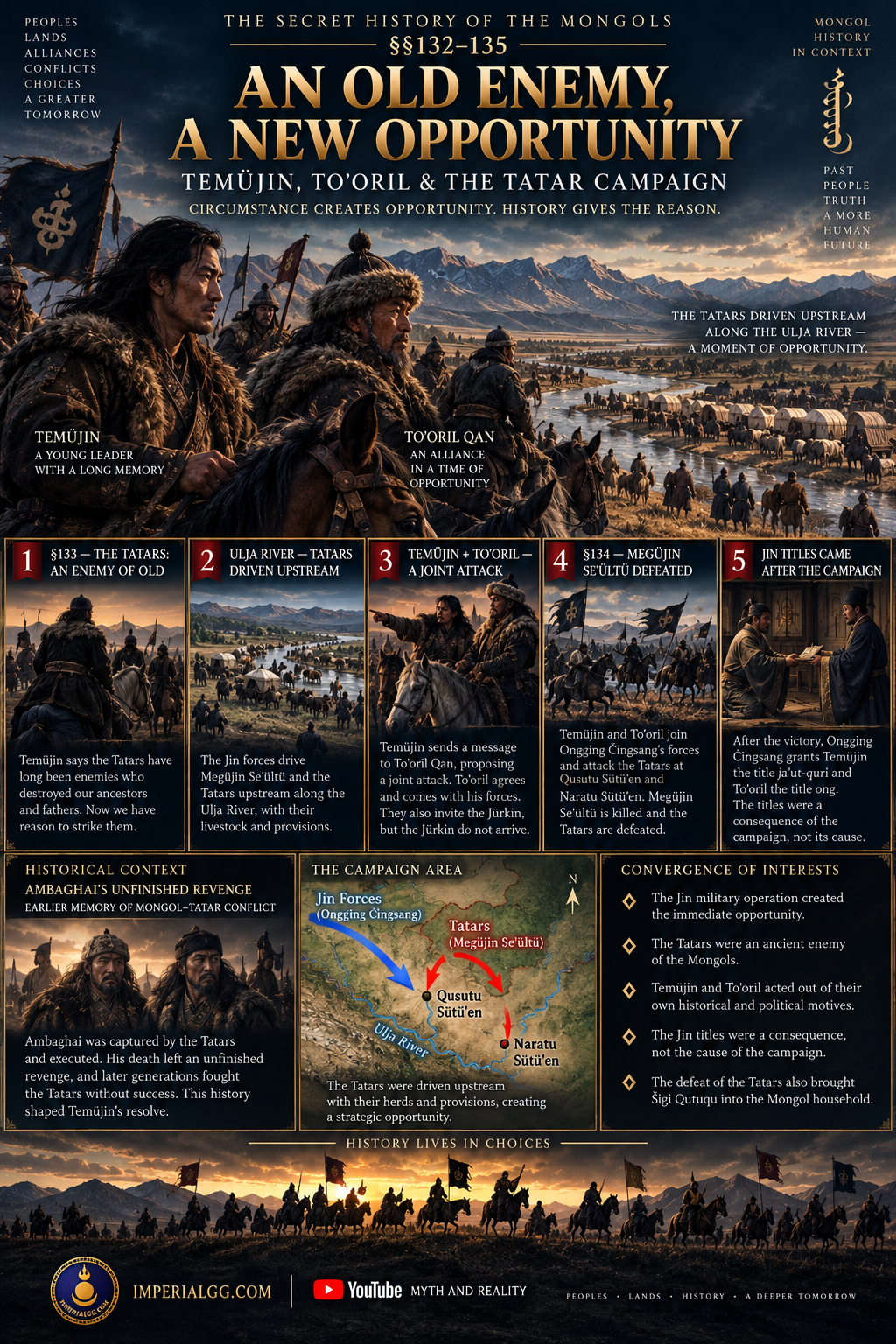
AN OLD ENEMY, A NEW OPPORTUNITY
Temüjin, To’oril, and the Tatar Campaign
The episode recorded in §§132–135 of The Secret History of the Mongols occupies an important position in the development of Temüjin’s political career. It begins in the immediate aftermath of the confrontation with the Jürkin and ends with the incorporation of the young Šigi Qutuqu into Hö’elün’s household. Between these two points, however, the narrative records a significant military decision: Temüjin and To’oril Qan join forces against the Tatars at precisely the moment when a Jin military operation has driven Megüjin Se’ültü and other Tatar groups upstream along the Ulja River, together with their herds and provisions. The Secret History does not present Temüjin’s decision simply as participation in a campaign ordered by the Jin authorities. Rather, the initiative emerges from Temüjin’s own recognition that an external military movement had created an opportunity to confront an old enemy. His stated justification is historical and ancestral: the Tatars, he declares, had long been enemies of his people and had destroyed their ancestors and fathers.
This distinction is fundamental to understanding the episode. The Jin military operation created the immediate circumstances in which the Tatars became vulnerable. Temüjin and To’oril, however, determined to exploit that circumstance for their own purposes. The subsequent titles granted by the Jin commander belong to the aftermath of the campaign rather than to its original motivation. The episode therefore provides an early example of Temüjin responding to a rapidly changing political environment by identifying where the interests of different powers temporarily converged and turning that convergence into an opportunity for his own military and political objectives.
THE JÜRKIN CONFLICT AND THE ARRIVAL OF NEW NEWS
The episode opens while the dispute with the Jürkin is still being settled. After Belgütei had urged Temüjin not to allow his injury to destroy relations with their kinsmen, Temüjin nevertheless attacked the Jürkin. His forces defeated them and captured Qorijin-qatun and Qu’urchin-qatun. The women were subsequently returned when efforts were made to settle the dispute. It was during this exchange of envoys and negotiations for peace that Temüjin received information concerning the movements of the Tatars.
The timing is significant. The Secret History deliberately places the new information inside an already unsettled political environment. Temüjin had just demonstrated his willingness to use force against a neighboring Mongol group, yet the possibility of reconciliation remained open. At this moment the movement of an entirely different military force changed the strategic situation.
The Jin ruler had ordered Ongging Čingsang to mobilize troops against Megüjin Se’ültü and the Tatars after they had failed to reach an agreement with him. Ongging Čingsang was advancing upstream along the Ulja, driving Megüjin Se’ültü and the other Tatars before him with their livestock and provisions.
This detail deserves particular attention. The Tatars were not merely an army retreating from battle. They were moving with the material resources of their communities. Their herds and provisions accompanied them, while the Jin forces pushed them upstream. From Temüjin’s perspective, therefore, an enemy with whom his family and political community had a long history of conflict was being brought into a position where he could be attacked.
The Secret History immediately connects this information to Temüjin’s decision.
THE MEMORY OF AN ANCIENT ENEMY
Temüjin’s statement in §133 is the central piece of evidence for understanding his motive. After learning of the Tatars’ movement, he identifies them as enemies from the distant past and associates them with the destruction of his ancestors and fathers. He then concludes that there is now an opportunity to attack them jointly.
The order of events matters. The Tatars were already being driven by the Jin military forces. Temüjin did not initiate that movement. What he did was recognize its strategic significance and decide to act upon it.
This makes the episode different from a simple account of military service to Jin. The Secret History does not place a Jin command to Temüjin at the center of his decision. Instead, it places Temüjin’s own historical memory of conflict at the center of his explanation. The immediate military circumstance and the historical motive therefore come from two different directions: Jin pressure created the opening, while the inherited Mongol–Tatar conflict gave Temüjin a reason to use it.
The distinction is particularly important because the Tatars had already occupied a central place in the preceding generations of Mongol history as preserved in the Secret History. Their conflict with the Mongols was not presented as a new dispute arising in Temüjin’s lifetime.
AMBAGHAI KHAN AND THE UNFINISHED REVENGE
The most important earlier episode in this historical memory is the fate of Ambaghai Khan. The Secret History records that Ambaghai, who had assumed leadership of the Mongols after Khabul Khan, was captured by the Tatars while escorting his daughter. He was subsequently delivered to the Jin ruler and executed. Before his death, Ambaghai sent a message to Qutula and Qada’an instructing them to avenge him.
The subsequent narrative makes the connection between Ambaghai and the Tatar wars explicit. After Ambaghai’s death, Qutula was raised as qahan, and he went to war with Qada’an against the Tatars. The Secret History records thirteen battles against the Tatar leaders Kötön-baraqa and Jali-buqa but states that they failed to avenge Ambaghai.
Consequently, the Tatar conflict that Temüjin inherited was not simply a matter of personal hostility. It had already become part of a political memory extending across generations. Ambaghai’s capture and execution, Qutula’s succession, and the thirteen unsuccessful campaigns formed a continuous narrative of unfinished vengeance.
At the same time, historical precision requires that we distinguish between what the text states explicitly and what can reasonably be inferred from its wider structure. Temüjin does not name Ambaghai in §133. He speaks of the Tatars as those who had destroyed “our ancestors and fathers.” The identification of Ambaghai as an important referent within that inherited memory is therefore an interpretation based upon the preceding sections of the Secret History, not an explicit statement that Temüjin was specifically announcing “the revenge of Ambaghai.” The connection is nevertheless historically significant because the Secret History itself has already established Ambaghai’s death and the subsequent Tatar campaigns as part of the same inherited conflict.
YESÜGEI BA’ATUR AND THE TATAR CONFLICT
The memory of Yesügei Ba’atur adds another generation to this history. The Secret History records Yesügei’s encounter with the Tatar leaders Temüjin-üge and Qori Buqa and his capture of them. The circumstances of this encounter gave his son the name Temüjin. Later, after Yesügei had taken food with Tatars, he was poisoned and subsequently died.
Yesügei’s death therefore belongs to the same wider history of conflict with the Tatars, although it should not be represented as identical to Ambaghai’s fate. Ambaghai was captured and delivered to the Jin authorities; Yesügei was poisoned after an encounter with Tatars. The two episodes were different, but both became part of the historical inheritance surrounding Temüjin.
This distinction is important when interpreting the phrase “ancestors and fathers” in §133. The wording is collective rather than personal. Temüjin does not present the campaign merely as an act of private vengeance for one individual. He frames the Tatars as an inherited enemy whose conflict with the Mongols had extended across generations.
The political significance of the statement lies precisely in this collective memory. Temüjin was not merely reacting to an enemy army that happened to appear before him. He was placing the immediate military opportunity inside a much older history of conflict.
TEMÜJIN’S DECISION
Having learned that the Tatars were being driven upstream along the Ulja, Temüjin sent a messenger to To’oril Qan. He explained the movement of Megüjin Se’ültü and the other Tatars and proposed a joint attack. The appeal was framed through their shared historical memory of the Tatars and through the political relationship between Temüjin and To’oril. Temüjin addressed To’oril as “father,” while To’oril responded that his son was right and agreed to attack jointly. On the third day, To’oril assembled his forces and came in person.
The exchange reveals that the decision to attack was not imposed upon Temüjin by the Jin command. Temüjin identified the opportunity and sought the participation of To’oril.
This distinction also clarifies the character of Temüjin’s relationship with Jin at this point. The existence of a common enemy did not transform the Jin state into Temüjin’s political patron in any simple sense. Jin had its own reasons for acting against the Tatars. Temüjin had his own reasons for acting against them. The two interests happened to converge in the same military situation.
Such temporary convergence was politically useful precisely because it did not require the interests of the two sides to be identical.
THE JÜRKIN ARE INVITED
Temüjin and To’oril also sent word to the Jürkin, whose leaders included Sača Beki and Taichu, inviting them to participate in the campaign against the Tatars. The appeal is significant because it came immediately after the conflict between Temüjin and the Jürkin.
The Jürkin did not arrive promptly. Temüjin and To’oril waited six days, but eventually proceeded without them.
The episode illustrates the fluidity of political relationships on the steppe. A group could be a recent opponent in one political dispute and still be considered a potential participant in a larger military campaign. The Secret History does not explicitly explain Temüjin’s reasoning in inviting the Jürkin, so it would be inappropriate to assign a precise motive to him. The narrative nevertheless shows that the conflict with the Jürkin did not prevent him from attempting to mobilize them when a larger campaign against the Tatars presented itself.
The fact that the Jürkin failed to appear did not prevent Temüjin and To’oril from acting.
THE CAMPAIGN AGAINST MEGÜJIN SE’ÜLTÜ
Temüjin and To’oril advanced along the Ulja and joined the forces of Ongging Čingsang. Together they attacked the Tatars at Qusutu Šitü’en and Naratu Šitü’en on the Ulja. The campaign culminated in the defeat of the Tatar forces and the death of Megüjin Se’ültü.
The military episode should therefore be understood within the sequence established by the Secret History:
Jin military pressure drove the Tatars upstream; Temüjin learned of their movement; he interpreted them as an old enemy; he proposed a joint attack to To’oril; To’oril mobilized; and the two forces then joined Ongging Čingsang in attacking the Tatars.
The initiative and the circumstances should not be confused. The Jin military operation produced the immediate strategic opening, but Temüjin and To’oril independently chose to exploit it.
This is why the campaign can be understood neither simply as an autonomous war unrelated to Jin nor simply as a service performed on Jin’s behalf. It was a convergence of interests in which each side pursued its own objectives.
THE TITLES OF TEMÜJIN AND TO’ORIL
Only after the military success does the narrative turn to the titles granted by Ongging Čingsang.
Temüjin received the title ja’ut-quri, while To’oril received the title ong. The narrative subsequently explains the emergence of the name Ong Qan for To’oril.
These titles are historically important, but their position within the narrative must be kept clear. They appear after the decision to attack, after the joint mobilization, and after the defeat of Megüjin Se’ültü.
The titles therefore belong to the political consequences of the campaign rather than to the initial reason for entering it.
This distinction also prevents the episode from being reduced to a narrative in which Temüjin and To’oril fought simply to obtain recognition from Jin. The Secret History provides a different sequence. Temüjin already had a reason to fight the Tatars before any title was granted. To’oril accepted his proposal before any title was conferred. The military action preceded the Jin recognition.
The precise institutional meaning of the titles remains a separate historical question. Later scholarship has examined the relationship between ja’ut-quri and Jin terminology and cautioned against treating the title as a straightforward equivalent of a single Chinese office. Such questions are important for understanding Jin–Mongol relations, but they should not be confused with the immediate motivation for the campaign itself.
ŠIGI QUTUQU: THE HUMAN CONSEQUENCE OF THE CAMPAIGN
The campaign does not end with the death of Megüjin Se’ültü. Among the possessions taken from the Tatars, Temüjin’s forces encounter a young boy dressed in valuable clothing. The child is brought to Hö’elün, who takes him into her household. This child is Šigi Qutuqu, who later becomes an important figure in the Mongol imperial administration.
The Secret History thus transforms a military episode into a story of incorporation. The defeat of an external enemy produces not only booty and political recognition but also the absorption of a child into the household of Temüjin’s mother.
The later importance of Šigi Qutuqu makes this passage especially interesting. At the same time, the chronology of his childhood in the Secret History has been questioned by modern scholarship. Christopher P. Atwood has specifically noted the chronological problem created by the account of Šigi Qutuqu appearing as an orphaned infant in §§135 and 138 while subsequently occupying a major position in 1206. Atwood therefore treats the Secret History’s presentation of Šigi Qutuqu’s early life with caution.
For an academic treatment, the distinction is essential: the incorporation of Šigi Qutuqu is a fact of the narrative; the historical reliability of every chronological detail surrounding his childhood is a separate question.
CONCLUSION
Sections 132–135 present a military episode whose significance extends beyond the defeat of Megüjin Se’ültü. The immediate circumstance was created by Jin military action. Ongging Čingsang was already driving Megüjin Se’ültü and the Tatars upstream along the Ulja, and the Tatars were moving with their herds and provisions. Temüjin learned of this movement while the conflict with the Jürkin was still being settled. He recognized that an old enemy had suddenly become accessible and proposed to To’oril that they attack together.
His justification was not the promise of a Jin title. It was the history of conflict between the Tatars and his ancestors and fathers. That history reached back through the fate of Ambaghai Khan, whose capture and execution had produced an unfinished demand for vengeance and thirteen unsuccessful campaigns under Qutula and Qada’an. It also included the conflict surrounding Yesügei Ba’atur, whose encounter with the Tatars and subsequent poisoning formed part of Temüjin’s own inherited experience.
Accordingly, the campaign can be interpreted as an instance of strategic opportunism grounded in historical memory. The Jin state had created the immediate military circumstance, but Temüjin did not need Jin to tell him why the Tatars should be attacked. He already possessed a historical reason. What changed was the opportunity.
The subsequent Jin titles were consequences of the campaign. They did not create its original motive. The episode therefore reveals an important feature of Temüjin’s developing political practice: he could recognize when the movements of a larger power created an opening, mobilize his own relationships and military resources, and pursue an objective rooted in his own political memory. In §§132–135, the battlefield opportunity provided by the Jin offensive became, in Temüjin’s hands, an opportunity to confront an enemy whose conflict with his people extended across generations.
FOOTNOTES & PRIMARY SCHOLARLY SOURCES
- Igor de Rachewiltz, The Secret History of the Mongols: A Mongolian Epic Chronicle of the Thirteenth Century, §§132–135. De Rachewiltz’s edition is the principal scholarly English edition used here; the ANU describes it as a translation with extensive historical and philological commentary.
- The Secret History of the Mongols, §132: the Jürkin conflict, capture of Qorijin-qatun and Qu’urchin-qatun, subsequent negotiations, and news of the Jin operation against Megüjin Se’ültü.
- The Secret History of the Mongols, §133: Temüjin’s statement concerning the Tatars as an ancient enemy, his reference to ancestors and fathers, his proposal to To’oril, and To’oril’s mobilization.
- The Secret History of the Mongols, §§53, 57–58: Ambaghai’s capture and execution, his message to Qutula and Qada’an, Qutula’s accession, and the thirteen campaigns against the Tatars in an unsuccessful attempt to avenge Ambaghai.
- The Secret History of the Mongols, §§59–61: Yesügei Ba’atur’s encounters with Tatar leaders and his subsequent poisoning after an encounter involving Tatars.
- Francis Woodman Cleaves, The Secret History of the Mongols, §§132–135. Cleaves’ translation provides an important alternative rendering of the Middle Mongolian text and is particularly useful for comparison of the terminology surrounding the Tatar campaign.
- Urgunge Onon, The Secret History of the Mongols: The Life and Times of Chinggis Khan (Routledge, 2001), for comparative translation and historical presentation.
- Christopher P. Atwood, “The Date of the ‘Secret History of the Mongols’ Reconsidered,” especially the discussion of Šigi Qutuqu and the chronological difficulties surrounding §§135 and 138.