WHEN POWER ATTRACTS PEOPLE
By Altanbagana Baatar
DBA Candidate| Independent Historian
ImperialGG Historical Research Seriers
18 September 2026
TEMÜJIN’S RISING COALITION AND THE POLITICS BEHIND THE AIRAG DISPUTE
AUTHOR’S THESIS
SHM §§130–131|
1. A POLITICAL COMMUNITY IN MOTION
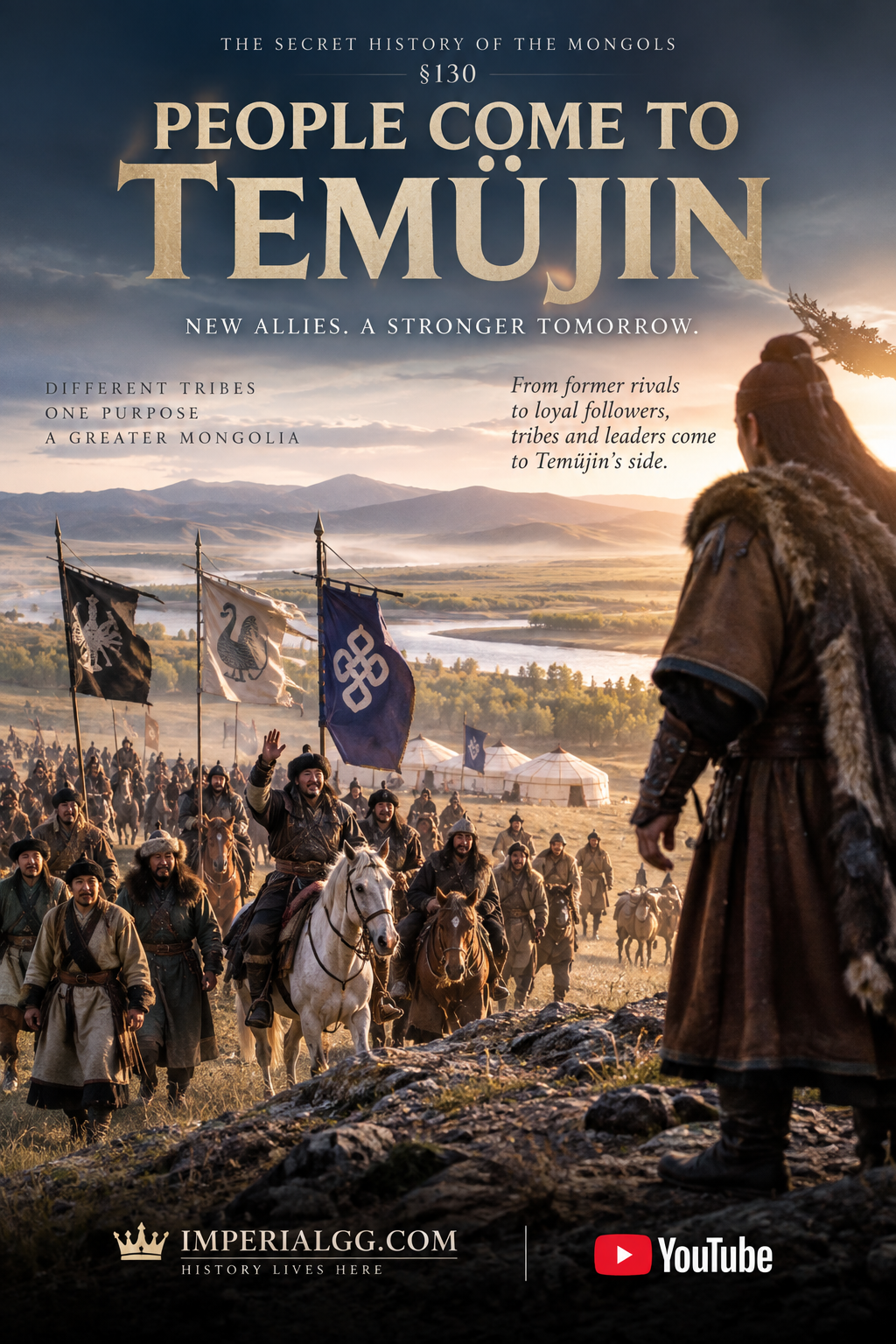
Section 130 opens after the political rupture between Temüjin and Jamuqa. The significance of the passage lies in the people who now cross from one camp to the other. Jürčidai brings the Uru’ut, Quyildar brings the Mangqut, and Mönglik comes with his seven sons. The text does not describe these arrivals merely as individual acts of friendship. Each man appears with a social following, meaning that political allegiance is being transferred at the level of groups and households.³This distinction matters. In the political environment described by the MNT, a leader’s strength was inseparable from the people who followed him. Temüjin’s growing power was therefore not simply a matter of possessing more warriors; it depended upon his ability to attract and retain communities that could become part of his political order. The arrival of Jürčidai, Quyildar, and Mönglik demonstrates that the political balance was beginning to move.Mönglik’s arrival deserves particular attention. Earlier in the MNT, when Yisügei was dying after being poisoned by the Tatars, he summoned Mönglik and entrusted him with the care of his young sons and widowed wife.⁴ Thus, when Mönglik later comes to Temüjin with his seven sons, his appearance carries a significance extending beyond the simple addition of another group of fighting men. He represents a link between the household of Yisügei and the political community that Temüjin was now constructing.At the same time, the MNT does not name Mönglik’s seven sons individually in §130. The later identification of Kököchü Teb-Tenggeri as one of the seven, specifically the middle son, occurs in §244.⁵ It is therefore methodologically preferable not to introduce Kököchü by name into the §130 narrative as though he were identified there.Temüjin’s response to these arrivals is equally important. The narrative emphasizes his joy that people are leaving Jamuqa and coming to him. The political significance is therefore not merely that Temüjin has survived defeat; he is becoming a new center of attraction.⁶2. TEMÜJIN’S EARLIER POLITICAL PRACTICE
The significance of this expanding coalition becomes clearer when §130 is read against §§124–125.After Temüjin had been made Khan, he began assigning people positions within his new political organization. Among those elevated were Bo’orču and Jelme, two men whose importance in the narrative derives not primarily from aristocratic genealogy but from their loyalty and service to Temüjin during periods when his political position was extremely weak. Temüjin recalls that when he had no companion other than his shadow, they had been his shadows, and when he had no nourishment beyond his tail, they had been his tail.⁷This language is important because it expresses the basis upon which Temüjin understood political loyalty. Bo’orču and Jelme were valuable because they had demonstrated loyalty at moments when loyalty carried real risk. Their political importance was therefore connected to service and proven allegiance, rather than merely to inherited status.This should not be described anachronistically as a fully developed meritocratic system. The MNT does not present Temüjin as abolishing aristocratic hierarchy. He remained deeply embedded within the Borjigin and wider aristocratic order. Nevertheless, the narrative reveals an important tendency: personal loyalty, competence, and demonstrated service could become sources of political advancement alongside lineage.That tendency becomes especially significant when placed beside the aristocratic figures who had earlier elevated Temüjin himself.3. THE MEN WHO MADE TEMÜJIN KHAN
Section 123 records Altan, Quchar, and Sača Beki agreeing to make Temüjin their Khan. Their decision was politically consequential. They were not outsiders attacking the aristocratic order; they were themselves participants in the process through which Temüjin acquired Khanhood.⁸This point prevents an overly simple interpretation of the later conflict. It would be historically inaccurate to claim that Altan, Quchar, and Sača Beki were opposed to Temüjin from the beginning. On the contrary, the MNT explicitly records their participation in elevating him.The more interesting question is what happened after Temüjin became Khan.Once his political community began expanding beyond the original circle of aristocratic supporters, the basis of political influence could begin to change. Men such as Bo’orču and Jelme had demonstrated their importance through service. New groups were now abandoning Jamuqa and joining Temüjin. Temüjin’s authority was therefore becoming increasingly dependent upon a broader coalition rather than upon the small group of aristocratic men who had initially recognized him.The MNT does not state that Altan, Quchar, or Sača Beki opposed this transformation. But the subsequent narrative makes it possible to ask whether the interests of the established aristocratic order and Temüjin’s emerging political system had already begun to diverge.That is the interpretive problem at the center of §§130–131.4. THE FEAST AT THE ONON
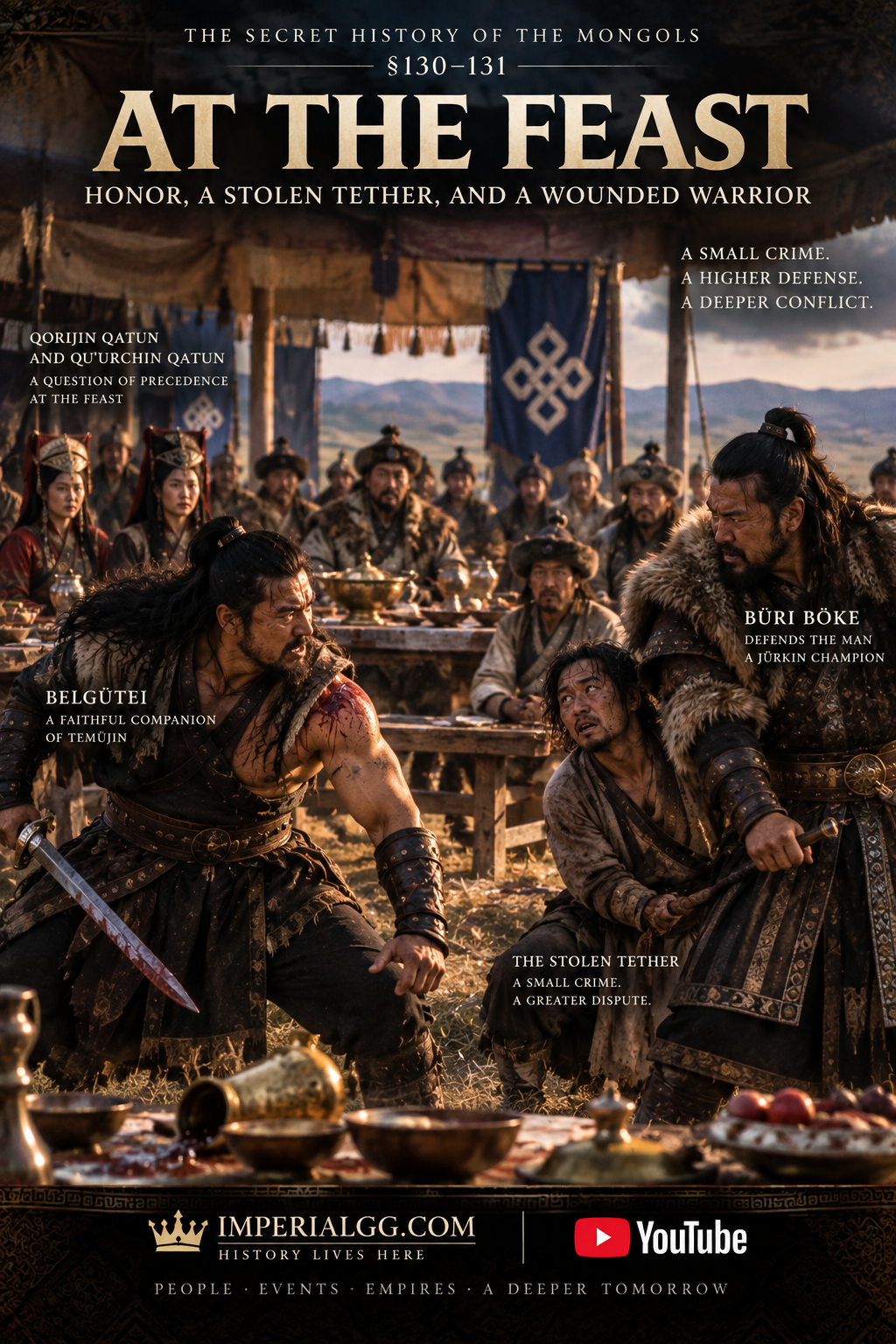
After the arrival of these new followers, the MNT describes a feast in the forest of the Onon. Temüjin, Hö’elün, Qasar, Sača Beki, and others participate. The feast therefore brings together different components of the emerging political community: Temüjin’s household, his followers, and the Jürkin aristocratic branch represented by Sača Beki.⁹5. SHIKI’ÜR’S LAMENT AND THE MEMORY OF THE OLD ORDER
The response of Shiki’ür gives the scene an unexpectedly political dimension. After being beaten, the cook cries out that he is being beaten because Yisügei Ba’atur and Nekün-taishi are no longer alive.¹²The remark is easy to overlook, but it is one of the most revealing details in the episode. Shiki’ür is effectively saying that the people who once stood above him and protected his position are gone. His lament connects the immediate humiliation at the feast with the disappearance of an earlier generation of authority.The statement should not be turned into a theory that the MNT itself does not articulate. Yet it is significant that, at the moment when precedence becomes contested, the cook remembers Yisügei and Nekün-taishi—figures associated with an earlier political order.This creates a striking chronological contrast. Yisügei belonged to the generation before Temüjin’s political rise. Temüjin is now constructing a new political community in which men who proved their loyalty to him can receive important responsibilities. Meanwhile, older aristocratic relationships remain deeply embedded in the social structure.The feast therefore brings two political memories into the same space: the old order of established rank and the emerging order of Temüjin’s personal coalition.6. FROM PRECEDENCE TO VIOLENCE
Section 131 transforms the atmosphere of the feast into physical confrontation.On Temüjin’s side, Belgütei is responsible for the feast and is holding Chinggis Qahan’s horses. On the Jürkin side, Büri Böke is responsible. A man of the Qadagin steals a tether from the place where Temüjin’s horses are tied. Belgütei catches him, but Büri Böke intervenes on behalf of the man.¹³The disagreement becomes personal.The MNT emphasizes Belgütei’s identity as a wrestler. He habitually removed his right sleeve, leaving his arm and shoulder exposed. When the confrontation occurs, Büri Böke slashes Belgütei’s naked shoulder with his sword. The Mongolian text is explicit: **Бэлгүтэй үргэлж барилдах тул баруун ханцуйгаа мулталж, гараа нүцгэн гаргаж явдаг байсан; Бэлгүтэйгийн нүцгэн мөрийг Бүри-бөх илдээр хаг цавчив.**¹⁴The significance of the detail is that the injury is not a vague accidental wound. The exposed shoulder is deliberately struck with a sword.Büri Böke himself was not an ordinary participant. Earlier genealogical material identifies him as the son of Qutuqtu Mönggür, and the MNT later remembers him as an exceptionally powerful wrestler among his people.¹⁵Thus the confrontation is symbolically appropriate to the political structure of the episode: two physically powerful men, each representing a different political camp, become the immediate agents through whom a larger tension becomes physical.7. BELGÜTEI’S RESPONSE
Perhaps the most revealing element of §131 is not the wound itself but Belgütei’s response.Temüjin sees the blood and asks what has happened. Belgütei minimizes the injury. He tells Temüjin not to allow the incident to cause a quarrel with their kinsmen, because the two sides have only recently established peace.¹⁶This is politically significant.Belgütei has every personal reason to demand retaliation. He has been attacked with a sword. Yet he explicitly places the preservation of the relationship above his own injury.His position demonstrates that the MNT does not present every member of Temüjin’s side as eager for confrontation. Belgütei understands the political cost of allowing a personal injury to become a conflict between allied or related groups.Temüjin nevertheless rejects this restraint.8. WHEN THE AIRAG DISPUTE BECOMES A POLITICAL CONFLICT
Section 132 records the consequence. Instead of following Belgütei’s advice, Temüjin and his people take branches from the trees and wooden kumiss paddles from the leather bags and fight the Jürkins. They defeat them and capture Qorijin-qatun and Qu’urchin-qatun. Later, however, they return the women and attempt to settle the dispute through negotiation.¹⁷The sequence is therefore remarkably clear:precedence at the feast → beating of Shiki’ür → dispute over the stolen tether → confrontation between Büri Böke and Belgütei → sword wound → armed conflict between Temüjin’s and the Jürkin sides.It would therefore be too simplistic to say that “the kumiss dispute caused the war.” The MNT gives us a much more complex chain of escalation.The kumiss dispute is better understood as the first visible expression of a tension that had already accumulated within the political community.This interpretation is supported by modern scholarship as well. L. Baasandorj has argued that the conflict between Belgütei and Büri Böke had deeper causes and should be considered in relation to the subsequent conflict between Temüjin and the Jürkin.¹⁸9. THE DEEPER QUESTION: WHO DESERVES POLITICAL PRECEDENCE?
At this point, the earlier history of Temüjin’s political organization becomes essential.Temüjin’s political authority was increasingly supported by men whose importance derived from what they had done rather than simply from who their ancestors were. Bo’orču and Jelme are the clearest early examples. They had stood beside Temüjin when his political position was extremely weak, and he subsequently rewarded their loyalty with positions of responsibility.¹⁹This does not mean that lineage ceased to matter. It clearly did not. Temüjin himself depended upon the Borjigin lineage, and the men who helped make him Khan—Altan, Quchar, and Sača Beki—belonged to the aristocratic political world.The important development was instead the growing coexistence of two principles of political value.One was established lineage, aristocratic precedence, and inherited status.The other was personal loyalty, demonstrated service, and practical ability.As long as Temüjin remained one aristocratic leader among several, these principles could coexist without necessarily producing open conflict. But as more people moved toward Temüjin and his personal coalition expanded, the balance began to change.The evidence therefore permits a stronger historical question:Was the conflict between Temüjin’s emerging political order and the interests of the established aristocratic elite already beginning at this stage?The MNT does not answer this question explicitly. Yet §§130–131 provide material from which such an interpretation can reasonably be developed.10. THE AIRAG AS A PRETEXT, NOT THE WHOLE CAUSE
The kumiss dispute should consequently be understood as a pretext or immediate trigger, rather than as the complete explanation for the conflict.The women’s complaint was precise: *Why was Ebegei served first rather than us?*²⁰ This is a complaint about precedence. The response was not a political declaration against Temüjin. It was a dispute over ceremonial order that escalated rapidly.But the political significance emerges from what follows.A question of precedence becomes an argument.An argument becomes a physical confrontation.
A physical confrontation becomes a sword wound.
The sword wound becomes armed conflict.The escalation suggests that the political relationship was already sufficiently fragile for a seemingly small dispute to become dangerous.This is why the airag itself should not dominate our interpretation. The airag was the occasion; precedence was the immediate issue; the deeper question was the distribution of authority and status within a rapidly changing political community.
11. THE OLD ARISTOCRACY AND TEMÜJIN’S NEW COALITION
The most important interpretive possibility concerns the relationship between Temüjin and the aristocratic figures who had helped elevate him.Altan, Quchar, and Sača Beki had once recognized Temüjin as Khan.²¹ That fact must remain central. It prevents us from constructing an artificial opposition between “Temüjin” and “the aristocracy” from the very beginning.The situation may instead have changed as Temüjin’s political base expanded.His authority was no longer dependent solely upon the aristocratic men who had initially recognized him. People were now leaving Jamuqa and joining him. Bo’orču and Jelme had already become important because of their demonstrated loyalty and service. Jürčidai, Quyildar, and Mönglik were now bringing additional followers into his coalition.In such circumstances, the political meaning of aristocratic precedence could itself begin to change.This is where the events of §§130–131 become especially revealing. The dispute is not over whether Temüjin is Khan. That issue had already been settled politically. The more subtle question is how authority would operate within the Khan’s expanding political community.Would inherited status continue to determine precedence and influence?Or would the political value of personal loyalty, ability, and service increasingly determine who stood closest to the Khan?The MNT does not formulate the question in these terms. But its narrative allows us to see the tension developing.CONCLUSION
MNT §§130–131 should therefore be read as more than an anecdote about a feast that descended into violence. Section 130 records the expansion of Temüjin’s political community: Jürčidai arrives with the Uru’ut, Quyildar with the Mangqut, and Mönglik with his seven sons. Their movement toward Temüjin demonstrates that his political strength was increasingly being created through the movement of people toward his camp.²²Immediately afterward, the MNT places this expanding coalition in the setting of a feast with the Jürkin aristocratic branch. The dispute over the order in which kumiss is served introduces the question of precedence. The beating of Shiki’ür, his invocation of the deceased Yisügei and Nekün-taishi, and the subsequent confrontation between Belgütei and Büri Böke gradually transform a ceremonial disagreement into physical violence.The significance of the episode lies precisely in this escalation.The kumiss was not the whole cause. It was the immediate occasion. The deeper issue was precedence within a political community whose structure was changing.Temüjin had already demonstrated a tendency to reward men such as Bo’orču and Jelme for loyalty and service. He was now attracting entire groups from Jamuqa’s side. Meanwhile, aristocratic figures such as Altan, Quchar, and Sača Beki remained important participants in the political order and had themselves been responsible for making Temüjin Khan. The evidence does not justify claiming that these aristocrats were already consciously opposed to Temüjin’s principles. It does, however, suggest that the tension between Temüjin’s emerging political order and the interests of the established aristocratic elite may already have been developing into an actual conflict.Seen in this light, the dispute at the Onon is an early episode in a larger transformation. Temüjin was no longer merely one aristocratic leader among others. He was becoming the center of an expanding coalition whose political value increasingly depended upon loyalty, service, and demonstrated ability. The old aristocratic order did not disappear, but it was being forced to operate within a political system whose center of gravity was moving toward Temüjin.The blood on Belgütei’s shoulder therefore marks more than the end of a quarrel at a feast. It is an early sign that the question of who deserved authority—and on what basis—was beginning to become a real political conflict.FOOTNOTES
- The Secret History of the Mongols (MNT), §130. See Christopher P. Atwood, trans., The Secret History of the Mongols; the section records Jürčidai, Quyildar, and Mönglik with his seven sons leaving Jamuqa and joining Temüjin.
- MNT §§130–131. The Mongolian text records the kumiss dispute in §130 and the Belgütei–Büri Böke confrontation in §131.
- MNT §130.
- MNT §68, concerning Yisügei’s final instructions to Mönglik.
- MNT §244. The seven sons of Mönglik are discussed there, with Kököchü Teb-Tenggeri identified as the middle son. This information should not be retroactively inserted into §130.
- MNT §130.
- MNT §§124–125, concerning Temüjin’s appointments and his praise of Bo’orču and Jelme.
- MNT §123, where Altan, Quchar, and Sača Beki agree to make Temüjin Khan.
- MNT §130.
- Atwood, Secret History, §130. The passage renders Ebegei as Sača Beki’s “little mother” and records Qorijin-qatun and Qu’urchin-qatun’s complaint.
- MNT §130, Mongolian text.
- MNT §130. Shiki’ür’s lament invokes Yisügei Ba’atur and Nekün-taishi.
- MNT §131.
- Ibid.
- MNT §§50–51 and later §140. The genealogical passage identifies Büri as the son of Qutuqtu Mönggür; §140 describes him as the strongest wrestler among the Jürkin.
- MNT §131. Belgütei explicitly urges Temüjin not to quarrel with their kinsmen because the two sides have only recently reconciled.
- MNT §132. Atwood likewise records the subsequent fight and later attempt at reconciliation.
- L. Baasandorj, “Монгол Нууц Товчоо дахь зарим асуудлыг дахин судалж авч үзэх нь,” Acta Mongolica 15 (2014). The study specifically argues that the Belgütei–Büri Böke conflict had deeper causes.
- MNT §§124–125.
- MNT §130.
- MNT §123.
- MNT §130.
SELECTED BIBLIOGRAPHY
Atwood, Christopher P., trans. The Secret History of the Mongols. Penguin Classics.Baasandorj, L. “Монгол Нууц Товчоо дахь зарим асуудлыг дахин судалж авч үзэх нь.” Acta Mongolica 15 (2014).Cleaves, Francis Woodman, trans. The Secret History of the Mongols. Harvard University Press.Onon, Urgunge, trans. The Secret History of the Mongols: The Life and Times of Chinggis Khan. Curzon.de Rachewiltz, Igor, trans. The Secret History of the Mongols: A Mongolian Epic Chronicle of the Thirteenth Century. Brill.