
JOCHI’S BIRTH AND THE MERKIT CAPTIVITY: RECONSTRUCTING THE CHRONOLOGY
By Altanbagana Baatar
DBA Candidate| Independent Historian
ImperialGG Historical Research Seriers
13 September 2026
AUTHOR’S THESIS
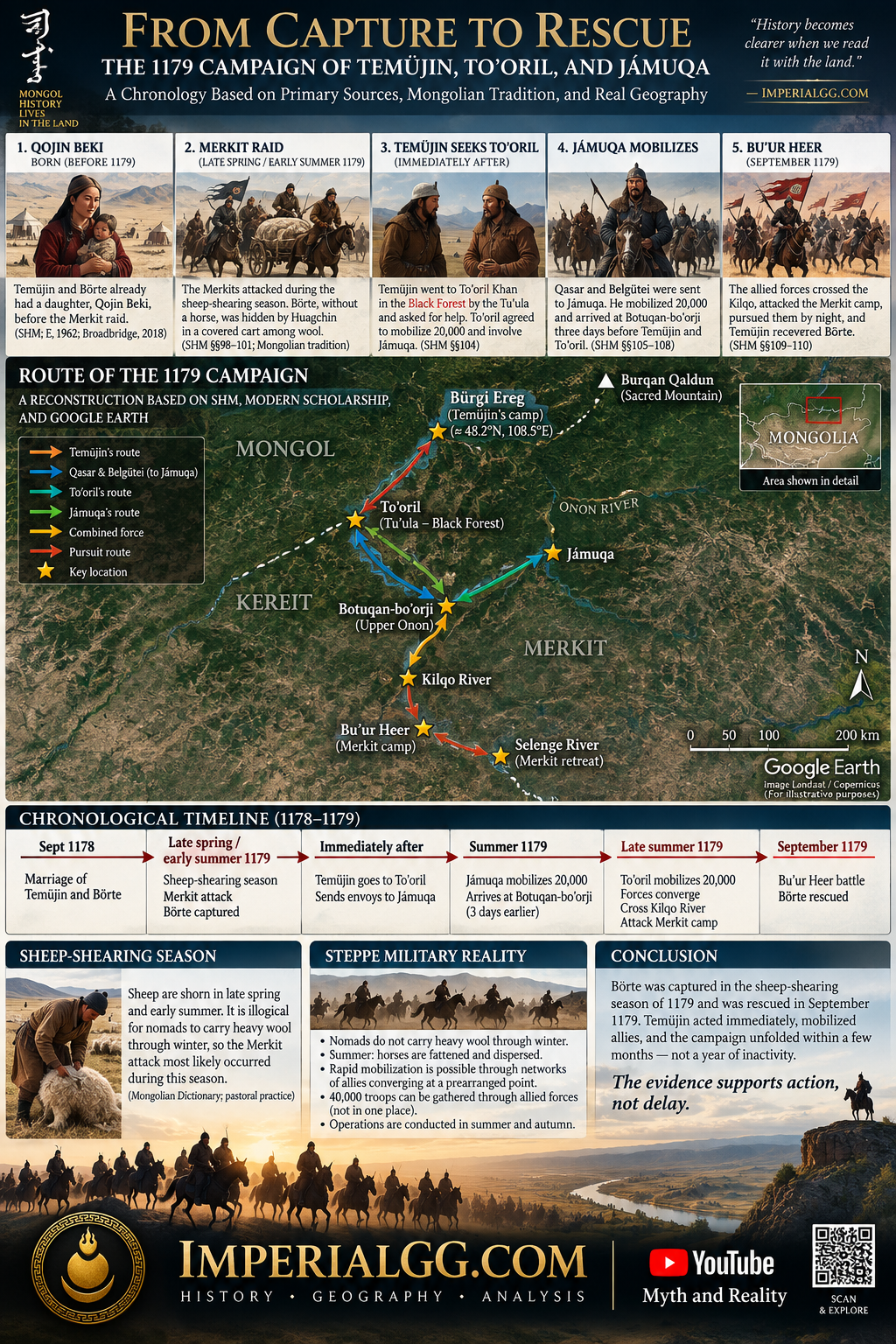
The historical sources do not portray Temüjin as remaining inactive after Börte was seized. Quite the opposite. The sequence recorded in the Secret History of the Mongols is remarkably direct. After the Merkit attack, Temüjin descended from Burqan Qaldun and went with Qasar and Belgütei to To’oril Khan, who was then in the Black Forest by the Tu’ula River. There he asked for assistance in recovering his wife and kid.¹
To’oril responded immediately. Recalling the sable coat Temüjin had previously given him, he declared his willingness to restore what had been lost and proposed a major military expedition. He would mobilize two tümen, while J̌amuqa was to be brought into the operation with another two tümen.²
Temüjin then acted without delay. He returned to his camp and sent Qasar and Belgütei as messengers to J̌amuqa, conveying To’oril’s proposal and asking him to join the campaign.³
J̌amuqa responded. The rendezvous was established. And the subsequent narrative demonstrates that the mobilization was rapid enough for J̌amuqa to reach Botuqan-bo’orji at the headwaters of the Onon three days before Temüjin and To’oril arrived.⁴ This is not merely an inference from military theory. It is the operational sequence preserved by the primary source itself.
A MOBILE COALITION, NOT A STATIC ARMY
The significance of this sequence is easily missed if the campaign is imagined according to the logistical assumptions of a sedentary state. The forty thousand men mentioned in the campaign were not necessarily gathered at one location and then set in motion as a single centralized army.
Rather, the Secret History shows different forces moving through different channels toward a predetermined rendezvous:
Temüjin → To’oril
Temüjin → Qasar and Belgütei → J̌amuqa
To’oril → 20,000 men
J̌amuqa → 20,000 men
J̌amuqa → Botuqan-bo’orji
Temüjin + To’oril → Botuqan-bo’orji
This is precisely why J̌amuqa’s arrival three days before the others is so important.⁵
The evidence therefore supports a much more dynamic model of steppe mobilization: forces did not have to wait for one another in a single place before the campaign could begin. They could converge on a prearranged point. That makes a prolonged mobilization period unnecessary for explaining this particular campaign.
THE CHRONOLOGY BECOMES CLEARER
When this military sequence is combined with the seasonal chronology, the picture becomes even more compelling. The Mongolian historical chronology places the Merkit attack in the following year’s sheep-shearing season, after Temüjin and Börte’s marriage in September 1178, and dates the Bu’ur Heer battle and recovery of Börte to September 1179.⁶
Thus:
LATE SPRING / EARLY SUMMER 1179
Sheep-shearing season → Merkit attack → Börte captured
↓
IMMEDIATE RESPONSE
Temüjin → To’oril
↓
RAPID MOBILIZATION
To’oril → J̌amuqa → predetermined rendezvous
↓
BOTUQAN-BO’ORJI
J̌amuqa already waiting three days
↓
KILQO
River crossed by rafts
↓
BU’UR HEER
Surprise attack on the Merkit camp
↓
NIGHT PURSUIT
“Börte! Börte!”
↓
SEPTEMBER 1179
Börte recovered
This is why the assumption of a nearly year-long interval deserves reconsideration. The sources instead present an urgent rescue operation unfolding within a much shorter chronological window. And that matters directly to the question of J̌oči. If Börte was seized in the late-spring/early-summer sheep-shearing season and recovered in September, the captivity interval is approximately three to four months.
The question then changes from: Was J̌oči conceived during Merkit captivity?
to the more fundamental historical question: Was Börte already pregnant when the Merkits seized her?
That question can then be tested against the second body of evidence: the phrase eme kö’ü, the circumstances of Börte’s captivity, and the traditional account that J̌oči was born after her recovery.
Footnote:
- Secret History of the Mongols, §§103–110 — үйл явдлын дараалал.
- Монголын түүхийн тайлбар толь, “Буур хээрийн байлдаан” — sheep-shearing season + September 1179.
- de Rachewiltz — eme kö’ü болон chronology-ийн philological тайлбар.
- Pecchia Riba + Gerelbadrakh — Google Earth / geography reconstruction.
TEMÜJIN’S RESPONSE: NO YEAR-LONG DELAY
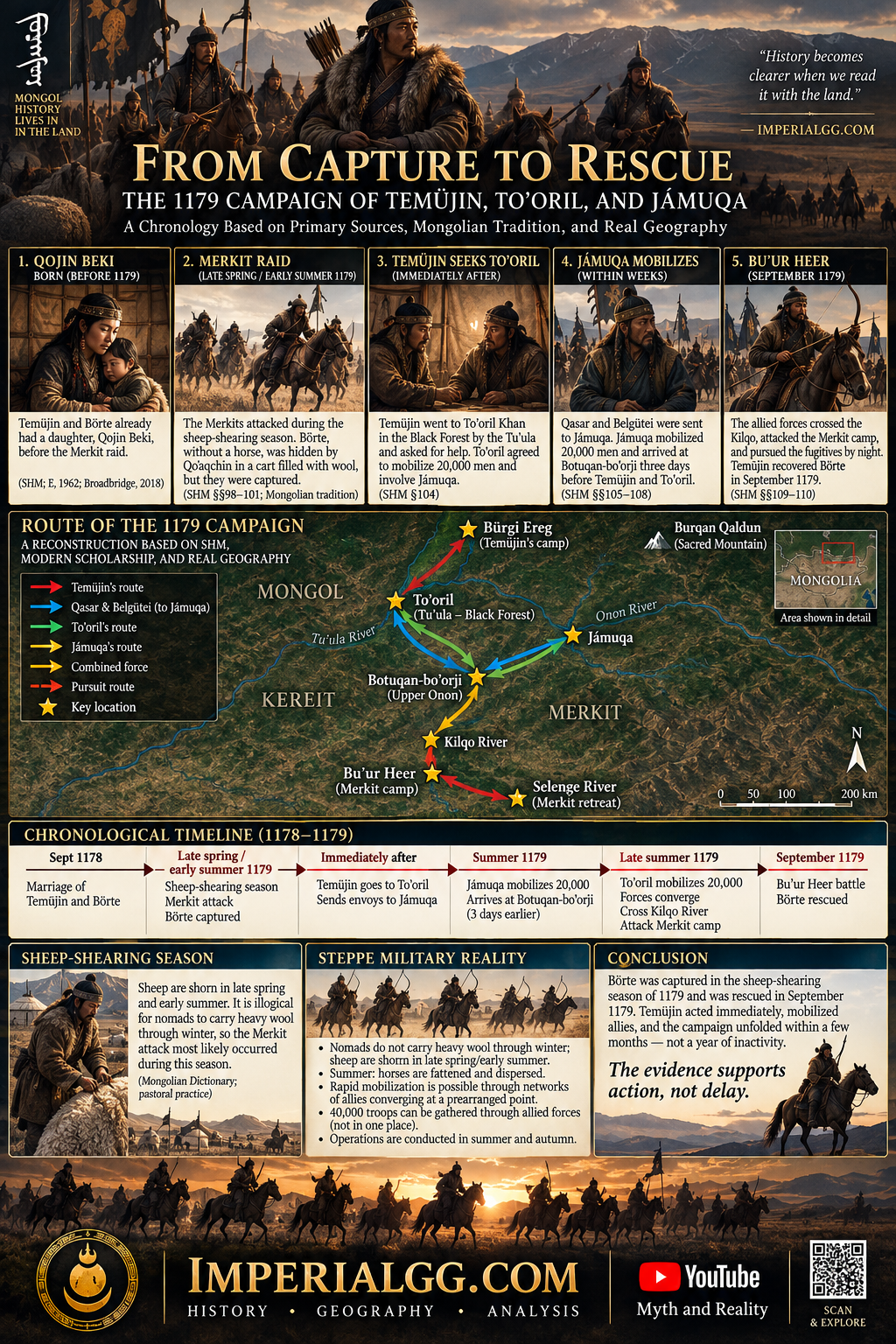
The historical sources do not portray Temüjin as remaining inactive after Börte was seized. Quite the opposite. The sequence recorded in the Secret History of the Mongols is remarkably direct. After the Merkit attack, Temüjin descended from Burqan Qaldun and went with Qasar and Belgütei to To’oril Khan, who was then in the Black Forest by the Tu’ula River. There he asked for assistance in recovering his wife.
The question of J̌oči’s birth has too often been approached as a question of paternity before the chronology of Börte Üjin’s abduction and rescue has been reconstructed. The more fundamental historical question is simpler: how long was Börte actually in Merkit captivity.
A close reading of The Secret History of the Mongols, combined with Mongolian historical chronology, traditional pastoral-season evidence, geographical reconstruction, and the military mobility described in the text, suggests a considerably shorter captivity period than a chronology that assumes a prolonged interval between abduction and rescue.
The Mongolian historical tradition places the Merkit raid in the sheep-shearing season of 1179 and the Bu’ur Heer campaign and recovery of Börte in September 1179. The Secret History itself then preserves an unusually compressed sequence of mobilization: Temüjin appeals to To’oril; To’oril immediately commits twenty thousand men; J̌amuqa is summoned; a rendezvous is established; J̌amuqa arrives at Botuqan-bo’orji three days before Temüjin and To’oril; the allied forces cross the Kilqo; and the Merkit camp is attacked.¹
This chronology does not require a year-long period of inactivity.
More importantly, it creates a coherent chronological framework in which Börte could already have been pregnant when the Merkits captured her. The difficult expression eme kö’ü in §104 has been interpreted by Igor de Rachewiltz as potentially meaning “wife-child,” or wife and unborn child, although other translators understand it simply as “wife.”² The question therefore remains philologically disputed. But the chronological evidence deserves to be examined before any conclusion about J̌oči’s paternity is drawn.
QOJIN BEKI: THE CHILD WHO CAME BEFORE JOCHI
J̌oči was not Börte’s first child. The later genealogy identifies Qojin Beki as an elder daughter of Temüjin and Börte. Chih-Shu E, discussing Rashīd al-Dīn’s genealogy, explicitly identifies Qojin-Beki as J̌oči’s elder sister.³
Anne F. Broadbridge likewise argues that the chronology requires Qojin to have been born before J̌oči and proposes moving Temüjin and Börte’s marriage earlier, to approximately 1178, in order to accommodate Qojin’s birth before the Merkit episode.⁴
This point is important because the Merkit raid did not interrupt the beginning of Temüjin and Börte’s family life. They already had a daughter. The Secret History later identifies Qojin Beki in the context of an attempted marriage exchange: Chinggis Qahan proposed Qojin for Tusaqa, Senggüm’s son, while seeking a bride from the same family for J̌oči.⁵
Thus the relevant family sequence is:
Qojin Beki → Merkit raid → Börte’s rescue → J̌oči
J̌oči was therefore Börte’s first son, but not her first child.
THE MERKIT RAID
The Secret History describes the Merkit attack in §§98–101. The attack was sudden. The people around Temüjin fled, but Börte and the elderly Qo’aqčin could not escape on horseback. The text specifically records that there was no horse for Börte. Qo’aqčin therefore concealed Börte in a covered cart with a wooden frame, harnessed an ox to it, and attempted to escape toward the Tenggelik stream. When the cart axle broke, the two women continued on foot toward the forest, where Merkit soldiers captured them.⁶
This detail is often treated merely as part of the dramatic narrative. It may also contain a chronological clue. The text places Börte among wool in the cart.⁷ The Secret History does not explicitly say that the wool had just been shorn. Therefore, the historian should not turn this into a certainty that the sheep had been shorn days earlier. But traditional Mongolian pastoral practice provides an important comparison.
Mongolian ethnographic sources describe sheep shearing as a late-spring/early-summer activity, when livestock have recovered from winter and the wool begins to loosen. The first summer shearing produces what is traditionally called urtyn noos, or the long/summer wool; autumn shearing produces akhryn noos.⁸ The Mongolian Dictionary likewise preserves the expression khavryn noos—spring wool—as wool taken from sheep in spring.⁹
The historical scene therefore fits naturally with:
late spring / early summer → sheep shearing → fresh seasonal wool → Börte concealed among wool. It is a seasonal consistency test.
The chronology becomes much more significant when combined with the date of the rescue.
THE 1179 CHRONOLOGY
A modern Mongolian historical chronology gives a particularly important sequence.
The Mongolian Historical Dictionary entry for the Bu’ur Heer battle states that Temüjin married Börte in September 1178, and that in the following year, at the time of sheep shearing, the Merkits suddenly attacked and abducted Börte, Belgütei’s mother, and Qo’aqčin. The same entry dates the Bu’ur Heer campaign to September 1179.¹⁰
This produces a striking seasonal sequence:
September 1178 — marriage
↓
late spring / early summer 1179 — sheep-shearing season and Merkit raid
↓
summer 1179 — captivity and rescue preparations
↓
September 1179 — Bu’ur Heer campaign and recovery of Börte
The interval is therefore measured in months, not approximately a year. The exact day of the raid is not supplied, so it would be excessive to claim an exact number of days. But if the raid occurred during the late-spring/early-summer shearing season and the recovery occurred in September, a captivity period of approximately three to four months is a reasonable chronological reconstruction. That is the central chronological proposition of this study.
TEMÜJIN DOES NOT WAIT A YEAR
The internal narrative of the Secret History is equally important. After the Merkits take Börte, Temüjin does not disappear from the narrative for months.
He acts.
In §104, Temüjin, Qasar, and Belgütei go to To’oril Khan, who is staying in the Black Forest beside the Tu’ula River. Temüjin asks him to recover his wife. In de Rachewiltz’s interpretation of the difficult phrase in this passage, Temüjin also asks for the recovery of his unborn child.¹¹
To’oril agrees.
He does not propose a campaign to be organized at some distant future date. He immediately announces his intention to mobilize two tümen and instructs Temüjin to summon J̌amuqa, who is to bring another two tümen and determine the time and place of their meeting.¹²
The next movement is equally direct. Temüjin returns and sends Qasar and Belgütei to J̌amuqa. J̌amuqa responds. The rendezvous is established.
To’oril moves. Temüjin moves. J̌amuqa moves. The armies converge. The narrative contains no indication of a year-long military preparation.
BOTUQAN-BO’ORJI: THE RENDEZVOUS
Section 108 provides perhaps the clearest evidence for the operational tempo of the campaign. Temüjin, To’oril, and Jaqa-gambu proceed together toward Botuqan-bo’orji, at the headwaters of the Onon. When they arrive, J̌amuqa has already been there for three days.¹³
This detail is easy to overlook, but it is fundamental to understanding steppe mobilization. The forty thousand men described in the campaign were not necessarily standing in one enormous stationary camp waiting for every participant to arrive. Rather, the forces were moving along separate lines toward a predetermined rendezvous.
The sequence was:
Temüjin appeals to To’oril
→
To’oril mobilizes
→
Temüjin sends messengers to J̌amuqa
→
J̌amuqa mobilizes
→
J̌amuqa reaches Botuqan-bo’orji
→
Temüjin, To’oril, and Jaqa-gambu arrive
→
the coalition continues toward the Merkits
The text even preserves J̌amuqa’s complaint that they had arrived late. He reminds them that they had sworn not to be delayed by rain or storm.¹⁴
That is not the language of an army that has spent months merely assembling. It is the language of a prearranged mobile rendezvous.
THE MILITARY GEOGRAPHY OF THE CAMPAIGN
The geography reinforces this interpretation.
Vito Pecchia Riba’s study of the geography of the Secret History explicitly examines the spatial and temporal relationships of the text using primary and secondary sources, satellite imagery, and field reconnaissance conducted in 2008, 2009, and 2010.¹⁵ His work demonstrates the value—and also the limitations—of reconstructing the campaign through the landscape itself.
Gerelbadrakh’s study of Bürgi Ereg is particularly relevant. He compares competing identifications and argues that Bürgi Ereg-II, near the Bürke river in modern Mungunmorit, better fits several details of the Secret History, including the proximity of forest and the Tenggelik/Terelj watercourse involved in Börte and Qo’aqčin’s escape. He gives the proposed location as approximately 48°13′30.7″ N, 108°32′36.7″ E, while emphasizing that the identification is a scholarly reconstruction rather than an uncontested fact.¹⁶
This matters because the campaign cannot be reconstructed merely from modern straight-line distances. A horseman does not move from point A to point B as a ruler on Google Earth.
He moves through:
- river valleys,
- mountain passes,
- forest edges,
- water sources,
- grazing areas,
- enemy observation zones,
- and established pastoral routes.
Therefore the proper question is not: “How many kilometers is the straight line?”
but: “How many operational days would a mounted force require to move between these historically proposed locations under urgent conditions?” That distinction is essential.
FROM BOTUQAN-BO’ORJI TO THE MERKIT CAMP
Section 109 records the next stage.
The allied army leaves Botuqan-bo’orji and reaches the Kilqo River. They lash rafts together and cross the river. They then reach the Bu’ur steppe and descend upon Toqto’a-beki’s camp.¹⁷
The operation is intended as a surprise attack. The text is explicit, however, that the Merkits were not completely without warning. Fishermen, sable-trappers, and hunters living along the Kilqo detected the approaching army and sent word to Toqto’a-beki during the night. Toqto’a-beki and Dayir-usun therefore escaped downstream along the Selenge toward Bargujin with a small group.¹⁸
This correction matters. It would be inaccurate to describe the Merkit camp as having no guards whatsoever.
The more precise conclusion is that the Mongol-Kereit-J̌amuqa coalition succeeded in approaching the Merkit territory sufficiently closely and rapidly that the main camp was placed under immediate pressure before the Merkits could organize a full defense.
The Secret History even says that Toqto’a could have been captured while asleep had the warning not reached him.¹⁹
That is evidence of an operation designed around speed, surprise, and exploitation of the landscape.
THE NIGHT PURSUIT
The Merkits fled. Section 110 states that they moved down the Selenge during the night and that the allied soldiers pursued them through the night. Then comes one of the most memorable scenes in the Secret History.
Temüjin called: “Börte! Börte!” Börte heard his voice. She recognized him. She came down from the fleeing cart. Qo’aqčin came with her. The two women reached Temüjin, and Börte took hold of his reins.²⁰
The rescue occurred at night, under moonlight. Temüjin then informed To’oril and J̌amuqa that he had found what he was seeking and proposed stopping for the night rather than continuing the pursuit.²¹
The sequence is therefore extraordinarily compact:
abduction → appeal → mobilization → rendezvous → march → river crossing → surprise attack → night pursuit → recovery.
Nothing in the surviving narrative requires this operation to have been delayed for a year.
HOW FAST COULD A NOMADIC ARMY MOVE?
This is where modern assumptions about military mobilization must be handled carefully. A sedentary state army and a pastoral military coalition do not necessarily possess the same logistical structure.
A sedentary army may need to:
- gather supplies,
- assemble transport,
- secure roads,
- concentrate troops,
- arrange depots,
- move infantry and animals,
- and coordinate a centralized departure.
A pastoral society already possesses a different infrastructure. Its population is geographically dispersed but mounted. Its principal transport animals are already part of household wealth. Its military units are drawn from communities accustomed to seasonal movement. And in the episode under examination, the commanders do not need to invent a campaign plan from nothing. They already possess political relationships, messengers, knowledge of the landscape, and a prearranged rendezvous.
The Secret History itself provides the clearest evidence: **J̌amuqa was already waiting at Botuqan-bo’orji three days before the arrival of Temüjin and To’oril.**²²
This does not prove that forty thousand men could always mobilize in a single day.
It proves something more modest—and more useful: The campaign did not require forty thousand men to assemble simultaneously at one location before movement began. They could converge. That distinction is critical.
A GOOGLE EARTH RECONSTRUCTION
A modern reconstruction can therefore be divided into phases rather than pretending to possess exact day-by-day measurements.
PHASE I — TEMÜJIN TO TO’ORIL
Temüjin travels from the Bürgi Ereg area toward To’oril’s Black Forest on the Tu’ula.
PHASE II — RETURN AND MESSAGE TO J̌AMUQA
Temüjin returns and immediately sends Qasar and Belgütei to J̌amuqa.
PHASE III — SEPARATE MOBILIZATION
To’oril mobilizes his two tümen. J̌amuqa mobilizes his two tümen. Temüjin joins To’oril’s movement.
PHASE IV — BOTUQAN-BO’ORJI
The forces converge. J̌amuqa is already there. He has been waiting three days.
PHASE V — KILQO
The combined army proceeds toward the Merkit territory and crosses the river using rafts.
PHASE VI — BU’UR HEER
The coalition strikes the Merkit camp.
PHASE VII — SELENGE PURSUIT
The fleeing Merkits are pursued through the night.
PHASE VIII — BÖRTE
Temüjin finds Börte.
This operational sequence is compatible with a rapid campaign lasting weeks rather than months. That conclusion must not be confused with the total length of Börte’s captivity. The two are different questions.
The Secret History does not tell us the exact number of days between the initial abduction and Temüjin’s appeal to To’oril. But once the Mongolian historical chronology places the abduction in the sheep-shearing season and the recovery in September, the total captivity window becomes approximately three to four months.²³
The sheep shearing
The wool in Börte’s cart deserves one further examination. Traditional Mongolian pastoral practice places the main summer sheep shearing in the period when the animals have recovered from winter, are well-fed on new grass, and their wool has begun to loosen. The first summer wool is traditionally distinguished from the autumn wool.²⁴
The Mongolian Dictionary likewise records khavryn noos—spring wool—and defines it as the long wool taken from sheep in spring.²⁵ This gives us an independent cultural calendar against which to test the historical narrative.
It says that Börte was hidden among wool.
The historical inference is therefore: The scene is compatible with the late-spring/early-summer shearing season.
That inference becomes much stronger because the Mongolian historical chronology independently says that the Merkits attacked **“at the time of sheep shearing.”**²⁶
We therefore have two different layers of evidence pointing in the same seasonal direction:
- the narrative image of Börte hidden among wool;
- the Mongolian chronological tradition explicitly placing the raid in sheep-shearing season.
Then comes the third point: September 1179 — rescue. Together they form a coherent seasonal sequence.
THREE TO FOUR MONTHS, NOT A YEAR
The chronology can now be expressed simply.
| Chronological stage | Approximate period |
|---|---|
| Temüjin and Börte married | September 1178 |
| Qojin already part of the family chronology | before J̌oči |
| Merkit raid | late spring / early summer 1179 |
| Börte hidden in wool cart | same seasonal window |
| Temüjin appeals to To’oril | shortly after abduction |
| J̌amuqa summoned | immediately within the narrative sequence |
| Forces converge at Botuqan-bo’orji | campaign phase |
| Kilqo crossed | campaign phase |
| Bu’ur Heer attack | campaign phase |
| Night pursuit | immediately after attack |
| Börte recovered | September 1179 |
| J̌oči | born after the recovery in the traditional chronology |
The important conclusion is not that we know the exact number of days. We do not. The important conclusion is that the available chronology does not require a year-long captivity.
A three-to-four-month captivity is entirely compatible with the Mongolian chronology that places the raid in the sheep-shearing season and the recovery in September.
THE PREGNANCY QUESTION
Only after establishing this chronology should we return to §104. Temüjin tells To’oril that the Merkits have taken his eme kö’ü. (wife – child)
De Rachewiltz notes that the expression is ambiguous. It can be understood as “wife” or potentially “wife-child.” His argument for the latter is that the expression is unusual and that J̌oči is subsequently born shortly after Börte’s recovery.²⁷
This is important evidence.
Other translators have rendered the passage simply as “wife,” and the philological problem should remain visible to the reader.²⁸
The strongest argument therefore does not rest on this single phrase.
It rests on the convergence of evidence:
Qojin precedes J̌oči in the family genealogy.
The Merkit raid is placed in sheep-shearing season.
Börte is physically concealed among wool.
The Mongolian chronology dates the rescue to September 1179.
The military sequence in §§104–110 unfolds rapidly.
The difficult eme kö’ü passage can plausibly refer to an unborn child.
J̌oči is born after Börte’s recovery in the traditional chronology. These facts do not provide modern genetic proof. They provide something different:
a chronological argument.
WHAT THE CHRONOLOGY CAN—and CANNOT—PROVE
The evidence allows us to make a strong historical argument, but not an unlimited one.
It can reasonably establish that:
- J̌oči was not Börte’s first child; Qojin Beki preceded him.
- Börte’s abduction is traditionally placed in the sheep-shearing season of 1179.
- The rescue is placed in September 1179.
- The captivity therefore fits approximately three to four months.
- Temüjin’s military response was organized through rapid mobilization and rendezvous rather than a year-long preparation.
- The chronology is compatible with Börte already being pregnant when the Merkits captured her.
- The chronology does not require conception during Merkit captivity.
What it cannot establish with absolute certainty is the exact day of conception, exact gestational age at capture, or biological paternity. Those are different questions. This distinction is essential if the argument is to withstand academic scrutiny.
THE LARGER HISTORICAL POINT
The significance of the chronology extends beyond J̌oči. The episode demonstrates something fundamental about the political world in which Temüjin lived. A household crisis could immediately become a military crisis. The loss of Börte activated Temüjin’s relationship with To’oril. To’oril activated J̌amuqa. J̌amuqa established the rendezvous.
Separate forces converged. The landscape became the operational framework. The army crossed rivers by improvised rafts. The coalition struck the Merkit camp. And the pursuit continued through the night until Börte was recovered. The speed of this sequence is itself historical evidence.
The steppe was not a space in which military power existed only after a long process of centralized assembly. Military power could emerge from relationships, mobility, animals, terrain, messengers, and rapid convergence. That is why the chronology of Börte’s captivity must be reconstructed before the question of J̌oči’s paternity is argued.
The first question is not: “Who was J̌oči’s biological father?”
The first question is: “What does the chronology actually allow?”
And when the chronology is reconstructed from the seasonal evidence, the Mongolian historical tradition, the Secret History’s internal sequence, and the geography of the campaign, the conclusion is clear enough to deserve serious consideration:
Börte’s captivity need not have lasted anything approaching a year. A late-spring/early-summer abduction followed by a September 1179 recovery produces a captivity window of approximately three to four months—and that chronology is entirely compatible with Börte having already been pregnant when the Merkits seized her.
FOOTNOTES
1. The Secret History of the Mongols (SHM), §§104–110; “Буур хээрийн байлдаан,” Монголын түүхийн тайлбар толь, which dates the battle and recovery to September 1179 and places the Merkit raid in the following year’s sheep-shearing season.
2. Igor de Rachewiltz, The Secret History of the Mongols: A Mongolian Epic Chronicle of the Thirteenth Century, commentary to §104. De Rachewiltz discusses eme kö’ü as an ambiguous expression that may literally suggest “wife-child.”
3. Chih-Shu E, Studies in the Career of Chinggis Qan, p. 69, citing Rashīd al-Dīn and identifying Qojin-Beki as J̌oči’s elder sister.
4. Anne F. Broadbridge, Women and the Making of the Mongol Empire (Cambridge: Cambridge University Press, 2018), chap. 2. Broadbridge notes that the earlier birth of Qojin creates chronological problems for later dating schemes and proposes an earlier marriage, around 1178, to accommodate Qojin’s birth before the Merkit raid.
5. SHM §165, where Chinggis Qahan proposes Qojin-beki in a marriage exchange involving J̌oči and Senggüm’s family.
6. SHM §§98–101. The narrative records Börte’s lack of a horse, Qo’aqčin’s use of an ox-cart, the broken axle, and their eventual capture.
7. SHM §§98–101. The cart and wool detail belongs to the narrative context of Börte’s attempted escape.
8. “Ноос хяргах,” Tourist Information Center of Mongolia: traditional Mongolian sheep shearing is described as occurring in late spring/early summer, with summer wool distinguished from autumn wool.
9. Монгол хэлний их тайлбар толь, entry “хавар,” which defines хаврын ноос as the long wool taken from sheep/goats in spring.
10. Монголын түүхийн тайлбар толь, “Буур хээрийн байлдаан.” The entry explicitly gives September 1179 for the battle and states that the Merkits attacked in the following year at sheep-shearing time.
11. De Rachewiltz, commentary to SHM §104.
12. SHM §104.
13. SHM §108. The Mongolian text states that when Temüjin, To’oril, and Jaqa-gambu reached Botuqan-bo’orji, J̌amuqa had already arrived and had waited three days.
14. SHM §108. J̌amuqa’s statement about not being delayed by rain or storms emphasizes the importance of keeping the agreed rendezvous.
15. V. Pecchia Riba, “Geography of ‘The Secret History of the Mongols’: Location of C13th Mongol Place Names and Topographical Features in Northeast Mongolia,” Mongolian Journal of Anthropology, Archaeology and Ethnology 6, no. 1 (2010): 98–125. The study explicitly combines historical sources, satellite imagery, and field reconnaissance.
16. J. Gerelbadrakh, “Where is the actual location of Bürgi ergi of ‘The Secret History of the Mongols’?” Acta Historica Mongolici XX (2019). Gerelbadrakh compares competing locations and proposes Bürgi Ereg-II near the Bürke river, while acknowledging the historiographical uncertainty.
17. SHM §109.
18. SHM §109. The text specifically names fishermen, sable-trappers, and hunters as the people who transmitted warning to Toqto’a-beki.
19. SHM §109. The narrative states that Toqto’a could have been seized while sleeping had the warning not arrived.
20. SHM §110. The Mongolian text records Temüjin calling “Börte, Börte” and Börte recognizing his voice.
21. SHM §110.
22. SHM §108.
23. This is a chronological reconstruction, not an exact medieval dating statement. It combines the sheep-shearing chronology and the September 1179 dating of the Bu’ur Heer campaign.
24. “Ноос хяргах,” Tourist Information Center of Mongolia.
25. Монгол хэлний их тайлбар толь, “хавар.”
26. Монголын түүхийн тайлбар толь, “Буур хээрийн байлдаан.”
27. De Rachewiltz, commentary to SHM §104.
28. The philological disagreement is explicitly acknowledged by de Rachewiltz, who notes that many translators render eme kö’ü simply as “wife.”
SELECTED BIBLIOGRAPHY
- Broadbridge, Anne F. Women and the Making of the Mongol Empire. Cambridge: Cambridge University Press, 2018.
- de Rachewiltz, Igor. The Secret History of the Mongols: A Mongolian Epic Chronicle of the Thirteenth Century. Leiden: Brill, 2004–2013.
- E, Chih-Shu. Studies in the Career of Chinggis Qan. SOAS University of London.
- Gerelbadrakh, J. “Where is the actual location of Bürgi ergi of ‘The Secret History of the Mongols’?” Acta Historica Mongolici XX, 2019.
- Pecchia Riba, V. “Geography of ‘The Secret History of the Mongols’: Location of C13th Mongol Place Names and Topographical Features in Northeast Mongolia.” Mongolian Journal of Anthropology, Archaeology and Ethnology 6, no. 1 (2010): 98–125.
- Монголын түүхийн тайлбар толь. “Буур хээрийн байлдаан.”
- Монгол хэлний их тайлбар толь. “Хавар,” including хаврын ноос.