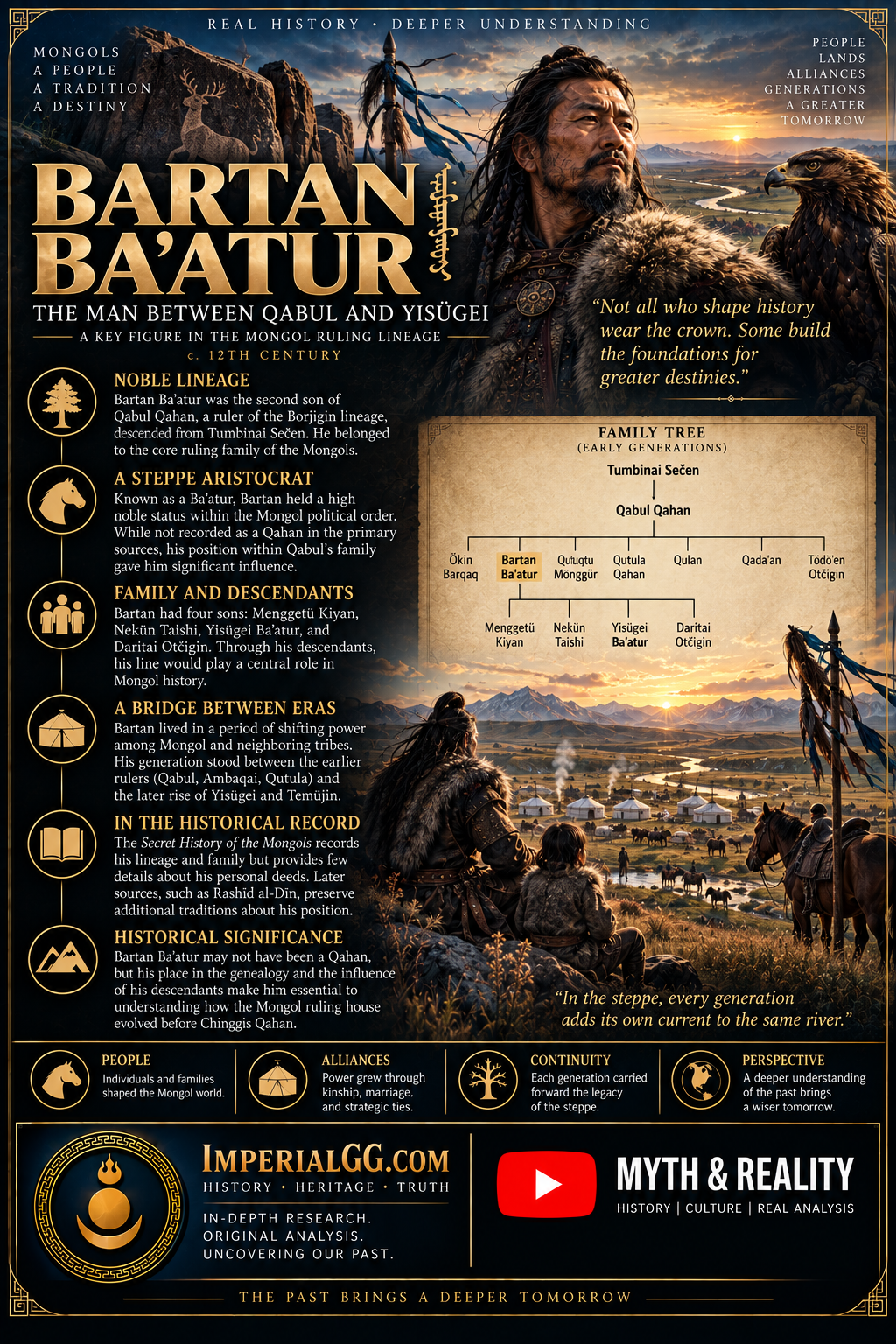
BARTAN BA’ATUR: THE MAN BETWEEN QABUL AND YISÜGEI
By Altanbagana Baatar
DBA Candidate| Independent Historian
ImperialGG Historical Research Seriers
06 September 2026
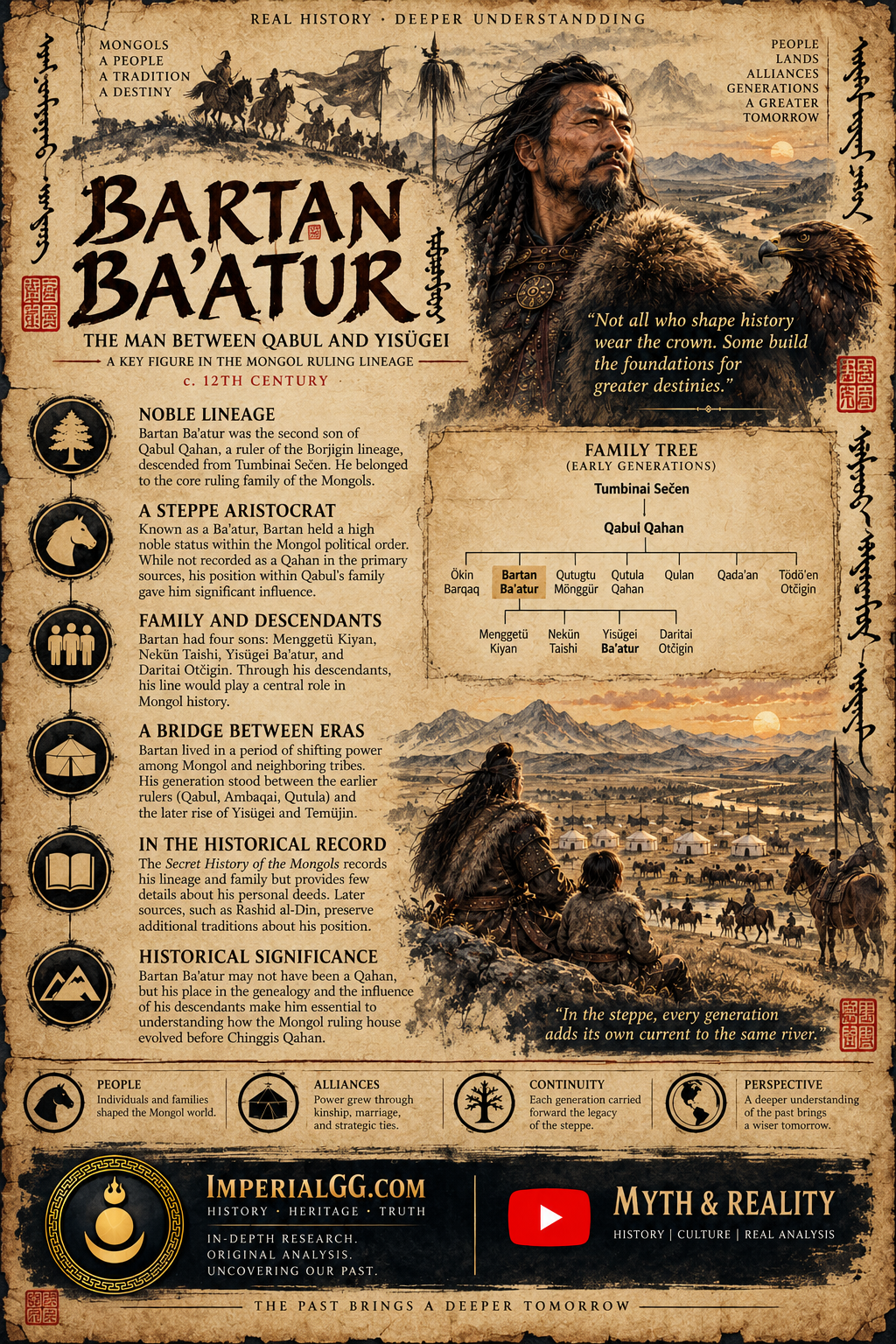
LINEAGE, POLITICAL STATUS, AND THE HISTORICAL RECORD OF A PRE-CHINGGISID MONGOL NOBLE
Bartan Ba’atur occupies an unusual position in the history of the pre-Chinggisid Mongols. He was neither a figure whom the Secret History of the Mongols presents as a Qahan nor a ruler whose deeds are narrated at length. Yet he cannot be omitted from the political history of the Mongols. His name stands within the ruling lineage descended from Qabul Qahan, and the surviving genealogical traditions place him at a critical point between the generation of Qabul and Qutula and the generation of Yisügei Ba’atur. The historical problem surrounding Bartan is therefore not that he is unimportant, but that the surviving sources preserve considerably more information about his position in the genealogy than about his individual actions.
For that reason, Bartan Ba’atur should be studied neither as a forgotten Qahan nor merely as “the grandfather of Chinggis Qahan.” He deserves examination as a political figure in his own right, with careful distinction between what the sources explicitly record, what later genealogical traditions claim, and what remains unknown.
EARLY LIFE AND FAMILY BACKGROUND
Bartan Ba’atur belonged to the Borjigin ruling lineage. The Secret History of the Mongols places him among the sons of Qabul Qahan, identifying Qabul as the son of Tumbinai Sečen. Qabul had seven sons, listed as Ökin Barqaq, Bartan Ba’atur, Qutuqtu Mönggür, Qutula Qahan, Qulan, Qada’an, and Tödö’en Otčigin. Bartan was therefore the second son of Qabul Qahan, not his successor in a simple father-to-son political sequence.¹
This distinction is fundamental. Qabul’s sons belonged to the same powerful ruling family, but their political positions were not identical. The Secret History explicitly identifies Qabul as Qahan and later identifies Qutula as Qahan, while Bartan is consistently called Ba’atur rather than Qahan. The surviving evidence therefore does not justify treating Bartan as another Qahan merely because he was Qabul’s son.²
The title Ba’atur itself is significant. It was an honorific associated with valor and martial distinction in the political culture of the steppe. In Bartan’s case, however, the source gives the title without narrating the particular military achievement through which he supposedly earned it. We should therefore preserve the title while resisting the temptation to manufacture a biography around it.³
BARTAN’S POSITION IN THE MONGOL POLITICAL ORDER
Bartan lived during a period in which political authority among the Mongols was already organized through a hierarchy of ruling lineages, aristocratic families, military leaders, and assemblies, but before Chinggis Qahan transformed that political order into a new imperial system.
His position must therefore be understood within the wider family of Qabul rather than through the later model of a strictly hereditary throne. Qabul had seven sons, yet after his death the Secret History does not say that Bartan, as the second son, automatically inherited the position of Qahan. Instead, §52 states that Ambaqai Qahan, son of Senggüm Bilge, became ruler of the Mongols according to Qabul’s will. After Ambaqai’s capture, the Mongols and Tayichi’ut gathered and chose Qutula Qahan.⁴
This political sequence is essential for understanding Bartan. His position within Qabul’s family gave him considerable genealogical importance, but seniority within the ruling family did not itself guarantee the Qahanate. Bartan consequently belongs to a generation in which political authority was negotiated among powerful lineages rather than transmitted automatically from father to eldest or second son.
This is one reason why Bartan should not be inserted artificially into the succession as though the political sequence were:
Qabul → Bartan → Qutula.
The sources do not support that reconstruction as a straightforward succession of Qahans.
THE HISTORICAL RECORD OF BARTAN
The most important characteristic of Bartan’s biography is the scarcity of direct narrative.
The Secret History provides his place in the genealogy and then records his four sons: Menggetü Kiyan, Nekün Taishi, Yisügei Ba’atur, and Daritai Otčigin. It does not preserve a long account of Bartan’s campaigns, political decisions, captivity, death, or speeches comparable to those preserved for Ambaqai, Qutula, or later Yisügei.⁵
This silence cannot be treated simply as evidence that Bartan accomplished nothing. The Secret History is not a modern biography and does not attempt to provide equal narrative coverage of every member of the ruling aristocracy. Its genealogical sections frequently preserve names and relationships that are not accompanied by individual biographies.
Indeed, the later historian Rashīd al-Dīn explicitly treated the descendants of Bartan as worthy of separate treatment. In the Jāmiʿ al-Tawārīkh, Bartan Bahādur is identified as a son of Qabul Khan, and the history announces a separate account concerning Bartan and his sons.⁶
That is important evidence. Bartan was not merely an accidental name preserved in a genealogy. By the Ilkhanid period, his lineage was recognized as a distinct and historically significant branch of the Chinggisid ancestral tradition.
BARTAN AS A FATHER
The clearest personal information concerning Bartan concerns his household. The Secret History records four sons: Menggetü Kiyan → Nekün Taishi → Yisügei Ba’atur → Daritai Otčigin. It also identifies their mother as Süjigil, described as the daughter of a Mongol Targut woman of the Tayichi’ut.⁷
This information gives Bartan a clearly identifiable position within the political genealogy of the Mongols. His household was not an incidental branch of the Borjigin family. Through his sons, particularly Yisügei, Bartan’s line became one of the principal surviving branches through which the later Chinggisid genealogy was remembered.
Yet even here caution is necessary. The importance of Bartan’s descendants should not be projected backward onto Bartan himself. We should not assume that because his grandson eventually became Chinggis Qahan, Bartan himself must have possessed the same political authority. Historical significance and political status are not the same thing.
THE QUESTION OF WHETHER BARTAN SUCCEEDED QABUL
One of the most important problems in Bartan’s biography emerges when different genealogical traditions are compared. The Secret History of the Mongols clearly presents Qabul → Ambaqai → Qutula as the major political sequence. Bartan is one of Qabul’s sons, but is not called Qahan in this sequence.⁸
Other traditions, however, preserve a different conception of the relationship between Qabul and Bartan. Christopher P. Atwood’s study of the pre-Chinggisid genealogical traditions demonstrates that multiple genealogies circulated within the Mongol imperial world and that they did not always agree. One such tradition presents Bartan as succeeding Qabul, while another genealogical tradition preserves the lineage Qabul → Bartan → Yisügei.⁹
This does not mean that Bartan should simply be declared the successor of Qabul. Rather, it demonstrates that different historical traditions remembered the political structure of the pre-Chinggisid Mongols differently. Some genealogies compressed political history into ancestral succession, while the Secret History preserves a more complicated political sequence in which Ambaqai and Qutula occupy the Qahanate.
This distinction is particularly important because later genealogical texts were often concerned with establishing legitimate lines of descent. Genealogy and political succession could therefore become intertwined, even when they were not originally identical.
BARTAN IN THE SOURCES OF THE MONGOL EMPIRE
The problem becomes even more interesting when the sources of the Mongol imperial period are compared. Atwood demonstrates that several different written genealogies of the pre-Chinggisid Mongols circulated during the Mongol Empire. In one tradition, Bartan appears as an ancestor directly between Qabul and Yisügei. Atwood also points out that the Shengwu qinzheng lu preserves evidence in which Bartan Ba’atur is associated with descendants who elsewhere are assigned differently, showing that genealogical traditions were not completely fixed.¹⁰
This has a direct implication for Bartan’s biography: the surviving sources tell us more securely who Bartan was related to than exactly what political office he exercised. That is not a weakness of the research. It is the historical evidence. A responsible biography therefore has to resist filling the silence with invented campaigns, invented titles, invented dates, or imagined political achievements.
BARTAN’S HISTORICAL SIGNIFICANCE
Bartan Ba’atur’s importance rests on three connected facts. First, he was a son of Qabul Qahan, one of the major pre-Chinggisid Mongol rulers. Second, he himself occupied a recognized aristocratic position marked by the title Ba’atur. Third, he became the father of a generation that included Yisügei Ba’atur, through whom the genealogy reached Temüjin.
The later historical memory of Bartan consequently became inseparable from the formation of the Chinggisid ancestral line. Rashīd al-Dīn explicitly describes Bartan as the grandfather of Chinggis and devotes a separate section to his branch of the family.¹¹
But the proper historical conclusion is more precise than simply calling him “the grandfather of Chinggis Khan.”
Bartan represents the political generation between the early Qabul-Ambaqai-Qutula order and the generation of Yisügei. His life belongs to a period in which the Mongol political community was already structured around competing but interconnected aristocratic lineages, in which Qahan authority was not necessarily inherited automatically, and in which individual Ba’atur figures could possess substantial standing without being Qahan.
His historical importance therefore lies not only in whom he descended from or whom he fathered, but in what his position reveals about the political organization of the Mongols before Temüjin.
WHAT WE CAN AND CANNOT KNOW ABOUT BARTAN
The evidence permits several conclusions with reasonable confidence. Bartan was a son of Qabul Qahan. He was the second of Qabul’s seven sons in the Secret History. He bore the title Ba’atur. He had four sons, among them Yisügei Ba’atur. His family constituted a significant branch of the ruling lineage later remembered by Mongol historians.¹²
What the evidence does not securely establish is equally important. We do not possess a reliable contemporary biography giving Bartan’s birth date, death date, major campaigns, territorial administration, or a definitive period during which he held the supreme Qahanate. Nor should his place in some later genealogies be converted automatically into proof that he politically succeeded Qabul.
The result is a biography that is necessarily more restrained than those of Qabul, Ambaqai, Qutula, or Yisügei. That restraint is not an omission. It is the correct response to the character of the sources.
CONCLUSION
Bartan Ba’atur was a member of the ruling Borjigin generation that stood between Qabul Qahan and the later generation of Yisügei Ba’atur. The Secret History of the Mongols preserves him primarily through genealogy: as the second son of Qabul and the father of four sons, including Yisügei. It does not give him the title Qahan, nor does it provide a detailed narrative of his political career.¹³
Later Mongol historical traditions, however, preserve a more complex memory of Bartan and his place in the ancestral succession. The existence of these divergent genealogies demonstrates that the political and genealogical history of the pre-Chinggisid Mongols cannot be reduced to a single uncomplicated line of succession.¹⁴
Bartan should therefore be remembered neither as a forgotten Qahan nor merely as an ancestor of a more famous man. He was Bartan Ba’atur, a member of the Qabulid ruling family and an important figure in the aristocratic political order from which the later Mongol Empire emerged. The limited nature of the surviving record is itself part of his history: we know his place, his lineage, and his family with considerable confidence, while the details of his individual political career remain largely beyond recovery.
That boundary between what the sources preserve and what they do not preserve is precisely where a serious history of the pre-Chinggisid Mongols must begin.
NOTES
1. The Secret History of the Mongols, §48. In Christopher P. Atwood’s recent translation, Qabul Qahan is identified as the son of Tumbinai Sečen, and his seven sons are listed with Bartan Ba’atur as the second. The same genealogical sequence is preserved in other translations of the Secret History.
2. The distinction is visible directly in the terminology of the Secret History: Qabul is Qahan, Qutula is Qahan, while Bartan is Ba’atur. The source therefore does not support silently upgrading Bartan’s title.
3. On the historical use of ba’atur/baghatur as an honorific associated with valor and martial status, see the discussion summarized in the reference material on the title. The existence of the title does not by itself establish a particular military achievement for Bartan.
4. The political sequence is given in The Secret History of the Mongols, §§52–58: Ambaqai becomes Qahan after Qabul; after Ambaqai’s capture, Qutula is made Qahan by the Mongols and Tayichi’ut. This is why Bartan should not be inserted into the sequence as an automatic Qahan.
5. Secret History of the Mongols, §§48–50. Bartan’s principal appearance in the early genealogy is his position among Qabul’s sons and his four sons.
6. Rashīd al-Dīn, Jāmiʿ al-Tawārīkh, section on Bartan Bahādur. The surviving translation explicitly introduces a separate account of Bartan Bahādur and his sons.
7. Secret History of the Mongols, §50. The text names Menggetü Kiyan, Nekün Taishi, Yisügei Ba’atur, and Daritai Otčigin as Bartan’s four sons and identifies their mother as Süjigil.
8. The Secret History is explicit about Ambaqai and Qutula as Qahans. This is the principal reason for distinguishing the political succession from the genealogical relationship among Qabul’s descendants.
9. Christopher P. Atwood, “Six Pre-Chinggisid Genealogies in the Mongol Empire.” Atwood’s central argument is that multiple written genealogical traditions circulated in the Mongol imperial period and that they cannot simply be collapsed into one supposedly immutable genealogy.
10. Atwood discusses the Shengwu qinzheng lu tradition in which Bartan Ba’atur appears in a genealogical context differing from the later Yuan shi version. He notes that the parallel in Rashīd al-Dīn preserves the form Bartān Bahādur, helping establish the reading Bartan rather than a later altered form.
11. Rashīd al-Dīn explicitly identifies Bartan as Chinggis’s grandfather and treats Bartan and his sons in a separate genealogical section.
12. For the genealogical structure, see the Secret History §§48–50 and the genealogy reproduced in modern scholarly editions.
13. This is an important methodological point: absence of a detailed narrative should not be converted into either an assertion of insignificance or an invented biography.
14. Atwood’s study is particularly useful here because it demonstrates that the pre-Chinggisid genealogical traditions were plural and sometimes contradictory. The existence of these variants is evidence for the historical development of Mongol genealogical memory itself.