HOW MANY “STANS” WERE PART OF THE MONGOL WORLD?
By Altanbagana Baatar
DBA Candidate| Independent Historian
ImperialGG Historical Research Seriers
03 September 2026
RETHINKING CENTRAL ASIA, THE MONGOL EMPIRE, AND THE HISTORICAL GEOGRAPHY BEHIND THE MODERN MAP
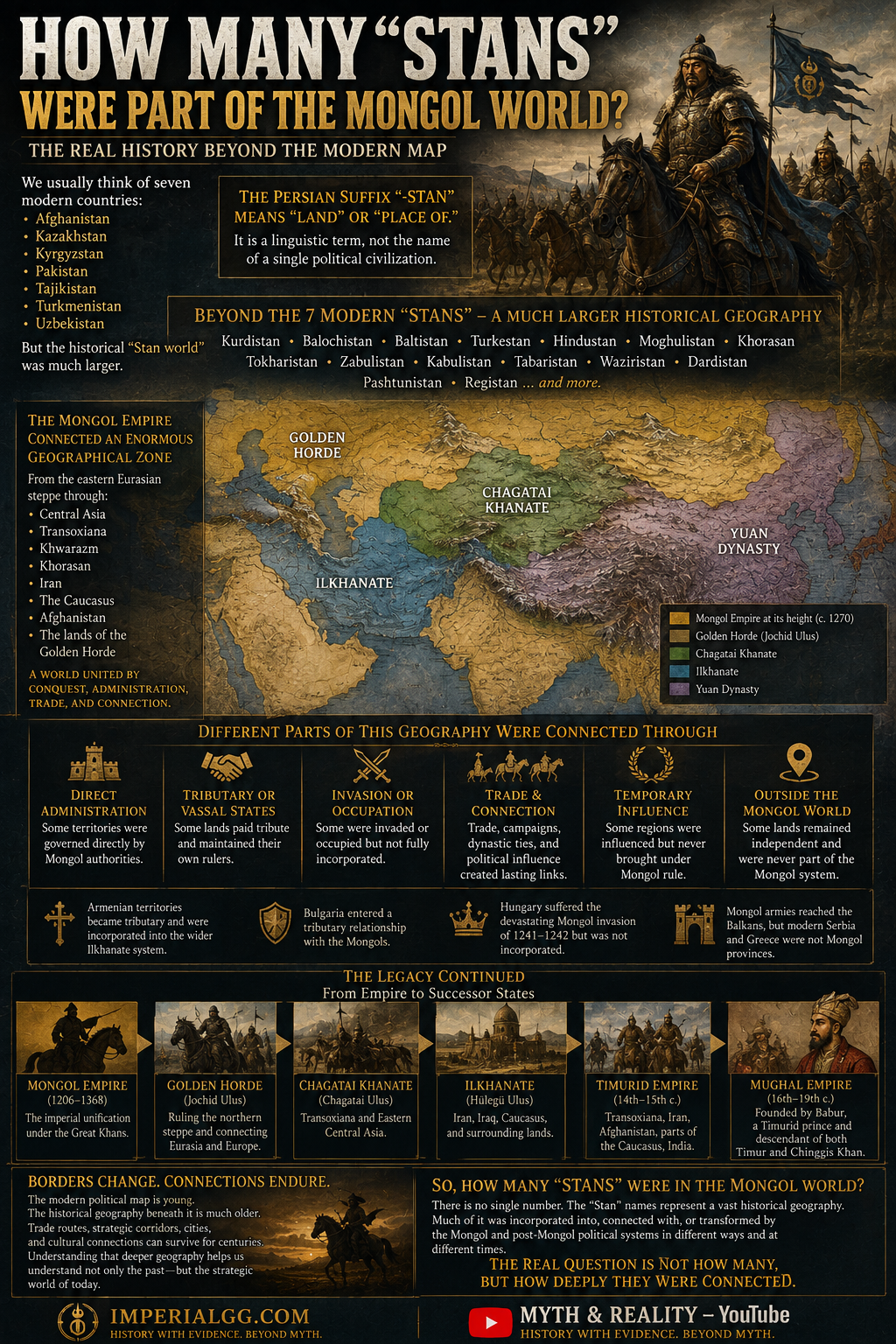
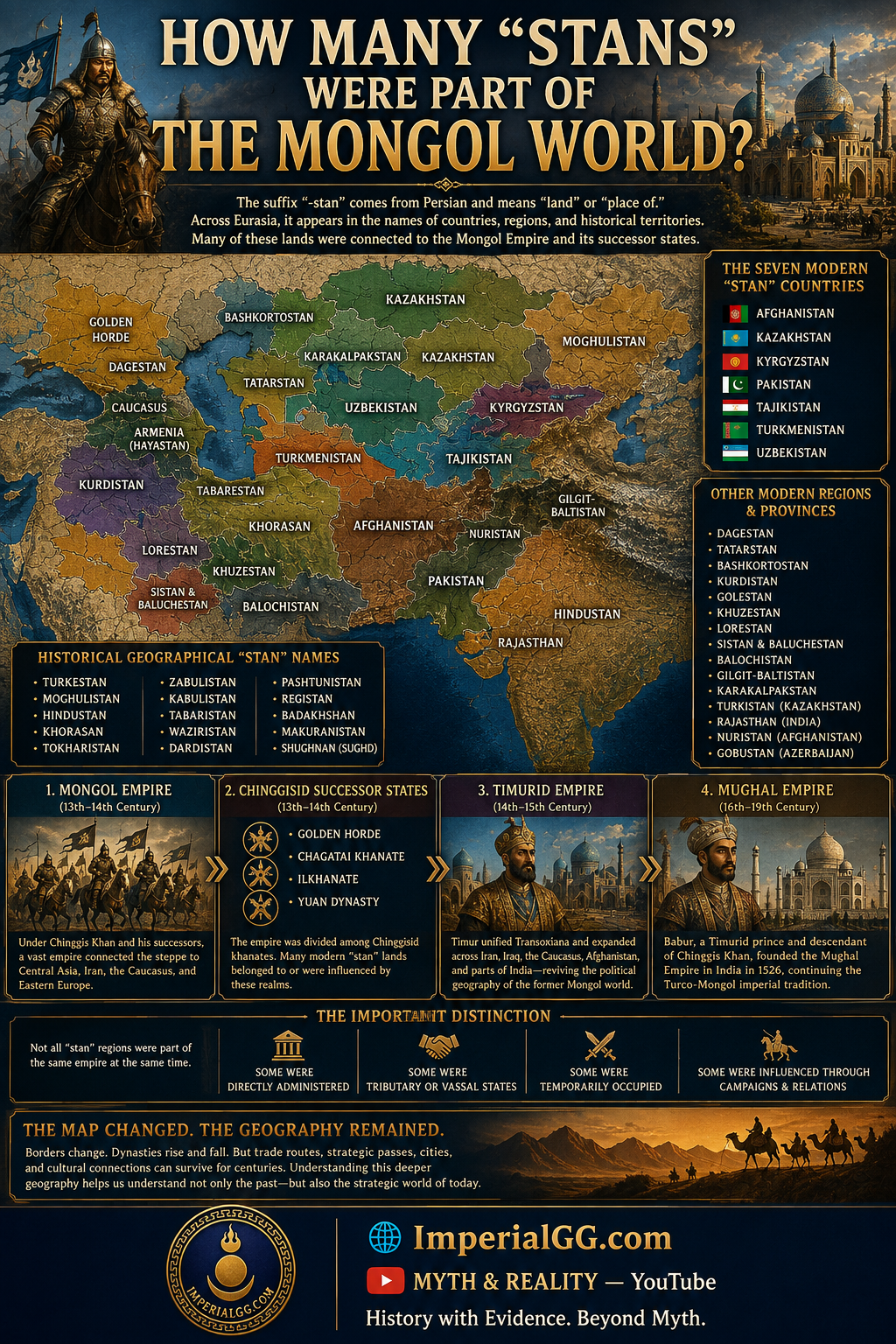
When we hear the word “Stan,” we usually think of the seven modern states whose English names end in -stan: Afghanistan, Kazakhstan, Kyrgyzstan, Pakistan, Tajikistan, Turkmenistan, and Uzbekistan.
Yet the historical geography represented by -stan is considerably broader than the modern political map.
The Persian suffix -stān is a geographical formation meaning, broadly, a place, land, or country associated with the preceding name. Its history reaches back through the Iranian linguistic tradition and has cognates and related forms elsewhere in Indo-Iranian languages. It is therefore important not to treat “Stan” as the name of a single ethnic, political, or civilizational bloc.[1] This distinction is fundamental. A place ending in -stan was not necessarily Mongol, Turkic, Persian, Islamic, or even politically connected to the Mongol Empire.
But many of these geographical names belong to a historical landscape that was profoundly transformed by the Mongol conquests and the post-Mongol political order.
THE “STAN” WORLD WAS NOT A SINGLE POLITICAL WORLD
Among historical and modern geographical names incorporating -stan are:
Afghanistan, Kazakhstan, Kyrgyzstan, Pakistan, Tajikistan, Turkmenistan, Uzbekistan, Kurdistan, Balochistan, Baltistan, Turkestan, Hindustan, Moghulistan, Kabulistan, Tokharistan, Zabulistan, Waziristan, Dardistan, Pashtunistan, and Registan.
But these names belong to different periods, languages, political traditions, and geographical contexts. Some are modern states. Some are historical regions. Some describe cultural or ethnographic territories. Some were administrative or political terms whose meanings changed over time. And some should not be projected backward into periods when the name did not yet possess its modern meaning. This is why an academic discussion of the “Stan world” must begin with historical geography rather than a modern map.
Central Asia itself has never had a single universally fixed boundary. Peter B. Golden notes that, historically, the region could extend from the Caspian Sea to Chinese Turkestan and from the Kazakh steppe southward toward Persia, Afghanistan, China, and Tibet; in broader political and cultural usage, its interactions reached from the Black Sea to the Pacific.
The geographical category was therefore fluid long before the Mongols appeared.
THE MONGOL CONQUEST TRANSFORMED THIS GEOGRAPHICAL SYSTEM
The Mongol expansion of the thirteenth century connected an extraordinary range of landscapes under Chinggisid rule. The empire extended across eastern Eurasia, China, the Central Asian steppe, Transoxiana, Khwarazm, Khorasan, Iran, Afghanistan, the Caucasus, and the western steppe.
Peter Jackson summarizes the scale of the conquest as encompassing China, Central Asia, the south Russian steppe, Iran, Afghanistan, and Iraq. This was not simply territorial expansion. The Mongols created political connections between regions that had previously belonged to different imperial and commercial systems.
Military conquest was accompanied by:
- taxation;
- census and registration;
- diplomatic networks;
- military mobilization;
- relay stations;
- migration and deportation;
- commercial connections;
- dynastic marriages;
- and the movement of administrators, craftsmen, scholars, merchants, and soldiers.
The result was a new Eurasian political geography. The modern -stan countries therefore cannot simply be labeled “Mongol lands.” Rather, many of their territories became parts of, or neighboring zones within, the Mongol imperial system at different moments.
That distinction is essential.
TRANSOXIANA AND THE CHAGHATAYID WORLD
One of the clearest examples is Transoxiana, corresponding broadly to the lands between the Amu Darya and Syr Darya. After Chinggis Khan’s death in 1227, the territories associated with Chagatai formed one of the principal Chinggisid political domains.
The Chagatai ulus encompassed Transoxiana and extended eastward into what is now Xinjiang. Its political history continued for centuries after the fragmentation of the united Mongol Empire. This matters enormously for the history of modern Central Asia. The region now divided among Uzbekistan, Kazakhstan, Kyrgyzstan, Tajikistan, and parts of Xinjiang cannot be understood through the modern borders alone. The Chagatai political tradition continued to shape Central Asian politics long after the thirteenth century.
Michal Biran describes the Chaghatayid Khanate as one of the most enduring Mongol successor states and emphasizes that its political culture continued to influence Central Asia into the nineteenth century. She also identifies the Chaghatayid world as an important root of both the Timurid and Mughal imperial traditions.
TURKESTAN: A GEOGRAPHICAL WORLD BEFORE AND AFTER THE MONGOLS
The historical term Turkestan provides another important example. It was not originally the name of a modern nation-state. Rather, it became a geographical designation for territories associated with Turkic peoples in Central Asia. Encyclopaedia Iranica notes that the appearance of the term Turkestan reflects increasing Turkicization in Central Asia and that, after the Mongol invasions, the term Moghulistan emerged for a more specific eastern/northern zone of the former Chagatai world.
This gives us an important chronological sequence:
Turkestan → Mongol conquest → Chagatai Ulus → Moghulistan → Timurid and later Central Asian states
These were not identical political entities. But they occupied overlapping geographical spaces and inherited political, cultural, and economic connections from one another.
MOGHULISTAN: THE “STAN” MOST DIRECTLY CONNECTED TO THE MONGOL SUCCESSOR WORLD
Among the -stan names, Moghulistan is especially significant for the history of the Mongol world. The name literally associates the region with the Moghuls/Mongols and emerged in the eastern part of the Chagatai political sphere. The region included areas north of the Tien Shan and around the eastern Central Asian steppe and Tarim Basin. The political history of Moghulistan demonstrates why “Mongol world” cannot be limited to the period of Chinggis Khan’s unified empire. The Chinggisid political tradition survived the breakup of the empire.
Eastern Central Asia continued to be ruled by Chaghatayid khans, while political authority was often exercised in cooperation with powerful local amirs.
Thus:
Mongol Empire → Chagatai Ulus → Moghulistan
is not a simple succession of unrelated states. It represents a long-term transformation of a connected political world.
AFGHANISTAN AND KHORASAN: CONNECTION WITHOUT SIMPLIFICATION
Afghanistan presents a more complicated case. The territory of modern Afghanistan was never simply a single Mongol administrative province corresponding to today’s national borders. Rather, different portions of the region were incorporated into different Mongol political and military structures.
Khorasan, Balkh, Herat, Ghazni, and other regions possessed their own historical identities long before the Mongol period. During the Mongol conquest, these territories experienced military devastation, demographic transformation, and the establishment of new administrative arrangements. Encyclopaedia Iranica records the Mongol conquest of Khorasan and Sistan and describes the subsequent use of military governors and civil administrators, including systems for taxation and the mobilization of fiscal and military resources.
The important point is therefore not: “Afghanistan was a Mongol country.”
The academically defensible formulation is: Much of the territory of modern Afghanistan became incorporated into, or politically affected by, Mongol imperial structures at different stages of the thirteenth and fourteenth centuries. That is a much stronger historical statement because it respects the complexity of the region.
THE CAUCASUS AND THE WESTERN EDGE OF THE MONGOL WORLD
The Mongol political horizon extended even farther west. The Caucasus became an important zone of Mongol military and political activity. According to Lorenzo Pubblici’s chapter in The Cambridge History of the Mongol Empire, the Mongols first entered the Caucasus during an exploratory campaign in 1220 and then undertook a full invasion in 1235–1236. Within several years they had subdued territories extending from present-day Armenia to Ossetia.
Importantly, Mongol rule in the Caucasus frequently operated through indirect administration, preserving existing institutions and relying on local aristocracies. Greater Armenia provides a particularly instructive case.
Research on Mongol-Armenian relations describes demands imposed on newly subjected territories that could include hostages, military service, household registers, taxes, and the provision of yam relay stations. At the same time, Cilician Armenia retained a considerable degree of political and economic independence rather than simply becoming an ordinary Mongol province. This demonstrates why “part of the Mongol world” is a broader and more historically accurate category than “Mongol province.”
THE GOLDEN HORDE AND THE NORTHERN STEPPE
The western Mongol world followed another trajectory. The Golden Horde, or Jochid Ulus, emerged from the territories associated with Jochi and Batu and became one of the major Mongol successor states. Its core territories included the steppe north of the Black and Caspian Seas. The Golden Horde also developed political relationships with the Russian principalities and controlled or influenced territories extending into the wider Eurasian steppe. The importance of this zone cannot be reduced to modern Kazakhstan or Russia.
The Jochid world was a transcontinental steppe political system, connected to Central Asia, the Islamic world, Eastern Europe, and the Caucasus. Its economic position at the intersection of Asia, Europe, and the Islamic world enabled extensive diplomacy and commercial interaction.
NOT EVERY MONGOL CAMPAIGN CREATED A MONGOL PROVINCE
This is where historical precision becomes essential. The Mongols invaded many lands that they did not permanently incorporate. Hungary is a classic example.
The Mongol invasion of Hungary in 1241–1242 was one of the most destructive campaigns in medieval European history, but Hungary did not become a permanent Mongol province. Modern scholarship increasingly examines the invasion through its wider Eurasian context rather than treating it simply as an isolated European episode.
The same principle applies farther west. Mongol armies entered the Balkans and reached areas associated with modern Serbia, Bulgaria, Greece, and neighboring regions. But military penetration, tribute, temporary occupation, political pressure, and permanent territorial incorporation are not synonymous. A map that colors all territories ever entered by Mongol armies as “Mongol Empire” would therefore be historically misleading.
FROM THE MONGOLS TO THE TIMURIDS
The Mongol political world did not simply disappear after the empire fragmented. It evolved. By the fourteenth century, Timur emerged in Transoxiana and constructed a vast empire over much of the former Mongol political landscape. Timur belonged to the Barlas, a Turkicized Mongol lineage, and rose within the political environment created by the fragmentation of the Chagatai realm.
The Timurid Empire extended across major parts of:
Transoxiana → Khwarazm → Iran → Afghanistan → Central Asia → parts of the Caucasus and northern India
The political culture of this period cannot be understood without the preceding Mongol and Chinggisid order. Timurid historians themselves inherited and developed the Persianate historiographical tradition that had flourished under earlier Mongol courts. Thus the Timurid period represents not a complete break with the Mongol age, but a post-Mongol transformation of the political world.
BABUR AND THE MUGHAL TRANSFORMATION
The connection becomes even more striking with Bābur. Bābur was a Timurid prince and the founder of the Mughal Empire in India. His father descended from Timur.
His mother descended from Chinggis Khan through Chagatai Khan. This dual genealogy is historically important. Bābur therefore inherited two powerful strands of Inner Asian imperial legitimacy:
Timurid descent + Chinggisid descent
He carried this Central Asian political tradition into northern India, where it developed into the Mughal Empire. The Mughals were not simply “Mongols who moved to India.” Indeed, Bābur himself did not identify himself simply as a Mongol. His political and cultural identity was deeply Timurid and Turkic, while his maternal Chinggisid descent remained an important dynastic connection. This is precisely why the term Turco-Mongol imperial tradition is so useful.
THE REAL CONTINUITY WAS NOT THE MAP
The greatest historical mistake would be to imagine a single uninterrupted Mongol state stretching from Mongolia to India and Europe for centuries. That did not exist. Instead, what survived was a network of institutions, dynasties, political traditions, commercial routes, military practices, genealogical claims, and cultural exchanges.
The sequence is therefore better represented as:
MONGOL EMPIRE → JOCHID ULUS / GOLDEN HORDE → CHAGATAI ULUS → ILKHANATE → MOGHULISTAN → TIMURID EMPIRE → MUGHAL EMPIRE
These were not successive names for one state. They were different political formations emerging from an interconnected post-Chinggisid Eurasian world. Modern scholarship increasingly emphasizes precisely this point. The Cambridge History of the Mongol Empire treats the Mongol Empire holistically, emphasizing the connections between the steppe, China, Iran, Russia, Central Asia, and the wider Eurasian world.
SO, HOW MANY “STANS” WERE IN THE MONGOL WORLD?
There is no academically valid single number. That is because “-stan” and “Mongol world” describe two different categories.
-Stan is primarily a linguistic and geographical formation. The Mongol world was a historical and political phenomenon. Their intersection changed according to time, territory, and political status. A territory might have been:
directly administered → tributary → vassal → militarily occupied → politically allied → commercially connected → or completely outside Mongol rule. Therefore, counting countries ending in -stan would produce a misleading answer.
The better question is: How much of the historical geography represented by the “Stan” regions became incorporated into, connected with, or transformed by the Mongol and post-Mongol political systems?
The answer is: A very large portion of Inner Asia and the Iranian world. But it was never a single homogeneous political space.
THE MAP WE SEE TODAY IS NOT THE MAP THEY KNEW
Today’s political map divides Central and Inner Asia into sovereign states whose borders are largely products of modern and early-modern history. The medieval inhabitants of these regions operated with very different geographical concepts.
They thought in terms of: ulus, khanate, province, oasis, steppe, river basin, caravan route, dynasty, tributary relationship, and imperial frontier.
The modern borders between Kazakhstan, Uzbekistan, Kyrgyzstan, Tajikistan, Turkmenistan, Afghanistan, Pakistan, Iran, China, and Mongolia therefore conceal historical connections that existed long before the modern nation-state system. Central Asia was not an empty space between civilizations. It was one of the principal corridors of Eurasian history.
CONCLUSION: BEYOND THE “STAN” LIST
The seven modern -stan states are only the most visible remnants of a much older geographical vocabulary. The deeper history reveals something considerably more interesting.
Turkestan, Moghulistan, Transoxiana, Khwarazm, Khorasan, Afghanistan, the Iranian plateau, the Caucasus, and the Eurasian steppe were repeatedly connected through successive political systems.
The Mongol Empire was one of the most powerful forces ever to reorganize those connections. Its successor states did not preserve the empire as a single political unit. They preserved and transformed parts of its political culture, dynastic legitimacy, institutions, commercial networks, and transregional connections.
That is why the history of the “Stan world” cannot be reduced to seven modern countries. And it is why the Mongol Empire should not be studied merely as an episode in Mongolian history. It was a major restructuring of Eurasian historical geography.
The modern political map is young.
The historical geography beneath it is much older.
NOTES AND REFERENCES
[1] Kinga Maciuszak, “The Persian Suffix -(e)stān ‘The Land Of’,” Studia Iranica 37 (2008). The suffix has a long Iranian linguistic history and is related to formations meaning a place or land associated with the preceding term. See also the linguistic discussion summarized in the University of California Berkeley repository.
[2] Peter B. Golden, “Central Asia X. Economy Before the Timurids,” Encyclopaedia Iranica, vol. V. Golden emphasizes the fluidity of historical definitions of Central Asia and its interaction with Mongolia, Iran, Afghanistan, Tibet, and the wider Eurasian world.
[3] Peter Jackson, “Mongols,” Encyclopaedia Iranica. Jackson summarizes the Mongol conquest as extending across China, Central Asia, the south Russian steppe, Iran, Afghanistan, and Iraq, while also describing Mongol administrative developments in Khorasan.
[4] Bertold Spuler, “Central Asia V. In the Mongol and Timurid Periods,” Encyclopaedia Iranica. The article discusses the Chagatai and Ögödei uluses, their territorial extent, administration, and subsequent development of Moghulistan.
[5] Michal Biran, “Mongol Central Asia,” in The Cambridge History of the Mongol Empire, vol. I. Biran emphasizes the durability of Chaghatayid political culture and its relationship to the later Timurid and Mughal empires.
[6] Lorenzo Pubblici, “Georgia and the Caucasus,” in The Cambridge History of the Mongol Empire, pp. 707–733. The chapter examines Mongol conquest and indirect administration in the Caucasus, including Armenia and Georgia.
[7] Bayarsaikhan Dashdondog, The Mongols and the Armenians (1220–1335). The study examines Mongol-Armenian political relations, taxation, military obligations, and the distinction between different forms of Mongol political control.
[8] Marie Favereau and Roman Yu. Pochekaev, “The Golden Horde, c. 1260–1502,” in The Cambridge History of the Mongol Empire. The chapter examines the Jochid Ulus as a major Mongol successor state linking the Eurasian steppe, Russia, Europe, and the Islamic world.
[9] József Laszlovszky et al., “The Mongol Invasion of Hungary in Its Eurasian Context,” Historical Studies on Central Europe 3, no. 2 (2023): 184–206. The study places the 1241–1242 invasion within the wider Eurasian history of Mongol military expansion.
[10] Robert D. McChesney, “Central Asia VI. In the 16th–18th Centuries,” Encyclopaedia Iranica. The article traces the transition from Timurid rule to Mughal, Chaghatayid, Safavid, and later Central Asian political formations.
[11] Fritz Lehmann, “Bābor, Ẓahīr-al-Dīn Moḥammad,” Encyclopaedia Iranica. Bābur is identified as a Timurid prince and founder of the Mughal Empire, with Chinggisid descent through his mother.
[12] Stephen F. Dale, Babur: Timurid Prince and Mughal Emperor, 1483–1530, Cambridge University Press. Dale discusses Bābur’s Timurid paternal descent and Chinggisid maternal descent and places his political identity within the Central Asian Turco-Mongol world.
IMPERIALGG HISTORICAL RESEARCH SERIES
THE MONGOL WORLD — BEFORE, DURING, AND AFTER THE EMPIRE
🌐 ImperialGG.com
▶️ MYTH & REALITY — YouTube
History with Evidence. Beyond Myth.