DONGHU 東胡
By Altanbagana Baatar
DBA Candidate| Independent Historian
ImperialGG Historical Research Seriers
22 August 2026
THE EASTERN HU AND THE STEPPE WORLD BEFORE THE XIONGNU EMPIRE
INTRODUCTION
The history of the Donghu (東胡) occupies a critical but frequently misunderstood position in the reconstruction of early Inner Asian history. In the transmitted Chinese historical tradition, the Donghu appear most clearly in the Shiji account of the Xiongnu, where they are presented as a powerful political force situated to the east of the Xiongnu shortly before the rise of Modu Chanyu and the formation of the Xiongnu imperial confederation. Yet the Donghu were not simply a peripheral people who suddenly appeared in the historical record only to disappear beneath Xiongnu expansion; rather, the available evidence places them within a much older northern frontier environment characterized by pastoral mobility, mixed economies, political competition, exchange with agricultural states, and the gradual emergence of larger supra-tribal political formations.
The central historical problem is therefore not whether the Donghu were “the Xiongnu under another name.” The sources do not support such an equation. The Shiji explicitly describes the Donghu and Xiongnu as neighboring powers and narrates the destruction of the Donghu by Modu as a major military event in the consolidation of Xiongnu power. At the same time, later Chinese historical traditions preserve a different kind of continuity: the Hou Hanshu identifies the Wuhuan and Xianbei as descendants or surviving branches of the Donghu, while archaeological and genetic studies have identified northern East Asian populations associated with the Donghu cultural sphere and later Xianbei-related populations.
The most productive interpretation, therefore, is to understand the Donghu and Xiongnu as distinct political formations emerging from a broader and partially overlapping Inner Asian population and cultural environment. Such an interpretation allows continuity to be investigated without turning the ancient steppe into a sequence of identical ethnic labels.
1. THE NAME DONGHU 東胡
The name Donghu is conventionally translated as “Eastern Hu,” although the precise historical meaning of the designation remains debated.
The component Hu (胡) was a flexible term in early Chinese historiography and could refer to peoples living beyond the political and cultural centers of the Central Plains. Consequently, the designation Donghu should not automatically be interpreted as the name of a single modern-style ethnic nation. Rather, it was a historical designation applied to a powerful population or political complex located in the eastern sector of the northern frontier. The term became particularly important in later Chinese historiography because the Donghu were remembered as one of the principal powers confronting the Xiongnu before the latter’s imperial expansion.
This problem of terminology is important because the historical record concerning the Donghu is exceptionally limited. Unlike the Xiongnu, who became the subject of an extensive chapter in Sima Qian’s Shiji, the Donghu left no comparable indigenous written historical record. Most of what is known about them was transmitted by their neighbors and political successors, particularly the Chinese states and later Chinese dynasties.
Michimasa Yoshimoto has emphasized precisely this difficulty: the Donghu appear in a relatively small number of textual passages, and later scholars have sometimes attempted to construct a continuous Donghu history by accepting the Shiji narrative more literally than the evidence permits.
2. THE DONGHU BEFORE THE XIONGNU EMPIRE
The historical significance of the Donghu becomes clearer when the chronology is placed before the rise of the Xiongnu Empire.
The Shiji describes the Donghu as a powerful northern population during the period preceding the establishment of Modu’s empire. It also recalls earlier references to the Donghu and related northern groups in the context of the Spring and Autumn and Warring States periods. This retrospective structure is important because it suggests that the name Donghu had become associated with a political power that Chinese historians believed had occupied the northeastern frontier for a considerable period.
Yet the retrospective character of the evidence must be recognized. Sima Qian was writing around the end of the second century BCE, after the Xiongnu had already become a major imperial power. His reconstruction of earlier northern history therefore reflects the information available to Han historians as well as their understanding of the political geography of their own time. Yoshimoto accordingly argues that the Shiji‘s treatment of the Donghu should not be accepted uncritically as a continuous chronological account extending unchanged from the Spring and Autumn period to the age of Modu.
This does not make the Donghu account unreliable; rather, it tells us how it should be used. The Shiji provides evidence for historical memory and political geography, while archaeology must be used to reconstruct the deeper material history of the populations living in the region.
3. THE DONGHU AND THE NORTHERN FRONTIER
The geographical position of the Donghu placed them within one of the most dynamic regions of ancient Eurasia.
The eastern steppe and the northern frontier of the Zhou, Yan and later Qin and Han states were not sharply divided cultural worlds. Communities engaged in agriculture, pastoralism, hunting, metallurgy and exchange occupied overlapping ecological zones. The archaeological record shows that populations in this region participated in wider networks connecting northeastern China, Mongolia, Manchuria and the eastern Eurasian steppe.
The importance of this frontier environment is visible in the development of mounted warfare and pastoral economies during the first millennium BCE. Étienne de la Vaissière has argued that the Xiongnu should be understood as part of a broader transformation that began before the Xiongnu Empire, when mounted warrior societies and new forms of pastoral organization appeared along the northern boundaries of expanding Chinese states.
The Donghu should therefore be placed within this pre-Xiongnu steppe transformation, rather than treated as an isolated tribe.
4. DONGHU AND THE XIONGNU: TWO POWERS, ONE BROADER WORLD
The relationship between the Donghu and Xiongnu is documented most dramatically in the Shiji.
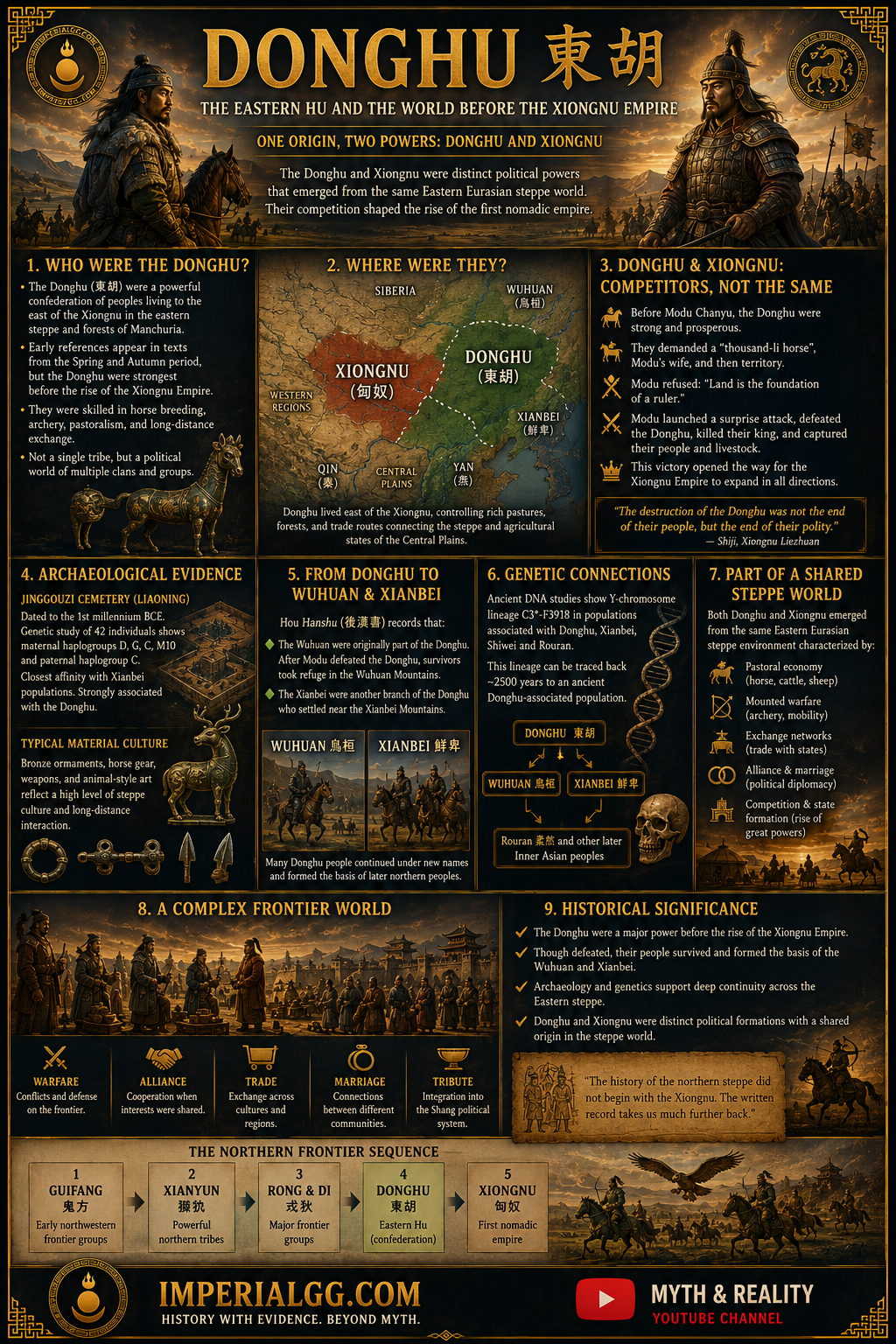
When Modu seized power among the Xiongnu, the Donghu were described as strong and prosperous. Believing that Modu was politically vulnerable after killing his father Touman, the Donghu demanded first the famous “thousand-li horse” and later one of Modu’s wives. Modu surrendered both, apparently calculating that material possessions and even personal relationships were less important than preserving political stability while he consolidated his authority.
The Donghu then made a much more consequential demand: they sought territory lying between the two powers. At this point Modu refused. His response, as transmitted by Sima Qian, was based upon a fundamental principle of steppe kingship: land was not disposable property but the foundation of political authority. Modu executed those who had advised surrender and launched a sudden eastern campaign against the Donghu.
The Donghu were defeated, their ruler was killed, and their people and livestock were captured. Modu subsequently turned westward against the Yuezhi and southward against other northern peoples before recovering territories previously taken by the Qin general Meng Tian. The importance of this narrative cannot be overstated. It presents the destruction of the Donghu not as an isolated battle, but as part of the formation of a new steppe imperial order.
5. DONGHU AND XIONGNU WERE NOT THE SAME POLITY
The historical record therefore gives us an apparent paradox. The Donghu and Xiongnu were clearly different political powers. Yet they occupied the same broad northern Eurasian world, shared many aspects of steppe political and economic culture, and interacted directly before the Xiongnu conquest of the Donghu. This is why the statement that they were “the same people” is too simple.
A more historically defensible formulation is:
The Donghu and Xiongnu were distinct political formations that emerged from a related and overlapping population environment of the Eastern Eurasian Steppe.
This distinction allows us to recognize continuity without erasing political difference. The same principle is visible elsewhere in steppe history. Later populations could preserve cultural, biological and social elements from earlier populations while reorganizing themselves under new political names. The emergence of the Xiongnu Empire should therefore be understood partly as a process of political aggregation and incorporation, rather than the sudden appearance of a completely new population.
6. THE ARCHAEOLOGICAL DONGHU
Archaeology provides an essential second line of evidence because the Donghu did not leave an indigenous written corpus comparable to the Chinese histories. One of the most frequently discussed archaeological contexts is the Jinggouzi cemetery, located in northeastern China and dated broadly to the first millennium BCE.
A genetic study of 42 human remains from Jinggouzi identified mitochondrial haplogroups D, G, C and M10 and Y-chromosome haplogroup C, all of which are found broadly across North and East Asia. The researchers concluded that the Jinggouzi population was genetically closest among ancient comparative samples to Xianbei populations and that archaeological and genetic evidence supported an association between Jinggouzi and the Donghu. This evidence is significant, but it must also be used carefully.
Jinggouzi cannot simply be labeled “the Donghu capital” or assumed to represent every person historically designated Donghu. The archaeological association is an interpretive reconstruction, not an indigenous inscription stating “we are Donghu.” Nevertheless, the combination of chronology, geography, material culture and biological evidence makes the Donghu association historically meaningful.
7. THE DONGHU AND THE C3/F3918 LINEAGE
Genetic research has provided another potentially important connection. A 2018 study examining ancient remains associated with Jinggouzi, Chenwugou and Gangga found Y-chromosome C3*-F3918 among individuals attributed archaeologically to Donghu, Xianbei and Shiwei contexts. The researchers proposed that this paternal lineage could be traced back to an ancient Donghu-associated population. This does not mean that C3-F3918 was a “Donghu gene.” Y-chromosome lineages do not identify entire ethnic groups.
Rather, the evidence demonstrates that certain paternal lineages associated with later northeastern and Inner Asian populations have deep chronological roots extending into populations archaeologically associated with the Donghu sphere.
That finding becomes especially interesting when considered alongside later evidence from Xianbei and Rouran populations.
8. FROM DONGHU TO WUHUAN AND XIANBEI
The strongest textual evidence for Donghu continuity does not come from the Shiji, but from the much later Hou Hanshu. The Biographies of the Wuhuan and Xianbei state that the Wuhuan were originally part of the Donghu and that, after Modu destroyed the Donghu state, survivors took refuge in the Wuhuan Mountains and adopted the name Wuhuan. The same source describes the Xianbei as another branch of the Donghu that settled near the Xianbei Mountains and adopted that name. This tradition creates a remarkably important historical sequence:
DONGHU
↓
WUHUAN
XIANBEI
The historical value of this tradition is considerable, but again it should not be transformed into an absolute biological genealogy.
The Hou Hanshu was written centuries after the Donghu polity had disappeared. Its genealogical language is therefore itself a historical tradition that must be evaluated critically.
Nevertheless, the fact that multiple later Chinese sources preserve the Donghu ancestry of Wuhuan and Xianbei indicates that the memory of Donghu identity remained meaningful within Chinese historical consciousness.
9. XIANBEI AS A LATER DONGHU CONTINUITY
The relationship becomes particularly significant because the Xianbei later became one of the most powerful political forces in northern Eurasia. The Hou Hanshu explicitly describes the Xianbei as a branch of the Donghu, while later sources preserve similar traditions. Archaeological and genetic research has also identified connections between Donghu-associated populations and later Xianbei populations. A recent multidisciplinary study of late Xianbei individuals concluded that genomic, archaeological and historical evidence supports a Donghu origin for the Tuoba Xianbei, while also demonstrating substantial genetic heterogeneity within the Xianbei world.
This is an important warning against simplistic ethnic models.
Continuity does not mean purity. A population can preserve ancestry from an earlier population while incorporating people from many other regions. This was a defining feature of Inner Asian political history.
10. DONGHU AND THE FORMATION OF THE XIONGNU WORLD
The relationship between Donghu and Xiongnu becomes even more interesting when viewed through the archaeology of the eastern steppe. The Xiongnu Empire itself was genetically heterogeneous. Genome-wide studies demonstrate that the Xiongnu political system incorporated populations from widely separated regions of the Eastern Eurasian Steppe and surrounding areas. The empire was therefore not a biologically homogeneous nation but a political structure capable of integrating diverse populations. This provides a useful model for understanding the Donghu–Xiongnu relationship.
The Xiongnu Empire did not necessarily represent the migration of one genetically uniform population that replaced another. Instead, it appears to have emerged through political consolidation, conquest, alliance and incorporation within a pre-existing steppe population landscape. The Donghu were one of the major political powers within that landscape. Their defeat therefore changed the political map without necessarily eliminating the people themselves.
11. THE CONQUEST OF THE DONGHU WAS NOT THE END OF THE DONGHU PEOPLE
This distinction is particularly important. The Shiji says that Modu destroyed the Donghu king and captured their people and livestock. It does not say that every person belonging to the Donghu population was physically annihilated. Indeed, later historical traditions identify Wuhuan and Xianbei as surviving branches of the Donghu.
This suggests a pattern familiar throughout steppe history:
political destruction did not necessarily equal demographic extinction.
A defeated confederation could fragment. Its elites could be killed or absorbed. Its population could be redistributed. Its clans could establish new political identities. And centuries later, historians could remember those populations under entirely different names. Thus the disappearance of Donghu as a major political name should not be interpreted as the disappearance of all biological or cultural descendants of the populations once associated with it.
12. A SHARED NORTHERN EURASIAN ORIGIN?
This brings us to the central proposition of this article. Can the Donghu and Xiongnu be described as having one origin? If “one origin” means that they were literally one tribe with the same ethnic identity, the evidence does not justify the claim. But if “one origin” means that they emerged from a shared and interconnected population history of the Eastern Eurasian Steppe, the proposition becomes much more defensible.
Ancient DNA research demonstrates that the Eastern Steppe was not populated by one static people. Instead, the region contained multiple populations with different ancestries that interacted, mixed and reorganized over thousands of years. The Xiongnu Empire itself emerged from the mixture of distinct local and surrounding populations.
The archaeological record likewise shows long-term interaction among populations of Mongolia, northeastern China, southern Siberia and the northern Chinese frontier.
Therefore, Donghu and Xiongnu can reasonably be placed within a shared macro-historical formation, while still being recognized as distinct political communities.
This is a stronger historical argument than simply claiming:
“Donghu were Xiongnu.”
The evidence instead suggests:
Donghu and Xiongnu were two major political expressions of a broader Eastern Eurasian steppe population and cultural world.
13. THE DONGHU–XIONGNU RELATIONSHIP AS COMPETITION BETWEEN RELATED WORLDS
The story recorded by Sima Qian becomes particularly meaningful when viewed from this perspective. Modu did not conquer an unknown or culturally alien population. He defeated a neighboring steppe power that possessed sufficient political and military strength to challenge the newly consolidated Xiongnu state. The Donghu demanded horses, women and territory because they were participating in the same political culture of steppe power in which livestock, marriage alliances, territory and military prestige were fundamental political resources. Modu’s response transformed the relationship from competition into conquest. The destruction of the Donghu therefore represented a reorganization of an existing steppe political system. The Xiongnu did not create the northern steppe world from nothing. They inherited, absorbed and reorganized an already complex political landscape.
14. DONGHU, XIONGNU, AND THE LONG HISTORY OF THE EASTERN STEPPE
The Donghu question also changes the way we understand the chronology of Inner Asian state formation. If the Xiongnu were the first great steppe empire, this does not mean that the Xiongnu represented the beginning of complex political organization in the steppe.
The Donghu were already described as a powerful polity before Modu’s expansion, while archaeological evidence demonstrates that complex pastoral societies, mounted warriors and long-distance exchange networks existed throughout the preceding centuries.
Yoshimoto has even suggested that the surviving evidence allows the possibility that the Donghu had developed a major nomadic political formation before the Xiongnu, although he emphasizes that the evidence is too fragmentary to reconstruct a complete Donghu “empire” with confidence. This is precisely where archaeology and history must work together. The absence of a surviving written archive does not mean the absence of political organization.
15. FROM DONGHU TO THE LATER STEPPE WORLD
The longer historical trajectory becomes visible when the Donghu are placed alongside the later Wuhuan, Xianbei, Rouran and ultimately medieval steppe powers.
The genetic evidence from a Rouran-period individual at Khermen Tal identified a paternal lineage shared with ancient samples associated with Xianbei and Shiwei contexts, and the authors interpreted this lineage as an important paternal component within the Donghu–Xianbei branch. This does not establish a simple genealogical line from Donghu to every later Mongolian-speaking population.
It does, however, provide evidence that population continuity and population replacement were both operating simultaneously. The eastern steppe was therefore not a succession of completely unrelated peoples. Nor was it a single uninterrupted ethnic nation. It was a dynamic population system in which political names changed more rapidly than ancestry, while ancestry itself was repeatedly transformed through migration and mixture.
CONCLUSION
The Donghu occupy a pivotal position between the early northern frontier societies of the Zhou world and the imperial steppe order created by the Xiongnu.
The surviving Chinese sources identify the Donghu as a powerful eastern neighbor of the Xiongnu, while later histories preserve Wuhuan and Xianbei traditions of Donghu descent. Archaeological and genetic studies provide additional evidence for populations in northeastern China that can plausibly be associated with the Donghu and for paternal lineages extending from Donghu-associated populations into later Xianbei and other Inner Asian populations. The evidence therefore supports continuity, but not simplistic identity.
Donghu and Xiongnu were not the same political entity. They were competitors, and the Shiji explicitly records the destruction of the Donghu by Modu. Yet both belonged to a broader Eastern Eurasian steppe environment whose populations, economies, technologies and political institutions had been developing long before the formation of the Xiongnu Empire.
The most defensible historical conclusion is consequently:
THE DONGHU AND XIONGNU WERE DISTINCT POLITICAL FORMATIONS EMERGING FROM A RELATED AND INTERCONNECTED EASTERN EURASIAN STEPPE POPULATION WORLD.
The destruction of the Donghu did not erase that population world. It reorganized it.
The Donghu political name disappeared, while populations associated with the Donghu tradition continued through new political formations, most prominently the Wuhuan and Xianbei. The Xiongnu, meanwhile, transformed the same wider steppe environment into an imperial political system of unprecedented scale. In this sense, Donghu is not simply a chapter before Xiongnu.It is one of the keys to understanding why the Xiongnu Empire was possible at all.
FOOTNOTES
[1] Sima Qian, Shiji, ch. 110, “Xiongnu liezhuan.” The chapter places the Donghu to the east of the Xiongnu and describes them as a powerful polity immediately before Modu’s eastern campaign.
[2] Michimasa Yoshimoto, “On the Donghu,” Shirin 91, no. 2 (2008): 381–401. Yoshimoto stresses the fragmentary nature of the textual evidence and argues that the Shiji‘s chronological construction of Donghu history must be critically evaluated.
[3] On the broader historical use of Hu and the relationship between northern frontier peoples and later Xiongnu ethnography, see Nina Duthie, “The Nature of the Hu: Wuhuan and Xianbei Ethnography in the San guo zhi and Hou Han shu,” Early Medieval China 25 (2019): 23–41.
[4] Sima Qian’s account distinguishes the Donghu and Xiongnu politically rather than treating them as the same community. The Donghu are described as a powerful neighboring polity that Modu subsequently destroyed.
[5] Étienne de la Vaissière, “Xiongnu,” Encyclopaedia Iranica. De la Vaissière situates the emergence of the Xiongnu within a wider fourth-century BCE development of mounted warrior societies and the transformation of northern frontier economies.
[6] Haijing Wang et al., “Genetic Data Suggests that the Jinggouzi People are Associated with the Donghu, an Ancient Nomadic Group of North China,” Human Biology 84, no. 4 (2012): 365–378.
[7] The Jinggouzi study analyzed 42 human remains and identified mtDNA haplogroups D, G, C and M10 and Y-chromosome haplogroup C; the authors associated the population with Donghu on the basis of genetic and archaeological evidence.
[8] Ye Zhang et al., “The Y-chromosome haplogroup C3*-F3918, likely attributed to the Mongol Empire, can be traced to a 2500-year-old nomadic group,” Journal of Human Genetics (2018). The study examined remains associated with Donghu, Xianbei and Shiwei archaeological contexts and traced C3*-F3918 to an ancient Donghu-associated population.
[9] Hou Hanshu, ch. 120, “Biographies of the Wuhuan and Xianbei.” The text states that the Wuhuan were originally part of the Donghu and that the Xianbei were also a branch of the Donghu.
[10] The Sanguozhi likewise preserves the statement that the Xianbei were descendants/remnants of the Donghu who settled near the Xianbei Mountains.
[11] Jiawei Li et al., “The genome of an ancient Rouran individual reveals an important paternal lineage in the Donghu population,” American Journal of Physical Anthropology 166, no. 4 (2018): 895–905. The study identifies a paternal lineage shared among samples associated with Donghu, Xianbei and Shiwei contexts and discusses its contribution to later Rouran populations.
[12] Choongwon Jeong et al., “A Dynamic 6,000-Year Genetic History of Eurasia’s Eastern Steppe,” Cell 183, no. 4 (2020): 890–904.e29. The genome-wide study of 214 ancient individuals demonstrates substantial population movement and admixture across the Eastern Steppe and finds that the Xiongnu Empire formed through the mixing of distinct local and surrounding populations.
[13] The Shiji explicitly records that the Donghu were powerful when Modu became ruler and narrates the sequence of demands, the dispute over the unoccupied land, and Modu’s subsequent destruction of the Donghu polity.
[14] On the problem of reconstructing Donghu history from the Shiji, see Yoshimoto, “On the Donghu,” pp. 381–401. Yoshimoto notes that the Shiji‘s Donghu narrative is essentially the only Chinese source that attempts a diachronic account extending from the Spring and Autumn period through Modu’s conquest.
[15] Nina Duthie demonstrates that later Chinese ethnographic accounts of Wuhuan and Xianbei deliberately echo earlier Xiongnu descriptions while also diverging from them, showing that “northern peoples” were continually reclassified in Chinese historiography.
[16] On the heterogeneous nature of the Xiongnu political population, see Choongwon Jeong et al., “Genetic population structure of the Xiongnu Empire at imperial and local scales,” Science Advances 9 (2023). The study describes the Xiongnu Empire as a multiethnic political formation incorporating diverse populations across the Eastern Eurasian Steppe.
[17] The 2012 Jinggouzi study should be treated as evidence for an archaeological association with Donghu rather than as proof that every individual at the site was ethnically Donghu. The authors themselves frame their conclusion as an inference based on genetic and archaeological evidence.
[18] Ts. Turbat’s archaeological research on the origins of Xiongnu funerary culture likewise argues for substantial connections between Xiongnu archaeological traditions and earlier Bronze and Early Iron Age populations of Mongolia, emphasizing long-term population continuity alongside cultural transformation.
[19] The available evidence therefore supports a model of population continuity + admixture + political reorganization, rather than either complete replacement or an uninterrupted ethnic identity. The genome-wide Eastern Steppe study is particularly important for this interpretation.
RESEARCH POSITION
For the ImperialGG — Before the Mongols series, I would use the following formulation as our standard:
GUIfANG → XIANYUN → RONG/DI → DONGHU → XIONGNU
is not presented as a proven biological succession of identical peoples. Instead, it represents a research sequence tracing changing political names, populations, archaeological cultures, and historical memories across the northern frontier of East Eurasia.
Within that framework, the Donghu article gives us a particularly strong bridge to the next stage: the Xiongnu were not an isolated historical beginning, but a new imperial political formation emerging from an already developed eastern steppe world.
AUTHOR’S THESIS
DONGHU: THE EASTERN STEPPE BEFORE THE XIONGNU
The Donghu should be understood not as an isolated “tribe,” but as a major political formation of the eastern Eurasian steppe whose historical geography extended across eastern Mongolia and into the northeastern frontier of present-day China.
The textual tradition places the Donghu to the east of the Xiongnu, while later historical sources associate their surviving branches with the Wuhuan and Xianbei. Modern scholarship, however, cautions that “Donghu” may have functioned as a broad historical designation for several related northeastern steppe communities rather than the name of a single, uniform ethnic nation.
Within this framework, the territory associated with the Donghu corresponds substantially with the eastern Mongolian steppe, including areas around present-day Sükhbaatar Province, and extends eastward toward the Greater Khingan and northeastern Inner Mongolia. Mongolian historical scholarship has likewise placed the Donghu in the eastern part of present-day Mongolia and adjoining regions of Russia and China.
This geographical continuity is historically significant.
Sükhbaatar and the eastern Mongolian region were not a peripheral space appearing only with the Mongol Empire. They belonged to a much older zone of interaction in which successive steppe political communities developed, competed and transformed.
The Donghu therefore provide an important historical bridge between the earlier northern frontier communities and the Xiongnu imperial formation.
The decisive turning point came with Modu Chanyu. According to Sima Qian’s Shiji, the Donghu were still “strong” when Modu came to power. After a sequence of demands involving a prized horse, Modu’s consort and finally territory, Modu launched an eastern campaign and destroyed the Donghu political leadership, capturing their people and livestock.
Yet the destruction of the Donghu polity did not mean the disappearance of its population or historical legacy. Later sources identify the Wuhuan and Xianbei as branches of the Donghu tradition, while archaeological and genetic research has identified long-term population connections across the eastern steppe.
THE CENTRAL THESIS
The Donghu and Xiongnu should therefore be understood as distinct political formations emerging within the same broader Eastern Eurasian steppe world—not as identical peoples, but as neighboring and historically interconnected populations whose political traditions developed before, alongside, and after the rise of the Xiongnu Empire.
From this perspective, the Donghu homeland in eastern Mongolia and northeastern Inner Asia represents one of the important geographical foundations for understanding the long prehistory of later Mongolic-speaking political formations.
However, the evidence does not yet allow us to prove that every Donghu community spoke an early form of Mongolic. That linguistic identification remains a research hypothesis rather than an established fact. What can be demonstrated more securely is the long-term archaeological, demographic and political continuity of the eastern Eurasian steppe, within which later Mongolic-speaking populations emerged.
AUTHOR’S THESIS:
DONGHU WAS NOT THE BEGINNING OF A PEOPLE, BUT ONE POLITICAL EXPRESSION OF AN OLDER EASTERN STEPPE WORLD—A WORLD THAT CONNECTED EASTERN MONGOLIA, MANCHURIA, AND INNER MONGOLIA, AND FROM WHICH THE XIONGNU AND LATER NORTHERN POLITIES EMERGED.