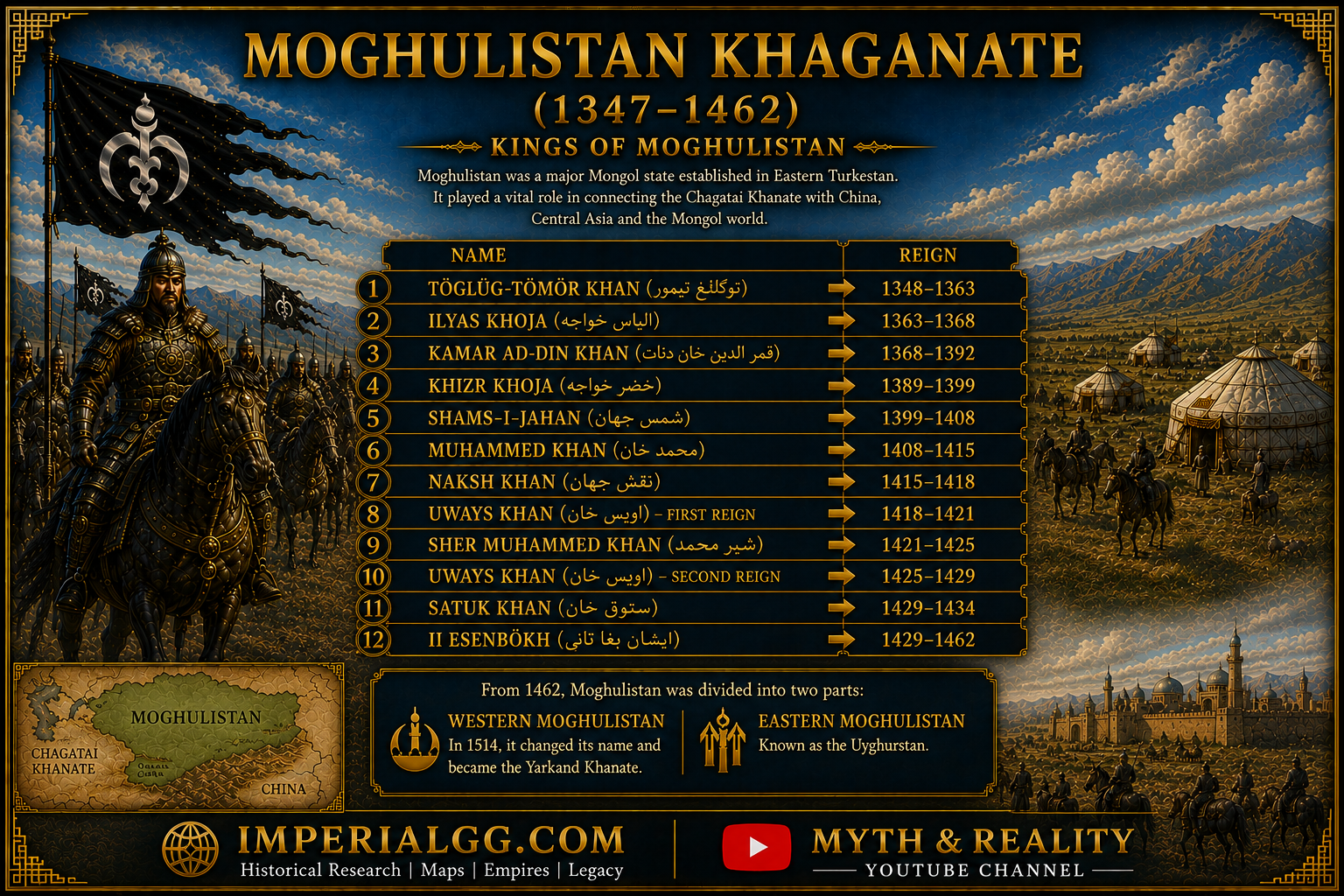
MOGHULISTAN: THE EASTERN SUCCESSOR OF THE CHAGATAI KHANATE | 1347–17th Century
By Altanbagana Baatar
DBA Candidate| Independent Historian
ImperialGG Historical Research Seriers
18 AUGUST 2026
INTRODUCTION
The history of the Mongol world did not end with the fragmentation of the great Chinggisid uluses. Across Central Asia, political communities continued to organize themselves around Chinggisid dynastic legitimacy, Mongol political institutions, and the military and social networks created during the imperial period. One of the most important of these successor polities was Moghulistan, a political formation that emerged in the eastern regions of the Chagatai Ulus during the fourteenth century.[1]
Moghulistan occupied a strategically important zone extending across parts of present-day eastern Kazakhstan, Kyrgyzstan, and Xinjiang. Its territory connected the steppe north of the Tian Shan with the agricultural and urban centers of the Tarim Basin, placing the khanate between two different but interconnected economic and ecological worlds.[2]
The emergence of Moghulistan therefore should not be understood simply as the disappearance of the Chagatai Khanate and the appearance of an unrelated new state. Rather, it represented one stage in the political reorganization of the Chinggisid world after the crises of the mid-fourteenth century.
THE CHAGATAI ULUS AND ITS EASTERN WORLD
The Chagatai Ulus was established from the territories assigned to Chagatai, the second son of Chinggis Khan. Its political geography encompassed a vast zone extending from Central Asia into eastern Inner Asia, including Transoxiana, the Ili Valley, parts of Semirechye, and territories toward the Tarim Basin.[3]
The political structure of this realm was never completely static. Nomadic pastoral zones, agricultural settlements, oasis cities, and major commercial routes existed within the same imperial framework. The geography of eastern Central Asia was particularly significant because the Tian Shan and surrounding steppe provided extensive pastoral environments, while the Tarim Basin contained oasis agriculture and urban centers.[4]
By the first half of the fourteenth century, political authority within the Chagatai realm had become increasingly fragmented. Competing Chinggisid princes, military commanders, tribal elites, and regional political interests struggled for influence. Yet political fragmentation did not necessarily mean that the Chagatai political tradition had disappeared.
David M. Robinson has emphasized that contemporaries did not always perceive the fourteenth-century transformation as a clean rupture. The Chagatai political legacy continued to function as a source of legitimacy, while competing rulers attempted to position themselves within the broader Chinggisid political order.[5]
This distinction is essential. The collapse of a centralized dynasty was not equivalent to the disappearance of its political world.
THE EMERGENCE OF MOGHULISTAN
During the 1340s, the eastern territories of the Chagatai Ulus entered a new period of political consolidation. The polity that historians commonly call Moghulistan emerged in this eastern zone, with its political center associated particularly with the Ili region and the broader lands east of the Tian Shan.[6]
The traditional narrative identifies Tughlugh Timur Khan as the founding ruler of Moghulistan, generally dated to approximately 1347–1348.[7] Later sources, particularly the Tārīkh-i Rashīdī of Muḥammad Haydar Dughlat, present Tughlugh Timur as a Chinggisid ruler who was elevated to the khanate by the powerful Dughlat amir Bolaji.[8]
According to this tradition, the search for a legitimate Chinggisid ruler was itself a political act. The authority of the khan was not merely personal; it was connected to the wider legitimacy of the Chinggisid dynasty.
This is particularly important because Moghulistan’s political system retained a distinction between the Chinggisid khan and the powerful military and tribal elites who exercised practical authority. The later history of the khanate demonstrates that this relationship between dynastic legitimacy and aristocratic power was central to its political structure.[9]
TUGHLUGH TIMUR AND THE QUESTION OF THE “FIRST KHAN”
The identification of Tughlugh Timur as the first khan of Moghulistan is widely accepted in modern historical writing, but it should not be presented as an uncontested fact.
A 2023 study in the Turkic Studies Journal examined the medieval sources and modern historiography concerning Moghulistan’s first khan. It notes that scholars including V. V. Bartold, O. F. Akimushkin, and others regarded Tughlugh Timur as the first khan, drawing on sources such as the Muʿizz al-Ansāb, Ẓafar-nāma, and Shajarat al-Atrāk.[10]
Other scholars, however, have emphasized the evidence of the Tārīkh-i Rashīdī and Shajara-yi Turk, which present Esen Buqa Khan in an earlier position within the formation of Moghulistan.[11]
The disagreement illustrates a broader methodological problem in Central Asian history: much of the surviving narrative evidence was written considerably later than the events it describes.
Consequently, the safest formulation is not that Tughlugh Timur “created Moghulistan from nothing,” but that his elevation marked a major stage in the consolidation of the eastern Chagataid political order that became known as Moghulistan.
This formulation preserves both the conventional historical narrative and the uncertainty of the source tradition.
A CHINGGISID SUCCESSOR STATE
Moghulistan’s legitimacy was deeply connected to the Chinggisid dynasty.
Haydar Dughlat provides a genealogy connecting Tughlugh Timur to Chagatai, son of Chinggis Khan, and ultimately to Alan Qoa, the legendary ancestress of the Mongol ruling lineages.[12] Such genealogies were not merely antiquarian exercises. In the political culture of the post-Mongol world, descent from Chinggis Khan carried powerful implications for legitimate sovereignty.
Robinson’s study of the Moghul khanate demonstrates that Chinggisid identity remained politically meaningful long after the Mongol Empire itself had fragmented. Moghul political elites continued to value Chinggisid law, institutions, dynastic descent, and Mongol political traditions.[13]
The evidence is especially striking because Moghulistan was not simply a “Mongol state” frozen in the thirteenth century. It was a changing Turco-Mongol political society. Its population included nomadic pastoral communities, settled populations, oasis inhabitants, merchants, religious figures, and military elites. Over time, Mongolian political culture interacted increasingly with Turkic language and Islamic institutions.[14]
The result was a distinctly Turco-Mongol political civilization, rather than a simple continuation of the demographic or cultural conditions of the age of Chinggis Khan.
GEOGRAPHY: BETWEEN THE STEPPE AND THE SILK ROAD
Geography was fundamental to Moghulistan’s political importance.
The khanate’s historical territory extended across portions of Zhetysu/Semirechye, the Ili Valley, the eastern Kazakh steppe, Issyk-Kul, Kashgar, and areas adjoining the Tarim Basin.[15]
The region’s ecological diversity created both opportunities and political challenges.
To the north and west were extensive grasslands suitable for pastoralism and horse breeding. To the south were the mountain systems of the Tian Shan and the oasis settlements of the Tarim Basin. Rivers and mountain passes connected these environments and provided routes for military movement and commercial exchange.
The Cambridge History of Inner Asia emphasizes the importance of geography in eastern Central Asian history: the northern regions favored pastoralism and horse breeding, while the southern Tarim and Turfan basins contained fertile agricultural zones, religious centers, and commercial entrepôts.[16]
Moghulistan therefore occupied a geographical position where nomadic and sedentary economies were not separate worlds but interconnected systems.
This helps explain the political significance of the khanate. Control of the steppe provided military mobility and pastoral resources; control or influence over oasis regions provided agricultural production, taxation, urban centers, and access to long-distance trade.
THE MOGHUL KHANS AND CHAGATAID LEGITIMACY
The history of Moghulistan after Tughlugh Timur continued to revolve around Chinggisid legitimacy.
Among the most important rulers was Khizr Khwaja Khan, the son of Tughlugh Timur. His reign demonstrates the continuing importance of Chagataid dynastic authority in the region.[17]
Later rulers such as Yunus Khan and Ahmad Alaq Khan continued the Chagataid line in the eastern Central Asian political environment.
The khans, however, did not exercise power in isolation. The Dughlat amirs and other tribal aristocracies possessed considerable political influence. This dual structure—Chinggisid dynastic legitimacy combined with the power of tribal and military elites—was characteristic of much of the post-Mongol political world.[18]
The political history of Moghulistan consequently cannot be reduced to a simple succession list. It was a negotiation between dynasty, aristocracy, pastoral power, urban wealth, religion, and geography.
ISLAM AND THE TRANSFORMATION OF MOGHUL SOCIETY
The religious history of Moghulistan also illustrates the transformation of the post-Mongol world. Islam had already entered the Chagatai political sphere before the formation of Moghulistan. Several Chagataid rulers had converted to Islam, and Muslim institutions increasingly influenced political and cultural life in Central Asia.[19]
Tughlugh Timur is traditionally associated with the Islamization of the Moghul khanate, although the process was gradual rather than instantaneous. The later Moghul khans ruled over societies in which Islamic institutions coexisted with older Mongol political customs. Haydar Dughlat preserves evidence of practices associated with Mongol political culture, including military organization, hunting, falconry, pastoral customs, and traditions surrounding the khan’s household.[20] This coexistence is important. Islamization did not simply erase Mongol political culture. Instead, Mongol and Islamic traditions became incorporated into a new political synthesis.
THE MOGHULS AND THE TIMURIDS
Moghulistan’s history was closely connected to the rise of Timur. In the second half of the fourteenth century, the Moghul khans and Timur competed for influence across the former Chagatai territories. Timur’s power base lay primarily in Transoxiana, while Moghulistan controlled much of the eastern region. Their rivalry was therefore more than a series of military campaigns. It was also a contest over the political inheritance of the Chagatai Ulus.
Robinson notes that the conflict between the Timurids and Moghuls can be understood partly as a struggle over the Mongol imperial legacy and the possibility of restoring political unity within the Chagatai world.[21]
Yet the political distinction between Timur and the Moghul khans was fundamental: Timur himself was not a Chinggisid. His authority therefore operated through a different political strategy, including marriage alliances with Chinggisid women and the installation of Chinggisid khans as legitimizing figures.[22] Moghulistan, by contrast, retained a Chinggisid khanate. This distinction helps explain the political significance of the Moghul state within post-Mongol Central Asia.
MOGHULISTAN AND THE LONG AFTERLIFE OF THE MONGOL EMPIRE
The history of Moghulistan demonstrates that the Mongol Empire’s political legacy survived long after the empire ceased to function as a single unified state. Its rulers continued to use Chinggisid genealogy. Its elites maintained Mongol political traditions. Its military organization retained features inherited from the Mongol imperial system. Documents could still be produced in the Mongolian language, while the wider society increasingly adopted Turkic linguistic and Islamic cultural forms.[23] This was not an isolated phenomenon.
Across Eurasia, the fourteenth and fifteenth centuries witnessed the emergence of new political systems built from the institutions, populations, and memories of the Mongol Empire. The Timurids, Jochid successor states, Moghulistan, and later Central Asian khanates all participated in this broader transformation.[24]
Moghulistan is therefore best understood not as an historical footnote following the “collapse” of the Mongol Empire, but as part of the post-imperial continuation of Chinggisid political civilization.
FROM MOGHULISTAN TO THE LATER KHANATES
The political history of Moghulistan continued for centuries, although its territory, political institutions, and ruling relationships changed repeatedly. By the fifteenth and sixteenth centuries, the Chagataid political world had become divided among several eastern Central Asian formations. The Yarkand Khanate, established in 1514 by Sultan Said Khan, emerged from this eastern Chagataid environment. UNESCO’s History of Civilizations of Central Asia identifies Said Khan as a descendant of Tughlugh Timur and describes the earlier eastern Chagataid realm as encompassing Moghulistan, Uighuristan, and Mangalai Suyah at different stages.[25]
This genealogy demonstrates the durability of Chagataid dynastic legitimacy. The political map had changed, but the dynastic memory had not disappeared.
CONCLUSION
Moghulistan emerged from the eastern political world of the Chagatai Ulus during the fourteenth century. Its formation was part of the fragmentation and reorganization of Chinggisid Central Asia, but fragmentation should not be confused with historical discontinuity.
The Moghul khans continued to claim Chinggisid legitimacy. Mongol political traditions remained influential. Nomadic and sedentary economies remained interconnected. Islam increasingly shaped political and cultural life without simply replacing older Mongol institutions.
For these reasons, Moghulistan can be described as an eastern Chagataid successor polity—not because the Chagatai Khanate continued unchanged, but because the political institutions, dynastic traditions, elite networks, and historical memory of the Chagataid world continued to shape the new state.
Its history therefore occupies an important position in the transition:
CHINGGIS KHAN → CHAGATAI ULUS → MOGHULISTAN → LATER CHAGATAID KHANATES
The story is not one of disappearance.
It is a story of political transformation, dynastic continuity, and cultural adaptation across the post-Mongol steppe.
FOOTNOTES
1. David M. Robinson, “Eurasia after the Fall,” in In the Shadow of the Mongol Empire (Cambridge University Press, 2019), pp. 29–46. Robinson emphasizes the continuing importance of Chinggisid institutions, legitimacy, political culture, and elite networks after the fragmentation of the Mongol Empire.
2. Denis Sinor, ed., The Cambridge History of Early Inner Asia, and related scholarship on eastern Central Asia; see also the Cambridge History of Inner Asia discussion of Moghulistan’s geography, pastoral zones, oasis agriculture, and commercial centers.
3. Thomas T. Allsen, Culture and Conquest in Mongol Eurasia (Cambridge University Press, 2001), for the institutional and cultural framework of the Chinggisid uluses.
4. The Cambridge History of Inner Asia, discussion of eastern Central Asia and the ecological distinction between the northern pastoral regions and the southern oasis zones.
5. Robinson, “Eurasia after the Fall.” The chapter specifically cautions against viewing the fourteenth-century collapse of Chinggisid states as a simple contemporary rupture and emphasizes the persistence of Chinggisid legitimacy and political culture.
6. On the emergence of Moghulistan in the eastern portion of the Chagatai Ulus, see Sergazy Akhmetkul, Umirbaj Bekmaganbetov, and Kairat Battalov, “The First Khan of Moghulistan in Medieval Sources and Works of Researchers,” Turkic Studies Journal 5, no. 4 (2023): 7–17.
7. Ibid. The article summarizes the conventional historiographical position identifying Tughlugh Timur as the first khan of Moghulistan.
8. Muḥammad Haydar Dughlat, Tārīkh-i Rashīdī, trans. Edward Denison Ross; the surviving account traces Tughlugh Timur’s Chinggisid genealogy and describes his elevation by Amir Bolaji. See also Robinson, who discusses Dughlat’s account and the elevation of Tughlugh Timur.
9. Robinson, “Eurasia after the Fall,” especially his discussion of Chinggisid descent, Moghul political institutions, and the role of non-Chinggisid military elites.
10. Akhmetkul, Bekmaganbetov, and Battalov, “The First Khan of Moghulistan,” pp. 7–17.
11. Ibid. The authors specifically discuss the historiographical argument that Esen Buqa may represent an earlier Moghulistan khan according to the Tārīkh-i Rashīdī and Shajara-yi Turk.
12. Robinson, “Eurasia after the Fall,” citing Dughlat’s Tārīkh-i Rashīdī genealogy of Tughlugh Timur.
13. Robinson notes that the Moghul khanate retained written documents in Mongolian, valued Chinggisid law, and continued to conceptualize itself through Mongol political traditions.
14. Ma Dazheng, “The Tarim Basin under the Chaghatay Khanate,” in History of Civilizations of Central Asia, vol. 5 (UNESCO), pp. 182–193. The study discusses the Chagataid Moghuls, their territory, political history, and the persistence of Mongolian language and pastoral culture into the early sixteenth century.
15. Ibid., pp. 182–183.
16. The Cambridge History of Inner Asia, section on eastern Central Asia and Moghulistan.
17. Ma Dazheng, “The Tarim Basin under the Chaghatay Khanate,” which identifies Khizr Khwaja as the son of Tughlugh Timur and describes the extent of the eastern Chagataid realm during his reign.
18. Robinson, “Eurasia after the Fall.” The chapter emphasizes the interaction between Chinggisid khans and Turco-Mongolian lineages in Moghul political life.
19. On Islam and the Chagataid political world, see Robinson’s discussion of Chagataid rulers and the later Moghul khanate.
20. Robinson, “Eurasia after the Fall,” including his discussion of archery, hunting, falconry, military organization, Mongol customs, and the Tārīkh-i Rashīdī.
21. Robinson notes that the conflict between the Timurids and Moghuls has been interpreted as a struggle for the inheritance and possible reunification of the Chagatai political world.
22. Ibid. Robinson discusses Timur’s reliance on Chinggisid connections and his use of Chinggisid khans to reinforce political legitimacy.
23. Robinson, “Eurasia after the Fall.”
24. Robinson’s broader analysis places the Moghul and Timurid polities within a larger Eurasian process in which successor states adapted Mongol institutions, political culture, and historical memory.
25. Ma Dazheng, “The Tarim Basin under the Chaghatay Khanate,” History of Civilizations of Central Asia, vol. 5, UNESCO, pp. 182–193. The chapter identifies Sultan Said Khan, founder of the Yarkand Khanate in 1514, as a descendant of Tughlugh Timur and discusses the eastern Chagataid territorial divisions.
SELECTED ACADEMIC SOURCES
Akhmetkul, Sergazy, Umirbaj Bekmaganbetov, and Kairat Battalov. “The First Khan of Moghulistan in Medieval Sources and Works of Researchers.” Turkic Studies Journal 5, no. 4 (2023): 7–17.
Allsen, Thomas T. Culture and Conquest in Mongol Eurasia. Cambridge: Cambridge University Press, 2001.
Dughlat, Muḥammad Haydar. Tārīkh-i Rashīdī: A History of the Moghuls of Central Asia. Translated by Edward Denison Ross, edited and with commentary by N. Elias. London, 1895.
Ma Dazheng. “The Tarim Basin under the Chaghatay Khanate.” In History of Civilizations of Central Asia, vol. 5. Paris: UNESCO.
Robinson, David M. “Eurasia after the Fall.” In In the Shadow of the Mongol Empire. Cambridge: Cambridge University Press, 2019.
The Cambridge History of Inner Asia. Cambridge University Press.
EDITORIAL NOTE: Dates and political boundaries in fourteenth- to seventeenth-century Central Asia remain subject to source variation. The terminology “Moghulistan,” “Moghul Khanate,” and “eastern Chagataid realm” can refer to overlapping but not always identical geographical and political concepts; therefore, this article uses them with contextual rather than rigidly modern territorial definitions.