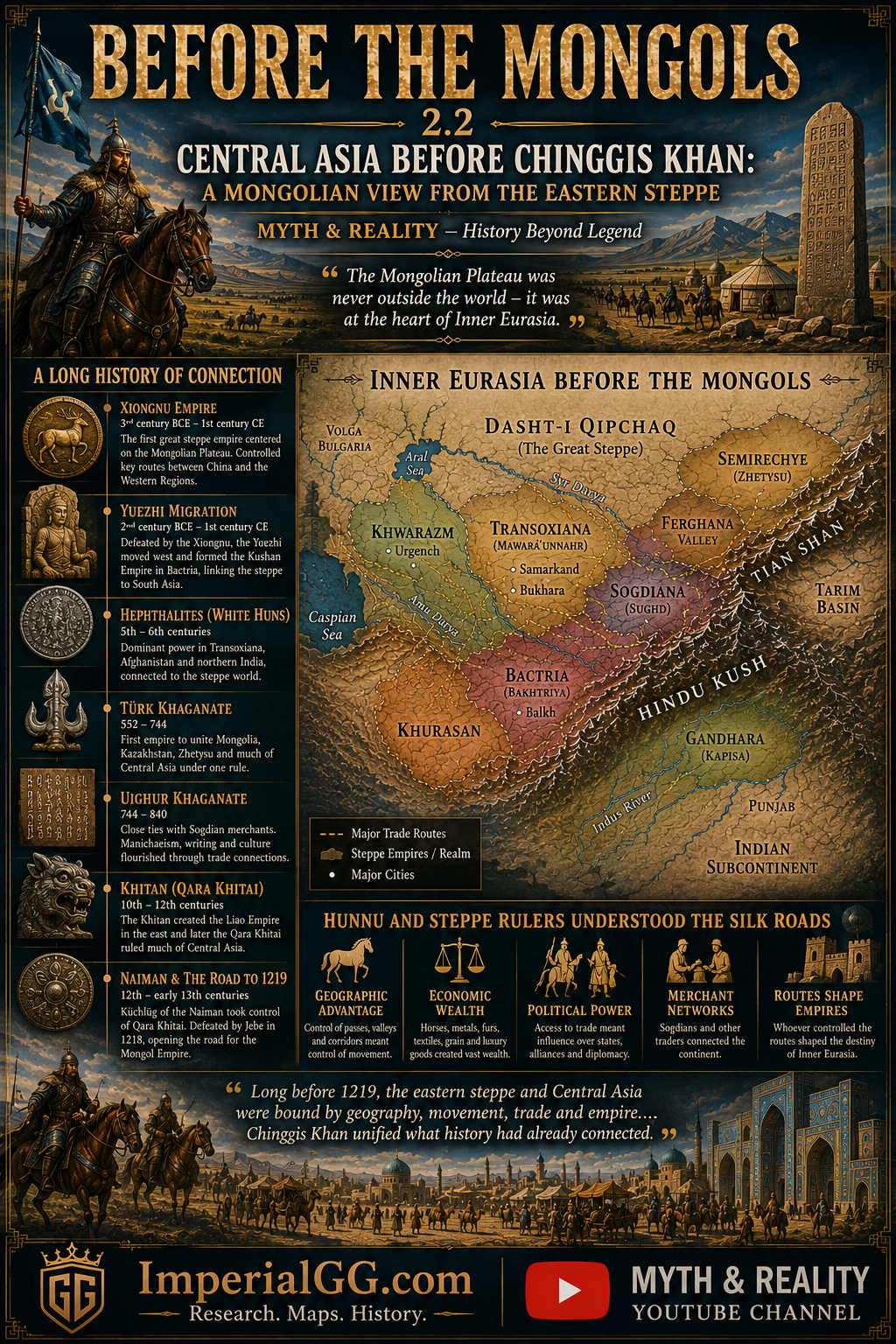
2.2 - CENTRAL ASIA BEFORE CHINGGIS KHAN: A MONGOLIAN VIEW FROM THE EASTERN STEPPE
By Altanbagana Baatar
DBA Candidate| Independent Historian
ImperialGG Historical Research Seriers
17 July 2026
The World Beyond the Altai Was Never Foreign
Modern maps encourage us to imagine Mongolia and Central Asia as separate geographical worlds. Mongolia appears in the northeast of Inner Asia, while Kazakhstan, Kyrgyzstan, Uzbekistan, Tajikistan, Turkmenistan, Afghanistan, and the lands farther south appear as another region called Central Asia. Political borders reinforce this division, and modern national histories often begin their narratives within those borders. Yet from the perspective of the ancient and medieval steppe, such a separation would have made little sense.
For the peoples who lived on the Mongolian Plateau, the Altai was not the western wall of their world. It was one of the great gateways into a much larger Inner Eurasian space. Beyond it stretched the valleys of the Irtysh, the grasslands of eastern Kazakhstan, the lands of Semirechye or Zhetysu, the Tian Shan, the Syr Darya, and eventually the oasis civilizations of Transoxiana. Farther south stood Bactria, Khurasan, Afghanistan, and the routes crossing the Hindu Kush toward the Indian subcontinent. These regions differed greatly in language, religion, economy, and political organization, but they were connected by routes of movement that had existed long before the rise of the Mongol Empire.
Seen from the eastern steppe, therefore, Central Asia was not a distant foreign world suddenly discovered by the Mongols in the thirteenth century. It was the western extension of an interconnected Inner Eurasian political environment in which peoples, confederations, merchants, technologies, religions, and ruling traditions had moved for centuries. The Mongol conquest of Central Asia can only be fully understood when this older eastern connection is restored to the story.
The Altai as a Bridge Between Two Worlds
The Altai Mountains occupy a unique position in the geography of Inner Eurasia. Today they are divided among Mongolia, Kazakhstan, Russia, and China, but historically they stood near the center of a vast zone connecting the Mongolian Plateau with the western steppe. Mountain valleys, river systems, and seasonal pastures created corridors through which pastoral populations could move between regions that modern political geography now separates.
For ancient steppe societies, distance functioned differently from the way it did for sedentary agricultural states. A thousand kilometers of open grassland could sometimes be politically easier to cross than a much shorter region of mountains, forests, fortified cities, or heavily cultivated territory. Horses, mobile households, seasonal migration, and decentralized networks allowed steppe communities to maintain relationships across enormous spaces. Political alliances could therefore stretch from Mongolia toward the Altai and Kazakhstan, while military movements could carry populations from the eastern steppe deep into Central Asia within a relatively short historical period.
This geographical reality explains why major political transformations on the Mongolian Plateau repeatedly produced consequences far to the west. The rise of a new confederation in Mongolia could push defeated groups toward the Altai, which in turn displaced other populations toward Zhetysu, Transoxiana, or the western steppe. Conversely, political powers based in Central Asia could extend their influence eastward toward Mongolia. Inner Eurasian history was therefore shaped by chains of movement rather than by isolated national histories. The Mongols of the thirteenth century inherited this geography. They did not create the corridor connecting Mongolia with Central Asia; they became the most successful political power ever to use it.
Ancient Movements Across Inner Eurasia
Long before any people known as Mongols appeared in the written historical record, the eastern and western regions of Inner Eurasia were already connected. Archaeological evidence from the Bronze and Iron Ages reveals broad patterns of technological exchange, horse culture, metallurgy, artistic traditions, and pastoral mobility extending across the steppe.
These connections should not be simplified into claims that every ancient population of the Eurasian steppe was ethnically Mongol, Turkic, Iranian, or the direct ancestor of a modern nation. Ancient Inner Eurasia was far more complex. Languages changed, confederations absorbed different populations, political identities appeared and disappeared, and communities frequently moved across enormous territories. Modern ethnic categories cannot simply be projected backward several thousand years.
Yet avoiding simplistic ethnic claims does not require us to deny historical continuity altogether. There was a profound continuity of geographical interaction. The same broad corridors repeatedly carried populations and political power between the Mongolian Plateau and Central Asia. The Altai, eastern Kazakhstan, Zhetysu, and the Tian Shan repeatedly served as intermediate zones between the eastern steppe and the oasis civilizations farther west and south. This structural continuity is one of the keys to understanding the later rise of the Mongol Empire. Chinggis Khan’s armies moved through routes that generations of steppe peoples had already known. What changed in the thirteenth century was the political organization capable of controlling those routes on an unprecedented scale.
The Xiongnu and the First Great Eastern Steppe Empire
From a Mongolian historical perspective, one of the most important early transformations came with the rise of the Xiongnu Empire in the late third century BCE. Centered on the Mongolian Plateau, the Xiongnu created the first historically documented steppe empire to unite a vast portion of Inner Asia under a durable imperial structure.
The Xiongnu were not confined to the territory of modern Mongolia. Their political influence extended toward the Altai, the Gobi, southern Siberia, and the regions connecting the eastern steppe with Central Asia. Their rise altered the balance of power far beyond the Mongolian Plateau and contributed to population movements that reshaped Central Asian history.
The most famous example involved the Yuezhi. After conflict with the Xiongnu, major Yuezhi groups moved westward across Inner Asia and eventually reached Bactria. From the political world that followed their migration emerged the Kushan Empire, which later controlled territories extending through Afghanistan into the Indian subcontinent. This sequence demonstrates the extraordinary geographical reach of steppe politics. A conflict originating near the eastern regions of Inner Asia contributed, through successive migrations and political transformations, to the emergence of an empire centered thousands of kilometers away in Central and South Asia.
From the viewpoint of conventional regional histories, the Xiongnu, Yuezhi, Bactria, and Kushans are often placed in separate chapters. From an Inner Eurasian perspective, however, they belonged to a connected chain of historical transformation. The eastern steppe could reshape Central Asia, and Central Asian political changes could in turn influence India, Iran, and the wider Eurasian world.
The Xiongnu Question and the Limits of Modern Identity
For Mongolian readers, the Xiongnu naturally occupy a central place in the deep history of the Mongolian Plateau. Their imperial center lay in the same broad geographical world in which later Rouran, Turkic, Uyghur, Khitan, and Mongol states would rise. This geographical and political continuity deserves serious historical attention.
At the same time, historical continuity should not be confused with a simplistic claim of unchanged ethnic identity across fifteen centuries. The relationship between the Xiongnu and later Mongolic-speaking populations remains a complex scholarly question involving archaeology, linguistics, genetics, and historical interpretation. The Xiongnu Empire itself almost certainly contained multiple populations and linguistic communities.
The more historically defensible point is broader and, in many ways, more significant. The Mongolian Plateau repeatedly functioned as the center of large Inner Eurasian political systems whose influence extended into Central Asia. The political traditions of steppe confederation, imperial mobility, control of pasture networks, diplomatic exchange with sedentary civilizations, and management of multiethnic populations did not begin with Chinggis Khan. The Mongol Empire emerged from a region with a very long history of imperial state formation. Central Asia had experienced the consequences of that history many times before 1219.
The Huns and the Westward Movement of Steppe Power
The relationship between the Xiongnu and the later Huns remains debated, and a direct identification cannot simply be treated as established fact. Nevertheless, the broader historical pattern of westward movement across the Eurasian steppe is undeniable.
During Late Antiquity, political transformations originating in Inner Eurasia contributed to waves of migration and military expansion that reached Central Asia, the Caspian steppe, and eventually Europe. Groups identified in different sources as Huns, Hephthalites, and other names emerged within this changing environment, although their precise ethnic and linguistic relationships remain subjects of continuing scholarship.
For the history of Central Asia, the Hephthalites became especially important. Their political power extended across parts of Transoxiana, Afghanistan, and northern India during the fifth and sixth centuries. They interacted with the Sasanian Empire, Indian states, and steppe powers, once again demonstrating that the regions north and south of the Hindu Kush belonged to an interconnected political system.
The eastern steppe was not always the direct center of these states, but the wider mechanism remained familiar. Political change moved across Inner Eurasia through alliances, migrations, military pressure, and the reorganization of confederations. Central Asia stood at the center of these movements because it connected the eastern steppe with Iran and South Asia.
The Rouran and the Political World Before the Turks
After the fragmentation of Xiongnu power, the Mongolian Plateau continued to generate new political formations. Among the most important were the Xianbei and, later, the Rouran Khaganate, known in Mongolian historical discussions through the Nirun tradition.
The Rouran established a major steppe empire across Mongolia and surrounding territories during the fourth to sixth centuries. Their political system formed part of the long sequence of imperial powers centered on the Mongolian Plateau before the rise of the Turks.
The importance of the Rouran for Central Asian history lies partly in what followed their destruction. In the middle of the sixth century, the Türk rebellion overthrew Rouran supremacy and created a new imperial order that expanded with extraordinary speed across Inner Eurasia. Once again, a political revolution centered in the eastern steppe transformed the history of Central Asia.
The Türk Khaganate: When Mongolia and Central Asia Entered One Imperial System
The rise of the Türk Khaganate in 552 represents one of the decisive moments in the history of Inner Eurasia. Originating in the political world of the Mongolian Plateau and the Altai, the Turks rapidly created an empire extending from the eastern steppe deep into Central Asia and toward the western Eurasian grasslands.
For perhaps the first time since the height of earlier steppe empires, Mongolia, the Altai, Kazakhstan, Zhetysu, and major parts of the Central Asian political world were incorporated into a single imperial system whose ruling elite emerged from Inner Asia. The importance of this development cannot be overstated. The routes later used by the Mongol Empire were already operating within a large steppe imperial structure centuries earlier. Political authority moved between Mongolia and Central Asia, diplomatic missions crossed the continent, and Sogdian merchants became crucial partners in the commercial networks of the Türk Empire.
The relationship between the Turks and the Sogdians demonstrates the complementary character of steppe and urban power. The Turks possessed military mobility and controlled enormous territories, while Sogdian merchants possessed commercial networks, urban knowledge, literacy, and diplomatic experience. Together, these worlds created a system connecting China, Mongolia, Central Asia, Iran, and the western steppe. The Mongol Empire would later reproduce this pattern on a still greater scale by combining steppe military organization with the administrative, commercial, and intellectual resources of conquered sedentary civilizations.
Mongolia Was Not Outside the Silk Roads
Popular images of the Silk Road often draw a narrow line from China through the Tarim Basin toward Samarkand and Persia, leaving the Mongolian Plateau somewhere outside the main network. Historically, the reality was much more complex.
Trade routes followed political opportunities. When powerful steppe empires controlled Mongolia and the northern corridors, merchants used those routes. Horses, furs, metals, textiles, livestock, luxury goods, diplomatic gifts, and information moved through the steppe as well as through oasis cities.
Sogdian merchants were active in the political worlds of the Turks and other Inner Asian empires. Archaeological discoveries across Mongolia reveal objects and influences originating from distant regions, demonstrating that the Mongolian Plateau participated in continental exchange long before the Mongol Empire. The Silk Roads should therefore be understood as a network rather than a single road. Mongolia represented one of the northern branches of that network, while Central Asia formed its great central intersection. When the Mongols later unified much of Eurasia, they did not invent transcontinental exchange. They inherited and dramatically expanded older systems in which their own homeland had already participated.
Popular images of the Silk Road often draw a narrow line from China through the Tarim Basin toward Samarkand and Persia, leaving the Mongolian Plateau somewhere outside the main network. Historically, however, the reality was far more complex. From at least the age of the Xiongnu, the rulers of the eastern steppe understood the strategic, geographical, and economic value of the trans-Eurasian routes connecting China, the Mongolian Plateau, Central Asia, and the lands farther west. Control over these routes, the territories surrounding them, and the movement of valuable commodities was not merely a secondary consequence of steppe expansion but an important element of imperial power.
The Xiongnu understood that geography itself was a source of wealth and political influence. The Mongolian Plateau stood between the agricultural economy of Han China and the enormous Inner Eurasian world extending westward through the Altai and Central Asia. Horses, livestock, furs, metals, textiles, grain, luxury goods, and diplomatic gifts moved through interconnected networks of exchange, while control over strategic corridors allowed powerful steppe states to influence the movement of both goods and people. Relations between the Xiongnu and Han therefore involved far more than warfare alone; they also concerned access to resources, frontier markets, tribute and gift exchange, and the political regulation of economic relations between two very different but deeply interconnected worlds.
The struggle over the Hexi Corridor further demonstrated the strategic importance of controlling the routes toward Central Asia. For the Han dynasty, expansion into the corridor opened more secure access toward the Western Regions, while for the Xiongnu the loss of influence there weakened an important connection between the eastern steppe and the wider Central Asian world. The political competition surrounding these routes shows that the geographical and economic significance of transcontinental exchange was understood long before the period traditionally associated with the flourishing of the medieval Silk Roads.
Later steppe empires inherited and expanded this understanding. The Türk Khaganates controlled enormous territories linking the Mongolian Plateau, the Altai, Zhetysu, and Central Asia, while Sogdian merchants became crucial participants in their commercial and diplomatic networks. The Uyghur Khaganate similarly benefited from international exchange and maintained close relationships with merchant communities operating across Inner Eurasia. Trade routes followed political power, and when strong states controlled the Mongolian Plateau and the northern steppe corridors, those routes became important arteries of imperial wealth and diplomacy.
The Mongols therefore did not suddenly discover the economic importance of Eurasian trade in the thirteenth century. They inherited a strategic understanding that had developed through centuries of state formation on the Mongolian Plateau. From the Xiongnu onward, the great powers of the eastern steppe had repeatedly recognized that control of territory also meant control of movement: the movement of armies, merchants, animals, commodities, information, and diplomatic missions across the continent. Chinggis Khan and his successors eventually brought this older geopolitical logic to an unprecedented scale by uniting many of the principal routes of Eurasia within a single imperial system.
The Silk Roads should therefore be understood not as a commercial network that passed around Mongolia, but as a larger Eurasian system in which the Mongolian Plateau and its successive empires repeatedly played an active political role. Long before the Pax Mongolica, the rulers of the eastern steppe understood a fundamental reality of Inner Eurasian power: whoever could secure the great corridors connecting East and West possessed not only land, but access to the wealth, information, and strategic networks of the wider continent.
The Uyghur Khaganate and the Central Asian Connection
After the collapse of the Second Türk Khaganate, the Uyghur Khaganate became the dominant power on the Mongolian Plateau during the eighth and ninth centuries. The Uyghurs maintained close relationships with Sogdian commercial and cultural networks, and their political world reflected the deepening interaction between the eastern steppe and Central Asia.
Manichaeism entered the Uyghur court through these connections, while Sogdian influence contributed to traditions of literacy and administration. After the destruction of the Uyghur Khaganate in the ninth century, groups of Uyghurs moved south and west toward the Gansu corridor and the Tarim Basin. This movement again demonstrates the permeability of the boundaries between Mongolia and Central Asia. A population that had ruled an empire centered on the Mongolian Plateau became an important component of the political and cultural world farther west.
Centuries later, the Mongols would encounter Uyghur communities whose scribal and administrative traditions became crucial to the emerging Mongol state. The vertical Mongolian script itself developed through this broader chain of cultural transmission from Sogdian-derived writing traditions through the Uyghur world. Thus, one of the most important instruments of Mongol imperial administration carried within it the history of centuries of interaction between Central Asia and the eastern steppe.
The Khitan and the Road West
The Khitan created another major empire in the eastern regions of Inner Asia with the rise of the Liao dynasty. Their political world included parts of Mongolia and northern China and continued the long tradition of powerful states emerging along the frontier between the steppe and the agricultural civilizations of East Asia.
When the Liao dynasty fell in the early twelfth century, the Khitan prince Yelü Dashi led followers westward across Inner Asia. Their migration eventually produced the Qara Khitai, or Western Liao, which became one of the dominant powers of Central Asia. From a Mongolian geographical perspective, this movement is particularly revealing. A political elite displaced from the eastern Inner Asian world crossed the steppe and established a new empire thousands of kilometers to the west, ruling over territories extending across Zhetysu and much of Central Asia.
The Qara Khitai defeated the Seljuk Sultan Sanjar near Samarkand in 1141 and became overlords of several Muslim states. Their empire stood directly within the political landscape that Chinggis Khan would encounter less than a century later. Once again, the history of Central Asia cannot be separated from the political history of Mongolia and the eastern steppe.
The Naiman, the Qara Khitai, and the Immediate Road to the Mongol Conquest
The connection became even more direct during the lifetime of Chinggis Khan. After the defeat of the Naiman ruler Tayang Khan, his son Küchlüg fled westward from the Mongolian political world and entered the territory of the Qara Khitai.
Küchlüg eventually seized effective control of the Qara Khitai state, transforming a conflict that had begun on the Mongolian Plateau into a major political crisis in Central Asia. His rise affected the cities and populations of the region and brought him into direct conflict with the expanding Mongol Empire.
In 1218, the Mongol commander Jebe pursued and defeated Küchlüg. The campaign eliminated one of Chinggis Khan’s old enemies but also brought the Mongols directly to the borders of the Khwarazmian Empire. This sequence is essential for understanding what happened next. The Mongols did not suddenly decide to march into an unknown Central Asia. The road west had been opened through a chain of political conflicts extending from Mongolia itself. The struggle against the Naiman had moved into the Qara Khitai world, and the destruction of Küchlüg placed the Mongol Empire directly beside Khwarazm. The geography of Inner Eurasia had turned a war on the Mongolian Plateau into a confrontation in Transoxiana.
A Familiar Political World, Not a Familiar Civilization
None of this means that the Mongols considered Samarkand, Bukhara, Khwarazm, or the Islamic cities of Central Asia culturally identical to Mongolia. They clearly were not. The Mongols entering these regions encountered enormous cities, sophisticated irrigation systems, Islamic religious institutions, Persian literary traditions, established bureaucracies, and commercial economies very different from the pastoral society of the Mongolian Plateau.
The distinction that matters is between cultural unfamiliarity and geopolitical unfamiliarity. Central Asia’s urban civilization may have been different from Mongolia, but the political routes leading toward it were deeply embedded in the history of the steppe. The Mongols understood alliances, tribute, submission, dynastic competition, mobile warfare, long-distance diplomacy, and the political importance of controlling trade routes. They also inherited information from merchants, Uyghur administrators, conquered peoples, and earlier steppe networks.
The Mongol conquest therefore represented the meeting of different civilizations within a geopolitical space that had already connected them for centuries.
Why the Mongol View Changes the Story
When the history of Central Asia is written primarily from the perspective of sedentary civilizations, steppe peoples often appear suddenly at the borders of established states. They arrive as invaders, destroy existing political orders, and then disappear or become absorbed into the civilizations they conquered.
From the perspective of Inner Eurasia, the chronology looks different. The steppe had its own political history. Empires rose and fell on the Mongolian Plateau. Their victories and defeats produced movements across the Altai. Those movements reshaped Kazakhstan and Zhetysu. Changes there affected Transoxiana. Transformations in Transoxiana influenced Afghanistan and the Indian subcontinent. The process could also operate in the opposite direction.
What appears from one regional perspective as an unexpected invasion may appear from another as the latest stage of a political transformation already moving across the continent. This is why the Mongol conquest of Central Asia should not begin historically in 1219. Its deeper history begins centuries earlier.
The Mongols as Heirs to an Inner Eurasian Tradition
Chinggis Khan’s greatest achievement was not simply the creation of a powerful cavalry army. Steppe societies had produced formidable mounted forces long before his birth. His deeper achievement was the construction of a political system capable of integrating different tribes, conquered peoples, military units, administrators, merchants, and specialists into a rapidly expanding imperial structure.
In this respect, the Mongol Empire belonged to a much older Inner Eurasian tradition while simultaneously transforming that tradition. The Xiongnu had created a large steppe empire centered on the Mongolian Plateau. The Rouran had ruled another major confederation. The Turks had connected Mongolia with Central Asia. The Uyghurs had deepened relationships with Sogdian commercial culture. The Khitan had demonstrated that eastern Inner Asian political traditions could migrate westward and establish new states. The Mongols inherited this historical landscape but exceeded all their predecessors in geographical scale and institutional adaptability. Their conquest of Central Asia was therefore both revolutionary and historically connected to what had come before.
1219 Seen from the East
From the viewpoint of Bukhara or Samarkand, the arrival of the Mongol armies in 1219 represented the beginning of a catastrophic invasion from the east. From the viewpoint of the Mongolian Plateau, however, those armies had already traveled through a long sequence of political transformations.
Chinggis Khan had unified the Mongolian steppe. The Naiman had been defeated. Küchlüg had fled west. The Qara Khitai political order had been overturned. Jebe had pursued the conflict into Central Asia. The Mongols and Khwarazm had become neighbors. Commercial contact followed. The Otrar crisis transformed diplomacy into war. These events formed one continuous geopolitical sequence.
Seen from this perspective, 1219 was not the moment when Mongolia first entered Central Asian history. It was the moment when a political power centered on the Mongolian Plateau finally imposed direct imperial rule upon a region with which the eastern steppe had been connected for centuries.
Before the Conquest, There Was Connection
The deepest historical lesson is therefore not that Mongolia and Central Asia were always one civilization, because they were not. Their languages, religions, economies, and social structures often differed profoundly. Nor should every ancient steppe population be retrospectively identified as Mongol.
The deeper continuity lies elsewhere. It lies in geography. It lies in movement. It lies in the repeated rise of political systems that crossed the Altai. It lies in the routes connecting Mongolia with Kazakhstan, Zhetysu, the Tian Shan, Transoxiana, and the worlds beyond. It lies in the merchants who traveled between cities and steppe courts, in displaced peoples who created new states thousands of kilometers from their former homelands, and in imperial traditions that repeatedly reorganized the same enormous continental space.
For a Mongolian reader, this perspective changes the meaning of the phrase “the Mongol conquest of Central Asia.” The Mongols were certainly conquerors when they entered Khwarazm. Their campaigns destroyed states, devastated resisting cities, and transformed the lives of millions of people. These realities should neither be denied nor romanticized.
But the Mongols were not outsiders to the deeper history of Inner Eurasia. They came from one of its oldest centers of steppe state formation. They followed corridors used by earlier empires. They inherited political traditions shaped over centuries. They entered a Central Asian world already connected to their own through the Altai, the steppe, commerce, migration, warfare, and imperial competition.
The conquest of 1219 therefore marked both a rupture and a culmination. It destroyed the existing Khwarazmian political order, yet it also brought under one imperial system regions that had been interacting across Inner Eurasia for centuries. The Mongol Empire did not create the historical relationship between Mongolia and Central Asia, but it transformed that ancient relationship into the foundation of the largest contiguous land empire in recorded history.
To understand what happened after the Mongols, we must first recognize what existed before them. The road from the Mongolian Plateau to Central Asia did not begin with Chinggis Khan, and the history of the Mongols did not stop at the Altai. Long before the banners of the Great Mongol State appeared before the walls of Bukhara and Samarkand, the eastern steppe and Central Asia had already belonged to the same vast and constantly changing theater of Inner Eurasian history. The Mongols did not discover that world. They rose from within it.
BEFORE THE MONGOLS — 2.2
The Worlds That Existed Before the Rise of the Mongol Empire
MYTH & REALITY — History Beyond Legend
ImperialGG.com — Research. Maps. History.