The Xiongnu as a Manufacturing Empire: Archaeology Is Rewriting an Old Narrative
By Altanbagana Baatar
DBA Candidate| Independent Historian
ImperialGG Historical Research Seriers
28 July 2026
For generations, the Xiongnu were frequently portrayed through the eyes of their sedentary rivals: mobile warriors who raided agricultural societies and depended upon China for manufactured goods. Archaeological discoveries from Mongolia are increasingly challenging that picture.
Research discussed by Mongolian archaeologist Dr. G. Eregzen points toward a considerably more complex society—one possessing elite centers, specialized production, long-distance exchange networks, and connections extending across Eurasia.
Mongolia and the Archaeological Heartland of the Xiongnu
The geographical scale of Xiongnu archaeology itself is remarkable.
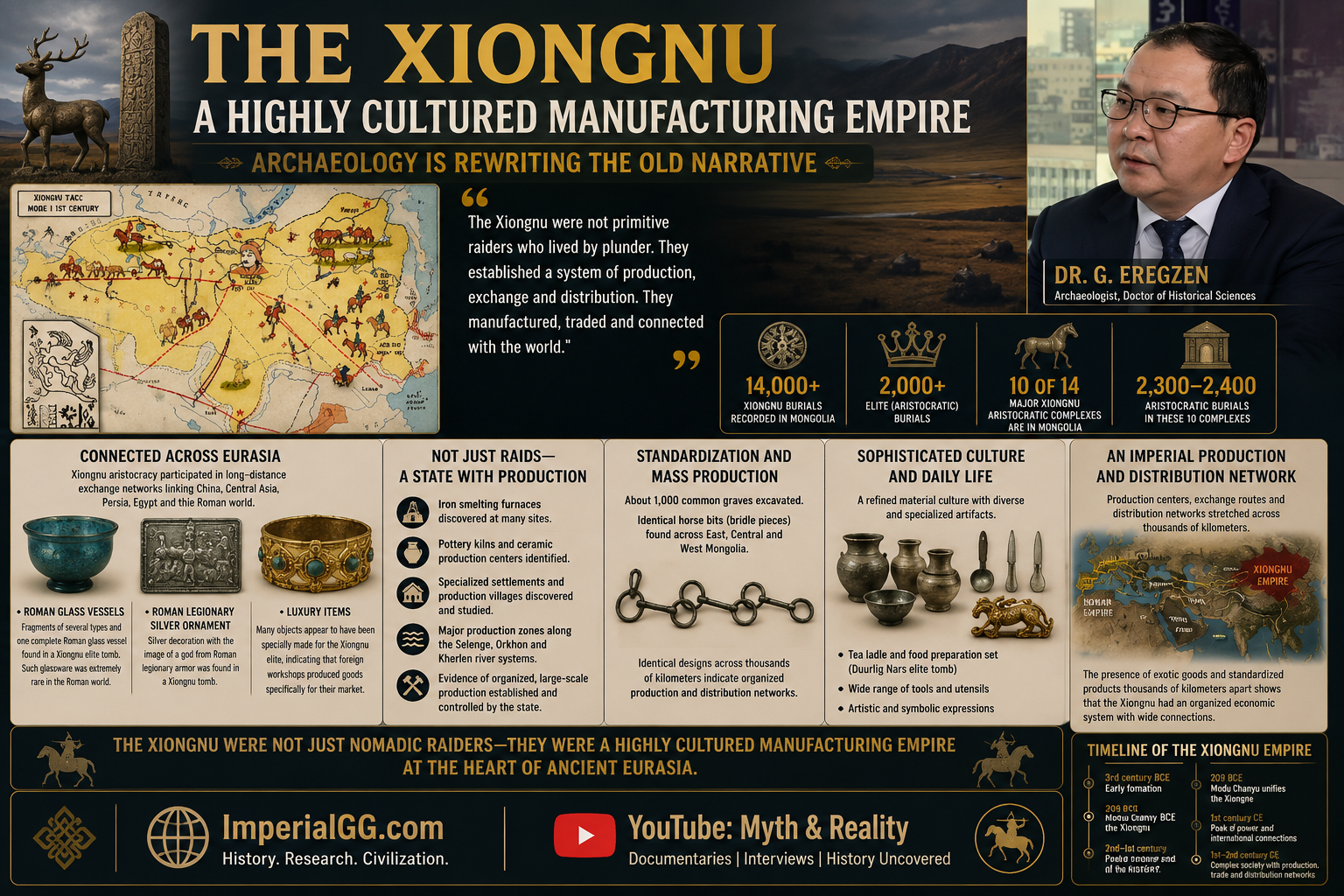
According to Dr. Eregzen, approximately 14,000 Xiongnu burials have been registered in Mongolia, including more than 2,000 elite tombs. Of fourteen known major Xiongnu aristocratic burial complexes worldwide, ten are located in Mongolia.
These concentrations are important because elite tombs preserve evidence extending far beyond funerary practice. They reveal the political reach, economic connections, technological capabilities, and material culture of the Xiongnu Empire.
The emerging archaeological picture is therefore no longer simply that of a mobile population inhabiting the northern frontier of China. It is that of a large imperial system whose principal archaeological concentration lay on the Mongolian Plateau.
An Elite Connected Across Eurasia
Some of the most striking evidence comes from objects recovered from aristocratic Xiongnu tombs. Artifacts associated with Han China, Central Asia, Persia, Egypt, and the Roman world have been discovered in Xiongnu contexts. Their presence demonstrates that the Xiongnu elite participated in exchange networks reaching far beyond their immediate neighbors.
Among the most remarkable discoveries are fragments of several types of Roman glass vessels and a complete Roman glass vessel recovered from a Xiongnu elite burial.
Such glassware represented an exceptionally prestigious form of material culture in the Roman world. Its appearance thousands of kilometers away in a Xiongnu aristocratic context raises an important historical question: by what political and exchange mechanisms did such objects travel from the western extremities of Eurasia to the Mongolian Plateau?
Other discoveries, including western-style luxury objects and decorative elements, further demonstrate the extraordinary geographical reach of Xiongnu elite material culture.
These finds do not by themselves establish direct diplomatic relations between a Roman emperor and a Xiongnu ruler. They do, however, provide material evidence that the Xiongnu aristocracy was incorporated into long-distance Eurasian networks through which highly prestigious objects could travel enormous distances. The Xiongnu world was not isolated. It stood within an interconnected Eurasia.
Beyond Trade: Evidence of Xiongnu Production
Imported luxury goods tell only one part of the story. Perhaps more important for understanding the internal organization of the Xiongnu Empire is the growing archaeological evidence for domestic production. Research is increasingly identifying settlements, production sites, furnaces, pottery-making facilities, and specialized manufacturing areas associated with Xiongnu communities.
According to Dr. Eregzen, this evidence requires scholars to move beyond an older model of small-scale household production. The question now concerns production on a much larger scale.
Iron-smelting furnaces have been identified at multiple sites. Archaeologists have investigated pottery-production areas and specialized settlements connected with manufacturing. Evidence suggests that major river systems—including the Selenge, Orkhon, and Kherlen—may have supported important zones of production. This changes the historical problem fundamentally. The issue is no longer simply whether the Xiongnu manufactured objects.
The question becomes: how was production organized across an empire extending over enormous distances?
Standardization and Mass Production
One particularly significant form of evidence comes from ordinary Xiongnu burials. Approximately a thousand smaller Xiongnu graves have been excavated, according to Dr. Eregzen. Objects such as iron horse bits recovered from sites in eastern, central, and western Mongolia display striking similarities in form.
Standardized objects appearing across widely separated regions are potentially significant indicators of organized production and distribution. An object manufactured in one locality cannot repeatedly appear across distances approaching thousands of kilometers without mechanisms capable of moving materials, finished products, technological knowledge, or standardized designs.
This raises the possibility of something considerably more sophisticated than isolated household manufacture: regional production centers connected to wider distribution networks. If supported by continuing archaeological investigation, such evidence would suggest an economy in which mobility and manufacturing were not opposites. They could function together within the same imperial system.
The False Opposition Between “Nomad” and “Producer”
This is perhaps the broader historical significance of the new evidence. Older models often created an implicit opposition:
sedentary society = production and civilization
nomadic society = livestock, warfare, and acquisition from others
Xiongnu archaeology increasingly makes that binary difficult to sustain. A mobile imperial society could maintain pastoral production while simultaneously operating settlements, metallurgical workshops, ceramic industries, specialized manufacturing centers, exchange routes, and mechanisms for distributing goods. Mobility did not necessarily prevent economic specialization. It could instead connect production zones separated by enormous distances. This distinction matters because the Xiongnu Empire cannot be understood simply by applying economic assumptions derived from sedentary states. Its infrastructure may have operated differently.
Material Culture and Everyday Life
The sophistication revealed by archaeology is not confined to weapons, horses, or elite prestige objects. Domestic and dining equipment recovered from Xiongnu contexts suggests differentiated practices of food preparation and consumption. Dr. Eregzen points, for example, to utensils recovered from the elite burials at Duurlig Nars, including implements apparently designed as coordinated sets.
Such discoveries reveal something historical texts rarely preserve: everyday practices. Food, vessels, utensils, clothing, horse equipment, metalworking, and funerary objects collectively provide evidence for a society whose material culture was considerably more complex than the traditional stereotype of the “steppe raider.”
Archaeology and the Reassessment of the Xiongnu Empire
The importance of these discoveries extends beyond Mongolia. For much of recorded history, knowledge of the Xiongnu was mediated primarily through written sources produced by their sedentary neighbors and political rivals. Those sources are indispensable, but they necessarily describe the Xiongnu from outside.
Archaeology provides another archive. A furnace does not describe the Xiongnu as civilized or barbarian. A standardized iron object does not praise or condemn them. A Roman glass vessel deposited in an aristocratic tomb does not reproduce the political vocabulary of a Han chronicler. These objects instead reveal systems: production, consumption, hierarchy, exchange, technology, mobility, and political organization. The cumulative evidence is producing a substantially different image of the Xiongnu Empire.
The Xiongnu were certainly a formidable mobile military power. But mobility and warfare constituted only part of their historical reality. Archaeology increasingly reveals an imperial society capable of organizing production, sustaining specialized technologies, distributing manufactured goods across great distances, and participating in exchange networks spanning much of Eurasia. The old image of the Xiongnu as merely raiders standing outside the world of “civilization” is therefore becoming increasingly untenable.
The archaeological record points instead toward something far more consequential:
a mobile empire that was also a producing empire.