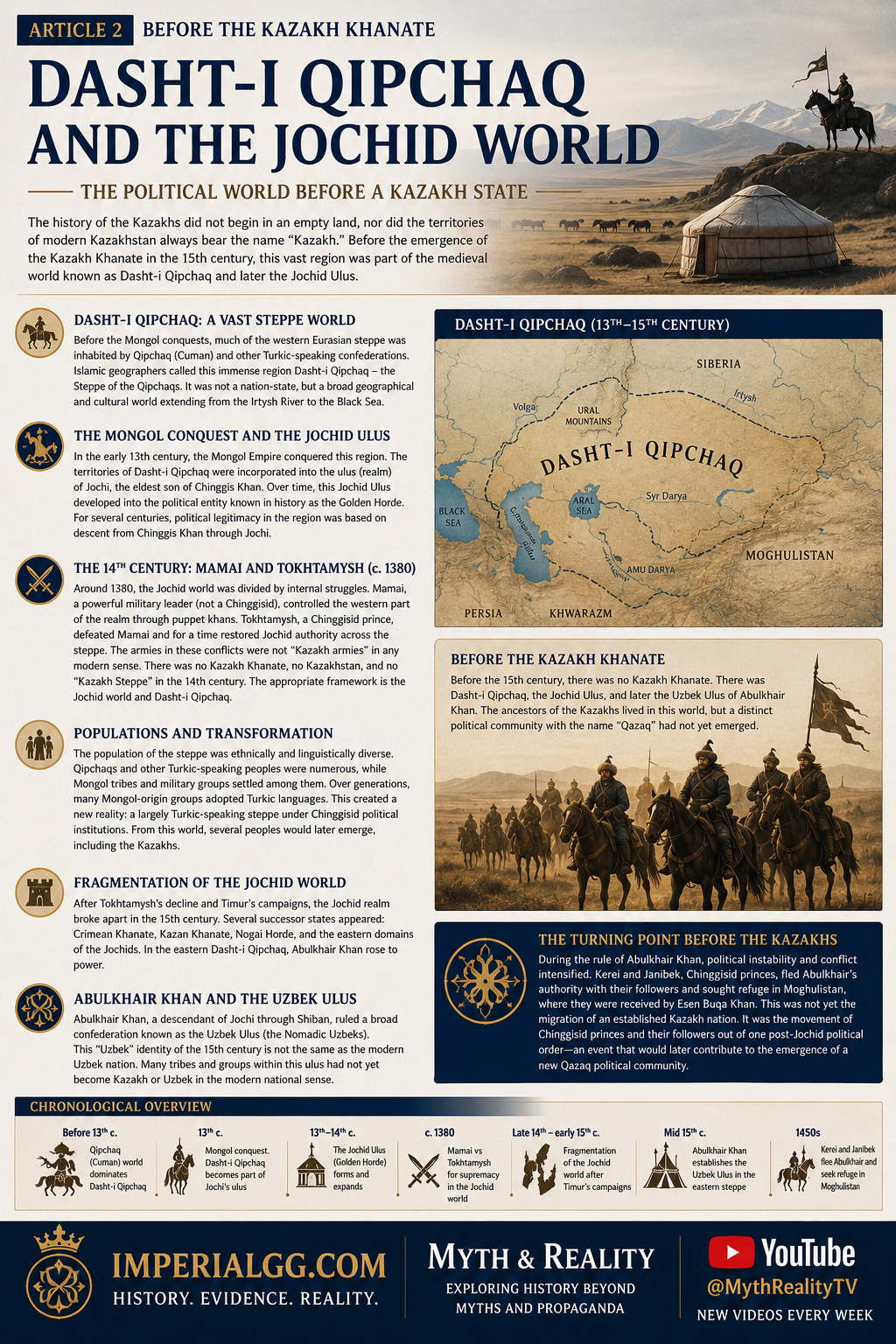
2. Before the Kazakh Khanate: Dasht-i Qipchaq and the Jochid World
The Political World That Existed Before a Kazakh State
The history of the Kazakhs did not begin in an empty land, nor did the territories of modern Kazakhstan always constitute a political or geographical entity known as the “Kazakh Steppe.” Long before the emergence of the Kazakh Khanate, these vast territories formed part of a much larger historical world that medieval Muslim geographers and chroniclers generally knew as Dasht-i Qipchaq, the Steppe of the Qipchaqs.
This distinction is essential for understanding the history of Central Eurasia without projecting modern national borders and identities backward into the medieval past. The geographical territory of present-day Kazakhstan has a history extending thousands of years, but the history of a territory and the history of the modern nation that now occupies it are not identical. Before a Kazakh state appeared, the region had already passed through successive periods of Scythian, Saka, Turkic, Qipchaq and Mongol political domination. By the thirteenth and fourteenth centuries, the decisive political framework was the imperial order created by the Mongol conquests and inherited by the descendants of Chinggis Khan.
Before the Mongol expansion, much of the western Eurasian steppe was dominated by Qipchaq and Cuman confederations. Their political world stretched across an enormous zone extending from Central Asia toward the Black Sea. The name Dasht-i Qipchaq reflected this historical reality. It described a vast steppe region rather than the national territory of any modern people.
The Mongol conquests of the early thirteenth century fundamentally transformed this world. Large parts of Dasht-i Qipchaq were incorporated into the territories associated with Jochi, the eldest son of Chinggis Khan, and subsequently ruled by his descendants. From this imperial inheritance developed the broad political world of the Jochid Ulus, within which the polity conventionally known as the Golden Horde emerged.
For the next several centuries, political legitimacy across much of this region was fundamentally Chinggisid. The rulers who claimed the title of khan derived their legitimacy from descent from Chinggis Khan through Jochi. The political geography of the steppe was therefore shaped not by a Kazakh state but by competing branches of the Jochid dynasty and by the institutions inherited from the Mongol imperial order.
The populations living within this enormous territory were highly diverse. Turkic-speaking Qipchaqs and other steppe populations remained numerically important, while Mongol tribes, military contingents and ruling lineages had entered the region during the conquests. Over the generations that followed, extensive political integration, migration, intermarriage and linguistic assimilation transformed the region. Many groups of Mongol origin gradually adopted Turkic languages, while retaining tribal names, genealogical traditions and political institutions inherited from the Mongol imperial world.
This complex interaction between Turkic-speaking populations and Mongol political structures became one of the foundations from which several later peoples of Central Eurasia eventually emerged. Among them were the ancestors of the modern Kazakhs. Yet the presence of those ancestors should not be confused with the existence of a Kazakh state or a fully formed Kazakh ethnopolitical identity.
The Jochid World in the Fourteenth Century
The political struggles of the late fourteenth century provide a particularly clear example of the danger of projecting later national identities into an earlier historical period.
Around 1380, the struggle for supremacy within the Jochid world involved two of the most important political figures of the age: Mamai and Tokhtamysh. Their conflict took place almost a century before the conventional date associated with the foundation of the Kazakh Khanate.
Mamai was one of the dominant military and political figures in the western territories of the fragmented Jochid realm. Because he was not himself a descendant of Chinggis Khan, he lacked the dynastic legitimacy required to rule as khan in his own name. His political authority therefore depended upon controlling and supporting Chinggisid khans through whom formal legitimacy could be exercised.
Tokhtamysh stood in a fundamentally different dynastic position. He was a Chinggisid prince and a descendant of Jochi. After receiving support from Timur during his rise to power, Tokhtamysh eventually defeated his principal rivals, overcame Mamai’s political position and succeeded for a time in restoring authority across much of the divided Jochid realm.
The forces involved in these struggles emerged from the complex tribal and military population of the Jochid territories. Qipchaq-speaking populations were prominent throughout Dasht-i Qipchaq, alongside numerous groups whose histories reflected the profound transformations produced by more than a century of Mongol rule.
What these forces should not be called, however, are “Kazakh armies” in the modern ethnic or national sense.
There was no Kazakh Khanate in 1380. There was no political territory officially constituted as Kazakhstan. Nor was the historical region generally known to contemporary writers as the “Kazakh Steppe.” The appropriate political and geographical frameworks for understanding this period are the Jochid Ulus and Dasht-i Qipchaq.
This does not mean that the ancestors of later Kazakhs were absent. On the contrary, populations that would eventually participate in Kazakh ethnogenesis were undoubtedly present within this enormous historical world. The distinction lies between the existence of ancestral populations and the later formation of a distinct people under a specific ethnonym.
Modern national histories often seek deep antiquity by tracing contemporary peoples backward through every population that previously inhabited their present territory. Such genealogical connections can be historically meaningful, but they become misleading when later identities are imposed upon people who did not use those identities themselves.
The history of the Kazakhs should therefore be approached through historical development rather than retrospective national labeling.
The Mongol Transformation of Dasht-i Qipchaq
The Mongol conquest did not simply replace one population with another. Its most enduring consequence was the creation of a new political order across the Eurasian steppe.
The older Qipchaq population did not disappear after the conquest. Instead, it became incorporated into the political and military structures of the Mongol Empire and its successor uluses. Mongol ruling and military groups settled among much larger Turkic-speaking populations, producing a long process of cultural and linguistic interaction.
Over time, much of the western Jochid world became increasingly Turkic-speaking. Yet political legitimacy remained closely connected to the dynasty of Chinggis Khan. This created a distinctive historical combination: a largely Turkic-speaking steppe population governed within a political tradition whose ruling legitimacy originated in the Mongol imperial conquest.
This combination is crucial for understanding the later emergence of the Kazakhs.
The Kazakh Khanate would eventually become a predominantly Turkic-speaking political community, but its ruling dynasty was not derived from a pre-Mongol Kazakh monarchy. Its founders belonged to the Chinggisid aristocracy descended from Jochi. The right of its rulers to bear the title of khan rested upon the political tradition established by the Mongol Empire.
The later Kazakh ethnopolitical community therefore emerged not before the Mongol imperial order but from the historical transformation of the world created by that order.
This does not make the later Kazakhs simply “Mongols,” just as it does not make the earlier Jochid population “Kazakh.” It demonstrates instead that ethnic, linguistic and political identities in medieval Eurasia changed over time. The political structures of the Mongol Empire survived even as many of the populations within those structures became linguistically Turkicized and eventually developed new collective identities.
From the Golden Horde to Political Fragmentation
The political unity of the Jochid world weakened significantly during the fourteenth century. Dynastic conflict, regional rivalries and struggles among powerful military elites created repeated periods of instability. The crisis commonly known as the Great Troubles saw numerous khans rise and fall as rival branches of the Jochid dynasty competed for authority.
Tokhtamysh temporarily restored a significant degree of unity, but his later conflict with Timur severely weakened his power. The campaigns of Timur against Tokhtamysh at the end of the fourteenth century devastated important centers of the Jochid realm and accelerated the political fragmentation already underway.
The collapse of unified authority did not immediately create a Kazakh state. Instead, the fifteenth century witnessed the emergence of several competing political formations from the former Jochid world. These included the Crimean Khanate, the Kazan Khanate, the Nogai Horde and various eastern Jochid domains. In the eastern Dasht-i Qipchaq, another major political formation arose under the leadership of Abulkhair Khan.
Throughout this process, Chinggisid legitimacy remained politically important. The fragmentation of the Golden Horde did not erase the dynastic order created by the Mongol Empire. Across much of Central Eurasia, descent from Chinggis Khan continued to provide the principal legal and political basis for claiming the title of khan.
The later founders of the Kazakh Khanate belonged directly to this political world.
Abulkhair Khan and the Uzbek Ulus
Abulkhair Khan rose to power in the eastern Dasht-i Qipchaq during the fifteenth century. A descendant of Jochi through Shiban, he established authority over a broad and unstable confederation of tribes that modern historians commonly describe as the Uzbek Ulus, the state of the Nomadic Uzbeks, or Abulkhair’s Khanate.
The use of the term “Uzbek” in this context requires the same caution as the use of “Kazakh.” The Nomadic Uzbeks of the fifteenth century should not simply be equated with the modern Uzbek nation. They belonged to a broader post-Jochid political community whose constituent tribes would later follow different historical paths.
Some populations remained associated with the political movements that eventually contributed to the formation of the Uzbek khanates of Central Asia. Others became part of the communities from which the Kazakhs and other steppe peoples later emerged.
The important point is that, during the rule of Abulkhair Khan, these populations had not yet been permanently divided according to the modern national categories of Kazakh and Uzbek.
The political crisis that eventually contributed to this division emerged from within Abulkhair’s own Jochid world.
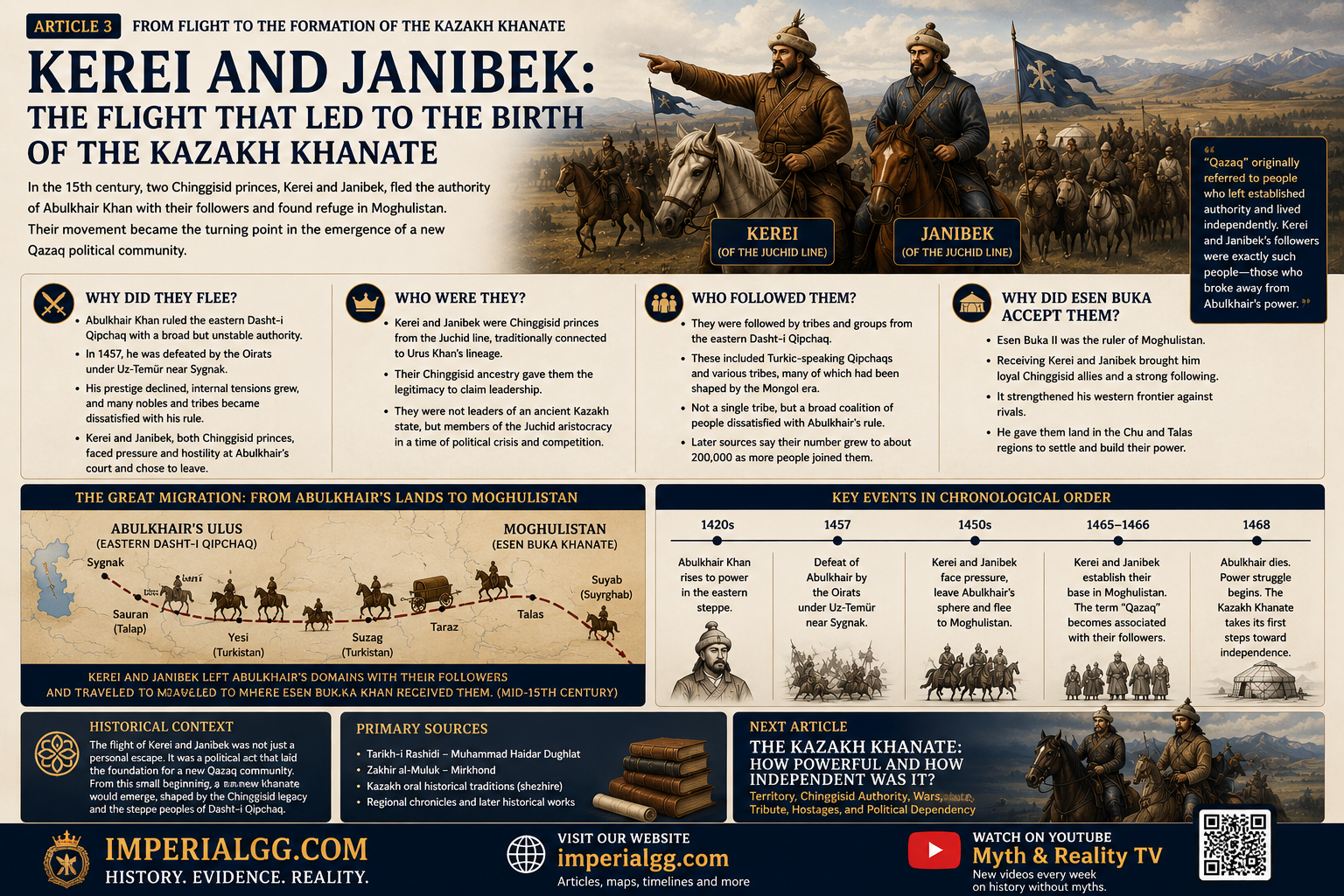
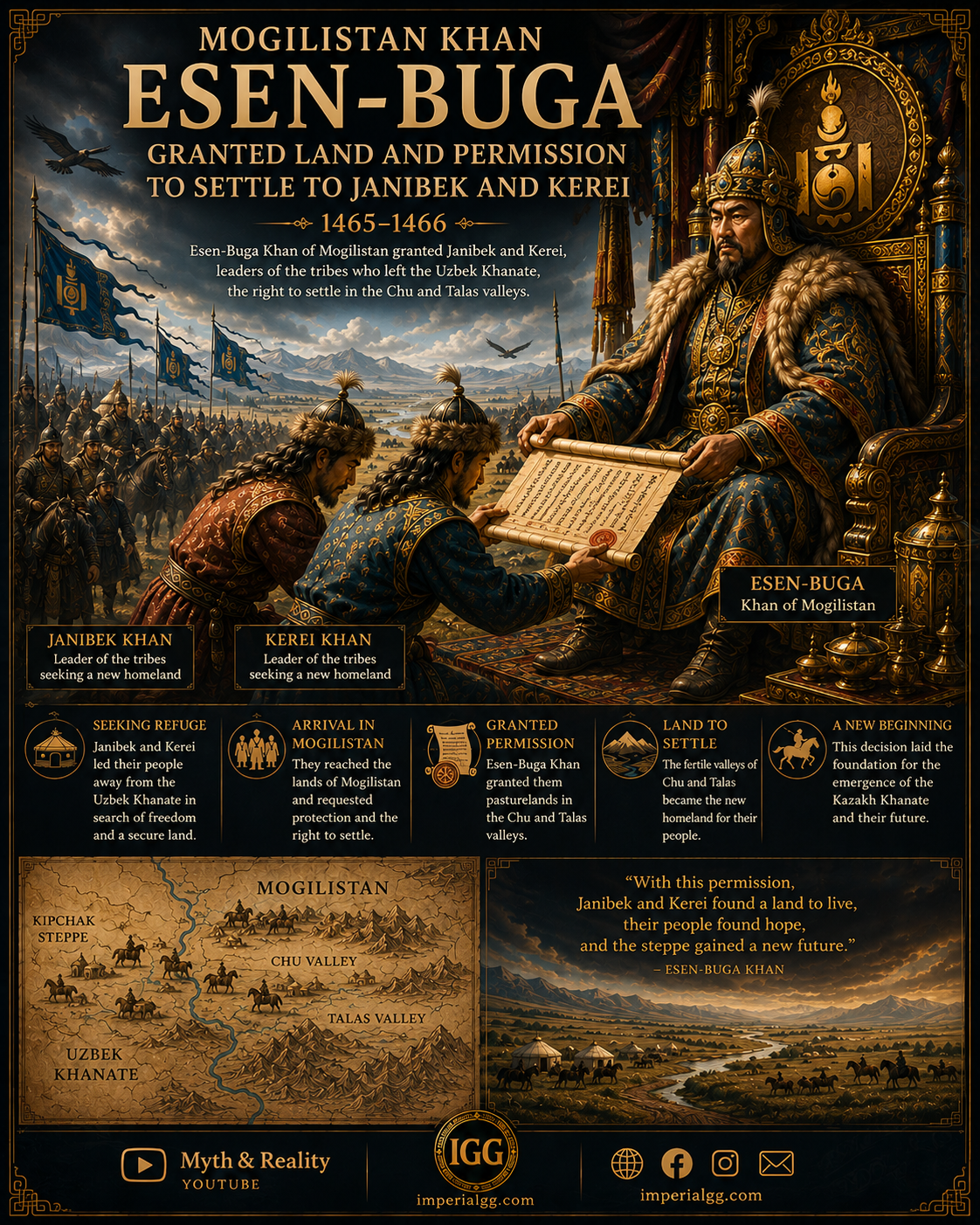
Two Chinggisid princes, Kerei and Janibek, became the central figures in this development. They belonged to a rival branch of the Jochid dynasty and possessed their own claims to political legitimacy. At some point during the political instability of Abulkhair’s reign, they left his sphere of authority with groups of followers and moved into Moghulistan, where they were received by Esen Buqa Khan.
Later Kazakh historical narratives often present this movement as the straightforward birth of an already existing Kazakh nation seeking independence. The historical situation was considerably more complex.
Kerei and Janibek did not lead an internationally recognized Kazakh state into exile. Nor is there evidence that they were commanding a fully formed modern ethnic nation already possessing the complete political identity later associated with the Kazakhs. They were Chinggisid princes operating within the violent and unstable political world produced by the fragmentation of the Jochid Ulus.
Their movement toward Moghulistan was therefore a political migration of dynastic leaders and their followers out of Abulkhair’s sphere of power. Whether this departure should be understood as flight, political withdrawal, dynastic rebellion, or a combination of these circumstances must be examined through the surviving sources rather than softened into the neutral language of a simple “separation.” The consequences, however, were historically profound.
As additional groups dissatisfied with Abulkhair’s authority gathered around Kerei and Janibek, a new political community gradually took shape. The older term qazaq, which had previously described people living apart from established authority, became increasingly associated with this emerging group.
The process was not the sudden creation of a people in a single year. It was the beginning of a political consolidation that would eventually produce both a new ethnopolitical identity and a new khanate.
The World Before the Kazakh Khanate
The historical sequence preceding the emergence of the Kazakh Khanate is therefore considerably more complex than a modern national map might suggest.
Before the Kazakh Khanate, there was the wider world of Dasht-i Qipchaq. The Mongol conquest then incorporated much of this region into the imperial territories of Jochi and his descendants. The Jochid Ulus created a new political framework in which Chinggisid dynastic legitimacy became dominant, while extensive interaction between Mongol and Turkic populations transformed the ethnic and linguistic character of the steppe.
The fragmentation of the Jochid realm subsequently produced competing successor formations. Among them emerged the Uzbek Ulus of Abulkhair Khan, from whose political sphere Kerei and Janibek eventually departed with their followers.
Only after this long historical sequence did a distinct political community bearing the Qazaq name begin to emerge.
The difference between these stages is fundamental. The ancestors of the Kazakhs existed before the fifteenth century, but that does not mean that every earlier Qipchaq, Turkic or Turkicized Mongol population should retrospectively be called Kazakh. The territories of modern Kazakhstan existed geographically, but that does not mean that a medieval state called Kazakhstan occupied them. The word qazaq existed, but that alone does not establish the existence of a Kazakh Khanate.
The year 1380 illustrates the chronological problem particularly clearly. When Mamai and Tokhtamysh struggled for supremacy in the Jochid world, the political landscape was still defined by the legacy of the Mongol Empire, the rival branches of Jochi’s descendants and the populations of Dasht-i Qipchaq. The conventional foundation of the Kazakh Khanate still lay approximately eight decades in the future.
The emergence of the Kazakhs must therefore be understood as part of the transformation of the post-Mongol world rather than projected backward into the period before that transformation occurred.
The next article will examine the decisive turning point in this history: the crisis of Abulkhair Khan’s rule, the position of Kerei and Janibek, the circumstances that drove them toward Moghulistan, the identity of the people who followed them, and the historical evidence behind the claim that their community eventually grew to approximately 200,000 people.
3. Kerei and Janibek: From Flight to the Formation of the Kazakh Khanate
Why Two Chinggisid Princes Fled Abulkhair Khan, Who Followed Them, and How the Qazaq Political Community Emerged
The emergence of the Kazakh Khanate was not the restoration of an ancient Kazakh state. Nor did an already fully formed Kazakh nation suddenly migrate into an empty territory and establish a new kingdom. The political community that eventually became known as the Kazakhs emerged from the fragmentation of the post-Jochid world during the fifteenth century.
At the center of this transformation stood two Chinggisid princes: Kerei and Janibek.
Both belonged to the dynastic aristocracy descended from Chinggis Khan through Jochi. Their political importance rested precisely upon this ancestry. They were not representatives of a pre-existing non-Chinggisid Kazakh monarchy; they were members of the ruling house created by the Mongol imperial order, operating within the continuing political traditions of the Jochid world.
Their departure from the authority of Abulkhair Khan and their movement into Moghulistan became the decisive political event around which a new Qazaq community eventually consolidated.
Abulkhair Khan and the Crisis of the Eastern Dasht-i Qipchaq
By the middle of the fifteenth century, Abulkhair Khan had established considerable authority over the eastern Dasht-i Qipchaq. He was himself a Chinggisid, descended from Jochi through Shiban, and had ruled since the late 1420s over a broad and often unstable confederation generally described as the Uzbek Ulus or the state of the Nomadic Uzbeks.
The term “Uzbek” in this period did not refer exclusively to the modern Uzbek nation. It described a broader political population of the post-Jochid steppe. Many tribal groups that would later be associated with the Kazakhs still inhabited this same political world.
Abulkhair’s authority, however, was never uncontested. Like many steppe confederations, his state depended upon military success, dynastic legitimacy, alliances among powerful tribal leaders and the ruler’s ability to distribute political and economic rewards. When these relationships weakened, rival Chinggisid princes could attract dissatisfied groups to their own leadership.
A major crisis came in 1457, when Abulkhair suffered a serious defeat at the hands of the Oirats under Uz Temür Taishi near Sygnak. The defeat damaged his prestige and exposed the vulnerability of his political authority. It would be too simplistic to claim that this single battle alone caused Kerei and Janibek to flee, but it formed part of the broader instability in which opposition to Abulkhair intensified.
The surviving sources do not provide a complete day-by-day account of the dispute between Abulkhair and the two princes. Later historical narratives have therefore produced different explanations for their departure. What is clear is that Kerei and Janibek rejected continued submission to Abulkhair’s political authority and moved with followers into the territory of Moghulistan.
This was not yet the migration of a sovereign Kazakh nation. It was the flight and political withdrawal of rival Chinggisid princes and their supporters from one Jochid ruler to another political sphere. Its consequences, however, would be enormous.
Who Were Kerei and Janibek?
Kerei and Janibek belonged to the descendants of Jochi through the line traditionally associated with Urus Khan. Their Chinggisid ancestry gave them the dynastic legitimacy necessary to compete for political leadership in the steppe. This point is fundamental to understanding the birth of the Kazakh Khanate.
The populations that gathered around them were diverse, but the political leadership capable of transforming those populations into a new khanate came from the Chinggisid dynasty. In the political culture inherited from the Mongol Empire, tribal military strength alone did not normally provide sufficient legitimacy to claim the title of khan. The ruler was expected to belong to the Golden Line of Chinggis Khan.
The later Kazakh khans therefore derived their sovereign legitimacy from exactly the same broader Chinggisid political tradition that shaped the Golden Horde, the Shaybanid states, Moghulistan and several other post-Mongol states of Central Eurasia.
The Kazakh Khanate was new as a political formation, but the dynastic principle upon which it was built was inherited directly from the Mongol imperial world.
Flight to Moghulistan
Kerei and Janibek moved with their followers toward Moghulistan, the Chaghatayid successor state occupying territories east and southeast of the eastern Dasht-i Qipchaq.
The ruler of Moghulistan, Esen Buqa II, received them and allowed them to settle in the western borderlands of his realm, traditionally associated with the regions of Chu and Talas.
Esen Buqa’s decision was not simply an act of generosity toward refugees. It made political sense.
Moghulistan faced its own regional rivalries, and the arrival of two Chinggisid princes with an armed following could provide a useful buffer against competing powers to the west. Kerei and Janibek, meanwhile, obtained territory in which they could establish an independent political base beyond the immediate reach of Abulkhair Khan.
Their position at this stage must be described carefully. They had escaped Abulkhair’s authority and were received within the political sphere of another Chinggisid ruler. This does not automatically mean that they immediately possessed a fully sovereign and internationally defined state in the modern sense. The political community that would become the Kazakh Khanate was still forming.
Who Followed Them?
One of the most important questions in Kazakh history is also one of the most frequently oversimplified: who exactly followed Kerei and Janibek?
They were not followed by a homogeneous modern Kazakh nation already possessing a fixed national identity. The people who gathered around them came from the tribal world of the eastern Dasht-i Qipchaq. They belonged to populations that had lived for generations within the Jochid political sphere and, more immediately, within the broader political confederation ruled by Abulkhair Khan.
Linguistically, much of this population belonged to the Turkic-speaking world of the steppe. Historically, however, its tribal composition had been profoundly shaped by the Mongol conquest. Some groups had older Turkic and Qipchaq roots, while others carried names and genealogical traditions connected to Mongol-origin tribes that had undergone substantial Turkicization over the preceding centuries.
The emerging Kazakh population was therefore not simply the continuation of one ancient tribe. It developed through the consolidation of diverse steppe populations within a new political framework.
This is one of the central realities of Kazakh ethnogenesis: the community was consolidated under Chinggisid political leadership from populations shaped by both the Turkic world of Dasht-i Qipchaq and the Mongol imperial transformation of that world.
Were There Really 200,000 Followers?
A frequently repeated claim states that approximately 200,000 people followed Kerei and Janibek when they left Abulkhair Khan. This requires careful correction. The principal source usually cited for this number is Muhammad Haydar Dughlat’s sixteenth-century Tarikh-i Rashidi. The text describes large numbers of people subsequently gathering around Kerei and Janibek and reports that their number eventually reached approximately 200,000. This should not automatically be interpreted as evidence that Kerei and Janibek crossed into Moghulistan at the head of a single organized migration of exactly 200,000 people. The more historically cautious interpretation is that an initial group followed the princes and that their political community subsequently expanded as additional populations abandoned Abulkhair’s authority and joined them. The number 200,000 itself must also be treated as a figure transmitted by a later historical source rather than as a modern census.
Nevertheless, the tradition preserves an important political reality. Kerei and Janibek became an alternative center of Chinggisid authority, and their following grew sufficiently large to challenge the existing political balance of the eastern Dasht-i Qipchaq.
When Did These People Become “Qazaqs”?
This is where the history of the word discussed in Article 1 becomes directly connected to the formation of the Kazakh people. The term qazaq had existed before Kerei and Janibek. It originally carried social and political meanings associated with people who had left an established authority and lived independently or outside their previous political order.
The followers of Kerei and Janibek had done precisely this: they had left the political authority of Abulkhair Khan and established themselves beyond his direct control. In this historical environment, the designation Qazaq became increasingly associated with this particular political community.
The transformation was gradual. A term describing political separation became attached to a specific group. As that group developed its own ruling dynasty, territorial base, political interests and shared historical experience, the designation became increasingly permanent. Eventually, Qazaq ceased to describe merely a condition of political independence and became the name of a distinct ethnopolitical community.
The Kazakhs were therefore not an ancient nation suddenly appearing in 1465. Nor were they a people without ancestors before that date. They were a new ethnopolitical community formed from older populations through a specific historical process. The distinction is essential.
Was 1465 the Exact Birth of the Kazakh Khanate?
The date 1465–1466 is widely presented as the official foundation date of the Kazakh Khanate. It is an important conventional date, but it should not be treated as though a surviving foundation charter records the creation of a state on one precise day. The chronology derives primarily from Muhammad Haydar Dughlat’s later account in the Tarikh-i Rashidi. The formation of the khanate was almost certainly a process rather than a single event.
Kerei and Janibek first established themselves in Moghulistan. Their following grew. Abulkhair Khan died in 1468, after which the political order he had constructed entered a severe crisis. This created opportunities for Kerei, Janibek and their supporters to return to the eastern Dasht-i Qipchaq and compete for control over territories and populations formerly subject to Abulkhair. The emergence of the Kazakh Khanate should therefore be understood as a sequence of political developments extending across several years rather than as an instantaneous national foundation.
What is historically significant is that, by the later fifteenth century, a distinct Chinggisid political formation associated with the Qazaq name had clearly emerged. For the first time, the term was becoming permanently connected not merely to wandering individuals or temporary political outsiders but to an enduring political community ruled by its own Chinggisid khans.
A New People Formed Under an Old Imperial Dynasty
The formation of the Kazakh Khanate presents an apparent historical paradox. The Kazakhs were emerging as a new ethnopolitical community, but their rulers belonged to one of Eurasia’s oldest and most prestigious imperial dynasties of the period.
Kerei and Janibek did not invent a new principle of kingship. They inherited the political legitimacy of the Chinggisid world. The people gathering around them were developing a new collective identity, but the state they created remained deeply rooted in the political traditions established by the Mongol Empire. This is why the Kazakh Khanate must be understood as a product of the post-Mongol world.
Its rulers descended from Chinggis Khan. Its political institutions developed within the Jochid tradition. Its population emerged from the transformed tribal world of Dasht-i Qipchaq. Its name developed from an older Turkic social designation that acquired a new political and eventually ethnic meaning. The Kazakh Khanate was therefore neither an ancient state predating the Mongol Empire nor simply another name for the Golden Horde. It was a new political formation created from the fragmentation and reorganization of the Jochid world.
From Refugees to Rulers
The historical importance of Kerei and Janibek lies precisely in this transformation. They left Abulkhair’s political sphere as rival Chinggisid princes with followers and sought refuge and political space in Moghulistan. From that initially vulnerable position, their movement developed into an alternative center of power.
As Abulkhair’s political order weakened and eventually collapsed after his death, the community around Kerei and Janibek expanded. Groups that had previously belonged to the Nomadic Uzbek political world increasingly entered the new Qazaq political alignment. Out of this process emerged the Kazakh Khanate.
Its creation did not mean that every population of the eastern Dasht-i Qipchaq immediately became Kazakh. Nor did it instantly create a centralized and permanently unified state. The political consolidation of the Kazakhs would continue under later rulers, particularly during the reign of Qasim Khan. The next question is therefore not simply when the Kazakh Khanate was founded, but how powerful it actually became.
The next article will examine the Kazakh Khanate at its strongest and weakest moments: the territorial expansion associated with Qasim Khan, the fragmentation of political authority, relations with the Chinggisid states of Central Asia, conflicts with the Oirats and Dzungars, and the harder evidence of sovereignty itself—who paid tribute, who provided hostages, who controlled territory, and who was ultimately able to impose political authority over whom.
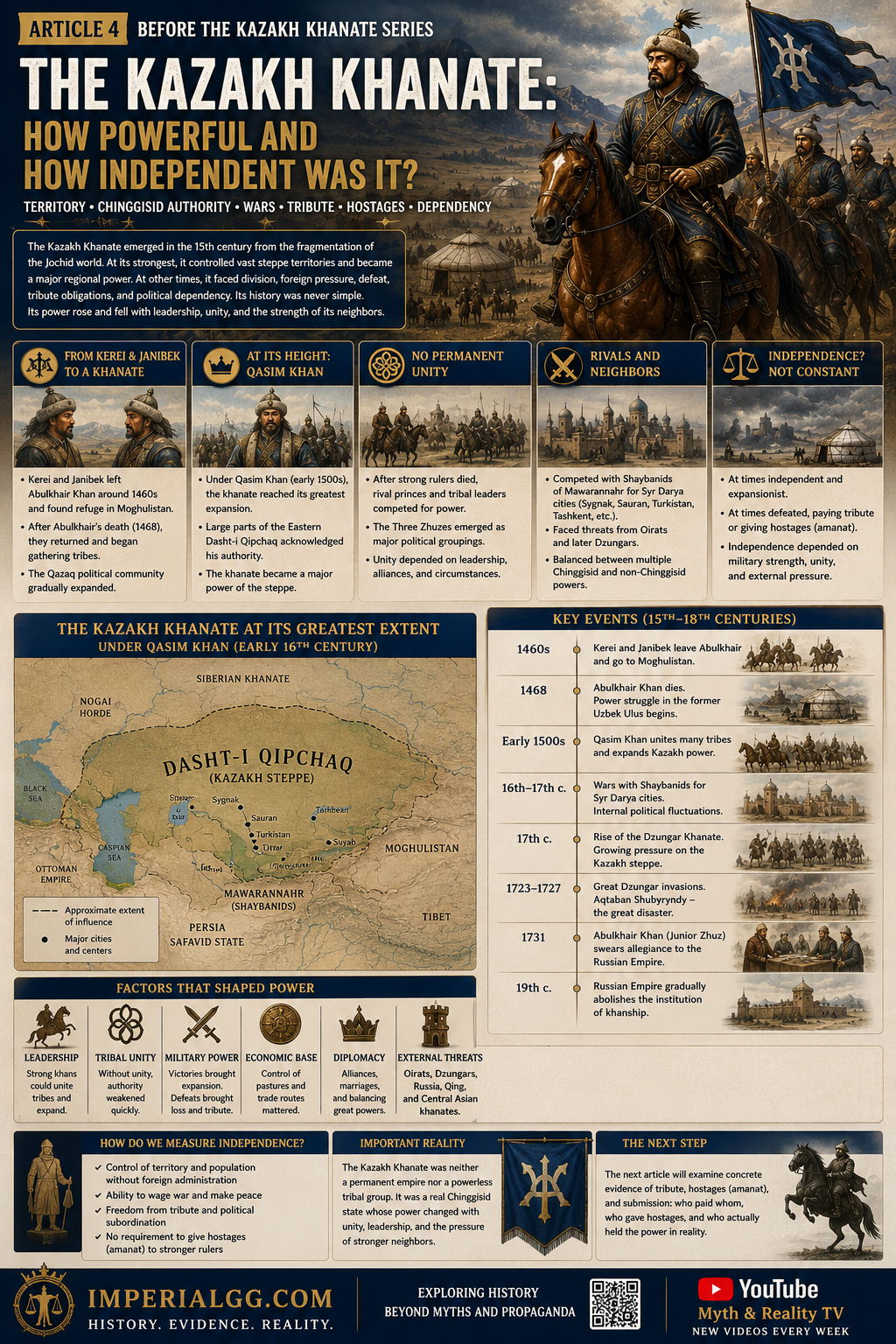
4. The Kazakh Khanate: How Powerful and How Independent Was It?
Power, Territory, Chinggisid Authority, and the Struggle for Survival in Central Eurasia
The establishment of the Kazakh Khanate in the second half of the fifteenth century introduced a new political force into the eastern Dasht-i Qipchaq. Yet the foundation of a khanate should not automatically be confused with the existence of a permanently centralized, continuously sovereign state in the modern sense. From its emergence in the post-Jochid world until the gradual expansion of Russian imperial authority over the Kazakh steppe, the political strength of the Kazakh khans changed considerably from one generation to another.
This distinction is essential because the history of the Kazakh Khanate is often presented through two opposing narratives. One portrays it as the direct continuation of the Golden Horde and therefore as the inheritor of a vast Eurasian empire. The other reduces it to a weak and insignificant tribal confederation that never possessed meaningful political authority. Neither interpretation adequately reflects the historical record.
The Kazakh Khanate was a genuine Chinggisid political formation. At certain moments it became one of the major powers of the eastern Eurasian steppe, controlled extensive pasturelands, competed for important cities and attracted large numbers of tribes into its political sphere. At other moments, however, central authority fragmented, individual Chinggisid princes pursued competing interests, and Kazakh rulers faced military pressure from stronger neighboring states.
The more useful historical question is therefore not whether the Kazakh Khanate was simply “powerful” or “weak,” but when it was powerful, where its rulers exercised effective authority, and how long that authority could be maintained.
The Rise of the Khanate After Abulkhair
The death of Abulkhair Khan in 1468 transformed the political balance of the eastern Dasht-i Qipchaq. The broad confederation that he had ruled entered a period of instability, creating opportunities for Kerei, Janibek and their followers to return from the political refuge they had established in Moghulistan and compete for influence over populations that had previously belonged to Abulkhair’s political sphere.
The expansion of the emerging Qazaq community was therefore closely connected to the collapse and redistribution of power within the former Uzbek Ulus. Groups that had once existed within the same post-Jochid political structure increasingly divided between competing Chinggisid leaderships. Some remained associated with the Shaybanid political movement, while others gathered around the descendants of Kerei and Janibek.
This process continued over several decades. The Kazakh Khanate was not created as a fully developed territorial state in a single year. Its political community expanded as rulers attracted new followers, defeated rivals and established influence over strategically important regions of the steppe.
The first great period of expansion came under Qasim Khan in the early sixteenth century.
Qasim Khan and the First Great Expansion
Under Qasim Khan, the Kazakh Khanate reached a level of political strength that cannot be dismissed as insignificant. His authority extended across a large portion of the eastern Dasht-i Qipchaq, and contemporary and near-contemporary accounts suggest that the number of people recognizing his leadership increased substantially.
Qasim’s reign therefore represents one of the strongest arguments against the claim that the Kazakh Khanate never became an important regional power. Under a capable ruler, the khanate could mobilize large numbers of steppe warriors, attract tribal loyalties and compete for economically important territories.
At the same time, the nature of this power must be understood within the political realities of the nomadic steppe. A large zone appearing under the authority of one khan on a modern historical map did not necessarily represent a territory governed through permanent administrative institutions, fixed borders and direct bureaucratic control.
Much of a steppe ruler’s authority depended upon the loyalty of Chinggisid princes, tribal aristocracies and mobile populations. Political control was therefore often personal and negotiated. A powerful khan could expand his influence rapidly, but the political structure could also weaken rapidly after his death.
This vulnerability became visible after the reign of Qasim Khan.
The Problem of Political Unity
The Kazakh Khanate never possessed the kind of permanent centralized administration associated with large sedentary empires. This did not make it unique among the political formations of the Eurasian steppe, but it created recurring difficulties in maintaining unified authority across enormous distances.
The Chinggisid dynasty itself contained multiple branches capable of competing for power. Tribal leaders controlled their own military followings and economic resources, while regional interests frequently shaped political loyalties. When a strong khan succeeded in balancing these forces, the khanate could act with considerable unity. When central authority weakened, competing rulers and regional groupings could pursue their own policies.
Following Qasim Khan’s death, the khanate entered a period of political instability before later rulers restored some degree of unity. Haqnazar Khan, for example, succeeded in strengthening Kazakh power during the sixteenth century, while Tauke Khan later became associated with another important period of political consolidation.
Yet the recurring need to restore unity itself demonstrates the structural difficulty of maintaining permanent centralized authority.
By the seventeenth and eighteenth centuries, the political organization of the Kazakh population was increasingly associated with the three major Zhuzes: the Senior Zhuz, Middle Zhuz and Junior Zhuz. Their exact origins and historical development remain subjects of scholarly discussion, but their political significance is clear.
The Zhuzes were not simply three modern provinces administered continuously from a single capital. Their khans, sultans and tribal elites could make separate diplomatic decisions, conduct their own negotiations and respond differently to external threats.
This decentralization became increasingly important as the Kazakh steppe entered a period of intense geopolitical pressure.
The Kazakh Khanate Was Not the Only Heir of the Jochid World
One of the most important corrections to modern national narratives concerns the idea of exclusive inheritance from the Golden Horde.
The Kazakh Khanate unquestionably emerged from the political world created by the descendants of Jochi. Its rulers were Chinggisids, and its political institutions belonged to the wider traditions of the post-Mongol steppe. But this inheritance was not exclusively Kazakh.
Several political formations emerged from the fragmentation of the Jochid world. The Crimean Khanate, Kazan, Astrakhan, the Nogai political confederations, the Shaybanid states and the Kazakh Khanate all developed from different parts of the broader political order that followed the fragmentation of the Golden Horde and related Jochid territories.
The Shaybanids are particularly important in this context. They descended from Jochi through Shiban and established their power in Transoxiana at the beginning of the sixteenth century. Their conquest of the region created a new Chinggisid political order centered upon the great cities of Mawarannahr.
The rulers of the Kazakh Khanate and the Shaybanid rulers of Central Asia were therefore not representatives of two timeless modern nations fighting one another across an ancient national border. They belonged to competing branches of the broader Chinggisid political world.
Their conflicts over the Syr Darya cities were part of this post-Mongol struggle for territory, trade and dynastic power.
The Struggle for the Syr Darya Cities
The relationship between the nomadic steppe and the urban centers of Central Asia was fundamental to the power of the Kazakh khans. Cities such as Sygnak, Sauran, Turkistan and Tashkent possessed strategic and economic importance far beyond their immediate surroundings.
Control of these cities connected steppe rulers to agricultural production, commercial routes and the political world of Mawarannahr. For this reason, they became repeated objects of conflict among Kazakh rulers, Shaybanid rulers and other regional powers.
The control of these territories changed repeatedly.
At some moments, Kazakh rulers successfully extended their authority southward. At others, rival powers regained important cities or imposed military pressure on the steppe. The frontier between the nomadic and sedentary worlds was therefore not a permanent national border but a contested political zone.
This reality complicates attempts to draw the Kazakh Khanate as a single fixed territorial state across several centuries. Its sphere of influence changed according to military strength, dynastic alliances and the ability of individual rulers to maintain loyalty.
A map showing the maximum territorial influence of the khanate under one ruler should therefore not automatically be treated as the permanent borders of the Kazakh state throughout its history.
Pressure from Mawarannahr
The states centered on Bukhara and the wider region of Mawarannahr remained major actors in Central Asian politics. Relations between them and the Kazakh rulers alternated between conflict, alliance, diplomacy and competition for strategically important territory.
The political identity of these states also requires careful historical terminology. During the Shaybanid period, the ruling dynasty of Bukhara was Chinggisid. Later, the Astrakhanid or Janid dynasty, itself connected to the Jochid world, succeeded the Shaybanids.
The history of the region therefore cannot be reduced to a simple confrontation between modern ethnic categories. Chinggisid dynastic politics continued to shape Central Asia long after the fragmentation of the original Mongol Empire.
Kazakh rulers participated actively in this world. They were capable of military intervention and territorial expansion, but they were also vulnerable to defeat and political pressure.
Their power must therefore be evaluated period by period rather than assumed to have remained constant for centuries.
The Oirats and the Changing Balance of Steppe Power
From the east came another increasingly important challenge: the Oirats.
The military power of western Mongol groups had already become evident before the Kazakh Khanate emerged. Abulkhair Khan’s defeat by Oirat forces near Sygnak in 1457 demonstrated that the balance of power in the eastern steppe was already changing.
During the following centuries, conflicts between Kazakh groups and Oirat powers became a major feature of Inner Asian history. These conflicts involved competition over pasturelands, migration routes, tributary populations and political dominance.
The emergence of the Dzungar Khanate in the seventeenth century transformed this rivalry into a far more serious geopolitical struggle.
The Dzungars created one of the most formidable military states in Inner Asia. Their political organization and military capabilities allowed them to challenge several neighboring powers simultaneously. They fought not only against Kazakh groups but also against the Qing Empire and other regional forces.
For the Kazakh political world, the rise of Dzungar power created an increasingly severe threat.
The relationship between the Kazakhs and the Dzungars, however, cannot be summarized by saying that one side permanently dominated the other throughout the entire period. Warfare produced changing outcomes. Kazakh rulers sometimes resisted successfully and recovered territory, while at other times Kazakh groups suffered major defeats and were forced into disadvantageous political relationships.
This is precisely where the question of sovereignty becomes more complicated.
How Should Independence Be Measured?
Modern states usually define sovereignty through internationally recognized borders and exclusive governmental authority. The political world of seventeenth- and eighteenth-century Inner Asia operated differently.
A ruler could govern his own population while simultaneously acknowledging the superiority of a stronger ruler. Political dependency could be expressed through tribute, military service, diplomatic submission or the delivery of amanat, hostages given as guarantees of loyalty.
At the same time, the exchange of gifts or the sending of diplomatic missions did not automatically prove permanent vassalage. The meaning of each relationship must be established from its specific political context.
This distinction is particularly important when examining Kazakh relations with the Dzungars, Russia and the Qing Empire.
If a Kazakh ruler paid tribute after military defeat, sent a son or close relative as an amanat, or formally acknowledged the authority of another ruler, such evidence is directly relevant to the question of political independence. But it must be connected to a specific ruler, date and political situation rather than generalized across the entire Kazakh population for several centuries.
The historical record must therefore be reconstructed case by case.
Who paid tribute?
To whom was it paid?
Was it regular or temporary?
Who was given as an amanat?
Was the hostage a son of a khan, another member of the ruling dynasty or a tribal noble?
What military event preceded the arrangement?
Did the stronger state exercise actual power over the weaker ruler, or was the relationship largely symbolic?
These questions provide a much more reliable measure of sovereignty than modern national claims.
The Dzungar Crisis
The early eighteenth century brought one of the most devastating crises in Kazakh history. The major Dzungar offensives beginning in 1723 caused enormous population displacement and suffering and became remembered in Kazakh historical tradition as the catastrophe of Aqtaban Shubyryndy.
The disaster demonstrated both the military strength of the Dzungar state and the political vulnerability of the divided Kazakh world.
Kazakh groups subsequently organized significant resistance and achieved important military successes. The history of this period therefore cannot be written as a simple story of permanent Kazakh submission. Resistance was real, military recovery occurred, and Dzungar domination was never absolute across every Kazakh population.
Nevertheless, the scale of the catastrophe makes it equally impossible to portray the Kazakh political world as a continuously dominant and secure regional power.
The Kazakh rulers were fighting for survival in an increasingly dangerous geopolitical environment.
Between Dzungar Power and Expanding Empires
By the eighteenth century, the Kazakh steppe stood between several expanding powers. The Dzungar Khanate remained a major military threat from the east. The Russian Empire was advancing from the north and northwest through forts, trade networks and political relationships with individual Kazakh rulers. Farther east, the Qing Empire was expanding into Inner Asia and would eventually destroy the Dzungar Khanate.
Kazakh rulers attempted to navigate this environment through diplomacy, warfare and shifting political alignments.
In 1731, Abulkhair Khan of the Junior Zhuz formally swore allegiance to the Russian empress Anna. This event did not instantly transform the entire Kazakh steppe into a fully administered Russian province. Russian authority expanded gradually, and Kazakh rulers continued to exercise substantial local power for decades.
Nevertheless, the event marked an important change in the political relationship between Kazakh rulers and the Russian Empire.
Other Kazakh leaders later developed their own relationships with Russia, while some simultaneously maintained diplomatic relations with the Qing court. Such overlapping allegiances were not unusual in Inner Asian politics, where weaker rulers could attempt to balance stronger neighboring empires against one another.
This strategy could preserve autonomy temporarily, but the long-term balance of power increasingly favored the expanding empires.
Russian military infrastructure moved deeper into the steppe. Imperial administrative control increased. The political authority of individual Kazakh khans became increasingly restricted, and during the nineteenth century the Russian Empire abolished the institution of khanship across much of the Kazakh steppe.
The political world created by Kerei and Janibek had entered a fundamentally different historical age.
So, How Powerful Was the Kazakh Khanate?
The answer cannot be reduced to a slogan.
At its strongest, particularly under rulers such as Qasim Khan, the Kazakh Khanate was an important regional power with substantial military strength and influence across a broad area of the eastern Eurasian steppe. Its rulers possessed genuine Chinggisid legitimacy and were active participants in the political struggles of Central Asia.
Yet its strength was never constant.
The decentralized structure of steppe politics made long-term unity difficult to maintain. Rival Chinggisid princes, tribal interests and regional divisions repeatedly weakened central authority. The emergence of the Zhuzes further complicated the idea of a single political center capable of continuously controlling the entire Kazakh population.
External pressures intensified these internal weaknesses. The khanate competed with the Chinggisid states of Mawarannahr, confronted Oirat and later Dzungar military power, and eventually faced the expansion of two enormous imperial systems: Russia and Qing China.
The historical record therefore does not support the idea of an uninterrupted line of fully sovereign Kazakh statehood extending unchanged from the fifteenth century to the modern Republic of Kazakhstan.
At the same time, denying that the Kazakh khans ever exercised meaningful independent power would also be historically inaccurate.
The more defensible conclusion is that the Kazakh Khanate was a real and at times powerful post-Mongol Chinggisid state whose degree of political unity and independence changed dramatically over time.
That conclusion leads directly to a more difficult question. General descriptions such as “powerful,” “independent,” “vassal” or “tributary” are not enough. The actual evidence must now be examined.
The next article will therefore move away from broad political narratives and reconstruct specific relationships of power. It will examine documented cases of tribute, amanat, military defeat and political submission involving Kazakh rulers and their stronger neighbors, particularly the Oirats and Dzungars.
The purpose will not be to deny Kazakh history or to create another national myth in its place. It will be to ask the most concrete questions available to the historian: who paid whom, who surrendered hostages, under what circumstances, and who possessed enough military power to enforce the arrangement?
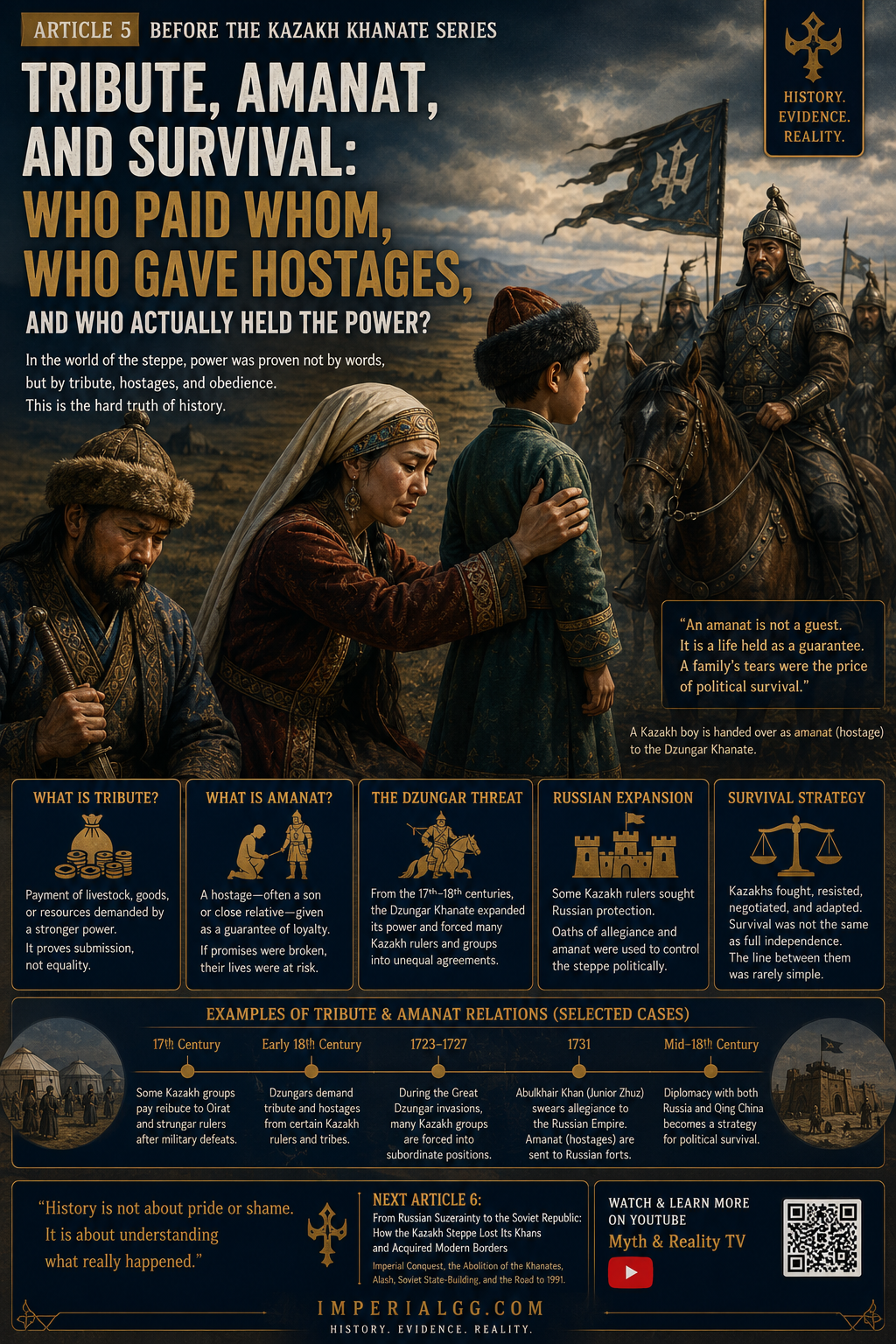
5. Tribute, Amanat, and Survival: The Kazakh Khanates Under the Power of Stronger States
Who Paid Tribute, Who Gave Hostages, and How Kazakh Rulers Survived Between the Dzungars, Russia, and Qing China
The true independence of a premodern state cannot be measured only by the title carried by its ruler or by the borders drawn on a modern historical map. A khan might continue to call himself a khan while paying tribute to a stronger ruler. He might govern his own tribes while surrendering a son or close relative as an amanat, a political hostage guaranteeing his loyalty. He might recognize the sovereignty of one empire while simultaneously negotiating with another.
For the Kazakh khanates, particularly during the seventeenth and eighteenth centuries, this distinction between formal rulership and actual political power became increasingly important.
The Kazakh political world faced pressure from several directions. To the east stood the growing power of the Oirats and later the Dzungar Khanate. To the south were the states of Central Asia. From the north and northwest came the expanding Russian Empire. After the destruction of the Dzungar Khanate, the Qing Empire became the dominant military power in eastern Inner Asia.
Caught between these powers, Kazakh rulers did not follow a single political strategy. Some fought. Some negotiated. Some paid tribute. Some sent amanat. Some formally accepted the protection or sovereignty of a stronger empire. Many attempted to preserve their own authority by balancing one great power against another.
This was not simply cowardice or weakness. It was often a strategy of political survival. But survival and complete sovereignty are not the same thing.
Tribute as a Measure of Power
Tribute was one of the clearest expressions of unequal political relationships in premodern Eurasia, although its meaning varied considerably.
A weaker ruler might provide livestock, valuable goods or other payments after military defeat. In other cases, what one side described as tribute might be presented by the other as diplomatic gifts or participation in a regulated trading relationship.
For this reason, the existence of tribute must be examined carefully.
The crucial questions are whether the payment was compulsory, whether it followed military defeat, whether the stronger power demanded it regularly, and whether punishment followed refusal.
Where these conditions existed, tribute represented more than diplomacy. It reflected an unequal balance of power.
During periods of Oirat and Dzungar military superiority, Kazakh groups experienced precisely these kinds of relationships. Some rulers were compelled to negotiate from positions of weakness, and certain Kazakh populations became subject to demands for payments and political guarantees.
This does not mean that the entire Kazakh population remained continuously under Dzungar rule. The political geography of the steppe was too fragmented for such a simple conclusion. Different Kazakh rulers could occupy very different positions at the same time.
One group might be fighting the Dzungars.
Another might have reached an accommodation with them.
Another might be paying tribute.
A fourth might be seeking Russian protection.
The Kazakh political world was not acting as a permanently unified state.
Amanat: When a Ruler Gave His Own Family as a Guarantee
The institution of amanat provides even stronger evidence of the realities of political dependency.
An amanat was not simply a diplomatic guest. In many Inner Asian and Russian frontier relationships, a ruler or political community was required to provide a person of high status—sometimes the son, brother or close relative of a ruler—as a guarantee that agreements would be respected.
The political logic was simple. If the subordinate ruler rebelled, refused obligations or changed allegiance, the stronger power already held someone valuable to him.
The use of amanat therefore reveals the limits of political freedom more clearly than ceremonial titles.
Kazakh rulers and elites participated repeatedly in this system during their relations with surrounding powers. Amanats appeared in dealings with the Dzungars and became particularly important in Russian imperial diplomacy on the steppe.
However, every case must be examined individually. The surrender of a hostage by one Kazakh ruler does not prove that all Kazakhs everywhere were subjects of the same power.
It does demonstrate that the ruler involved was operating within an unequal political relationship.
The Dzungar Ascendancy
The rise of the Dzungar Khanate fundamentally changed the balance of power in Inner Asia.
The Dzungars were not merely raiding bands attacking the Kazakh steppe. By the late seventeenth and early eighteenth centuries, they had created a sophisticated military state capable of challenging the Qing Empire itself.
For divided Kazakh rulers, this presented an enormous threat.
During periods of Dzungar military superiority, Kazakh groups suffered invasions, loss of pasturelands, population displacement and political pressure. Some Kazakh rulers were forced to negotiate and accept subordinate arrangements.
The relationship was not permanent or uniform. Kazakh forces repeatedly resisted the Dzungars and later achieved significant victories. Nevertheless, periods of Dzungar dominance cannot be removed from the history simply because they conflict with a modern narrative of uninterrupted independence.
The clearest evidence must be sought in the specific cases of tribute, hostages and political submission recorded in contemporary sources.
Tauke Khan and the Problem of Dzungar Power
The reign of Tauke Khan is often remembered as one of the last important periods of Kazakh political unity before the great eighteenth-century crisis.
Yet even during this period, relations with the Dzungars remained one of the central problems facing the Kazakh political world.
Following Tauke’s death, political unity weakened further. Different khans and sultans increasingly pursued their own strategies as Dzungar pressure intensified.
This fragmentation became catastrophic when the Dzungars launched their great offensives in the early eighteenth century.
The invasion beginning in 1723 produced the disaster remembered as Aqtaban Shubyryndy. Large populations were displaced, territories were lost, and the political weakness of the divided Kazakh leadership became brutally visible.
Kazakh forces later reorganized and resisted successfully in several major campaigns. Yet the crisis demonstrated a fundamental historical reality: the Kazakh khanates could not consistently guarantee the security of their own territory against a stronger and better-organized military state.
This vulnerability encouraged some Kazakh rulers to seek another powerful protector.
That power was Russia.
Abulkhair Khan and the Russian Empire
In 1731, Abulkhair Khan of the Junior Zhuz formally accepted a relationship of allegiance to the Russian empress Anna.
This event has been interpreted very differently.
Russian imperial historiography often presented it as the voluntary incorporation of the Kazakhs into the Russian Empire. Later Kazakh national narratives have frequently described it instead as a limited diplomatic arrangement intended to obtain military protection without surrendering sovereignty.
The historical reality was more complicated.
Abulkhair sought Russian support in a dangerous geopolitical environment. He faced Dzungar pressure, rivalry among Kazakh elites and his own ambitions to strengthen his political position.
Russia, however, interpreted the relationship through the language of imperial sovereignty.
The two sides therefore did not necessarily understand the agreement in exactly the same way.
Nevertheless, an oath of allegiance was given. Russian authorities subsequently demanded political obligations and increasingly used the institution of amanat to secure the loyalty of Kazakh rulers.
The relationship had moved beyond ordinary diplomacy.
Amanat Under Russian Expansion
As Russian influence expanded, the surrender of hostages became an important mechanism for controlling relations with Kazakh rulers.
Members of elite families could be held in Russian-controlled settlements as guarantees of political loyalty. This system allowed the empire to exert influence without immediately occupying and administering the entire steppe.
The process was gradual.
Russia did not conquer all Kazakh territories in 1731. For decades, imperial authority remained uneven, and Kazakh rulers retained substantial freedom of action.
But the direction of political development became increasingly clear.
Russian forts expanded along the frontier.
Trade became increasingly tied to Russian-controlled centers.
Imperial officials intervened more deeply in succession disputes and relations among Kazakh rulers.
The khans increasingly operated within a political environment in which Russia possessed greater military, economic and diplomatic leverage.
The use of amanat was one visible symbol of this changing balance of power.
Between Russia and Qing China
The destruction of the Dzungar Khanate by the Qing Empire in the 1750s transformed Inner Asian politics once again.
The disappearance of the Dzungars removed one of the greatest military threats to the Kazakhs, but it did not create an empty geopolitical space. Qing China now controlled the former Dzungar territories and became the dominant power on the eastern frontier of the Kazakh steppe.
Kazakh rulers, particularly Ablai, responded with sophisticated diplomacy.
Ablai maintained relations with both Russia and the Qing Empire. He accepted titles and recognition from powerful neighboring courts while attempting to preserve as much practical autonomy as possible.
Modern nationalist history may attempt to interpret such diplomacy as evidence of complete independence. Imperial records, by contrast, often described the same relationship as submission.
Neither vocabulary should be accepted uncritically.
The more important question is what each power could actually enforce.
Ablai’s ability to negotiate with both empires demonstrates significant political autonomy. At the same time, his need to navigate between them demonstrates that the Kazakh political world no longer existed in a geopolitical environment where it could simply ignore the demands of stronger states.
This was survival through diplomacy.
Tribute Does Not Always Mean Direct Rule
One of the greatest dangers in writing this history is treating every tributary relationship as if it were identical to modern colonial occupation.
That would be inaccurate.
A ruler could pay tribute while retaining considerable internal autonomy. A khan could acknowledge an emperor ceremonially while continuing to govern his own people. An amanat could guarantee a particular agreement without necessarily meaning that every member of the ruler’s population was directly administered by the foreign power.
Premodern sovereignty existed in layers.
But the opposite mistake is equally serious.
Modern historians cannot simply rename every tribute payment a “gift,” every hostage an “honored guest,” and every oath of allegiance a meaningless diplomatic ceremony in order to preserve a narrative of uninterrupted national independence.
The political context determines the meaning.
If a payment was demanded by a victorious army, it reflected power.
If a ruler surrendered his child because a stronger state required a guarantee of loyalty, it reflected power.
If refusal could bring military punishment, it reflected power.
The language used to describe these relationships should not conceal that reality.
The End of the Khanate
During the late eighteenth and early nineteenth centuries, Russian imperial influence increasingly became direct political control.
The process did not occur in a single conquest. It developed through treaties, oaths, fortified frontier lines, trade restrictions, diplomatic intervention and administrative reform.
Eventually, the empire no longer needed to govern the Kazakh steppe primarily through cooperative khans.
In 1822, the Russian imperial administration abolished the khanship of the Middle Zhuz. In 1824, the khanship of the Junior Zhuz was also abolished.
These reforms marked a fundamental political transformation.
The Chinggisid institution of khanship that had governed Kazakh political life since the fifteenth century was being dismantled by an expanding imperial state.
Resistance continued, including major uprisings, but the balance of power had changed decisively.
The political order founded by the descendants of Kerei and Janibek was coming to an end.
Survival Was Not the Same as Sovereignty
The history of Kazakh relations with stronger neighboring powers should not be reduced either to humiliation or to patriotic denial.
The Kazakh rulers survived for centuries in one of the most competitive geopolitical regions of Eurasia. They fought powerful enemies, negotiated with empires and repeatedly adapted to changing circumstances.
But survival often required compromise.
At different times, Kazakh rulers paid tribute, surrendered amanat, swore allegiance and sought protection from stronger states. At other times, they resisted, rebelled and attempted to recover political autonomy.
The history was not a straight line from independence to conquest.
It was a continuous struggle over the limits of power.
The most important task now is to move from general statements to documented evidence. Each major case of tribute and amanat should be placed on a timeline identifying the year, the Kazakh ruler involved, the stronger power, the person surrendered as hostage, the payment demanded and the political circumstances that produced the arrangement.
Only then can the question of Kazakh sovereignty be examined without either imperial propaganda or modern national mythology.
The historical record is strongest when names replace slogans and dates replace legends.
6. From Russian Suzerainty to Soviet Kazakhstan: The Long Road to Modern Statehood
The Abolition of the Khans, Imperial Rule, Alash, Soviet State-Building, and Independence in 1991
The history of modern Kazakhstan cannot be presented as an uninterrupted continuation of the Kazakh Khanate from the fifteenth century to the present. Between the political order established by the descendants of Kerei and Janibek and the independent Republic of Kazakhstan that emerged in 1991 lies a long period of profound transformation under the Russian Empire and the Soviet Union. During these centuries, the traditional authority of the Kazakh khans was gradually dismantled, the steppe was incorporated into a centralized imperial system, new administrative borders were created, and a modern territorial republic bearing the Kazakh name eventually emerged within the Soviet state. The Kazakh people, their language and their historical identity survived these transformations, but political institutions changed fundamentally. For this reason, the history of the Kazakh Khanate and the institutional history of the modern Republic of Kazakhstan are connected but cannot simply be treated as the continuous history of one unchanged state.
A decisive turning point occurred in 1731, when Abulkhair Khan of the Junior Zhuz swore allegiance to the Russian empress Anna. This act did not immediately transform the entire Kazakh steppe into a directly administered Russian territory. The Kazakh political world remained decentralized, individual khans and sultans retained considerable freedom of action, and Russian power could not yet be enforced uniformly across the enormous steppe. Nevertheless, the agreement opened a new phase in which the Russian Empire increasingly claimed political authority over Kazakh rulers who had entered relationships of allegiance with the imperial court. Abulkhair himself had compelling reasons to seek Russian support. Dzungar military pressure remained a serious threat, rivalry among Kazakh elites limited political unity, and Abulkhair sought external support that might strengthen his own position. Russia, however, approached the relationship from the perspective of a rapidly expanding imperial state. What Kazakh rulers could regard as protection or strategic alliance was increasingly interpreted by Russian authorities as submission to imperial sovereignty.
The geopolitical position of the Kazakh steppe changed even more dramatically after the Qing Empire destroyed the Dzungar Khanate between 1755 and 1758. For generations, the Dzungars had represented one of the most formidable military threats to Kazakh populations. Their disappearance removed this immediate enemy but simultaneously brought the expanding Qing Empire directly into the political world of eastern Central Asia. Kazakh rulers now had to navigate between two enormous imperial systems: Russia to the north and west and Qing China to the east. Ablai Khan became the most prominent example of this diplomatic balancing strategy. He maintained relations with both empires, accepted recognition and titles while attempting to preserve practical freedom of action, and avoided allowing either power to exercise complete control over his political decisions. Russian and Qing records could describe such relationships through their own imperial concepts of submission, while Ablai’s actual behavior demonstrated considerable autonomy. Nevertheless, the larger balance of power had changed permanently. Kazakh rulers were increasingly negotiating not with neighboring steppe confederations of comparable scale but with centralized empires possessing far greater demographic, military and economic resources.
Russian influence expanded gradually through military forts, commercial networks, diplomatic agreements and intervention in the internal affairs of the steppe. The process did not constitute a single conquest completed in one campaign. Instead, the empire progressively transformed limited relationships of allegiance into more direct forms of political control. By the beginning of the nineteenth century, Russian authorities possessed sufficient influence to begin dismantling the traditional institutions of Kazakh political leadership. In 1822, the Statute on the Siberian Kirghiz, associated with the administrative reforms of Mikhail Speransky, abolished the institution of khanship in the Middle Zhuz. Two years later, in 1824, the khanship of the Junior Zhuz was likewise abolished. These reforms represented a fundamental break with the political order that had existed since the formation of the Kazakh Khanate. For centuries, the legitimacy of Kazakh khans had rested upon descent from Chinggis Khan through Jochi. Russian imperial administration now replaced this Chinggisid political structure with institutions increasingly subordinated to imperial officials.
The abolition of the khanates did not mean that Kazakh resistance immediately ended. During the nineteenth century, several major uprisings challenged Russian expansion, the most historically significant being the movement led by Kenesary Qasymov between 1837 and 1847. Kenesary, himself a descendant of the Chinggisid ruling house, attempted to restore khanly authority and resist the expansion of Russian administrative control. His struggle demonstrated that the destruction of the traditional political system was neither universally accepted nor peacefully accomplished. Nevertheless, his defeat marked the failure of the last major attempt to restore a unified Kazakh khanate. By the middle of the nineteenth century, no independent Kazakh khan exercised sovereign authority over the territory that would later become the Republic of Kazakhstan.
Russian imperial control continued to deepen throughout the nineteenth century. Fortified lines advanced into the steppe, administrative districts replaced older political arrangements, and imperial authorities increasingly regulated migration, land use and local government. At the same time, Russia expanded southward into Central Asia and conquered the khanates that had controlled or influenced territories inhabited by Kazakh populations. The incorporation of these southern regions eventually brought much of the Kazakh-inhabited steppe under a single imperial political system. This development contributed to the later territorial consolidation of Kazakhstan, but it was an imperial administrative process rather than a restoration of the medieval Kazakh Khanate. The boundaries of modern Kazakhstan were not simply inherited unchanged from the territories once controlled by Qasim Khan, Tauke Khan or Ablai Khan; they emerged through later Russian and especially Soviet administrative decisions.
The collapse of the Russian Empire in 1917 created the first major opportunity in generations for Kazakh intellectuals to formulate a new political future outside the traditional institution of khanship. The Alash movement, associated with figures such as Alikhan Bukeikhanov, represented a distinctly modern political project. Its leaders were educated intellectuals who sought territorial autonomy, representative government, educational development and protection of Kazakh political and cultural interests. Their political vision was therefore fundamentally different from an attempt simply to restore the Chinggisid monarchy. The Alash movement demonstrated that Kazakh political identity had entered a new historical stage in which the language of modern nationalism and territorial autonomy was replacing the dynastic political principles of the medieval steppe. However, the movement did not succeed in establishing a durable, internationally recognized independent state. The Russian Civil War and the eventual victory of the Bolsheviks brought the region under Soviet control.
The Soviet period became decisive in the formation of the territorial and institutional structure inherited by modern Kazakhstan. The Bolsheviks did not create the Kazakh people, whose ethnic identity and historical traditions long predated Soviet rule. Nevertheless, the Soviet system played a central role in defining a modern administrative territory bearing the Kazakh national name. In 1920, an autonomous republic was established within Soviet Russia. Because the Russian Empire had historically used the term “Kirghiz” for the Kazakhs in order to distinguish them from the Russian Cossacks, the new entity was initially officially called the Kirghiz Autonomous Soviet Socialist Republic. In 1925, the terminology was corrected and the republic was renamed the Kazakh Autonomous Soviet Socialist Republic.
The broader Soviet process of national-territorial delimitation during the 1920s reorganized the political geography of Central Asia. The borders separating the Kazakh, Uzbek, Kyrgyz, Turkmen and other Soviet national territories emerged from complex administrative negotiations involving demographic distribution, economic connections, transportation networks, historical claims and political considerations. These boundaries were not simply ancient national frontiers rediscovered and restored by Soviet officials. They were modern administrative borders created within the political framework of the Soviet Union. The territorial form of present-day Kazakhstan was substantially shaped through this process, making Soviet state-building an indispensable part of the institutional history of the modern republic.
In 1936, the Kazakh Autonomous Soviet Socialist Republic was elevated to the status of the Kazakh Soviet Socialist Republic, one of the constituent union republics of the USSR. This represented another major institutional development. The Kazakh SSR possessed formally defined republican borders, governmental structures and constitutional status within the Soviet federal system. Yet it was not an independent sovereign state in the modern international sense. Foreign policy, military power and ultimate political authority remained under the control of the Soviet central government and the Communist Party. The constitutional existence of a Kazakh republic therefore coexisted with the absence of genuine independent sovereignty. Nevertheless, this Soviet republic provided the territorial and administrative framework that would later become the independent Republic of Kazakhstan.
Soviet rule also transformed Kazakh society on an unprecedented scale. Industrialization, urbanization, mass education, scientific institutions and modern transportation networks fundamentally altered the economic and social structure of the region. At the same time, forced collectivization and the destruction of traditional pastoral economic systems contributed to the catastrophic famine of the early 1930s, causing enormous loss of life and mass migration. Political repression devastated the Kazakh intellectual elite, including many former members of the Alash movement. Large populations from other parts of the Soviet Union were deported or resettled in Kazakhstan, while later industrial and agricultural campaigns brought additional migration. By the second half of the twentieth century, Kazakhstan had become one of the most ethnically diverse and strategically important republics of the Soviet Union.
The scale of Soviet investment also transformed Kazakhstan into a major center of military, scientific and technological infrastructure. The Baikonur Cosmodrome became central to the Soviet space program, while the Semipalatinsk nuclear testing complex made Kazakhstan one of the principal territories associated with the Soviet nuclear weapons program. The Soviet Union developed major mining, energy and industrial centers across the republic. These developments provided the infrastructure inherited by independent Kazakhstan, although they were created and controlled within the broader Soviet state rather than by an independent Kazakh government. The same period therefore produced a complicated historical legacy in which modernization and institutional development existed alongside political repression, environmental destruction and the denial of sovereign national decision-making.
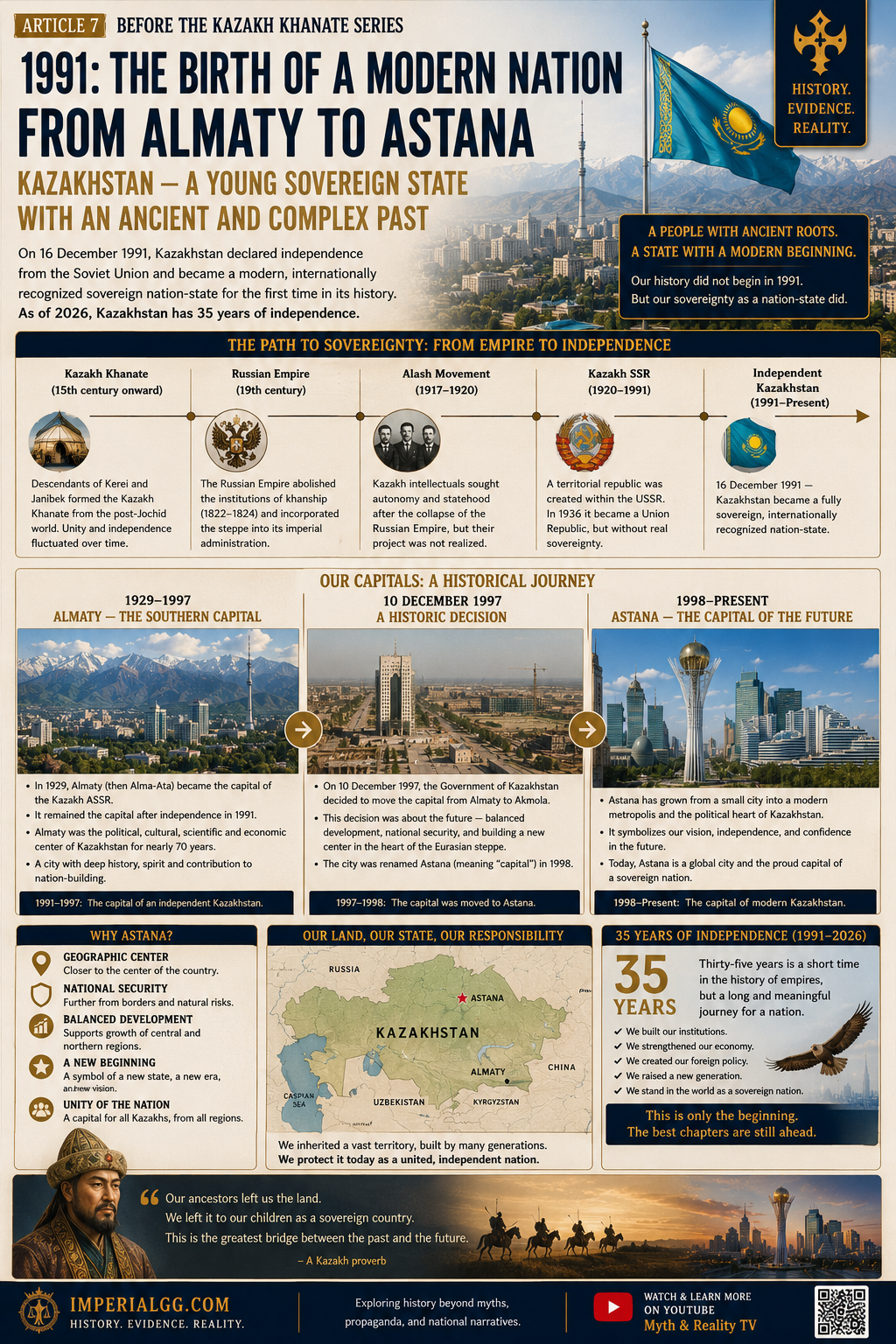
When the Soviet Union entered its final crisis in 1991, the Kazakh SSR already possessed the essential territorial and administrative framework of a modern state. On 16 December 1991, Kazakhstan declared independence and emerged as the internationally recognized Republic of Kazakhstan. The new state inherited the borders of the Soviet republic, along with its cities, industries, educational institutions, transportation networks, scientific infrastructure and major strategic facilities. It also inherited the consequences of Soviet economic planning and environmental policies, as well as the complex issue of nuclear weapons located on its territory following the dissolution of the USSR.
The establishment of independence in 1991 therefore represented the beginning of Kazakhstan’s existence as a fully sovereign modern republic within the contemporary international system. This statement does not imply that Kazakh history began in 1991. The history of the Kazakh people, their ancestors and their earlier political formations extends centuries into the past. What began in 1991 was a specific form of statehood: an internationally recognized sovereign republic exercising formal authority over the territory inherited from the Kazakh SSR.
This distinction between the history of a people and the constitutional history of a modern state is essential. The populations that eventually became Kazakhs existed before the fifteenth century. A distinct Qazaq ethnopolitical community emerged from the transformation of the post-Jochid world, and the Kazakh Khanate subsequently developed as a genuine Chinggisid political formation. Its rulers experienced periods of significant independence and regional power, but its political unity fluctuated and its institutions were eventually dismantled during Russian imperial expansion. The Soviet period later created the territorial-administrative republic whose borders and institutions became the foundation of the independent state established in 1991.
Modern Kazakhstan is therefore the product of several historical layers rather than the unchanged continuation of a single state extending from the Golden Horde to the present. Its deeper historical inheritance includes the ancient steppe civilizations, Turkic political traditions, the Mongol Empire, the Jochid world and the Kazakh Khanate. Its modern territorial structure was profoundly shaped by Russian imperial expansion and Soviet national-territorial organization, while its contemporary sovereign statehood dates from the collapse of the Soviet Union.
As of 2026, the Republic of Kazakhstan has existed as an independent modern state for approximately thirty-five years. That comparatively short history of contemporary sovereignty does not erase the much older history of the Kazakh people. It does, however, require a distinction between ancestry, ethnogenesis, dynastic rule, imperial administration, Soviet republican statehood and modern national independence. When these separate historical processes are collapsed into a single uninterrupted narrative, history becomes national mythology. When they are examined in their proper chronological context, the development of modern Kazakhstan becomes both more complicated and more historically significant.
The next question follows naturally from this chronology. If the modern Republic of Kazakhstan emerged from a Soviet territorial republic in 1991, while the medieval Kazakh Khanate itself emerged centuries earlier from the fragmentation of the Jochid political world, on what basis can modern Kazakhstan claim to be the exclusive successor of the Golden Horde? The answer requires separating legitimate historical inheritance from the modern political appropriation of a shared Eurasian past.
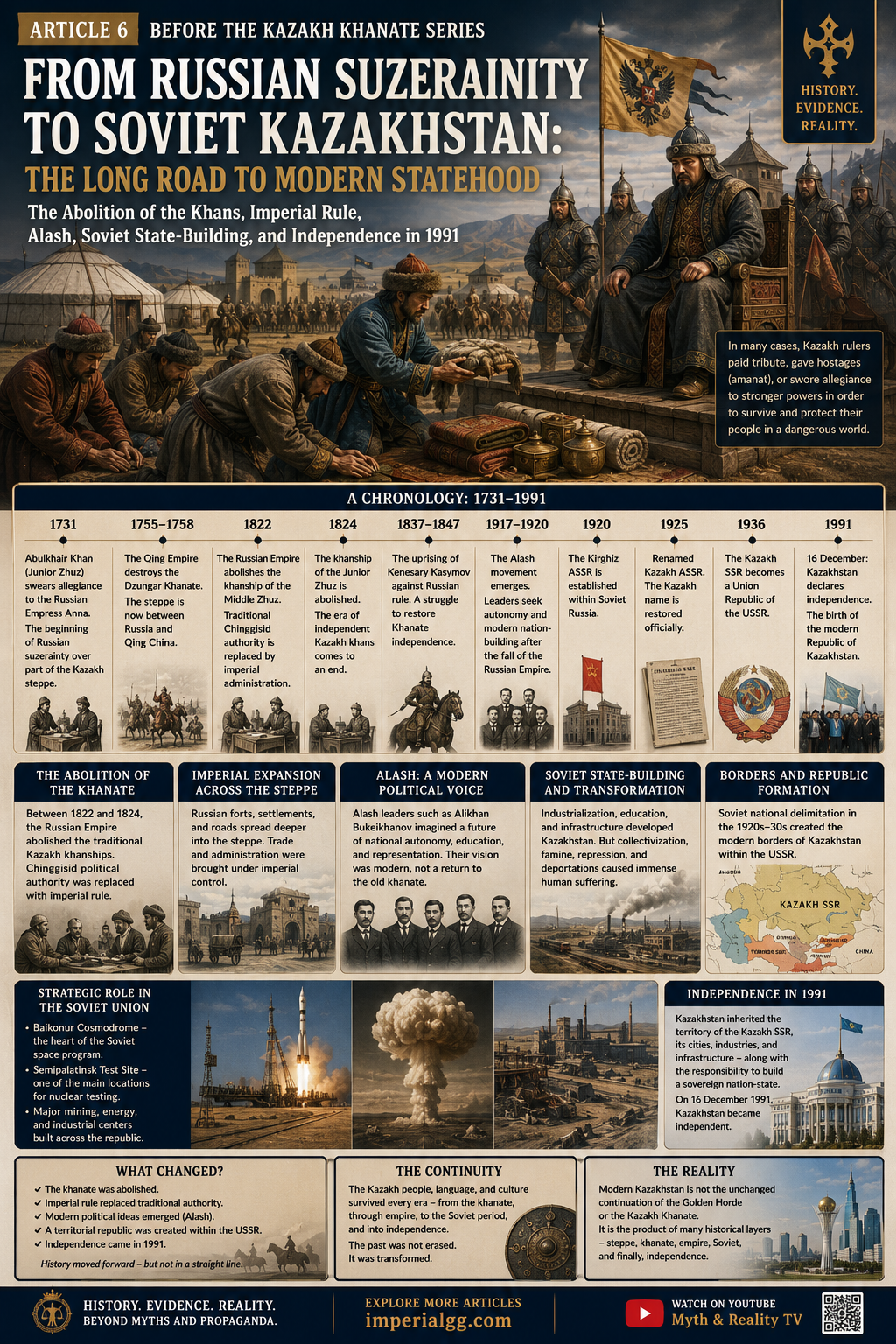
7. Kazakhstan: A Young Sovereign State with an Ancient and Complex Past
Independence in 1991, Thirty-Five Years of Sovereignty, and the Difference Between the History of a People and the History of a Modern State
Modern Kazakhstan is a young sovereign state with a much older historical inheritance. This distinction is fundamental to understanding its history. The peoples, tribes and political communities from which the modern Kazakh nation emerged possess deep roots in the history of Central Eurasia, but the existence of ancient ancestors should not automatically be equated with the continuous existence of a modern Kazakh nation-state.
The Republic of Kazakhstan became an independent and internationally recognized sovereign state on 16 December 1991. As of 2026, it has therefore existed as a modern independent republic for approximately thirty-five years. Before that date, the Kazakh Soviet Socialist Republic was a constituent republic of the Soviet Union. Before the Soviet period, most of the territory and population associated with the modern Kazakh nation had been incorporated into the Russian Empire. Earlier still, the Kazakh Khanate had existed as a decentralized Chinggisid steppe polity whose degree of unity, territorial control and independence changed considerably over time.
These historical formations are connected, but they are not identical.
The Kazakh Khanate was not the Republic of Kazakhstan under another name. The Kazakh SSR was not an independent sovereign state. The Russian imperial steppe territories were not a Kazakh nation-state. Likewise, the Golden Horde cannot simply be renamed an early Kazakh state merely because the Kazakh Khanate later emerged from one branch of the post-Jochid political world.
The distinction between these historical stages is not a denial of Kazakh history. It is precisely what makes serious historical analysis possible.
A people may possess an ancient cultural ancestry while its modern state is comparatively young. Many contemporary states share this historical pattern. Modern sovereignty, ethnic formation, dynastic legitimacy and cultural ancestry are separate historical categories and should not be collapsed into a single uninterrupted national timeline.
The Kazakh case illustrates this distinction particularly clearly. Before the fifteenth century, the territory of modern Kazakhstan formed part of several different political and cultural worlds. The steppe was inhabited and ruled at different times by numerous peoples and political formations, including ancient Iranian-speaking populations, Turkic confederations, Karluks, Kipchaks, Mongol imperial forces and the successor states of the Mongol Empire. None of these societies can simply be projected backward as the modern Kazakh nation.
The Mongol conquest of the thirteenth century transformed this political landscape fundamentally. Much of the western Eurasian steppe entered the ulus of Jochi, from which the political structure conventionally known as the Golden Horde developed. Its ruling dynasty was Chinggisid, its population was multiethnic, and its political territory extended far beyond the borders of modern Kazakhstan. Its history belongs to the wider history of Eurasia and to the historical inheritance of numerous later peoples and states.
The Kazakh Khanate emerged only much later, during the political fragmentation of this broader post-Mongol world. Kerei and Janibek were themselves Chinggisid princes operating within a political environment already shaped by the descendants of Jochi. The communities that gathered around them during the second half of the fifteenth century gradually became the foundation of a distinct Qazaq ethnopolitical identity.
This chronology matters. The Golden Horde did not begin as a Kazakh state and later change its name. The Kazakh Khanate emerged generations after the fragmentation of the Jochid political order, alongside other successor formations that possessed equally legitimate connections to that historical inheritance.
The Crimean Khanate was ruled by descendants of Jochi. The Shaybanids descended from Jochi. The rulers of Kazan and Astrakhan emerged from the same broader political tradition. The Nogai political world developed within the former territories of the Golden Horde. The Kazakh khans likewise belonged to this post-Jochid environment.
Kazakhstan can therefore legitimately claim a historical connection to the Golden Horde. What cannot be sustained historically is an exclusive claim that transforms the entire Golden Horde into a medieval Kazakh national state.
The same problem appears when modern national borders are projected backward. The lands of the Golden Horde were not called Kazakhstan. The eastern Dasht-i Qipchaq was not universally known as the “Kazakh Steppe” during the fourteenth century, and armies fighting in the political struggles of that period should not automatically be labeled Kazakh merely because some of their descendants may later have contributed to Kazakh ethnogenesis.
When Mamai and Tokhtamysh struggled for power in the late fourteenth century, for example, they were actors within the Jochid political world. The populations under their authority included Turkic-speaking steppe peoples commonly associated in historical sources with the broader Kipchak world, alongside Mongol and other elements. To rewrite these conflicts retrospectively as episodes of an already existing Kazakh national history imposes a later identity upon an earlier political age.
The term Qazaq itself also requires chronological discipline. Before it became firmly associated with a specific ethnopolitical population, the word had broader social meanings connected with political separation, freebooting, wandering or living independently from established authority. Its existence as a word before the fifteenth century does not prove the existence of a Kazakh nation-state in those earlier centuries.
The emergence of the Kazakh Khanate therefore represents a genuine historical beginning—not the beginning of all ancestral history on the territory of Kazakhstan, but the beginning of a distinct political formation increasingly associated with the Qazaq name.
That khanate subsequently developed its own important history. Under rulers such as Qasim Khan, it became a significant regional power. At other times, it fragmented and faced intense pressure from neighboring states. During the seventeenth and eighteenth centuries, Kazakh rulers confronted Oirat and Dzungar military power, negotiated with Central Asian states, and increasingly entered political relationships with the Russian and Qing empires.
By the nineteenth century, the Russian Empire had abolished the principal institutions of Kazakh khanship and incorporated the steppe into its imperial administrative system. Whatever limited sovereignty individual Kazakh rulers had previously retained was progressively eliminated.
The revolutionary collapse of the Russian Empire briefly created new political possibilities, most importantly through the Alash movement, but no durable internationally recognized independent Kazakh state emerged from that period. Soviet power eventually prevailed, and the territories that would form modern Kazakhstan were reorganized within the Soviet political system.
The Soviet period was decisive in establishing the territorial and administrative framework of the modern republic. A Kazakh autonomous republic was established, its national designation was formally recognized, its boundaries were developed through Soviet territorial processes, and in 1936 the Kazakh SSR became a constituent union republic.
Yet the Kazakh SSR remained part of the Soviet Union. It did not possess independent control over foreign affairs, defense or the central instruments of sovereignty. Its territory became one of the most strategically important regions of the Soviet state, hosting major industrial complexes, the Baikonur space center and nuclear testing infrastructure, but these belonged to and were controlled within the Soviet system.
The dissolution of the USSR therefore represented a genuine historical rupture.
On 16 December 1991, Kazakhstan declared independence. For the first time in the modern international system, a sovereign state officially named Kazakhstan possessed internationally recognized borders, its own government, independent foreign relations and membership in the global community of states.
This is the historical significance of 1991.
The modern Republic of Kazakhstan did not appear from nowhere. It inherited a territory substantially consolidated through Russian imperial expansion and Soviet administration. It inherited the borders of the Kazakh SSR, much of its infrastructure, educational system, industrial capacity and state institutions. It also inherited a much deeper cultural and historical identity connected to the Kazakh Khanate and, through that khanate, to the wider post-Mongol and Jochid world.
But inheritance is not the same as institutional continuity.
Modern Kazakhstan may legitimately commemorate the Kazakh Khanate as an important predecessor in its national history. It may recognize the Golden Horde as part of the broader historical world from which the Kazakh people eventually emerged. It may celebrate Turkic, Kipchak and steppe traditions as elements of its cultural inheritance.
What historical scholarship should resist is the attempt to convert all of these separate civilizations and political formations into a single uninterrupted national state stretching backward from 1991 into antiquity.
The Republic of Kazakhstan is approximately thirty-five years old as an independent modern sovereign state. The Kazakh people and their historical ancestors are far older. These two statements do not contradict one another.
Indeed, separating them produces a stronger historical argument.
Kazakhstan does not need to claim exclusive ownership of the Golden Horde to possess a significant history. It does not need to transform every Kipchak of the medieval steppe into a Kazakh, nor every territory ruled by a descendant of Jochi into an ancient Kazakh national province. Its actual history—the emergence of a new ethnopolitical community from the post-Mongol world, the creation of the Kazakh Khanate, centuries of struggle between powerful neighbors, incorporation into the Russian Empire, transformation under Soviet rule and eventual achievement of sovereign independence in 1991—is historically important in its own right.
The harder historical truth is therefore also the more interesting one: Kazakhstan is a young sovereign state built upon an ancient, shared and deeply layered Eurasian past.
Its thirty-five years of modern independence should not be extended backward artificially by renaming earlier empires. Nor should its young statehood be used to deny the much older history of its people.
The distinction between the two is precisely where history begins and mythology ends.
ImperialGG.com — Myth & Reality
Exploring History Beyond Legends, Propaganda, and National Narratives.