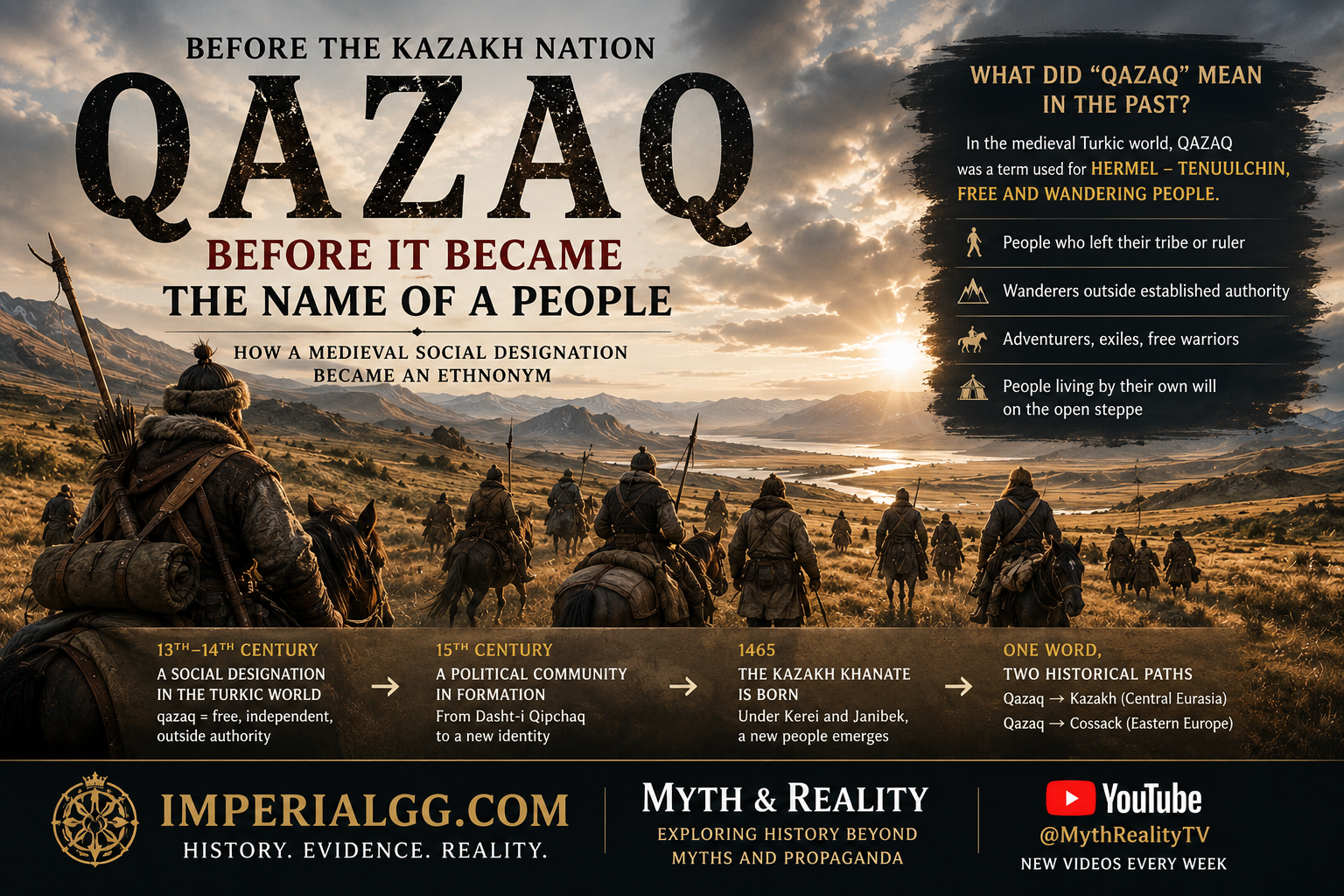
The Name “Qazaq”: Before It Became the Name of a People
By Altanbagana Baatar
DBA Candidate| Independent Historian
ImperialGG Historical Research Seriers
22 July 2026
How a Medieval Social Designation Became an Ethnonym
The history of the Kazakhs cannot be understood without first examining the history of the name itself. The word Qazaq existed before the emergence of the Kazakh Khanate and before the formation of the Kazakhs as a distinct ethnopolitical community. Its early appearance in medieval sources therefore should not automatically be interpreted as evidence for the existence of a Kazakh nation or a Kazakh state.
The precise etymology and earliest attestation of the word remain subjects of scholarly discussion. Forms that have sometimes been connected with qazaq have been identified in medieval sources associated with the Turkic-speaking world of the Black Sea and Dasht-i Qipchaq, including the Codex Cumanicus. Some of these identifications, however, are disputed. More securely documented fourteenth-century usages indicate that the term originally functioned primarily as a social designation rather than as the name of a particular ethnic population.
In the political culture of medieval Eurasia, qazaq referred broadly to a person who had separated from an established political authority or social community and was living independently. Depending on the historical context, it could describe a wanderer, an exile, a political adventurer, a free warrior, or an individual temporarily living outside the protection and authority of an established ruler. The related concept of qazaqliq referred to such a condition or way of life.
This was not necessarily a permanent identity. A prince who lost a political struggle and withdrew with his followers could enter a period of qazaqliq. Armed groups operating beyond established political authority could likewise be described in related terms. The concept therefore belonged to the broader social and political vocabulary of the medieval Turkic world.
This distinction is fundamental because the existence of the word qazaq in a medieval document does not demonstrate that a people corresponding to the modern Kazakhs already existed under that name. A social designation can later develop into an ethnonym, but these are two different historical stages.
The Steppe Before a Kazakh State
When Chinggis Khan established the Mongol Empire in 1206, there was no political state known as the Kazakh Khanate. Contemporary sources likewise do not describe a Kazakh nation ruling a territory called the “Kazakh Steppe.”
The use of the term “Kazakh Steppe” for the thirteenth and early fourteenth centuries can therefore create a misleading historical impression. Much of the enormous steppe zone stretching across western Eurasia was historically associated with Dasht-i Qipchaq, the Qipchaq Steppe. Following the Mongol conquests, large parts of this region became incorporated into the territories assigned to Jochi and his descendants, creating the political world of the Jochid Ulus.
The population of this vast region was highly diverse. It included numerous Turkic-speaking tribal populations, communities descended from the earlier Qipchaq world, and Mongol-origin military and tribal groups introduced or reorganized during the expansion of the Mongol Empire. Over the following centuries, extensive political integration, migration, intermarriage and linguistic assimilation transformed the demographic landscape of the region.
Many Mongol-origin groups gradually adopted Turkic languages while preserving tribal names, genealogical traditions and elements of the political culture created by the Mongol Empire. The populations that would later contribute to the formation of the Kazakhs therefore existed long before the Kazakh ethnonym became firmly established. The same broader Jochid world also contributed to the historical formation of several other later peoples, including Uzbeks, Nogais, Tatars and Bashkirs.
Recognizing this ancestry, however, is different from projecting later national identities backward into the thirteenth century. The ancestors of a people may exist centuries before the political and historical circumstances that produce a distinct ethnonym and collective identity.
From the Jochid World to a New Political Community
The transformation that eventually produced the Kazakhs took place within the political order that followed the fragmentation of the Mongol imperial world.
During the fourteenth and fifteenth centuries, the territories of the Jochid Ulus experienced repeated dynastic conflicts and political fragmentation. Different branches of the descendants of Jochi competed for authority across Dasht-i Qipchaq. From this environment emerged a number of political formations whose populations and ruling elites remained deeply connected to the institutional and dynastic traditions of the Mongol Empire.
By the fifteenth century, much of the eastern Dasht-i Qipchaq had come under the authority of Abulkhair Khan. His political confederation is commonly described in modern scholarship as the state of the Nomadic Uzbeks or the Uzbek Ulus. The terminology again requires caution. The word “Uzbek” in this fifteenth-century context should not simply be equated with the modern Uzbek nation. It referred to a much broader political population within the post-Jochid steppe.
It was from this political environment that the Chinggisid princes Kerei and Janibek eventually separated from Abulkhair Khan.
Their departure and the movement of their followers toward Moghulistan became a decisive stage in the emergence of a new political community. The people who joined them did not represent a single modern ethnic nation migrating as an already fully formed people. They came from the complex tribal population of the eastern Dasht-i Qipchaq and from a historical environment shaped by centuries of interaction among Turkic-speaking and Turkicized Mongol-origin populations.
The leadership under which this new community consolidated was itself Chinggisid. Kerei and Janibek belonged to the dynastic world descended from Chinggis Khan through Jochi. The emergence of the Kazakhs as a distinct political community must therefore be understood within the broader history of post-Mongol Eurasia rather than as a development separate from it.
As groups separated from existing political authorities and gathered around the new Chinggisid leadership, the older term qazaq increasingly acquired a more specific political meaning. Over time, a word that had described a social condition became associated with a particular community. Through this historical process, Qazaq gradually developed from a social and political designation into an ethnopolitical name.
Qazaq and Cossack: Two Paths from a Shared Word
The history of the word qazaq also extends far beyond the history of the modern Kazakh people.
Related forms of the same Turkic word entered the frontier vocabulary of Eastern Europe. In the borderlands between the steppe and the settled states of Eastern Europe, communities of armed free men developed outside or along the margins of established political authority. The East Slavic forms kazak and kozak, from which the English word Cossack ultimately derives, are historically connected to this wider Turkic linguistic tradition.
The historical development of the word therefore followed two different paths. In Central Eurasia, Qazaq gradually became associated with a specific political community and ultimately developed into the ethnonym Kazakh. In Eastern Europe, related forms became associated with frontier warrior communities that became known as the Cossacks.
The Kazakhs and the Cossacks are not the same people and emerged through very different historical processes. Their names, however, preserve the history of a word that once belonged to the wider social and political vocabulary of medieval Eurasia.
This linguistic connection further demonstrates why the early appearance of the word qazaq cannot by itself be used as evidence for the existence of an ancient Kazakh nation. The meaning of a word changes as the societies using it change.
When Did the Kazakh Khanate Appear?
The formation of the Kazakh Khanate is conventionally associated with the fifteenth century and particularly with the political movement led by Kerei and Janibek. The frequently cited date of approximately 1465–1466 is derived principally from the later account of Muhammad Haydar Dughlat in the Tarikh-i Rashidi. The precise chronology of the foundation requires careful examination, and the traditional date should not be treated as if it were recorded in a contemporary foundation document.
Nevertheless, the broader historical sequence is clear. A political state bearing the Kazakh name did not exist during the foundation of the Mongol Empire in 1206. It did not exist during the initial Mongol conquest of Dasht-i Qipchaq. The populations from which the Kazakhs would eventually emerge were present, but they belonged to earlier political and tribal worlds.
The distinction between ancestry, ethnonym and statehood is therefore essential. The ancestors of the Kazakhs existed long before the fifteenth century. The word qazaq also existed before the fifteenth century. Neither fact, however, demonstrates the existence of an earlier Kazakh state.
The Kazakhs emerged as a distinct ethnopolitical community through a long process of political consolidation within the post-Mongol and post-Jochid world. Their history is therefore inseparable from the transformation of the political order established by the Mongol conquests.
The next stage of this history begins with Kerei and Janibek. To understand the actual origins of the Kazakh Khanate, it is necessary to examine why these two Chinggisid princes broke with Abulkhair Khan, which populations followed them, why the ruler of Moghulistan accepted them, and how their migration eventually gave rise to a new political community bearing the name Qazaq.