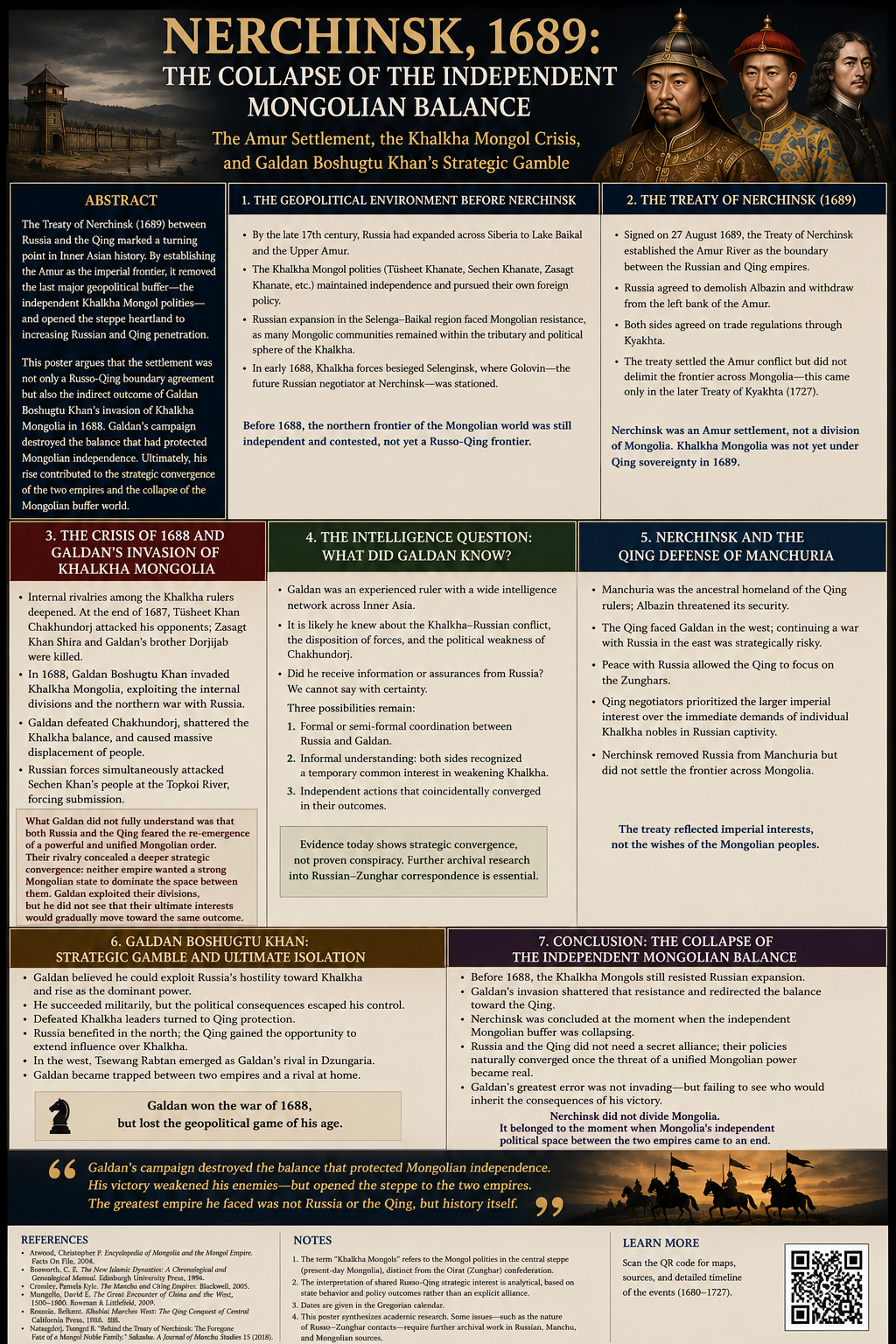
NERCHINSK, 1689: THE COLLAPSE OF THE INDEPENDENT MONGOLIAN BALANCE
By Altanbagana Baatar
DBA Candidate| Independent Historian
ImperialGG Historical Research Seriers
19 July 2026
The Amur Settlement, the Khalkha Mongol Crisis, and Galdan Boshugtu Khan's Strategic Gamble
1. INTRODUCTION: NERCHINSK BEYOND THE RUSSO – QING NARRATIVE
The Treaty of Nerchinsk, concluded between the Russian state and the Qing Empire in 1689, is conventionally presented as the first formal diplomatic settlement between the two expanding powers and as the agreement that ended their military confrontation in the Amur basin. This interpretation is broadly correct, but it becomes historically misleading when the political geography of the eighteenth century is projected backward onto the substantially different world of 1689. At the time of the treaty, the Khalkha Mongol polities had not yet entered the Qing imperial order formalized after the political settlement of 1691, the Zunghar state remained an independent and formidable Inner Asian power, and the frontier west of the Argun had not been comprehensively delimited between Russia and the Qing. Nerchinsk was therefore not a treaty by which two already established imperial sovereigns formally divided Mongolia between themselves. Its immediate purpose was to resolve the military confrontation over the Amur basin and, from the Qing perspective, to remove the Russian military presence threatening the approaches to Manchuria, the ancestral homeland and strategic heartland of the Manchu ruling house.[1]
Yet Nerchinsk cannot be separated from the wider geopolitical transformation taking place across the Mongolian world. Immediately before the treaty, the Khalkha Mongol polities were pursuing their own military policy against Russian expansion in the Selenga–Baikal region. In early 1688, Mongol forces besieged Selenginsk, where Fyodor Golovin, the Russian plenipotentiary who would subsequently negotiate at Nerchinsk, was himself present. The invasion of Khalkha Mongolia by Galdan Boshugtu Khan later that year abruptly destroyed this northern military front, forced Tüsheet Khan Chakhundorj, Zanabazar, and much of the Khalkha political elite toward Qing protection, and relieved the immediate military pressure upon Russian positions in Trans-Baikalia.[2]
The chronology raises a larger historical problem. At the beginning of 1688, the Khalkha Mongols were still capable of conducting an independent war against Russian expansion. By the end of the same year, their political and military balance had been shattered by another Mongolian power. In 1689, Russia and the Qing reached an accommodation at Nerchinsk according to their respective imperial interests. Only in 1691 was the relationship between the Khalkha nobility and the Qing emperor formally transformed at Dolon Nor.
These events should neither be collapsed into a single predetermined imperial conspiracy nor treated as unrelated episodes. Their intersection produced one of the decisive transformations in the history of seventeenth-century Inner Asia. The central argument of this article is therefore that Nerchinsk should be understood primarily as an Amur-Manchurian settlement concluded at the precise historical moment when the independent Mongolian balance between Russia and the Qing was collapsing. Within this process, Galdan Boshugtu Khan occupies a particularly paradoxical position. His invasion destroyed the principal Mongolian power then resisting Russian expansion in the north and simultaneously drove the defeated Khalkha leadership toward the Qing. Whether this outcome resulted partly from Russian-Zunghar strategic coordination remains an unresolved question requiring further documentary evidence. What can already be examined, however, is whether Galdan attempted to exploit Russia as a temporary geopolitical partner, only to discover that Russia had benefited from his campaign while pursuing an entirely independent accommodation with the Qing.
2. THE INDEPENDENT KHALKHA MONGOL FRONTIER AND THE WAR AGAINST RUSSIAN EXPANSION
The conventional history of Russian expansion across Siberia often emphasizes the extraordinary speed with which Cossack detachments, merchants, military officials, and tribute collectors crossed northern Eurasia. Following the conquest of the Siberian Khanate, Russian power expanded through a network of river routes and fortified settlements, eventually reaching Lake Baikal, the Pacific coast, and the Amur basin. Yet the establishment of an ostrog and the collection of yasak did not automatically transform contested territories into universally recognized Russian possessions. Along the southern Siberian frontier, Russian expansion encountered existing political systems whose own understandings of sovereignty, tribute, and allegiance differed substantially from the territorial assumptions of the expanding Muscovite state.[3]
The Selenga–Baikal region was one such contested political space. Communities whom Russian officials increasingly classified within administrative categories such as Buryat remained connected to the wider Mongolian world through networks of kinship, migration, tribute, military obligation, and political allegiance. Russian authorities attempted to incorporate these populations into the tsar’s yasak system, while Khalkha Mongol rulers continued to regard at least some of the same communities as belonging within their own political domains. The conflict therefore concerned people as much as territory. It represented a confrontation between expanding Russian imperial jurisdiction and pre-existing Mongolian claims that had not yet been extinguished by any recognized international boundary.[4]
The research of Tsongol B. Natsagdorj has brought this neglected Mongolian dimension of the Nerchinsk period into much sharper focus. Drawing upon Russian archival documents and Manchu-language materials, Natsagdorj reconstructs a coordinated Khalkha military effort against Russian positions immediately before Galdan’s invasion. Forces associated with the Tüsheet Khan and Sechen Khan polities were assigned to operations toward the Cis-Baikal fortresses, Selenginsk, Udinsk, and the eastern frontier. Severe climatic conditions and the death of Sechen Khan Rabdan Yeldeng disrupted part of the planned campaign, but significant military operations nevertheless took place.[5]
At the end of January 1688, Mongol forces besieged Selenginsk. Golovin, who had been dispatched eastward with authority to negotiate with the Qing, was inside the Russian position while awaiting the arrival of the Qing mission. The historical significance of this episode extends beyond the siege itself. The future Russian negotiator at Nerchinsk encountered the Khalkha Mongols not as subjects of the Qing emperor but as an independent military adversary pursuing its own frontier policy.[6]
The Khalkha campaign was closely connected to the contested allegiance of Mongolic populations around Lake Baikal. Groups moved between Russian and Mongolian authority under changing military and political circumstances, while both sides attempted to convert flexible relationships of tribute and allegiance into more exclusive forms of jurisdiction. From the perspective of the Khalkha Mongol rulers, Russian expansion was removing populations from their political sphere. From the Russian perspective, communities that had begun paying yasak were increasingly treated as subjects of the tsar whose transfer back to Mongolian authority could not be accepted.
This frontier conflict is essential to understanding the political status of Khalkha Mongolia immediately before Nerchinsk. The northern Mongolian frontier had not yet become a Russo-Qing frontier. Russia confronted the Qing farther east over the Amur and Albazin, but around the Selenga and Lake Baikal it simultaneously confronted independent Mongolian political powers. These were geographically connected but politically distinct conflicts.
The distinction is fundamental because it challenges the retrospective assumption that the Qing could already speak for all Mongolian territories and political interests in 1689. The Khalkha Mongol polities were themselves attempting, through diplomacy and ultimately military force, to determine the northern boundary of their political world.
3. CRISIS OF 1688 AND GALDAN’S INVASION OF KHALKHA MONGOLIA
The independent Khalkha campaign against Russian expansion was destroyed not by a decisive Russian military victory but by a catastrophic conflict originating within the Mongolian world itself. Relations among the Khalkha ruling houses had deteriorated over a prolonged period, particularly around the political disputes involving the Zasagt Khan and Tüsheet Khan domains. At the end of 1687, Tüsheet Khan Chakhundorj attacked his opponents, and both Zasagt Khan Shira and Galdan Boshugtu Khan’s brother Dorjijab were killed. These events provided the immediate political and dynastic background to Galdan’s eastward campaign.[7]
The internal causes of the war must be acknowledged clearly. Galdan’s invasion cannot simply be reduced to a Russian plot. He possessed his own reasons for confronting Chakhundorj and pursued an independent project of political expansion that had already transformed the balance of power across Central Asia. Nevertheless, identifying the immediate cause of a war does not fully explain the strategic timing of a military campaign.
When Galdan moved against Khalkha Mongolia, significant Khalkha military resources had recently been committed to the confrontation with Russia in the north. The precise movements of Chakhundorj himself and the distribution of individual Khalkha contingents require further reconstruction from contemporary records, but the broader strategic situation is unmistakable. The Khalkha Mongol political system was already engaged in a major frontier conflict when Galdan opened a second and considerably more dangerous front.
The consequences were devastating. Galdan defeated the forces opposing him and shattered the existing Khalkha political balance. Large populations were displaced. Chakhundorj, Zanabazar, and other leading figures moved south and east toward Qing-controlled territories, while groups unable to escape in that direction were forced toward the Russian frontier. The organized Khalkha military pressure upon Selenginsk and the Baikal region consequently collapsed at precisely the moment when it had developed into a serious challenge to Russian expansion.[8]
Russian forces quickly exploited the changed circumstances. On 30 September 1688, approximately eight hundred troops under Golovin launched a night attack upon the Tabunangγud, associated with the Sechen Khan polity, at the Topkoi River. According to the archival evidence examined by Natsagdorj, approximately two hundred men were killed, while the surviving population was compelled to submit to the Russian tsar. Golovin subsequently attempted further operations against other Khalkha groups trapped in the region by the wider military crisis.[9]
The strategic transformation was remarkable. At the beginning of the year, Golovin had been besieged by Mongol forces at Selenginsk. By the latter part of the same year, he was attacking fragmented Khalkha groups whose political and military organization had been disrupted by Galdan’s invasion.
This sequence explains why some contemporary Khalkha nobles concluded that Russia and Galdan were cooperating against them. Natsagdorj notes that the simultaneous attacks by Golovin’s forces and those of Galdan created the perception among the Khalkha that the two were acting as allies.[10] Such contemporary suspicion cannot, by itself, establish the existence of a prearranged military conspiracy. It does, however, demonstrate that the possibility of Russian-Zunghar coordination is not merely a modern retrospective speculation. It was a political interpretation formed by people directly experiencing simultaneous military pressure from the north and west.
4.THE INTELLIGENCE QUESTION: WHAT DID GALDAN KNOW?
The central unresolved question is therefore not whether Galdan possessed independent reasons for invading Khalkha Mongolia; he clearly did. The more difficult question is what he knew about the military disposition of his opponents when he chose to act.
Galdan was an experienced ruler whose power had been built through warfare, diplomacy, and political expansion across Central Asia. His state maintained contacts with neighboring powers, including Russia, and operated within the communication networks characteristic of early modern Inner Asia. Envoys, merchants, religious figures, frontier communities, defectors, prisoners, and political intermediaries all functioned as potential channels of information. It would therefore be difficult to assume that Galdan was unaware of a major military confrontation involving Chakhundorj’s political sphere and Russian positions in the north.
The Mongolian tradition of strategic intelligence provides an important broader context. From the era of the Mongol Empire onward, successful campaigning had depended heavily upon the systematic collection of information concerning enemy forces, political divisions, routes, water sources, pastures, fortifications, and potential allies. It would require separate evidence to claim direct institutional continuity between the intelligence structures of the thirteenth-century empire and those of the seventeenth-century Zunghar state. Nevertheless, the political culture of information gathering remained deeply embedded within Inner Asian statecraft. Galdan’s campaigns elsewhere provide little reason to imagine that he would have entered a major war without attempting to understand the military circumstances of his opponent.
The timing of the 1688 invasion therefore deserves investigation as a strategic decision rather than merely as the automatic consequence of Dorjijab’s death. If Galdan knew that substantial Khalkha resources had been committed to the Russian front, then his decision to attack at that moment represented a calculated exploitation of military opportunity. This would not itself prove Russian complicity. Intelligence concerning the northern war could have reached Galdan through numerous channels independent of the Russian authorities.
A stronger hypothesis would require stronger evidence. If Russian-Zunghar diplomatic communications before the invasion contained information concerning Khalkha military deployments, or if Russian officials provided assurances that allowed Galdan to calculate that his northern flank would remain secure, then the relationship between the two powers would have to be interpreted as something more substantial than the accidental convergence of independent interests.
At present, three analytical possibilities must remain open. The first is formal or semi-formal strategic coordination between Russian authorities and Galdan. The second is an informal understanding in which both sides recognized their temporary common interest in weakening Khalkha without establishing a binding alliance. The third is independent action in which Galdan and Russia pursued separate objectives that happened to converge strategically.
The available evidence is strongest concerning the consequences rather than the intentions. Russia unquestionably benefited from the destruction of the Khalkha northern front. Galdan’s invasion removed the principal organized Mongolian military challenge to Russian positions in the Selenga–Baikal region without requiring Russia itself to defeat the combined power of the Khalkha Mongol polities. The subsequent fragmentation of Khalkha political authority also enabled Russian forces to absorb populations and strengthen positions that had previously remained contested.
This does not prove that Russia created Galdan’s campaign. It does establish why Russian authorities had little strategic reason to oppose it.
What Galdan appears not to have fully understood was that his rise was taking place within a geopolitical environment in which both Russia and the Qing had reasons to fear the re-emergence of a powerful and unified Mongolian political order. Their interests were by no means identical, and in the 1680s the two states remained direct military rivals in the Amur basin. Yet beneath this rivalry lay a deeper strategic convergence. Neither Moscow nor the Qing court had an interest in seeing the Mongolian world reunited under a single military power capable of challenging Russian expansion in Siberia while simultaneously threatening Qing authority in Inner Asia. The independent military strength of the Khalkha Mongol polities had already demonstrated the danger such resistance could pose to Russia, while Galdan’s rapid expansion increasingly revealed to the Qing the potential consequences of a powerful Mongolian state emerging beyond its control.
The tragedy of 1688 was that Galdan may have recognized the immediate divisions among his enemies without fully appreciating this deeper convergence of interests. He could exploit Russia’s conflict with Chakhundorj, just as Russia could benefit from his destruction of the Khalkha northern front, but the rise of a dominant Zunghar power was no more compatible with Russia’s long-term security interests than it was with those of the Qing. The two empires did not need to form a secret alliance against the Mongols for their policies gradually to move toward a common strategic outcome. Their rivalry over territory could coexist with a shared interest in preventing any single Mongolian power from becoming strong enough to dominate the political space between them.
In this sense, Galdan’s invasion contained a geopolitical contradiction that he may not initially have perceived. By destroying the independent Khalkha balance, he removed one of the principal barriers separating the expanding Russian and Qing imperial systems. He may have believed that the weakening of Chakhundorj would strengthen his own position and that Russia’s hostility toward the Khalkha Mongols created a favorable strategic alignment. Yet the same campaign demonstrated how dangerous a powerful Mongolian ruler could become to both neighboring empires. The stronger Galdan became, the greater the incentive for Russia and the Qing to avoid exhausting themselves against one another while a third power expanded between them.
The Treaty of Nerchinsk should not therefore be interpreted as documentary proof of a secret Russo-Qing alliance against the Mongols. Its immediate purpose remained the settlement of the Amur conflict and the security of Manchuria. Nevertheless, the treaty revealed an emerging strategic reality that Galdan may have failed to anticipate: Russia and the Qing could remain imperial rivals while simultaneously discovering that accommodation with one another was preferable to allowing a powerful Mongolian state to exploit their conflict. Galdan entered the war of 1688 believing that the divisions surrounding Khalkha created an opportunity for his own expansion. He did not yet understand that his own success could become one of the forces pushing Russia and the Qing toward a geopolitical accommodation from which he, rather than either of them, would ultimately emerge isolated.
5. NERCHINSK AND THE QING DEFENCE OF MANCHURIA
While the Mongolian political world was entering its greatest crisis of the late seventeenth century, Russia and the Qing were confronting one another over a geographically distinct but strategically connected frontier. Russian expansion into the Amur basin had brought Muscovite power into direct contact with territories of exceptional importance to the Qing ruling house. Manchuria was not simply another peripheral province of an empire centered exclusively upon China proper. It was the ancestral homeland of the Manchu dynasty and remained central to the political identity and strategic security of the Aisin Gioro ruling house.[11]
The establishment of the Russian position at Albazin therefore represented a direct challenge. Qing forces attacked the fortress in 1685, and after the Russians returned, renewed military operations followed in 1686. Both states, however, confronted logistical limitations. Russia could extend power across enormous distances through its Siberian river systems and fortified network, but sustaining a major war on the Amur was exceptionally difficult. The Qing possessed greater military resources near the contested region but also faced the costs of maintaining prolonged operations on a distant frontier.[12]
The emergence of Galdan as a major threat gave the Qing an additional reason to seek a settlement with Russia. Continuing the Amur war while confronting an increasingly powerful Zunghar state would have forced the Kangxi government to manage simultaneous strategic crises on widely separated fronts. Peace with Russia could secure the northeastern approaches to Manchuria while reducing the possibility of active Russian support for Galdan.
This wider strategic context is visible in the diplomatic material examined by Natsagdorj. His reconstruction of the fate of Erdeni Toyin Dayiching and his family indicates that Qing negotiators were prepared to subordinate the immediate interests of individual Khalkha nobles to the larger objective of reaching an agreement with Russia. Members of the family who had fallen into Russian hands sought assistance from the Qing delegation, yet their release did not become a condition upon which the Qing were prepared to risk the negotiations. Natsagdorj interprets the relevant correspondence as evidence that the Qing prioritized peace and Russian neutrality in the anticipated struggle with the Zunghars.[13]
The episode is important because it reveals the danger of projecting later Qing sovereignty backward onto the negotiations of 1689. The Qing delegation negotiated according to Qing imperial interests. The Khalkha Mongol polities were not represented as an independent contracting party, but neither were all Khalkha interests automatically treated as interests for which the Qing would sacrifice the larger settlement.
The Treaty of Nerchinsk itself reflected the immediate strategic priorities of the two negotiating powers. Russia abandoned Albazin, while the territorial provisions established a frontier in the upper Amur region associated with the Argun and the surrounding watershed. The boundary farther west across the Mongolian world was not comprehensively determined. The later extension and formalization of the Russo-Qing frontier toward Mongolia belonged to subsequent negotiations, above all the Treaty of Kyakhta in 1727, concluded in a fundamentally changed political environment.[14]
For this reason, Nerchinsk should not be described as the treaty by which Russia and the Qing divided Mongolia. In 1689, Khalkha Mongolia had not yet entered the political order established after Dolon Nor, the Zunghar state remained independent, and the territorial provisions of Nerchinsk did not establish the later imperial frontier across the Mongolian north.
The significance of Nerchinsk for Mongolian history was nevertheless profound. By settling their immediate conflict over the Amur, Russia and the Qing demonstrated an ability to separate direct territorial disputes from their broader strategic rivalry. Russia accepted withdrawal from Albazin while preserving the essential structure of its Siberian expansion and its increasingly secure position in Trans-Baikalia. The Qing secured the approaches to Manchuria and gained greater freedom to confront Galdan. Meanwhile, the independent Mongolian political balance that had previously constrained both imperial systems was collapsing.
The chronological distinction between Nerchinsk in 1689 and Dolon Nor in 1691 is therefore indispensable. The emergency dependence created when the defeated Khalkha leadership sought Qing protection should not be treated as though it had retroactively established Qing sovereignty over Khalkha Mongolia before the crisis. In early 1688, Khalkha forces were still independently fighting Russia. In 1689, Russia and the Qing concluded an agreement over the Amur. Only afterward was the political relationship between the Khalkha nobility and the Qing emperor formally transformed.
6. GALDAN BOSHIGTU KHAN: STRATEGIC PARTNER, INSTRUMENT, OR ARCHITECT OF HIS OWN ISOLATION
The question of Galdan’s relationship with Russia cannot be answered adequately by portraying him either as a Russian puppet or as a ruler acting in complete geopolitical isolation. He was one of the most formidable political figures of seventeenth-century Inner Asia, and his earlier campaigns demonstrated considerable military and political ability. Any serious interpretation must therefore begin from the assumption that Galdan pursued his own strategic objectives and regarded relations with Russia according to the interests of his own state.
From Galdan’s perspective, the circumstances preceding the invasion of Khalkha Mongolia may have appeared unusually favorable. His principal enemies were divided. Chakhundorj’s political system was engaged in a confrontation with Russia in the north. Galdan possessed considerable military prestige following his campaigns in Central Asia. Relations with Russia offered potential commercial advantages, access to weapons, diplomatic leverage, and perhaps the expectation that Russia would remain hostile toward the same Khalkha forces that Galdan intended to defeat.
Under these circumstances, Galdan may not have regarded himself as Russia’s instrument at all. He may instead have believed that he was exploiting Russian pressure upon Khalkha for his own purposes.
If so, his fundamental strategic error emerged only after his military victory.
Galdan succeeded in destroying the existing Khalkha balance but failed to control the political consequences. The defeated Khalkha leadership did not submit permanently to him. Instead, Chakhundorj, Zanabazar, and other nobles moved into the Qing sphere and increasingly sought imperial protection. Galdan therefore destroyed an independent Mongolian political barrier but could not prevent the Qing from becoming the principal beneficiary of the resulting vacuum.
The same paradox operated in the north. Galdan’s campaign destroyed the organized military pressure being exerted against Russian expansion, yet the territories and populations lost by the weakened Khalkha polities did not pass into a durable Zunghar system. Russia benefited from the disappearance of its immediate Mongolian military opponent.
If Galdan expected this temporary convergence of Russian and Zunghar interests to develop into a lasting strategic partnership, he fundamentally misread the nature of Russian policy. Moscow had an interest in weakening Khalkha resistance, but it had no necessary interest in the creation of an overwhelmingly powerful Zunghar state. Once the Khalkha northern front had collapsed, Russia remained free to negotiate with the Qing according to its own strategic requirements.
Nerchinsk exposed the limits of any Russian-Zunghar alignment. Russia obtained the weakening of Khalkha without accepting responsibility for Galdan’s larger political ambitions. By reaching an accommodation with the Qing, Moscow reduced the danger of a costly eastern war while preserving its broader Siberian position. Galdan, meanwhile, faced an increasingly powerful Qing opponent without receiving the decisive Russian support that a durable alliance would have required.
His position was further weakened by developments within the Zunghar political world. While Galdan remained committed to prolonged warfare in the east, Tsewang Rabtan emerged as a rival center of authority in Dzungaria. The personal and dynastic dimensions of their conflict, including traditions concerning marriage and family rivalry, require careful source criticism and should not substitute for structural political analysis. The strategic consequence, however, is clear. Galdan could no longer assume that the western territories from which his power had originally emerged remained a secure political and military rear.
His eastern campaign thus created a strategic trap. Retreat toward Dzungaria became increasingly difficult, while remaining in the east exposed him to the expanding military resources of the Qing. Galdan had entered Khalkha Mongolia at the height of his power but ultimately found himself isolated between a strengthening Qing imperial system and a western political base over which his authority had become contested.
The question of whether Galdan was “used” by Russia and whether he was responsible for his own strategic failure should therefore not be framed as a simple choice between two mutually exclusive explanations. Both processes may have operated simultaneously. Galdan could have deliberately exploited Russian hostility toward Khalkha while Russia independently exploited the consequences of Galdan’s campaign. The temporary convergence of interests required neither permanent loyalty nor a formal alliance.
The deeper strategic failure was therefore one of geopolitical calculation. Galdan may have understood Russia’s immediate interest correctly but misunderstood its limits. He may have recognized that Russia benefited from the weakening of Chakhundorj but failed to appreciate that Moscow would pursue accommodation with the Qing once such an agreement became more advantageous. At the same time, he underestimated the capacity of the defeated Khalkha elite to transfer their political allegiance toward the Qing and failed to secure his own rear against the rise of Tsewang Rabtan.
Galdan’s military victory consequently produced a political order increasingly favorable to others. Russia strengthened its northern position. The Qing acquired an unprecedented opportunity to extend its authority over Khalkha Mongolia. Tsewang Rabtan consolidated power in the west. Galdan himself inherited an expanding war whose geopolitical consequences he could no longer control.
7. CONCLUSION: THE COLLAPSE OF THE INDEPENDENT MONGOLIAN BALANCE
The Treaty of Nerchinsk should be restored to the specific political geography of 1689 rather than interpreted through the imperial boundaries that emerged during the eighteenth century. It was primarily an agreement concerning the Amur basin and the security of Manchuria. The Qing sought to remove Russian military power from a strategically sensitive region adjoining the homeland of the ruling dynasty, while Russia sought to stabilize its eastern frontier without sacrificing the broader achievements of its expansion across Siberia. The treaty did not comprehensively delimit the later Russo-Qing frontier across Mongolia, nor was Khalkha Mongolia already an uncontested Qing possession when the agreement was concluded.
The broader significance of Nerchinsk lies in the transformation occurring around it. Immediately before the treaty, the Khalkha Mongol polities were still pursuing an independent military policy against Russian expansion. Their campaign demonstrated that the political future of the Selenga–Baikal frontier remained contested and that the Mongolian world still possessed the capacity to resist the advance of neighboring imperial systems.
The destruction of this position resulted from the intersection of external expansion and internal Mongolian conflict. Galdan’s invasion of 1688 shattered the Khalkha military balance at the moment when substantial resources had been committed to the northern front. Russia immediately benefited from the resulting fragmentation. The defeated Khalkha leadership moved toward Qing protection. The Qing gained a strategic opportunity that decades of diplomacy alone had not produced.
Whether Galdan deliberately coordinated his invasion with Russian authorities remains an unresolved question. The evidence currently available establishes contemporary Khalkha suspicion, diplomatic contact between Russia and the Zunghar state, simultaneous military pressure, and a clear convergence of strategic benefits. It does not yet establish beyond doubt a prearranged military conspiracy. The distinction must be preserved if the argument is to remain historically rigorous.
Yet the unresolved question of coordination should not obscure the larger conclusion. Galdan’s campaign was a catastrophic strategic success. He won militarily and destroyed the political balance he intended to overthrow, but he failed to inherit the order that followed. Russia benefited in the north. The Qing benefited in the south and east. His own political base in Dzungaria became contested by Tsewang Rabtan. The campaign that appeared to represent the culmination of Galdan’s power ultimately contributed to his isolation.
The tragedy of the period therefore cannot be reduced to a simple narrative in which Russia and the Qing secretly divided Mongolia at Nerchinsk. The historical process was more complex and, from a Mongolian perspective, more consequential. Russia and the Qing pursued coherent imperial interests and demonstrated an increasing capacity to negotiate when direct conflict ceased to serve those interests. The Mongolian powers, despite possessing considerable military strength, were simultaneously engaged in a destructive struggle among themselves.
In early 1688, the Khalkha Mongols were still besieging Russian fortresses and attempting to determine their own northern frontier. In 1689, Russia and the Qing settled their confrontation over the Amur while the Mongolian political world remained fractured. In 1691, the relationship between the Khalkha nobility and the Qing emperor entered a fundamentally new stage.
Nerchinsk did not divide Mongolia. It was concluded before that later imperial division had taken shape. Nevertheless, the treaty belonged to the historical moment in which the balance capable of preserving an independent Mongolian political space between Russia and the Qing was collapsing.
The most important unanswered question concerns Galdan himself. Did he know that the Khalkha military system was strategically extended on the northern front and deliberately choose that moment to strike? Did his relations with Russia provide information or assurances that influenced his calculations? Did he believe that he was exploiting Russia, only to discover that Russia was equally prepared to exploit his campaign? These questions require further investigation of Russian-Zunghar correspondence, Manchu archival materials, and Mongolian sources.
What can already be said is that Galdan’s greatest error may not have been his decision to invade Khalkha Mongolia. It was his failure to understand who would ultimately inherit the consequences of his victory. By destroying the existing Mongolian balance without creating a stable political order to replace it, he opened strategic space for the two expanding imperial powers on either side of the Mongolian world. In this sense, the history surrounding Nerchinsk was not simply the story of Russian and Qing expansion. It was also the history of a Mongolian geopolitical collapse whose principal architect became, in the end, one of its most consequential victims.
NOTES
[1] Joseph Sebes, The Jesuits and the Sino-Russian Treaty of Nerchinsk (1689): The Diary of Thomas Pereira, S.J. (Rome: Institutum Historicum Societatis Iesu, 1961); V. S. Frank, “The Territorial Terms of the Sino-Russian Treaty of Nerchinsk, 1689,” Pacific Historical Review 16, no. 3 (1947): 265–270; Peter C. Perdue, China Marches West: The Qing Conquest of Central Eurasia (Cambridge, MA: Harvard University Press, 2005).
[2] Tsongol B. Natsagdorj, “Behind the Treaty of Nerchinsk: The Foregone Fate of a Mongol Noble Family,” Saksaha: A Journal of Manchu Studies 15 (2018).
[3] For the broader process of Russian expansion and the political economy of the Siberian frontier, see Clifford M. Foust, Muscovite and Mandarin: Russia’s Trade with China and Its Setting, 1727–1805 (Chapel Hill: University of North Carolina Press, 1969). For the Inner Asian geopolitical context, see Perdue, China Marches West.
[4] Natsagdorj, “Behind the Treaty of Nerchinsk.” His reconstruction of the Bargu, Buryat, and other Mongolic populations demonstrates the persistence of overlapping political and tributary claims along the Baikal frontier.
[5] Ibid. Natsagdorj reconstructs the planned operations of forces associated with the Tüsheet Khan and Sechen Khan polities against Russian positions and discusses the circumstances that prevented parts of the campaign from proceeding as intended.
[6] Ibid. Mongol forces besieged Selenginsk at the end of January 1688 while Fyodor Golovin was present there awaiting the Qing mission.
[7] Ibid.; Perdue, China Marches West. The deaths of Zasagt Khan Shira and Galdan’s brother Dorjijab formed the immediate background to Galdan’s campaign, although the conflict must also be situated within the longer political rivalry among the Mongolian ruling houses.
[8] Natsagdorj, “Behind the Treaty of Nerchinsk.”
[9] Ibid. Natsagdorj records the attack led by Golovin’s forces against the Tabunangγud at the Topkoi River on 30 September 1688 and the subsequent submission of surviving members of the group.
[10] Ibid. Natsagdorj notes that the coincidence of Russian and Zunghar attacks led contemporary Khalkha nobles to conclude that Golovin and Galdan were cooperating against them. This contemporary perception should be distinguished from documentary proof of a formal military alliance.
[11] On the Qing strategic position in Inner Asia and the wider importance of the Manchu imperial homeland, see Perdue, China Marches West.
[12] Sebes, The Jesuits and the Sino-Russian Treaty of Nerchinsk; Frank, “The Territorial Terms of the Sino-Russian Treaty of Nerchinsk.”
[13] Natsagdorj, “Behind the Treaty of Nerchinsk.” His analysis of the Erdeni Toyin Dayiching case and Qing diplomatic correspondence emphasizes the priority given to peace with Russia and Russian neutrality in the developing confrontation with Galdan.
[14] Frank, “The Territorial Terms of the Sino-Russian Treaty of Nerchinsk”; Sebes, The Jesuits and the Sino-Russian Treaty of Nerchinsk. The later westward delimitation of the Russo-Qing frontier belongs to the subsequent diplomatic settlement associated particularly with the Treaty of Kyakhta of 1727 and should not be projected backward onto the territorial provisions of Nerchinsk.
BIBLIOGRAPHY
Foust, Clifford M. Muscovite and Mandarin: Russia’s Trade with China and Its Setting, 1727–1805. Chapel Hill: University of North Carolina Press, 1969.
Frank, V. S. “The Territorial Terms of the Sino-Russian Treaty of Nerchinsk, 1689.” Pacific Historical Review 16, no. 3 (1947): 265–270.
Natsagdorj, Tsongol B. “Behind the Treaty of Nerchinsk: The Foregone Fate of a Mongol Noble Family.” Saksaha: A Journal of Manchu Studies 15 (2018).
Perdue, Peter C. China Marches West: The Qing Conquest of Central Eurasia. Cambridge, MA: Harvard University Press, 2005.
Sebes, Joseph. The Jesuits and the Sino-Russian Treaty of Nerchinsk (1689): The Diary of Thomas Pereira, S.J. Rome: Institutum Historicum Societatis Iesu, 1961.