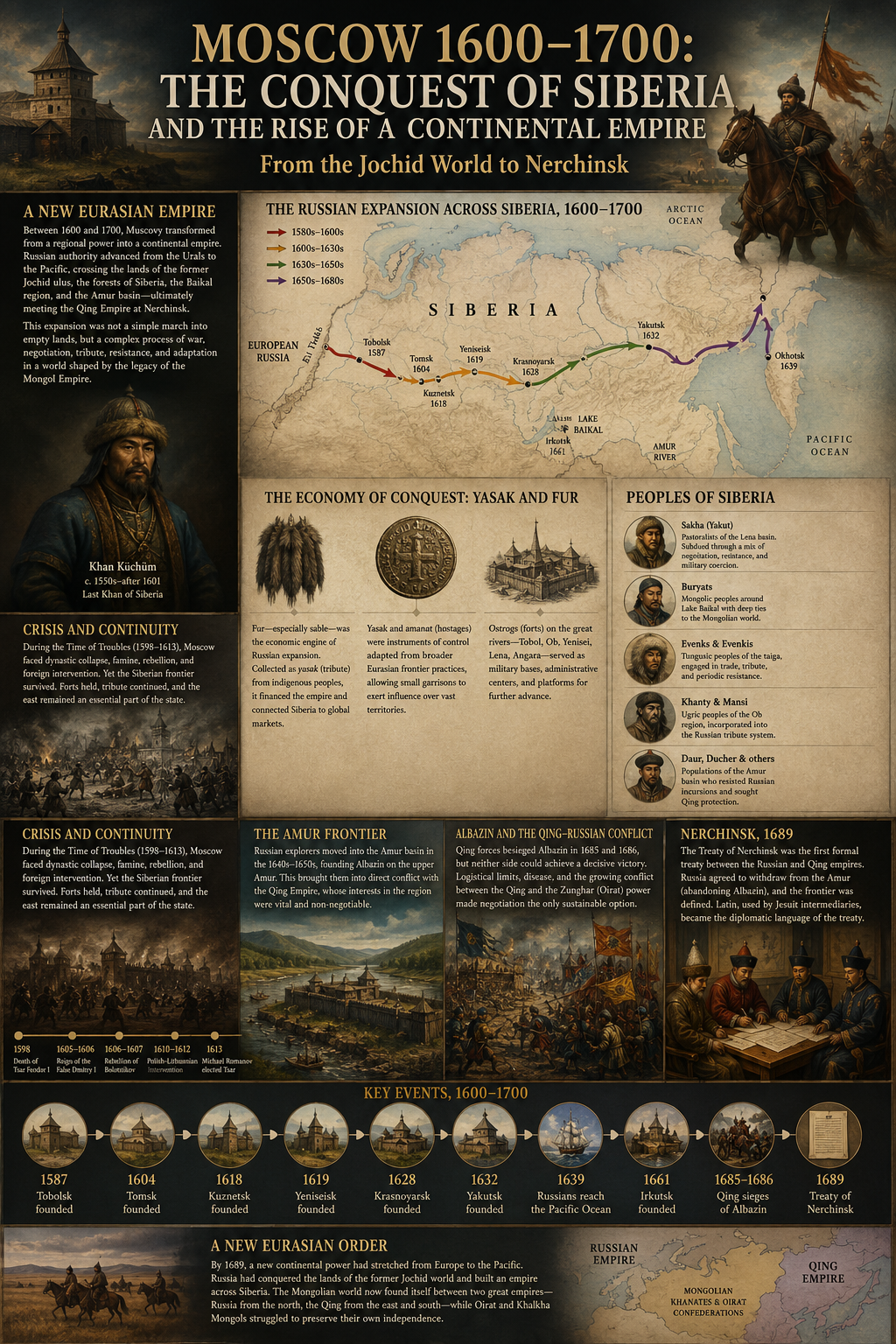
MOSCOW 1600–1700: The Conquest of Siberia and the Rise of a Continental Empire
By Altanbagana Baatar
DBA Candidate| Independent Historian
ImperialGG Historical Research Seriers
19 July 2026
FROM THE JOCHID FRONTIER TO NERCHINSK
The seventeenth century occupies a decisive place in the history of Moscow’s transformation from a regional Eurasian state into a continental empire. At the beginning of the century, the Muscovite state was politically unstable, dynastically vulnerable, and still consolidating territories acquired during its long confrontation with the successor states of the Jochid ulus. By the end of the century, however, Russian authority extended across the entire breadth of northern Eurasia, from the old centers of Muscovy to the Pacific Ocean. Russian forts stood in the Baikal region, expeditions had entered the Amur basin, and Moscow had become a direct geopolitical neighbor of both the Mongolian world and the expanding Qing Empire.
This transformation is often presented within a conventional narrative of Russian exploration and colonization, in which Siberia appears as an immense geographical space gradually discovered by Cossacks, merchants, hunters, and state officials moving eastward from the Urals. From the perspective of Mongolian and Inner Asian history, however, this interpretation is insufficient. Siberia was neither politically empty nor historically disconnected before the arrival of Russian power. Its forests, river valleys, steppes, and mountain corridors were inhabited by numerous communities whose histories were connected through trade, migration, warfare, tribute, diplomacy, and dynastic politics. Turkic, Mongolic, Tungusic, Ugric, Samoyedic, and other peoples had created and participated in overlapping regional systems long before Moscow crossed the Urals.
Nor can the seventeenth-century Russian advance be separated from the deeper political history of the Mongol imperial world. The Mongol conquests of the thirteenth century had integrated enormous territories into a continental system of political authority and communication. Although direct administrative control varied greatly from region to region, the emergence of the Mongol Empire and its successor states fundamentally altered the political geography of Eurasia. Western Siberia became closely associated with the world of the Jochid ulus, while southern Siberia, the Altai, the Sayan region, and the territories surrounding Lake Baikal remained connected in different ways to Mongolic and Turkic political formations.
By 1600, Moscow had already destroyed or subordinated several of the principal powers that had once dominated the western territories of the Jochid world. Kazan had fallen in 1552, Astrakhan in 1556, and Russian expansion had crossed the Urals into the territories of the Siberian Khanate. The campaign associated with the Cossack leader Yermak in the 1580s became the most famous episode of this conquest, but the reduction of Siberia to a single heroic expedition obscures the longer and more complicated historical process. Khan Küchüm continued resistance after Yermak’s death, and the political networks of the Siberian Khanate did not disappear immediately with the occupation of its principal centers. The beginning of the seventeenth century therefore represented not the beginning of Russian involvement in Siberia but the transition from invasion to permanent occupation.
THE END OF THE SIBERIAN KHANATE AND THE CHINGGISID FRONTIER
The Siberian Khanate was one of the last important Chinggisid political formations east of the Urals. Its ruling elite belonged to the broader political tradition that had emerged from the fragmentation of the Golden Horde and the competing Chinggisid lineages of western Eurasia. The khanate itself controlled neither all of Siberia nor a territorially centralized state in the modern sense; rather, its authority depended upon networks of tribute, alliances with local elites, control of strategic river routes, and the political legitimacy of the Chinggisid dynasty.
Khan Küchüm’s resistance to Moscow must therefore be understood as part of the final struggle between the expanding Muscovite state and the surviving political structures of the Jochid world. Even after Russian forces captured the principal center of the khanate, Küchüm remained capable of mobilizing supporters and conducting attacks, while Russian authority was initially confined to fortified positions and depended upon the gradual establishment of military and administrative control over river corridors.
The founding of Tobolsk in 1587 proved especially important. Located near the confluence of the Tobol and Irtysh river systems, it became the principal center of Russian administration in western Siberia, from which Moscow could organize military expeditions, supervise tribute collection, communicate with European Russia, and direct further expansion eastward. The defeat of Küchüm’s remaining forces near the end of the sixteenth century and his disappearance from the political record around the turn of the century did not immediately pacify the region. Members of Chinggisid families, Tatar elites, and indigenous communities continued to exercise influence, with some resisting Russian authority while others entered Russian service or negotiated new relationships with the expanding state.
This process is historically significant because Moscow did not simply eliminate the political elites of the conquered world but also incorporated some of them into its own political hierarchy. The Russian state had already developed considerable experience in dealing with Tatar and Chinggisid elites during its conquest of the Volga region. Princes and nobles from conquered or subordinated dynasties could enter Muscovite service, receive estates, and become integrated into the expanding imperial structure. The conquest of the Jochid world was therefore simultaneously a process of territorial destruction and political absorption. By the early seventeenth century, Moscow was increasingly becoming a state that ruled not only former Rus’ principalities but also Muslim, Turkic, Finnic, and Siberian populations, giving its political geography an increasingly Eurasian character.
THE TIME OF TROUBLES AND THE SURVIVAL OF THE EASTERN FRONTIER
This expansion occurred at precisely the moment when the Muscovite state itself entered one of the deepest crises in its history. The death of Tsar Feodor I in 1598 ended the ruling line of the Rurikid dynasty, and the resulting succession crisis contributed to the period known as the Time of Troubles, a complex political catastrophe involving dynastic competition, famine, social rebellion, foreign intervention, and the temporary collapse of central authority.
Between 1598 and 1613, Moscow experienced competing rulers, the appearance of the False Dmitrys, the rebellion associated with Ivan Bolotnikov, Polish-Lithuanian intervention, and the occupation of Moscow itself. For a state that had expanded dramatically during the sixteenth century, the crisis raised a fundamental question: could the territorial structure created under Ivan IV survive the collapse of the dynasty that had built it?
Remarkably, the Siberian frontier largely survived. Communication with the center became difficult, resources were limited, and local officials often operated under uncertain conditions, yet the fortified network established beyond the Urals was not abandoned. This continuity demonstrates that Russian expansion into Siberia had already become structurally important to the state. Siberia was no longer merely a distant military frontier but had become a source of revenue, especially through the fur trade, and an expanding field of political authority. The election of Michael Romanov as tsar in 1613 marked the beginning of a new dynasty and the gradual restoration of central government, while the early Romanov state inherited both the territorial achievements and the unresolved problems of the sixteenth century. One of its most important long-term projects would be the consolidation and extension of Russian power across Siberia.
FUR, YASAK, AND THE POLITICAL ECONOMY CONGUEST
The economic engine of Russian expansion across Siberia was fur. In seventeenth-century Eurasia, high-quality furs, particularly sable, were among the most valuable commodities available to the Russian state. They could be traded internationally, presented as diplomatic gifts, distributed within elite networks, and converted into substantial fiscal revenue. Siberia therefore represented not merely a territorial acquisition but an enormous reservoir of portable wealth.
The principal mechanism through which Moscow extracted this wealth was yasak, generally collected from indigenous male populations in the form of furs. The amount demanded varied according to region, population, local conditions, and the negotiating power of the communities involved. Russian officials conducted censuses and maintained tribute registers, attempting to transform mobile and politically diverse populations into identifiable fiscal subjects of the tsar.
The terminology itself reveals the broader Eurasian context within which Russian imperial institutions developed. Yasak belonged to a Turkic political vocabulary associated with tribute and taxation across the steppe and forest-steppe worlds. Its adoption by the Russian state does not demonstrate a simple or direct institutional transfer from the Mongol Empire, but it does show that Moscow’s expansion operated within a political environment shaped by centuries of interaction with Turkic and Mongol powers. The taking of amanaty, or hostages, usually members of influential families held as guarantees that communities would fulfill tribute obligations and maintain political loyalty, similarly belonged to a broader Eurasian frontier repertoire rather than to an exclusively Russian political tradition.
Together, yasak and amanat allowed relatively small Russian garrisons to exercise influence over territories vastly larger than the areas they could directly occupy. Yet this system was frequently coercive and violent. Communities resisted tribute demands, attacked Russian detachments, abandoned their territories, or attempted to negotiate between competing authorities, while Russian officials and Cossack groups sometimes imposed demands beyond officially established quotas. Punitive expeditions were used against communities classified as rebellious, hostages became instruments of political pressure, and competition for valuable fur-producing territories encouraged repeated military expansion. The conquest of Siberia was therefore not simply the movement of settlers into an empty frontier but the construction of a colonial system of political control and economic extraction.
THE OSTROC AND THE ARCHITECTURE OF EXPANSION
If yasak provided the economic foundation of Russian expansion, the ostrog provided its physical structure. Russian forces established fortified settlements at strategic points along Siberia’s great river systems, and these forts simultaneously housed military detachments, stored tribute, protected merchants, served as administrative centers, and provided bases for further expeditions.
The Russians did not move eastward across Siberia as a continuous territorial front. Instead, they advanced through river corridors, establishing isolated points of authority and gradually connecting them through transportation and tribute networks. Tomsk was founded in 1604, strengthening Russian control over the upper Ob region; Kuznetsk followed in 1618; Yeniseisk was established in 1619, providing a gateway into central Siberia; and Krasnoyarsk was founded in 1628 as another important strategic center. From these positions, Russian expeditions moved toward the Angara, the Lena, and eventually Lake Baikal.
The rivers of Siberia were therefore not merely geographical features but the infrastructure of empire. This method allowed Moscow to expand with relatively limited manpower, because a small fortified settlement could project authority over a large surrounding territory if it controlled transportation routes and tribute collection points. Once established, each ostrog became a platform for the next stage of expansion. In this sense, the Russian conquest of Siberia was initially less a continuous occupation of territory than the progressive seizure of strategic nodes across an enormous continental network.
THE LENA AND THE ACCELERATION TOWARD THE PACIFIC
The movement into the Lena basin represented another major stage in Moscow’s continental expansion. Russian expeditions reached the Lena during the 1620s and 1630s, and the establishment of Yakutsk in 1632 created what would become one of the most important centers of Russian power in northeastern Siberia.
The Sakha, or Yakut, communities of the Lena region possessed their own social hierarchies, pastoral economy, and political structures. Russian authorities sought to incorporate them into the yasak system, producing repeated cycles of negotiation, resistance, and military coercion. Yakutsk subsequently became the principal base from which expeditions moved farther east and northeast toward the Arctic coast, the Pacific watershed, and eventually the Sea of Okhotsk. In 1639, an expedition associated with Ivan Moskvitin reached the Pacific coast, marking an extraordinary geographical stage in Russian expansion.
Within approximately half a century, Russian power had advanced from the western Siberian frontier to the Pacific Ocean, but geographical speed should not be confused with complete political control. Russian authority remained thinly distributed, vast distances separated small forts, and indigenous communities continued to possess considerable autonomy, particularly beyond the immediate reach of Russian garrisons. Moscow’s empire in Siberia was initially an archipelago of forts, tribute relationships, and transportation routes rather than a uniformly administered territory. Nevertheless, the strategic implications were enormous: a state centered in eastern Europe had crossed northern Asia and established a political network spanning the Eurasian continent.
THE BAIKAL FRONTIER AND THE MONGOLIAN WORLD
For Mongolian history, Russian expansion into the Baikal region represents one of the most consequential developments of the seventeenth century. Lake Baikal and the territories surrounding it cannot be treated simply as an isolated Siberian frontier, because the region formed part of a broad zone of interaction connecting the forests of northern Asia with the Mongolian steppe. Buryat communities belonged linguistically and culturally to the Mongolic world, while political relationships connected various groups around Baikal with Mongol powers farther south.
The arrival of Russian forces therefore introduced a new imperial actor directly into the northern borderlands of the Mongolian world. Russian expeditions entered the region during the first half of the seventeenth century, seeking new tribute populations and access to additional fur-producing territories, but their advance encountered complex local political conditions. The Buryats were not a single centralized political entity capable of responding uniformly to Russian expansion, and different clans and territorial groups pursued different strategies according to local circumstances. Some entered tributary relationships with Moscow, others resisted Russian demands or moved beyond the immediate reach of Russian forts, while still others negotiated within a political environment involving both Russian authorities and neighboring Mongol powers.
This complexity is essential because later imperial borders can easily distort our understanding of the seventeenth-century world. The modern boundary separating Russia and Mongolia did not exist, and the Baikal region and the Mongolian Plateau formed interconnected political and cultural spaces across which people, livestock, merchants, religious figures, and military forces moved. The Russian advance into Baikal was therefore the beginning of a process that would eventually divide historically connected Mongolic populations between different imperial systems.
The establishment of Russian forts made this presence increasingly permanent, and Irkutsk, founded in 1661, would later become one of the principal administrative centers of eastern Siberia and a major base for Russian relations with Mongolia and China. By the second half of the seventeenth century, Russia was no longer merely approaching the Mongolian world but had become a permanent political power along its northern frontier.
THE AMUR AND THE LIMITS OF FRONTIER EXPANSION
After reaching the Pacific and consolidating positions in eastern Siberia, Russian attention increasingly turned toward the Amur basin, whose richer agricultural resources, more densely settled communities, and potential routes toward the markets and political centers of East Asia offered attractions unavailable in much of northeastern Siberia.
Russian expeditions under Vasilii Poyarkov in the 1640s and Yerofei Khabarov from 1649 onward entered the region and encountered Daur, Ducher, and other communities inhabiting the Amur basin. The violence associated with some of these expeditions had major political consequences, as Russian detachments demanded tribute and provisions while local populations resisted, fled, or sought protection from larger regional powers.
The Amur was fundamentally different from many of the northern territories through which Russian expansion had previously passed because Moscow was now entering the strategic frontier of a powerful centralized empire. The Manchu conquest of Beijing in 1644 had established the Qing dynasty as the dominant power in China, but the origins and strategic interests of the Qing ruling house remained deeply rooted in Manchuria. Russian movement into the Amur basin therefore represented a direct challenge to Qing interests in their ancestral northeastern territories.
The two expanding empires had followed very different historical trajectories. Moscow had moved eastward through the former political worlds of the Volga, the Jochid successor states, and Siberia, while the Qing had expanded from Manchuria into China and were simultaneously developing increasingly complex relationships with the Mongol polities of Inner Asia. By the second half of the seventeenth century, these two trajectories met in the Amur basin, where Moscow encountered for the first time in its eastward advance a state with the military and administrative capacity to impose a strategic limit upon Russian expansion.
ALBAZIN AND THE QING – RUSSIAN CONFLICT
Albazin became the principal focus of this confrontation. Located on the upper Amur, the Russian settlement developed into an important fortified position and agricultural colony whose existence represented a permanent Russian claim in a region the Qing regarded as strategically connected to their own imperial frontier.
In 1685, Qing forces launched a major attack against Albazin, and faced with superior forces and artillery, the Russian defenders surrendered and withdrew. Russian forces soon returned and rebuilt the fortress, leading to another Qing siege in 1686. The second siege became one of the most important military confrontations in the early history of Russian expansion in East Asia. Disease, hunger, combat losses, and harsh conditions devastated the defenders, while Qing forces themselves suffered from the logistical difficulties of maintaining a large army in the region. Neither empire could easily achieve a decisive and inexpensive military solution, and diplomatic negotiations consequently became increasingly important.
Both powers also faced strategic concerns elsewhere. For Moscow, maintaining distant forces on the Amur was extraordinarily difficult, while for the Qing court the growing conflict with the Zunghar ruler Galdan Boshugtu Khan was becoming an increasingly urgent problem in Inner Asia. The Russian-Qing frontier was therefore not an isolated bilateral question but part of a much larger geopolitical transformation involving the future of the Mongolian world.
THE MONGOLIAN DIMENSION OF THE RUSSIAN – QING ENCOUNTER
From a Mongolian historical perspective, the meeting of Russian and Qing power in the seventeenth century must be understood as part of the gradual compression of the independent political space of Inner Asia. The Mongols themselves remained a major political force: the Khalkha khanates retained substantial independence, while the Oirat confederations of western Mongolia and Dzungaria were building powerful political structures. Under Galdan Boshugtu Khan, the Zunghar state emerged as one of the strongest Inner Asian powers of the late seventeenth century.
Yet the political fragmentation of the Mongolian world created strategic vulnerabilities. Russian forts and tribute systems were advancing into Mongolic territories around Baikal from the north, while the Qing state had already consolidated control over the Southern Mongols and was increasing its involvement in Khalkha affairs from the east and southeast. At the same time, the Zunghar state was attempting to construct its own Inner Asian empire from the west. The seventeenth century therefore produced not a simple confrontation between Russia and the Qing Empire but a complex multipolar struggle involving several competing centers of power, with the Mongolian world occupying the geographical and political center of this transformation.
NERCHINSK, 1689
The conflict over the Amur eventually led to formal negotiations between Moscow and the Qing court, resulting in the Treaty of Nerchinsk in 1689. The agreement was the first formal diplomatic treaty between the Russian and Qing empires and one of the most important geopolitical settlements in the early modern history of northern Eurasia.
The negotiations themselves reflected the unusual character of the encounter, as neither side possessed a shared diplomatic language adequate for complex negotiations. Jesuit missionaries serving at the Qing court played an important role as interpreters, and Latin became one of the principal languages through which the agreement was formulated. Under the treaty, Russia agreed to abandon Albazin and withdraw from the contested upper Amur region, while the frontier was defined through geographical landmarks whose precise interpretation would continue to present difficulties.
For Moscow, Nerchinsk represented a strategic retreat from the Amur but not a defeat of Russian expansion as a whole. By 1689, Russia had already secured an enormous continental sphere across Siberia, and the treaty stabilized relations with the Qing Empire while allowing Moscow to redirect attention toward other priorities. For the Qing court, the settlement reduced pressure on its northern frontier at a critical moment when the growing confrontation with Galdan Boshugtu Khan and the Zunghar power demanded increasing attention in Inner Asia. The settlement between Russia and the Qing therefore had consequences extending directly into Mongolian history.
FROM THE JOCHID WORLD TO A NEW EURASIAN ORDER
Between 1600 and 1689, the political geography of Eurasia underwent a transformation of extraordinary scale. At the beginning of the century, Moscow was still consolidating the territories taken from the successor states of the Jochid world and soon descended into the Time of Troubles; by the end of the century, Russian authority stretched from eastern Europe to the Pacific and had entered into formal diplomatic relations with the Qing Empire.
This expansion cannot be understood solely as Russian national history but belongs to the broader history of Eurasian imperial transformation. Moscow had first expanded into the political space of the Jochid ulus, conquering Kazan and Astrakhan, destroying the Siberian Khanate, absorbing or subordinating Tatar elites, and inheriting strategic routes that had once connected the western regions of the Mongol imperial world. During the seventeenth century, however, Russian expansion moved beyond the former core territories of the Jochid world and entered the broader northern Eurasian space, where the Russian state encountered Turkic, Tungusic, Mongolic, Ugric, and numerous other peoples while imposing new systems of political authority and adapting older Eurasian practices of tribute, hostage-taking, local elite incorporation, and frontier negotiation.
This does not make Russia a direct successor to the Mongol Empire in any simple dynastic or institutional sense, but neither can the rise of the Russian Empire be separated from the political geography created by the Mongol conquests and subsequently transformed by the fragmentation of the Chinggisid successor states. The historical relationship is better understood as one of structural succession rather than direct inheritance. Moscow expanded into territories whose political structures had been transformed by the decline of older steppe empires, but these regions were never empty of peoples, institutions, historical memory, or political traditions.
The conquest of Siberia was therefore both a Russian imperial expansion and a major stage in the redistribution of power across the post-Mongol Eurasian world. For Mongolian history, its consequences were profound. By 1689, a new continental power had established itself permanently along the northern approaches to the Mongolian Plateau, while another expanding empire, the Qing, was consolidating its position from the east and southeast. Between them remained the divided but still formidable political worlds of the Khalkha and Oirat Mongols.
The Treaty of Nerchinsk did more than establish the foundations of a frontier between Russia and the Qing Empire. It marked the emergence of a new geopolitical structure in Inner Asia in which two expanding imperial powers had formally recognized one another while the independent political space between them was becoming increasingly contested. The next stage of this history would therefore no longer concern primarily the conquest of Siberia or the forts of the Amur. During the final years of the seventeenth century and throughout the eighteenth, the central geopolitical question would increasingly become the political future of Mongolia itself.