The Mongol Empire: From One Empire to Four Great Khanates
By Altanbagana Baatar
DBA Candidate| Independent Historian
ImperialGG Historical Research Seriers
30 June 2026
The Mongol Empire: From One Empire to Four Great Khanates
At its height in the mid-thirteenth century, the Mongol Empire was the largest contiguous land empire in history, stretching from Korea and China to Eastern Europe and the Middle East.
In 1259, the fourth Great Khan, Möngke Khan, died during the Mongol campaign against the Southern Song dynasty in China. His death triggered a succession crisis between his brothers, Kublai and Ariq Böke, and gradually weakened the political unity of the empire.
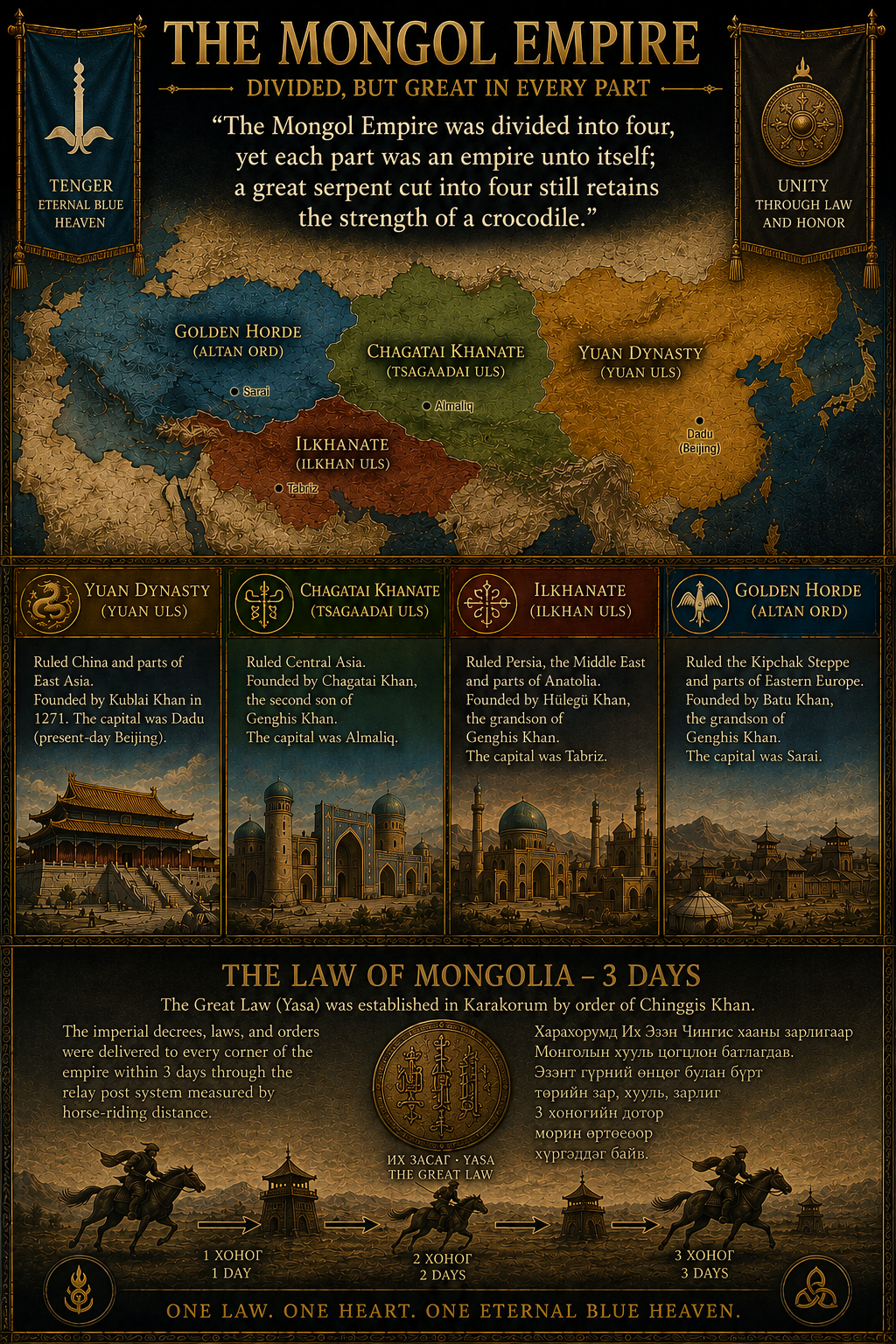
Over the following decades, the empire evolved into four major political centers:
- The Yuan Dynasty in China and Mongolia, founded by Kublai Khan.
- The Chagatai Khanate in Central Asia, descended from Chagatai, the second son of Chinggis Khan.
- The Ilkhanate in Persia and the Middle East, founded by Hülegü Khan.
- The Golden Horde in the Kipchak Steppe and Eastern Europe, founded by Batu Khan.
Although politically separate, these states shared a common Mongol imperial heritage. They continued to govern vast territories, maintain diplomatic relations, facilitate trade across Eurasia, and preserve many institutions inherited from the empire of Chinggis Khan.
A traditional Mongolian saying reflects this historical reality:
“The Mongol Empire was divided into four, yet each part was an empire unto itself; a great serpent cut into four still retains the strength of a crocodile.”
The saying emphasizes that the division of the empire did not mark its immediate decline. Rather, each successor state remained a formidable empire in its own right.
The Law of Mongolia – Three Days
According to Mongolian historical tradition, laws and imperial decrees issued from Karakorum could be transmitted to the farthest corners of the empire within three days through the remarkable Yam relay-post system.
This expression symbolizes the extraordinary administrative efficiency of the Mongol Empire and its ability to govern a vast transcontinental realm through communication, organization, and law.
One Law. One Heart. One Eternal Blue Heaven.