WHO WAS CHAGATAI KHAN?
By Altanbagana Baatar
DBA Candidate| Independent Historian
ImperialGG Historical Research Seriers
23 June 2026
Guardian of the Yasa and Architect of the Chagatai Ulus
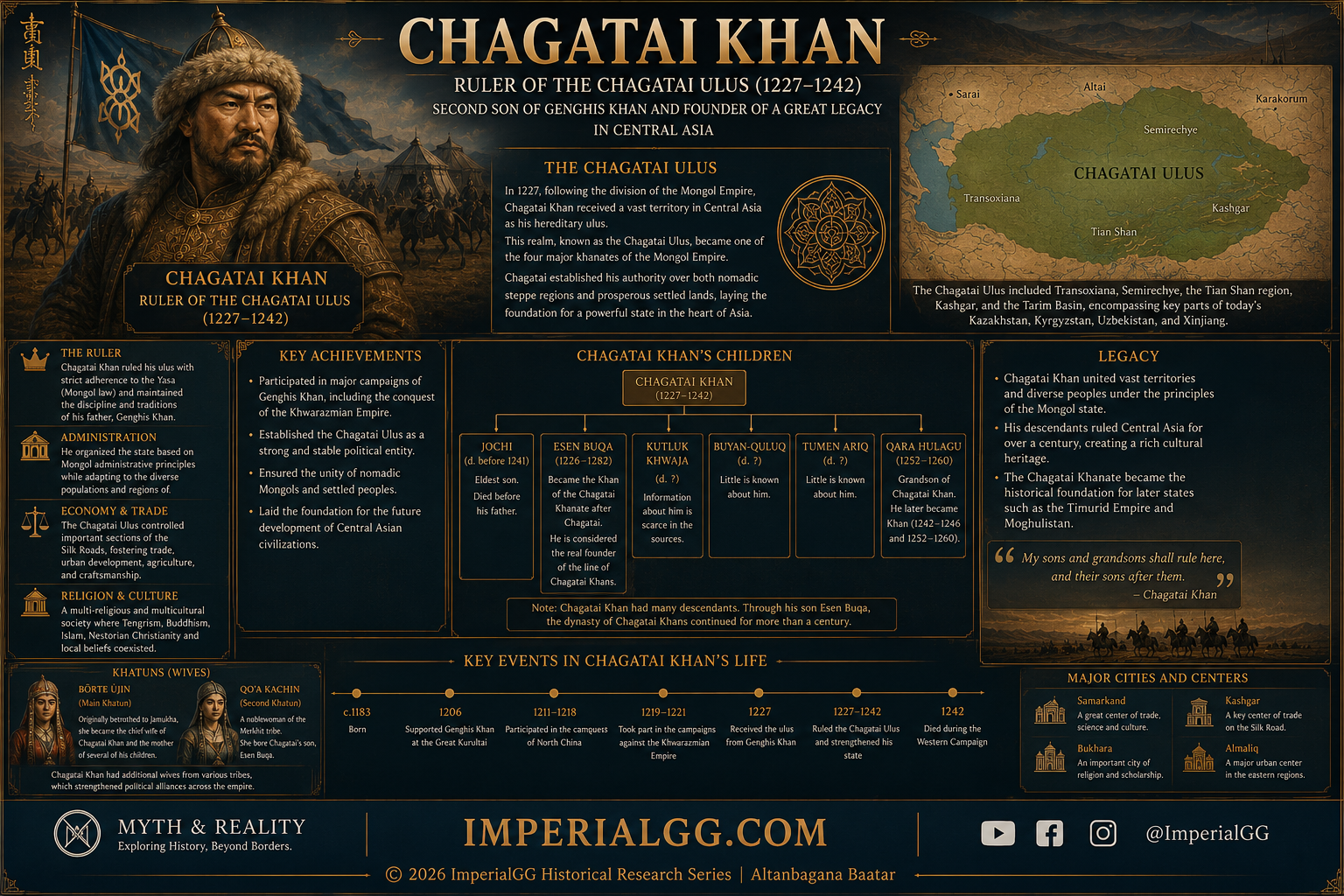
Chagatai Khan (c. 1183–1242) was the second son of Genghis Khan and Börte Üjin. From an early age, he participated in nearly all of his father’s major campaigns and gained a reputation as a courageous commander and a strict guardian of Mongol customs and laws.
Among the sons of Genghis Khan, Chagatai was particularly noted for his unwavering commitment to the Yasa, the imperial legal code of the Mongols. Medieval chroniclers often described him as stern, disciplined, and deeply devoted to preserving the traditions established by his father.
Following the division of the Mongol Empire in 1227, Chagatai received the vast territories of Central Asia as his hereditary ulus. These lands later became known as the Chagatai Khanate, one of the most influential successor states of the Mongol Empire.
LIFE AND MILITARY CAREER
Chagatai accompanied Genghis Khan during the conquest of North China and the campaigns against the Khwarazmian Empire between 1219 and 1221. During these campaigns he commanded substantial forces and played an important role in the destruction of Khwarazmian resistance.
Although he was never elevated to the position of Great Khan, Chagatai remained one of the principal figures of the imperial family and frequently participated in important political decisions.
His military career was characterized by loyalty to his father, strict discipline, and an uncompromising adherence to Mongol law and custom.
THE CHAGATAI ULUS
The lands assigned to Chagatai formed the geographical heart of Central Asia and included:
- Transoxiana (Mawarannahr)
- Semirechye (Seven Rivers)
- The Tian Shan region
- Kashgar and the Tarim Basin
- Portions of present-day Kazakhstan, Kyrgyzstan, Uzbekistan, and Xinjiang.
These territories contained both nomadic steppe regions and prosperous urban centers, making the Chagatai Ulus one of the most economically and strategically important parts of the Mongol Empire.
Its location along the Silk Roads facilitated commerce, cultural exchange, and diplomatic contacts between East Asia, the Middle East, and Europe.
GOVERNANCE AND LEGACY
Chagatai devoted considerable attention to maintaining order and enforcing the principles of the Yasa throughout his domains. Under his rule, the administration sought to balance the interests of the nomadic Mongol aristocracy and the sedentary populations of Central Asia.
After his death in 1242, his descendants continued to rule Central Asia for more than a century. The political and cultural traditions established within his ulus profoundly influenced later states such as:
- the Chagatai Khanate,
- the Timurid Empire,
- Moghulistan,
- and several of the historical foundations from which modern Central Asian peoples eventually emerged.
The legacy of Chagatai Khan remains particularly significant in the historical development of present-day Kazakhstan, Kyrgyzstan, Uzbekistan, and Xinjiang.
CHILDREN AND DESCENDANTS
Chagatai Khan fathered numerous sons and daughters, though the sources differ concerning their exact number and identities.
Among the most important descendants were:
- Mö’etüken
- Baidar
- Yesü Möngke
- Qara Hulagu (grandson)
The dynasty founded by Chagatai governed Central Asia for generations and left a lasting imprint on the political and cultural history of Inner Asia.
HISTORICAL SIGNIFICANCE
Chagatai Khan was more than a military commander and the son of Genghis Khan. He was the founder of a political tradition that connected the Mongolian steppe with the great urban civilizations of Central Asia. The state that bore his name became one of the principal bridges between the Mongol Empire and the later history of Central Asia, leaving a legacy that endured long after the fall of the Mongol world empire.