
Shagdaryn Namkhai: The Greatest Champion in the History of Mongolian Wrestling
By Altanbagana Baatar
DBA Candidate| Independent Historian
ImperialGG Historical Research Seriers
23 June 2026
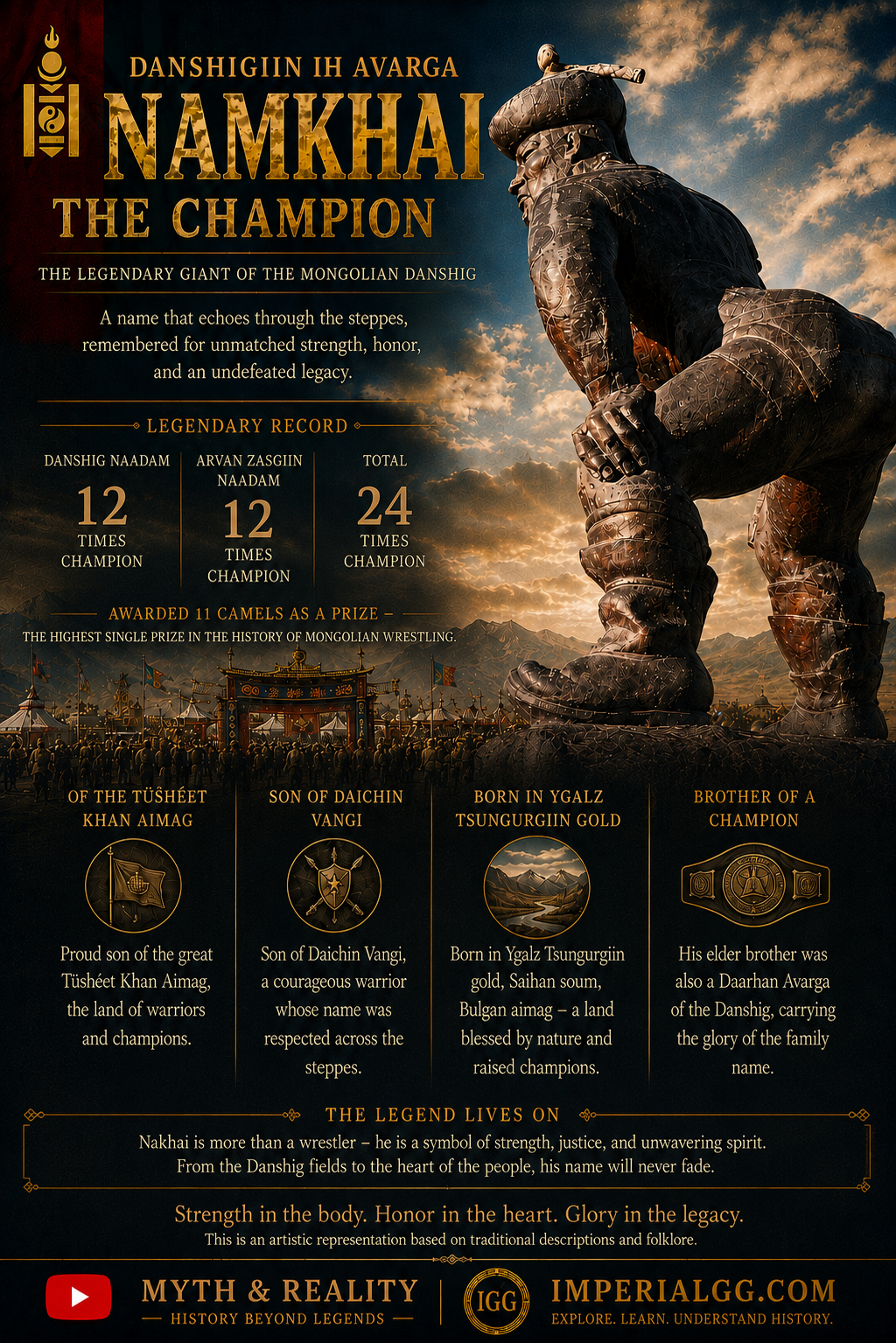
Introduction
Among the many celebrated champions of Mongolian traditional wrestling, few names command as much admiration as Shagdaryn Namkhai (1870–1911). Known to generations of wrestling enthusiasts as Sandaq-Ochir Avarga, he stands as one of the most extraordinary athletes in the history of Bökh, Mongolia’s ancient national wrestling tradition.
During the final decades of Qing rule and the dawn of the Bogd Khan era, Namkhai established a record of dominance that has rarely been equaled and perhaps never surpassed. His remarkable achievements, combined with his spiritual devotion and legendary reputation, secured his place among the greatest figures in Mongolia’s sporting and cultural heritage.
The Ancient Tradition of Mongolian Wrestling
Mongolian wrestling, known as Bökh, is one of the oldest continuously practiced sporting traditions in the world. Archaeological evidence suggests that forms of wrestling existed on the Mongolian Plateau thousands of years ago. Throughout history, Bökh served not only as entertainment but also as military training, helping warriors develop strength, endurance, balance, and discipline. Wrestling became one of the celebrated “Three Manly Skills” of the Mongols, alongside horsemanship and archery.
By the nineteenth century, wrestling occupied a central place in Mongolian society. Victories at major festivals brought prestige not only to individual wrestlers but also to their families, monasteries, and home regions.
It was within this highly competitive world that Shagdaryn Namkhai emerged.
Early Life
Shagdaryn Namkhai was born in 1870 in what is today Saikhan Soum of Bulgan Province. Growing up on the Mongolian steppe, he was immersed in a culture that valued physical strength, endurance, and personal honor.
From a young age, Namkhai displayed exceptional athletic ability. His natural strength was complemented by remarkable balance, technique, and determination. These qualities would eventually propel him to national prominence.
Yet Namkhai’s life was not devoted solely to physical achievement. Unlike many wrestlers of his generation, he pursued a religious path and became a lama, embracing Buddhist discipline while simultaneously excelling in wrestling competitions.
Rise to National Fame
The wrestling festivals of the late nineteenth century attracted the finest competitors from across Mongolia. Success required not only strength but also strategic intelligence and technical mastery.
Namkhai rapidly distinguished himself from his contemporaries.
Over the course of his career, he won an astonishing twenty-six state-level Danšig championships and finished as runner-up five times. Such consistency remains virtually unparalleled in the history of Mongolian wrestling.
While many wrestlers enjoyed brief periods of success, Namkhai maintained elite performance across decades. His repeated victories transformed him from a champion into a national legend.
His name became synonymous with excellence, and spectators traveled great distances to witness his matches.
The Champion of Eleven Camels
Among the many stories surrounding Namkhai’s career, one has become particularly famous.
Following a major victory, he was awarded eleven camels as his prize. In the pastoral economy of nineteenth-century Mongolia, livestock represented wealth, status, and economic security. Receiving such a reward was an extraordinary honor.
Historical accounts remember this event as one of the most remarkable prizes ever granted to a wrestler, reflecting both the significance of the competition and the esteem in which Namkhai was held.
Even today, the story of the “Eleven Camels” remains part of Mongolian wrestling folklore.
The Legendary Seventy-Six Word Title
Traditional Mongolian wrestling possesses a unique ceremonial culture. Before important matches, wrestlers are introduced through elaborate poetic titles known as tsol.
These titles celebrate a wrestler’s achievements, character, and symbolic qualities. Most champions received impressive titles, but Namkhai’s became legendary.
His ceremonial title reportedly consisted of seventy-six words, making it one of the longest and most magnificent wrestling titles ever recorded in Mongolian history.
The title praised his courage, strength, agility, endurance, and repeated triumphs. It served as both a public recognition of his accomplishments and a reflection of the deep respect he commanded throughout Mongolia.
A Family of Wrestling Champions
Namkhai’s achievements did not emerge in isolation.
His elder brother, Shagdaryn Luvsanjamba, was himself a renowned champion who earned the prestigious title of Darhan Avarga.
The two brothers occupy a unique position in Mongolian wrestling history. Their combined accomplishments established the Shagdar family as one of the most distinguished wrestling lineages ever known.
For many wrestling historians, the brothers represent an extraordinary example of talent, discipline, and dedication passed through a single family.
A Lama on the Wrestling Field
One of the most remarkable aspects of Namkhai’s life was his devotion to Buddhism.
As a lama, he lived according to religious principles and remained deeply committed to spiritual practice. Unlike many of his fellow wrestlers, he never married and left no direct descendants.
This combination of religious devotion and athletic greatness distinguished him from other champions of his era.
To later generations, Namkhai came to symbolize the harmonious union of physical strength and spiritual discipline—qualities deeply valued within traditional Mongolian culture.
Legacy
When Shagdaryn Namkhai passed away in 1911, Mongolia lost one of its greatest sporting heroes. Yet his legacy endured.
His twenty-six Danšig victories remain a benchmark against which other champions are measured. His legendary title, remarkable prizes, and extraordinary career continue to be celebrated in wrestling circles throughout Mongolia.
More than a century after his death, Namkhai remains one of the most revered figures in the history of Bökh.
His story embodies the highest ideals of Mongolian wrestling: strength without arrogance, perseverance without surrender, and honor without compromise.
In the collective memory of the Mongolian people, Shagdaryn Namkhai stands not merely as a champion, but as a symbol of an era when wrestling represented the spirit of the nation itself.
Explore the life, achievements, and legacy of Shagdaryn Namkhai (1870–1911), the legendary Mongolian wrestler who won 26 Danšig championships and became one of the greatest champions in Bökh history.
From Jiuli to Guifang: 1,300 Years on the Nomadic Frontier
By Altanbagana Baatar
DBA Candidate| Independent Historian
ImperialGG Historical Research Seriers
20 August 2026
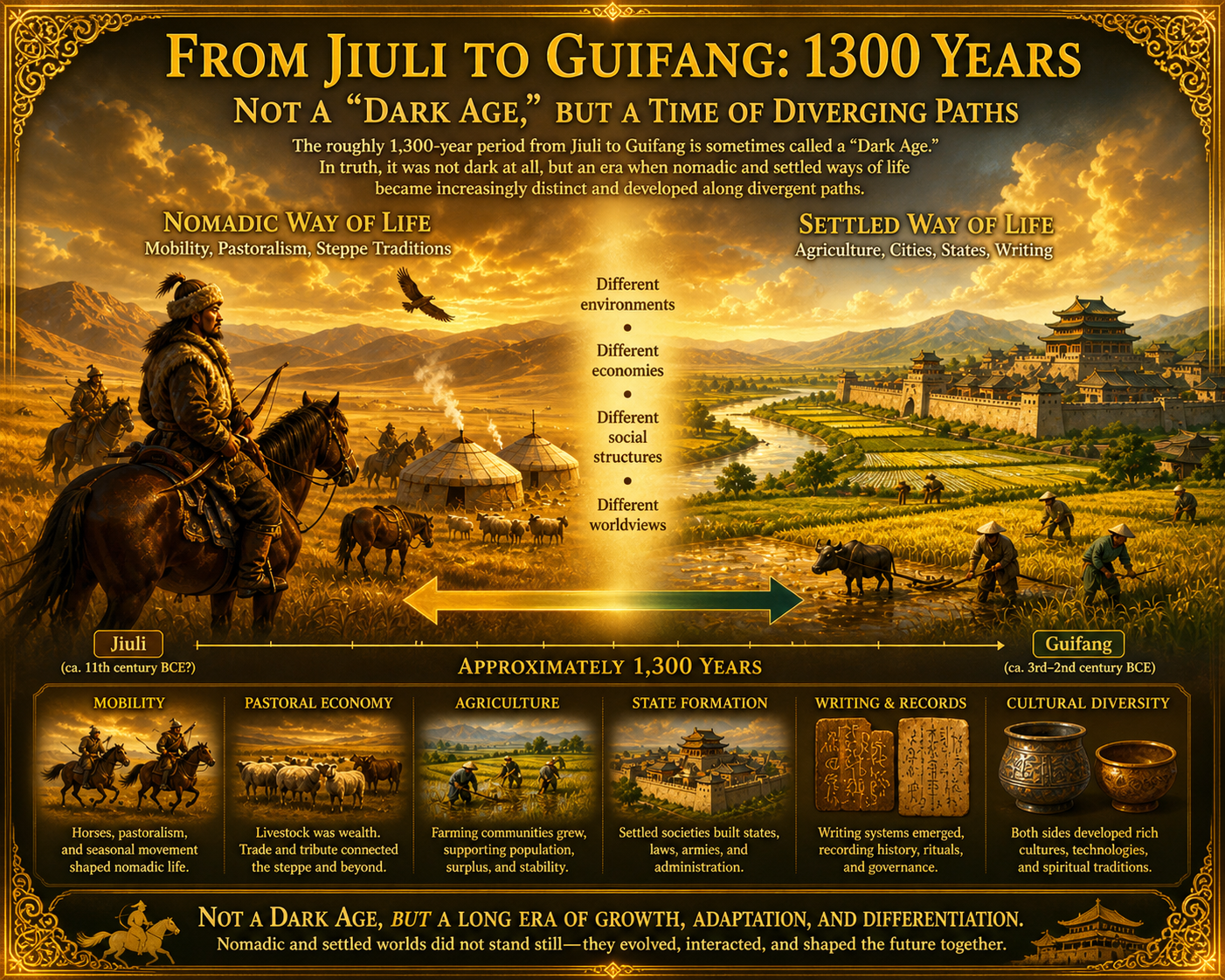
1,300 Years on the Nomadic Frontier
Long before the rise of the Xiongnu, the Göktürks, the Mongols, or any of the great steppe empires remembered in history, the northern frontier of ancient China was already shaped by a persistent struggle between settled agricultural societies and the peoples of the grasslands. Among the earliest names recorded in Chinese sources are the Jiuli (Juli) and the Guifang, peoples who occupied different places in the long evolution of the steppe world.
The story from Jiuli to Guifang is not merely a span of approximately 1,300 years. It represents the gradual formation of a distinct nomadic civilization—a civilization that would eventually produce some of the most formidable mounted warriors and imperial systems in world history.
Jiuli: The Earliest Frontier
Chinese tradition associates the Jiuli with the legendary era of Chiyou, a figure remembered as a powerful rival to the ancestors of later Chinese states. Whether historical or semi-mythical, these traditions preserve an important memory: the northern frontier was never an empty wilderness. It was inhabited by organized peoples whose culture, economy, and worldview differed significantly from those of the agricultural communities developing along the Yellow River.
At this stage, the distinction between nomadic and settled societies was still evolving. Herding, hunting, farming, and seasonal movement often existed side by side. The frontier was not a fixed border but a broad zone of interaction, conflict, and exchange.
The Transformation of the Steppe
Over the following centuries, the ecology of the northern grasslands encouraged increasing mobility. Communities became more dependent upon livestock, particularly horses, sheep, and cattle. Seasonal migration patterns expanded, and mastery of mounted travel became increasingly important.
This transformation gradually produced a way of life fundamentally different from that of the agricultural states to the south.
While sedentary societies invested labor in fields, irrigation systems, and permanent settlements, the peoples of the steppe developed institutions suited to movement. Wealth was measured not by land ownership but by livestock. Political authority depended less on fixed territorial administration and more on personal loyalty, clan networks, and military leadership.
As mobility increased, so did military effectiveness.
The horse became not merely a means of transportation but the foundation of a new form of warfare. Generations of experience in riding, hunting, and managing herds produced warriors capable of covering vast distances across difficult terrain. Over time, mounted combat techniques became increasingly sophisticated, giving frontier peoples a strategic advantage in speed, reconnaissance, and maneuverability.
The Rise of the Guifang
By the late Shang period, Chinese records increasingly refer to the Guifang, one of several northern frontier groups that repeatedly challenged Shang authority.
The Guifang were not simply raiders appearing suddenly from beyond the frontier. They represented a mature stage in the development of northern steppe societies. Their repeated campaigns against Shang territories reveal organized military capabilities and the ability to sustain long-term pressure against settled states.
Oracle bone inscriptions indicate that Shang rulers conducted numerous military expeditions against the Guifang. These conflicts were not isolated incidents but part of a continuing frontier struggle.
The persistence of Guifang attacks suggests that the balance of power along the northern frontier had begun to change. The growing effectiveness of mounted and semi-mounted warfare allowed northern peoples to challenge agricultural kingdoms in ways that earlier societies could not.
Diverging Civilizations
During these thirteen centuries, the contrast between nomadic and sedentary civilizations became increasingly pronounced. In the south, political authority grew more centralized. Administrative systems became more complex, cities expanded, and agriculture supported larger populations. In the north, mobility remained the key to survival. Tribal confederations emerged, alliances shifted, and military leadership became central to political legitimacy.
The two worlds were not isolated from one another. Trade, diplomacy, intermarriage, and cultural exchange occurred alongside warfare. Yet each followed a different historical trajectory shaped by its environment and economic foundations. By the time of the Guifang, the foundations had been laid for a frontier dynamic that would continue for millennia.
Legacy
The journey from Jiuli to Guifang marks one of the earliest chapters in the history of the Eurasian steppe. It reveals how a frontier society gradually transformed into a powerful nomadic world whose influence would eventually extend across continents. The horse, mobility, clan organization, and frontier warfare that characterized later steppe empires did not appear suddenly. They were the product of centuries of adaptation, innovation, and interaction.
Seen from this perspective, the Guifang were not merely enemies of the Shang dynasty. They were heirs to a long process of nomadic development—a process that began centuries earlier on the vast grasslands beyond China’s northern frontier and would ultimately shape the course of Eurasian history.
The Guifang Wars: The Earliest Recorded Steppe Frontier Conflict
The earliest detailed evidence for the Guifang comes not from later historical chronicles, but from the oracle bone inscriptions of the Shang Dynasty (c. 1600–1046 BCE). These inscriptions, carved onto ox scapulae and turtle plastrons for royal divination, preserve some of the oldest written records in East Asia. Among thousands of questions posed to ancestral spirits, many concern military campaigns against the Guifang, revealing that they were among the most formidable enemies faced by the Shang state. The oracle bones repeatedly record royal concerns such as:“Should we attack the Guifang?”“Will the Guifang invade our borders?”“Should the king personally lead the campaign?”“Will victory over the Guifang bring great spoils?” The frequency of these references demonstrates that the Guifang were not merely occasional raiders. They represented a persistent frontier power capable of threatening Shang territory over extended periods.
A Prolonged Frontier War
Later historical traditions associate the reign of King Wu Ding (r. c. 1250–1192 BCE) with a major military struggle against the Guifang. According to these accounts, the conflict lasted approximately three years and required repeated military expeditions before the Shang finally secured victory.
Unlike the great set-piece battles described in later historical literature, the Guifang wars were likely characterized by continuous frontier warfare:
- Rapid cross-border raids.
- Attacks on settlements and agricultural communities.
- Livestock seizures and resource competition.
- Counteroffensives launched by Shang forces.
- Seasonal campaigns across the northern frontier.
The evidence suggests that neither side achieved immediate dominance. Instead, the conflict developed into a prolonged contest of endurance and military adaptation.
The Frontier Beyond the Agricultural World
The Guifang occupied regions beyond the settled agricultural core of the Shang kingdom. Their society appears to have been organized differently from the bureaucratic and city-centered system of the Shang. While Shang power rested upon walled cities, agricultural production, and aristocratic administration, frontier groups such as the Guifang relied upon mobility, decentralized leadership, and adaptation to the grassland environment. This contrast created fundamentally different military systems.
Shang armies depended heavily upon infantry and war chariots operated by noble elites. The frontier peoples, by contrast, were accustomed to long-distance movement across open terrain and possessed a strategic flexibility that repeatedly challenged the Shang military machine. Although fully developed horse-mounted warfare would emerge centuries later, the Guifang already represented an early stage in the military evolution of the northern steppe.
An Early Steppe Tradition
The Guifang should not automatically be identified with any later ethnic group. Their precise origins remain debated among scholars. Nevertheless, they occupied an important position within the long historical development of northern Eurasian frontier societies.
Many of the characteristics that later defined the great nomadic confederations can already be observed:
- High mobility.
- Tribal alliance structures.
- Dependence on animal husbandry.
- Ability to project military force across vast distances.
- Continuous interaction with settled states through both trade and warfare.
In this sense, the Guifang represent one of the earliest historically documented manifestations of the steppe frontier tradition that would later produce the Xiongnu, Xianbei, Turks, Khitans, Mongols, and many other nomadic powers.
Historical Significance
The wars between the Shang Dynasty and the Guifang were more than isolated frontier skirmishes. They constitute one of the earliest recorded chapters in the long relationship between the nomadic world of Inner Asia and the sedentary civilizations of East Asia. For more than three millennia, this frontier dynamic would shape the political history of Eurasia. Empires rose and fell, dynasties changed, and technologies evolved, yet the interaction between the grasslands and the agricultural heartlands remained one of the central forces of regional history.
The Guifang wars stand at the beginning of that story—a story in which the northern frontier was not a barrier separating civilizations, but a vast zone of conflict, exchange, adaptation, and transformation.
From Jiuli to Guifang, the frontier was never silent. It was the crucible in which the military traditions, political structures, and cultural identities of the Eurasian steppe were forged.