
HEAVENLY WIND 750™ | TENGERIIN SALKHI 750™
By Altanbagana Baatar
DBA Candidate| Independent Historian
ImperialGG Historical Research Seriers
17 August 2026
2027–2031 INTERNATIONAL CONFERENCE & RESEARCH SERIES
Heavenly Wind 750™ is a five-year international interdisciplinary conference and research initiative marking the 750th anniversary of the Mongol maritime expeditions of 1281 and the environmental, military, political, and cultural transformations associated with those events.
The series is founded on a central scholarly proposition: the events of 1281 should be examined not only through the narratives and historical memories that have emerged around them, but also through the evidence that can be brought to bear on their causes, circumstances, and consequences. The term Heavenly Wind therefore serves as a conceptual framework for moving from inherited narratives toward evidence-based historical inquiry.
For centuries, the survival of the Mongol fleets and the defeat of the invasions have been closely associated with the Japanese concept of the kamikaze, or “divine wind.” While this tradition remains an important subject of historical and cultural study, the 750th-anniversary series seeks to examine the events beyond a single explanatory narrative. It asks how far historical sources, archaeology, maritime archaeology, environmental evidence, climate and paleoclimate research, oceanography, military history, technology, and comparative disaster studies can contribute to a more comprehensive understanding of what occurred in 1281.
The central objective is therefore a transition from legend to evidence, from inherited interpretation to interdisciplinary analysis, and from commemorative narrative to scientifically informed historical conclusions.
The series will investigate the Mongol world of the late thirteenth century as an interconnected political, economic, technological, military, maritime, and cultural system. Particular attention will be given to imperial organization and decision-making, military mobilization, maritime logistics, shipbuilding and naval technology, environmental conditions, extreme weather and oceanic processes, coastal archaeology, and the formation and transmission of historical memory.
At the same time, the series recognizes that no single discipline can adequately explain a historical event of such complexity. Historical texts must therefore be considered alongside material evidence, archaeological data, environmental records, technological analysis, and comparative regional scholarship. Where evidence remains uncertain or contested, the program will distinguish established findings from hypotheses and identify areas requiring further research.
Beginning in the United States in 2027, the series will establish a global and comparative research framework before moving through Mongolia, China, South Korea, and Japan. Each conference will address a distinct regional and thematic dimension while contributing to a shared five-year research agenda culminating in the 750th anniversary program in Japan in 2031.
Heavenly Wind 750™ is conceived not simply as a commemorative conference series, but as a long-term international scholarly platform dedicated to advancing evidence-based research, interdisciplinary collaboration, academic publication, and a more rigorous understanding of the Mongol maritime expeditions of 1281 and their place in Eurasian and East Asian history.
INTELLECTUAL AND METHODOLOGICAL FOUNDATION
The inaugural 2027 conference in the United States will establish the intellectual and methodological foundation for the subsequent four-year program of the Heavenly Wind 750™ International Conference & Research Series.
Rather than treating the 750th anniversary as a sequence of independent commemorative events, the series will adopt a coherent, cumulative research framework in which each subsequent conference builds upon the questions, methodological principles, and scholarly findings established at the inaugural meeting.
The 2027 conference will therefore serve as the foundational stage of a five-year research program. Its principal objective will be to develop and formally adopt a shared intellectual and methodological framework for the study of the Mongol maritime expeditions of 1281 and their wider historical context.
This framework will establish common principles for the critical examination of historical narratives through the systematic integration of primary sources, archaeology, maritime archaeology, environmental and climatic evidence, technological analysis, historical geography, and comparative interdisciplinary research.
The framework will also establish standards for distinguishing documented evidence from interpretation, hypothesis, and later historical memory. In doing so, it will provide a common scholarly basis through which the conferences held in Mongolia, China, South Korea, and Japan from 2028 to 2031 can pursue distinct regional and thematic questions while remaining part of a single cumulative research program.
Accordingly, the 2027 conference is conceived not merely as the first event of the series, but as the intellectual foundation upon which the subsequent four years of research, discussion, collaboration, and publication will be developed.
The resulting framework will be reviewed, refined, and formally adopted by participating scholars at the inaugural conference and will serve as the guiding methodological reference for the remainder of the Heavenly Wind 750™ program.
HEAVENLY WIND 750: INTERNATIONAL CONFERENCE SERIES ANNOUNCED
By Altanbagana Baatar
DBA Candidate| Independent Historian
ImperialGG Historical Research Seriers
19 August 2026
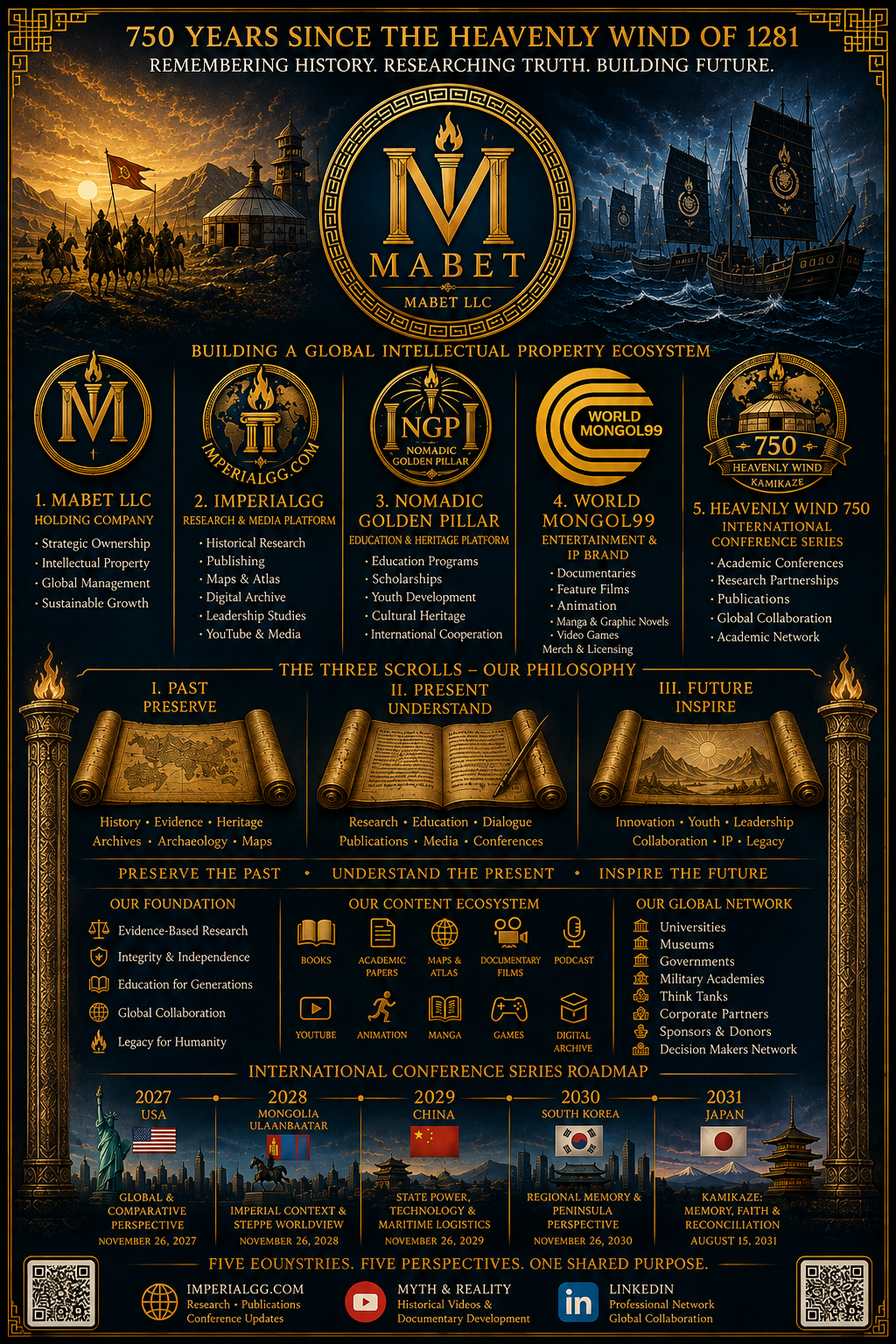
Remembering History. Researching Truth. Building Future.
ImperialGG is pleased to announce Heavenly Wind 750, a five-year international conference series marking the 750-year anniversary of the historic 1281 maritime campaign and the events that became deeply embedded in East Asian historical memory.
Beginning in the United States in 2027 and continuing through Mongolia, China, South Korea, and Japan, the series will bring together scholars and researchers from history, archaeology, environmental and climate studies, maritime history, technology, political studies, religion, cultural memory, philosophy, and the humanities.
WHY 1281 MATTERS
The events of 1281 represent one of the most significant encounters between imperial power, maritime technology, military organization, environmental forces, and cultural memory in medieval East Asia. Yet the history of 1281 cannot be fully understood through a single national narrative.
The campaign connected the Yuan imperial world, the Korean Peninsula, China, Japan, and the wider maritime environment of East Asia. Its consequences were interpreted differently across generations and societies, eventually becoming associated in Japan with the concept of the “heavenly wind.”
Heavenly Wind 750 approaches this history as an opportunity to ask broader questions:
What happened in 1281? How did political power, technology, logistics, and the maritime environment shape the campaign?
How did people of the period understand these events?
How did later societies remember and reinterpret them? And what can the study of this history contribute to dialogue in the present?
BEYOND A SINGLE HISTORICAL NARRATIVE
Heavenly Wind 750 is not designed to promote a single interpretation of 1281. Its purpose is to create a scholarly environment in which historical evidence can be examined from multiple perspectives and disciplines.
The series will encourage research involving history, archaeology, environmental and climate studies, maritime history, military and technological history, political studies, religion, cultural memory, philosophy, and digital humanities.
By bringing these perspectives together, the conference series seeks to examine the historical event not simply as an episode of conflict, but as a complex intersection of human action, environment, technology, belief, political power, and memory.
A FIVE-YEAR INTERNATIONAL JOURNEY
The Heavenly Wind 750 conference series is planned as a five-year intellectual journey across five countries.
2027 — UNITED STATES
GLOBAL & COMPARATIVE PERSPECTIVE
November 26, 2027
The series will begin in the United States with a global and comparative examination of the historical questions surrounding 1281. The opening conference will establish the broader intellectual framework for the five-year series.
2028 — MONGOLIA
IMPERIAL CONTEXT & STEPPE WORLDVIEW
November 26, 2028 — Ulaanbaatar
The second conference will examine the imperial context of the period and the political, cultural, and intellectual traditions of the steppe world. Particular attention will be given to the wider structure of the Mongol imperial world and its relationship with the events of 1281.
2029 — CHINA
STATE POWER, TECHNOLOGY & MARITIME LOGISTICS
November 26, 2029
The third conference will focus on state organization, technology, maritime operations, military logistics, and the capacity required to conduct large-scale campaigns across the East Asian maritime environment.
2030 — SOUTH KOREA
REGIONAL MEMORY & PENINSULA PERSPECTIVE
November 26, 2030
The fourth conference will examine the regional dimension of the historical events, including the Korean Peninsula’s position within the political and maritime environment of medieval East Asia. The conference will also explore how historical memory develops across borders and generations.
2031 — JAPAN
KAMIKAZE: MEMORY, FAITH & RECONCILIATION
August 15, 2031
The final conference will take place in Japan during the 750-year commemoration. The concluding gathering will examine the relationship between historical memory, faith, cultural interpretation, and reconciliation, bringing the five-year research journey back to the place where the legacy of the 1281 events became particularly enduring.
AN INTERDISCIPLINARY RESEARCH PLATFORM
Heavenly Wind 750 is intended to extend beyond the conference room.
The broader initiative envisions collaboration involving:
- Universities and research institutions
- Museums and archives
- Archaeological researchers
- Historians and scholars of the humanities
- Environmental and climate researchers
- Maritime and technology historians
- Cultural institutions
- International academic networks
- Documentary and digital media producers
Research generated through the series may contribute to academic papers, edited publications, maps and atlases, digital archives, documentaries, podcasts, educational resources, and other forms of public scholarship.
FROM PAST TO FUTURE
The intellectual philosophy of Heavenly Wind 750 is expressed through three principles:
PAST — PRESERVE
History • Evidence • Heritage • Archives • Archaeology • Maps
PRESENT — UNDERSTAND
Research • Education • Dialogue • Publications • Media • Conferences
FUTURE — INSPIRE
Innovation • Youth • Leadership • Collaboration • Intellectual Property • Legacy
The objective is not simply to remember an event that occurred 750 years ago.
It is to understand how historical evidence becomes knowledge, how knowledge becomes dialogue, and how dialogue can contribute to future generations.
THE ROAD TO 2031
The five conferences are designed as connected stages rather than isolated events.
2027 — GLOBAL
The questions are opened.
2028 — IMPERIAL
The historical context is examined.
2029 — MARITIME & TECHNOLOGICAL
State power, technology, and logistics are investigated.
2030 — REGIONAL
Memory and the broader East Asian perspective are explored.
2031 — MEMORY & RECONCILIATION
The journey concludes in Japan with questions of faith, memory, and reconciliation.
Together, these stages form a single international research trajectory.
AN INTERNATIONAL DIALOGUE
Heavenly Wind 750 seeks to create a space where scholars from different countries and disciplines can examine a shared historical subject without reducing it to a single national perspective. The project recognizes that historical memory can divide as easily as it can connect. For that reason, the series places particular importance on evidence, intellectual independence, scholarly dialogue, and international collaboration. The goal is not to recreate the past. The goal is to understand it more deeply.
BUILDING A GLOBAL INTELLECTUAL ECOSYSTEM
Heavenly Wind 750 is being developed within the broader intellectual property, research, education, and media ecosystem of Mabet LLC, alongside ImperialGG, Nomadic Golden Pillar, and World Mongol 99.
Within this ecosystem, ImperialGG serves as a research and media platform, while Heavenly Wind 750 provides an international academic framework for research partnerships, publications, conferences, and scholarly exchange.
THE JOURNEY BEGINS
The 750th anniversary provides an opportunity to look back—but also to look beyond the event itself. From the comparative perspective of the United States in 2027 to the final gathering in Japan in 2031, Heavenly Wind 750 will explore how history, evidence, environment, technology, belief, and memory intersect across time and borders.
Remembering History. Researching Truth. Building Future.
HEAVENLY WIND 750
International Conference Series
Five Countries. Five Perspectives. One Shared Purpose.
2027 INTERNATIONAL CONFERENCE
By Altanbagana Baatar
DBA Candidate| Independent Historian
ImperialGG Historical Research Seriers
09 August 2026
🇺🇸 UNITED STATES | Global & Comparative Perspectives
OFFICIAL INVITATION
The inaugural Heavenly Wind 750™ International Conference will be held in the United States in 2027 as the opening conference of the five-year international conference and research series.
The conference will establish the intellectual and methodological foundation for the subsequent conferences in Mongolia, China, the Republic of Korea, and Japan.
PURPOSE
To examine the Mongol world of the late thirteenth century through global, comparative, and interdisciplinary perspectives, while establishing a collaborative research framework for the Heavenly Wind 750™ conference series.
CONFERENCE THEMES
- The Mongol World in Global Perspective
- Yuan Dynasty and Eurasian History
- Maritime Eurasia
- Environmental & Climate History
- Military and Political History
- Religion, Culture & Historical Memory
- Historical Geography
- Archaeology & Material Culture
- Comparative Imperial Studies
- Digital Humanities
INVITED PARTICIPANTS
- Universities Worldwide
- Historians & Social Scientists
- Research Institutes
- Museums & Heritage Organizations
- Faculty Members
- Researchers
- Graduate Students
- International Academic Partners
CONFERENCE SERIES
2027 USA → 2028 Mongolia → 2029 China → 2030 Republic of Korea → 2031 Japan
From ancient steppes to global history — projects that reveal Mongolia’s connections to the wider world.
2027 INTERNATIONAL CONFERENCE
EXPRESSION OF INTEREST
United States | Global & Comparative Perspectives
Researchers, faculty members, graduate students, academic institutions, museums, research organizations, and international partners interested in participating in the inaugural Heavenly Wind 750™ International Conference are invited to submit an Expression of Interest.
AREAS OF INTEREST
- Mongol and Eurasian History
- Yuan Dynasty Studies
- Maritime Eurasia
- Environmental & Climate History
- Military and Political History
- Religion, Culture & Historical Memory
- Historical Geography
- Archaeology & Material Culture
- Comparative Imperial Studies
- Digital Humanities
WHO MAY EXPRESS INTEREST?
- University Faculty
- Independent Researchers
- Graduate Students
- Research Institutes
- Museums & Heritage Organizations
- Academic Associations
- International Institutional Partners
WHAT HAPPENS NEXT?
Expressions of Interest will help the organizing team identify potential participants, research interests, institutional connections, and areas for collaboration.
Formal Call for Papers and detailed conference information will be announced at a later stage.
2027 USA → 2028 Mongolia → 2029 China → 2030 Republic of Korea → 2031 Japan
CONTACT
ImperialGG Historical Research Series
ImperialGG.com
contact@imperialgg.com
KAMIKAZE: THE ENDLESS END
follows the final maritime ambitions of the Mongol Yuan Empire and the 1281 expedition across the eastern seas. Through war, loyalty, prophecy, and human ambition, the novel explores the enduring relationship between destiny, nature, and the limits of human power
By Baatar Altanbagana
ImperialGG Kamikaze Series
Published 25 Juni 2026
THE KHAN’S THOUSAND SHIPS
Chapter One
To bring the world to its final peace, gather all beneath a single banner,
The Great Emperor, with an unbending heart
Sent across the sea a force never before seen by humankind
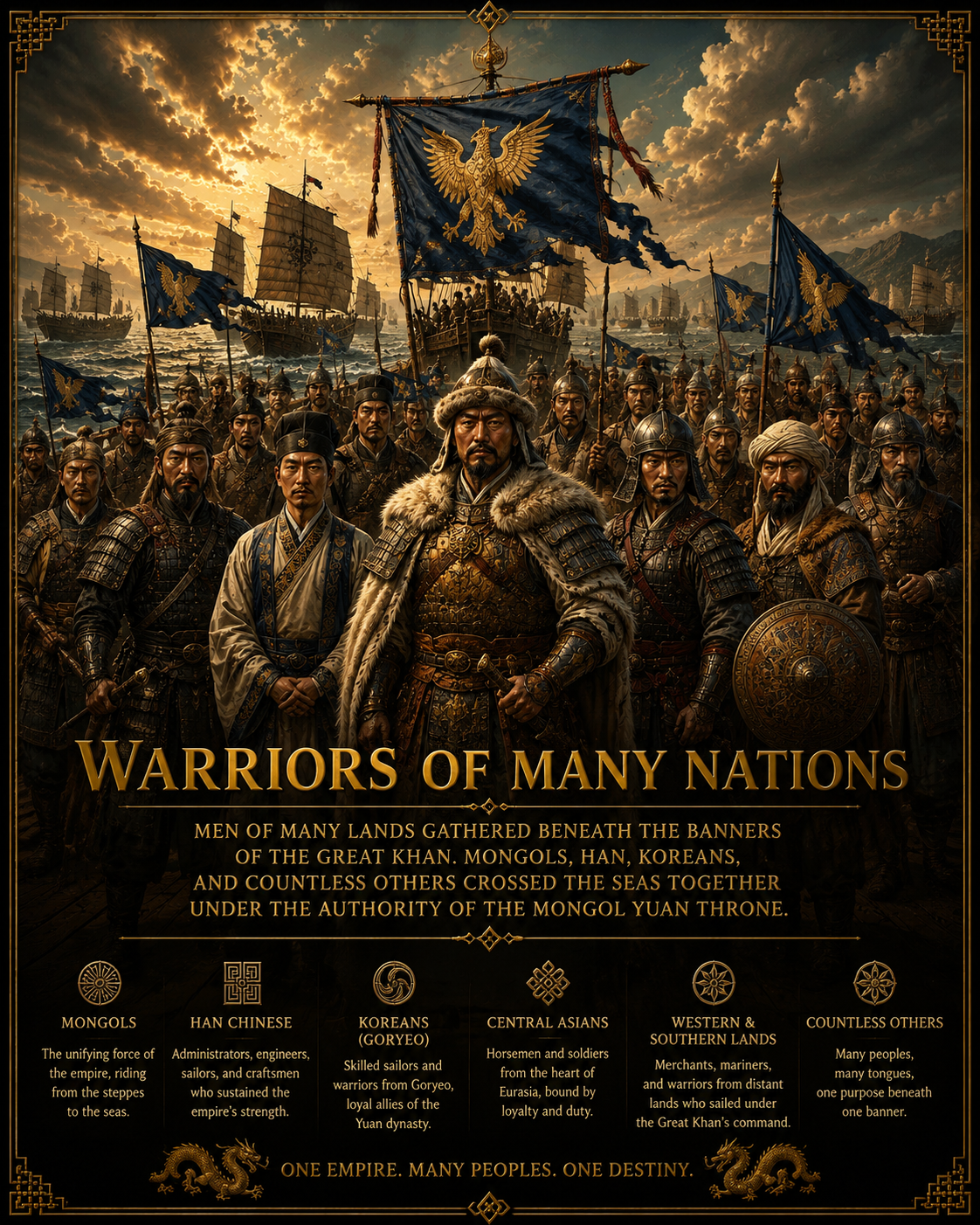
Beneath the clear, unbroken sky where not even a trace of cloud lingered, the wind moved gently yet with purpose, filling the sails of the warships so that they swelled like living beings, and in that steady breath of air the black war-standard made from the tail of a stallion streamed fiercely, while the many-colored banners bearing the image of the white falcon trembled and rippled to the rhythm of the heroic songs rising from the warriors, and the countless ships—holding their formation in strict accordance with the discipline of war—advanced in ordered ranks with unwavering speed across the vast expanse of the sea.
O great ocean—your immense whales, your terrifying flesh-devouring giants, your hawk-beaked and heavy-headed creatures, your long-snouted fish, and even the countless small, brilliantly colored beings that swarm in dazzling shoals; your soft-bodied life, your radiant and veiled forms, your tireless and languid creatures alike; your ancient longlived turtles that come ashore to lay their eggs in the warmth of the sand and multiply—though the strong devour the weak and the great swallow the small, still it is from you alone
that such overwhelming power is felt, for within your warm and living depths all existence continues without end, never wholly vanishing but endlessly renewing itself.
Your boundless surface, shimmering in hues of blue, green, and gold, moves in quiet undulation beneath the soft wind, yet when that wandering wind gathers its strength and turns in wild play, you rise, spiral, and unleash towering waves that display your terrible majesty, though in your deepest reaches you remain calm and undisturbed, and to perceive this truth is to bow in reverence before you, O vast and eternal sea.
Across all four directions and beyond the farthest horizons, the deep blue ocean stretched without boundary, merging with the pure blue vault of heaven as though losing itself in that immeasurable distance, and in that very moment a commanding, resonant voice rang out:
“Let the hand-to-hand battle begin.”
It was the twenty-first year of Khubilai Khan of the Great Mongol Yuan state, in the late summer of the red monkey month, on the third day of the new moon—by common reckoning, the twenty-third day of the seventh month in the year 1281.
The great ship, with its wide-spreading sails and towering mast, measuring two hundred and eighty-seven chi in length, stood as the flagship of the trusted general Alakhan, leading behind it nearly four thousand warships of slightly lesser size as they cut through the hollowing waves of the fierce sea.
“Let the Land of the Sun be brought beneath the banner of the Great Yuan!”—with this cry the order for swift assault was given, and the great warships, vast and formidable, had their entire framework bound with oak while their hulls, destined to endure the sea, were sealed with lime and red clay, and at the highest point of the stern tower of General Alakhan’s flagship the blue standard of Eternal Heaven fluttered, the wind whistling through it as though coaxing forth the mythic birds of savage war, while upon the upper deck stood the protected chamber housing the great war drum, above it the watchtower, and in the middle sections the resting chambers, the galley, the tables of food, and the banners and pennants, and at the lowest level the stalls of the warhorses could be
seen, and when the great drum of impending battle thundered with its commanding rhythm, sending forth its signal, the vigilant soldiers stationed upon every elevated post of every ship turned their full attention at once.
Within his vast command chamber, General Alakhan sat surrounded by his warrior commanders and, consulting with them, issued an order that from among the Mongol warriors the unrenowned young champions and the unseen fighters of lesser rank should be included, that from among the regular troops those without distinction should also be chosen, and that from the common soldiers those who desired to contend for the title of hero should be selected from each tumen, and no sooner had this command been given than the message-bearing arrows spread swiftly, and it was a remarkable sight to behold how the chosen warriors hastened toward the great ship in small boats.
By Altanbagana Baatar
DBA Candidate| Independent Historian
ImperialGG Historical Research Seriers
02 August 2026
The great war drum, fashioned by stretching the entire hide of a male camel, was so immense that five men could not fully encircle it with their outstretched arms, and upon one side was depicted with striking precision the symbolic pair of fish representing wisdom and method, while on the other side the sacred khas emblem had been rendered with extraordinary craftsmanship, and the long drumstick, nearly two fathoms in length, bore at its end the image of a red dragon with its mouth agape, the drum itself being struck with the curved body of that dragon’s neck and belly.
From the archery platform of the leading warship, crowned with a massive dragon’s head, a colossal black bow made of stag horn was drawn into a full circle, and the arrow released from it roared as it flew, while many other arrows shot from lesser bows flew alongside it in unison, a sight both awe-inspiring and terrible, and from a swaying plank moved by the rhythm of the ship, the message-arrow flew without deviation, and a swift soldier leapt into its path and caught it mid-flight, and at the blare of trumpets summoning immediate council upon the ships of the Nankhiad and the Guulin commanders, the leaders of thousands and captains of hundreds could be seen gathering in an instant, their movement unified, precise, and swift, revealing the discipline and readiness of the warriors of the Great Mongol state.
Within the campaign pavilion of the Nankhiad commander, the assembled generals spoke among themselves, saying that since the contest to grant the title of hero would be held aboard Alakhan’s flagship, the finest warriors would surely go there, while among the Guulin commanders it was agreed that they must by all means defeat the Mongol champions in this contest and therefore send forth their strongest warrior skilled in the arts of combat.
On the ships of the blue-eyed men and the Saracen warriors, a proclamation was made: “If there is any bold one who dares to blind the Mongol champions, let him step forward,” and several men rose, declaring that to take part in a contest where the sharpness of weapons and the strength of manhood would be tested against the Mongols was itself the pride of being born a man, and among them were a blue-eyed man named Alexander, taken hostage from the Piast kingdom near the great waters called Dunatsuk, and a renowned Arab warrior from Assyria named Adad Nirad din Sicle, who brandished his curved and masterfully forged blade, and also there rose a giant black man of Nubia, baring his teeth like a beast and flashing his eyes with savage intensity.
The long column of the great expedition did not halt, and from the small boats that had approached the ship where the contest would be held, warriors climbed swiftly aboard using ropes and grappling lines, and at the council of the regular troops a young warrior stepped forward and declared, “I am Zevnei, son of Sühehei the elephant-like; though my skill and strength may not yet equal those of my elder brothers, I will bring honor to the name of the regular warrior and triumph in this contest today, and I ask my elder brothers’ permission to present the title of hero as a gift to the beloved maiden I shall soon meet,” and he stood there a formidable youth just past twenty, with a slightly hooked nose, strong jaw, short black beard covering his lips and chin, broad chest, high back, a forehead like the sky, and dark eyes that moved like restless waves.
Upon the platform where Mongol, Nankhiad, and Guulin warriors and commanders had gathered, the chief judge of the contest explained the rules of hand-to-hand combat and granted each fighter the right to choose his weapons, and it was established that in order to compete for the title of hero one must first defeat the Mongol champions before advancing further, and immediately the bronze drums thundered, and upon the towering prow of the great ship, General Alakhan appeared clad in a red cloak and shining battle armor—
With a resonant voice he stepped forth and proclaimed that the days would come when the mighty standard of the imperial realm would resound across the seas, and that in order to bear the name of the Eternal Heaven, the strength of their hands, the swiftness of their bodies, the beating of their hearts, and the heat of their blood must all unite as one, and at his command to begin, the very blue reflection of the ocean seemed to tremble, while upon the specially prepared circular arena the chief judge took his place facing the seat of General Alakhan, with two other judges positioned at either side, and at the thunderous rhythm of the war drum the contest commenced.
The Mongol champions stood in awe-inspiring presence—though some lean, yet firm and resilient in body, with hardened brown faces, sons of Etügen Mountain, men of the vast steppe with calm yet formidable bearing, broad-browed and thick-muscled, others towering like the sons of the great waters, others still powerful and proud as the dark mountains, and sinewy as desert wood, all adorned in the ancient attire of wrestlers, their necks thick, their chests broad, their limbs bound with coiled muscle, their movements slow yet immense in force, standing calmly as they awaited the warriors of Nankhiad and Guulin before entering into fierce hand-to-hand combat upon the field.
At last eight warriors remained—two regular soldiers, one shadow-warrior, two young Mongol fighters, and one each from Nankhiad, Guulin, and the blue-eyed men—and though the giant black warrior and the Saracen fighters tested their strength against the Mongol champions, they could not overcome them, while the Nankhiad warriors displayed remarkable skill and speed in their use of sword and spear, and thus a Mongol warrior named Bagadai, whose voice thundered like lightning and who bore a blue mark upon his left shoulder, stepped forward to face a Nankhiad man named Lyu Chanu, their silk armor and steel blades flashing in the sunlight as their swords collided and sent a thousand sparks scattering into the air, while the sea wind seemed to hum like a distant song, Bagadai moving with the force of a mountain and Lyu Chanu striking with the fluid grace of water, their clash immense and unrelenting.
Meanwhile, the monk-warrior known as the White Tiger, descended from the Shaolin temples of Fujian, came forth to face the young warrior Zevnei, and though the White Tiger struck like a storm, Zevnei avoided every blow with effortless composure, lightly evading while even chewing dried meat from his pouch, astonishing all who watched, and the White Tiger, who had once slain a tiger of the Himalayas with his bare fists, gradually lost his inner strength through prolonged exertion until at last he collapsed before Zevnei, unable even to rise, yet Zevnei did not strike him, saying that to strike a man who had lost all strength was no different from extinguishing a dying flame, and thus he withdrew with honor.
Elsewhere a giant blue-eyed warrior attempted to crush a Mongol champion with a massive iron mace, but the Mongol fighter met his force without yielding, disarmed him, and struck him powerfully in the chest, sending him collapsing with blood surging from his mouth and nose, nearly falling beyond the ship’s edge into the sea, a terrible and heart-rending sight, and after each battle General Alakhan raised his gaze toward the heavens, observing the courage and spirit of his warriors, though within his eyes lay a hidden thought—whether this great power would shake the heavens or provoke their wrath.
Declaring that the blue-eyed men and those of the eastern lands did not understand that water and the world itself were alive, and that human blood had now mingled with the great sea, he ordered that a shaman be brought to appease the lord of the waters, and at once a shaman clad in ritual garments appeared, beating his drum and calling upon the spirit of the ocean, while a drop of blood that had fallen into the sea entered the eye of a small fish, which then dove swiftly into the dark depths, where darkness slowly gave way to light and countless creatures dwelled in a palace like something from legend, where that fish transformed into a mighty lord of the waters before whom all creatures bowed, yet a strange affliction seized him, his eyes reddening and filling with blood, though he did not perceive the spirit calling him.
The shaman, striking his drum, spoke that the sea was the tear of Heaven’s eye, that if man sought to conquer it and rule the heavens, those waters would boil and devour all, that the edge of the sky was not an unbreakable wall but a raging black wind, and that wind was the silent voice of Heaven, and whoever failed to understand that voice would meet not victory but death, though he confessed he could not foresee the calamity that approached.
General Alakhan listened in silence, yet what arose within him was not fear but an even greater resolve, and he declared that their horses would indeed reach the edge of the sky, and that if the wind was Heaven’s voice, then they would follow that fierce black wind, and so he ordered the contest to continue.
Thus the remaining warriors—Bulnai the shadow-warrior, Zevnei the regular soldier, the Guulin fighter Song Hyun Min, and Bagadai—fought on, and though the Guulin warrior was massive and composed, and the shadow-warrior swift and sharp-eyed, it was Zevnei who prevailed through composure and skill, ultimately defeating even Bagadai, who fell unconscious from the force of battle, whereupon General Alakhan forbade his death, declaring that a Mongol must not kill a Mongol, and ordered that he be saved.
Thereafter certain deadly weapons were forbidden in the contest, including the “Three-Bladed Spear,” forged of iron and sharpened like a blade capable of piercing armor, and the crescent-shaped “Moon Blade,” used by elite scouts to silently kill their enemies, for such weapons brought death too swiftly and without honor.
By Altanbagana Baatar
DBA Candidate| Independent Historian
ImperialGG Historical Research Seriers
02 August 2026
Addressing his warriors, Alakhan warned that though these weapons were dangerous, the enemies they would face beyond the sea—the so-called “demons beyond the ocean”—were far more deadly, and that only when facing them would such weapons reveal their true power, for these enemies, created long ago under the will of the sun goddess Amaterasu, possessed secret arts surpassing even those of the Shaolin, and fought without retreat, choosing either death in battle or self-destruction, and knowing this, Alakhan had devised this trial to strengthen his warriors.
Thus the final contest began between Bulnai and Zevnei, where the shadow-warrior used smoke, deception, and hidden weapons, yet Zevnei calmly evaded each attack, until at last he struck down his opponent’s helmet without killing him, demonstrating both power and restraint, and when Bulnai challenged him to fight barehanded, both cast aside their weapons and engaged in brutal combat, exchanging blows until Zevnei struck with lightning force and brought Bulnai down.
Yet before the contest could end, another hidden warrior leapt forth like a beast, but was halted by Alakhan’s command, though the warrior escaped using smoke and concealment, later revealing herself to be a woman, her skill in such arts unmatched, and finally, for his victory, Zevnei was granted the title of Hero, thereafter known as Zevnei the Hero, while Bulnai received the title Wind-Rider Warrior.
As the sun set in crimson light, the deck—stained with armor, steel, sweat, and blood—glowed as one, and as the final beat of the drum faded, white clouds like sea mist rose upon the horizon, and General Alakhan spoke softly to his attendant:
“The wind is stirring. Heaven has begun to watch us. Look at that cloud.”
Chapter Two
Khubilai the Wise Khan
The execution of envoys gave rise to wrath,
the plundering of subject lands exhausted endurance.
Thus was the cause of the great campaign of war fulfilled.
The Khan’s anger was not wind but storm; his word not an echo but thunder.
At the eastern edge, where the sun rises, stretched the Fiery Great Sea; at the western edge, where the sun sinks, lay the Vast Great Ocean. Between them extended the mighty Mongol Empire, terrible in strength, at a time when all who wore cloak and hat, from the peoples of the dark northern lands to those as far south as the island of Java, bowed in submission beneath its authority. This was the Great Mongol Yuan Empire.
There stood Dadu, encircled by blue-gray walls. The vast and fearsome city, long and rectangular in form, seemed to float beneath drifting white clouds as though steam itself were rising into the sky above it. Beneath them towered, in solemn magnificence as though set at the center of the world, the Temple of Ten Thousand Tranquilities, and this indeed was the palace of the Great Lord Khubilai Khan. Its lofty gates belonged to a palace so formidable that thousands upon thousands of warriors would not dare storm it, nor would the trampling of a hundred tumens of horses cause it to tremble. Its bronze roof shone like gold in the sunlight. Within the broad halls, pearl-like columns rose in splendor enough to leave any man in awe. Along the walls of every chamber precious stones glittered, while graceful curtains woven of silk and brocade stirred almost imperceptibly in the passing wind.
This palace was not merely an accumulation of jewels, gold, silver, silk, and brocade. It was the embodiment of power, wisdom, and the majesty of an imperial realm.
In the central hall of the palace the sovereign Khan was seated. His face possessed the severity of a being descended from the upper heavens, and his mind seemed to penetrate the very limits of the world. Whoever tarried in the court of Khubilai Khan departed with a single overpowering thought left burning in the mind: there is but one Khan in the world. Some moments before General Alakhan was to set sail upon the boundless sea, he spoke thus with Khubilai Khan:
“My trusted general. Will the heroes of our three peoples—the Mongols, the Nankhiad, and the Guulin—truly be able to unite beneath one banner?”
“They have all raised their warrior blades in the name of Your Majesty. And yet there is one thing I have observed. In their eyes there is the fire of victory, but there also flickers a fear of Heaven.”
“What thing is fear? Shall they say they tremble before Heaven, which has no body and only an imagined form?”
“My sovereign lord, the warriors have said that if Heaven means to test our courage, then we shall make an offering of that fear to Heaven itself.”
“Is not Heaven itself bound to obey the sovereign Khan?”
“My Khan, forgive me. The reckoning of Heaven and the order of earth submit to no man. Even so, I still hope that the disastrous ruin which befell us seven years ago, when we attacked the Great Land of the Sun, will not be repeated.”
“That day seven years ago, the sea itself spoke in the tongue of those ‘demons beyond the sea’ and proclaimed their hatred. The voice of Heaven was the wind. The answer of the wind was the sea’s mighty storm. And now—shall it happen again?”
“Perhaps not, my lord. Mankind has always been intoxicated by its own grandeur and its desire to rule over others. Yet there exists a white boundary, unseen, which is called the limit of Heaven. The moment a man steps across it, human desire encounters the judgment of Heaven.”
“Wherever I have gone, I have believed that the majesty and strength of my imperial dominion would triumph and flourish. Yet is it truly so that the fate of the shoreless sea takes on another meaning beneath the favor of Eternal Blue Heaven?”
“It is exactly so, my sovereign.”
When Alakhan dared to speak thus, Khubilai Khan fell silent for the space of several moments, as though listening to a sound from far away. Into the depths of his heart there crept a cold thought, and in his gaze were joined together a sea-deep meditation and a wind-sharp resolve, though the final end of all these things.
At that moment, as though the empire stood on the threshold of reaching even the heavens themselves, the sovereign Khan spoke with a distant, searching tone, wondering whether the sky could indeed be brought under dominion, and General Alakhan answered that Heaven was not something to be conquered, but rather that which tests the faith of men, and that although their warriors were brave and their strength immense, and though their warships and swift-footed warhorses might reach even the farthest edge of the sky, still there was no cause for the Khan to be troubled, and thus, with those words, the exchange between sovereign and general drew to its quiet close.
At the same time, throughout the capital city of Dadu, murmurs spread like wind through dry grass, passing from mouth to mouth: that their sovereign was pouring all his wealth into thousands upon thousands of ships for the sake of a small island in the Land of the Sun, that tens upon tens of thousands of soldiers might lose their lives, that beloved sons and brave warriors alike might be swallowed by the boundless sea without return, and thus unease and sorrow settled among the people.
Yet the true cause for the campaign against the Land of the Sun had been set in motion long before Khubilai Khan became ruler of the Yuan Empire. In the time of Ögedei Khan, the king of the Guulin state had sworn loyalty to the great Mongol Empire, sending his two sons together with six noble maidens and pledging yearly tribute—more than ten thousand bolts of silk, five hundred loads of dyed cloth, one hundred thousand measures of white grain, and thirty thousand liang of gold—in return for which the Mongols promised not to invade Guulin and to defend it with military force should the “demons beyond the sea” suddenly descend upon the island lands from the direction of the rising sun.
Even before that, for five hundred years since the era of the Tang dynasty, unknown and fearsome raiders clad in black, arriving in dozens of ships, had descended like demons upon the coastal towns of Guulin, plundering and destroying, filling the clear blue sky of peaceful life with the black smoke of ruin, and such devastation had never ceased even into the time of Khubilai Khan. Though after naming his realm the Yuan Empire, the Khan had devoted little effort to outward campaigns and instead turned his attention toward music, celebration, culture, and the struggles of daily life, one day the blare of horns rang out and an urgent envoy arrived from Guulin.
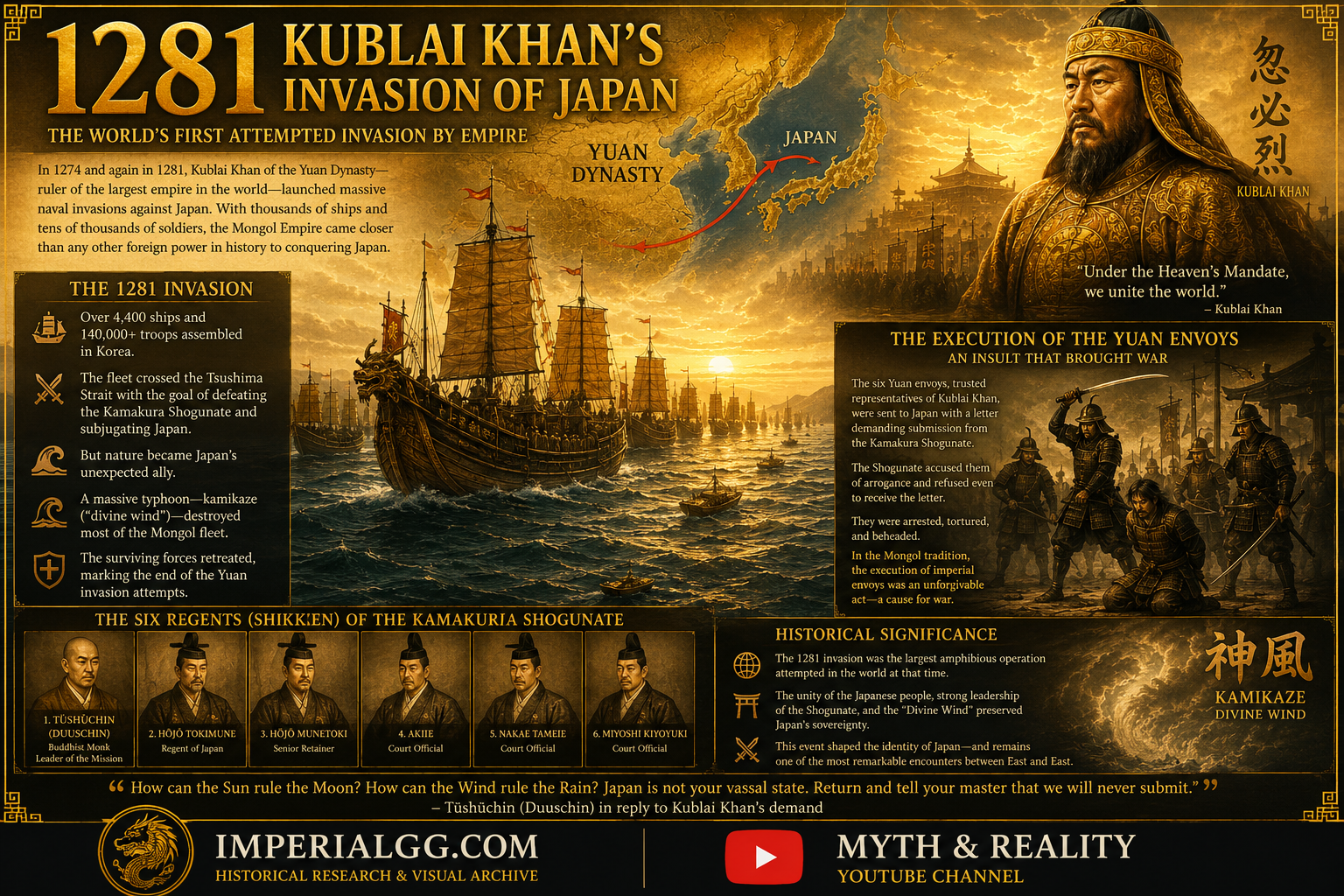
A formal letter sent by the noble Khadaan, stationed in Guulin on behalf of the Yuan Empire, was presented to the Khan: that the “demons beyond the sea” had attacked in great force, slaughtering innocent people, looting and ravaging, seizing hundreds of young women and carrying them away upon their ships toward the rising sun. Though such news bore the weight not merely of disaster but of heavenly punishment, Khubilai Khan received it with calm composure and sent envoys to the ruler of the Land of the Sun, Hojo Tokanumi, demanding submission to the supreme authority of the Great Yuan, yet the shogun and his commanders paid no heed.
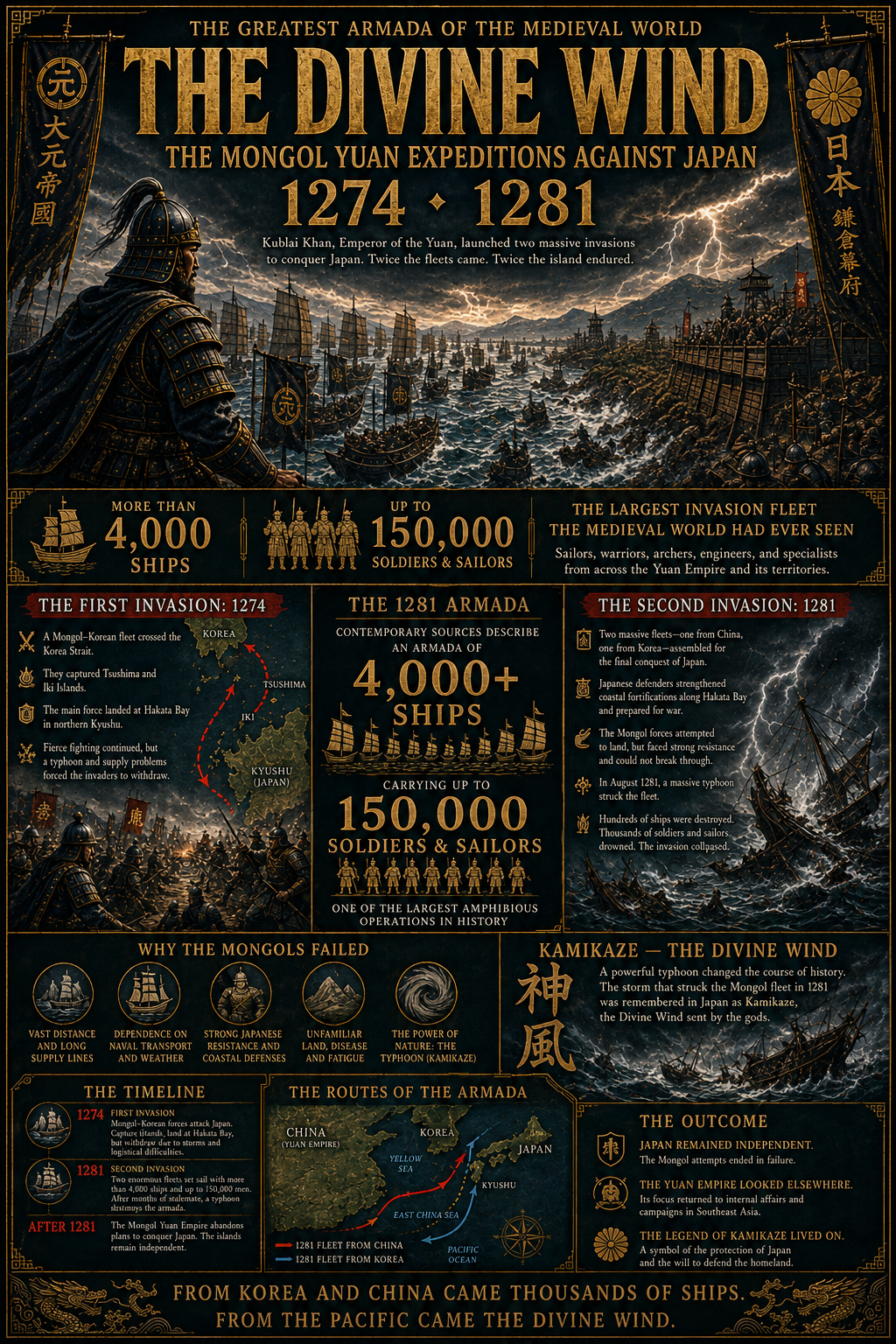
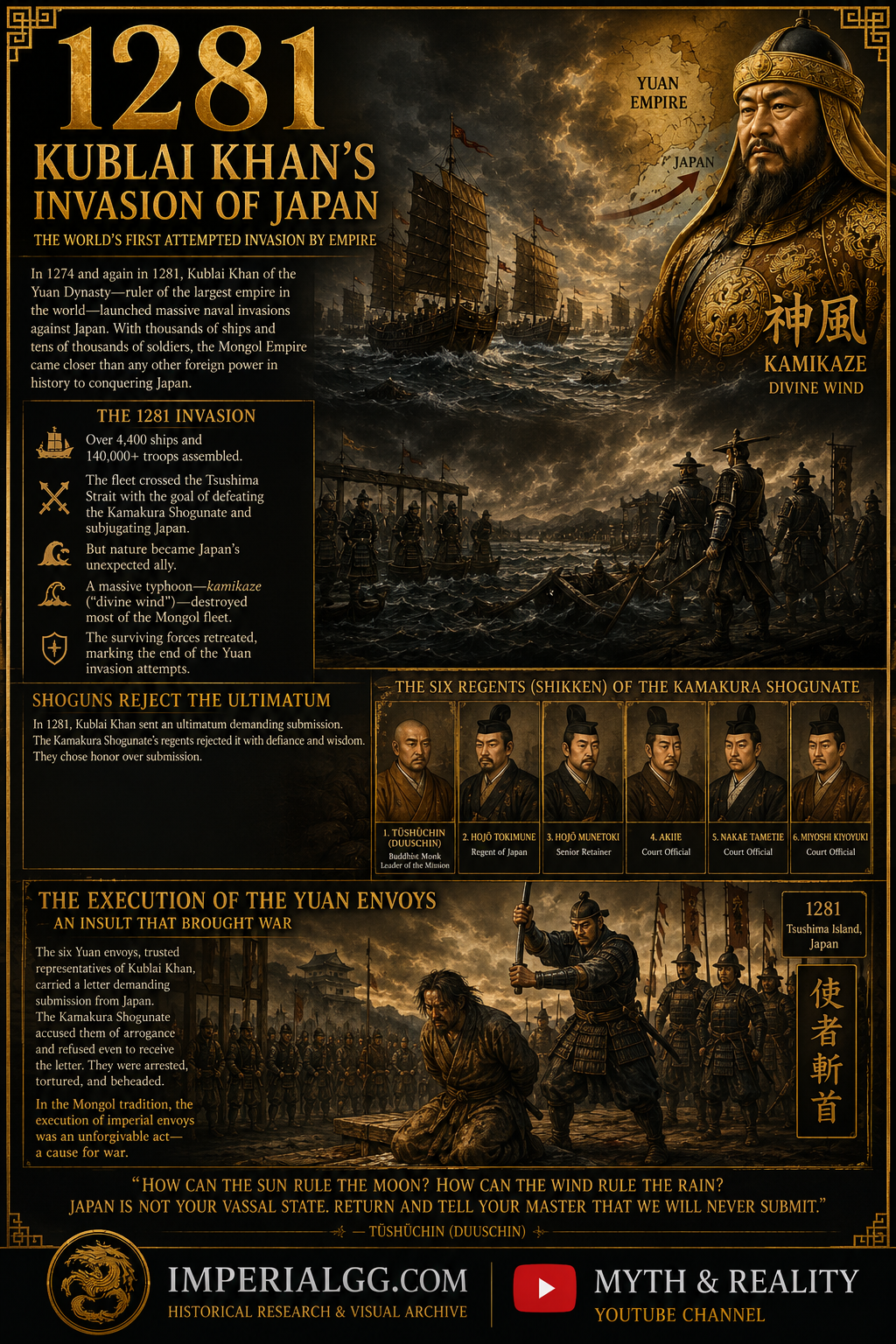
At a time when no force in the world stood equal to him, the Khan sent envoys again and again, demanding submission, yet those ignorant of the customs of the Mongol state and the sanctity of envoys repeatedly imprisoned and executed them, and thus the Khan’s patience came to an end. He assembled a vast naval force—nine hundred ships bearing twenty-five thousand soldiers and fifteen thousand sailors—and set forth upon the boundless sea, reaching Hakata Bay on the island of Kyushu, where his armies fought successfully throughout the day, yet as night fell they returned to their ships, only for a violent storm to threaten to tear them from their moorings, forcing the sailors to take to the open sea, where the raging black tempest shattered the fleet and destroyed the greater part of it.
Even this defeat did not halt the sovereign Khan.
He once more sent envoys demanding submission, yet matters only worsened. Five envoys led by Tushchin were brought before the ruler of the Land of the Sun, yet the ruler and the military authorities of the shogunate, displeased by the dignity and unyielding nature of Mongol envoys, paid little regard to the customs of diplomacy.
In the quiet hour when the morning sun reflected upon the mist of the blue sea, as dew gathered upon the leaves and the temple bell sounded faintly, the ruler of the Land of the Sun sat in proud composure among his generals, a silver sword held in his hand, and before him stood Tushchin—broad-backed, eagle-nosed, calm in gaze and resolute in spirit—clad in ceremonial attire, speaking with solemn voice:
“By the power of Eternal Heaven, my sovereign Khubilai Khan seeks to unite the world. It is fitting that your Land of the Sun come under the banner of the Great Yuan and dwell in peace through alliance.”
A cold wind seemed to pass through the court, and the Hojo nobles murmured among themselves in rising anger. The ruler, Hojo Tokanumi, drew his brows tight and, with lips barely parting, spoke:
“Beneath the sun there cannot be two sovereigns. Your lord calls himself the son of Heaven—yet upon this earth, the sun rises only under the heavens of the Land of the Sun. I will not live as a slave within the heart of a foreign land. For speaking such arrogant words, you deserve death.”
Tushchin lowered his head, yet no fear dwelled in his gaze—only the quiet radiance of duty fulfilled.
“If you refuse the decree of Heaven, this is not a trial of my life, but a divine test that will determine your fate.”
At these words, a chill fury filled the court. The ruler rose, drawing his sword:
“You foreigner—was it not the divine wind of our Heaven that cleansed your kind before? It shall cleanse you again. There cannot be two rulers beneath the sun!”
Tushchin smiled faintly.
“To die for one’s sovereign is the duty of an envoy. To stand by one’s word is the honor of a man.”
At once the ruler commanded:
“Execute these dogs who have come begging from the Nankhiad lands!”
The executioner approached, gripping his sharpened blade, and Tushchin stepped forward with pride onto the execution platform, and before the sword fell, he spoke his final verse:
When the blade whistles, this body may fall,
yet the thought of the great cause
cannot be cut down by steel.
When the wind howls, the clouds may scatter,
yet resolve and courage
are broken by neither wind nor sword.
From sunrise to sunset,
the Great Yuan shall triumph.
Then he spoke softly:
“Eternal Blue Heaven, carry the words of your envoy beyond all borders.”
In the next instant, the blade flashed, and the heads of Tushchin and the five envoys fell together.
It was the twenty-ninth day of the seventh month in the year 1279. As the temple bell rang again, a strange and unseen wind passed through the ruler’s heart, while the devout monks of the Land of the Sun buried Tushchin with honor and carved his verses into sacred stone.
Black clouds gathered along the edge of Eternal Blue Heaven, and the harsh eastern wind lashed the battle banners of the Yuan Empire, and within the stone halls of the inner palace Khubilai Khan sat surrounded by his ministers and trusted generals as the blood-stained news of his slain envoys was brought before him, the so-called “demons beyond the sea” having executed them and brought insult upon his great name, and within him anger rose like a volcanic fire from the depths of the earth—
In his own time, he felt that such events were fated to repeat themselves upon him, and he recalled with clarity how his great ancestor had dealt with the treachery of Khwarezm, remembering how, by the decree of Genghis Khan, four hundred and fifty merchants of Mongolia, bearing five hundred camels laden with goods, had gone to Khwarezm to conduct trade, only for the governor of Otrar, Inalchuq, to slaughter them all without fear, thereby stirring the boundless fury of the Great Khan, and he remembered also how, in answer, his forefather had reduced Khwarezm to ashes, capturing Inalchuq alive and pouring molten gold into his mouth, thus ending his life in retribution.
And now, hearing the grievous news that the Land of the Sun had again and again pursued, humiliated, and finally executed the envoys he had sent, Khubilai Khan began to think of reducing that island realm, too, into ashes like Khwarezm.
“An envoy,” he declared, “is the bearer of the word of Eternal Heaven, the living voice of the sovereign Khan. Yet they have stained the truth of that envoy’s words with bitter blood. By taking the heads of my envoys, that arrogant people who dare call their own ruler the son of Heaven have defiled the very face of Eternal Blue Heaven itself. Let there be war!”
As Khubilai Khan uttered these words, his voice resounded through the palace like thunder joining the roar of the heavens.
“Whether carried by birds or borne upon the wind, let my words be heard by the rulers of that small island! The scent of an envoy’s blood cannot be washed away by the waters of the raging sea—only the edge of a sharp blade can cleanse it. My trusted generals—prepare to cross the boundless ocean and strike toward the land of the rising sun!”
Thus did Khubilai Khan issue his command.
For his generals had long known that the Khan’s anger was not wind but storm, and his words not echo but thunder, and so, to raise the dark and fearsome war standard under Heaven’s blessing, they rose at once. Outside the palace, fierce and restless horses stamped and neighed, war drums thundered like stone struck against stone, and sparks flashed along the edges of drawn blades, casting light upon the palace walls.
In that moment, it seemed as though the world itself felt the wrath of the Great Khan, and even the wind fell silent, as if struck blind and overcome with sorrow.
Chapter Three
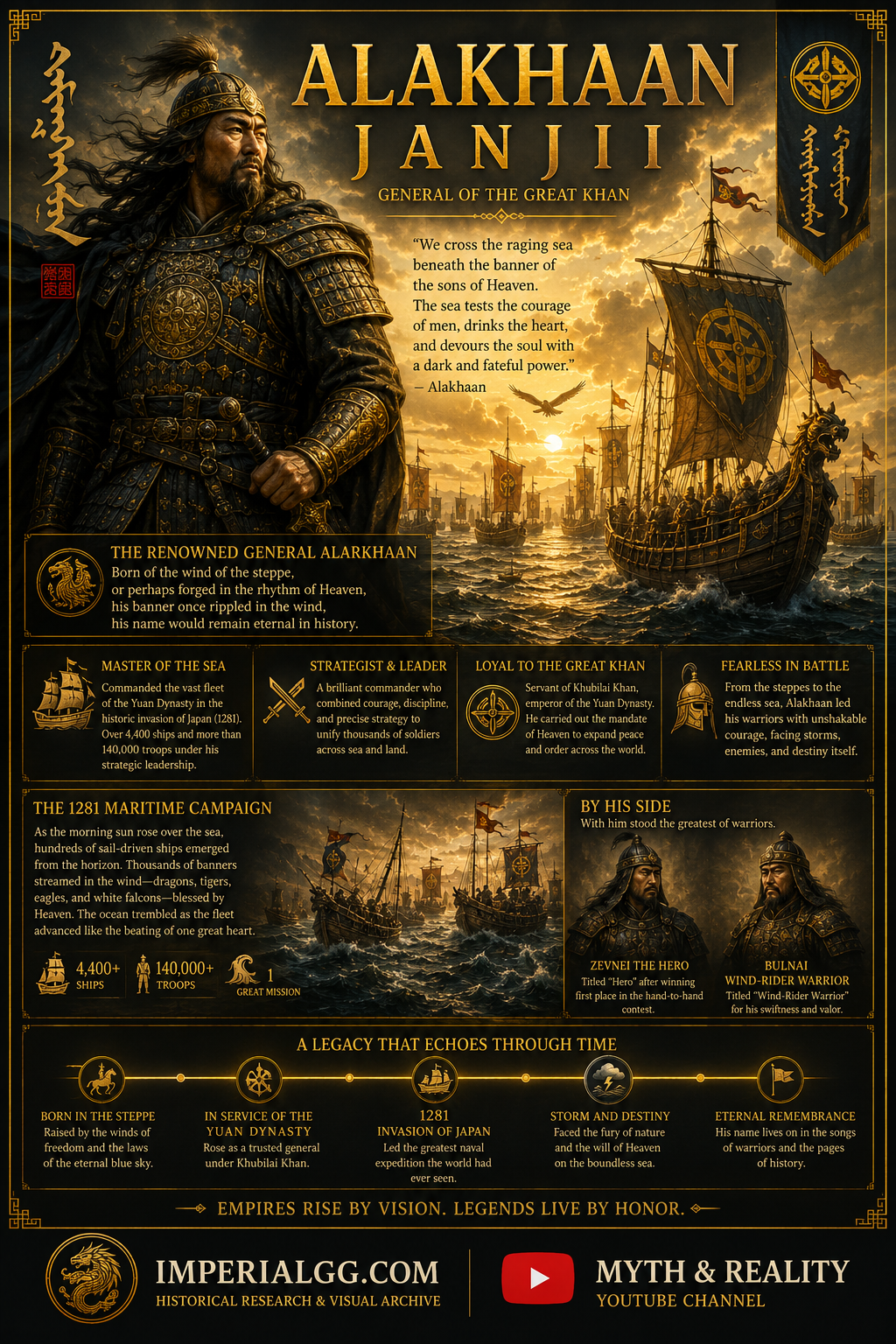
The Renowned General Alakhan
Born of the wind of the steppe,
or perhaps forged in the rhythm of Heaven,
his banner once rippled in the wind,
his name would remain eternal in history.
As the morning sun poured gently upon the surface of the sea like a veil of flowing water, from the edge of the horizon hundreds of sail-driven ships emerged, their thousands upon thousands of banners and standards streaming in the wind, a sight magnificent as though upon the board of destiny itself the pieces of a great empire were breathing and moving between heaven and earth; and upon the prows of each vessel cutting through the open sea under the command of the great lord Khubilai Khan were carved the images of dragons, tigers, eagles, and white falcons, as though they sailed under the very blessing of Heaven itself.
Moved by the rhythm of the sea wind filling their sails, the countless ships advanced in unison, and the vast ocean trembled like the beating of a single great heart, while at times white foam burst upon the water’s surface and mingled with the distant cries of birds in the sky.
Upon the high deck of his great flagship stood General Alakhan, gazing into the distance together with Zevnei the Hero—who had claimed first place in the hand-to-hand contest and been granted the title of “Hero”—and Bulnai, who had received the title “Wind-Rider Warrior.”
“We cross the raging sea beneath the banner of the sons of Heaven,” Alakhan said quietly. “The sea, though silent as a bottomless void, tests the courage of men, drinks the heart, and devours the soul with a dark and fateful power.”
For seven years earlier, when he had served as a commander of a thousand, Alakhan had taken part in the naval campaign of Khubilai Khan, reaching the port of Hakata in the Land of the Sun, and had been among the few who returned alive without being consumed by the great storm, and thus he had come to know well the harsh and unpredictable nature of the shoreless sea; yet from that time onward, a certain doubt had taken root within him.
“In ancient times,” he continued, “there was a legendary general of the western lands named Sulkharna, who climbed the Pamir Mountains and, gazing eastward, beheld the peaks of the Altai and said: ‘In that direction I must never march—for if I go there, I will be defeated.’ And now, in the same way, there turns within my mind the thought: ‘I must never reach the shores of the Land of the Sun—for if I do, I will be defeated.’ Whether this is a sign of good fortune or ill, I do not know.”
Hearing this, Zevnei the Hero, as though to strengthen his commander’s spirit, spoke with firm conviction:
“My general, do not trouble your mind. You are surrounded by chosen warriors alone. We shall show those ‘demons beyond the sea’ who we truly are. Our courage and our blades are sharp; our spirits and our steeds surge with pride; our bodies and our ships are strong. The swords of the samurai will be subdued by our ‘Moon Blades.’”
These words truly strengthened Alakhan’s resolve.
“You are not only brave and strong, but a warrior of wisdom as well. You have steadied my heart. The decree of the sovereign Khan is the law of this world. Even Heaven itself must resound beneath his might. Yet the raging sea listens not to the sword, but to the wind. If Heaven is testing us, then we must answer not with blood, but with courage. Otherwise, why should we be driven like a dream upon the aimless winds of this vast and boundless sea?”
The sunlight reflected upon the sea seemed to bind the ships to the clouds of the upper heavens, making them appear like islands drifting within the cosmos itself. The breath of the sea, the scent of the wooden ships, the fragrance of the wind like incense, and the breathing of thousands upon thousands of men—all blended into a single vast harmony.
Why had General Alakhan invited Zevnei the Hero and Bulnai onto the deck of his flagship? He had placed great trust in these two, seeing in them something beyond even the Nankhiad commanders, who might harbor hidden intentions. This judgment had been shaped by what he had witnessed seven years earlier at the battle of Hakata, where the Nankhiad soldiers and commanders, despite the laws of war and the authority of the sovereign Khan—
It was born of a single incident of betrayal that had shattered trust, and of this he spoke further:
“Seven years ago, under the naval command of the sovereign Khan, more than four thousand Mongol soldiers were led by our commander Shinduu, and at that time I myself served as a commander of a thousand, while more than fifteen thousand Nankhiad troops were under the command of their general Liu Fuxiang. Our Mongol forces advanced first, taking the islands of Tsushima and Iki in succession, and after two days we landed upon the island of Izamu and seized it, after which we joined with the forces of the Guulin state and launched an assault upon Hakata harbor—the principal stronghold of the Land of the Sun.
At such a critical and perilous moment, the great strength of the Nankhiad army was of utmost importance to us, yet misfortune struck: their general Liu Fuxiang was wounded on the battlefield, and so he gathered his ships and withdrew toward the sea, and what followed—under his command, all fifteen thousand Nankhiad soldiers fled the battlefield and retreated with him back to the sea.
Thus our Mongol commanders and warriors, faced with the fierce assault of the samurai of the Land of the Sun and those so-called ‘demons beyond the sea,’ found their strength failing against necessity, and we were left with no choice but to withdraw to the sea just as the Nankhiad had done…”
Having spoken thus, Alakhan turned his gaze toward the waves of the sea, which shimmered like gold and silver pearls beneath the light.
Behind the advancing ships that cut through the deep blue ocean, white foam trailed and scattered away in the wind, vanishing as though it had never been, and the young warrior Zevnei the Hero, eager to hear the account of Alakhan—who had endured countless battles—could not restrain himself and asked:
“And what happened after that?”
“When we returned to our ships,” Alakhan continued, “the wind was calm, the sea steady and peaceful. But as evening fell, clouds gathered along the horizon, and the light around us slowly dimmed, and then a sudden storm of rain struck. Before long thunder roared and lightning split the heavens, and as the sky flashed, the waves of the sea rose like mountains. Then, from the heart of the night, a powerful black storm descended.
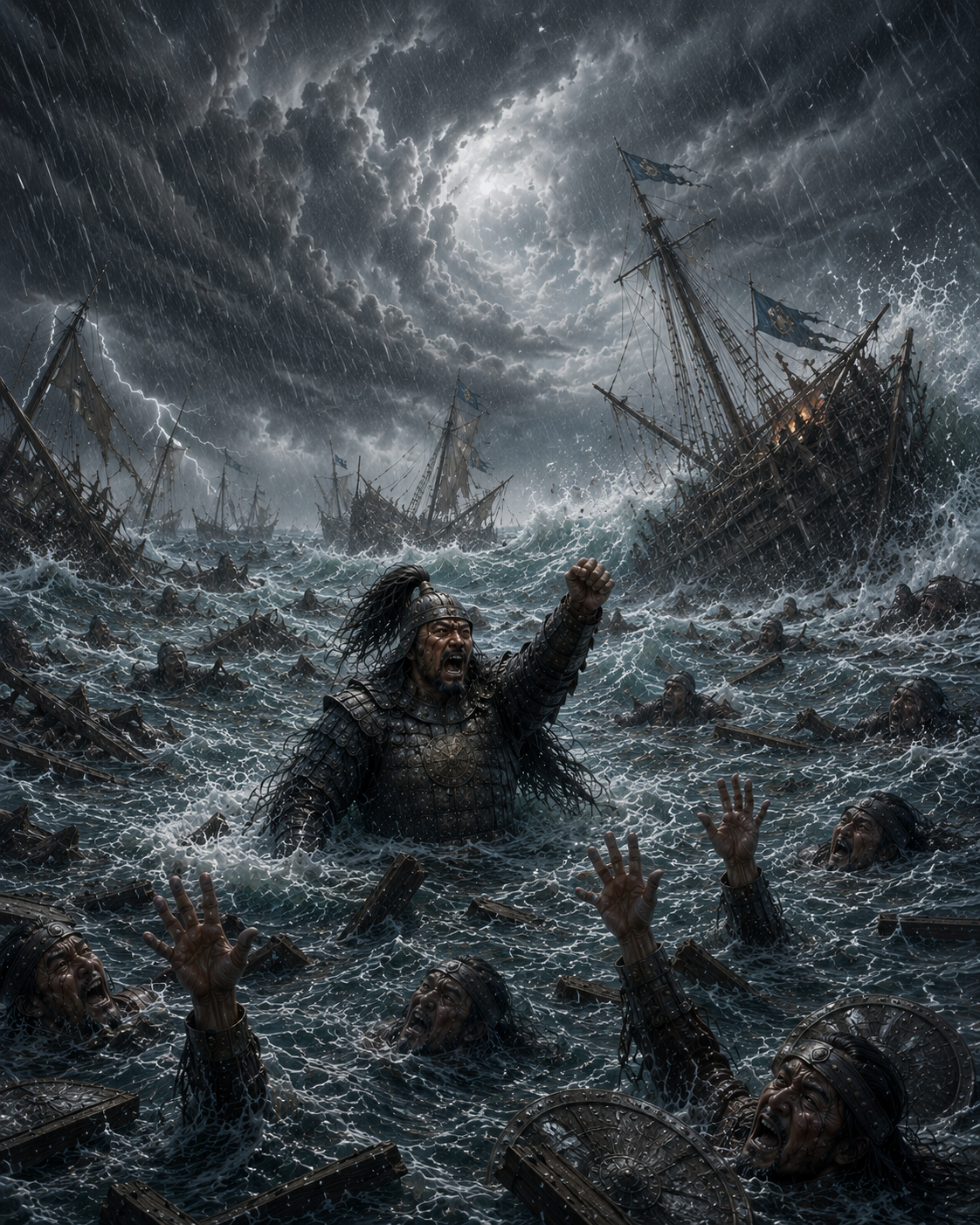
Men cried out, and thousands upon thousands of voices were swallowed at once by the sea, and the black storm of the ocean seized our nine hundred ships one after another and cast them aside. Of those, scarcely a hundred ships remained. More than half of the sovereign Khan’s great army was swallowed by the waters of the boundless sea and vanished without trace.
Of the Nankhiad soldiers and commanders, scarcely any survived. They received the judgment of Khubilai Khan not upon dry land, but in the terrible depths of the sea itself. Though we suffered immense losses in soldiers, weapons, and ships, still the sovereign Khan turned all his thought toward launching another campaign against the Land of the Sun, and after seven years, we now stand once more at this very moment.
Truly, the sovereign Khan is unyielding—and this fate is harsh, unbearably harsh…”
Having said this, General Alakhan lifted his gaze toward the heavens and offered a silent prayer.
“If those fifteen thousand Nankhiad soldiers had not faltered in fear and retreated to the sea, would we have been able to fully seize Hakata harbor?” Zevnei the Hero and Bulnai asked, almost at the same moment.
“To say nothing of Hakata harbor—even beyond it, we had the golden opportunity to advance and capture the capital city of Kamakura itself, and to bring the ruler of the Land of the Sun under the supreme authority of the Yuan Empire. Was it not for this very purpose that the sovereign Khubilai Khan sent us to that small island? Had such an opportunity truly been ours, we would not have been overtaken by the black storm of the sea. For the Nankhiad soldiers and commanders, instead of being swept away by that dark storm, it would have been a far nobler fate to die in battle. And now—what is it that we must do?” asked General Alakhan in a grave and searching tone.
Then, turning to the two warriors, he said:
“Brave warriors, to you both I entrust the fleet of the Nankhiad ships.”
Hearing this, Zevnei the Hero raised his sword high and declared:
“Though our blood bears three names—Mongol, Nankhiad, and Guulin—from this moment we stand beneath a single banner. To live under the standard of our sovereign Khan, and to die in the name of Eternal Heaven—we are ever ready!”
At these words, Bulnai, the Wind-Rider, answered and lifted his gaze toward the heavens:
“Grant us that hidden force—neither god nor man—that it may bend to our will!”
To the south stretched a chain of coral islands, their slopes thick with evergreen forests, their dark and ancient woods filled with venomous serpents, and alive with the cries of countless birds; in the valleys at the foot of the mountains, bees hummed as they flew in swarms, insects darted and leapt, and in the clear waters of streams and ponds countless varieties of fish, frogs, and turtles thrived in restless motion. Along the shoreline, several watch posts had been established, facing toward the sea.
On that clear and fateful morning destined to be recorded in history, as the sun rose into the eastern sky, fragments of light shimmered upon the boundless blue sea like scattered crystals, and the world itself seemed to transform in color and form, as though revealing the hidden path of its own vast existence. Beyond the mist that lay upon the blue waters, the horizon brightened and cleared, and upon the surface of the sea thousands upon thousands of sail-driven ships appeared, gleaming in the light—this was the fleet of Khubilai Khan making landfall upon Tsushima Island.
The decision they had once made seven years earlier—to strike through Hakata harbor—had now changed entirely. For the rulers of the Land of the Sun, those far-seeing shoguns, had long anticipated that the forces of Khubilai Khan would return, and in preparation they had constructed along the shores of Hakata a defensive wall stretching twenty thousand paces, more than two fathoms in height, built so solidly that no sinful hand could break it, so thick that even stone-hurling engines could not breach it, and so high that no warhorse could leap across.
There they had also gathered the so-called “demons beyond the sea,” warriors highly skilled in the arts of war.
Yet the scouts of Khubilai Khan had learned of this well in advance, and thus they chose the peaceful and quiet island of Tsushima, establishing it as their strategic foothold from which to launch their assault toward the capital city of Kamakura.
And so, from this place, they prepared to descend upon the so-called—
—those so-called “demons beyond the sea”—to draw them away to another place, and in that moment to seize the ruler of the Land of the Sun and bring him under the supreme authority of the Yuan Empire—such was the golden opportunity they had resolved to take.
The island of Tsushima lay in serene beauty: small fishing boats drifted upon the gentle wind, and the fishermen, their catches abundant, lived in quiet contentment. When they saw upon the deck of a great ship a sharp-eyed Arab man of middle years, with a thin black beard, they assumed that merchants from the western lands had arrived.
On the deck of the ship stood warhorses and guards, and the Arab man climbed to the upper deck, where he appeared to be reporting something to a formidable Mongol warrior. Though the fishermen rowed swiftly, they lagged behind the merchant vessels, unwilling to lose sight of goods that might slip beyond their reach, and thus they made their way to the island.
There they found traders displaying various rare wares. Among them approached a man of lean frame, quick and agile in movement, dressed in simple white garments of a fisherman; he greeted the merchants and revealed himself to be the chief of Tsushima Island. Soon, the traders were invited into the chief’s modest yet dignified dwelling, where they were treated with food and drink, and in turn presented gifts to the people there.
The chief’s son, a tall young man of about twenty years, was unloading fish from his boat, and in that moment exchanged glances of affection with a beautiful young woman dear to him. Though the merchants conversed casually with the island chief, beneath their words there lingered a quiet unease.
Sensing this, the island chief, as night fell, found an opportunity to secretly entrust a message to his son, sending him eastward toward the greater island in a small arrow-shaped boat manned by two oarsmen. As the small vessel drifted away under the pale light of the moon, the chief called out after them:
“Go carefully, and carry the message well!”
Yet as he returned, he muttered to himself:
“These men are no ordinary traders. They must be invaders from Nankhiad—there can be no doubt.”
As the small boat carrying the message passed beside a rocky islet, another swift vessel, lying in wait, suddenly emerged and blocked their path. A desperate struggle followed between them, a fight for life itself, but the ambushers were astonishingly swift and strong, and they captured the island chief’s son together with the two oarsmen, imprisoning them in a pit that had been prepared in advance.
Early the next morning, the island chief rose and looked out toward the western sea—and when he saw the vast warships spread across the horizon, his heart trembled. At that same moment, the Arab man, no longer merely a merchant in appearance, revealed himself in a different, more terrible form, a faint smile curling upon his lips.
The vanguard of the invading fleet passed beyond Tsushima Island and set their course toward Iki Island, and before departing, the Arab man—having fulfilled his duty—presented the island chief with a richly bound gift of great value, offering it with exaggerated courtesy and signaling him to open it.
The silk-wrapped bundle—
When the bundle was opened, inside lay a finely crafted rectangular box, and upon lifting its lid, there appeared a smiling mask.
“Put it on,” came the command.
And when the mask was removed—beneath it emerged the severed head of his beloved son.
The island chief, striving with all his will not to let his face betray what he felt, placed the mask upon himself and fulfilled the ritual of parting, for there remained no other path but to bow and accept. Yet as he stood gazing at the endless ranks of warships stretching beyond the horizon, beneath the chin of that smiling mask a thin stream of blood began to seep—he had bitten through his own lip in the terror and grief he dared not reveal.
His jaw trembled, his face strained against the mask—and a young woman, seeing this, cried out in anguish. She was the beloved of his son.
From the upper deck, staring toward the island with unyielding intensity, stood General Alakhan—tall of stature, broad of chest, wide of jaw, his brow squared like a carved stone, his gaze fierce, his teeth large like those of a warhorse, a hollow set beneath his chin that spoke of iron will, a man who would never turn back from what lay before him.
His fleet had now reached the shores of Iki Island.
The island itself was small, oval in shape, its surface dark with barren stone, its vegetation sparse, its hills low and subdued. Along the coast, the fortifications raised by the shoguns were not overly high, yet they were thick, solid, and extended far along the curve of the shore.
As Alakhan’s fleet approached, a commander of the Guulin state—Hong Tagu, leader of the northern forces—who had arrived at Iki Island more than a month earlier and had been strengthening his position while awaiting the main army, came swiftly by a small boat to greet him. Climbing aboard with agility by rope ladder, he spoke:
“You have traveled well, I trust?”
“We came without hindrance, carried by the blue winds of the sea,” Alakhan replied. “And you—how stands your position? How well have you measured the enemy? From what I see of their fortifications, they are not to be taken lightly.”
“Our secrecy has already been lost,” Hong Tagu answered. “The scouts of the Land of the Sun have learned of our coming. Yet the so-called ‘demons beyond the sea’ are not here—they guard Hakata harbor. Here, it is the samurai who gather in force. Forty thousand stand for the defense of the coast. The fortifications stretch twenty thousand paces, and for every pace—two samurai. They are armed with bows and long spears.”
Alakhan listened, yet showed no sign of concern.
“Now that secrecy is lost, what of it?” he said calmly. “It is not as though we are untrained in battle. Such defenses—we could cut through them as easily as casting aside scraps while drinking tea. If we seize them, will they not come to greet us with the banners of victory?”
“By the command of the Great Khan, we have awaited the southern forces,” Hong Tagu replied. “These samurai are fierce and proud. You would do well not to overlook them. Such is the nature of this people…”
General Hong Tagu of Guulin pointed toward the shore. There, riding a handsome white horse and clad in full battle gear, a samurai could be seen advancing toward Alakhan’s ship. From the manner of his coming, it was plain that he had arrived to challenge a Mongol champion to single combat, and that he was one of those men in whom courage seemed ready to leap out through the mouth itself, a self-offering warrior who counted death as no more than dust.
General Alakhan paid him no heed at all, but laughed in mockery.
“Bare-legged, yet with battle in his mind. Even so, he must not be underestimated. In the heart of a samurai there dwells, holier than the sword itself, a vow to honor and to death. Therefore let him be thoroughly chastened. Prepare three mounted squads from the three central ships to enter the fight. After the great guns have been fired three times, let a screen of smoke be laid, and then send thirty of the ‘Invisible Warriors.’ Let not a single living soul remain within three hundred fathoms.”
So saying, he gave a broad and peculiar signal with his hand. Seeing it, the drummer struck the battle signal—“All ships to war!”—and the hatches of the vessels were opened, revealing mounted and foot soldiers standing ready to surge forth.
At the same moment, the samurai commander Hojo Takakasu could be heard shouting orders to the defenders of the coast:
“They mean to attack—prepare your bows!”
Among the Mongol ranks, a young warrior, hearing the roll of the drum, began to move in agitation, but an older soldier beside him instructed him sharply:
“When a fox runs, the mountain does not crack. Do not be hasty, younger brother. Our squad has not yet been called into battle. Learn to distinguish between the drum’s voice and the voice of command.”
Yet no movement followed from Alakhan’s ship except that Zevnei the Hero came riding forth upon his black stallion. The samurai who had issued the challenge went forward to meet him and introduced himself as Takezaki Suenaga of the Hojo clan, and Zevnei the Hero in turn offered his own greeting.
The two great armies stood arrayed against one another in ranks, while their finest two champions came forth first to test their strength in single combat. This spectacle had long been an established custom of war, descending from the ancient realms of Han and the Hun, and thus none had the right to intrude across the line between the two combatants. That the strongest and most excellent warrior of one army should step before all, cut down the opposing champion with a sharp sword or pierce him through with a spear, was at once a proud display of the power and spirit of his own host and a means of striking dread into the hearts of the enemy. The commanders of the Land of the Sun had evidently long since mastered this art of warlike arrogance.
As the two warriors charged straight at one another, the samurai thrust fiercely with his long spear, but Zevnei the Hero, without drawing spear or sword, slipped aside with astonishing agility and struck the back of the man’s head with his bamboo staff, so that the samurai nearly toppled over together with his horse. At this, laughter rang out loudly from the Mongol ships.
The samurai wheeled his horse about and recovered his balance, and as he prepared to attack again, Zevnei the Hero dismounted, stroked the neck of his black stallion, and with a gesture seemed to tell it, “Wait here,” then stood facing the enemy with no weapon at all in his hands. Furious to the point of madness, the samurai spurred forward, swinging his long straight sword with practiced force, but Zevnei, shielding himself several times with the joints of both arms, leapt upward with wrestler’s cunning, seized hold above the horse’s mane, ran alongside it, and then, in a single swift motion, overturned the rider.
The samurai, barely escaping being crushed beneath his horse, sprang up with speed and strength plain to see. Yet as he came rushing in with his long sword gripped in both hands, Zevnei the Hero met him head-on, and before the descending blade could fall, drove a tremendous punch into his chest. The samurai was hurled backward, blood bursting from his mouth, and fell as though dead.
This astonishing skill of Zevnei the Hero had been forged upon the wide Mongolian steppe, where from blackest childhood he had wrestled with colts and foals and learned to seize a wild stallion by the chest and throw it flat. Samurai who had never before faced any weapon but the sword stared in dumb amazement at such mastery. In this way he raised high the pride, strength, and glory of the Mongol warrior.
Nor did he stop there. Whistling sharply, he summoned his black stallion, vaulted onto its back with effortless swiftness, and then, displaying astonishing strength and agility in the saddle, performed movements such as leaning as though to fall from the side of the horse and springing upright again upon the saddle, so that before the stunned samurai could regain their wits, he had already sped back toward the opening of the ship.
The samurai who had been struck so powerfully and flung backward sat for a while upon one knee, his head bowed in pain—
The samurai tried to rise to his feet, but could not. He sought to call for his battle-horse, yet no voice came from him. Instead, the noble warhorse itself came near of its own accord and bent its two forelegs before him. The gravely wounded samurai strained with all the strength left in him to haul himself up by the saddle, yet he could not mount.
For a samurai warrior, this was humiliation beyond endurance, and the bitterness in him boiled to its highest pitch. Drawing a sharp dagger from the slim pouch at his waist, he wasted no time: he plunged it into his own belly and gave up his breath. From atop the fortifications, the shogun’s warriors could do nothing but watch in grief and lamentation. Yet though this samurai had been defeated, he had at least preserved his honor by daring to commit harakiri. To overcome unbearable pain, to reveal courage at the very edge of death, and before the gods and all others to proclaim the purity of one’s thought and intention—this, it seemed, had been his truest duty. But it was equally plain that Zevnei the Hero’s powerful victory had sent fear and dread coursing through the enemy ranks.
Before the battle began, the Mongol soldiers raised their long song in resonant melody. After that, by the signal of drum and banner, they moved in ordered ranks and shouted in fierce unison:
“Let the savage battle begin! Uukhai! Uukhai!”
Before the sun should set, General Alakhan gave the order:
“Show them what tomorrow will be!”
As he raised three fingers, at the roll of the drum three squads from the three central ships burst forth like floodwater, the warriors mounted on black, white, and dappled horses riding in circles as they advanced, loosing down a hail of arrows upon the enemy, each shaft landing with astonishing precision.
Then the thousands of ships drawn up along the shore each fired their great guns three times toward the enemy, and the thunderous roar and devastation that followed left the coastal defenders shocked and bewildered, scarcely able to answer with more than a stray arrow or two.
Thus the samurai, unaccustomed alike to the powerful weapons and the art of war of the Mongol army, fell dead and wounded in such numbers that all order began to dissolve. Thirty warriors rode in tight circles at close range, loosing volleys of arrows ten by ten with incredible speed, then wheeling back into the ship-gates again, while from many dozens of vessels a black smoke was launched forth, and in that choking bitter cloud the samurai, unable to breathe, collapsed as though dying where they stood.
The masked Invisible Warriors, their mouths covered, darted lightly into the coastal defenses and cut down the samurai—whose eyes streamed with tears and who fell reeling blind—as though mowing grass with a scythe.
When the Mongol soldiers drew their bows and loosed their arrows, it seemed as though even the blue sky itself held its breath. The name of that missile was the Moon Blade. Though dim in hue beneath the sunlight, it carried a pale gleam as though it had gathered into itself the radiance of the moon. And once it was cast with deadly accuracy toward the enemy, the samurai came to understand all too well how it deprived a man alike of faith and of hope.
Yet not every Mongol warrior could hurl it with equal skill. From childhood onward, only a small number of chosen and extraordinary fighters, trained from youth to cast the Moon Blade and to make of it the very spirit and dread standard of their art of war, had been selected, raised, and disciplined by General Alakhan himself.
From within the smoke, a Mongol warrior suddenly emerged and, in swift succession, hurled several Moon Blades, striking down four or five samurai at once. Seeing him through the haze, the other samurai cried out in terror:
“A demon! A demon—look there!”
The arrows of the Mongol archers flew like birds, whistling through the air as though slicing its very fabric, and even the sound of the sea wind seemed to fall silent, leaving only the shrill singing of the arrows to rule the world around them.
Yet some fierce samurai still pressed forward, their blades flashing like steel that could pierce the very light of the sun, their steps measured, their movements precise, the path of their swords straight and unwavering, flowing with the rhythm of the wind itself—and in so doing they cut down many dozens of soldiers of both Mongol and Nankhiad alike.
Even so, in the eyes of the Mongol warriors who had crossed the vast blue sea without faltering, the samurai sword was no more than a reflection of sunlight. For while the samurai blade spoke only of the skill of a single man, the Moon Blade seemed to carry within it the blessing of the heavens and the breath of the steppe wind; its true force lay in striking the very heart of the enemy, silencing him as though heaven and earth themselves had met and stilled him.
The bows and Moon Blades of the Mongols possessed a range twice that of the weapons of the Land of the Sun, and with that reach came twice the certainty of death. The samurai, masters of close combat, did not yet understand this, and so many advanced into what they thought was striking distance, only to be cut down before they could even draw breath.
Like the silent sky and the swift wind, the Mongol archers slew the samurai as though they were but falling leaves. Within a short span, across three hundred fathoms of ground, not a single defender remained alive.
Beneath the heavens, death spread even as the song of victory rose. Slain and shattered samurai lay in ruin, the thick scent of blood rising into the hot wind, while the cries of the seabirds wheeling above mingled with the final breaths of the dying.
And yet, from the depths of the island, more samurai came forth day by day, their sharp swords at their sides, increasing like the swelling tide.
Upon the mist-covered slopes of the mountains, at the crest of Sokhara Hill, the imposing figure of the samurai commander Kikuchi Takefusa emerged through the silken breath of a strange wind.
His crimson silk kimono, a mark of noble lineage and refined authority, glimmered faintly at its edges with the reflection of his steel blade. Upon his head shone the bronze helmet known as the kabuto, forged with divine craftsmanship, and within the edge of his sword—sharpened a thousand times over—he had entrusted both his life and his spirit.
He was no longer merely a man, but a living embodiment of honor, discipline, and the warrior’s code—a fragment of history made flesh.
Standing before his soldiers, he drew a line in the dust with his foot and declared:
“This is our land. It must be defended with our lives. The Mongols must not be allowed beyond this line.
They are strong upon the open steppe—but in forests, in mountains, in ravines, their horses will falter. We shall call upon the spirit of this land itself.
The Mongols who have come here are swift as the wind. That swiftness—we shall defeat with endurance. If they are strong, we are wise. If they strike like fire, then remember—fire is subdued by water.
Let our movements be like flowing water—yielding, yet relentless—and like burning earth—fierce and unyielding. Let your hearts be calm as still water.
And pour all your spirit into your swords!”
With these words, he drew his blade and raised its edge toward the heavens.
Lorem ipsum dolor sit amet, consectetur adipiscing elit. Ut elit tellus, luctus nec ullamcorper mattis, pulvinar dapibus leo.
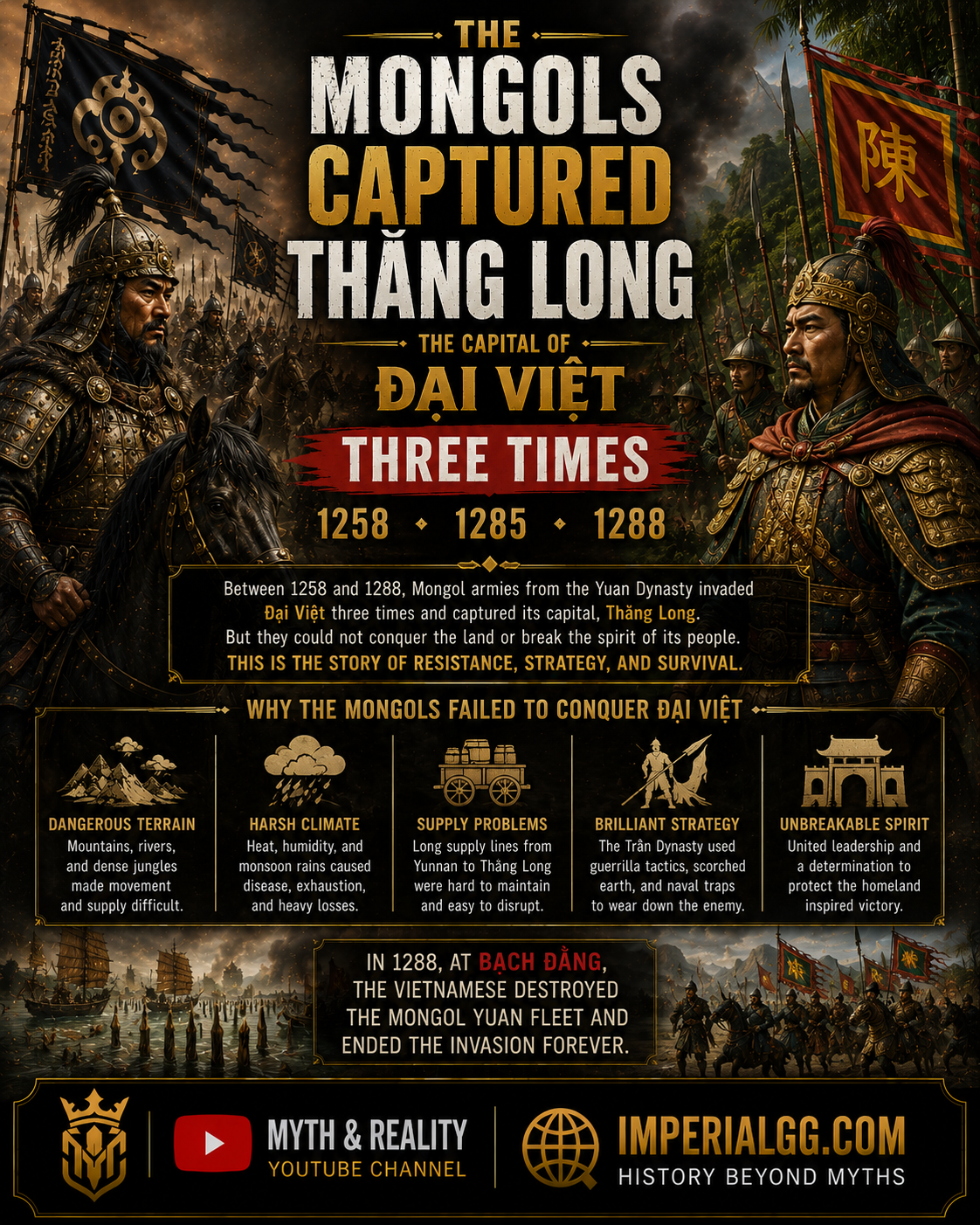
Between 1258 and 1288, Mongol armies launched three major campaigns against Đại Việt.
In 1258, 1285, and 1288, the Mongols captured Thăng Long, the capital of Đại Việt. Despite these victories, they were unable to establish permanent direct rule over the kingdom.
Difficult terrain, tropical climate, supply problems, and determined resistance made long-term occupation impossible.
After the wars, Đại Việt remained self-governing under the Trần Dynasty, but continued tributary relations with the Mongol Yuan Empire. Envoys, tribute missions, and diplomatic exchanges continued between the two states.
The Mongols captured the capital three times.
Yet Đại Việt survived as a kingdom.
Heavenly Wind 750 is a historical-philosophical maritime chronicle exploring the final oceanic ambitions of the Монголын Юань гүрэн. Amid storm, war, and prophecy, fleets from many lands crossed the eastern seas beneath one imperial destiny, where the boundary between divine judgment and human ambition dissolved into wind and water.
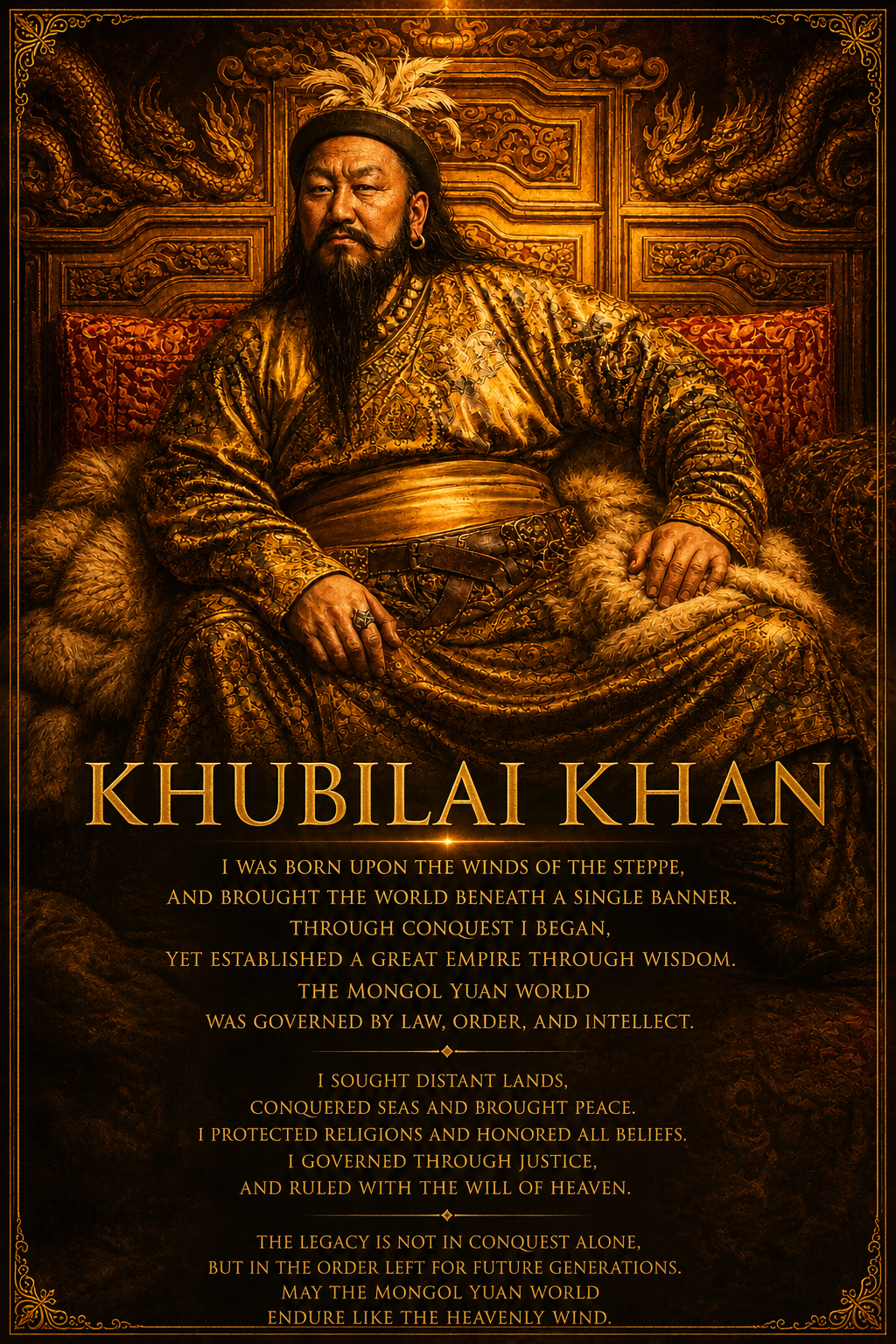
Khubilai Khaan was the founder of the Монголын Юань гүрэн and one of the greatest imperial rulers of the medieval world. A grandson of Chinggis Khaan, he transformed the Mongol Empire from a dominion of the steppe into a vast Eurasian state connected by trade, administration, military power, and maritime ambition. Under his reign, the empire expanded its influence across East Asia and toward the eastern seas, where fleets, soldiers, scholars, and merchants from many nations moved beneath the authority of the Great Khaan.
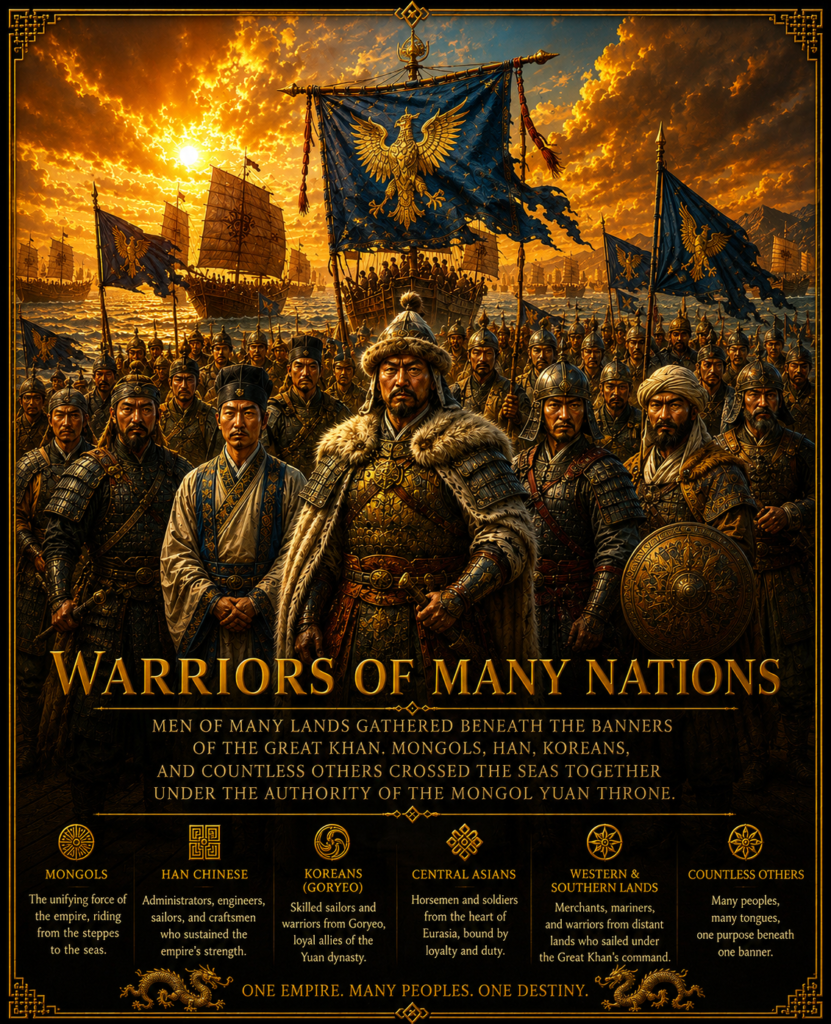
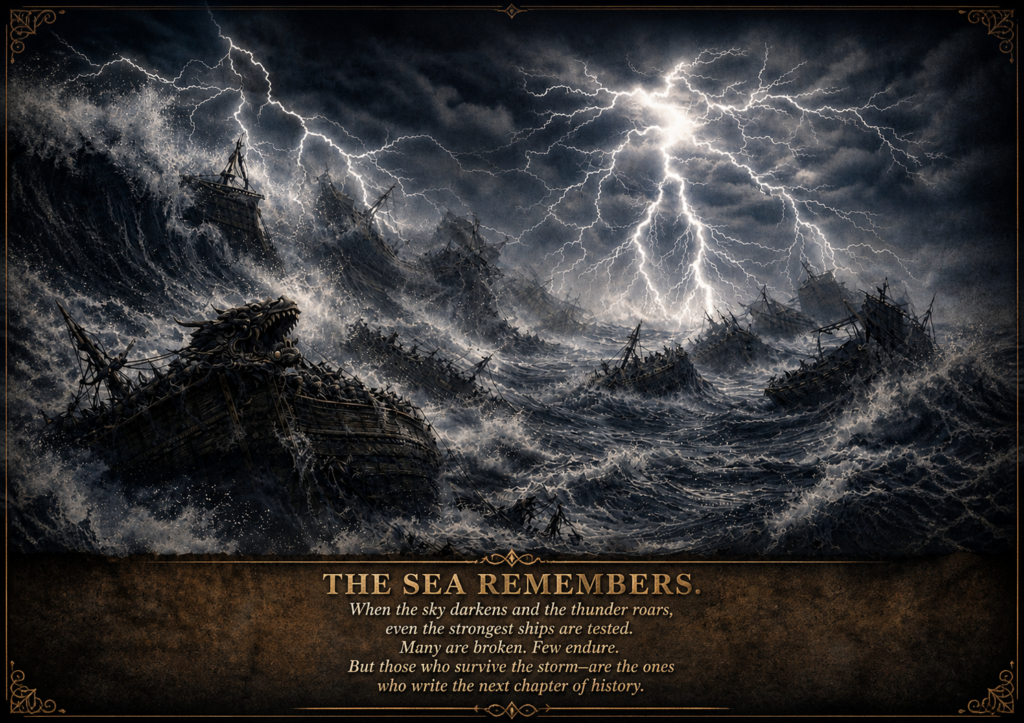
From the banners of many nations to the fury of the blackened sea, these chronicles follow the final maritime visions of the Монголын Юань гүрэн under Khubilai Khaan. Mongols, Han, Goryeo Koreans, Central Asian horsemen, sailors, and countless others crossed the eastern seas beneath one imperial command, carrying the ambition of an empire that sought to unite land and ocean alike. Yet beyond the fleets and the armies stood a greater force — the sea itself. Storms shattered ships, thunder consumed horizons, and the waves became the final judge of imperial destiny. Together, these scenes tell the story of unity, ambition, catastrophe, and memory at the edge of the medieval world.
- Massive Force: Following the failed 1274 attempt, the Yuan Dynasty sent two massive fleets from Korea and the recently conquered Song China, aiming for Kyushu.
- Japanese Defenses: The Japanese, led by samurai, built a 20-kilometer stone defensive wall (shakujibi) at Hakata Bay.
- The Standstill: The samurai used small, nimble boats to attack the large, cumbersome Mongol ships at night, preventing them from establishing a strong beachhead for nearly two months.
- The Kamikaze: A massive typhoon, or “divine wind,” struck on August 15, 1281, obliterating the Mongol fleet and drowning or forcing the surrender of over half the troops.
- Consequences: The failed invasion preserved Japanese independence, severely weakened the Yuan dynasty’s naval resources, and fostered the idea of Japan as a protected divine nation. [1, 2, 3, 4, 5]