

From Karakorum to the Edge of the Known World
Beyond maps and timelines lie the stories themselves. Chronicles brings together campaigns, voyages, diplomatic missions, forgotten conflicts, and remarkable encounters from the Mongol age, revealing how peoples and empires across Eurasia were connected through war, trade, diplomacy, and exploration.

The Three Mongol Captures of the Dai Viet Capital: A History of Victory Without Conquest
One of the most remarkable episodes in the history of the Mongol Empire was its repeated invasion of Dai Viet (medieval Vietnam). Although Mongol and later Yuan forces succeeded in capturing the Dai Viet capital on three separate occasions, they ultimately failed to secure permanent control over the kingdom. The campaigns demonstrated both the extraordinary military reach of the Mongol world and the limitations of imperial conquest in difficult environments.
First Invasion (1258)
The first Mongol invasion occurred during the reign of Möngke Khan. After diplomatic disputes and Dai Viet’s refusal to fully cooperate with Mongol demands, a Mongol force under Uriyangkhadai advanced southward from Yunnan.
The campaign moved rapidly. Dai Viet forces attempted to block the invaders but were defeated in open battle. In January 1258, the Mongols entered the capital of Thang Long (present-day Hanoi). The royal court abandoned the city before the Mongols arrived, leaving the capital largely deserted.
Although the Mongols had achieved their immediate objective and occupied the capital, they soon encountered difficulties. The tropical climate, unfamiliar terrain, supply shortages, and continuous harassment by Vietnamese forces made long-term occupation difficult. After only a short stay, the Mongols withdrew. Dai Viet accepted a tributary relationship, but effective independence remained intact.
Second Invasion (1285)
The second invasion was launched by the Yuan dynasty under Kublai Khan. By this time, the Mongol Empire had transformed into a vast Eurasian power, and Kublai sought to strengthen Yuan authority in Southeast Asia.
A massive force advanced into Dai Viet from multiple directions. Commanded by Prince Toghon and supported by experienced generals, the Yuan army pushed deep into the kingdom.
Once again, the Vietnamese court abandoned Thang Long, allowing the invaders to enter the capital. The city was occupied, and for a brief period it appeared that Yuan victory was inevitable.
However, the Tran dynasty deliberately avoided decisive confrontation. Vietnamese commanders adopted a strategy of withdrawal, scorched earth tactics, and attacks on supply lines. Food shortages became severe within the occupying army. Disease, heat, and guerrilla warfare gradually weakened the invaders.
In the following months, Vietnamese counterattacks intensified. Major Yuan forces suffered defeats, and Toghon was eventually forced to retreat northward. What had begun as a triumphant occupation of the capital ended in a costly withdrawal.
Third Invasion (1287–1288)
Determined to restore imperial prestige, Kublai Khan launched a third and even larger expedition.
Again, Yuan forces penetrated deep into Dai Viet and occupied Thang Long. For the third time, the capital fell into Mongol hands.
Yet the fundamental problem remained unchanged. The Vietnamese leadership refused to surrender and avoided annihilation. Instead, they continued to preserve their armies while denying supplies to the invaders.
The turning point came in 1288 at the famous Battle of Bach Dang River. Vietnamese commander Tran Hung Dao prepared a carefully planned ambush using wooden stakes hidden beneath the river’s surface. When the Yuan fleet attempted to withdraw, it was trapped by the tides and attacked from multiple directions.
The result was catastrophic for the Yuan expedition. Much of the fleet was destroyed, thousands of soldiers were killed or captured, and the campaign collapsed. Surviving forces retreated to China.
Why the Mongols Captured the Capital but Failed to Conquer Dai Viet
The Mongols achieved what many armies throughout history could not: they captured the Dai Viet capital three separate times.
However, taking the capital did not mean controlling the kingdom.
Several factors explain this outcome:
- The Vietnamese court repeatedly evacuated before capture.
- Local forces preserved their military strength instead of defending the city at all costs.
- Tropical climate and disease weakened the invaders.
- Supply lines stretched hundreds of kilometers through difficult terrain.
- Vietnamese commanders successfully employed guerrilla tactics and scorched-earth strategies.
- Rivers, jungles, and monsoon conditions reduced many traditional Mongol advantages.
The campaigns illustrate a broader lesson of imperial history: occupying a capital city is not the same as conquering a nation.
Legacy
The three captures of Thang Long remain among the most extraordinary episodes of Mongol military history. Few states endured repeated invasions by the Mongol world and survived as independent kingdoms.
For the Mongols and the Yuan dynasty, the campaigns demonstrated the limits of even the greatest empire of the age. For Dai Viet, they became a foundational narrative of resistance and state survival, celebrated for centuries in Vietnamese historical memory.
Despite entering the capital three times—in 1258, 1285, and 1288—the Mongols never succeeded in permanently incorporating Dai Viet into the empire. The kingdom remained independent, making the Dai Viet campaigns one of the most significant strategic setbacks of the Yuan era.
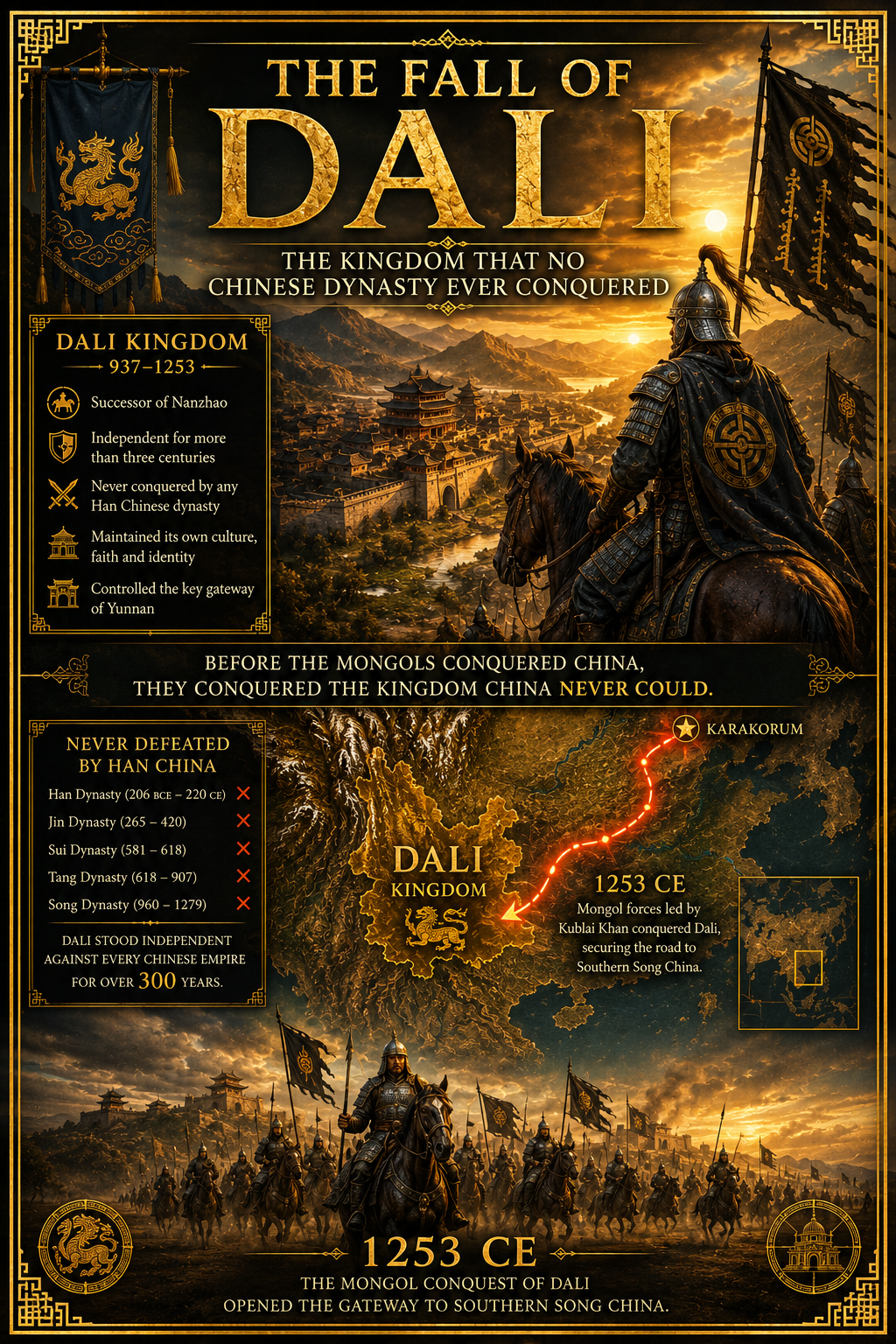
The Fall of Dali: The Mountain Kingdom That Opened the Road to Southern China
For more than three centuries, the Kingdom of Dali stood beyond the reach of every Chinese dynasty. Protected by the rugged mountains, deep valleys, and fortified strongholds of Yunnan, Dali inherited the legacy of Nanzhao and controlled one of the most strategic regions in East Asia.
The kingdom occupied a natural fortress. Armies advancing from the north had to cross difficult mountain passes, narrow valleys, and hostile terrain before reaching Dali’s heartland. These geographical barriers helped preserve Dali’s independence while successive dynasties—including the Han, Jin, Sui, Tang, and Song—failed to bring the region under lasting control.
In 1253, the Mongol Empire launched one of its most ambitious campaigns. Rather than attacking only through traditional routes, Mongol commanders maneuvered through some of the most challenging terrain in Asia. Their forces crossed mountains, rivers, and remote frontier regions to strike the kingdom from unexpected directions.
The conquest of Dali was far more than a regional victory. By securing Yunnan, the Mongols removed the last major independent state on the southwestern frontier and gained a strategic base for future operations against the Southern Song Dynasty. The campaign demonstrated the remarkable mobility of Mongol armies, which successfully operated in landscapes very different from the open steppes where their power had first emerged.
Dali’s fall opened the gateway to southern China. The mountain barriers that had protected the kingdom for centuries were finally overcome, allowing the Mongols to expand deeper into East Asia. The conquest became a crucial step on the road toward the eventual unification of China under the Mongol Yuan dynasty.
The mountains were taken. The gateway was opened. History changed.
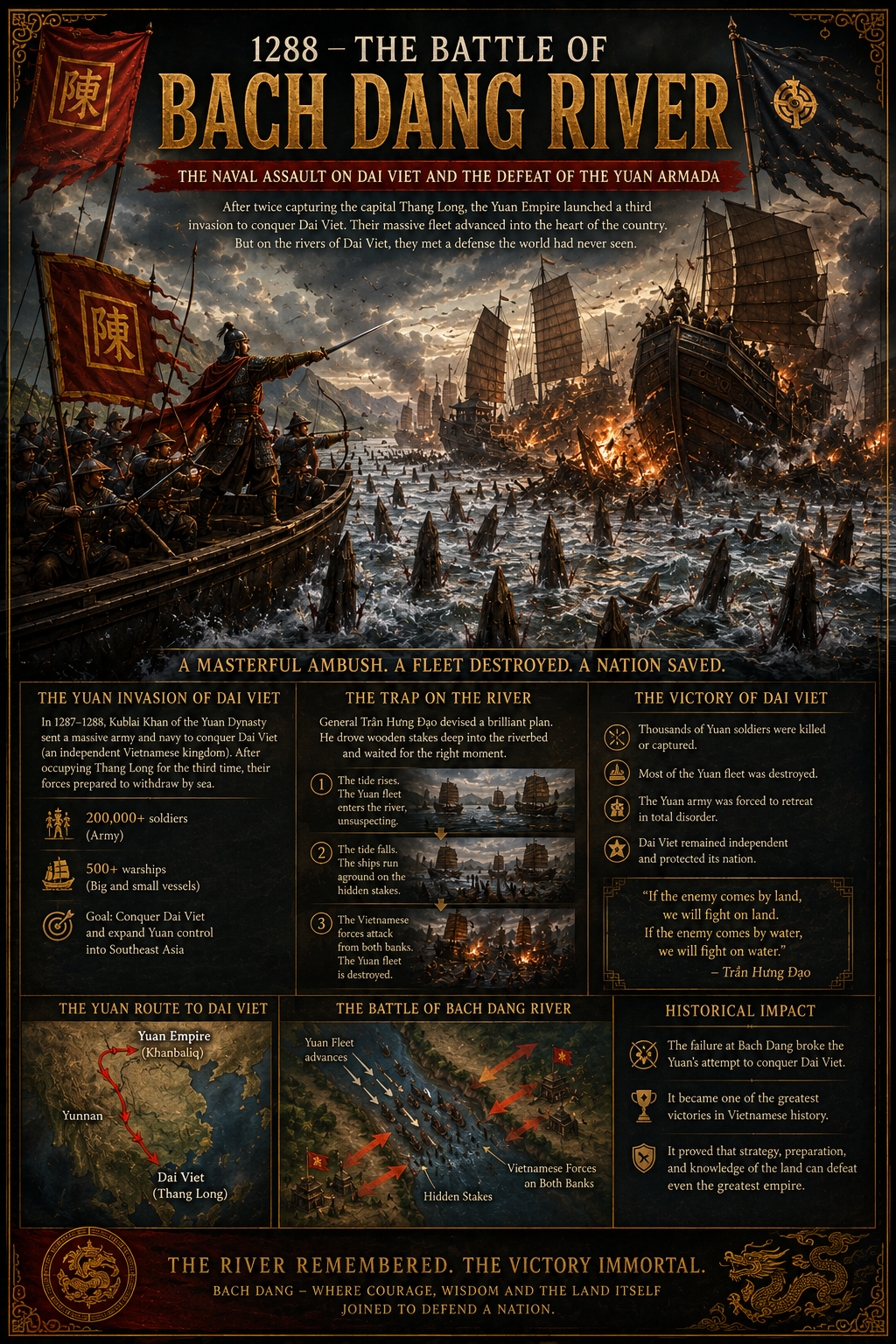
The Mongol Naval Campaigns Against Dai Viet
The wars between the Mongol Empire and Dai Viet were among the most difficult campaigns the empire ever faced. Unlike the open grasslands of Eurasia, northern Vietnam was a landscape of dense forests, tropical rivers, swamps, mountains, and a coastline shaped by tides and estuaries. Success depended not only on military strength, but also on control of waterways and supply routes.
The Mongols launched major invasions in 1258, 1285, and 1287–1288. During these campaigns, Mongol and Yuan forces repeatedly advanced deep into Dai Viet, capturing the capital of Thang Long (modern Hanoi) on multiple occasions. Yet occupation proved far more difficult than conquest.
Dai Viet commanders avoided decisive battles when necessary, withdrew into the countryside, and targeted Mongol supply lines. Rivers became the central battleground of the war. Fleets carried troops, food, weapons, and reinforcements through the complex network of waterways that connected the Red River Delta to the sea.
The largest naval confrontation occurred during the campaign of 1287–1288. Seeking to secure permanent control over Dai Viet, the Yuan Empire assembled a massive combined land and naval force. The campaign depended heavily on maritime logistics. Hundreds of vessels transported supplies from southern China to support the advancing armies.
Dai Viet commander Tran Hung Dao recognized that the invading forces depended upon their fleet. After supply convoys were disrupted and shortages began to affect the Yuan army, the invaders were forced to retreat toward the coast.
At the Battle of Bach Dang River in 1288, Dai Viet forces prepared one of the most famous naval ambushes in Asian history. Wooden stakes were driven into the riverbed beneath the waterline. As the tide rose, the Yuan fleet advanced into the river. When the tide receded, ships became trapped among the hidden obstacles. Dai Viet forces then attacked from multiple directions, setting vessels ablaze and destroying much of the fleet.
The defeat marked the end of Yuan attempts to conquer Dai Viet. Although the Mongol Empire had conquered territories stretching from Eastern Europe to the Pacific Ocean, the rivers, climate, terrain, and determined resistance of Dai Viet prevented permanent occupation.
“Three times the capital fell. Three times the empire advanced. Yet on the rivers of Dai Viet, conquest slipped away with the tide.”
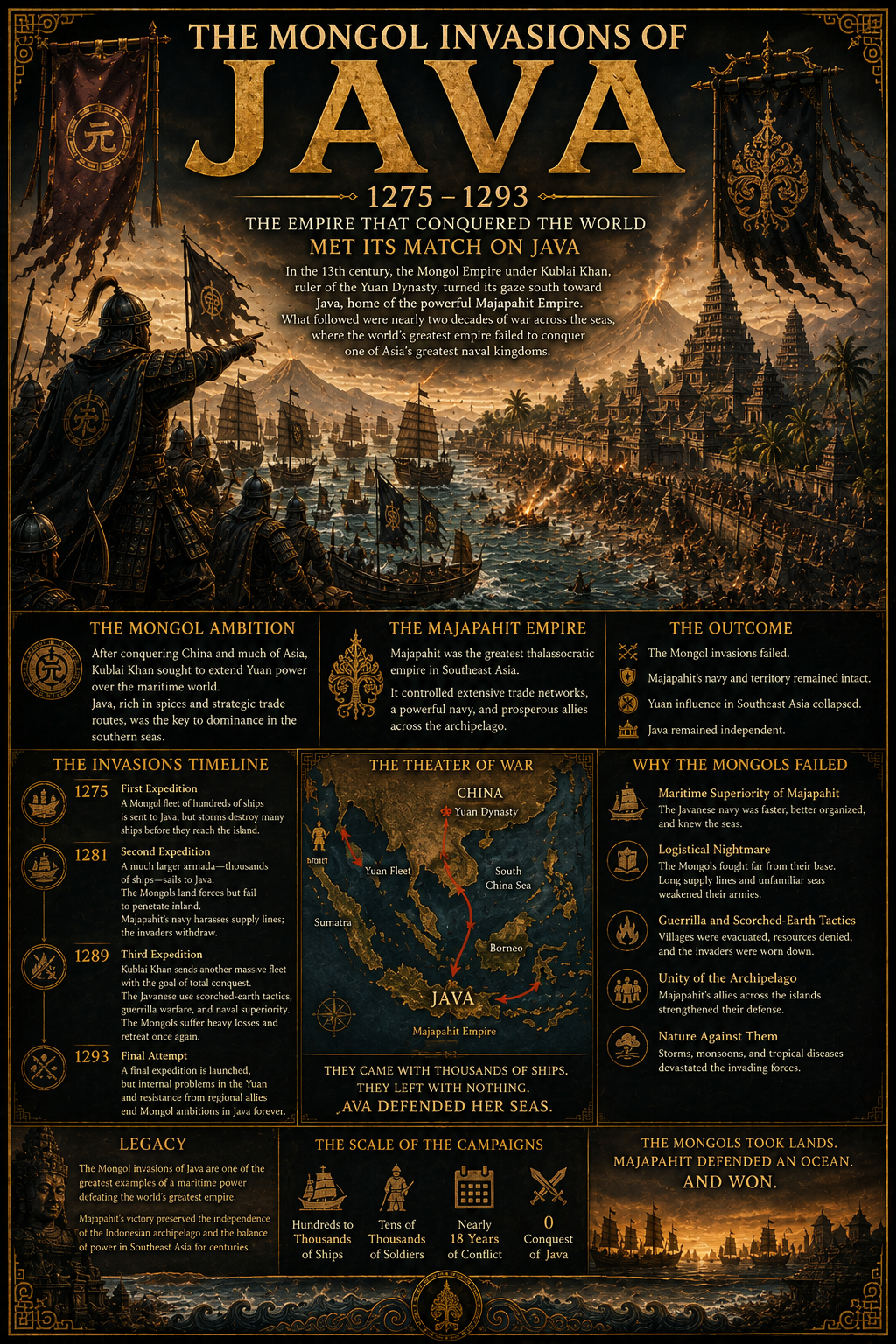
The Mongol Expedition to Java (1293)
By the late thirteenth century, the Mongol Empire had expanded across much of Eurasia. After the conquest of the Southern Song, the Yuan court under Kublai Khan turned its attention toward the maritime kingdoms of Southeast Asia. Among them, Java occupied a position of exceptional importance. Located at the center of the archipelago’s trade routes, the island controlled access to valuable commercial networks that connected China, India, and the Spice Islands.
The immediate cause of the expedition arose when the ruler of Singhasari, Kertanegara, rejected Yuan demands for submission. According to historical records, Mongol envoys were humiliated and sent back to China. In response, Kublai Khan ordered a punitive expedition to Java.
In 1293, a large Yuan fleet crossed the South China Sea and arrived on the northern coast of Java. The expedition represented one of the most ambitious overseas military operations undertaken by the Mongol Empire. Thousands of soldiers, sailors, and support personnel were transported over vast distances from China to the tropical waters of Southeast Asia.
Yet events on Java had changed before the fleet arrived.
Kertanegara had already been overthrown and killed by Jayakatwang, ruler of Kediri. Meanwhile, a prince named Raden Wijaya, son-in-law of Kertanegara, sought to reclaim power. Recognizing an opportunity, Wijaya formed a temporary alliance with the arriving Yuan forces.
Together, the allied armies marched inland and defeated Jayakatwang. The Mongols achieved their immediate military objective and helped destroy the ruler who had replaced Kertanegara. However, once Jayakatwang was defeated, the political situation shifted dramatically.
Raden Wijaya then turned against his former allies.
Using his knowledge of the terrain and the difficulties facing a foreign army operating far from its bases, Wijaya launched surprise attacks against the Yuan forces. The Mongols suddenly found themselves fighting in unfamiliar tropical conditions while facing mounting logistical challenges. With supplies limited and the monsoon season approaching, Yuan commanders concluded that remaining on Java was too dangerous.
The expedition withdrew from the island after only a few months.
Although the Yuan army had won major battles, it failed to establish lasting control over Java. The campaign became one of the few major overseas expeditions that ended without territorial conquest. In the aftermath, Raden Wijaya founded the Majapahit Kingdom, which would later become one of the most powerful states in Southeast Asian history.
Why Java Was Difficult to Conquer
- Vast distance from Yuan bases in China.
- Dependence on naval supply lines.
- Tropical climate unfamiliar to northern armies.
- Complex local politics and shifting alliances.
- Dense forests, rivers, and mountainous terrain.
- The unexpected betrayal of Raden Wijaya after Jayakatwang’s defeat.
“The Mongols conquered the usurper. The Javanese conquered the expedition.”
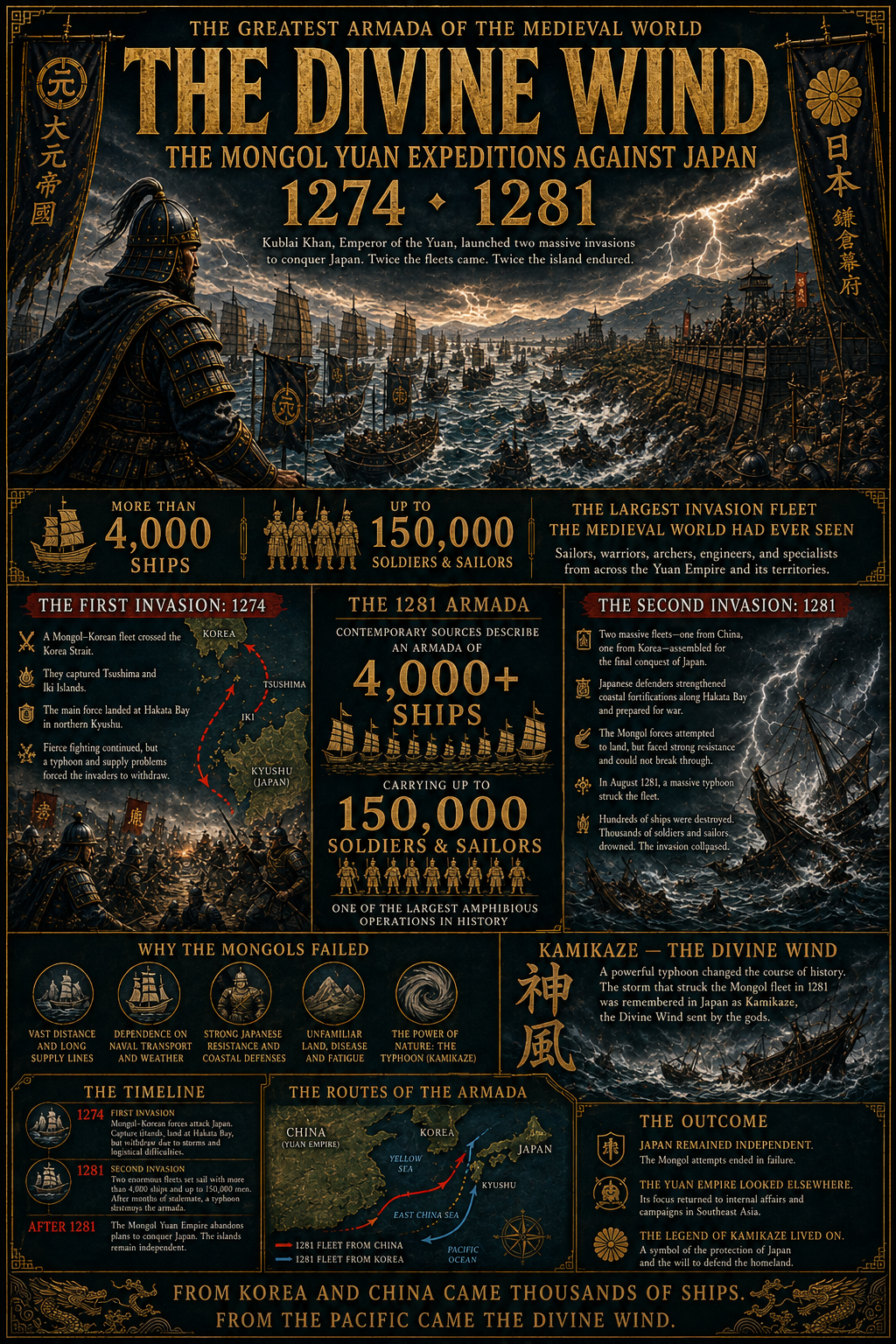
THE DIVINE WIND AND THE GREAT ARMADA
The Mongol Yuan Expeditions Against Japan, 1274–1281
By the late thirteenth century, the Mongol Yuan Empire had united much of Eurasia under a single imperial authority. Following the conquest of the Southern Song, Kublai Khan turned his attention across the sea toward Japan, whose rulers had repeatedly rejected demands for submission and diplomatic recognition.
The first expedition sailed in 1274, carrying Mongol, Chinese, and Korean forces across the Korea Strait. After capturing Tsushima and Iki Islands, the invaders landed at Hakata Bay in northern Kyushu. Although the campaign demonstrated the military reach of the Yuan Empire, the invasion force withdrew before a permanent foothold could be secured.
Kublai Khan responded by ordering an even greater undertaking.
Over the following years, shipyards throughout China and Korea constructed thousands of vessels for a second invasion. In 1281, two massive fleets converged on Japan. Contemporary sources describe an armada of more than 4,000 ships carrying up to 150,000 soldiers and sailors, making it one of the largest amphibious operations ever attempted before the modern era.
Japanese defenders, having learned from the first invasion, strengthened coastal fortifications and resisted repeated landing attempts. As the campaign stalled along the shores of Kyushu, the enormous invasion fleet remained concentrated in exposed coastal waters.
Then nature intervened.
In August 1281, a powerful typhoon struck the armada. Hundreds of ships were shattered against the coast, thousands of men perished at sea, and the invasion collapsed. The storm entered Japanese memory as Kamikaze — the Divine Wind.
The failure of the 1281 expedition ended all serious plans for the conquest of Japan. Despite commanding the greatest empire of its age and assembling one of the largest fleets of the medieval world, the Mongol Yuan Empire was unable to overcome the combined challenges of distance, logistics, determined resistance, and the forces of nature.
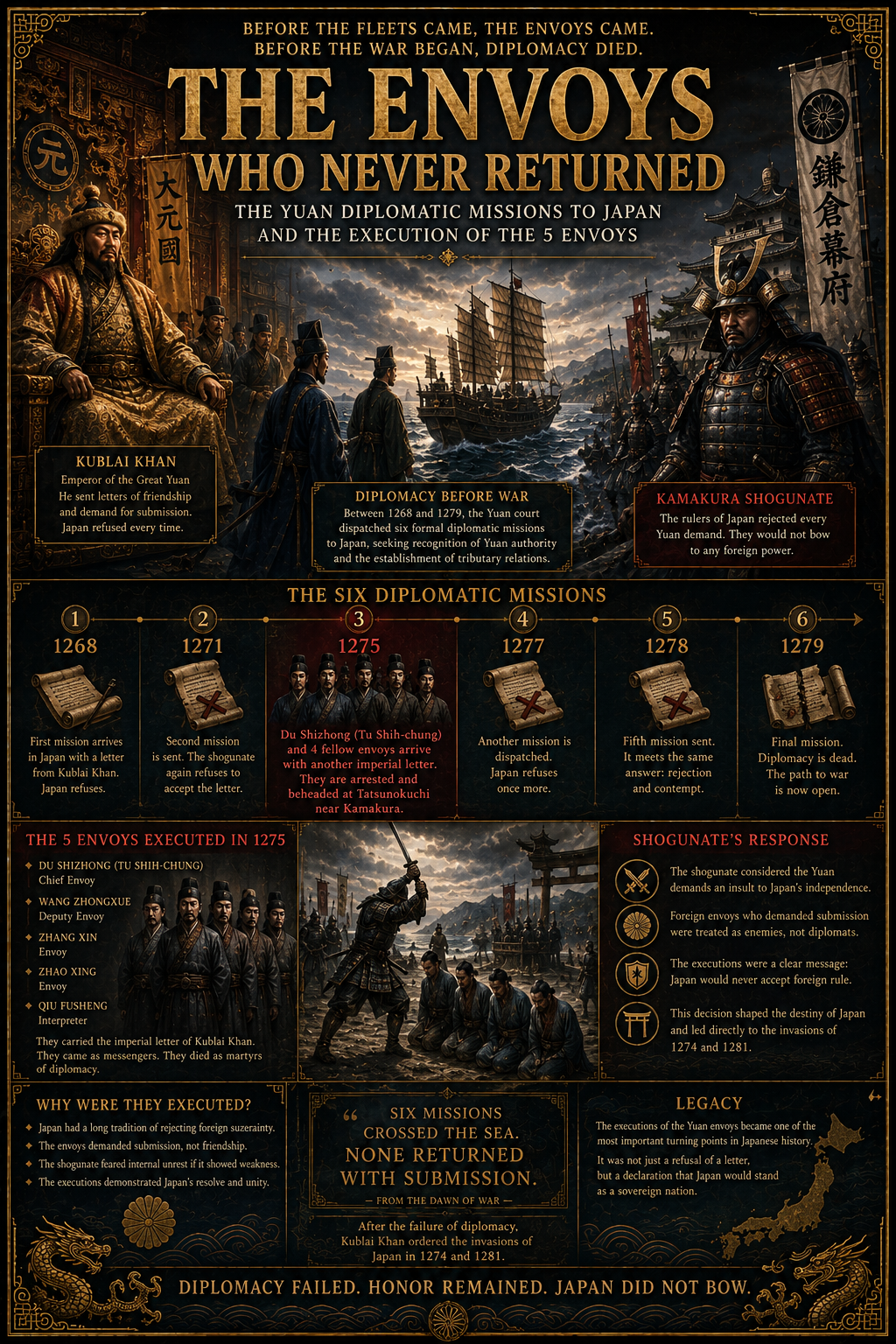
The Execution of the Yuan Envoys
Diplomacy preceded war.
Before launching his invasions of Japan, Kublai Khan repeatedly attempted to establish relations through formal diplomatic missions. Between 1268 and 1279, the Yuan court dispatched a series of envoys demanding that Japan recognize the authority of the Great Khan and enter into tributary relations, as many neighboring states had already done.
The Japanese Kamakura Shogunate refused every request.
The most dramatic confrontation occurred in 1275, when a Yuan mission led by Du Shizhong (Tu Shih-chung) and several accompanying envoys arrived in Japan carrying another imperial letter from Kublai Khan. Rather than receiving the delegation, the Kamakura authorities ordered their execution.
The envoys were taken to Tatsunokuchi near Kamakura and beheaded.
Subsequent diplomatic missions met a similar fate. Additional Yuan representatives sent in later years were likewise arrested and executed. By the end of the diplomatic exchanges, Japan had rejected every Yuan demand and had demonstrated that no negotiated submission would be accepted.
From the perspective of the Kamakura Shogunate, the executions sent an unmistakable message: Japan would not acknowledge foreign overlordship, regardless of the power behind the demand.
From the perspective of the Yuan court, the executions represented a grave insult to imperial authority and a direct violation of diplomatic norms. The deaths of the envoys strengthened the argument within Kublai Khan’s government that military action was the only remaining option.
In total, six major diplomatic missions were dispatched from the Yuan Empire to Japan before the invasions. None achieved their objective. Several ended with the execution of their envoys.
The failure of diplomacy marked the final step on the road to the invasions of 1274 and 1281.