
THE COVERED WAGON IN THE NOMADIC WORLD
By Altanbagana Baatar
DBA Candidate| Independent Historian
ImperialGG Historical Research Seriers
26 June 2026
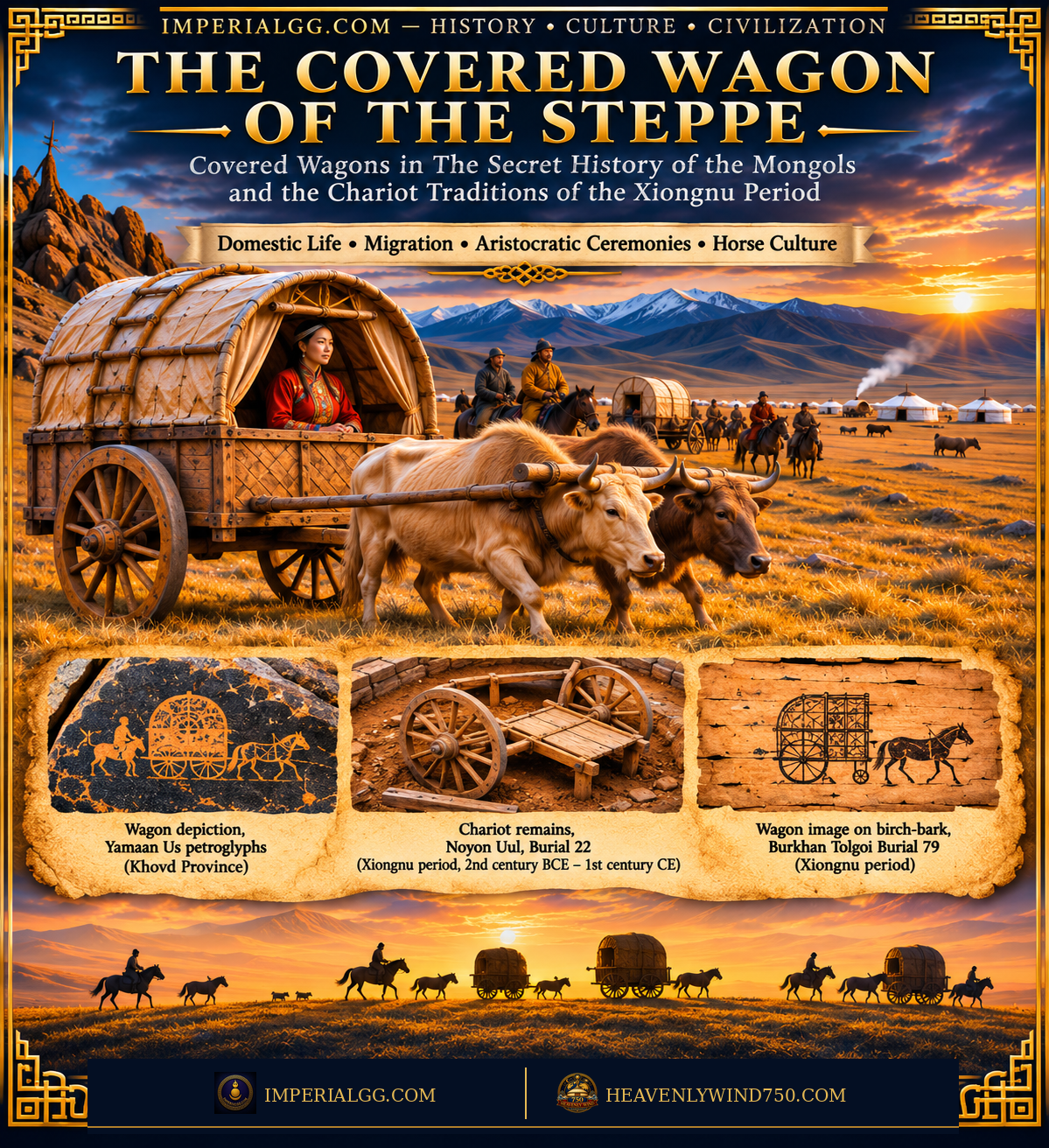
Covered Wagons in The Secret History of the Mongols and Chariot Traditions of the Xiongnu Period: Domestic Life, Migration, Aristocratic Ceremonies, and the Horse Culture of the Steppe
ABSTRACT
The history of nomadic civilizations across the Eurasian steppe is commonly associated with horsemanship. Horses were indispensable to warfare, transportation, communication, pastoral production, and the organization of political power. Yet the transportation systems of nomadic societies were not limited to riding horses, driving herds, or carrying loads on pack animals. Archaeological discoveries from the Xiongnu period, including chariot remains from elite burial complexes at Noyon Uul, together with depictions of covered wagons on rock surfaces and birch-bark objects, demonstrate that ancient steppe communities possessed a diverse tradition of wheeled transportation.
This article examines references to covered wagons in The Secret History of the Mongols, particularly §6, where Alun Gua is described as travelling in a covered wagon among a migrating group, and §§56 and 100–101, which describe wagons associated with Hö’elün and Börte. These textual references are compared with archaeological evidence from Xiongnu-period elite burials at Noyon Uul, Gol Mod, and Duurlig Nars, as well as wagon depictions from petroglyph sites and birch-bark objects discovered at Burkhan Tolgoi and Tsaram.
The central argument is that wheeled transportation among the nomadic peoples of the Eurasian steppe was not a single, uniform technological category. Different forms of vehicles served different purposes: everyday transportation, the movement of household possessions, the mobility of families, long-distance journeys, aristocratic ceremonies, and funerary practices. The article also examines the relationship between wheeled transportation and horse culture, including the use of horses and cattle for traction, the construction of wagon bodies and canopies, and the representation of vehicles in ancient rock art.
Rather than treating the horse culture and wagon culture as separate or competing traditions, this study approaches them as complementary components of a wider system of nomadic mobility.
Keywords: The Secret History of the Mongols; Alun Gua; Hö’elün; covered wagon; Xiongnu; Noyon Uul; chariot; umbrella chariot; petroglyphs; birch-bark objects; horse culture; nomadic transportation; aristocratic ceremonies.
1. INTRODUCTION: THE ROLE OF WHEELED TRANSPORTATION IN NOMADIC CIVILIZATION
The horse was unquestionably one of the fundamental elements of the political, economic, military, and cultural organization of the ancient nomadic peoples of the Eurasian steppe. Nevertheless, interpreting nomadic transportation exclusively through horsemanship provides an incomplete picture of their everyday lives. Seasonal migrations across vast territories required the movement not only of people and livestock but also of dwellings, household equipment, food supplies, clothing, tools, and other possessions. The transportation of women, children, and elderly family members, as well as the movement of aristocratic households and ceremonial equipment, created a demand for different forms of wheeled vehicles.
For nomadic societies, a wagon was therefore much more than a device for carrying goods. Its construction, dimensions, draft animals, covering, decoration, and seating arrangements could reflect its intended function and the social position of its owner. Some vehicles were equipped with enclosed or semi-enclosed compartments for passengers; others had open platforms for transporting cargo. Certain vehicles carried umbrella-like canopies, while others were designed to accommodate the framework or furnishings of a mobile dwelling.
This subject is particularly important for the study of ancient Mongolia. Archaeological investigations have recovered chariot remains from elite Xiongnu-period burials, while petroglyphs across the Altai, Gobi, and Khangai regions preserve depictions of vehicles drawn by horses and cattle. These representations provide evidence of a transportation tradition that extended beyond mounted mobility.
In their 2020 study, Ch. Enkhtör and Ts. Mönkhbat examined newly identified wagon depictions from the Mongolian Altai and discussed the growing number of known vehicle images in Mongolian rock art. Their research illustrates the importance of wheeled transportation as a subject within the archaeology of the Mongolian steppe.[1]
This article approaches the subject through three principal categories of evidence. The first consists of written sources, especially The Secret History of the Mongols, which preserves descriptions of covered wagons and their use in the lives of prominent Mongol families. The second consists of archaeological discoveries from Xiongnu-period burial complexes, including chariot remains and vehicle-related objects. The third consists of petroglyphs and depictions on birch-bark objects, which provide visual evidence of different vehicle forms.
A chronological distinction must be maintained throughout this comparison. The Secret History of the Mongols was composed in the thirteenth century, whereas the archaeological evidence from Noyon Uul and other Xiongnu-period sites belongs to a much earlier historical period. The vehicles described in the written chronicle cannot simply be identified as unchanged survivals of Xiongnu-period designs. Nevertheless, comparing the forms, functions, and cultural significance of vehicles across these periods provides a valuable framework for investigating the long history of transportation among the nomadic peoples of the steppe.
2. COVERED WAGONS IN THE SECRET HISTORY OF THE MONGOLS
2.1. Alun Gua and the Covered Wagon — §6
One of the earliest references to a covered wagon in The Secret History of the Mongols appears in §6, in the account of Düwa Soqor and Dobun Mergen.
From the summit of Burkhan Khaldun, Düwa Soqor looks down toward a group of people migrating along the Tünggelik stream. Among them, he notices a beautiful young woman travelling in a covered wagon. He informs his younger brother, Dobun Mergen, who subsequently approaches the group, learns that the woman is unmarried, and seeks to arrange a marriage. In the following section, §7, the woman is introduced by name as Alun Gua.[2]
Although this episode belongs to the genealogical and legendary narrative of the Mongol ancestors, its description of the wagon offers valuable information about the social environment imagined by the chronicle.
Alun Gua is not portrayed as travelling alone on horseback. She is part of a migrating community and is being transported in a covered vehicle. The wagon therefore appears as a means of carrying passengers within the broader movement of a family or tribal group.
This detail suggests that the covered wagon was associated with more than the transportation of cargo. It could provide shelter for passengers against wind, rain, and sunlight, while also offering a protected space for personal possessions during extended journeys.
The description is particularly significant because it places a woman within the context of organized nomadic mobility. The wagon is presented as an ordinary element of a migrating community rather than as an extraordinary object reserved exclusively for military or ceremonial purposes.
The passage does not provide enough technical information to reconstruct the precise shape or dimensions of Alun Gua’s vehicle. Nevertheless, the reference establishes that the covered wagon was a recognizable form of transportation within the narrative world of the Mongol chronicle.
2.2. Hö’elün and the Wagon — §§56 and 100–101
Wagons appear again in The Secret History of the Mongols in the accounts associated with Hö’elün and Börte. In §56, the narrative concerning Hö’elün and Chiledu describes the circumstances surrounding her departure and marriage to Yesügei Ba’atur. The passage includes details of the wagon and the movement of the people involved.[3]
A particularly informative description appears in §§100–101, during the Merkit attack and the abduction of Börte. The elderly woman Qo’aqchin hides Börte inside a wagon described as having a black covering and a wooden framework. The wagon is drawn by an ox. When its axle breaks, Börte and Qo’aqchin are forced to abandon it and continue their escape on foot.[4]
This passage provides several important details about wagon use.
First, the vehicle was suitable for transporting women and could accommodate a passenger inside an enclosed or covered compartment.
Second, the description of a wooden framework and black covering suggests a construction that offered some degree of protection and concealment.
Third, the use of an ox as a draft animal demonstrates that the transportation system described in the chronicle was not exclusively dependent on horses.
The broken axle is also significant. It provides a practical detail about the mechanical limitations of wheeled transportation. The wagon was useful for mobility and concealment, but its effectiveness depended on the condition of its structural components.
The episode therefore presents the covered wagon not simply as a symbolic object but as a functional vehicle with a specific construction, a draft animal, and a practical role in the movement of people.
2.3. Wagons and the Mobile Household
One of the most important aspects of nomadic transportation was the movement of the household itself. For nomadic communities, a dwelling was not merely a permanent structure. It was a mobile domestic space consisting of a wooden framework, felt coverings, furniture, household equipment, and personal possessions. The seasonal movement of families required an organized system for transporting these materials.
This tradition is relevant to the distinction between covered wagons, household wagons, and mobile dwelling carts.
Michael Gervers and Wayne A. Schlepp examined the subject in their study, “Felt and ‘Tent Carts’ in The Secret History of the Mongols,” published in the Journal of the Royal Asiatic Society in 1997.[5] Their research is important because it places references to felt and tent carts within the wider context of Mongolian domestic mobility.
The distinction between these vehicles must be maintained. A covered passenger wagon could have an enclosed compartment designed to protect its occupants. A tent cart could be intended to carry the components of a mobile dwelling or accommodate a dwelling structure. An open wagon, by contrast, could be used primarily for transporting household goods and other cargo.
Although these categories may have overlapped in practice, they should not be treated as identical without additional archaeological or textual evidence.
3. ARCHAEOLOGICAL EVIDENCE OF WHEELED TRANSPORTATION IN THE XIONGNU PERIOD
3.1. The Chariot from the Elite Burial Complex at Noyon Uul
Figure 1. Remains of a chariot discovered in Xiongnu-period Burial 22 at Noyon Uul. The discovery was made during the 2012 Mongolian–Russian joint archaeological expedition. Source: Science First Hand, “Traces of Chinese Chariot.”
The archaeological complex at Noyon Uul is particularly important for understanding the transportation culture of the Xiongnu period.
In the summer of 2012, a joint expedition involving the Institute of Archaeology of the Mongolian Academy of Sciences and the Institute of Archaeology and Ethnography of the Siberian Branch of the Russian Academy of Sciences excavated Burial 22 at Noyon Uul. The excavation revealed remains of a chariot at a depth of approximately ten metres within the burial complex.[6]
Although much of the wooden structure, lacquered surfaces, textile coverings, and metal fittings had deteriorated during nearly two millennia underground, the surviving traces and the arrangement of the archaeological remains allowed researchers to investigate the vehicle’s construction.
The chariot was identified as belonging to the yao che type associated with the Han-period Chinese tradition. It was a light, two-wheeled vehicle with an umbrella-like canopy. The reconstruction described a canopy supported by approximately thirty wooden ribs and covered with red silk. The vehicle also included lacquered components and metal fittings.[7]
The discovery is significant because it demonstrates that wheeled vehicles formed part of the material culture represented in elite Xiongnu-period burials.
However, the identification of the vehicle with a Han-period type raises important questions about cultural exchange and production. Was the chariot imported from the Han Empire as a diplomatic gift? Was it acquired through trade or political exchange? Or did Xiongnu craftsmen adapt an externally influenced design to their own needs?
The archaeological evidence alone does not resolve all these questions. Nevertheless, the discovery demonstrates that the elite material culture of the Xiongnu incorporated sophisticated wheeled vehicles and technologies associated with long-distance cultural interaction.
3.2. Were Xiongnu Chariots Merely an Adoption of Chinese Technology?
Bryan K. Miller’s study, “Vehicles of the Steppe Elite: Chariots and Carts in Xiongnu Tombs,” published in The Silk Road in 2012, provides an important framework for examining wheeled vehicles in Xiongnu burial contexts.[8]
Miller argues that the presence of elaborate Han-style chariots in Xiongnu elite burials should not automatically be interpreted as evidence that wheeled transportation was entirely imported from China.
This distinction is important because vehicle-related wooden components have also been recovered from other Xiongnu burial contexts, including sites that do not necessarily represent the same level of aristocratic wealth as the elaborate chariot burials.
At Tevsh Uul and Shombuuzyn Belchir, for example, excavated wooden elements have been interpreted as possible components of wheeled vehicles. In some cases, complete vehicles were not preserved. Instead, disassembled wooden components were placed in the burial structure or above the coffin.
Such discoveries suggest that different forms of wheeled transportation may have existed within Xiongnu society. Elaborate chariots represented one category, while more practical carts and wagons may have served everyday transportation and household needs.
Consequently, the study of Xiongnu vehicles should distinguish between the adoption of foreign designs, local manufacturing traditions, and the practical use of carts within the steppe economy.
3.3. Horse Equipment and Chariot Traditions in Xiongnu Society
The research of Mongolian archaeologist G. Eregzen is particularly relevant to the relationship between horse equipment and wheeled transportation.
In his 2019 study, “Horse Equipment and Chariots of the Xiongnu,” Eregzen examined horse-related archaeological materials alongside vehicle remains from Xiongnu burial contexts.[9]
His research identifies chariot-related remains from several important burial complexes, including Noyon Uul, Gol Mod, Gol Mod II, and Duurlig Nars.
The archaeological distribution suggests that elaborate chariots were especially associated with major elite burials, whereas horse equipment appears more widely across Xiongnu burial contexts.
Eregzen also considers the possibility that some of the vehicles discovered in elite burials were used for ceremonial occasions. Their two-wheeled construction, seating compartments, and umbrella-like canopies distinguish them from ordinary cargo carts.
This evidence is important because it demonstrates that horse culture and chariot culture were not mutually exclusive. They formed complementary parts of a wider transportation system.
4. COVERED WAGONS IN XIONGNU-PERIOD PETROGLYPHS AND BIRCH-BARK OBJECTS
4.1. Wagon Depictions at Yamaan Us
Figure 2. Wagon-related petroglyphs from Yamaan Us, Khovd Province. Source: Yamaan Us Petroglyphs, Escape to Mongolia. The precise dating of individual images requires comparison with archaeological and stylistic evidence.
The petroglyph site of Yamaan Us in western Mongolia is significant for the study of ancient vehicles.
V. V. Volkov’s research discussed wagon depictions at the site, including vehicles drawn by one to three horses. Later studies of Xiongnu-period petroglyphs have considered whether certain wagon images from Yamaan Us may belong to the Xiongnu period, broadly dated between the second century BCE and the second century CE.[10]
The presence of horse-drawn vehicles in the rock art is important because it demonstrates that wheeled transportation was represented within the visual culture of the ancient steppe.
Nevertheless, not every wagon image at a petroglyph site can automatically be assigned to the same historical period. Rock-art locations often contain images created over many centuries. The dating of individual depictions must therefore consider their style, position, relationship with other images, vehicle construction, and comparison with independently dated archaeological materials.
4.2. Covered Wagons at the Khüren Del Range
In their 2020 study, Ch. Enkhtör and Ts. Mönkhbat examined two wagon depictions discovered at the Khüren Del range in Manhan soum, Khovd Province. One image represents a covered wagon drawn by an ox. The other depicts a vehicle with a rectangular or compartment-like upper structure and an animal whose identity is not entirely clear.
The researchers compared these images with wagon representations from Del Uul in Dundgovi Province, the birch-bark object from Burial 79 at Burkhan Tolgoi in the Egiin Gol region, and the birch-bark material from Burial 7 at Tsaram in Buryatia.[11]
The comparison is significant because it suggests that covered wagons were not exclusively associated with horse traction.
Ox-drawn vehicles may have been suitable for transporting heavier loads, household equipment, and other possessions during slower movements across the steppe. However, the precise function of each depicted vehicle cannot be established from the image alone.
4.3. Birch-Bark Objects from Burkhan Tolgoi and Tsaram
Figure 3. Vehicle depictions and associated archaeological material from Xiongnu-period birch-bark objects. See B. K. Miller, “Vehicles of the Steppe Elite,” 2012, figures 1–2.
One of the most interesting categories of evidence comes from wagon depictions preserved on birch-bark objects recovered from burial contexts.
A birch-bark object from Burial 79 at Burkhan Tolgoi in Mongolia preserves a vehicle image. A comparable depiction was identified on birch-bark material from Burial 7 at Tsaram in Buryatia.[12]
These objects are important because they demonstrate that vehicles were represented not only in monumental rock art but also on portable objects associated with burial contexts.
The depiction of a wagon on an object placed within a grave raises questions about the symbolic and social significance of wheeled transportation. It may reflect the importance of vehicles in everyday life, the identity or status of the deceased, or beliefs concerning movement and transportation beyond death.
The evidence does not establish a single interpretation. Nevertheless, it provides an additional dimension to the archaeological study of Xiongnu vehicles.
5. CLASSIFICATION OF VEHICLE TYPES IN THE XIONGNU PERIOD
Ch. Enkhtör and Ts. Mönkhbat distinguish two principal forms of Xiongnu-period ceremonial vehicles:
Umbrella chariots: vehicles with an umbrella-like canopy positioned above the passenger compartment or seating area. These are especially associated with elite burial discoveries.
Covered wagons: vehicles with an enclosed or semi-enclosed compartment constructed on a wheeled platform.
Within the covered-wagon category, the researchers also discuss variations in the shape of the upper structure, including arched and rectangular forms.[13]
These distinctions are important because the shape of a vehicle could reflect its intended function.
An umbrella chariot offered protection from sunlight and weather while leaving much of the passenger area open. A covered wagon provided a more enclosed space and could offer greater protection and privacy.
A covered compartment may have been particularly useful for transporting women, children, elderly people, and personal belongings during long-distance journeys.
However, archaeological remains do not always reveal whether a particular vehicle was used primarily for everyday transportation or ceremonial occasions. A vehicle placed in a grave may have been used during the owner’s lifetime, constructed specifically for the funeral, or prepared as a symbolic representation of transportation.
Such questions require further examination of the archaeological context.
6. EVERYDAY, TRAVEL, AND CEREMONIAL VEHICLES
The transportation culture of the Xiongnu should not be understood as a single category of vehicle. Written sources, archaeological remains, and visual representations suggest several distinct forms of use.
6.1. Everyday Household Wagons
Everyday nomadic life required the transportation of food, clothing, household equipment, tools, containers, animal equipment, and other possessions.
For these purposes, practical carts with open platforms and durable wheels were likely important. Depending on their construction and intended load, such vehicles could be drawn by oxen or horses.
Miller’s study discusses wooden components from sites including Tevsh Uul and Shombuuzyn Belchir, which have been interpreted as possible remains of ordinary carts or wagons.[14]
More recently, research by T. Tumurbaatar and C. A. Makarewicz has examined cattle traction in the Xiongnu Empire through zooarchaeological evidence from the Mongolian steppe.[15]
Their research provides an important basis for considering the role of cattle and other large domestic animals in transportation. Heavy loads and household equipment may have required a different form of traction from the faster vehicles used for personal travel or military movement.
The distinction between horses and cattle is therefore important. Horses were particularly valuable for riding, rapid movement, communication, and military activity. Oxen could provide a more suitable source of traction for heavy loads and slower transportation.
6.2. Covered Wagons for Long-Distance Travel
Covered wagons offered practical advantages for long-distance travel. Their upper structures could protect passengers from sunlight, wind, rain, and other environmental conditions.
The descriptions of Alun Gua, Hö’elün, and Börte in The Secret History of the Mongols place women within the context of wagon transportation.
The account of Börte is particularly informative because the chronicle describes a black-covered wagon with a wooden framework, drawn by an ox. Its use in concealing and transporting Börte demonstrates that the covered compartment could provide protection and privacy.
Ethnographic descriptions of later Mongolian covered wagons also record their use for transporting elderly people, infants, women, and household possessions during migrations.[16]
These later observations must not be treated as direct evidence of Xiongnu-period practice. However, they provide comparative information about the possible practical functions of covered wagons within a nomadic household.
6.3. Ceremonial and Aristocratic Chariots
The chariots discovered in elite burial complexes at Noyon Uul, Gol Mod, and Duurlig Nars differ from ordinary transportation vehicles in their construction and decoration.
The chariot discovered in Noyon Uul Burial 22, for example, included a silk canopy, lacquered components, wooden structural elements, and metal fittings.
Such features suggest a vehicle associated with considerable wealth and social distinction.
Eregzen’s research also considers the possibility that certain Xiongnu chariots were used in ceremonies and formal occasions.[17]
In this context, the vehicle was more than a practical means of transportation. It could function as a visible expression of political authority, aristocratic identity, wealth, and social rank.
The decoration of a vehicle, the materials used in its construction, and the presence of elaborate canopies or fittings could communicate the status of its owner to the surrounding community.
7. THE RELATIONSHIP BETWEEN HORSE CULTURE AND WAGON TECHNOLOGY
The horse culture of the nomadic peoples and their wagon traditions should not be understood as opposing forms of mobility. They were complementary elements within the same transportation system.
Horses played a central role in riding, warfare, communication, and rapid movement. Wagons provided a means of transporting people, household equipment, and heavy loads that could not conveniently be carried on horseback.
Archaeological evidence from Xiongnu burials demonstrates the importance of both horse equipment and wheeled vehicles. Eregzen’s research identifies the different distribution patterns of horse-related objects and chariot remains, suggesting that their functions and social contexts were not identical.[18]
The construction of a wagon required considerable technical knowledge. Its principal components included wheels, axles, shafts, draft-animal fittings, a wooden framework, and, where applicable, a covered compartment or canopy.
The manufacture of more elaborate vehicles also required woodworking, metalworking, leatherworking, textile production, and the use of materials such as felt, silk, and lacquer.
The Noyon Uul chariot illustrates this combination of technologies. Its wooden structure, lacquered surfaces, silk canopy, and metal fittings demonstrate the integration of several craft traditions within a single vehicle.
The use of horses and cattle for traction further illustrates the flexibility of the transportation system.
Horse-drawn vehicles could offer greater speed and mobility, while ox-drawn carts were potentially better suited to heavy loads and slower movements. The precise choice of draft animal would have depended on the vehicle’s construction, the weight being transported, the terrain, and the purpose of the journey.
8. WAGONS AND BELIEFS ABOUT THE AFTERLIFE
The archaeological association between vehicles and burial practices introduces another important dimension to the study of nomadic transportation.
The presence of chariot remains in Xiongnu elite burials suggests that wheeled vehicles could have held significance beyond their practical functions during life. Their inclusion in graves may have reflected the deceased person’s social position, wealth, identity, or beliefs concerning the journey after death.
Ch. Enkhtör and Ts. Mönkhbat have discussed the possibility that depictions of vehicles with solid wheels on deer stones may have been associated with beliefs about the afterlife. They contrast these with depictions of vehicles with spoked wheels, which may represent more practical forms of transportation.[19]
This interpretation is worth considering, but it should not be treated as a universally established rule. The absence or presence of spokes may reflect technological variation, artistic conventions, or the limitations of the image itself.
The broader archaeological context must therefore be considered before assigning a symbolic meaning to a particular wheel design.
The Secret History of the Mongols also contains accounts in which a wagon is associated with the transportation of the deceased Chinggis Khan’s remains. Such descriptions demonstrate that vehicles continued to have an important role in funerary contexts in the thirteenth-century Mongol world.[20]
This does not establish an uninterrupted ritual tradition extending directly from the Xiongnu period. Rather, it provides an opportunity for comparative research into the changing practical and symbolic meanings of wheeled transportation across different periods of steppe history.
9. THE HISTORICAL SIGNIFICANCE OF XIONGNU WAGON CULTURE
Taken together, the archaeological and textual evidence demonstrates that wheeled transportation among the nomadic peoples of the Eurasian steppe was diverse in form and function.
The chariots from Noyon Uul, Gol Mod, and Duurlig Nars provide evidence of elaborate vehicles associated with elite burial contexts. The birch-bark depictions from Burkhan Tolgoi and Tsaram show that vehicles were also represented on portable objects connected with funerary settings. The petroglyphs of Yamaan Us and Khüren Del provide additional information about vehicle forms, draft animals, and the visual representation of wheeled transportation.
These discoveries challenge any interpretation of Xiongnu society that focuses exclusively on mounted warriors and cavalry.
The Xiongnu were not simply a society of horse-riding warriors. Their political and economic organization also depended on the movement of households, possessions, people, and ceremonial equipment. This required knowledge of vehicle construction, animal traction, woodworking, metalworking, and the production of textiles and other materials.
The relationship between the horse and the wagon is therefore central to understanding the practical organization of nomadic life.
The horse provided speed, military mobility, and rapid communication. The wagon provided the capacity to move households, passengers, and heavy possessions across the steppe. Oxen and other large domestic animals could provide additional traction for different types of transportation.
Together, these elements formed a flexible system of mobility adapted to the geographical and economic conditions of the Eurasian steppe.
10. CONCLUSION
The description of Alun Gua travelling in a covered wagon in §6 of The Secret History of the Mongols provides an important textual reference to the transportation culture of the Mongol ancestors. The accounts of Hö’elün and Börte in §§56 and 100–101 further demonstrate the use of wagons for transporting women, protecting passengers, and facilitating movement during periods of migration and conflict.
Archaeological discoveries from the Xiongnu period provide an earlier material context for investigating this tradition. The chariot remains from Noyon Uul, Gol Mod, and Duurlig Nars, together with wagon depictions on birch-bark objects from Burkhan Tolgoi and Tsaram and petroglyphs from Yamaan Us and Khüren Del, reveal a transportation culture with multiple forms and functions.
These vehicles were not limited to one purpose. They could serve everyday household needs, long-distance journeys, the movement of families, aristocratic ceremonies, and funerary practices.
Their construction also demonstrates the integration of several technological traditions, including woodworking, metalworking, textile production, leatherworking, and the use of animal traction.
The relationship between horse culture and wagon culture is particularly important. The two were not competing systems. Rather, horses, oxen, wagons, household equipment, and mobile dwellings formed complementary components of a broader nomadic transportation system.
The central conclusion of this study is that the mobility of the ancient nomadic peoples cannot be understood through horsemanship alone. Their civilization also depended on the ability to transport households, possessions, passengers, and symbols of political authority across vast territories.
The horse and the wagon were not separate symbols of the steppe world. They were complementary instruments of a civilization organized around movement.
FOOTNOTES AND REFERENCES
Ch. Enkhtör and Ts. Mönkhbat, “Newly Discovered Wagon Depictions from the Mongolian Altai,” Mongolian Journal of Anthropology, Archaeology and Ethnology 10, no. 1 (497) (2020), pp. 1–10.
The Secret History of the Mongols, §§6–7. Igor de Rachewiltz, The Secret History of the Mongols: A Mongolian Epic Chronicle of the Thirteenth Century (Leiden: Brill, 2004).
The Secret History of the Mongols, §56. De Rachewiltz, 2004.
The Secret History of the Mongols, §§100–101. De Rachewiltz, 2004.
Michael Gervers and Wayne A. Schlepp, “Felt and ‘Tent Carts’ in The Secret History of the Mongols,” Journal of the Royal Asiatic Society, Third Series, vol. 7, no. 1 (April 1997): 93–116. DOI: 10.1017/S1356186300008336.
“Traces of Chinese Chariot,” Science First Hand, April 19, 2013. Report on the 2012 Mongolian–Russian archaeological excavation at Noyon Uul Burial 22.
Ibid. Discussion of the yao che type, two-wheeled construction, silk canopy, and lacquered components.
Bryan K. Miller, “Vehicles of the Steppe Elite: Chariots and Carts in Xiongnu Tombs,” The Silk Road 10 (2012): 29–38.
G. Eregzen, “Horse Equipment and Chariots of the Xiongnu,” Journal of Oriental Art History (2019), vol. 9, pp. 49–75.
N. Batbold, “Mongolian Nomadic People in Ancient Times: Petroglyph during the Xiongnu Era in Mongolia,” Journal of Oriental Art History 9 (2019): 28–47. DOI: 10.22978/aarth.2019.9..28.
Ch. Enkhtör and Ts. Mönkhbat, 2020, pp. 5–8. Discussion of the covered-wagon depictions from Khüren Del and their proposed chronological relationship with Xiongnu-period material.
Ts. Törbat, “Wagon Depictions on Birch-Bark Objects from Xiongnu Burials,” Scientific Journal of the Mongolian State University of Education III, fasc. 2 (2001): 66–68; S. S. Minyaev and L. M. Sakharovskaya, “An Elite Burial Complex of the Xiongnu in Tsaram Valley,” Russian Archaeology 1 (2006): 194–201; Miller, 2012.
Ch. Enkhtör and Ts. Mönkhbat, 2020, p. 7. Classification of Xiongnu-period vehicles.
Miller, “Vehicles of the Steppe Elite,” 2012, pp. 29–38.
T. Tumurbaatar and C. A. Makarewicz, “Cattle Traction in the Xiongnu Empire: Zooarchaeological Evidence from the Mongolian Steppe,” Archaeological Research in Asia 44 (2025), article 100643. DOI: 10.1016/j.ara.2025.100643.
National Center for Cultural Heritage, “Mukhulag Tereg” (Covered Wagon), Mongolian Intangible Cultural Heritage Database. Used here as comparative ethnographic evidence for later Mongolian wagon traditions, not as direct evidence of Xiongnu-period practice.
Eregzen, 2019, pp. 76–96; archaeological studies of the chariot remains from Noyon Uul, Gol Mod, and Duurlig Nars.
Ibid. Discussion of the archaeological distribution of horse equipment and chariot remains.
Ch. Enkhtör and Ts. Mönkhbat, 2020, pp. 8–9. Discussion of solid-wheel and spoked-wheel depictions and possible funerary symbolism.
The Secret History of the Mongols, account concerning the transportation of Chinggis Khan’s remains by wagon; see also Ch. Enkhtör and Ts. Mönkhbat, 2020, pp. 6–7.
ADDITIONAL BIBLIOGRAPHY
Batbold, N. Treasure of Xiongnu: Culture of the Xiongnu, the First Nomadic Empire in Mongolia. Ulaanbaatar, 2011.
Enkhtör, Ch., and Ts. Mönkhbat. “Newly Discovered Wagon Depictions from the Mongolian Altai.” 2020.
Gervers, Michael, and Wayne A. Schlepp. “Felt and ‘Tent Carts’ in The Secret History of the Mongols.” 1997.
Miller, Bryan K. “Vehicles of the Steppe Elite: Chariots and Carts in Xiongnu Tombs.” 2012.
Minyaev, S. S., and L. M. Sakharovskaya. “An Elite Burial Complex of the Xiongnu in Tsaram Valley.” 2006.
Novgorodova, E. A. The World of Mongolian Petroglyphs. Moscow, 1984.
Törbat, Ts. “Wagon Depictions on Birch-Bark Objects from Xiongnu Burials.” 2001.
Volkov, V. V. “Ancient Chariots of the Mongolian Altai.” Studia Archaeologica V, fasc. 6 (1972): 75–89.
IMPERIALGG.COM — HISTORY • CULTURE • CIVILIZATION
MYTH & REALITY — HISTORY • PEOPLE • TRUTH